


Key Takeaways
- An AMS holds the policy with its coverage, term dates, documents, and commission, so the whole agency works from one file.
- A CRM closes the opportunity at the sale, while an AMS carries the policy through servicing into renewal, which is why most agencies run both systems.
- Carrier connectivity decides how much typing is left in the day, since downloads arrive in the ACORD standard and post against the matching policy.
- Deployment sets what can be added later, because an on-premises database can be integrated directly, while a cloud platform allows what the vendor’s API exposes.
- Cost has three parts: the per-user subscription, one-time implementation covering migration along with training, and the development cost where the system is built.
- A build is the answer when the book needs fields a stock product does not carry, including surplus lines filings, stamping fees, and member counts.
An insurance agency’s value is in its books of business. An insurance agency management system (AMS) holds that book, policy by policy, along with the client and commission on each one. This book answers what an agency is worth and what renews every month.
Insurance agencies, brokerages, and independent agents are all using some form of this system for their records. The size of the agency is what decides how much of it is actually needed.
This blog will help you understand what an insurance agency management system (AMS) is, how it works, including its features, and how much it costs.
What is an insurance agency management system (AMS)?
An insurance agency management system (AMS) is software that helps agencies, brokerages, and independent agents manage clients, policies, documents, and commissions in one place, and handle each policy from quote through renewal.
It breaks down operational silos to ensure sales, customer service, and accounting teams all work from the same updated data.
How does an AMS differ from a CRM?
An AMS and a CRM are two different systems built for different jobs. An AMS manages the entire post-sale policy lifecycle and retention, while an insurance CRM works on the front-end acquisition and pipeline conversion side.
| CRM | Agency management system | |
| Central record | The contact, with the sales opportunity attached | The policy, with the client attached |
| After the sale | The opportunity is marked closed | The policy stays active to its term date, then renews |
| Money tracked | Deal value on the opportunity | Commission due, received, and the producer’s split |
| Carrier data | Entered by the user | Downloaded automatically from carriers using the ACORD standard |
| Documents | General file storage | Policy documents, certificates of insurance, and ACORD forms filed against the policy |
| Record keeping | Contact and activity history | The policy file the agency keeps for the retention period its state sets |
How does an insurance agency management system work?
An AMS works by centralizing all the records and automating data flows across every stage of the policy lifecycle.
- Intake: The client information, like name, address, contact details, and business line, is added to the software.
- Quoting: The application is sent to an automated underwriting system or to the carrier for manual underwriting. The result of underwriting is saved on the client’s file.
- Binding: Once the customer accepts the policy quotes, it gets converted into an active policy with coverage, premium, and other details.
- Updates: Changes in policy sync automatically, like endorsements, billing changes, and claims, to keep the policy updated.
- Servicing: Every document, change request, and certificate is saved with timestamps.
- Accounting: Tracks premiums and commission for both direct billing and agent billing.
- Renewal: AMS automatically flags expiring policies and queues them for re-underwriting using existing data.
All these operational stages are connected into a unified lifecycle workflow which minimizes manual intervention and improves overall accuracy.
Insurance AMS features that make the biggest difference
An insurance AMS works across functional areas that directly impact the daily operations, workflows, and policy management. Evaluating the system against the agency’s specific line of business, client volume, and analytics ensures it aligns with operational needs.
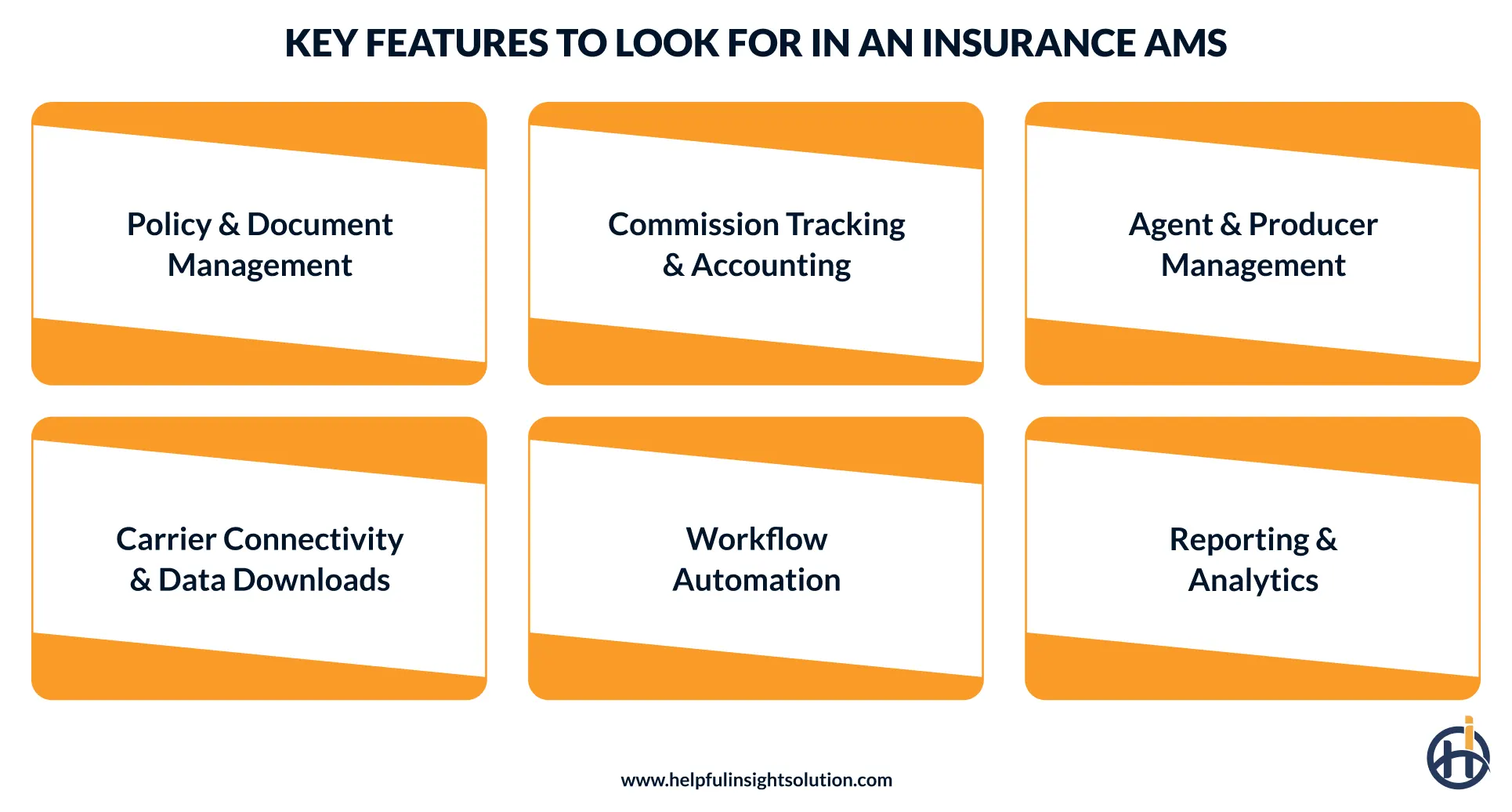
Policy and Document Management
Policy and document management is the core feature of an AMS. It stores policy data and paperwork in an organized way, much like a policy administration system does for carriers, so files are easy to access.
- The policy record: Coverage, limits, deductibles, term date, and premium all policy-related details are added to each policy to provide a unified record.
- Documents on the policy: Documents collected to issue a policy, from signed applications to binders and declaration pages, are stored in line with insurance compliance requirements.
- Certificates of insurance: Policy issuance documents are produced from all submitted documents and kept.
- Edit history: Every change is stored with a date and user name to be answered later.
Commission Tracking and Accounting
An AMS tracks expected policy revenue against the carrier statement to flag unpaid premiums. It separates direct billing and agency billing to calculate premium liabilities from net operational revenue.
Agent and Producer Management
AMS systems also work on the people’s side, including the producers who write the business and staff who serve them.
- Licenses and appointments: It keeps a record of each producer’s license and their appointment dates with expiration.
- Book ownership: Each account is assigned to a producer, so commission and responsibility follow the same assignment.
- Access by role: Service staff, producers, and accounting each have access to their own allowed data only to prevent unauthorized access.
Carrier Connectivity and Data Downloads
Carrier connectivity ensures that data like policy, billing, claims, and commissions are synchronized to keep agency and carrier records aligned.
Automated download support eliminates time-consuming manual data entry and reduces the scope for human errors. By enabling real-time rating and direct updates right inside the system, carrier connectivity streamlines the entire quoting and policy management workflow.
Automation Features
Automation, including robotic process automation in insurance, lets routine tasks run with little or no manual work.
- Renewal queues: Policies are renewed automatically by tracking expiration, sending payment links, and updating the same in AMS systems.
- Document reading: Declarations pages and ACORD forms are read into the record to extract the relevant information.
- Certificate issuance: When certificates are requested, they can be fetched from policy data.
- Client messaging: Renewal notices, payment reminders, and requests for missing documents go out on a set schedule. Newer systems can also use AI agents for insurance to handle follow-ups
These are just core cases for automation capabilities; more can be added to a custom insurance agency management system to meet specific requirements.
Reporting and Analytics
Reporting and analytics transform raw policy data into strategic operational metrics to help with decision-making.
Book of business analysis: A centralized record of revenue and volume across carriers, product lines, and individual producers to identify top-performing drivers and risks
Retention tracking: Automated monitoring of renewal vs. lapse rates across client segments, providing early indicators of client churn and ongoing account stability. Predictive analytics can go further and flag accounts likely to lapse.
Loss ratio evaluation: Compares claims experience against total written premium per carrier, providing vital leverage during contingent commission negotiations and carrier contract reviews.
Data export & portability: Enables seamless data extraction for custom external analysis, ensuring actionable metrics are directly accessible for leadership and board reporting.

Cloud-based vs. on-premise agency management systems
Insurance agency management software is available in two deployment models: cloud-based and on-premises.
A cloud-based agency management system is hosted on the vendor’s servers and accessed through the internet. The on-premises option is installed on a server the agency owns and keeps in its own office or data center.
| Cloud-based | On-premise | |
| Where records are kept | On the vendor’s servers | On a server the agency owns and houses |
| Updates | Applied by the vendor on its own release schedule | Scheduled by the agency, with IT time or a vendor fee per upgrade |
| Cost shape | A per-user subscription billed monthly or annually | A license paid up front, plus server hardware and annual maintenance |
| Branch and remote access | Any browser with a login | A VPN or remote desktop connection into the office network |
| Security work | Patching and backups are run by the vendor, with the controls named in its security audit report | Patching, backups, and physical access are handled by the agency |
| Getting the data out | Limited to the export the vendor provides | Direct access to the database the agency holds |
The deployment of an agency also decides how the system can be upgraded and integrated with systems later on. An on-premise system gives direct access to the database and allows you to build an insurance agency management system integration yourself. A cloud-hosted platform allows only with systems what vendor’s API allow, so beyond this need to added by the vendor.
The cost also changes with headcount. A cloud-based system is billed per user, so the amount grows as more users are added. Also, it supports scalability to increase capacity to meet rising demands without upgrading the servers. On-premises servers require upfront costs to set them up, including infrastructure, ongoing IT maintenance overhead, hardware upgrades, and physical security costs.
How modern agency management systems streamline daily operations
An agency management system centralizes daily operations like service calls, emails, certificate issues, and binding queries to its parent policy record. This eliminates fragmented communication and data silos across teams.
Work Queues
When a client submits a request, it gets assigned to an owner, and real-time status keeps the progress updated to the entire team. This clear ownership ensures every request gets the attention it deserves, with centralized tracking eliminating communication gaps between staff.
If the assigned agent is unavailable, another team member can work on the request while retaining the complete context, ensuring uninterrupted customer service.
Suspense Items
Suspense is the term used in the agencies for follow-up that is held against a policy until someone closes it. A signed application with no update, pending inspection, and due premium is kept as a dated suspense item on the policy itself.
Billing Questions
- Direct bill: Carrier status gets downloaded automatically to provide an instant answer to client questions related to billing without the need to place call inquiries.
- Agency bill: Invoices, received payments, and balances owed are consolidated on the policy file, giving a complete financial overview at a glance.
- Commission splits: Producer payouts are calculated directly from policy rules, removing manual calculations and guesswork entirely.
How much do insurance agency management systems cost?
The cost of an insurance agency management system is decided by three factors: ongoing subscription cost, upfront implementation, and custom development cost.
Subscription Fee
Platform vendors’ prices per user per month, which include service staff, accounting, and administration alongside producers.
The subscription fee ranges from $50 to $99 per user across small- to mid-market systems, while enterprise platforms quote against the agency’s requirements.
Implementation Cost
Implementation is the one-time cost required to onboard an agency onto a new AMS. The implementation process varies from company to company, so does the AMS software implementation cost, depending on the agency size and operational complexity.
- Historical data migration: This step includes extracting, cleaning, and mapping existing data to ensure its compatibility with the new AMS.
- Third-party integrations: An AMS needs to work with existing systems like rating engines, comparative raters, accounting tools, and communication channels. These integrations need custom API setup and testing, which adds to the cost.
- Custom configuration: The AMS can be tailored to meet automation, document templates, permission tiers, and commission structure to meet the existing agency’s workflows.
- Team training and change management: Once the AMS system is implemented, the next step is to train a team that will work on it.
Custom Insurance Agency Management System Development Cost
A custom build is priced on scope instead of seats. The cost is paid once during development, then followed by hosting and maintenance rather than a per-user license.
| Build scope | Cost (USD) | Timeline | What it includes |
| Basic build | $10,000 – $15,000 | 6 – 10 weeks | Client and policy records in one database, documents stored against each policy, task assignment, policy entry done by hand |
| Mid-tier AMS | $20,000 – $50,000 | 3 – 5 months | Everything above, with commission matched against carrier statements, claim tracking, the first carrier API connections, e-signature |
| Full platform | $100,000+ | 6 – 12+ months | Everything above, with multi-carrier quoting, ACORD forms generated from policy data, a client portal, m |
How to choose the right AMS for your agency
The best insurance agency management systems are the one that matches an agency’s needs, from its line of business and the locations it operates to the size of the team.
The first verification is knowing the carrier support. If a system doesn’t support your carrier, staff will have to spend most of the time manually entering the data to keep records updated.
Product documentation is the best way to learn about the post-deployment support, hidden costs, and workflows before making a commitment. Ask an insurance management systems development company or provider for a live demo using your agency’s data to evaluate real-world performance. Have post-contract terms documented that specifically clarify fee structure for adding users, expanding carrier support, and APIs for third-party integrations.
How to Choose AMS for a Multi-Location Insurance Agency?
Selecting an AMS for a multi-location agency is an architecture decision, and three capabilities answer it.
Data at each branch partitioned into its own records. Accounting runs by entity for branches set up as separate legal structures, with granular permissions that keep client data limited to the staff allowed to see it.
Here is a list of the factors to be considered when evaluating an AMS for a multi-location insurance agency.
- Permission model: Access is allowed by the branch, so staff in one office see their own book while shared accounts stay open to both. The same setup decides what a producer keeps access to after moving locations.
- Commission splits across offices: A policy written in one branch and serviced in another carries a split. The commission should be calculated according to the split, ensuring each branch gets commission.
- Accounting by entity: Branches working as separate legal entities need their own ledger and premium trust handling, with a consolidated view sitting above them.
- Reporting rollup: Book of business and retention are read per branch and for the group together, from the same records.
- Pricing by location: Some plans add a per-location charge above the per-user rate, which changes the figure for an agency running several offices.
P&C vs. life vs. health insurance AMS considerations
An AMS’s core architecture is defined by the foundational asset it anchors, like property renewals for P&C, long-term policy records for Life, or member census data for Health.
| P&C | Life | Health and benefits | |
| Policy cycle | Annual terms that renew | Long-dated policies that stay in force | Plan years with open enrollment |
| Commission | Percentage of written premium, split by producer | First-year commission held separately from renewal trail | Per member per month, recalculated as membership changes |
| Carrier data | Download in the ACORD standard over IVANS | In-force and commission feeds from the carrier | Enrollment and membership files from the carrier |
| Documents | Certificates of insurance and ACORD forms | Illustrations and signed applications | Plan documents and census files |
| Compliance | State retention rules and producer licensing | Suitability records | HIPAA handling of member data |
P&C insurance agency management systems calculate commission as a percentage of written premium. A benefits book is calculated per member, and the amount changes every time enrollment moves, which needs a different engine rather than a different setting. Holding both books in one system also brings HIPAA obligations onto the P&C side, because member health data carries access and audit requirements that policy data does not. Agencies writing both decide between one system and two on whether member and plan data can be held to that standard in the same place.
Off-the-shelf vs. custom-built agency management systems
The choice between an off-the-shelf and a custom-built agency management system depends on what an agency needs from it.
Off-the-shelf is the best choice for a team that has to be running on a proven AMS quickly, with the subscription and the implementation fee covering what it costs.
A custom insurance agency management system is the right choice when the system has to be purpose-built around one agency’s book. It gives an agency complete control over the software.
| Off-the-shelf | Custom-built | |
| Time to go live | Weeks, once migration finishes | Months, with the build running before migration starts |
| Workflow fit | The agency adapts its process to the product | The product is written around the process the agency already runs |
| Carrier connectivity | Download relationships and an ACORD form library arrive with the system | Both are established during the build |
| Form and feed updates | Handled by the vendor as part of the subscription | Owned by the agency, with each change scheduled as work |
| Niche and program business | Modeled only where the product already supports it | Modeled to whatever the book requires |
A custom insurance agency management system is the right choice when an agency has to write business that stock product doesn’t support.
Off-the-shelf insurance solutions are built for typical policies, like standard home or auto insurance, and only provide fields for common information. However, specialty agencies handle unique risks that require tracking details standard software was not designed to store.
Agencies comparing ready-made options against a build start by matching the type of insurance software to the work it has to do.
A custom build costs more at the start. It is the answer when no product on the market supports the agency’s book, and building the system around the agency’s own process is what makes that cost worth paying.
Real-world examples: how insurance agencies use AMS
An agency management system is now part of how agencies of every size operate, including national brokerages and independent agencies running a few producers. What those agencies gain from the system is what others are now working toward.
Goosehead Insurance built its own platform over two decades instead of licensing one. Its FY2025 annual report states that the cost of servicing policies, measured against the commission the agency earns, runs 2.0 times lower than the industry best practice figure the company cites.
The quoting tool it built, Digital Agent, shops home and auto rates across more than 100 carriers, returning a price in under two minutes. Acrisure built its system on the records it already held. The brokerage announced Auris AI in September 2026, a layer built on Palantir’s data platform that brings client, carrier, contract, and operational data together for its staff.
Acrisure ranked third on Insurance Journal’s 2025 Top 100 independent P/C agencies with $2.83 billion in property and casualty revenue, so the data it brought together had built up across years of acquisitions.
Most agencies are far smaller. Big “I” and Future One counted 37,000 independent P&C agencies in the US in 2026, with 54% of them using AI somewhere in the business, and those tools read whatever the agency management system holds.
How Helpful Insight builds custom insurance agency management systems
Helpful Insight provides insurance software development services and builds digital solutions for other highly regulated industries. We have delivered 2000+ custom-built platforms powered by scalable and secure architecture.
Each project is led by a team of 100+ software engineers, architects, and industry experts who understand your agency and align the software with the operational workflows. By combining domain knowledge with technical execution, each project is designed to clear operational delays, keep carrier data integration steady, and scale along with agency growth.
Frequently Asked Questions
An agency management system is a software system that is used by an insurance agency to keep its client records, its policy records, and the commission data together in one place. Agency management systems for insurance are also used for the storage of documents against each policy, and the activity history of the account is held in the same place. Access to that record is shared, which means the producers and the service staff are working from one file.
A CRM is used for the contact and for the sales opportunity that is attached to that contact. The policy is what an AMS is organized around. The client, the carrier, the term dates, and the commission are all held against that policy. Once a sale is completed, the opportunity in the CRM is closed, while the policy carries on through servicing and into renewal. Both systems are in use at most agencies, because prospecting is not something the agency management systems insurance agencies rely on are built for.
The subscription rates that are listed for small and mid-market systems run between $50 and $99 per user per month, while the larger platforms are quoted against the user count of the agency. Implementation is charged on its own. The data migration, the carrier download setup, and the training are all part of that charge. Pricing for a custom build is based on scope rather than seats, with a basic system starting at $15,000.
Policy and document management, commission tracking, carrier downloads, and reporting are the areas every agency needs covered. Certificate issuance, along with the handling of ACORD forms, is also needed in p&c insurance agency management systems. Producer licenses, carrier appointments, and the commission splits on each policy are what an insurance agent management system is responsible for.
Yes, and it is the option suited to agencies writing business that the stock products are not built for, which includes program administrators, MGAs, and specialty books. The carrier downloads and the ACORD forms that come as standard in a bought system have to be established during the build, so the number of carriers is what the timeline depends on. After launch, the updating of those forms and feeds becomes the responsibility of the agency.