


Key Takeaways
- Underwriting decides how much business a carrier can write without adding headcount, which is what puts it first in line for automation.
- The global insurtech market is valued at $23.54 billion in 2026, with a projection of $132.71 billion by 2034 at a CAGR of 24.1%, and underwriting automation takes a large share of that spend.
- Five system types are in use, rules-based, accelerated, predictive, hybrid, and agentic. The choice follows the product rather than the budget, so motor and term life run on rules while commercial property leans on a model with a referral step behind it.
- Rules make the decision, AI does the reading, the predicting, and the summarizing around it. Swiss Re reports over 95% accuracy predicting a genuine non-smoker, which narrows cotinine testing to one applicant in fifteen instead of one in three.
- Five components make up the software, five of which connect to a system somebody else owns. The number of downstream connections drives the build cost more than the size of the rulebook does.
- The straight-through rate falls on its own as exceptions accumulate after every loss, complaint, or audit finding. Holding it up needs somebody who reports the number monthly, with a fixed date for retiring rules.
Underwriting decides who an insurer accepts, on what terms, and at what price. Automated insurance underwriting lets software make that decision on its own, for every application matching rules the insurer has already written. Applications outside those rules are routed to an underwriter.
The time saved shows up first in quote turnaround. Insurance underwriting automation is also where a large share of technology spending in insurance is going, with the global insurtech market valued at $23.54 billion in 2026 and projected to reach $132.71 billion by 2034, at a CAGR of 24.1%.
This blog covers what automation is in insurance underwriting, how it works, where AI belongs, and how to implement it. Underwriting also sits inside a larger insurance software development effort that includes policy administration, claims, and billing.
What is an Automated Underwriting System?
An automated underwriting system is the decision layer of a policy administration stack. It evaluates each application against the insurer’s own rules and then accepts, rates, refers, or declines it without requiring an underwriter to review each file manually.
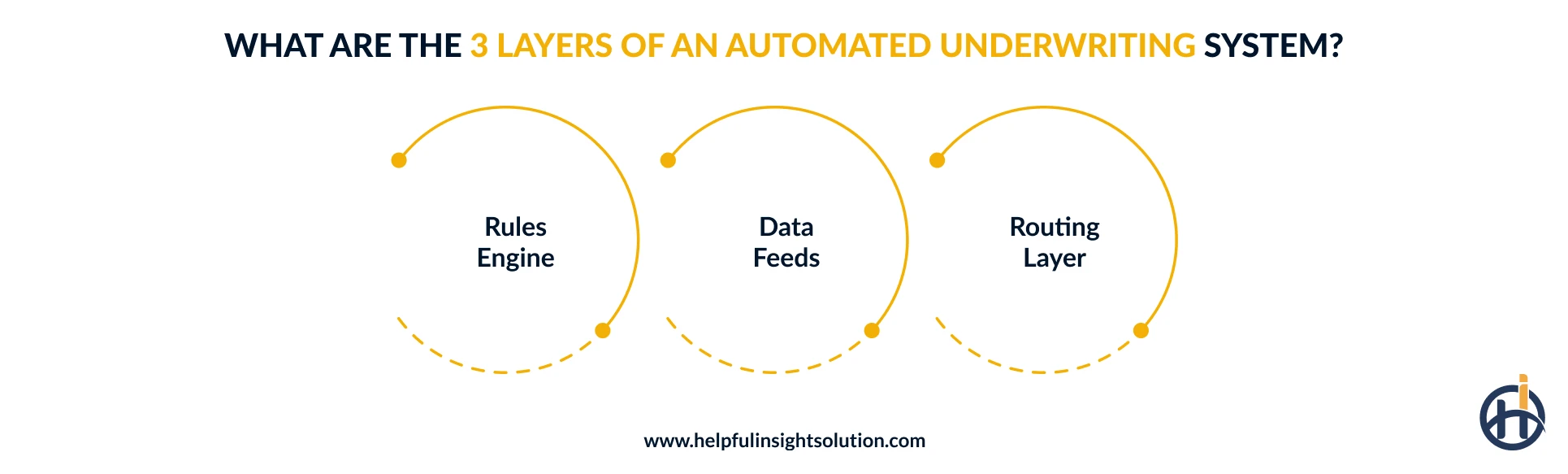
The system has three parts.
- A rules engine carrying the insurer’s appetite as decision tables, which cover age bands, sum assured limits, occupation classes, claim history, convictions, and excluded conditions.
- Data feeds which bring in evidence the applicant did not supply. Prescription history, motor vehicle records, credit data, and catastrophe exposure on a property are the common ones. Integration work in this layer carries most of the build cost.
- A routing layer that passes anything the rules cannot settle to an underwriter at the authority level the case requires.
The decision it returns comes from a fixed set, which is standard rates, loading, referral, postponement, or a decline. The rule version applied gets recorded against each outcome, along with the data the system tested it against.
How does Automated Underwriting Work in Insurance?
Automation in insurance underwriting follows the same order an underwriting agent would do, only the file does not wait in a queue between the steps.
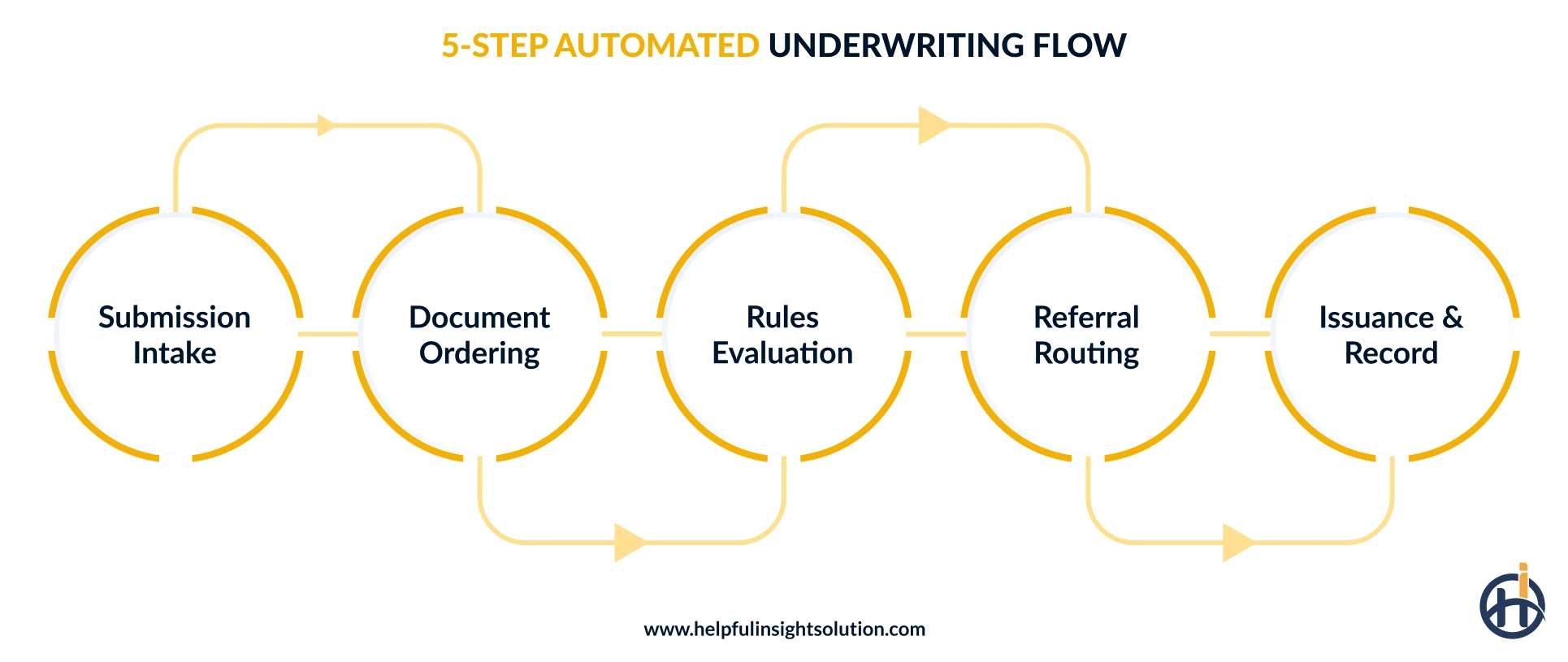
Submission intake
The first thing is getting an application from an agent portal, broker email, or a form on the website, all of it has to be put into one underwriting schema before any rule can work on it.
A form filled out on a portal is already mapped. A PDF sent over email is not, so OCR converts the scanned pages into text before an extraction step pulls out the fields the schema reads. This is why insurance portal development has more to do with underwriting speed than most carriers expect.
Document ordering
The system will ask for what is missing. Prescription history, motor vehicle records, a credit file, and, in life cases, a physician statement, these are common ones. The system collects this information and also decides which other documents are needed to process the request.
Fraud and identity check
The system compares what the applicant submits against the reports it ordered. A declared non-smoker with a nicotine prescription on record, an address missing from the credit file, each mismatch raises a flag. Sanctions screening runs here as well, and a flag routes the case to a person rather than declining it.
Rules evaluation
An insurance underwriting system tests each file against the decision table. Each rule is evaluated and writes back the result to the file for an audit trail of a decision.
Where a carrier runs an ML model alongside the rules, the model returns a risk score, and the decision table treats that score as one more field to test against.
Referral routing
Cases that meet the rules get their answer, the rest are routed to a human underwriter.
Issuance and the record
After that, the case goes into the policy administration system. Documents and billing follow from there. What gets written down at this point is the part carriers underestimate.
The rule version that was applied, the outcome, and the data each rule was tested against- all of it has to still be there three years later, because that is when a supervisor may ask for it. Many insurers keep these records inside insurance compliance software, so audits do not depend on rebuilding old decisions.
Automation in insurance underwriting breaks at whichever step is still manual.
Types of automated underwriting systems insurers run today
Automated insurance underwriting systems differ by what the decision runs on, a written rulebook or a trained model.
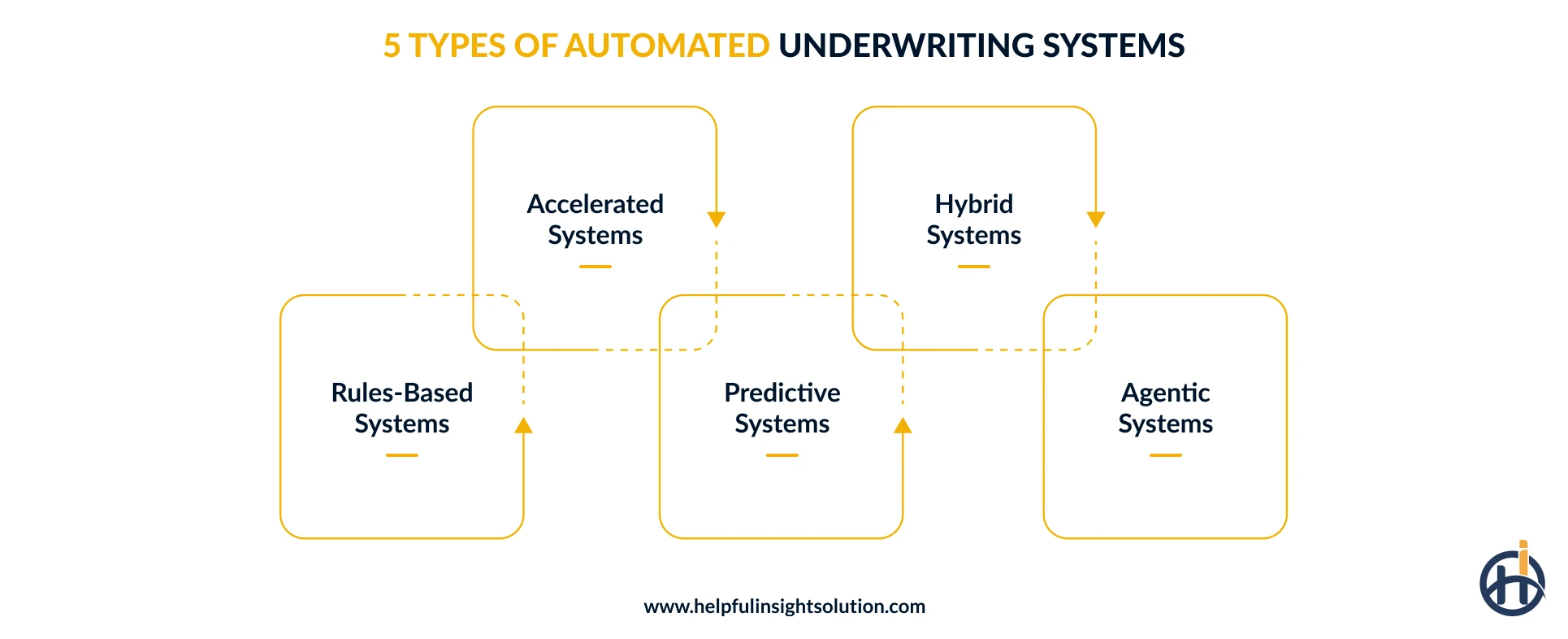
Five of them are in use, and the choice tends to follow the product rather than the technology budget.
Rules-based systems
A rules-based system decides on an application by matching it against conditions the insurer has written down beforehand, covering age, sum assured, occupation class and declared health history.
Products where risk can be described in a handful of known fields move through it without a person, which covers most motor, term life and small commercial business. The engine gives the same answer to the same facts every time, so a decision can be reconstructed years later.
Accelerated underwriting systems
Accelerated underwriting takes the medical exam and the fluid sample out of a life application. Evidence gets bought instead, from prescription histories, driving records and credit files.
It holds up where the sum assured is modest, and the applicant is young enough for that data to stand in for a test, so insurers set age and cover caps around it.
Anything outside those caps goes through the full process. Where the bought data does not settle the case, a manual exam is still required, even for an applicant inside the caps.
Predictive model systems
A predictive system scores each application using a model trained on two sources. The insurer’s own history gives the model past applications, the decisions taken on them, and how those cases performed.
Beyond this, third-party data integration helps with additional data like prescription records, motor vehicle records, credit files, and property exposure.
Building this scoring layer is a machine learning development exercise as much as an underwriting one — the score places the case rather than issuing it, and its accuracy depends on the volume sitting behind both sources.
Hybrid systems
A hybrid system splits the work between the automated system and the human underwriter. The routine applications matching the rules get decided automatically.
Complex or high-risk cases go to a human underwriter that have large sums insured, unusual occupations, poor claim history, and anything beyond the rules written.
Agentic systems
An agentic underwriting system uses AI agents to handle multiple steps in the underwriting process.
The agent reads the broker’s email, extracts information from attachments, identifies missing details, requests it from the broker, then prepares a recommendation for the underwriter.
Books where submissions arrive by email rather than a standard portal get the most from this, since that is where the manual handling is. Adoption is still early, and the underwriter reviews the recommendation before approving the case.
Benefits of Automated Underwriting Systems
The benefits of automated underwriting systems will not be the same for every carrier. Some show up in the loss ratio, others in acquisition cost, and a few appear as business a carrier could not write at all before.
Consistent underwriting decisions
Manual underwriting judgment varies between underwriters, changing with experience and workload. An automated system applies the same decision logic to every application, whether that logic is a written rule, a model score, or both together.
The same risk profile receives the same terms regardless of who is on shift, and the version of the logic applied gets recorded against each decision for the audit trail.
Early detection of missing or undisclosed information
Automated underwriting finds out what an applicant left off the form before a policy is issued. Previous claims, a driving conviction, flooding at the property, a health condition, these details get left out, sometimes deliberately, sometimes not.
In manual underwriting, an external check is requested when something in the file looks incomplete or suspicious. A rules engine orders it on every case, so the gap is found either way.
Finding it early is the whole benefit. The insurer can still decline, load the premium, or put an exclusion on the policy.
Once the policy is issued, the same fact only comes up at the claim stage, and by then the choices are an investigation, a dispute over the payout, or voiding cover the customer has been paying for.
Makes low-premium products more viable
An underwriter costs the same to review a small policy as a large one. When the premium is small, that cost takes most of the profit, so insurers stop selling those products.
Automated insurance underwriting reduces the cost of a simple decision to a fraction of that. Products the carrier dropped become worth selling again, low sum assured term cover among them, along with short duration travel policies.
Entry into digital and embedded channels
Automated underwriting gives a carrier new places to sell. Comparison sites, bank apps, airline checkouts, retail websites, all of these offer cover to somebody who is already partway through another purchase.
The sale happens at that moment, or it does not happen. The customer sees a price on the screen, accepts it, and carries on with what they were doing. A price arriving two days later reaches somebody who has stopped thinking about it.
A case going to an underwriter needs the queue, then the review, sometimes a report ordered from outside, and none of that fits inside a checkout.
Automated insurance underwriting returns a price the insurer will honor within the session, which is what these partners require before listing a carrier. The price shown in these channels usually comes from insurance quoting software that calls the underwriting rules at the moment of quote.
Core components of Automated Insurance Underwriting Software
Automated insurance underwriting software is made up of five components. Insurance underwriting automation tools include some of them as standard, and a carrier builds the rest.
Which components an underwriting software for insurance product includes is the main point of comparison between vendors, and it’s usually one part of a wider insurance software development program rather than a standalone build.
Rule authoring and release control
Underwriting rules change throughout the year. A rate goes up, an occupation class is added or removed, a postcode is restricted.
Rule authoring is where somebody writes or edits those rules. Release control covers what happens next. The change is tested against past applications, approved by a second person, then given a start date so it takes effect on a chosen day.
Every earlier version is kept, which means a decline written in 2024 can still be checked against the rules running in 2024. Without release control, a simple rule change waits for the IT team to schedule a software release.
Simulation and impact testing
Simulation tests a new rule before it goes live. The system takes the applications the carrier has already decided, then runs them through the new rule to see what would have changed.
The report gives numbers, how many accepted cases would have gone to an underwriter instead, which cases would have been priced differently, and how much premium the change would have added or removed.
Without this test, the carrier only finds out after the rule is live. A rule set too tight shows up weeks later as a longer referral queue.
Data orchestration and consent
External reports are the highest variable cost inside an underwriting file. Orchestration is the layer deciding which report gets called, in what order, and whether the next call is still needed after the first answer lands.
It will also reuse a report bought for the same applicant a month earlier rather than buying it twice. Consent belongs in the same place, the date the applicant signed, and the sources that signature covers.
A prescription record pulled without that on file becomes a regulatory finding, and orchestration keeps the running cost per case visible while the file is still open.
Workflow and case management
Insurance underwriting workflow automation manages the applications moving through the process. Each case carries an assigned underwriter, a status, a deadline, and the reason it was referred.
Not every application is handled automatically. Cases falling outside the automated rules are sent to an underwriter for review. A clear referral reason tells the underwriter why the case needs attention, which saves the time otherwise spent reading the file to find the problem.
Connectivity to existing systems
An underwriting decision has to reach the systems that act on it. Policy administration issues the contract, billing raises the first premium, document generation produces the schedule, the broker portal shows the quote as bound, and the insurance CRM updates the lead record.
Each of those is a separate connection. Where a system exposes an API, the decision passes as a service call. Where none exists, robotic process automation drives the system through its own screens, keying data the way a user would.
Claims intake and endorsement processing already run on that technology, and these RPA insurance use cases give the maintenance profile to expect on an underwriting connection.
The number of connections decides the size of the build. Six systems downstream of underwriting means six integrations, which is why insurance business process automation gets planned as one program rather than department by department.
Where does AI in insurance underwriting automation actually apply?
The rules make the decision. AI in insurance underwriting automation covers the reading, predicting, and summarizing that happens around that decision, which is a different job.
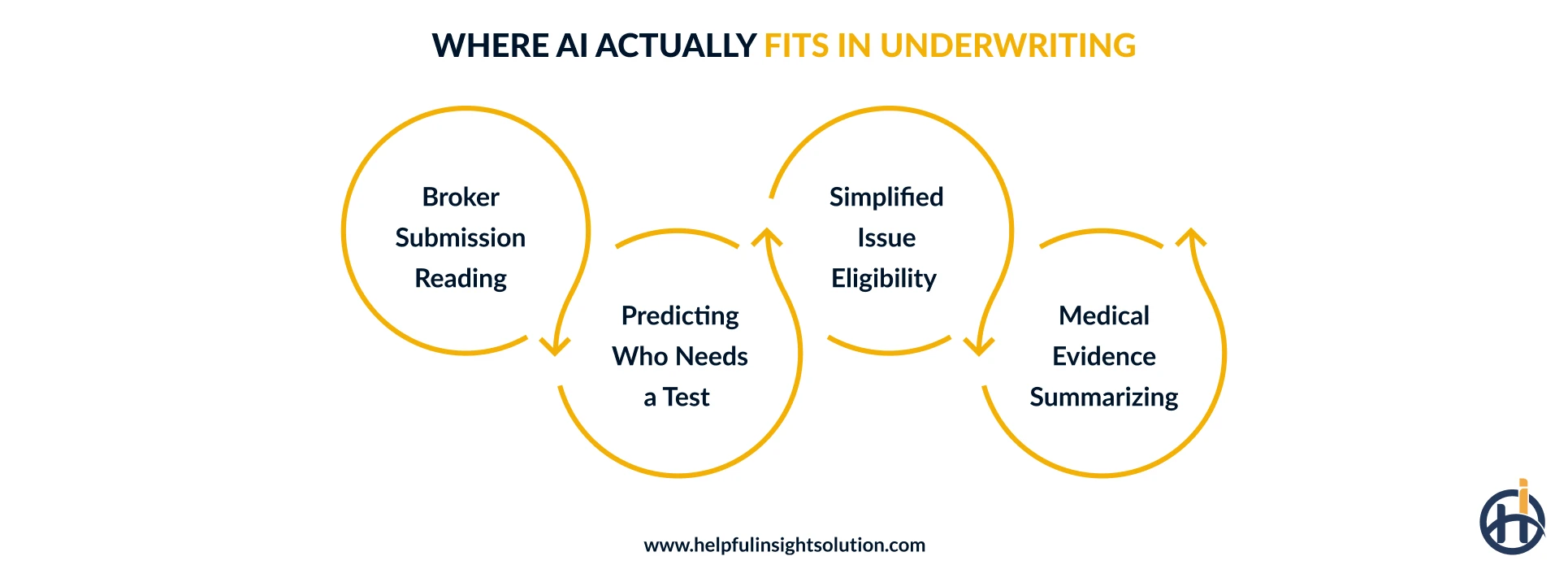
Three kinds of AI models do that work: large language models for reading documents, machine learning classifiers for prediction, and generative models for summarizing. Broader use cases for AI in insurance run across claims and servicing on the same technology.
Reading a broker submission and drafting the quote
A broker submission arrives as an email with attachments, free text in the body, a PDF schedule, sometimes a spreadsheet, none of it in a fixed format. A rules engine needs fields to test, and an email has no fields.
A large language model reads free text the way a person does, so it extracts location, occupancy, sums insured, and loss history, then writes those into the structure the rating model expects. Optical character recognition converts anything arriving as a scan into text first.
For example, Hiscox London Market went live with this in August 2024, running Google Cloud’s Gemini on sabotage and terrorism renewals from the US and Canada. The broker receives a quote in minutes. An underwriter reviews it before it leaves.
Predicting which applicants need a test
Cotinine testing checks whether somebody who declared themselves a non-smoker actually is one. Testing every applicant costs too much, so life underwriters test at random, around one in three.
A machine learning classification model changes who gets picked, sorting each applicant into one of two groups before any test is ordered.
It trains on past applications where a lab result later establishes the truth, learns which combinations of application answers and third-party data go with a false declaration, then scores each new applicant against that.
Swiss Re reports over 95% accuracy on that prediction in a US pilot. Testing narrows to one in fifteen declared non-smokers, at more than double the smoking detection rate of random testing.
Deciding who qualifies for simplified issue
Simplified issue skips the underwriting assessment. Skipping it raises anti-selection cost, since the applicants most likely to claim are the ones who take up cover with no questions asked.
A predictive model narrows that cost by estimating what a full underwrite would have concluded. What it reads on a new applicant is whatever the insurer already holds, banking transactions, health claims records, earlier policies.
Swiss Re reports helping clients with offers of simplified issues to more than 60% of applicants, with no or limited price increase. The models behind that combine alternative data, meaning sources outside the application form, with the insurer’s own past records.
Summarizing medical evidence for the underwriter
An attending physician statement runs to dozens of pages of clinical notes written for other doctors. What an underwriter needs out of it is the conditions, the dates, the medications, and the test results. A generative AI model reads the file and returns those as a structured summary, with the source text one click away for anything the underwriter wants to check.
Aviva said in its half-year 2026 results that it has halved the time taken to review each case in medical underwriting.
None of the four removes the underwriter from the decision. Swiss Re notes that many insurers partner on AI services while their own platforms are being modernized, so the choice of AI solution provider decides what AI in insurance underwriting automation a carrier can realistically run.
Challenges of Automated Underwriting in Insurance
Automated underwriting creates challenges during the build and after it. The build is a project with an end date. What follows has no end date, since the insurer’s products, risk appetite, regulations, and claims experience all keep changing while the rules stay as they were written.
Rule Sprawl
Rules keep getting added to an underwriting system, one after every large loss, complaint that reaches the ombudsman, and after every audit finding, however, very few of them are ever taken out again.
A motor rulebook which started with sixty conditions can carry three hundred after four years, and some of those will be contradicting each other or pointing at products the carrier stopped selling long back.
The people who wrote them have moved on, which means nobody left on the team can say what a particular rule was protecting against. Changing anything in that state feels risky, so the rulebook keeps growing while the appetite it was supposed to express has already moved somewhere else.
The referral rate goes back up
A carrier adds an exception after a bad loss, then another when a complaint comes in, then a third because a new product needs its own handling. Every exception takes cases back out of the automated lane, lowering the straight-through rate, meaning the share of applications decided without a person.
The fall is gradual, and no single change is responsible for it. Automation in insurance underwriting moves backwards on its own unless somebody monitors the straight-through rate alongside the referral rate, then reports both on a set schedule.
Brokers learn where the limits are
Fixed underwriting rules apply the same criteria whenever the same information is presented. Over time, brokers or applicants may learn where the thresholds and referral points fall, then adjust applications accordingly.
The risk is that applicants who understand the rules are more likely to land just inside the automated acceptance range, which shifts the mix of business being accepted.
Insurers manage that risk through regular monitoring, data analysis, rule reviews, and sampling of automatically accepted cases.
Data availability varies by market
A ruleset built for the US runs on prescription databases, motor vehicle records, and MIB checks. None of those has a direct equivalent in the UAE, and the Indian sources which do exist cover a different population at a different depth.
A carrier writing in three markets will end up maintaining three rulebooks with three evidence chains under them, and the thresholds in each one have to be set separately against local claims experience.
Automated underwriting in insurance does not travel across borders the way a software license suggests it might, which is the sort of thing that gets discovered after the second market goes live.
What insurers are building next in insurance underwriting automation
The next round of insurance underwriting automation is being built on the decision data the current round produces.
Carriers that have been running rules for a few years now hold a record of what was decided, on what evidence, with what outcome, and that record is what the newer work runs on.
Agentic workflows for quoting and binding
AI agents are emerging as a way to automate several steps in the underwriting workflow at once. Rather than handling one task, AI agents can handle submission intake, risk assessment, and quote preparation.
Simpler cases may need less manual involvement under this model, while complex or unusual risks are routed to an underwriter. McKinsey describes the direction as machine-first and human-governed. Early agentic work cells are quoting and binding the simplest policies.
As it develops, underwriters spend more time on complex risks, portfolio management, and exceptions, less on routine case processing.
AI-assisted rules and process optimization
Underwriting systems generate data on referral rates, processing times, automation levels, and other performance measures. AI can read that data to identify patterns, bottlenecks, or places where rules and workflows need review.
The rule change stays with people. The system recommends, then the underwriting or governance team evaluates the recommendation before anything is applied.
Insurers working this way identify problems earlier, then improve rules and processes against actual performance data.
More frequent portfolio monitoring
Automated underwriting gives insurers more timely insights into how a portfolio is performing. Combining underwriting activity with pricing, risk, and performance data lets a team monitor changes in business mix, conversion rates, plus other portfolio measures during the year.
These insights show when risk appetite, pricing, or underwriting rules need review, rather than waiting for a periodic portfolio review.
Aviva has expanded its use of portfolio intelligence alongside underwriting and pricing technology. The deployment covers its global corporate and specialty business.
Different models at different stages
One model can decide which evidence to order on a case, another predicts eligibility, a third samples outcomes after issue to check what the earlier models missed. Each supports a different stage of the underwriting workflow.
Swiss Re expects the future of underwriting to require multiple AI models. The approach is emerging rather than settled. Models get added around the process a carrier already runs, which is how the future of insurance underwriting technology is taking shape.
Building automated insurance underwriting with Helpful Insight
Helpful Insight builds automated insurance underwriting systems for insurers working in regulated markets. The build covers the underwriting engine, the connections it needs to policy administration and billing, plus the wider IT solutions for insurance a carrier runs alongside it.
- Rule authoring and release control: Rules written with their reason, author, and approval recorded, plus versioning so an earlier decision can be checked against the rules that applied at the time.
- A replay environment: Draft rules run against applications already decided, showing the effect before the rule goes live.
- Data orchestration and consent tracking: Ordering logic, caching, and records of the authorization behind each data pull, built as one layer.
- Connectivity to existing systems: Service calls where a policy core exposes an interface, screen-level automation where it does not.
- Multi-market rulebooks: Separate rule sets for IRDAI, NAIC, and Central Bank of the UAE requirements, held in one codebase.
Frequently Asked Questions
Automated underwriting system software makes the accept, rate, refer, or decline decision on an application without an underwriter opening it, provided the case falls within rules the insurer wrote in advance. Automated underwriting insurance platforms have three parts, the rules themselves, the data feeds bringing in outside evidence, plus the routing that sends anything unresolved to a person.
How automated underwriting works in insurance runs through five steps. The application is taken in and mapped to a single schema. Missing evidence is ordered, the rules are evaluated against the file, anything unresolved is routed to an underwriter, then the accepted case moves into policy administration for documents and billing. Automated insurance underwriting depends on all five running together, since the slowest step sets the turnaround a customer experiences.
Automated underwriting vs manual underwriting comes down to four things: decision time, cost per case, consistency of terms, and whether the reasoning behind a decision was recorded. A rules engine answers in seconds at a cost that does not move with premium size, applies one appetite to every case, and writes the rule version against each outcome. Manual underwriting still handles what the rules cannot settle, which is where judgment earns its place.
It works in commercial lines at partial rates. Small package business, workers’ compensation, and simple general liability are clear on rules, while complex property and cyber keep an underwriter inside the decision. The split is set by how much of the risk can be described in fields the insurer already holds.
Automated underwriting life insurance leans on bought evidence in place of a medical exam, using prescription histories, driving records, and credit files. Age caps and sum assured caps decide who qualifies, since that data stands in for a test only within limits. Applications above those caps go through full underwriting with the exam ordered as normal.
Insurance underwriting process automation begins at submission intake. A file arriving as an email attachment has to be read and mapped before any rule can test it, which is why carriers automating only the decision step end up with a fast answer on a case that took weeks to assemble. Automated insurance underwriting delivers its stated turnaround only when intake is automated too.
Underwriting automation insurer trends for 2026 point first at agentic work cells quoting and binding simpler policies. Rulebooks that read their own performance data, then proposed threshold changes are the second, with portfolio steering moving from an annual review to a continuous one as the third. All three need the decision record the current generation of rules produces.
Insurance software development cost on a build like this follows the number of systems the decision has to reach rather than the size of the rulebook. A single line of business connecting to two or three systems runs in the region of $150,000 to $300,000. A multi-market build touching five or six systems, with AI components on intake and scoring, runs from $400,000 upward. Most reach production in nine to twelve months. Rules take weeks to write, the connections take months.