

Key Takeaways
- Underwriting is the fastest-growing use of AI anywhere in insurance, at 41.6 percent a year, according to Fortune Business Insights. Part of the reason is that low-premium products that were never worth underwriting properly are becoming viable.
- Speed decides more sales than price does in retail lines. A customer comparing insurers usually buys from whoever quotes first, which is why quote turnaround moves conversion before it moves cost.
- How far underwriting can be automated depends on the line of business more than on the technology. A private car book can run close to hands-off. A cyber submission still needs an underwriter reading every file, because there is barely any loss history to train on.
- Where a problem gets caught decides what it costs, since non-disclosure found at the application stage costs a decline while the same non-disclosure found at the claim stage costs a dispute.
- The model is the cheapest part of an AI underwriting build. Reading the documents, linking claims records to policy records, and writing the score back into the policy system account for most of the budget.
- Regulators ask about one particular decision rather than about the model in general. Reason codes and a stored model version are what make that answer possible eighteen months later.
An underwriting process decides two things on every application: whether to accept the risk, and what premium to charge for it. AI in insurance underwriting supports both, from gathering the data to evaluating it against insurers’ rules, and returning a risk score the underwriter can review before issuing the policy.
The final decision stays with the underwriter, while AI handles the collection and analysis of data to support that decision. For insurers evaluating where AI fits within their broader insurance IT services stack, underwriting is consistently the fastest-returning starting point.
Insurers are already running this. Underwriting is the fastest-growing application of AI inside insurance, at 41.6 % a year, against 35.7 % for the wider AI in the insurance market.
This blog will help you understand how AI in underwriting works, where insurers are using it today, its benefits, the challenges involved, and what a build actually takes.
What is AI for insurance underwriting?
AI for insurance underwriting is the technology that reads an insurance application, checks the risk in it against the insurer’s past claims record, and returns a score the underwriter works from.
Insurers have automated underwriting for years, and those older systems ran on fixed rules. Someone wrote the condition, telling the system that an applicant under 40 with a clean medical history can be approved without review, and anything outside a defined rule escalates to a person.
These rule engines still run in plenty of insurers today. They only work when every value has already been keyed in, and they keep giving the same answer until somebody edits the rule.
An AI underwriting model does not need the data typed in first. It reads the proposal form, medical report, or surveyor’s photographs in the format they arrive in.
This shift is part of a broader wave of insurtech innovation that is changing how carriers assess and price risk across every line of business.
How AI in insurance underwriting works across the policy lifecycle
The underwriting process runs in sequence, where every stage depends on what the stage before it produced. AI in insurance underwriting works at four stages of the underwriting lifecycle.
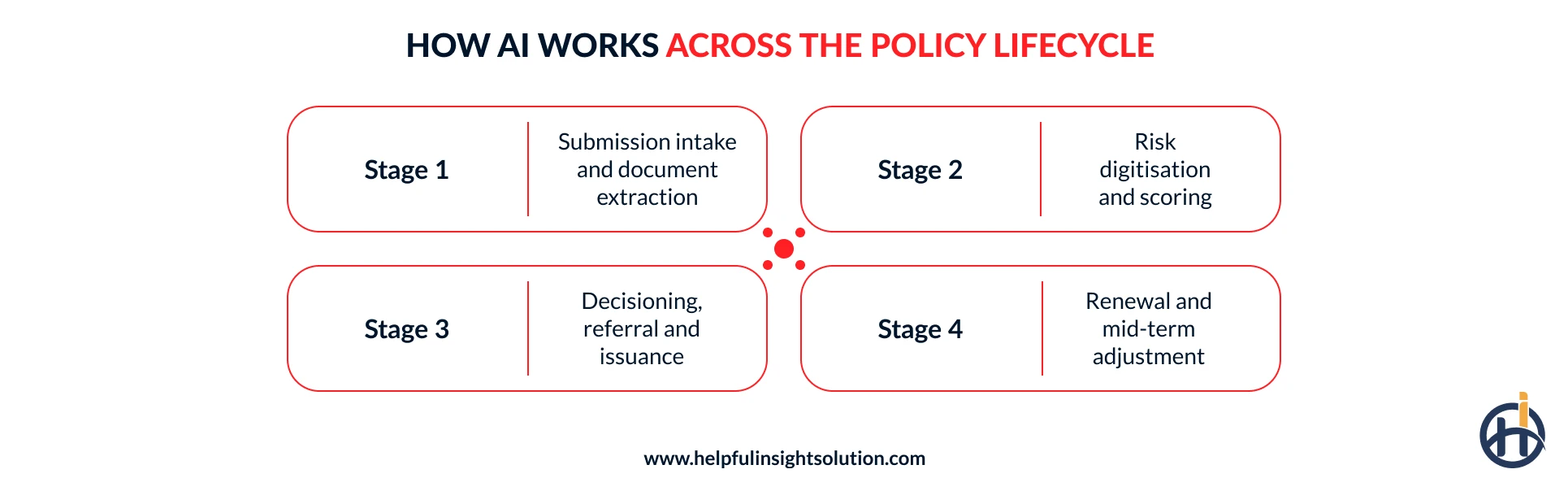
Submission intake and document extraction
An application reaches the insurer from an agent, broker, website form, or a mobile app, and it is often incomplete. With proposal forms, there are supporting documents, like medical records in life insurance, vehicle papers in the motor, and surveyor’s photographs in property.
The documents are uploaded as scans, PDFs, or images taken on the phone. The AI identifies each document, reads the values, and populates the fields an underwriter expects. Where the AI is uncertain about any value, it flags it for human verification rather than passing it forward as a confident read.
Risk digitisation and scoring
The values extracted from the documents are turned into rating variables, which are the fields a model works on. In life insurance, these fields could be age, smoking status, occupation, and the sum assured. In motor insurance, they cover vehicle model, age, declared value, and no-claim bonus.
External data is joined in at this point, like a credit bureau record, a prescription history in life insurance, or a registration check in motor insurance. Machine learning underwriting models are trained on the policies the insurer has already written, and they return two things, a score along with the variables that moved it.
These variables become the reason codes on the decline letter, which in the US must be issued under the Fair Credit Reporting Act whenever a credit-based score forms part of the decision.
Decisioning, referral and issuance
The application score is passed to the rules engine holding the insurer’s appetite limits, and those limits determine whether the application is accepted, referred or declined. A sum assured above a set figure refers regardless of how good the score was.
Where an underwriter overrides the outcome, the override must be stored with its reason. It is the evidence a regulator asks for at inspection, and it is the training data that corrects the model at the next retraining cycle. Insurers skipping this step keep a model that repeats the same error every quarter.
Issuance is a write-back. The decision, the premium, and the reason codes go into the policy administration system, which generates the policy document.
Renewal and mid-term adjustment
Endorsements are the trigger for a mid-term review, since an endorsement is the record of something having changed, like a vehicle being replaced, sum insured raised, address updated. AI in underwriting re-runs the score on the amended exposure, rather than leaving the risk priced once at inception for the full year.
Claims outcomes have to feed back into the training data for any of this to hold up. The obstacle is usually a technical one. A policy is identified one way in the policy system, and another way in claims.
Matching a loss back to the risk that produced it means joining those two records first. Insurers running the loop correctly retrain on a fixed cycle rather than waiting until someone notices the scores drifting.
Benefits of AI in insurance underwriting
The benefits of AI in insurance underwriting are easier to uphold when each one is connected to a number the business already reports. These are the ones that usually hold up.
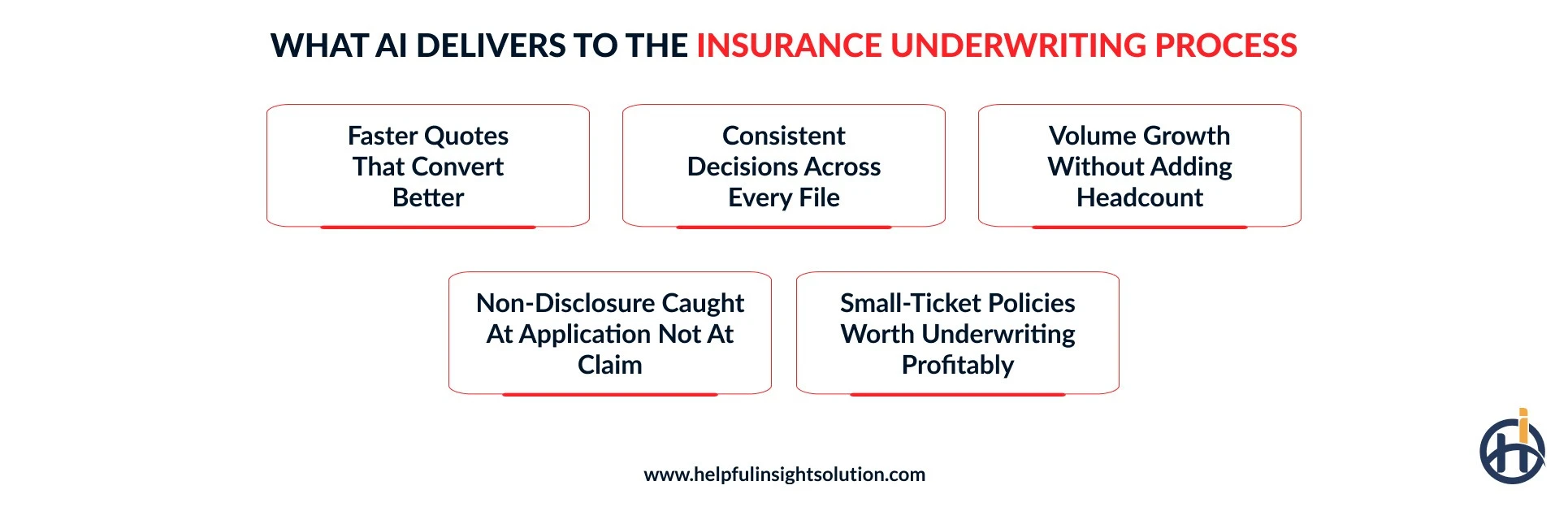
Faster quotes convert better
Customers shopping for a policy will often take the first quote that comes back. In retail lines, the whole comparison can happen on a phone in one sitting, so an insurer replying in minutes picks up business that would otherwise have gone elsewhere on price.
The metric to track is the quote-to-issue ratio, and it moves quickly enough that a pilot on one product will show the effectiveness within a few weeks.
Decisions stop varying between underwriters
Give the same proposal to two underwriters and the terms will not match. This is normal, and in most insurers nobody measures it.
Artificial intelligence in insurance underwriting scores every file by the same standard. The evaluation does not change depending on who is reviewing it or what time of day the file lands.
Volume can grow without hiring
Manual underwriting scales with headcount. To process more files, you need more people, which becomes a constraint at product launch or during a peak season.
Automating the low-risk or routine files to AI, while the underwriting team focuses on the submissions that need judgment, is how volume grows without a proportional increase in staff.
Non-disclosure gets caught at the application stage
AI underwriting checks what the customer has declared against the documents and external records attached to the file. A prescription record that does not match a declared medical history gets flagged. The same happens with a private car proposal on a vehicle registered for commercial use.
The insurer then declines the risk, or loads the premium, at a point where doing so is cheap. Found at the claim stage instead, the same non-disclosure turns into a repudiation, a complaint, and often legal complications.
Low-premium products become worth underwriting
Underwriting a file costs the same whether it is for a premium of $5,000 or $100. This is why small-ticket policies are often sold with almost no underwriting at all.
An AI-powered underwriting platform can run the risk assessment on those policies automatically, so an insurer knows what it is accepting without paying a person to review every file.

AI in insurance underwriting use cases
How far AI can be taken in underwriting depends less on the technology than on how standardized the risk is. A private car policy has a handful of rating variables behind it, with millions of past examples for a model to learn from.
Cyber cover for a mid-sized manufacturer has neither, which is why the same insurer will run one line almost hands-off while keeping an underwriter on every file in the other.
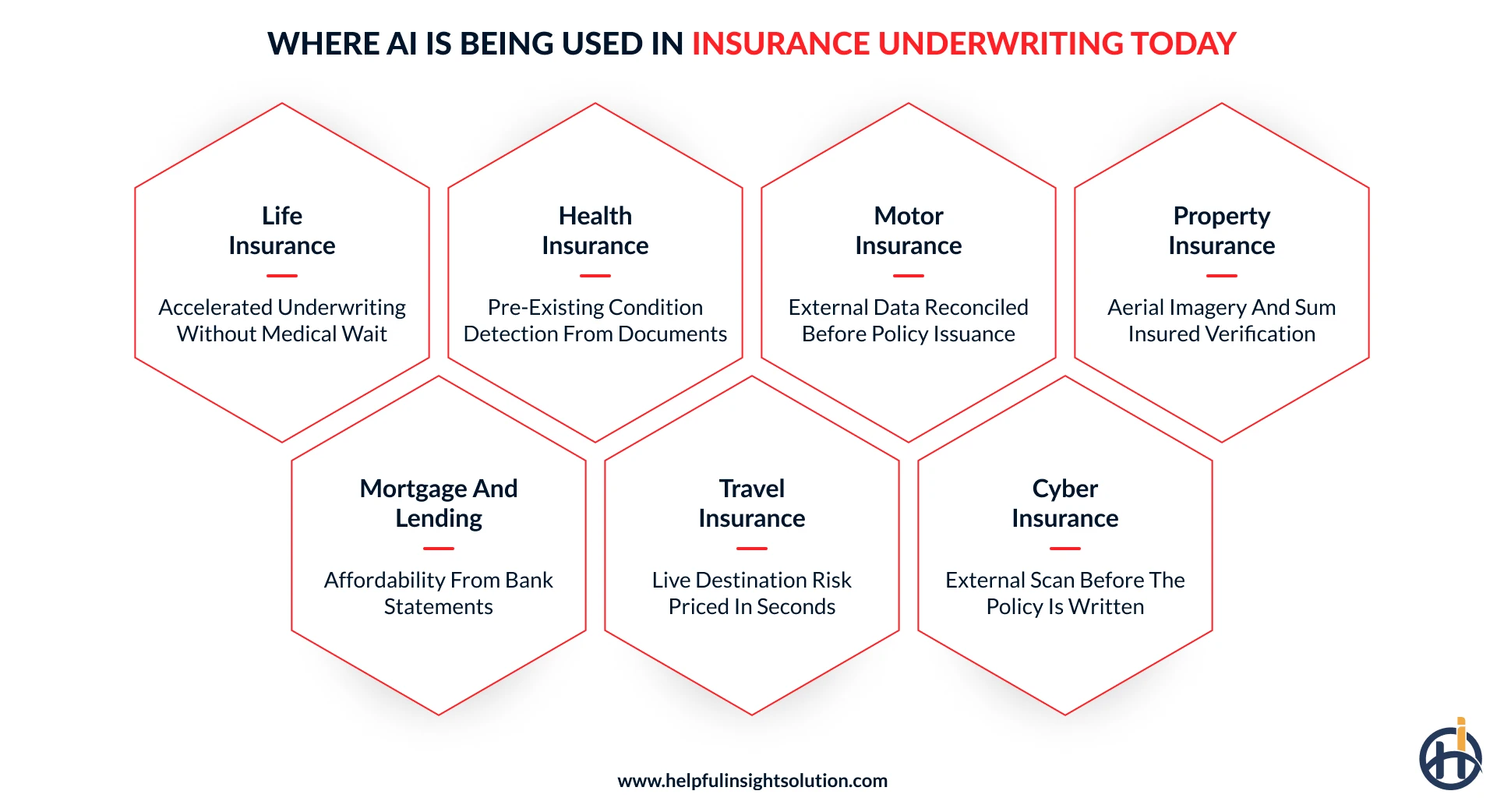
Life insurance underwriting without the medical wait
Life is the line where the delay is longest. A proposal waits weeks for the attending physician statement to arrive, and the medical examination has to be scheduled on top of that.
AI in life insurance underwriting is used to read those medical records once they land, pulling out the conditions, medications, and dates into a summary an underwriter can work through in minutes.
The benefit is accelerated underwriting, where the model predicts what the fluid tests would have shown from prescription history and other records, letting the insurer waive the examination for applicants who qualify.
Insurers running AI in life insurance underwriting this way still refer anything above their non-medical limit to a person, because the sums assured involved make an error expensive. Insurance underwriting software has to hold both paths, the accelerated one and the full medical one.
Health insurance and pre-existing conditions
Health insurance underwriting turns on a single question, what was the applicant already being treated for before the cover started?
Pre-existing conditions get declared on a form, but that declaration is often incomplete, and the gap only becomes visible when a claim is filed inside the waiting period. By then, it is a repudiation logged in the insurance claims management system, no longer an underwriting decision.
AI can read the medical documents attached to the proposal, such as discharge summaries, lab reports, and prescriptions, and map what it finds to ICD-10 codes.
The answer comes from the documents rather than from what the applicant remembered to write on the form.
Motor insurance underwriting
Most of what a motor underwriter needs exists before the proposal arrives. The vehicle registration record contains the make, model, and year of manufacture, while the claims history verifies claims made to date.
AI reconciles those external sources against what the customer has declared. An inflated IDV, no-claim bonus, vehicle registered for commercial use on a private car proposal- each of these gets caught before the policy is issued. Break-in cases where a policy lapsed before renewal will need a physical verification.
Customers can handle verification through the insurer’s own app in most cases, by uploading photographs for the model to read, which is why insurance app development is often scoped alongside underwriting rather than after it.
Property, home and real estate risk underwriting
Property insurance underwriting starts from the address. Once the address is confirmed, aerial or satellite imagery of the building can extract construction materials, condition, and age. This is the work a surveyor used to do for risks large enough to justify a visit.
The bigger issue for most insurers is the sum insured. Customers under-declare it, usually not deliberately: they enter the market value or the purchase price instead of what the building would cost to rebuild.
The model calculates the rebuild cost from the built-up area, the construction class, or the local material and labor rates, then compares it against what was declared. Where the declared sum insured falls short, you get to know at the proposal stage itself.
Location data does not come from the form at all. Flood zone, wildfire exposure, hail and cyclone frequency- these get pulled against the geocode. Accumulation is checked here as well, so you can see how much exposure you are already carrying in a given postcode before writing another risk in it.
A property declared as residential may be running a guest house or a small unit inside it. The model picks this up from listings, business registrations, or the imagery itself, and the occupancy changes your rating completely.
AI underwriting real estate portfolios is the same work at a bigger scale. A lender or an insurer holding thousands of buildings can get all of them re-scored after a hailstorm season, rather than waiting for each renewal to come up.
These models are built as a machine learning development exercise, which is a different skill from the document side.
Mortgage and lending underwriting
Lenders underwrite the borrower and the property together, which makes the file larger than any insurance proposal. Payslips, bank statements, tax records, and the valuation report all have to be read before an affordability decision can be reached.
AI underwriting mortgage applications means pulling the income out of those statements and calculating the debt-to-income ratio. The declared income then gets checked against what the account activity actually shows.
Mortgage insurance is priced off the same file, since the insurer is covering the lender against the borrower defaulting.
This is also where AI agents reduce underwriting delays in banking and insurance by chasing the missing document and requesting the valuation without a person having to remember. The file stays open until every input has arrived.
Travel insurance underwriting
Travel policies are issued in seconds, which leaves no room for a person in the process. The underwriting has to happen while the customer is still on the payment page.
What the model prices is the destination as much as the traveler. Medical evacuation from a remote region costs many times more than the treatment in a major city. A country with a weather event or some civil disruption this week carries a different exposure than it did last week.
Models pull those signals from live feeds, adjusting the rate by destination and travel date without anyone republishing a rate table. Most of this business reaches the insurer through aggregators, which is why the insurance portal carrying the quote often matters as much as the model behind it.
Cyber insurance underwriting
Cyber is the youngest line, with the least loss history to train on, which limits how far a model can be trusted on pricing. Where AI helps is on the input side.
The applicant’s declared controls can be verified externally before the policy is written. A scan shows what the organization has exposed to the internet, along with whether multi-factor authentication is enforced across the domain.
Credentials already circulating from an earlier breach show up the same way.
Underwriters treat all of this as evidence rather than as a score, because the loss data behind cyber stays too thin to price from a model alone.
Challenges of AI underwriting
The challenges of AI underwriting are mostly not about the model itself. They come up in the data you are already holding, and in what your regulator will ask you afterwards.
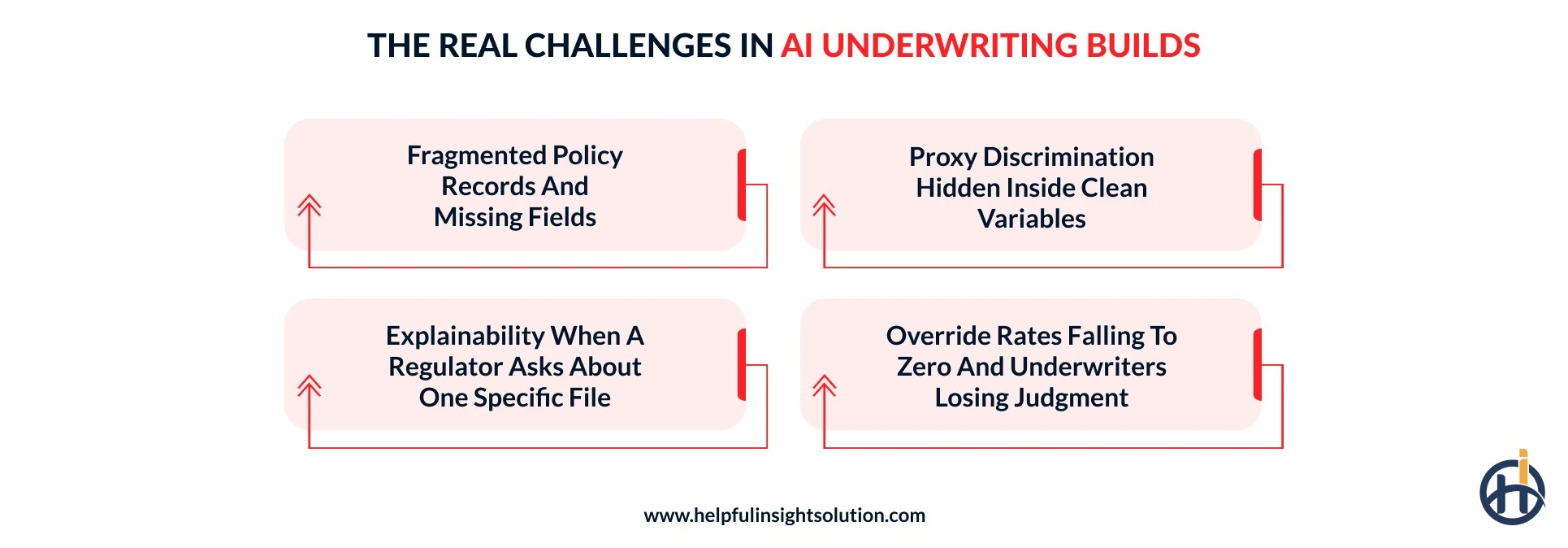
Data quality and fragmented policy records
Policy data often lives in silos, and that is where most AI underwriting builds run into their first real obstacle. The specific problems that come up are consistent across insurers:
- The same customer can be registered under two or three different IDs, because every migration created a new record that never merged afterwards.
- Half the fields are empty in the older policies that came across from the previous system, so your model has less to learn from than the policy count suggests.
- Claims get keyed against a different identifier, which means a loss cannot be matched back to the risk without a joining exercise first.
- Declined proposals are usually not stored anywhere, so artificial intelligence underwriting models end up learning from the business you accepted only, which hides whatever you turned away.
Proxy discrimination and model bias
Removing age, gender, and religion from the model does not remove their influence. Postcode carries income and community, occupation carries both also, and a credit-based score carries the history of who was able to get credit earlier.
This is why the testing has to be done on the output itself. You take the decisions the model gave, group them, and check whether one group is getting declined or loaded more than another without a reason you can defend.
In some US states, this testing has already become a filing requirement ahead of regulatory submission.
Explainability and audit trail
A regulator will not ask you how the model works. The question will be why this particular proposal was declined in March, and you should be able to answer that from the same case file.
The answer needs the reason codes stored with the decision, along with the version of the model that gave it. Insurers miss the version part often. If you retrain every quarter and keep the latest model only, a decision from eighteen months back cannot be reproduced at all, and you are left explaining something you cannot recreate.
Automation bias inside the underwriting team
Once the score is on the screen, underwriters will start agreeing with it. Override rates fall, and that looks like the system is working well.
It may not be. An override rate near zero can also mean nobody is checking the score anymore, and the junior underwriters coming up now are not building the judgment they will need later.
The challenges of AI underwriting on this side are cultural, and you should track the override rate as a control that needs to stay above zero.
How to build an AI underwriting model
Most of the work in an AI underwriting build happens before the model gets trained. If you are evaluating what a full build involves from architecture through to compliance integration, our insurance software development services cover the complete scope.
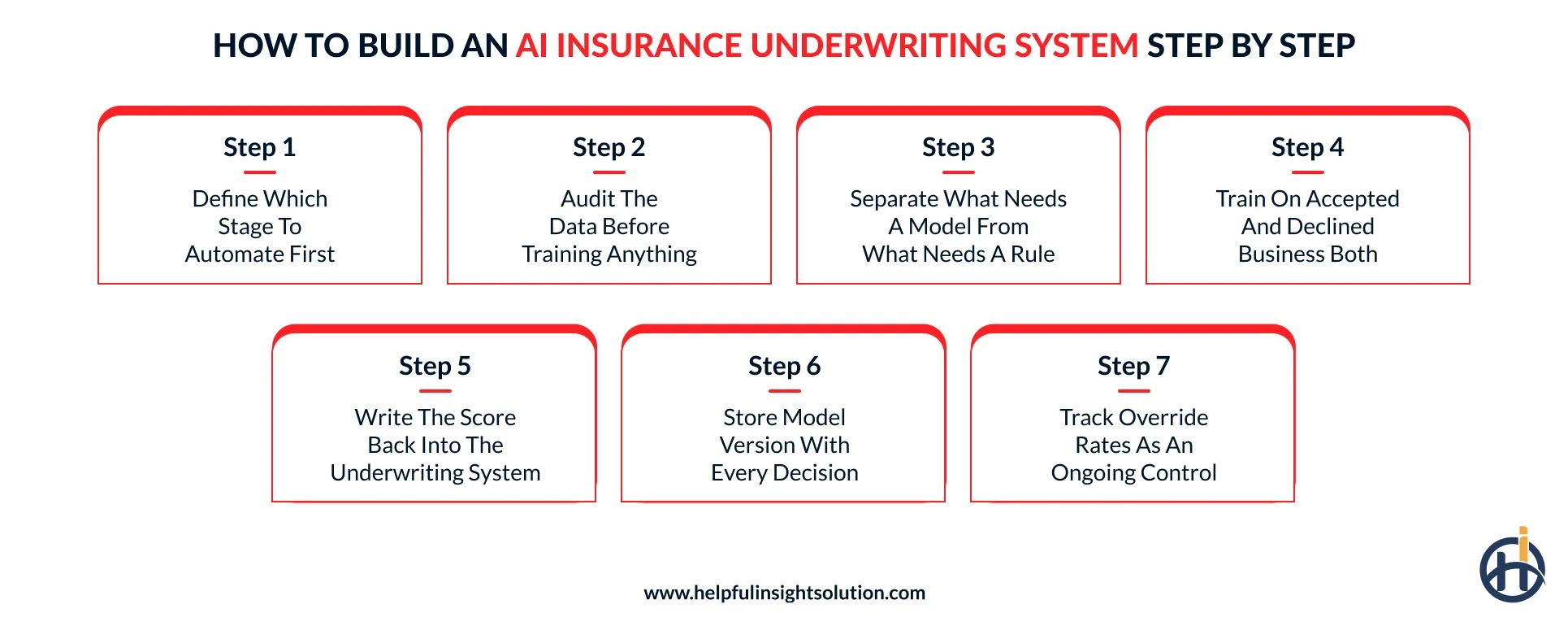
- A data audit should come first, since the audit shows which fields are actually populated in the policy records and whether a claim can be returned to the policy that produced it.
- One product with one stage is the best way to get started with AI. Document extraction is the most common use case to start with, because time saved by mundane tasks can be measured easily.
- Not every step needs a model. A check on whether the document is present, or whether the value falls inside a permitted range, should stay as a rule. Automation in insurance has been handling rule work for years already.
- There will be a confidence score below which the file must be sent to a person. When building AI models, this score must be fixed before it goes live
- The score has to be written back into the underwriting software for insurance, otherwise, the underwriter is reading the score on one screen and keying the decision into another one.
- Model version, reason codes, and the override with its reason should all be stored against every decision to answer regulatory questions.
- Turnaround time, straight-through rate, and override rate: if these numbers are not measured before the build starts, there will be no way to show afterwards what actually changed.
How real insurers are using AI in underwriting today
Four carriers with tools already in production, across life, commercial property, and cyber. Each one covers a single workflow inside one line, and the ones that scale are all piloted narrow first.
Each one started with a single workflow inside one line. The pattern across all four is the same: pilot narrow first, then scale.
How Aviva uses AI to summarise GP reports for life underwriters
Aviva is a British insurer writing life, general and health cover across the UK, Ireland and Canada. In November 2025, it put a summarization tool into its life underwriting.
The tool reads the GP report attached to an application, then returns a summary the underwriter works from. It was extended to critical illness cover in March 2026.
How Zurich North America uses AI to score roof conditions from aerial imagery
Zurich North America is the US commercial property and casualty arm of Zurich Insurance Group. It integrated aerial imagery from Nearmap into its underwriting workflow, with AI scoring the roof condition on each property submission.
Zurich ran a pilot first, then rolled the tool out across every US Middle Market underwriting office.
How QBE cut cyber submission review time by 65 percent using AI
QBE is an Australian insurer writing commercial and specialty lines, cyber liability among them. Its cyber underwriting assistant handles the first risk assessment on a broker submission. Review time on those submissions fell by 65 percent.
The cyber team had been spending close to 40 percent of its time on manual administrative work before the tool arrived.
How Allianz UK built BRIAN to answer underwriting guide questions instantly
Allianz UK writes commercial and personal general insurance. It built an internal tool called BRIAN for its underwriting team. BRIAN reads the property and casualty underwriting guides and answers questions put to it directly, so underwriters get an answer from the guide without searching through it manually.
The pilot ran with 190 users, and the tool is now live with 260 property and liability underwriters, with a target of reaching all 600 within a year.
The future of artificial intelligence in insurance underwriting
Underwriting artificial intelligence is moving towards a market where the buyer is also running software. McKinsey’s July 2026 report says nearly half of customers in North America already use AI somewhere in their insurance-buying journey.
Agentic tools can watch renewal dates independently, query carrier APIs and suggest a switch before the customer has thought about it. Quotes will be read by software before a person sees them.
On the risk side, the movement is different. AI is creating exposures with no loss history behind them, AI liability coverage and non-physical business interruption are the clearest examples.
The same McKinsey report puts the insured share of global cyber cost at under 1 percent. That gap is close to $900 billion, and it stays open primarily because the exposure cannot yet be priced with confidence from a model.
Spending is following both directions. Fortune Business Insights values AI in insurance at $13.45 billion in 2026, going to $154.39 billion by 2034. Within that market, artificial intelligence underwriting is the fastest-growing application of all. It is put at 41.6 percent a year.
Build AI in insurance underwriting stack with helpful insight
The decision in front of most insurers now is a practical one. Which product, and which stage of it, goes first. This decision gets easier once the numbers are on the table. How long a quote takes today, what share of files go straight through, how often an underwriter overrides.
AI in insurance underwriting cannot be explained without those three, because there is nothing to compare against afterwards.
The build itself is less about the model than most leadership teams expect. AI & Machine learning in insurance underwriting depends on document reading, data joins, and a write-back into the policy administration system. Those parts take most of the time and most of the budget.
Helpful Insight works on that side of the build. The appetite, the limits, and the referral rules stay with the underwriting team, since those are business decisions. Everything around them is what we build. That covers the document reading and the scoring, along with the integration into the policy system.
Frequently Asked Questions
AI for insurance underwriting is software that reads an insurance application, assesses the risk in it, then returns a score along with the reasons behind that score. It works on the documents an insurer already receives, including scanned proposal forms, medical reports, or inspection photographs. The final decision stays with the underwriter.
No. Routine files get issued without review, however, anything complex still reaches a person. What changes is the mix of work, since less of the day goes on collecting documents. Senior underwriters end up handling more of the difficult risks.
A single product at a single stage typically runs two to four months, with most of that time going on data preparation rather than model training. Full lifecycle programmes take considerably longer, often a year or more depending on the number of lines and the condition of the underlying data. AI in underwriting projects are measured by integration effort more than by model training time.
Automated decisions are permitted in most markets, with conditions attached. The insurer has to explain a decline, keep an audit trail, and then show the model is not discriminating against protected groups. Rules differ by regulator, so the build should be scoped against the specific market before it starts.
The cost depends primarily on how much data preparation is needed before anything can be trained. Insurers with clean, joined policy and claims records spend significantly less than those starting from fragmented or siloed systems. As a reference point, the document extraction and data integration work typically costs more than the model training itself. The model is rarely the largest line item on the project budget.