

The insurance industry involves a wide range of customer touchpoints, from purchasing a policy and paying premiums to managing documents and filing claims. Traditionally, these activities have been handled through a mix of agents, phone calls, and emails.
Insurance mobile app development is giving insurers another way to bring these services closer to customers while making frequently used tasks easier to access from a single place.
For insurers considering mobile app development services, the focus is not just on creating another digital channel. A well-planned app can bring policy servicing, premium payments, claims, and customer support into one place while fitting into the insurer’s existing processes.
As customers become more comfortable managing everyday services through their phones, insurers have more reason to invest in mobile experiences
According to Business Research Insights, the global insurance mobile apps market is projected to reach $7.59 million by 2035.
For insurance companies, the opportunity is not simply to move existing services onto a mobile screen, but to build an app around the needs of both customers and the business.
That requires more than choosing a set of features and starting development. The app type, integrations, security, compliance requirements, technology choices, and development costs can all shape the final product.
This guide looks at each of these areas, along with the development process and the key considerations involved in building an insurance mobile application.
What is Insurance Mobile App Development?
Insurance app development refers to the process of creating mobile applications that allow users to manage policies, check coverage, make secure premium payments, file claims, share required documents, and contact customer support from their smartphones.
The application may be developed for a single operating system or across iOS and Android, depending on the insurer’s goals and technical requirements.
As insurers pursue digital transformation, mobile apps can become part of a broader effort to replace fragmented, manual interactions with simpler digital processes connected to the insurer’s existing systems.
What are the Benefits of Insurance Mobile Application Development?
Insurance app development services can improve how insurers handle day-to-day operations while making policy servicing more convenient for customers.
The benefits can extend from lower manual effort and faster workflows to better customer engagement and more accessible insurance services.
Here are the key benefits of mobile app development for insurance businesses:
Streamlined Insurance Operations
An insurance app can simplify routine tasks for both customers and staff. Information and documents can be submitted online, so teams spend less time collecting details or handling requests manually.
Connecting the app with claims management software can make this process more efficient.
Information can move into existing claim workflows, reducing duplicate entry and giving teams more time for complex cases.
Better Customer Experience
Developing an Insurance app makes everyday interactions easier to manage from one place. Customers can check policy details, receive updates, or request help when needed.
For insurers, this means fewer routine service queries and more consistent communication. Built-in engagement tools can also support timely renewal reminders and help strengthen long-term policyholder relationships.
Faster Claim Filing and Tracking
Claims often generate repeated calls for status updates. With app development for insurance, customers can submit FNOL details, documents, and photos from their phones and follow progress without calling support.
This gives claims teams fewer routine queries to handle and helps move straightforward cases through the claims processing workflow more efficiently.
24/7 Self-Service Access
Insurance needs do not always fit within office hours. When businesses in the insurance sector build a mobile app, policyholders can handle simple requests whenever they need to. They can access documents, check policy details, or make payments outside regular working hours.
This extends service availability while reducing the need for staff to remain available for routine requests beyond normal business hours.
Cross-Sell and Upsell Opportunities
Developing an insurance mobile app can bring a policyholder’s existing products and interactions into one view, making potential coverage gaps easier to identify. Insurance companies can use this information to present relevant add-on policies at suitable points in the customer journey.
This could support cross-selling, encourage upgrades where appropriate, and increase the value of existing customer relationships without depending entirely on separate sales campaigns.
Data-Driven Customer Insights
The way people actually use an insurance app tells a business more than any survey. If customers keep hunting for the same piece of information, or drop off halfway through filing a claim, that’s usually a sign something in the flow needs fixing.
Insurance app development solutions can track these patterns and feed them back into decisions like which features to improve, how pricing should be adjusted, and where the next development budget should actually go.
Type of Insurance Apps
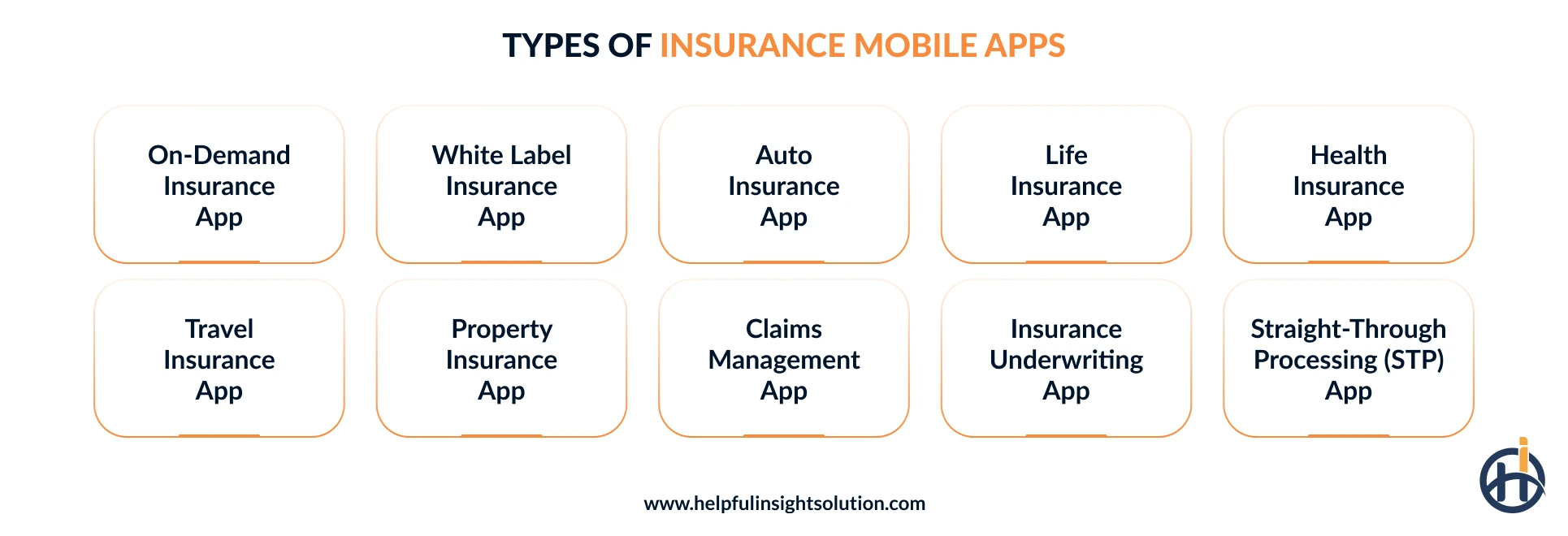
Not every insurance app is built for the same purpose. Some support a particular line of coverage, while others are designed around claims, underwriting, or a specific delivery model.
Custom insurance app development allows insurers to choose an approach that fits their products and internal processes.
The following types are grouped by business model, coverage area, and business function.
Insurance Apps by Business Model
On-Demand Insurance App
An on-demand app development model is gaining traction in the insurance industry. It allows customers to activate, pause, or cancel insurance in real-time without being obligated to a lock-in period or paperwork.
The users of these applications are gig workers, ride-share drivers, delivery riders, occasional motorists, and travellers. For these groups, coverage may need to change with work schedules, trips, or vehicle use rather than follow a fixed pattern.
The global on-demand insurance market was valued at USD 2.40 billion in 2024. It is expected to cross USD 14.61 billion by 2034, growing at a CAGR of 19.8%. The U.S. market alone is expected to expand at 26.9% CAGR over the same period. (Source: Market.us)
This mobile application can be a suitable option for insurance businesses serving gig workers and other customers with flexible coverage needs.
White Label Insurance App
A white-label insurance app is a pre-built mobile app that can be branded, customized, and launched as your own. So instead of building an app from scratch, get an insurance mobile app with all the necessary features already developed by an insurance app development company.
A white-label solution is the right choice for Insurtech startups, MGAs, brokers, and banks looking to offer insurance as an embedded product. They can have a market-ready app with their branding at a much lower cost than custom development.
So, if the priority is launching fast and testing the market before scaling, then a white-label insurance app is a feasible option.
Insurance Apps by Industry
Auto Insurance Mobile App
As the name suggests, the auto insurance mobile app is for auto coverage policy purchase, premium payment, garage network, FNOL, photo-based damage upload, and renewal. Beyond this, applications are also using the telematics data from a phone or connected device to support risk-based policies and premium calculation.
The demand for vehicle app development is high across the world. In the USA alone, over 47% of the auto insurance policies are purchased through mobile apps. (Source: JD Power 2025 U.S. Insurance Digital Experience Study)
Life Insurance App
Life insurance app development enables customers to buy a policy, pay a premium, update the nominee, request endorsement, and file a claim from their phone directly. Additionally, all the information related to their life insurance will be at their fingertips.
The global insurance software market is projected to grow from USD 92.39 billion in 2024 to USD 382.30 billion by 2035, at a CAGR of 13.78%. AI-driven underwriting alone can cut policy issuance times by as much as 50%. (Spherical Insights & Consulting)
It can enable customers to buy policies online conveniently, help businesses to reduce underwriting time, simplify claim settlement, and build long-term customer retention.
Health Insurance App
A health insurance app is for everything tied to medical coverage. Customers can purchase a health plan, access the cashless hospital network, raise an OPD claim, manage dependents, and renew the policy directly from the app.
Beyond this, modern health insurance app development also supports telehealth consultations and wearable device integration to support customers with proactive health tracking.
The benefit is also real and immediate, as the app makes the customer’s health journey simpler at a time when they are already stressed. They can find a network hospital, raise a pre-authorisation, and track a cashless claim, all from the same screen.
The global health insurance market is projected to reach USD 5.09cessing every transa trillion by 2034, at a CAGR of 9.23%. (Source: Straits Research)
Travel Insurance App
A travel insurance app allows customers to buy short-term coverage instantly, manage their trip in real-time, access emergency assistance abroad, and file a claim from anywhere in the world. Customers no longer have to plan their insurance days in advance. They can buy it minutes before boarding.
The global travel insurance market was valued at USD 27.14 billion in 2025 and is expected to reach USD 111.94 billion by 2035, at a CAGR of 15.22%. (Source: Precedence Research)
For a business in travel insurance, an app is the only channel that matches the speed and convenience customers expect today.
Property Insurance App
A property insurance app can support coverage for homes, commercial spaces, and other physical assets. Policyholders can buy coverage, add property photos or videos, submit FNOL details, and follow claims without switching between different channels.
With property insurance app development, IoT devices can add another layer of functionality. Smoke detectors, leak sensors, and smart locks can share risk signals with the platform, giving insurers more information for monitoring properties and assessing exposure.
Insurance Apps by Business Function
Claim Management App
With claims management app development, much of the initial claim filing can happen through a phone instead of forms, calls, or branch visits.
Customers can submit FNOL details, attach supporting documents, and share damage photos as part of the same process. Claims teams can then work with the submitted information while customers keep track of what happens next.
The global claims management market was valued at USD 5.79 billion in 2025 and is projected to reach USD 17.09 billion by 2034, at a CAGR of 12.80%. North America alone holds 46.20% of the market. (Source: Fortune Business Insights)
Handled well, claims are also the single biggest driver of retention and word-of-mouth which makes this kind of app less of a nice-to-have and more of a necessity for insurance businesses of any size.
Insurance Underwriting App
An insurance underwriting app gives internal teams mobile access to information needed to assess and process applications. It can bring together customer risk data, validation checks, rules-based assessments, and application decisions within a single workflow.
Underwriters often work with information pulled from several systems. A mobile underwriting app can bring key details into one place, allowing cases to be reviewed, scored, approved, or referred without being tied to a desktop.
Insurance underwriting software can also handle data collection, validation, and formatting. UST Insurance Insights reports that this can improve underwriting speed by up to 40%.
Straight-Through Processing (STP) App
A Straight-Through Processing (STP) app takes care of insurance tasks that can be handled using predefined rules. This may include KYC checks, premium calculations, underwriting validation, and document generation.
Instead of manually processing every transaction, teams can let routine cases move through the workflow and step in when something needs further review.
Human review still has a role when a case falls outside the defined rules or requires additional assessment. This exception-based approach allows teams to focus on cases that need judgment rather than reviewing every straightforward transaction.
For insurers, STP can help standardize repetitive workflows and shorten processing times. Claims, policy issuance, and other high-volume processes can be suitable areas for this type of insurance process automation.
Insurance Mobile App Features to Serve Customers, Agents, and Internal Teams
An insurance mobile app often serves two types of users: customers and internal team members simultaneously. Here in this section, we’ll have a list of must-have insurance app features.
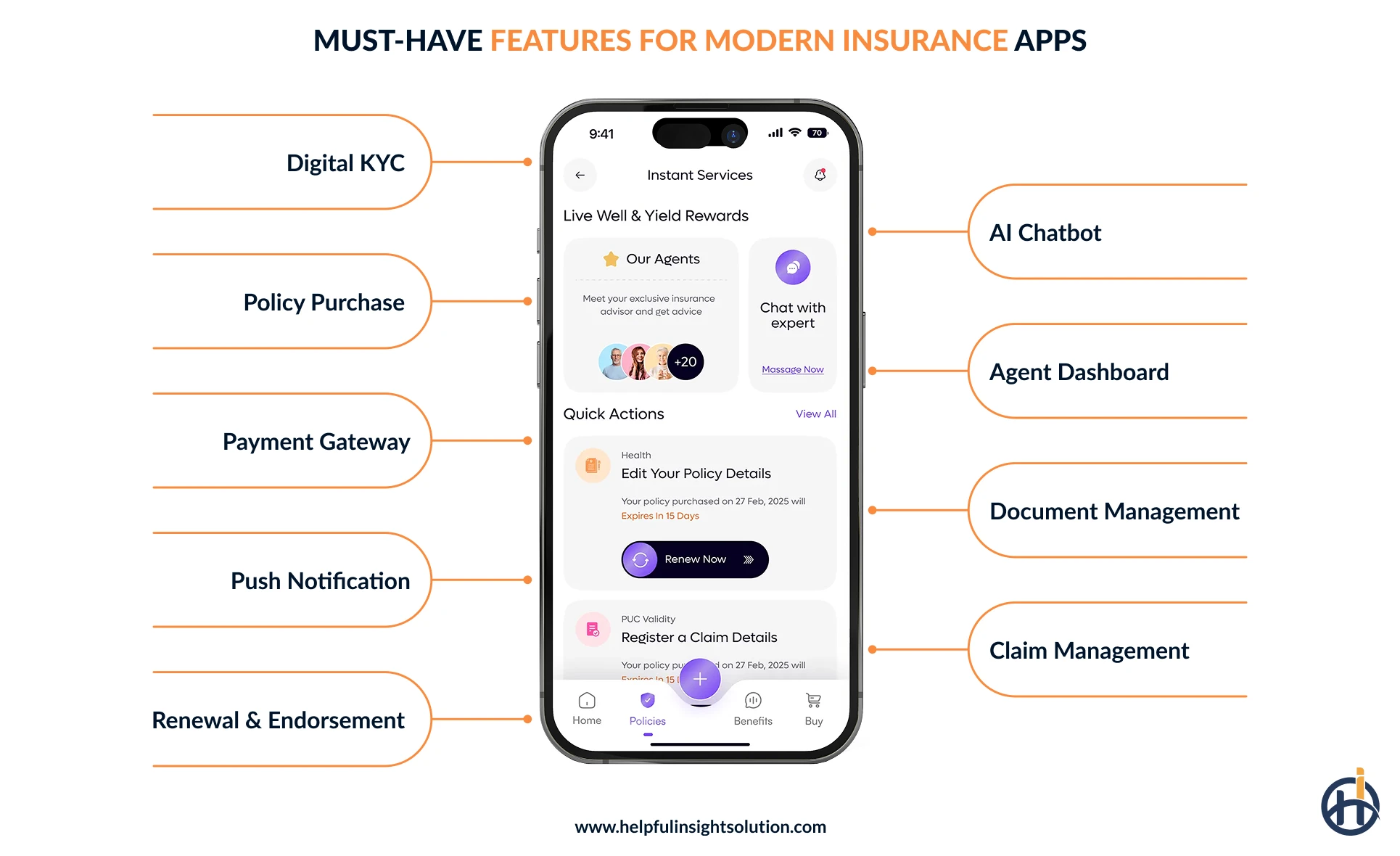
User Registration & Digital KYC
The first thing a customer does on the app is sign up. So, the process must be fast, simple, and fully digital. The app should let the customer register through a phone number or email, and complete KYC inside the same session.
So, by the time the customer is done with sign-up, they are already verified, onboarded, and ready to buy a policy.
Policy Purchase & Quote Generation
Quote generation works best when customers do not have to move between different channels. A mobile insurance platform can collect customer details, apply the relevant pricing rules, and return a quote within the app.
Straightforward policies may proceed directly to purchase, while complex cases can be passed to an underwriter with the information already captured.
Payment Gateway
The app must support every payment method target customer uses, such as UPI, net banking, debit/credit cards, digital wallets, and EMI options for high-value policies. Additionally, auto-debit is a must for recurring premiums.
The customer sets it up once, and the premium is deducted on time, every time. So, insurance companies do not lose policies because the customer forgot to pay on the due date.
The app should also send payment reminders, generate receipts instantly, and store all transaction history inside the app for the customer to access anytime.
Push Notifications
There are several points in a policy lifecycle when a customer needs a reminder. A digital insurance app can handle these through push notifications, whether it is an upcoming premium, renewal date, claim update, or document request.
Insurers can also use the same channel for relevant offers, provided the messages are based on customer needs and not sent indiscriminately.
Policy Renewal & Endorsement
Policy changes often require more than a simple payment. With insurance mobile app development, renewal and endorsement requests can be handled within the application.
Depending on the policy, customers may update an address, change a nominee, adjust the sum insured, or add a rider. The request can then move through the insurer’s existing approval workflow where required.
In-App Insurance Chatbot
Some support questions are fairly simple, like checking a premium, understanding a policy term, or finding out what happens next with a claim.
An AI chatbot can deal with these queries within the app. When a customer brings up something that needs a person to review, the chat can be transferred to the relevant support team.
Agent Dashboard
Agents are the lifeline of insurance businesses across all domains. Therefore, the insurTech mobile app must have an agent dashboard that lets them manage leads, issue policies, track commissions, and view their customer portfolio in one place.
So, agents can have all the information they need on a single screen, so they can focus more on closing customers rather than repetitive work.
Document Upload & Storage
Policy servicing involves several types of documents, and keeping track of them can become difficult across emails and physical files.
Insurers that develop a dedicated insurance app can provide options to scan, upload, or import supporting documents directly.
Depending on the system design, these records can be associated with a policy or profile, giving both policyholders and authorized teams easier access when required.
File a Claim
The app should provide a simple claim filing flow where policyholders can enter FNOL details, describe the incident, and attach photographs or supporting documents in one place.
Insurance app development agency support can help connect this feature with the claims system, allowing the app to show claim progress, pending requirements, and settlement updates without making policyholders switch between channels.
Industry-Specific Features for Insurance Mobile Apps
Core features cover the common needs of an insurance app, but each line of insurance has its own workflows and requirements.
Auto, health, life, travel, and property insurance may therefore need additional features based on how policies are sold, serviced, and claimed.
Life Insurance App Features
- Policy purchase, comparison, and renewal
- Premium calculator and EMI options
- Nominee management and updates
- Endorsement requests and rider addition
- Maturity value tracking
- Family member or dependent linking
- 24/7 customer support access
Car Insurance App Features
- Instant policy purchase and renewal
- Photo-based damage upload at the accident site
- FNOL filing from the spot
- Garage and cashless network locator
- Telematics-based premium tracking
- Roadside assistance request
- Police report and incident document upload
Health Insurance App Features
- Cashless hospital network locator
- Pre-authorisation request submission
- OPD claim filing and tracking
- Telehealth and doctor consultation
- Dependent and family member management
- Health record and report access
- Wellness reward tracking through wearables
Travel Insurance App Features
- Instant policy purchase before or during the trip
- Single-trip and multi-trip cover options
- Emergency assistance contact
- Real-time trip tracking
- Trip cancellation and luggage claim filing
- Cross-border medical emergency support
- Currency conversion for international claims
Property Insurance App Features
- Property documentation through photos and videos
- IoT sensor integration for smoke, leak, and theft alerts
- FNOL filing for fire, theft, or natural disaster
- Property maintenance reminders
- Claim tracking and settlement status
- Renewal and endorsement requests
Business Insurance App Features
- Multi-asset and multi-location policy management
- Certificate of insurance (COI) generation on demand
- Claim filing for loss, fraud, or business interruption
- Employee and contractor cover management
- Compliance document storage
- Renewal pipeline and audit reports
Tech Stack for Insurance Mobile App Development
Choosing the technology for an insurance app starts with understanding what the application needs to handle. The platform, features, APIs, databases, integrations, and security requirements all influence that decision.
In insurance application development, it is usually better to choose a stack around the product requirements than to rely on a fixed list of technologies.
Frontend Insurance App Development
The frontend is what customers usually see and experience. So, it must be intuitive to make it easier for customers to navigate and purchase policies through the app.
For native development, Swift is the best choice for iOS, and Kotlin is for Android. If looking for cross-platform app development, then frameworks like React Native and Flutter are the two leading options.
Both allow developers to write the code once and run it on iOS and Android, cutting insurance app development costs by 30-40%.
Backend Insurance App Development
The backend connects the mobile experience with the systems and logic needed to run insurance operations. It may handle APIs, customer data, policy rules, premium calculations, and communication with core insurance systems.
Some of the best choices for backend development include:
- Node.js: Popular choice for real-time data handling and supports high-volume API traffic
- Python: Best choice to support AI and machine learning-powered app development
- Java: Preferred choice for enterprise app development for insurance
The choice of backend technology varies with the business scale and the workloads the application needs to handle.
An experienced mobile app development company can review the technical requirements and suggest an appropriate backend stack.
Database
Insurance apps work with both structured data, such as policies, premiums, and customer details, and unstructured data, including claim photos, scanned documents, and telematics data.
This makes the database layer an important part of the application architecture.
PostgreSQL can handle structured policy and customer records, while MongoDB can be used for flexible data such as documents and image-related information.
Cloud & Hosting
The high availability of insurance applications depends on the cloud and hosting service providers. So, it is a must to have the right platform to support business operations.
AWS is the most common choice for insurance app hosting, offering the widest service catalog and strong compliance certifications across regions. Additionally, Microsoft Azure and Google Cloud are also the most trusted and reliable cloud hosting providers.
AI & Machine Learning
AI has a practical role in insurance apps when there is a lot of information to review. An integration with OpenAI or Anthropic Claude can help summarize policy or claim documents and support in-app conversations.
Machine learning is more useful for data-driven decisions. Insurers can use it for areas such as fraud detection, underwriting, and risk assessment. TensorFlow and PyTorch provide tools for developing these models.
Security & Compliance
Enterprise-grade security is a non-negotiable tech stack in insurtech app development.
OAuth 2.0 and JWT handle secure authentication and authorisation. AES-256 encryption protects data at rest, while SSL/TLS protects data in transit. On top of these, apps must comply with the regulations of every market it operates in, HIPAA for health data in the USA, GDPR for European users, DPDP Act for Indian users, and PCI-DSS for payment data globally.
A suitable technology stack for insurance applications should account for security from the start, especially when handling sensitive policy and customer data.
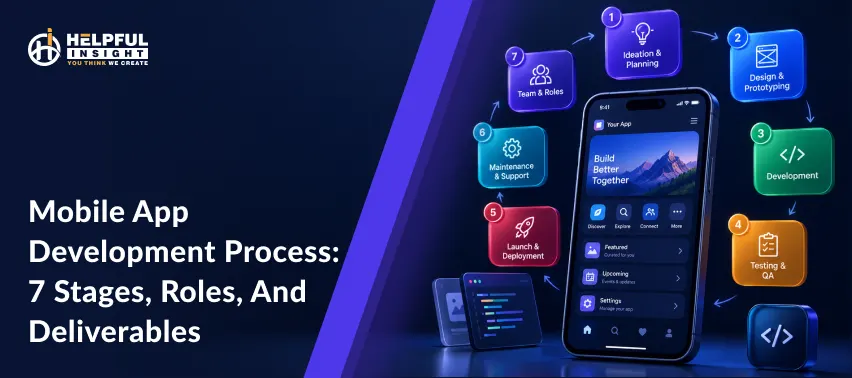
How to Develop an Insurance Mobile App: Step-by-Step Process
Insurance is a highly regulated industry, therefore, the insurance app development process must be built around regulations. Every region the mobile app operates in has its own rules on data residency, KYC, e-signatures, claim settlement timelines, and policy disclosures.
Beyond regulations, the process also has to handle integrations with core insurance systems, multiple user types like customers, agents, and underwriters, and the security standards needed to protect sensitive customer data.
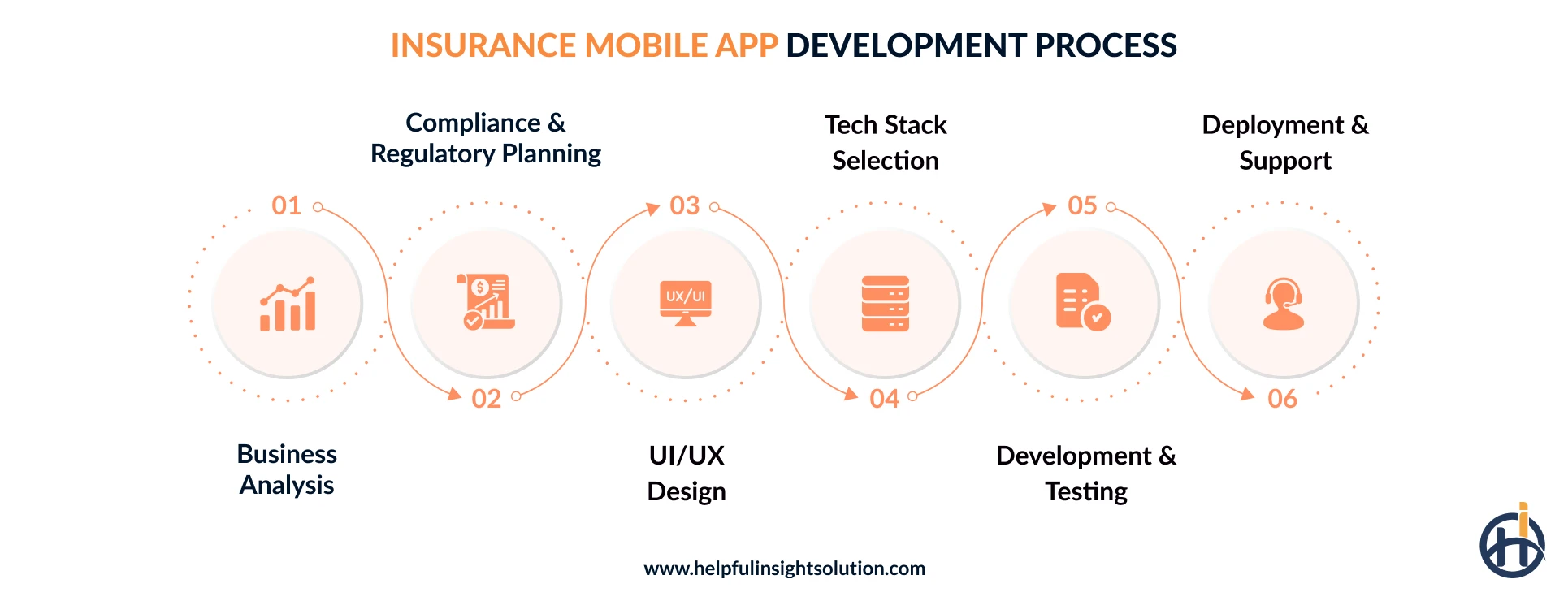
So, building an insurance app must have a structured process that gets the business goals, compliance, design, technology, and testing right from the start.
So, building an insurance app must have a structured process that gets the business goals, compliance, design, technology, and testing right from the start.
Step 1: Understanding Businesses and Defining Goals
Start by deciding what the app is supposed to do for. It could involve selling policies, making claims faster, bringing agents on board, or supporting a new on-demand product.
It is also important to settle the insurance line at this stage.
For example, a car insurance app may require telematics and FNOL early in the build, whereas a life insurance app may need nominee updates and recurring renewal workflows.
Once these requirements are clear, the app development process can be planned around the actual business need rather than a generic feature list.
Step 2: Mapping Regulatory and Compliances
Every insurance market has its regulations, so the application must map the compliance requirements for every region it will operate in.
This includes data residency rules, KYC norms, policy disclosure requirements, e-signature laws, premium refund rules, and claim settlement timelines.
For example, an app operating in the USA must follow NAIC model rules and state-level insurance regulations, while in the UAE, the Central Bank of the UAE regulates and supervises the insurance sector. Compliance mapping has to happen before the insurance app developers write a single line of code.
Step 3: Insurance App UI UX Design
Insurance app UI/UX design must be focused on being intuitive, transparent at each step, and building trust across the process, so customers can make purchases confidently.
The best practices for mobile app design are that the information hierarchy must put the most-used actions on the home screen, such as file a claim, view policy, pay premium, and contact support.
Every form must use progressive disclosure, asking for only what is needed at each step.
Beyond this, the design must also consider the moments when customers will open the app. Most insurance app sessions happen during stressful situations, such as after an accident or a hospital visit. So, the design must keep the load on the customer’s mind low, with clear next steps, large action buttons, and no unnecessary scrolling.
Step 4: Choose the Right Tech Stack
Technology stack selection is an important step in the mobile app development process. It is best practice to evaluate today’s requirements while keeping scalability in mind, so future growth can be handled well without the need to rebuild the application.
Beyond scalability, the tech stack must also support the security and compliance needs of insurance. So, the backend must support audit logging, encryption, and integrations with KYC and payment APIs.
The frontend must work smoothly across older Android phones and newer iOS devices, since your customer base will include both.
Step 5: Develop and Test
The development stage turns the approved requirements and designs into a working application. For insurance mobile application development, this can involve building customer features, connecting core insurance systems, and setting up the required APIs and workflows.
Testing then checks whether these components work as expected across devices while also covering security, performance, and integration issues.
Step 6: Deployment and Post-Launch Support
A staged rollout can make the launch easier to manage. Insurers can start with one region or one product line, monitor the performance, and update to ensure it meets your needs.
Post-launch, insurance app development solutions may include performance monitoring, maintenance, security updates, regulatory changes, bug fixes, and integration work as new requirements arise.
Challenges in Insurance Mobile App Development
Insurance application development comes with its own set of challenges. Data protection, regulatory requirements, third-party integrations, and existing insurance systems can all affect the development work.
Identifying these areas early makes it easier to account for technical constraints before they create delays or costly changes later.
Modelling Multiple Insurance Products in One App
A single insurance business often sells more than one product, such as auto, health, life, travel, property, and commercial are some of the most common. Each product has its pricing rules, claim flows, underwriting logic, and renewal patterns.
So, the app has to handle all of them inside one architecture without breaking. When a business decides to add a new product like pet insurance or cyber insurance, the app should support it without going through a major rebuild.
Handling Sudden Traffic Spikes
Insurance is a business with predictable peak seasons and unpredictable disaster events. Renewal season, festival sales, regulatory deadlines, and natural calamities like floods or earthquakes cause sudden 10x to 20x spikes in policy purchases and claim submissions.
Therefore, the app must be built to scale up without slowing down or crashing during these spikes.
Auto-scaling cloud infrastructure, such as AWS Lambda, ECS, or Azure App Service, can help the app handle the increased traffic while keeping the cost in control during normal days.
Balancing Automation with Human Decision-Making
Automation can take care of many repetitive insurance tasks, from checking KYC information to calculating premiums and collecting claim documents. The difficult part is knowing when automation should stop.
Complex underwriting decisions, suspicious applications, and high-value claims may need human review.
The application should make that handoff clear and carry the relevant information forward, rather than making staff start the process again.
Managing Both Structured and Unstructured Data
Insurance apps store two very different types of data. Structured data includes policies, premiums, customer details, and transactions. Unstructured data includes claim photos, scanned IDs, signed agreements, medical reports, and damage videos.
The insurance platform has to manage both types of data together in a way that the customer never feels the difference.
The backend usually runs on a combination of PostgreSQL for structured data and MongoDB for unstructured data, which adds another layer of architectural complexity to the build.
Securing Sensitive Data Across Multiple Markets
Insurance handles some of the most sensitive personal information of customers, including identity documents, medical history, financial records, and claim photos.
Keeping all of that information safe requires more than encryption. The application also needs proper access controls, secure storage, authentication, and monitoring.
Beyond this, the app must also comply with the data residency rules of every market it operates in. Building one app that follows all of these rules at the same time is a challenge in itself.
Insurance Mobile App Development Cost
The cost of insurance mobile app development usually falls between USD 40,000 and USD 300,000, depending on the complexity.
A basic single-product app with core features starts at the lower end. A full-scale enterprise app with AI underwriting, telematics, multi-product support, and deep core system integrations sits at the higher end.
So, the real cost is decided by the type of app, the number of integrations, the regulatory markets it serves, and the tech stack chosen.
Insurance App Development Cost by Complexity
| App Complexity | Estimated Cost (USD) | Timeline |
| Basic App | $40,000 – $70,000 | 3 to 5 months |
| Mid-Complexity App | $80,000 – $150,000 | 6 to 9 months |
| Enterprise App | $180,000 – $300,000+ | 10 to 14 months |
A basic app covers a single product with core features. A mid-complexity app adds multi-product support, agent dashboards, chatbots, and key integrations. An enterprise app handles the full policy lifecycle with AI, IoT, and deep core system integrations.
A minimum viable product (MVP) takes a different approach by limiting the first release to the features needed to validate the product.
As a result, MVP cost for an insurance app depends largely on the initial scope, required integrations, and technical complexity.
This model is particularly useful for startups developing an MVP to test an insurance product before expanding its features.
Insurance App Development Cost by Region
Where the development team is based can make a noticeable difference to the final project bill.
In the USA, hourly rates generally range from USD 100 to USD 180. The UK and Australia typically fall between USD 80 and USD 150, while the UAE ranges from USD 70 to USD 130. Across Asia, rates for comparable expertise can range from USD 25 to USD 60 per hour, depending on the market and project requirements.
So, a clear scope upfront is best practice to have an estimated cost of insurance mobile app development before the project begins.
How Can Helpful Insight Help You Build an Insurance Mobile App?
Insurance app development is changing how insurers deliver and manage digital services. An app can bring different parts of the insurance journey into a connected digital environment while also creating opportunities for new products and service models.
For insurance companies, mobile development offers a practical way to modernize selected processes without having to change the entire operating model at once.
Building an app, however, involves more than putting policy details and payments on a smartphone. Depending on the business model, the application may need to support policy sales, telematics, claims, underwriting, agent workflows, or connected devices.
The right approach will depend on the insurance product, operating model, existing integrations, and people using the application.
Our insurance software development company builds mobile solutions around these needs. We create different types of insurance apps for auto, life, health, travel, property, and other insurance segments.
Each solution is customized to the way the business operates, with the flexibility to add or change functionality as requirements evolve.
Whether the goal is to launch a new digital product or modernize an existing process, the application can be shaped accordingly.
Have an insurance app project in mind? Contact us or share the project requirements with our team to discuss the right approach.
FAQs
The timeline depends on the complexity of the app. A basic single-product insurance app takes around 3 to 5 months to build. A mid-complexity app with multi-product support, agent dashboards, and key integrations takes 6 to 9 months. A full enterprise-grade insurance app with AI underwriting, IoT integration, and deep core system integrations can take 10 to 14 months.
So, the timeline is decided by the features, integrations, and the complexity of the compliance requirements your app needs to meet.
The cost of an MVP for an insurance app typically falls between USD 25,000 and USD 50,000. The MVP usually covers a single insurance product with core features such as user registration, KYC, policy purchase, premium payment, and basic claim filing.
So, the MVP is the right approach when you want to test the market, gather customer feedback, and validate your business model before investing in a full-scale build.
Both options work, and the right choice depends on your priorities. A native app, built using Swift for iOS and Kotlin for Android, delivers the best performance and is ideal when your app uses heavy device features like telematics, biometric login, or AR-based damage capture.
A cross-platform app, built using React Native or Flutter, lets you launch on both iOS and Android with a single codebase, cutting development costs by 30% to 40%. So, if your priority is speed and budget, cross-platform is the right choice. If your priority is performance and long-term scale, native is the better fit.
Yes. AI and machine learning have become a standard part of modern insurance apps. AI is commonly used for underwriting decisions, fraud detection, document summarisation, and in-app chatbots. Machine learning is used to build custom risk models, claim automation, and behaviour-based pricing engines.
So, AI is not just an add-on feature anymore. It is what separates a basic insurance app from a smart insurance app that learns from every customer interaction.
The ROI of an insurance mobile app comes from multiple directions. Higher premium conversion at lower acquisition cost, 24/7 policy sales without a sales team, faster claim settlement, reduced customer service load, and stronger customer retention.
According to McKinsey, insurers running modern, specialised platforms achieve a 41% lower cost per policy and 40% higher operations productivity than peers using off-the-shelf or legacy software. So, most insurance apps recover their development cost within the first 12 to 24 months.