

Key Takeaways:
- EHR improves care coordination, reduces medical errors, and ensures faster clinical decision-making by centralizing patient data.
- E-prescriptions, patient portals, AI-powered clinical support, billing integration, and telemedicine are the major features of EHR.
- To develop EHR systems, you must analyze requirements, design the user interface, ensure compliance, and perform testing.
- Businesses can increase ROI, streamline workflows, enhance patient experiences, and maintain systems through EHR integration.
The healthcare industry is experiencing a digital shift due to multiple difficulties like missed appointments, billing issues, and security concerns in older systems. The introduction of electronic health record software has helped clinicians and hospital staff to easily manage administrative operations.
As reported by Fortune Business Insights, the EHR system market is generating revenue of $34 billion in 2026, which is growing at a rate of 5.6% CAGR and will reach a volume of 52.6 billion by 2034.
Around 49.7% of hospitals across the globe have installed EHR systems to reduce manual errors and operational expenses. Most small-scale and mid-sized businesses have also started investing in EHR software development services due to increased demand and ROI benefits. This is the digital healthcare revolution that ensures consistent patient satisfaction and medical workflow efficiency.
We are going to discuss various topics like types of EHR, benefits, features, development, and challenges in this blog. So, you get valuable information before targeting advanced medical record management solutions for system enhancements.
What is EHR?
An electronic healthcare record system provides a digital chart that stores patients’ health information, like illness, medicines, and test results. It allows multiple doctors, nurses, or hospital staff to share and read medical data safely.
This tool replaces old paper files with secure digitized systems, ensuring accessibility and regular updates. The information can be easily transferred between different healthcare organizations for research and experimental studies.
Types of EHR systems
Before creating an electronic health record system, businesses must know different EHR types that are available. It becomes easy to select a specific model by reviewing the functionalities offered by them.
1. Physician-hosted systems
In this EHR solution, doctors have ownership of the local server infrastructure and are responsible for maintenance, backup, security, and updates. This gives ultimate control and personalization power but also means an extensive IT skill set is required, including a huge investment upfront.
2. On-premises systems
On-premises electronic health record software development systems use dedicated servers that are handled by an internal or externally managed IT support team. Doctors have full control of patient data and customization options but bear the responsibility of investment, risk, and system maintenance.
3. Cloud-based systems
When utilizing a cloud-based EMR, the servers holding data reside remotely within a vendor-managed facility and are accessed via the internet. This model is favored by small healthcare providers that require functionality without large investments, ensuring automatic updates, enhanced scalability, and mobility.
4. Enterprise systems
Enterprise EHRs are typically built and installed within larger organizations and hospitals, designed to coordinate care across numerous individuals and facility-wide operations. EMR solutions for large hospitals include specialists, multiple clinics, accounting departments, and IT cells.
EHR vs. EMR
For EHR system development, it is crucial to know how it is different from EMR platforms. In this section, we are observing a table that describes key differences between EHR and EMR, considering various parameters.
| Comparison parameter | EHR (Electronic health record) | EMR (Electronic medical record) |
| Scope | A comprehensive digital record shared across multiple healthcare providers for coordinated patient care. | A digital version of a patient’s chart maintained within a single clinic or healthcare organization. |
| Data sharing | Enables secure interoperability and information exchange between hospitals, specialists, labs, and pharmacies. | Primarily used internally, with limited or no seamless sharing outside the originating practice. |
| Patient care | Supports long-term, coordinated care by providing a complete view of the patient’s health history. | Focuses on diagnosis, treatment, and follow-up within one healthcare provider’s practice. |
| Accessibility | Authorized providers across different organizations can access and update patient records when needed. | Access is generally restricted to healthcare professionals within the same organization. |
| Best use case | Ideal for integrated healthcare networks, multi-specialty hospitals, and value-based care models. | Best suited for standalone clinics or practices managing patient records internally. |
Benefits of using EHR Systems
Enterprises that are building EHR software must know its benefits that help both patients and hospital staff. Here are some of the key advantages discussed, which include enhanced patient care, accessibility, and more.
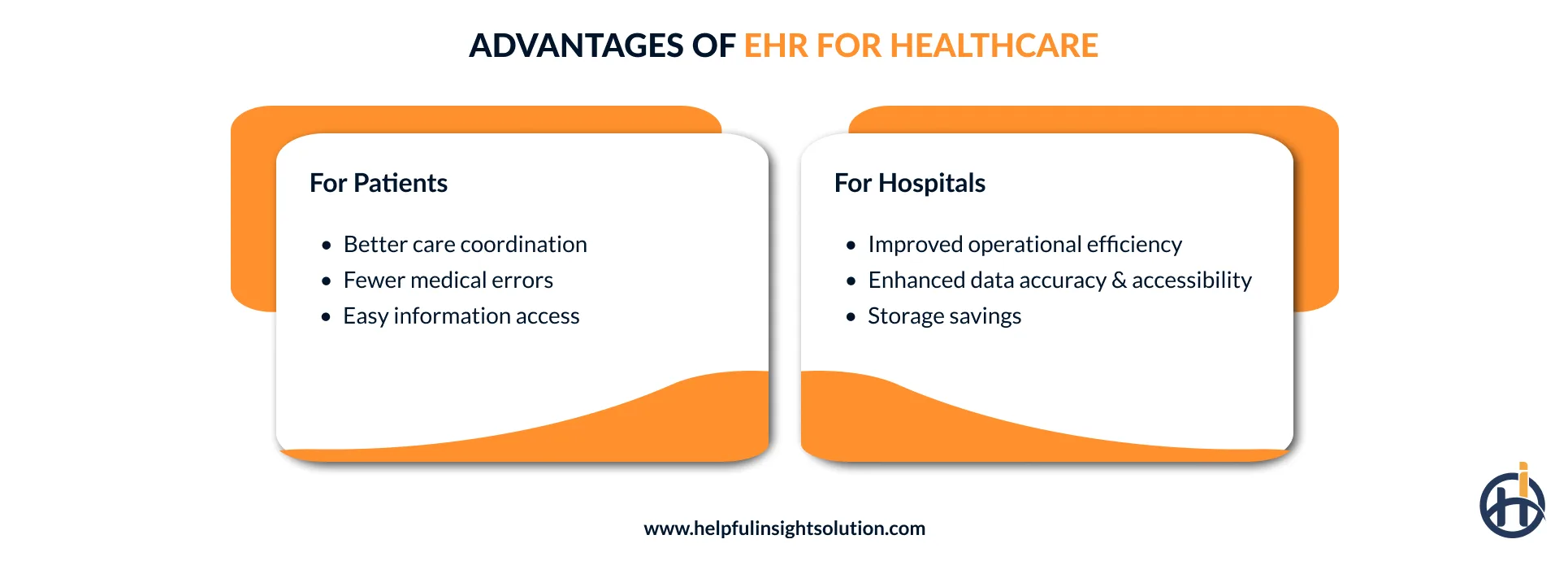
For patients
1. Better care coordination
All healthcare providers and medical practitioners caring for a particular patient will have the ability to view patient records in real-time. An “all information and same version policy” helps to eliminate communication breakdowns and provides a common thread.
2. Fewer medical errors
Sufficient accuracy, accessibility, and comprehensiveness provided by EHRs prevent human errors associated with illegibility of handwriting, lost pieces of information, or obsolete records. EHR’s incorporate automatic alerts to providers on various interactions & patient allergies.
3. Easy information access
Doctors can access patient history, medications, laboratory reports, and treatment records on any available authorized equipment without searching the folder or looking up information. It can be stored in a physical file or on multiple devices to achieve speedy clinical decision-making.
For hospitals
1. Improved operational efficiency
EHR automates tasks such as appointment bookings, billing, and filing information to cut down on manpower and integrate processes smoothly. The maximum time is allocated to patient service and care because AI in EHR systems reduces paperwork and increases the efficiency of the practice.
2. Enhanced data accuracy & accessibility
High information accuracy minimizes the margin of error and guarantees that the information for each department is the same. Employees can easily search for client details, and records remain accurate as staff can log in and amend the patient’s record from anywhere, ensuring accountability.
3. Storage savings
Digital records eliminate the necessity to purchase filing cabinets, store paper files, and allocate a larger space for documents, reducing storage costs. It also leads to a decrease in material consumption and wastage, and records can be accessed 24/7 without taking up unnecessary room.
Must-have features of a modern EHR system
To create custom EHR solutions, enterprises require the necessary features that target several medical operations. In this section, we are going to study some of the best EHR features that are commonly used.
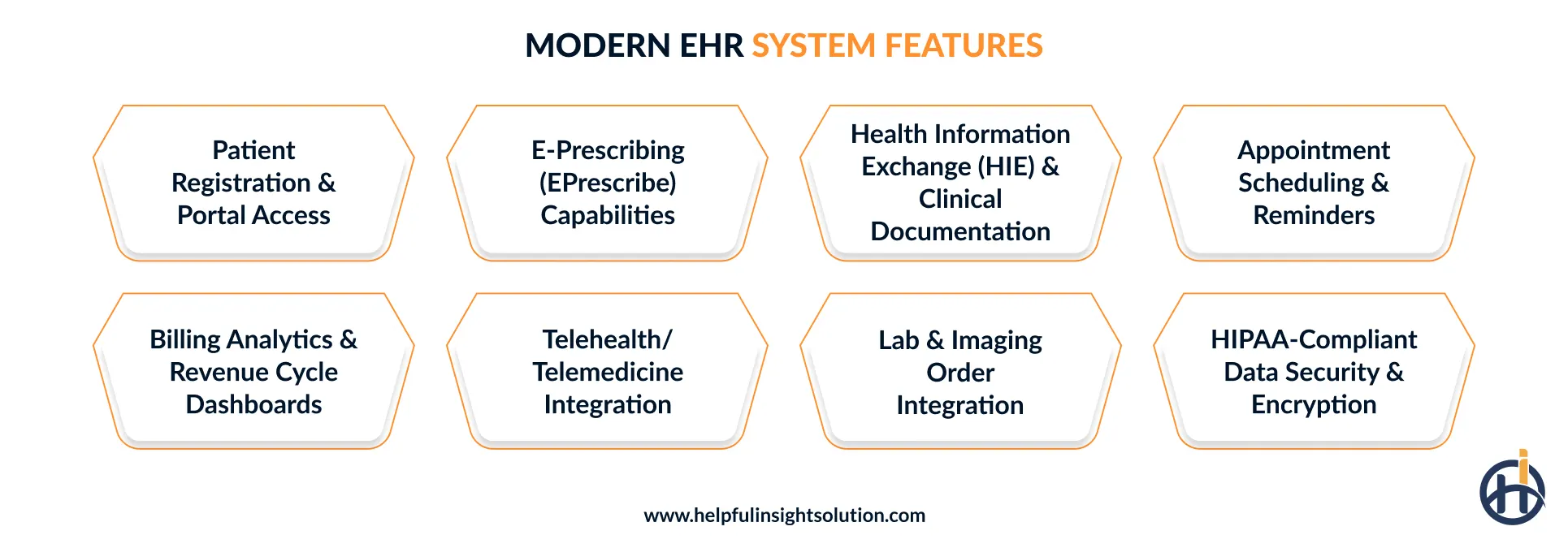
1. Patient registration & portal access
This feature enables patients to check in, update demographics and insurance information, and manage their own charts electronically. Patient portals allow patients to review their test results, order refills for their prescriptions, message their physician, and review their visit notes at any time.
2. E-prescribing (ePrescribe) capabilities
This feature allows physicians to easily transmit prescriptions directly to a pharmacy, reducing errors that can be due to illegible handwriting. Doctors can also use this to verify contraindications, allergies, and formulary status of the prescription in real time.
3. Health information exchange (HIE) & clinical documentation
This feature helps providers to share patients’ records securely between systems, ensuring better coordinated care. It is combined with strong clinical documentation features that make patient histories accurate, comprehensive, and readily available at the point of care.
4. Appointment scheduling & reminders
Current EHRs offer scheduling features that allow efficient management of physician schedules, appointment booking, and cancellations. Automated reminders like text messages, emails, or phone calls are also available for reducing patient no-show rates and engagement in care.
5. Billing analytics & revenue cycle dashboards
These tools offer real-time visibility into status, reimbursements, and denied or paid claims, as well as the practice’s financial performance via interactive dashboards. Reviewing this data helps you identify bottlenecks and billing issues to improve cash flow.
6. Telehealth/telemedicine integration
Your EHR also enables you to schedule virtual visits right on the EHR system, and all visit notes sync automatically with patients’ electronic health records. That avoids the need for special applications to streamline patient visits, no matter their location.
7. Lab & imaging order integration
Instead of having you pull lab orders and read scans, providers can submit requests electronically right within the EHR, and the tests come back automatically. That eliminates paper orders and reduces the wait to process data so care decisions can be made quickly.
8. HIPAA-compliant data security & encryption
Health data and EHR are targeted these days, whether stolen by attackers or used for unethical purposes. A HIPAA-compliant app includes multiple layers of encryption, authentication, and data backup as protection, with data integrity checks and audits to secure sensitive patient information.
How to create electronic health record software?
Medical professionals hire experts who follow a dedicated process to build electronic health record software. From market research to EHR maintenance, we will study the development stages in this section.
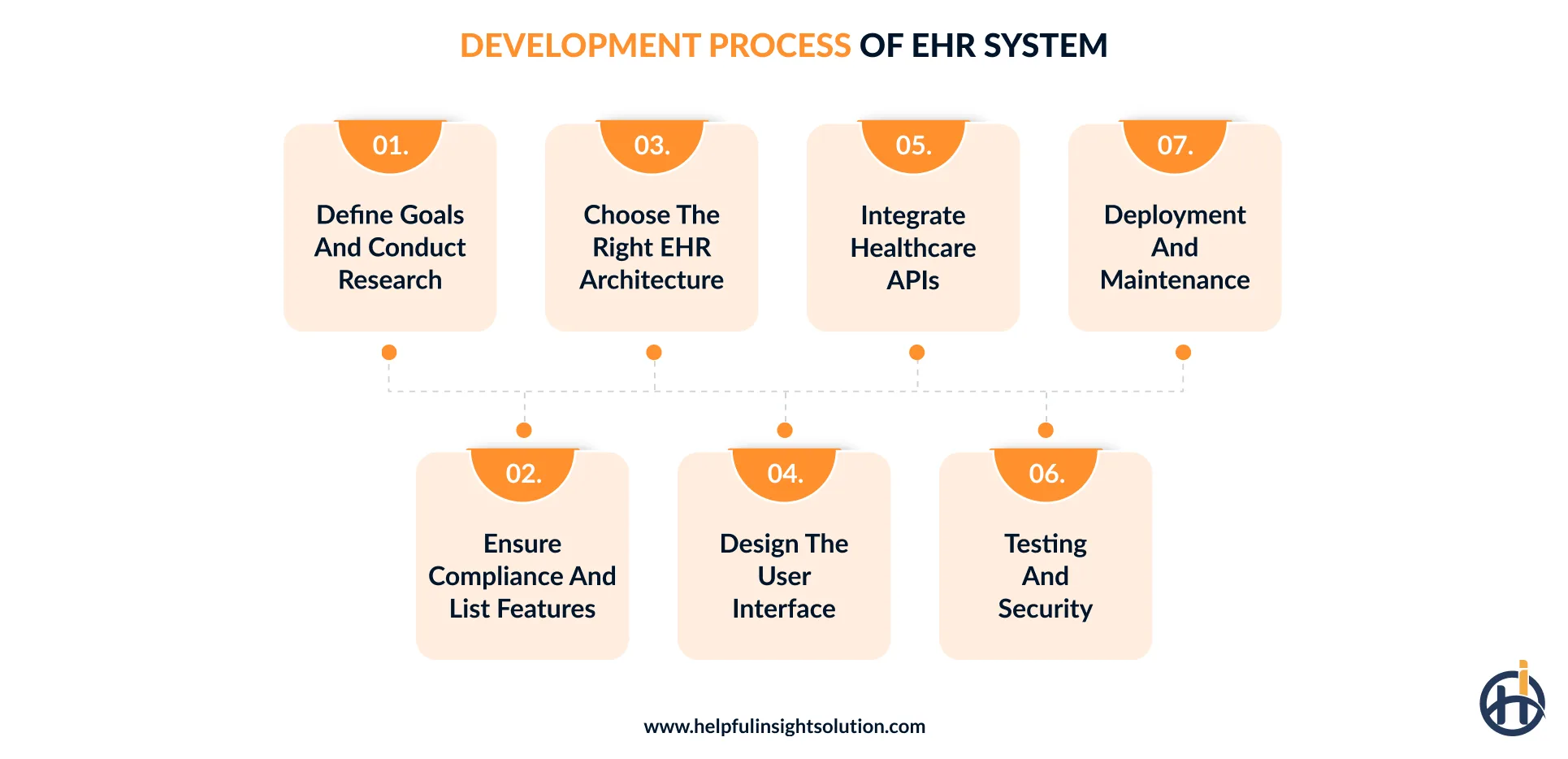
1. Define goals and conduct research
It is necessary to know what problem the EHR will solve, who the target audience is, such as small medical clinics or large hospital networks, and what benefits it will deliver.
Market research enables the team to assess competing vendors and source feedback from potential end users, like doctors, nurses, and administrators. This facility helps teams avoid making assumptions about what users and their real workflows demand in a clinical system.
2. Ensure compliance and list features
Compliance regulations and government standards, including HIPAA in the USA and GDPR in Europe, dictate that patient information should be handled securely with policies and protocols. To tackle the challenge of compliance together with other aspects that will affect the process, teams can compile the full feature list.
This shows how every element of the workflow, including patient charts, prescription pads, e-ordering, and billing, will meet these guidelines, satisfying the varied needs of users.
3. Choose the right EHR architecture
The technical foundations for an EHR system vary due to the implementation of a cloud-based, on-premises, or hybrid approach. A custom EHR software development company helps with cost, scalability, and control over the data, allowing system architectures to support integration with other health information systems.
They adhere to interoperability standards such as HL7 or FHIR for sharing health information and communicating through standardized healthcare formats.
4. Design the user interface
This stage allows clinicians to find information instantly and know that it is displayed correctly, while time is increasing rapidly. We need to focus on making the UI easy to navigate, requiring as few clicks as possible to complete standard tasks, and ensuring a visually clear hierarchy that supports less time on error. Including medical professionals throughout usability testing during this part of the project is a sure way to know if your UI actually fits into a clinical workflow.
5. Integrate healthcare APIs
In this healthcare app development phase, experts connect standard healthcare APIs that are built on FHIR so that it is easy to integrate data from labs, pharmacies, imaging centers, and other places seamlessly.
This step also includes integrating with third-party services to handle e-prescribing, insurance confirmation, and telehealth capabilities to form your coordinated ecosystem of care. API integration is a key part of having a standalone EHR that communicates with different systems.
6. Testing and security
The testing process includes functional accuracy, performance management, and usability for different users to remove bugs that can compromise patient safety.
Security testing, penetration testing, and vulnerability scanning help to ensure that all encryption standards, access control, and data protection mechanisms comply with HIPAA regulations. The testing phase is not the last step but rather a phase of the ongoing SDLC given the sensitive data we are working with.
7. Deployment and maintenance
Deployment is the final stage that involves gradual introduction into the clinical workflow and surgical training for the hospital staff, such as doctors and nurses.
Maintenance of EHR systems includes bug fixing, on-time feature releases, ongoing regulatory compliance, system monitoring, performance tracking, and security. Additionally, this method is essential to maintain healthcare productivity, along with real-time user feedback and market updates.
EHR software development challenges and their solutions
Most investors face different challenges, such as security and integration, while developing an electronic healthcare record system. Here, you will study major development issues with their respective industry-based solutions.
1. Regulatory compliance and data privacy
This issue occurs due to shifting regional laws, strict data protection mandates, and secure exchange requirements. Compliance laws like HIPAA change frequently, and unmonitored data views violate privacy rules.
Solution: Role-based models and MFA methods help to track regulatory shifts or code vulnerabilities, ensuring data security in real-time.
2. Interoperability Gaps
Inconsistent data formats, legacy systems, and vendor silos affect healthcare data sharing in a system. This prevents file sharing, resists modern data integration, restricts proprietary networks, and increases processing errors.
Solution: Businesses must use protocols like HL7 FHIR, SNOMED CT, and LOINC and build RESTful APIs for data exchange.
3. Data migration and downtime risk
Some of the crucial challenges are data corruption, clinical workflow disruptions, and interrupted safety events. As legacy systems store unstructured data, sudden EHR blackouts may influence patient care due to massive outages.
Solution: The experts should run scripts to standardize old data and move the information gradually to prevent an entire shutdown.
4. User adoption and workflow optimization
User adoption of EHR systems is affected by resistance to change, poor interface, and mismatched clinical pathways. Alert fatigue and information silos influence medical workflow efficiency due to missed warnings.
Solution: It is beneficial to use clean and minimal layouts with features like voice-to-text and conditional logic to reduce manual entry.
Cost of developing a custom EHR system
The EHR software development cost is majorly affected by the complexity of the healthcare systems and project requirements. The average price for building electronic health record software ranges from $20,000 to $200,000 depending on the feature specifications.
With features like appointment scheduling, workflow management, billing, and e-prescriptions, the cost is not more than $100,000. But due to AI development services, the price increases rapidly and also affects the budget. Here is a table listing key parameters with their respective costs and timelines in detail.
| Development Stage | Estimated Cost (USD) | Timeline | Suitable For |
| Basic EHR System | $20,000–$40,000 | 2–3 months | Small clinics needing patient records, appointment scheduling, and basic documentation. |
| MVP EHR Solution | $40,000–$70,000 | 3–5 months | Healthcare startups validating their product with essential workflows and limited integrations. |
| Custom Mid-Level EHR System | $70,000–$100,000 | 5–7 months | Multi-specialty clinics requiring e-prescriptions, billing, reporting, and role-based access. |
| Advanced EHR Platform | $100,000–$140,000 | 7–9 months | Hospitals needing interoperability, patient portals, analytics, and third-party integrations. |
| Enterprise EHR System | $140,000–$170,000 | 9–11 months | Large healthcare networks requiring scalable architecture, compliance, and multi-location management. |
| AI-Powered Custom EHR Ecosystem | $170,000–$200,000+ | 11–12 months | Enterprise healthcare organizations implementing AI-assisted documentation, predictive analytics, and advanced automation. |

How does Helpful Insight assist businesses in creating smart EHR platforms for healthcare?
Now, you can easily build electronic health record software that can help patients to store, share, and access their information in real-time. A software development services provider like Helpful Insight supports clients to focus on market trends, competitor offerings, and budget.
We have a proven track record in delivering highly secure, compliant, and patient-friendly healthcare platforms. Our experts implement modern technologies like AI that automate various clinical processes in real-time.
You can approach the EHR development company to ensure the credibility of your ideas, experience a collaborative environment, and lead from the front. We study business requirements and match them with market demands to prepare a corresponding model that enhances brand visibility.
So, it is the right time to accompany us in this healthcare modernization journey.
FAQs
A basic MVP model takes 2-3 months due to the integration of core features and limited functionalities. A mid-sized project takes 6-8 months, but the timeline for an enterprise-grade ecosystem may reach up to 12 months. The overall duration is mainly divided into the development cycle, from planning to testing.
AI automates repetitive tasks by preventing manual work, improving diagnostic accuracy, and reducing medical errors. It helps doctors to make better decisions for treatment, surgeries, and consultation. Artificial intelligence also enhances billing cycles and insurance claims through predictive analytics.
To ensure HIPAA compliance, businesses implement strict access controls, robust data encryption, and secure audit logs. These methods are described in the following manner:
- Access control: Users need unique IDs and role-based permissions to access medical data.
- Data encryption: The data stored in servers and transferred over the network is encrypted.
- Audit log: It can track changes in patient data and check log files to detect unethical activities.
EHR systems can be easily integrated with existing hospital tools by using standard protocols like HL7 and FHIR. This facility connects laboratory information systems, hospital information systems, and other systems with patient records. Businesses use various frameworks to normalize data formats and speed up timelines.
Businesses can migrate medical data from old legacy platforms to new EHR systems by following a general process. Here, 3 crucial data migration steps are discussed as follows:
- You should prioritize data, such as medication, for migration and keep a backup to prevent loss.
- It is necessary to fix errors, remove duplicate entries, and match new entries from the old data.
- Transfer data into a test environment and check results to ensure data accuracy across systems.