

Key Takeaways
- App development takes 2 to 4 months for a simple app and 9 to 18 months or more for an enterprise build. Every other app type falls between those two numbers.
- The gap between them comes from what the app has to connect with. A catalog and a checkout are built in 4 to 6 months, while an app reading from hospital records or policy systems takes 9 to 16 months.
- Those extra months are spent inside the same six stages. Development holds the largest share at 3 to 9 months, while discovery, testing, and deployment stay in weeks on projects of any size.
- Inside development, the feature list decides the weeks. A payment gateway adds 1 to 3 weeks, real-time chat adds 3 to 6 weeks, and an AI chatbot adds 4 to 10 weeks.
- On top of that work, the schedule includes time nobody codes in. Vendor verification, legal review, and internal audits are owned by people outside the development team.
- Both parts are settled in the first month. An MVP scope, a cross-platform framework, and vendor accounts opened during discovery keep a project at the lower end of its range.
An average of 2,266 new apps go live on the Apple App Store, and the Google Play Store adds another 2,384 each day.
Publishing is a short part, while the work before that runs for months. These months go into planning, design, development, and testing. How long it takes to develop an app depends on the amount of work in each of these stages.
A simple application can be developed within 2-4 months, while an enterprise application can take 9-18+ months. How long it takes to build an app comes down to the type of application and its complexity.
This blog covers an estimated timeline for app development by complexity, app type, features, and external factors.
What Is the Average App Development Timeline?
The average mobile app development timeline is measured in months, counting the work from the discovery session to deployment.
| Complexity | Timeline |
| Simple app | 2 to 4 months |
| Medium complexity | 4 to 8 months |
| Enterprise app | 9 to 18+ months |
| AI-led app | 10 to 20+ months |
How Does Complexity Affect the App Development Timeline?
App complexity is influenced by features, business rules, integrations, data, security, platforms, and governance. The number of platforms in scope adds to it as well. A simple application has one basic job, few screens to design, and simple login functionality. A custom backend, third-party integrations, and compliance requirements require more effort, extending the timeline.
The app development timeline by complexity is broken down according to features and team size.
| Complexity | Features included | Example | Team size | Timeline |
| Simple | One main function, device storage or a hosted backend service, email login, single platform | Google Authenticator, QR code scanner | 3 to 4 | 2 to 4 months |
| Medium | Custom backend, user accounts, payment gateway, push notifications, two or three external APIs | Calendly | 5 to 7 | 4 to 8 months |
| Enterprise | Single sign-on, role-based access, audit logging, offline sync, integration with internal systems | MyChart | 10 to 15+ | 9 to 18+ months |
| AI-led | Model selection, prompt and retrieval work, evaluation pipeline, human review queue | AI support assistant | 8 to 14 | 10 to 20+ months |
How Long Does a Simple App Take to Build? (2 to 4 Months)
QR code scanners, habit trackers, or event listing apps are common examples of simple apps. A first version of app development for a startup is also an example of a simple app, since an MVP development is scoped to one workflow before the rest of the features are planned.
A simple app can be built natively for a single platform, or in one codebase for Android and iOS using a cross-platform app development framework. Both approaches keep the build inside the 2 to 4 month range, and a native build for both platforms adds to it.
How Long Does a Medium-Complexity App Take? (4 to 8 Months)
On-demand apps like taxi booking and food delivery are in this category. These applications have three panels: customer side, provider side, and admin panel, extending the average time to develop an app from 4 to 8 months.
The additional time is spent on building features like:
- Payments: A merchant account is created with the payment gateway, and test transactions are run before making it live. Payment gateway setup takes time from 1 to 3 weeks.
- Maps and messaging: Google Maps or Apple Maps can be added for location tracking, and a service like Twilio for SMS alerts. Each has to be connected using APIs that need configuration and testing.
- Order status. An order goes through stages: placed, accepted, picked up, and delivered. Each change is sent to customers in real-time, which needs real-time data sync functionalities to build, taking additional time.
- Admin panel. The three panels are connected to each other, so the information is shared between them in real time. The operations team sets the pricing, commission, and refund rules from the admin panel, and the changes apply to both apps.
How Long Does Enterprise App Development Take? (9 to 18+ Months)
Enterprise applications are built for large organizations, where the application has to support role-based access, audit logging, and governance rules from the first release. Many of these applications also connect with systems the organization is already running, and that integration is planned before development begins.
Beyond development, an enterprise-focused complex app development timeline also covers the security review and a penetration test before release.
Mobile App Development Timeline by App Type
App type decides what has to be ready to work on. An e-commerce app with a product catalogue, cart, and payment gateway can be developed in 4 to 6 months. An insurance app development has to communicate with more than one platform for underwriting, payment collection, and policy issuance, so the development timeline can run between 8 and 14 months.
The market coverage is another part affecting the development timeline. An app built for one specific market takes less time than an app built for several markets, since compliance and payment methods are added per market. The mobile app development timeline by app type below is for a single market, expanding the same application to other markets may expand the timeline.
| App Type | Example app | Timeline |
| eCommerce | Instacart | 4 to 6 months |
| eLearning | Duolingo | 4 to 7 months |
| Fitness | Strava | 4 to 7 months |
| Food delivery | Deliveroo | 5 to 8 months |
| On-demand services | Uber | 5 to 8 months |
| Social media | 6 to 10 months | |
| Fintech | Mint | 9 to 15 months |
| Healthcare | Teladoc Health | 9 to 16 months |
| Enterprise SaaS | Salesforce | 9 to 18 months |
| AI-led apps | Grammarly | 10 to 20 months |
The timeline for each type of application has a range because the same app type is built at different sizes. An app that connects with a pre-built API can start working once configuration is done. An app that needs a custom API built adds that additional time to the schedule.
AI app development has the longest timeline because the work covers the model selection, data preparation, and evaluation rounds. The model is tested against a set of expected answers until the output reaches a level the business accepts, and a review queue is built for the answers that come back wrong.
The model, once developed, needs to be trained on real answers until it is verified to produce outputs acceptable to a business.
Stages of App Development and Their Timelines
There are six stages in the app development process. The core phases are similar for a simple app and an enterprise build. Enterprise projects may add governance, security, migration, compliance, and approval activities to them. The difference in the timeline comes from the time spent inside each stage.
A discovery session for a simple app can take two weeks, while for a complex one it can take four weeks or more.
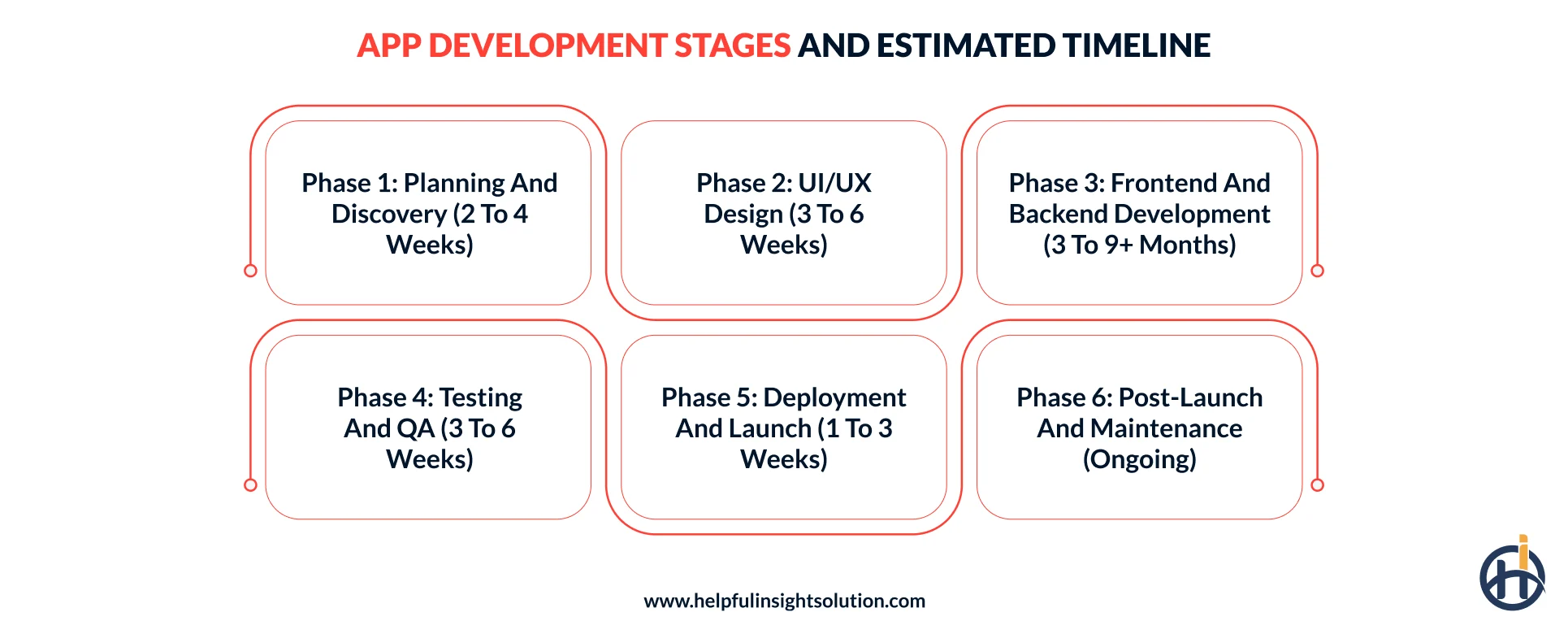
Phase 1: Planning and Discovery (2 to 4 Weeks)
The scope of the project is documented in this step. This step documents features, platform choice, security, and the target market, providing direction for the next steps.
| Key activities | Timeline | Output |
| Requirement workshops, feasibility check, feature list, architecture plan | 2 to 4 weeks | Product requirements document, architecture plan, estimate |
Phase 2: UI/UX Design (3 to 6 Weeks)
User interface and experience are designed before the development work begins. A clickable prototype is shared with the client, so the app design can be reviewed before anything is coded.
How long it takes to design an app varies depending on the approval rounds. As an enterprise application has several screens, so do the approval rounds, extending the timeline.
| Key activities | Timeline | Output |
| User flows, wireframes, clickable prototype, visual screens, design system | 3 to 6 weeks | Approved screens, design system |
Phase 3. Frontend and Backend Development (3 to 9+ Months)
The development stage takes most of the app development project timeline. App development companies work in sprints, focusing on developing one module at a time. The timeline range for this stage is wide because it varies depending on how many features are in the app.
| Key activities | Timeline | Output |
| Screen build, API development, database setup, third-party integrations, sprint releases | 3 to 9+ months | Working app builds |
Phase 4: Testing and QA (3 to 6 Weeks)
Testing ensures the app meets the requirements. Each issue found in the app is logged, fixed, and then tested again. The mobile app testing timeline runs between 3 and 6 weeks, depending on the number of devices the app needs to be checked on. For regulated industries, healthcare, and finance, compliance testing increases the timeline.
| Key activities | Timeline | Output |
| Functional testing, regression testing, load testing, device testing, user acceptance testing | 3 to 6 weeks | Signed-off build |
Phase 5: Deployment and Launch (1 to 3 Weeks)
The app is submitted to the app stores. The publishing timeline depends on how quickly the app clears the review process of the Apple App Store and the Google Play Store. An app that passes on the first attempt can be live within a week. An app that does not pass takes longer, since the changes have to be made and the app is submitted again.
| Key activities | Timeline | Output |
| Production setup, store listing, submission, monitoring setup, rollback plan | 1 to 3 weeks | Live app |
Phase 6: Post-Launch and Maintenance (Ongoing)
Crash reports, performance data, and app store reviews are monitored from the day the app goes live. Apple and Google release new operating system versions, making it essential for an app to be updated for each of these releases. Maintenance is a part of creating a mobile app to ensure it continues to work as expected and new features can be added to meet evolving users’ needs.
| Key Activities | Timeline | Output |
| Crash monitoring, bug fixes, operating system updates, feature releases | Ongoing | Release cycle |
How Long Does Each App Feature Take to Build?
Developing a feature involves three core components: design, backend, and testing. Simple display screens with static information can be developed rapidly since no data persistence is required. Conversely, integrating transactional workflows like payment gateways demands additional development effort to manage success callbacks, edge failures, and refund processing protocols.
A feature that has a dependency on third-party integration extends the timeline, as developers must provision external accounts, configure credentials, and conduct sandbox validation prior to production deployment
| Feature | Est. Development Time |
| In-app rating prompt | 2 to 3 days |
| Push notifications | 3 to 5 days |
| Social login with Google or Apple | 3 to 5 days |
| User profile and settings | 1 week |
| Two-factor authentication | 1 week |
| Email and password login | 1 to 2 weeks |
| Search and filters | 1 to 2 weeks |
| Ratings and reviews | 1 to 2 weeks |
| Multi-language support | 1 to 2 weeks |
| Document or photo upload | 1 to 2 weeks |
| Payment gateway | 1 to 3 weeks |
| Shopping cart and checkout | 2 to 3 weeks |
| Geolocation and maps | 2 to 4 weeks |
| Analytics dashboard | 2 to 4 weeks |
| Booking and scheduling | 2 to 4 weeks |
| Subscription billing | 2 to 4 weeks |
| Voice input and speech-to-text | 2 to 4 weeks |
| Offline mode | 3 to 5 weeks |
| Real-time chat | 3 to 6 weeks |
| Video upload and playback | 3 to 6 weeks |
| Admin dashboard | 3 to 6 weeks |
| Wearable app companion | 3 to 6 weeks |
| AI chatbot | 4 to 10 weeks |
| Augmented reality feature | 6 to 12 weeks |
What Are the Key Factors Affecting App Development Timelines?
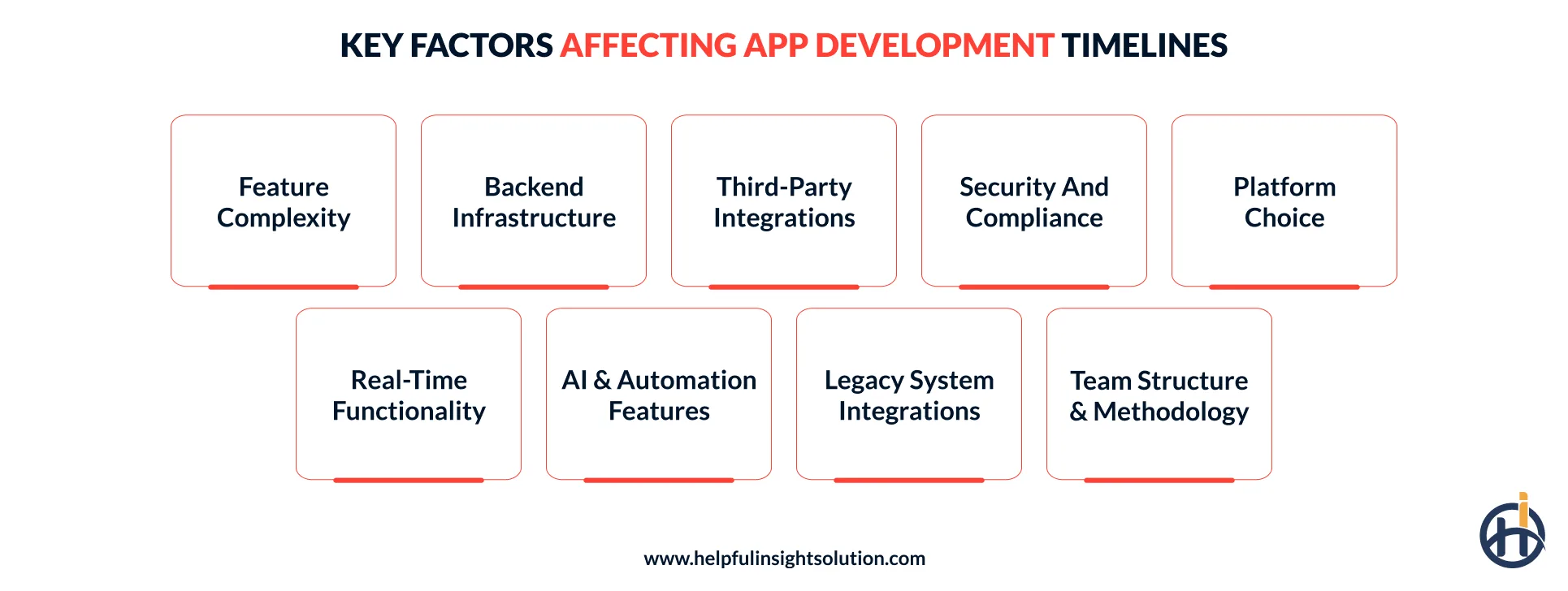
The following factors directly affect the average time to develop an app. Certain factors expand the development hours, whereas others introduce passive delay periods when zero coding occurs.
1. Feature Complexity
Feature complexity is measured by the rules behind a feature. For instance, a checkout feature that accepts one payment method has fewer rules than a checkout that accepts cards, wallets, and cash on delivery.
Each payment method has its own success path, failure path, and refund handling. The testing is repeated across every combination, which extends an app development project timeline.
2. Backend Infrastructure
Backend infrastructure encompasses server setup, database management, and custom APIs built to process user operations. The initial phase involves provisioning development, staging, and production environments, though the actual starting point shifts per project.
Setting up these environments, structuring database schemas, and crafting initial API endpoints generally spans 4 to 8 weeks.
3. Third-Party Integrations
Every third-party integration brings its own work. An API key is issued by the provider, flows are built in Sandbox against the keys, and the same flows are tested again once the live keys arrive.
Production credentials arrive only after vendor account verification, introducing a passive delay to the mobile app development timeline. Implementing custom error protocols, rate limiting, and webhook validation across each third-party integration further expands the total development hours.
4. Security and Compliance
Encryption, token expiry, and access rules are part of almost every feature. So, the timeline extends according to the number of features.
In regulated industries, an audit trail needs to be written for each record that is opened or changed, which further extends the timeline.
5. Platform Choice
Native app development means two separate applications, one for Android and one for iOS. Most features are built twice in this approach, though shared business logic and common components reduce part of the duplicated work.
Cross-platform development frameworks like Flutter and React Native keep one codebase working on both platforms. Camera, Bluetooth, and background location still need native modules on both platforms, so part of the duplicate work stays.
Android runs on devices from different manufacturers, each of which changes the operating system in its own way. Screen sizes, notification handling, and background process limits are different across them, so the QA round covers a device matrix rather than a single reference phone.
6. Real-Time Functionality
Food delivery, taxi booking, and instant messaging apps need to update information in real-time. Real-time delivery is built on a persistent connection such as a WebSocket, which keeps a channel open between the app and the server.
Push messaging and periodic polling are the other options, and the choice depends on how quickly an update has to reach the user. Each approach needs handling for dropped connections, reconnection, and message order.
Real-time features are planned at three to six weeks each, with the testing repeated on both platforms under different network conditions. The connection server is also monitored after release, so part of this work carries into maintenance.
7. AI and Automation Features
An AI feature returns different answers when the same question is worded differently. The testing is done against a set of expected answers over several rounds.
This work is planned for 4 to 10 weeks, and the range holds only when the expected answer set is ready before testing starts.
8. Legacy System Integrations
Connecting with older systems requires building a middleware layer that converts the data format between legacy protocols, like SOAP or batch file transfers, and modern app formats. Each data field must be mapped individually, and any update to either system may need re-validation of those mappings.
9. Team Structure and Methodology
Sprint length decides how often a build reaches the client for review. A two-week cycle gives twelve review points across six months, while a four-week cycle gives six. Fewer review points mean a wrong assumption is carried further before it is caught, and the rework then takes longer. A distributed team also loses part of a day on every handover between time zones.
External Factors Affecting Timeline for Mobile App Development
A project plan has tasks that the development team cannot close on its own. A finished build can wait on a security sign-off, a signed vendor contract, or a live payment key before it moves forward. Here are some of the common external factors that affect average app development time.
- Leadership approvals: Budget changes, feature additions, and design sign-offs go up to leadership. Whatever depends on that answer waits.
- Legal reviews: The privacy policy, the terms of use, and the data processing agreement are read by the legal team. Any changes suggested by the legal team will go through the app development process again, from design and development to testing.
- Procurement: Procuring server infrastructure, software licensing, and publisher profiles requires purchase approvals, which depend on corporate finance schedules.
- Vendor onboarding: Before a payment provider hands over live keys, the business registration is verified, a contract is signed, and a compliance form is filled in. This process is beyond the control of the development team and may take between 1 and 2 weeks.
- Internal security audits: Internal security assessments involve reviewing application code, server configuration, and user permissions. Because these evaluations are scheduled ahead of time, the application build must be completed prior to the review window. Resolving identified vulnerabilities requires further engineering effort and a follow-up verification round before final sign-off.
- App store rejections: A submission comes back with the guideline it did not meet. Fixing it can be quick. Getting back into the review queue is the part that costs days.
- API changes during development: An external provider retires a version of its API in the middle of the build. The integration is written again against the new one.
- Distributed stakeholders: Reviewers in other time zones open the build during their own working hours. One question at the end of a day becomes a full day of waiting.
Real-World Examples of App Development Timelines
The following six real-world examples illustrate how these development phases remain consistent across projects, even as the specific timeline for each stage varies.
1. MVP Ecommerce App Timeline (4 to 6 Months)
An MVP ecommerce app is the first working version of a full-fledged application. It offers a catalog, cart, and checkout. Product data can be fetched from the inventory system that the business is already using. Payment gateway integration is a significant part of development when refunds, failed transactions, reconciliation, and compliance are in scope.
| Phase | Timeline |
| Discovery | 2 weeks |
| Design | 3 weeks |
| Development | 10 to 12 weeks |
| Testing and deployment | 3 weeks |
| Total | 4 to 6 months |
2. Food Delivery App Timeline (5 to 8 Months)
Food delivery apps like Uber Eats, Swiggy, and Zomato have three products. A customer app, delivery partner app, and web panel that the restaurant uses. The dashboard handles menus, order acceptance, and payouts. It is also integrated with the restaurant’s POS system, which is the point-of-sale software used to record orders at the counter.
The order status is shared between all three at the same time, and most of the development weeks go into that part. Route planning and delivery rules setup add to the timeline as well. The rules cover delivery radius, batching of nearby orders, and surge pricing at peak hours.
| Phase | Timeline |
| Discovery | 2 weeks |
| Design | 4 weeks |
| Development | 12 to 20 weeks |
| Testing | 4 weeks |
| Deployment | 2 weeks |
| Total | 5 to 8 months |
3. Taxi Booking App Timeline (5 to 8 Months)
A taxi booking app like Uber, Lyft, or DiDi is used for booking, matching, and fare calculation. The matching is done based on distance and driver availability. Fare rules are different in different cities, so the pricing is kept configurable from the admin panel.
| Phase | Timeline |
| Discovery | 2 weeks |
| Design | 4 weeks |
| Development | 13 to 20 weeks |
| Testing | 4 weeks |
| Deployment | 2 weeks |
| Total | 5 to 8 months |
4. Insurance App Timeline (8 to 14 Months)
An insurance app is connected to the systems the insurer is running already. The policy records are read from the policy administration system, and the quotes are generated based on the rules kept there. Claims are filed from the app with photos and documents attached. The upload, the storage, and the status tracking are all part of the insurance app development timeline.
| Phase | Timeline |
| Compliance and discovery | 4 weeks |
| Design | 5 weeks |
| Backend and integrations | 4 to 9 months |
| Testing | 5 weeks |
| Deployment | 2 weeks |
| Total | 8 to 14 months |
5. AI-Powered Customer Support App Timeline (8 to 14 Months)
An AI customer support app is planned in the strategy phase first. The model is selected there, and the content it answers from is decided as well. Support articles and old tickets are converted into embeddings, and these are kept in a vector database.
| Phase | Timeline |
| AI strategy | 3 weeks |
| UX design | 3 weeks |
| Model development | 4 to 6 months |
| AI testing | 4 to 6 weeks |
| Deployment | 2 weeks |
| Total | 8 to 14 months |
6. Enterprise Healthcare App Timeline (10 to 16 Months)
An enterprise healthcare app has compliance work before the design work. HIPAA is the US health privacy law, and it decides how patient data is stored and who is able to read it. Beyond development, the compliance requirements take the majority of the development timeline.
| Phase | Timeline |
| Compliance and architecture | 4 weeks |
| Design | 5 weeks |
| Backend and integrations | 5 to 7 months |
| Security testing | 6 weeks |
| Deployment | 3 weeks |
| Total | 10 to 16 months |
How Can Companies Reduce App Development Time
The average time to build an app runs between 3 and 9 months, which can extend to 18 months. The following best practices to guide mobile app development can help to keep the timeline at the lower end.
- Start with an MVP: The first release carries only the features needed to launch, and the rest are planned for later versions. A shorter feature list means fewer screens, fewer API endpoints, and less testing.
- Use a cross-platform framework: Flutter and React Native let one codebase serve both iOS and Android. The same feature is written once instead of twice, and bug fixes are applied once also.
- Build a reusable component library: Buttons, forms, cards, and lists are built once. They are used on every screen after that, so later screens take less time than the first ones did.
- Use managed backend services: Authentication, push notifications, and file storage are available as ready services. Firebase and AWS Amplify are two of the common providers. These are configured rather than coded, which takes weeks off the backend phase.
- Automate builds and tests: CI/CD, which stands for continuous integration and delivery, runs the build and the test suite on every code change. Results come back the same day. Bugs are detected when they are written, so the fix is cheaper than it would be at the end of the sprint.
- Run short sprints: A two-week sprint puts a working build in front of the client twelve times across six months. A wrong assumption is corrected in the next cycle, and the rework stays small because of that.
- Open vendor accounts during discovery: Payment providers, maps, and identity services each need account verification before live keys are issued. Starting the paperwork in the first weeks means the verification runs while development is going on.
Platform, scope, and the outside services in use are agreed during discovery, which is where how long it takes to build an app gets decided.
Why Enterprise App Development Takes Longer Than Expected
Building enterprise app development requires coordination across multiple internal departments. The following 7 factors represent the most common sources of timeline expansions within large organizations.
- Approval bodies: An enterprise design is reviewed by more than one team. The architecture board, security team, and data governance team each give their approval separately. Waiting for their approval increases the timeline.
- Legacy release windows: The other systems in the organization have their own update schedule, and the app team does not control it. For instance, if the app needs a new field from one of those systems, the field is added whenever that system’s next release is planned. Sprint planning is done around that release date, and the integration testing can be started only once the update is available.
- Data migration: The records in the old system have to be moved into the new database structure, which requires cleaning, mapping, and rehearsing the data.
- Performance testing at scale: The app is tested with the actual number of users in the organization. The infrastructure team makes changes to server capacity after each test, and the test is repeated.
- Internal compliance sign-off. The company has its own compliance team, and they review all the documentation before an external auditor is brought in. The same evidence goes through two reviews because of this.
- Scope expansion after the pilot: Once the pilot group starts using the app, the other departments also get to see it. Requests come in for one more report or one more user role, and each of these looks small when it is seen on its own. For every such request, the estimate is revised, the approval is taken again, and the sprint plan is adjusted.
- Phased rollout with training: The app is released to one department first. Training material is prepared for their process, sessions are conducted, and their feedback is fixed before the next department starts. For a large organization, this rollout is measured in months.
Plan Your App Development Timeline With Helpful Insight
How long it takes to develop an app is decided by the scope of the build. A simple app is finished in 2 to 4 months. An enterprise app built with compliance work and legacy integrations takes 9 to 18 months or more. An estimate becomes reliable once the feature list, the integrations, and the approvals are mapped against the six stages.
Helpful Insight has been building mobile apps and software since 2016. The team has delivered 2,000+ projects for clients in 40+ countries across 30+ industries, with 100+ people on the delivery side.
Estimates from Helpful Insight are given stage by stage, with the output named at the end of each stage. Approvals, vendor verification, and audit windows are placed in the plan before the first sprint, so the date agreed at kickoff becomes the baseline schedule, and scope changes, dependencies, and approvals are tracked against it.
FAQs
There is no single number for this. It depends mostly on the features and the systems the app has to connect with. A simple app is done in 2 to 4 months. An enterprise app with compliance work takes 9 to 18 months, and sometimes more than that.
The fastest way is to start with an MVP. The features that are needed for the launch go into the first release, and the rest are kept for later versions. Using Flutter or React Native also helps, since one codebase is used for both iOS and Android.
The launch stage is 1 to 3 weeks. Production setup, the store listing, and the submission are all done in this period. If the app clears the Apple and Google reviews on the first attempt, it can be live within a week.
Development takes the longest. It is 3 to 9 months, and it goes beyond that on larger apps. The code of an app is related to the number of screens, the APIs, and the integrations that are part of the build.
Enterprise projects are mostly in the 9 to 18 month range. The approvals from different teams, the integration with existing systems, and the data migration all add to this. How long app development takes for enterprise projects is also related to the internal audit schedule.
An iPhone app takes the same time as an Android app when the features are the same. A native iOS build covers only that platform, so a separate native build is needed for Android. With a cross-platform framework, both of them are released together.