

Key takeaways
- MVP development for startups turns an early product idea into a focused, usable version that can be tested before committing heavily to full-scale development.
- Poor product-market fit was cited in 43% of failed venture-backed startups, showing why testing core assumptions early can matter before scaling investment.
- The benefits of MVP app development for startups include faster validation, reduced initial risk, clearer product direction, and valuable insights from early users.
- Startups can choose from different MVP types, including landing page, concierge, wizard of Oz, single-feature, piecemeal, and AI-powered MVPs, based on their validation needs.
- The cost to develop a startup’s MVP can range from around $5,000 to $60,000 for simple to mid-level products, while complex MVPs can reach or exceed $100,000.
- AI is making MVP development more accessible by allowing startups to test intelligent features using existing models, APIs, and machine learning capabilities.
A product idea can look convincing inside a startup team. The assumptions are usually clear, the problem feels real, and the opportunity seems worth pursuing. The uncertainty shows up the moment that idea reaches users. This is exactly why MVP development for startups exists as an important strategy. It gives founders a way to test the core product value early, before committing time and money to something unproven.
Founders who develop a minimum viable product (MVP), rather than jumping straight to the full product, get that answer while it’s still cheap to change course.
Knowing an MVP is the right move is only half the problem. Finding product-market fit is where most new ventures run into trouble.
McKinsey’s research on new venture building found that only about 20% of startups launched over the past decade grow into viable, large-scale businesses, and a mismatch between what companies build and what the market actually wants is behind that shortfall.
An MVP is how startups test that alignment early, before the mismatch gets expensive to fix. What’s harder to get right is everything that follows: what kind of MVP to build, what it should cost, and who’s equipped to build it.
If that’s the stage you’re at, whether it’s a mobile app, a software product, or anything else, this guide walks you through those decisions.
What is an MVP and what makes it viable?
A Minimum Viable Product (MVP) is a basic version of a digital product or an app that contains enough functionality to solve an important user problem and test the idea in the real market.
For startups, an MVP is not about releasing an unfinished product. It is about building the right first version, putting it in users’ hands, and learning from their response before making larger investments.
The following factors define what makes an MVP viable and valuable at the early stage.
Solves a real problem
The first question behind an MVP is not “what features should we build?” It is “what problem are we trying to solve?” A product has a better chance of gaining attention when it removes a real difficulty for users. That understanding shapes the scope of the MVP and keeps early development focused.
Clear user value
An MVP can have limited functionality and still make sense to users. The main benefit needs to be apparent through the product experience itself.
In MVP app development for startups, keeping that value clear helps avoid adding features that distract from the problem the product is meant to solve.
Focused product scope
An MVP works better when there is a clear boundary around what it is trying to prove. A narrow scope keeps the first release manageable and makes user responses easier to interpret.
It also gives the team room to make changes after launch instead of committing too early to a broader product direction.
Actionable user feedback
Once the early-stage build is in users’ hands, their response becomes part of the product conversation. Some feedback may point to a usability issue, while other signals may question the original idea itself.
Reading those signals carefully helps startups decide what to improve next, particularly during the early mobile app development lifecycle.
Why do startups need an MVP?
Nobody starts a startup already knowing what will work. Resources run thin fast, and a lot of what solo founders think they know about the market is really just a working theory.
Building an MVP for Mobile app startups creates a practical way to deal with that uncertainty before those assumptions turn into expensive product decisions.
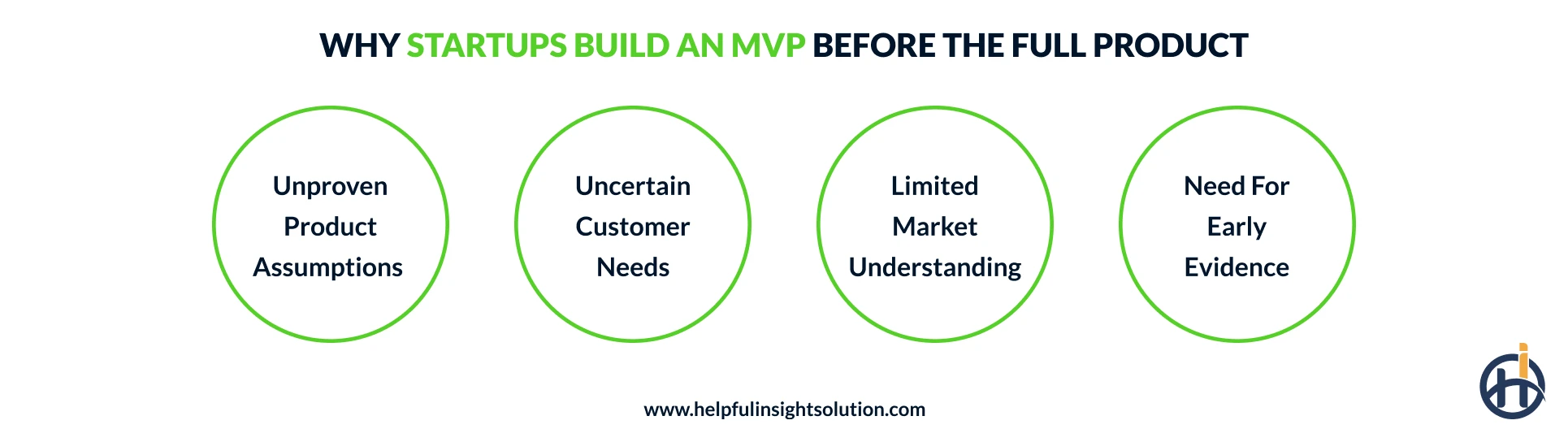
Let’s look at the reasons that make an MVP worth considering.
Unproven product assumptions
A product idea can feel obvious when everyone on the founding team agrees with it. That does not mean customers will see the same value.
A lean product gives you a chance to put those assumptions under real pressure before committing to a larger build.
A gym owner getting into fitness app development, for instance, might expect users to want advanced workout programs immediately, from the very first use of their app.
After testing an MVP, they might find greater interest in class booking and progress updates. Learning this early can help them spend development time on what members actually value.
Uncertain customer needs
It is easy to say you understand your customer until the first version of the product is in their hands. A mobile app MVP can expose that gap fairly quickly.
The way users interact with it, along with the feedback they share, gives new ventures something more useful than assumptions to guide the next product iteration.
Limited market understanding
A new market can look promising during research, yet the picture may change once the product reaches real users. An MVP acts as a “market probe”, giving small businesses early clues about customer behavior, competing products, and demand.
With startups MVP development, that early learning can help shape positioning before they commit to a larger build.
Need for early evidence
An app idea can sound convincing in a pitch deck, but startups eventually need something more concrete to support the next decision.
MVP mobile app development can produce early evidence through sign-ups, usage patterns, or customer responses.
For example, a startup building a subscription platform may learn from its MVP whether users actually return after the first week. That evidence can make conversations with investors more grounded and useful.
What should a minimum viable product actually validate?
The point of an MVP is not to prove that the entire business will succeed. It is to find out whether the most important assumptions hold up in the real world.
CB Insight’s analysis found that poor product-market fit was cited by 43% of failed venture-backed startups. A well-defined MVP can help founders test that fit early, before a larger product bet becomes harder to reverse.
Is there real demand?
Real demand shows up in actions, not just positive comments about an idea. If users are willing to try a new solution, leave behind an existing workaround, or take another meaningful step, the signal is stronger.
Startup MVP development gives entrepreneurs a way to test this “problem-solution fit” before treating early interest as proof that the market is ready.
Does the problem matter?
A genuine problem is not always a strong enough reason to build a product. Some problems are frustrating, but users have learned to live with them or already have an easy workaround. A useful MVP helps find out whether the issue has enough weight to drive action.
That insight can keep MVP development for small businesses focused on a problem customers genuinely care about solving.
Will customers pay?
A mobile app may attract plenty of users without proving that anyone will pay for it.
If you develop a daily fantasy sports app, users might create accounts and explore contests but stop before joining a paid one or subscribing. Testing these payment points through an MVP can help understand whether the pricing feels acceptable before investing further in the full product.
Can users use it easily?
SMEs and startups worry about a lot of things when launching something new, but usage is the one that actually matters. Will people stay, or will they quit halfway through?
An MVP is how you find out without guessing. Watch where users slow down, where they drop off, and you’ve got real data, not assumptions, before the budget grows.
PoC vs Prototype vs MVP: Which the difference
A prototype, PoC, and MVP may all appear early in tech product development, but they serve different purposes.
Understanding that difference before starting the mobile app development process can assist startups in avoiding spending development time solving the wrong problem.
| Factor | Proof of Concept (POC) | Prototype | MVP |
| Primary goal | Prove technical feasibility | Explore product experience | Validate the product in market |
| Target audience | Internal team and stakeholders | Stakeholders and potential users | Early users |
| Functionality | Limited technical implementation | Simulated or interactive experience | Core features work end-to-end |
| Cost level | Usually lowest | Low to moderate | Moderate to high |
| Time needed | 1 to 4 weeks | 2 to 6 weeks | 2 to 4 months |
| Best use case | Technical uncertainty | Product uncertainty | Market uncertainty |
Which should your startup choose?
POC: For complex products involving new AI models, integrations, or algorithms, AI-powered app development can begin with a PoC to test technical feasibility.
Prototype: When the goal is to get feedback on how the product looks and flows, screens, navigation, general feel, a clickable prototype is usually the right call. It lets people experience the idea without anyone writing a single line of real application code.
MVP: An MVP makes sense when the real question is adoption, will people actually use this. That’s not something you can fake with a prototype. Users need something functional to react to, not just a walkthrough.
Benefits of MVP development for startups
For tech startups, building an MVP is less about releasing something quickly and more about making a better call on what comes next. Early users can show what deserves attention, what needs changing, and what may not be worth pursuing.
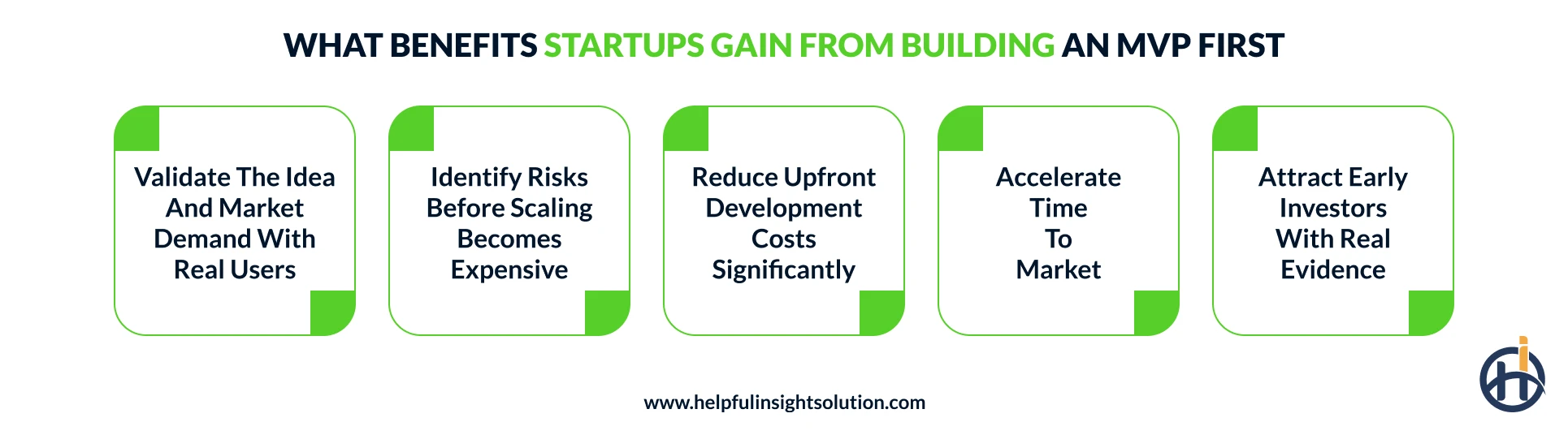
These benefits of minimum viable product development can make early investment decisions less of a guess.
Validate the idea and market demand
Small and early-stage companies can spend months discussing whether an idea has potential, but the market may give a very different answer. An MVP for startups brings that answer closer. When startups hold back and release only what’s needed to test the main idea, real user behavior starts to emerge.
That behavior can help decide where the next round of investment should go.
Take UberCab, for example. It started with a simple app-based black-car service in San Francisco. That small launch helped test whether people would actually use the service before the model expanded.
Identify risks before scaling
Scaling a product before knowing where it may break can create problems that are harder to contain later.
MVP product development gives startups a smaller environment to spot issues with performance, integrations, user flows, or security. Fixing these gaps while usage is limited is usually easier than dealing with them after a wider launch, when changes can affect more users.
Reduce upfront development costs
A full product build can consume a large part of a startup’s budget before there is enough evidence to justify that spending. An MVP keeps the first investment focused on what needs to be tested.
This helps tech companies owners decide where further spending makes sense, including whether it is time to hire remote software developers for startup projects at scale.
Accelerate time to market
A startup does not always need the complete product before it can enter the market. With an MVP launch strategy, the team can release the core experience, see how people respond, and use those findings in the next round of development.
Dropbox followed a similar approach by using an early product demonstration to gauge interest before building the full service. This gave them useful market signals while there was still room to change direction.
Attract early investors
It is easier for investors to judge a product when there is something real to look at. A working MVP can show how the product performs with actual users and what those users do after trying it.
Startup MVP development can therefore strengthen the funding conversation by replacing some of the uncertainty in a pitch with early evidence from the market.
How to choose the right MVP type for startups?
Not every startup needs the same level of product development to test an idea. A low-fidelity MVP can help when the goal is to test an early concept, while a high-fidelity MVP makes more sense when users need to experience the core product.
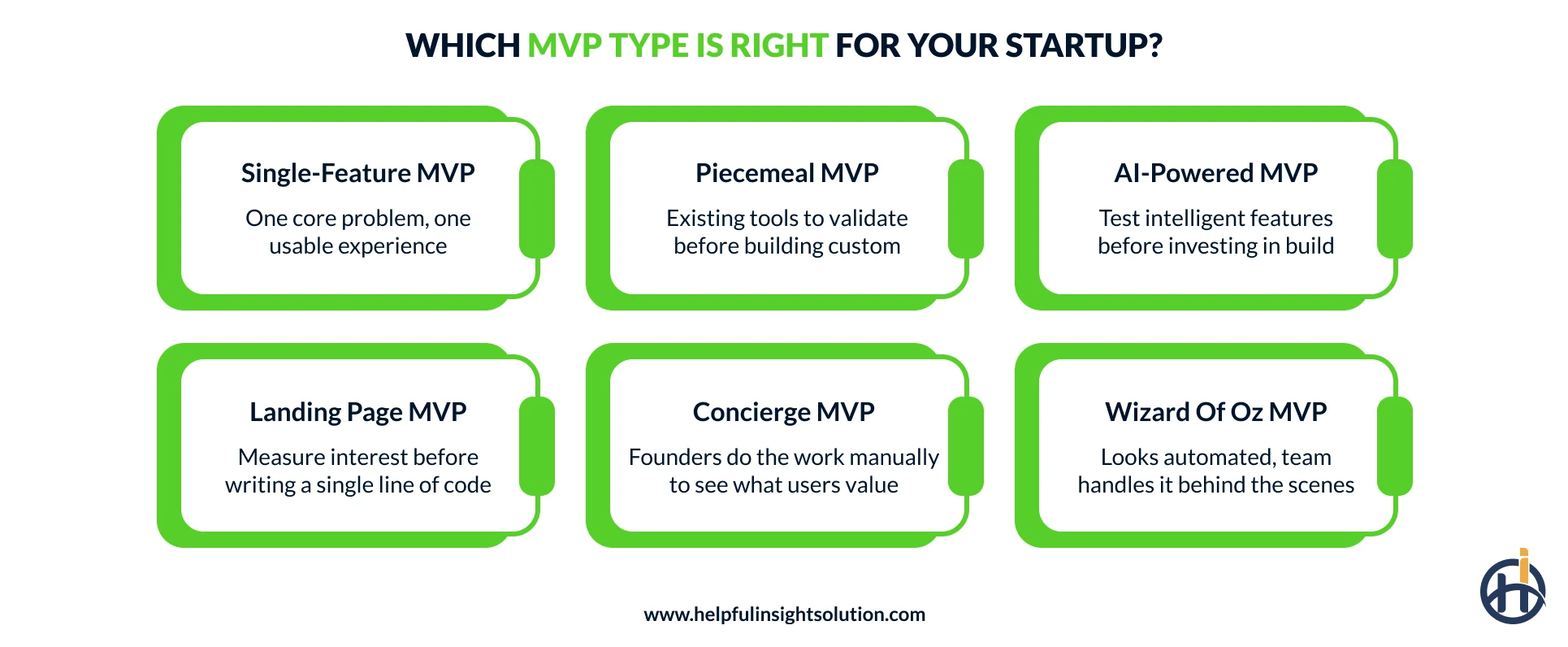
Let’s look at both approaches and where each MVP for startups fits best.
High-Fidelity MVPs
Single-feature MVP
A single-feature MVP helps startups avoid building too much too early. It takes the most important product idea and turns it into a usable experience.
The dedicated development team builds the feature closest to the user’s main problem and uses real usage data to guide future updates. For example, a budgeting app may start with expense tracking to see if users find it useful.
Suitable for
Startups that need early validation before expanding their product scope.
Piecemeal MVP
A piecemeal MVP uses existing solutions to bring their core idea to life and learn from real usage. This approach can work well when choosing platforms for MVP app development for startups, helping validate the product direction before spending more time and budget on a fully custom solution.
Suitable for
Startups need faster validation without building everything from scratch.
AI-powered MVP
Sometimes the real question is whether people even want the AI feature in the first place. You don’t need to build that from scratch to find out. Plenty of existing machine learning models and AI services can get you a working test fast.
Watch what happens when real users use it, and that tells you what’s actually worth building out before you scale anything.
Suitable for
AI startups validating artificial intelligence concepts before investing in advanced technology.
Low-Fidelity MVPs
Landing Page MVP
A landing page MVP is an early test version where startups use a focused webpage to explain their solution and see how potential customers respond. Instead of building every feature, businesses can measure interest through actions like registrations or demo requests.
Suitable for
Independent and emerging businesses testing product interest.
Concierge MVP
With a concierge MVP, there’s no automation, just the founding team doing the work manually. It’s a slower way to operate, but it puts founders close enough to see exactly what users need.
This kind of hands-on approach is common in early MVP product development, mainly because it tells you whether people actually value the solution or not.
Suitable for
Businesses validating customer needs with limited development investment.
Wizard of Oz MVP
A Wizard of Oz MVP is useful when startups want to understand whether a product concept works before investing in automation. The product may look fully functional to users, but the team handles key tasks manually in the early stage.
For example, an AI recommendation platform could use human experts initially to test whether users find the suggestions valuable.
Suitable for
Startups testing automation ideas before building complex technology.
Common MVP app development mistakes startups should avoid
An MVP isn’t just about getting something out fast. It’s about getting the sequence of decisions right. Startups lose real time and real money when they skip straight into building without clear priorities.
Growing businesses that understand the common mistakes in startup MVP development tend to avoid those costly detours and end up with something worth building on.
Unclear MVP objectives
It is easy to start building an MVP with a long list of things you want to test. The trouble starts when there is no clear answer to what the first version actually needs to prove. Maybe it is demand, pricing, or whether people will return.
Defining that upfront keeps startup MVP development from drifting and makes it easier to tell whether the product is worth taking further.
Feature scope mismanagement
Every feature feels necessary when you’re building the first version, that’s the trap. Trying to fit it all in usually just delays launch and buries whatever the product was actually supposed to do.
When developing an MVP, keeping the feature scope under control helps test the idea faster and understand what users actually value.
Skipping user validation
An MVP doesn’t prove anything on its own if you launch it and then stop paying attention. Users will tell you what’s working and what isn’t.
That’s the whole point of MVP development for tech startups. Pay attention to those signals and you build the right features next.
No future roadmap
The first version of an app will change or update as the product gets real users. Feedback may point to missing features, while growing demand can bring new requirements. That is why MVP in mobile app development should account for future improvements without trying to build everything upfront.
The right development approach keeps the initial product lean while giving startups enough flexibility to improve it as the business moves forward.
Wrong technology choices
The technology stack behind an MVP often looks fine at first, the real test comes once the product needs to grow or take on more users. React Native, Node.js, or Python can be a solid choice for an early version, and still need adjustments as the product’s needs change.
If you develop a FinTech app secure data handling and reliable integrations may matter from the beginning, even when the initial product is small.
Choosing technology that can support those requirements can save the team from replacing core components once the MVP starts gaining traction.
How much does MVP development for startups cost?
The cost to develop an MVP for tech startups can start at around $5,000 for a fairly simple product and go up to $60,000 for a more feature-rich build. If the product involves complex workflows, multiple platforms, advanced integrations, or enterprise requirements, the budget can reach $60,000 to $100,000+.
The actual cost depends on what you’re building and how much needs to be developed for the first release. The aim is to validate the core idea, not pay for the entire product roadmap.
The table below compares typical MVP mobile app development costs, who each option is best suited for, and what you can generally expect at each level.
| MVP type | Estimated cost range | What’s included | Best suited for |
| Simple MVP ( Low code) | $5,000-$20,000 | Basic workflows, core features, integrations, basic testing | Testing an idea before custom development |
| Standard MVP | $20,000-$60,000 | Custom UI/UX, multiple features, backend, APIs, authentication, QA | Startups preparing for early customer adoption |
| Complex MVP | $60,000-$100,000+ | Advanced workflows, custom architecture, integrations, security, multiple platforms | Startups with complex products and technical requirements |
How is AI changing MVP development for startups?
AI startup MVP development can shorten the gap between an idea and a working MVP. It can help with research, wireframes, code, testing, and other routine tasks. But faster development can also make it tempting to keep adding features, that’s where experienced developers help founders use AI where it adds value without letting speed replace sound technical decisions.
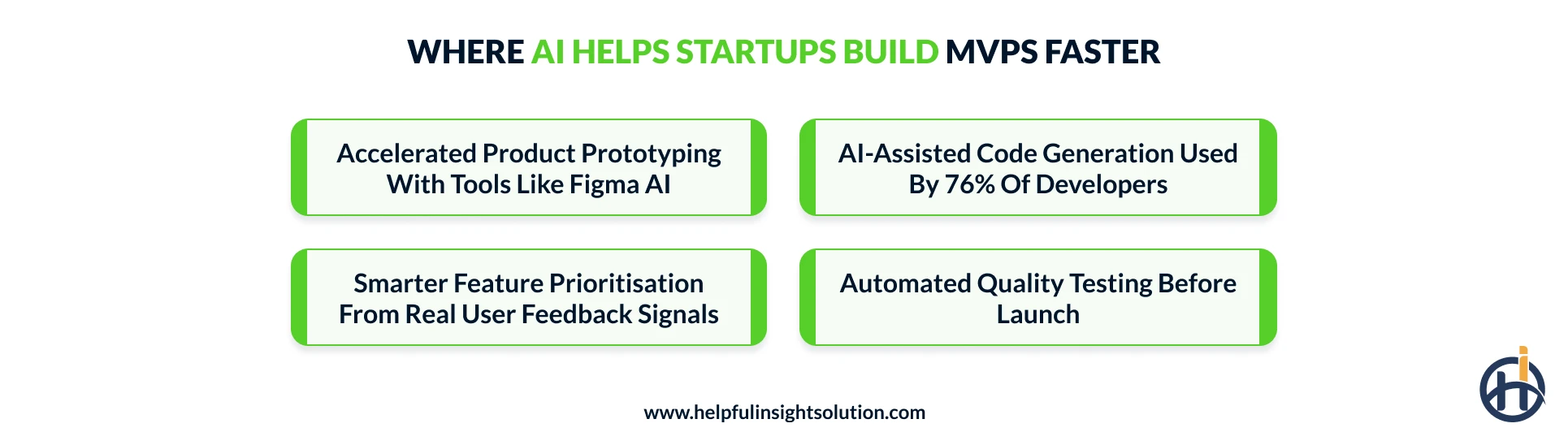
This section looks at where AI can genuinely help startups build MVPs faster.
Accelerated product prototyping
With tools like Figma AI and Galileo, a rough idea can become a working prototype in days and without touching the development budget yet.
Founders get to compare user flows, spot where an idea doesn’t hold up, and tighten the concept before coding even starts. That’s real clarity on what the MVP should include.
AI-assisted code generation
For a startup building an MVP, AI can take care of much of the repetitive coding involved in getting an initial product running.
In fact, 76% of developers now use AI coding tools or intend to adopt them. That speed is useful, but generated code still needs experienced review.
A capable MVP development team can decide where AI saves time and where human engineering judgment matters more.
Smarter feature prioritization
An early MVP does not need every feature on the product roadmap. AI can help here by scanning user feedback, competitor research, and whatever product data is available to surface which problems keep coming up again and again.
It’s useful for feature prioritization, but the actual decision still comes down to your customers, business model, and what the product is trying to achieve.
Automated quality testing
AI testing tools can take care of repeated checks, spot common bugs, and run tests again whenever the code changes. For a startup preparing its first release, that can mean fewer surprises close to launch.
An AI development company can bring automation into the testing process while developers handle the areas that still need human judgment, particularly around usability, security, and product behavior.
What startup founders often get wrong about MVP product development: Bursting the myths
Most early stage companies don’t misjudge their idea, they misjudge the MVP development process itself. Some treat a minimum viable product as a cheaper version of the full product. Others assume speed alone guarantees success. These assumptions quietly shape decisions long before a single feature gets built.
Clearing them up early helps approach ‘MVP validation’ with realistic expectations instead of ones borrowed from someone else’s success story.
An MVP only needs basic functionality
One of the common myths about MVP development is that “basic” means almost anything is acceptable. Users still expect the core experience to actually work, without friction getting in the way.
An MVP can absolutely have fewer features and still be solid, reliable, and worth using. The real question is not how much you can remove, it’s what the product has to get right for the idea to actually get validated.
AI tools can replace developers
Artificial intelligence can take over some of the repetitive work developers handle. It can generate code, find bugs, and handle repetitive tasks, which is useful when a startup is working with a tight budget. But it cannot judge whether a technical shortcut will cause problems later.
In MVP development, skilled developers and engineers still need to handle architecture, security, integrations, and important product decisions.
Low offshore development cost means better MVP value
It’s easy to assume the lowest quote is the smart choice. It usually isn’t. Staying on budget is important, but the cheapest option tends to skip exactly the things users notice right away.
Cost to develop software should support proper usability and validation. Otherwise, saving money early can make the MVP harder to learn from.
More product development time guarantees better results
It is easy to think that a longer development cycle will produce a stronger MVP, but time alone does not prove anything. In MVP app development for startups, months can be spent refining features that users may never need.
Getting a useful first version into the market sooner creates an opportunity to learn, adjust priorities, and invest the next round of development where it actually matters.
Who should build your MVP: In-house team, freelancer, or MVP development agency?
Deciding to build an MVP is only step one. The next question is who should actually build it. With MVP development for tech startups, in-house teams, freelancers, and development agencies each come with their own trade-offs around cost, speed, expertise, and reliability.
Choose an in-house team when
- Your team already understands the product and business goals.
- Technical development will continue well beyond the initial MVP.
- Close collaboration with product and business teams is essential.
- There is a budget for hiring and maintaining an internal engineering team.
Choose freelancer when
- The MVP has a small scope and straightforward technical requirements.
- Specialized development skills are needed for a limited period.
- The initial budget does not support a full-time engineering hire.
- A few core features make up most of the MVP.
Choose MVP development company when
- Product strategy, design, development, and testing need coordinated execution.
- The MVP includes complex workflows, integrations, or multiple user types.
- There is no experienced technical team available internally.
- Technical guidance is needed before committing to the build.
Conclusion
A successful MVP is not measured by how much was built or how quickly it reached the market. Its value comes from what the startup can learn and act on afterward. That is why MVP development for startups needs to balance product thinking with technical judgment.
A capable development partner should know what deserves attention, what can wait, and where cutting costs could create problems later.
This is usually the point where we get involved. Startups often come to us with a strong product idea but a long list of things they want in the first release.
As a leading mobile app development company, our role is to help make sense of that scope before development gets underway. We look at the target users, technology, and budget together. That helps us decide what belongs in the MVP now and what is better left for later. As the product gains users and clearer market signals, the MVP can evolve without having to start over.
If you’re weighing up an MVP, send us your requirements and we’ll help you assess the next step.
Frequently Asked Questions
An MVP helps startups test whether their core idea works with real users before committing a larger budget. It can reveal what customers actually value, where the product falls short, and which features deserve further investment. That early evidence helps reduce product development risk, control spending, and make better decisions about the next stage of the product.
Building an MVP for a startup can take 1 to 2 months when the product has a clear scope and only a few core features, while a more involved MVP can take 3 to 6 months or longer. Factors like the number of features, integrations, UI/UX design, testing, and changing requirements can all stretch the timeline.
A PoC is used to check technical feasibility of an idea, while on the other hand, an MVP comes later and works differently. It’s something real customers can actually use, which tells a startup whether the idea holds up enough to keep building.
Yes, startups can use AI when building an MVP, especially for getting early ideas into working prototypes. It can speed up coding, UI creation, and testing. Still, AI works best as development support; technical decisions, security checks, and product priorities need human judgment.