

Key Takeaways:
- Nearly 35% of startups say hiring developer talent is one of their biggest operational challenges.
- Knowing how to hire software developers starts with clarity on what your project needs, not with posting a job description.
- The right developer role depends entirely on what you are building, frontend, backend, full stack, or mobile app.
- Developer hiring costs range from $25 to $150+ per hour depending on location, experience, and engagement model.
- Skipping reference checks, rushing the process, and hiring on cost alone are the most expensive hiring mistakes.
For startups, building a digital product like a mobile app or software is exciting but it comes with decisions that can make or break your early momentum. One of the first and most consequential of those decisions is figuring out how to hire software developers for startup. A good developer can push your product to launch faster than you planned. A wrong one can set you back months.
Roughly 35% of startups say hiring developer talent is one of their biggest challenges. Not because developers are hard to find, but because finding someone who fits your product, your budget, and your current stage is a much harder problem than most founders expect going in.
Moreover, not every developer fits every stage either. Someone great at building quick prototypes may completely struggle once your product grows and the technical decisions get harder.
Getting that right takes more thought than a job posting and a few calls. It comes down to understanding what your product actually requires, what skills matter six months from now, and which hiring approach fits where you are today.
Whether you are hiring your first developer or scaling an existing team, this guide walks through every decision that matters before you make the hire.
Why hiring the right developers matters for startup success?
Hiring the right developer for your startup directly impacts product quality, development speed and long-term technical decisions. The wrong hire does not just slow you down, it shapes your codebase, your architecture and your ability to scale.
This section breaks down exactly why that hiring matters so much at the early stage.
1. Right hire accelerates growth
Growth puts pressure on everything your early team built, from database decisions and system structure to the way features were layered on top of each other. A developer who understands where your startup is headed makes choices from day one that absorb that pressure.
The difference shows up in modular code that does not collapse when a new feature is added, and a stack that the next person you hire can actually pick up and work with.
2. Faster time to market
Hiring the right developer means your MVP does not spend months in development waiting on fixes that should not have happened in the first place. Developers who have been through this stage know where time gets wasted and how to avoid it. That knowledge alone can cut weeks off your launch timeline.
3. Team productivity goes up
Productivity is everything for a startup running on a limited runway and a small team. When you work with the right development team, you stop losing days to rework, unclear ownership, and decisions that keep bouncing back to the startup owners. That recovered time goes back into building, which is exactly where it needs to be at this stage.
4. Builds investor confidence
Founders pitching for funding often focus entirely on the product and the market. Investors focus on the team and whether the development capability behind the idea is strong enough to deliver it. For early-stage startups going into seed or Series A, that technical credibility often makes the difference between a yes and a follow-up meeting that goes nowhere.
Define your startup’s tech needs before hiring a developer
Most hiring mistakes trace back to one thing that is unclear requirements. Two startups in the same industry can need completely different stacks, different seniority levels and different team structures.
That gap only becomes visible once someone is already hired and working in the wrong direction. Founders who define their technical needs with precision avoid the mid-project restarts and unbudgeted costs that vague briefs almost always produce.
1. Map out your goals first
Before anything else, get honest about where you’re headed. Short-term and long-term goals shape every technical decision you’ll make. Where does the product need to be in 3 months? What does growth look like in 5 years?
Answering these honestly gives your hiring decisions real direction and ensures the developers you bring on are building toward something specific.
2. Identify the gaps in workflows and current team
Look at who you already have before deciding who you need. Where are the skill gaps? Where are workflows breaking down or slowing things up? Sometimes the answer isn’t hiring more people, it’s hiring the right person to fix a specific gap, that distinction saves a lot of time and budget.
3. Review your tech stack
Every small and mid-scale business reaches a point where the original tools and technology choices need revisiting. That gap can directly affect which developers you’re able to hire.
Understanding where your stack stands before you hire a software development company ensures the expertise you bring in matches what the product actually needs to move forward.
4. Know which skills your startup lacks
The skill your startup is missing usually shows up long before you sit down to write a job post. It is in the delayed features, the repeated escalations, the technical decisions nobody on the team feels confident making. Spend time identifying that specific gap first; a focused hire almost always outperforms a general one.
5. Define your budget and hiring timeline
Here is something we see constantly: startups deep into interviews with no clear budget, no agreed timeline, and suddenly making offers they cannot sustain past quarter two. Decide what you can spend and when you need them, and write both down before you open a single job listing to hire software developers.
Types of developers to hire: roles and skills
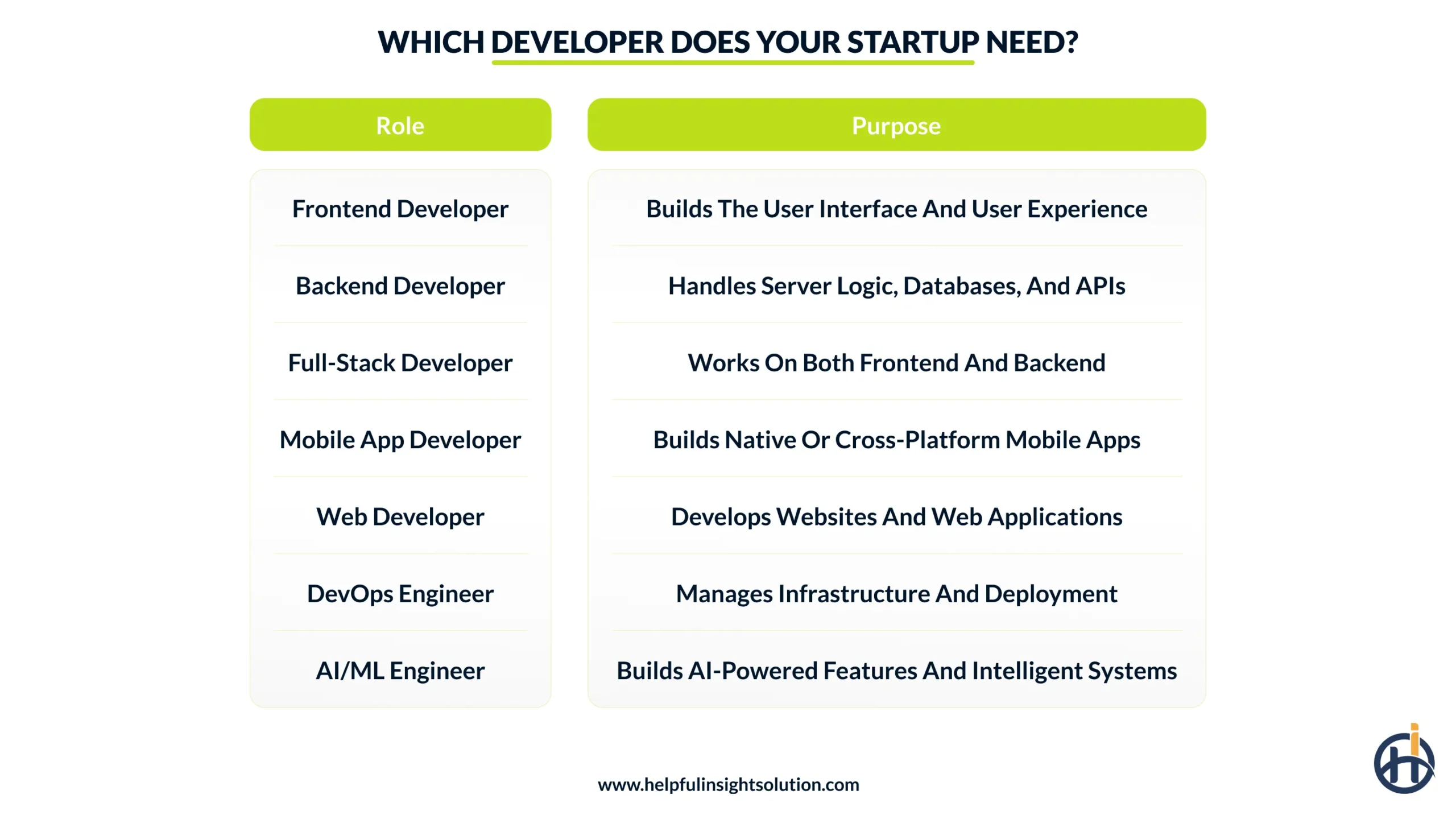
Understanding how to hire developers starts with knowing which roles your product actually requires. Not every startup needs the same team composition, software development has different demands than a mobile app. Getting clarity on the right roles before reaching out to anyone saves considerable time and budget down the line.
1. Frontend developers
Frontend developers are responsible for everything a user sees and interacts with on a digital product. They take designs and turn them into a working, responsive interface that feels intuitive across devices.
For startups, this role carries extra weight: a slow, confusing, or visually inconsistent interface loses users before they ever experience what your product actually does.
What they handle:
- Converting UI designs into functional interfaces
- Ensuring a consistent experience across browsers and screen sizes
- Managing user interactions and interface responsiveness
- Collaborating with backend developers on data display
What they work with:
- HTML5, CSS3 and JavaScript
- Frameworks like React, Vue.js, or Angular
- Performance and accessibility tools
2. Backend developers
Everything that happens behind the scenes, like user authentication, data storage, business logic, and third-party connections, is the backend developer’s domain.
Without a solid backend, the frontend has nothing reliable to display, and the product has no real foundation to grow from. For a startup, that foundation matters more than most realize.
What they handle:
- Building and maintaining server-side logic
- Creating APIs that connect the frontend to the backend
- Managing how data is stored, retrieved, and updated
- Handling authentication, security, and access control
What they work with:
- Python, Java, Node.js, Ruby, or PHP
- SQL and NoSQL databases
- Cloud platforms and server infrastructure.
3. Full-stack developers
There is a practical reason full-stack developers are popular among startups and mid-tier businesses. They handle both what users see and what runs behind the product, removing the need for multiple specialists during a phase when speed and budget efficiency matter most. One developer with full product visibility tends to move faster and make better-connected decisions.
What they handle:
- Designing and building user-facing interfaces
- Writing server-side logic and managing data flow
- Setting up and maintaining databases
- Integrating third-party tools and external APIs
What they work with:
- JavaScript, React, or Angular on the frontend
- SQL and NoSQL databases
- Backend languages like Node.js, Python, or Ruby
4. Mobile app developers
Mobile app developers build apps that work on phones and tablets, and the role splits quite clearly depending on the platform. iOS and Android have different languages, different guidelines, and different user behaviors.
Whether you need to hire Android developers or bring in someone who specializes in iOS depends entirely on where your users are and what devices they carry.
What they handle:
- Developing and maintaining iOS and Android applications
- App store submission processes and mobile deployment pipelines
- Device emulators and real device testing environments
- Working with backend teams to ensure smooth data flow
What they work with:
- Flutter or React Native for cross-platform builds
- Kotlin and Java for Android builds
5. Web developers
If you want to develop a website for your small business, a web developer handles everything from a simple informational site to a fully functional platform with user accounts, booking systems, or product listings.
The work does not stop at launch either. Keeping it stable, updated, and technically sound as the business evolves is just as much part of the role as building it.
What they handle:
- Building and updating websites
- Managing site performance and cross browser compatibility
- Setting up servers, databases and content management systems
- Running security checks, analytics integration and ongoing maintenance
What they work with:
- Flutter or React Native for cross-platform builds
- Kotlin and Java for Android builds
6. DevOps engineers
DevOps engineers are basically IT generalists, not always the first hire on a startup’s list, but they tend to become urgent the moment the product goes live and deployments start breaking things. They work with developers to take care of the infrastructure, the deployment process, and the monitoring setup that keeps your team informed about what is happening in production.
What they handle:
- Automating code deployment pipelines
- Scaling servers during traffic spikes
- Catching failures before users report them
- Setting up backup and recovery systems
What they work with:
- Docker for application containerization
- Cloud platforms like AWS, Google Cloud, or Azure
- Jenkins or GitHub Actions for CI/CD
7. AI/ ML engineers
AI and ML engineers build systems that can think, learn, and improve on their own. Unlike regular developers who follow fixed logic, these engineers train models on data and let the system figure out patterns, make predictions, and get better over time. When startups hire AI developers, the best outcomes happen when there is already a clear problem the AI is meant to solve, making the product smarter.
What they handle:
- Building models trained on real data
- Preparing and organizing data for model training
- Testing model accuracy and improving output over time
What they work with:
- Python as the primary development language
- PyTorch and TensorFlow for model building and training
- Data processing tools and cloud based ML platforms
- APIs that connect AI models to the rest of the product
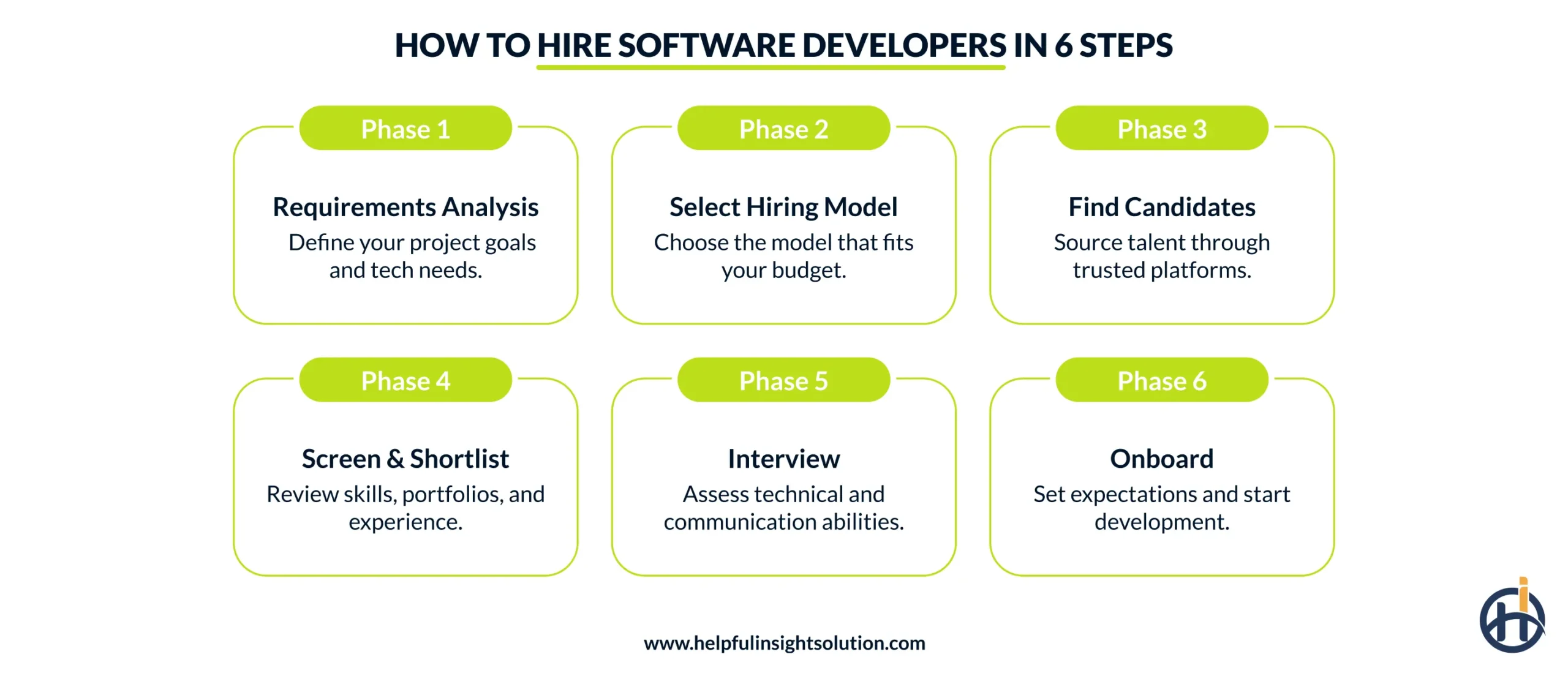
How to hire software developers: A 6-step process
Most hiring mistakes don’t happen because founders chose the wrong platform or wrote a bad job description. They happen because there was no clear process to begin with.
Below are the steps that walk you through exactly how to hire programmers for startups effectively.
1. Understand your project requirements
Hiring developers for a startup starts with mapping out exactly what the product needs technically, the stack, the specific responsibilities, and the experience level that makes sense for where the product currently stands. A well-defined requirement does not just attract better candidates; it makes every subsequent step in this process considerably faster.
2. Select your hiring model
The engagement model you choose determines how the entire working relationship runs. It influences the cost structure, the level of control, and how quickly you can make changes when the product direction shifts.
A freelancer is a good choice for well-defined projects, while a dedicated team fits better when the product is still evolving. For startups where cost is a real constraint, understanding how to hire offshore developers is worth the research as the talent pool is deep and the cost difference is significant.
3. Find developers through the right platforms
To find developers for startup, start with one or two platforms that match the role rather than posting everywhere at once. A backend engineer with five years of experience is not browsing the same places as a freelance frontend developer available for a two month contract.
Go where the specific person you need actually spends time rather than spreading the search thin across every platform available. Most companies use LinkedIn for professional roles, GitHub for technical talent, and Upwork or Toptal for freelance or contract-based work.
4. Screen and shortlist candidates
Go through resumes and portfolios with something specific in mind rather than a general sense of what looks impressive. The criteria shift depending on the product you are building, hiring programmers for startups operating in regulated spaces like healthcare or fintech means compliance awareness moves up the priority list considerably.
Write down what the role absolutely requires early in the process. Anyone who does not meet those criteria comes off the list fast, which is what keeps shortlisting manageable.
5. Conduct interviews
As the next step of the software developer hiring process, interview the shortlisted candidates, covering both technical and non-technical ground.
A hands-on assessment tells you what they can build. The conversation around it tells you whether they ask the right questions, take feedback well, and can work without someone directing every decision, all of which matter significantly in a startup environment.
6. Onboard the talent
Getting the offer accepted doesn’t mean the hard work is done. Whether you hire remote developers or someone in the same city, the first thing on the table should be the contract, NDA, and IP ownership agreement- not the project kickoff.
Developers who join without clear terms in place create legal and operational headaches that are difficult to tackle later. Give them everything they need to get moving without chasing people for access or sitting idle waiting for documentation.

Developer hiring models: Which one is right for you?
Understanding how to hire software developers covers the process, but the engagement model you choose shapes everything that follows. What you spend, how much the work demands from you daily and how quickly you can scale up or pull back all depend on which model fits where your startup currently stands.
In this section, we will discuss the different engagement models for hiring developers for startups and explore what each option actually involves.
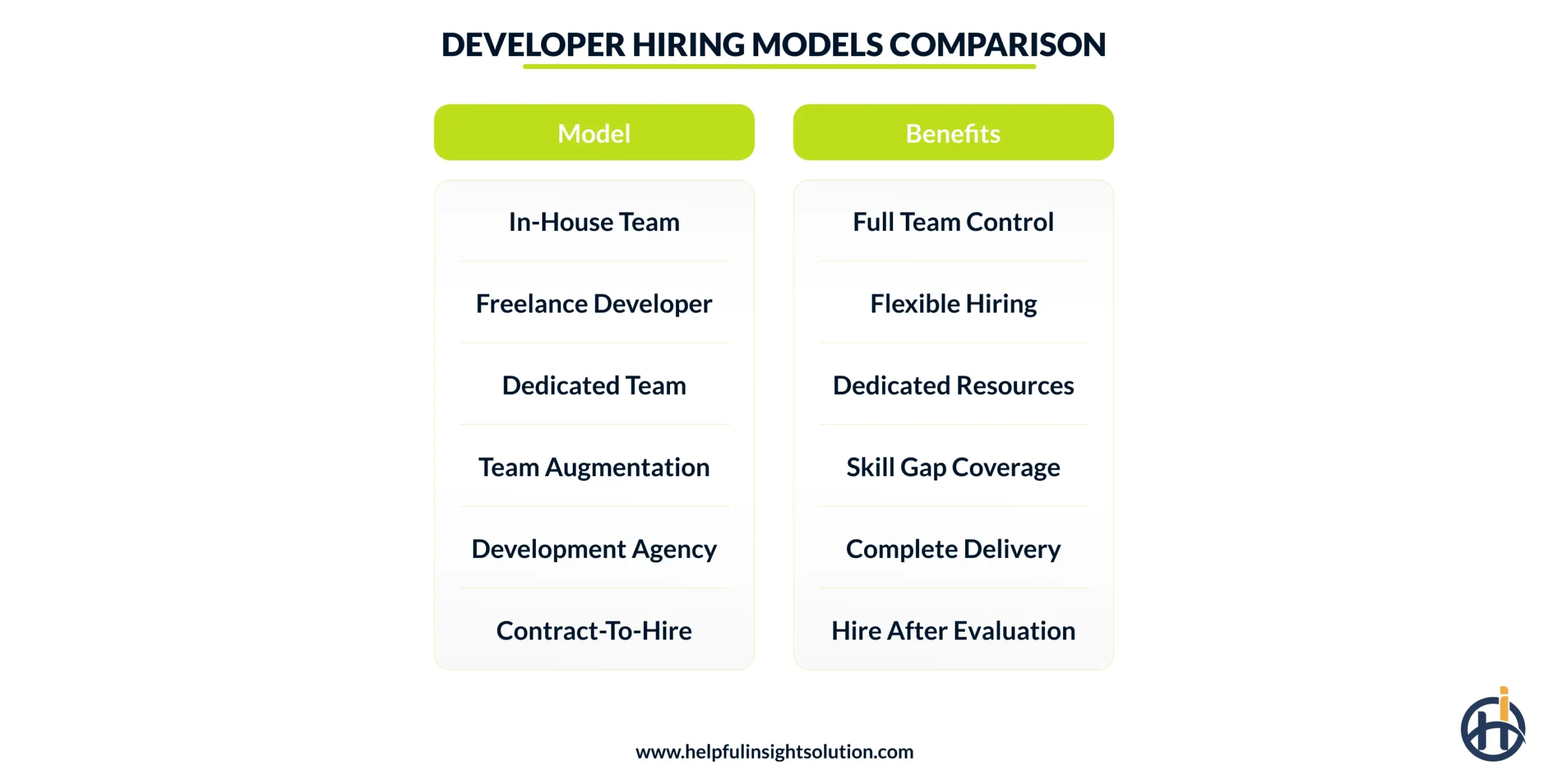
1. In-house
With in-house hiring, developers become part of your team permanently. They are on your payroll, work within your processes, and over time build a level of familiarity with what you are building that contracted or outsourced teams rarely match.
Pros
- Full team control
- Easier collaboration and communication
- Long-term skill development in-house
- Reduced dependency on third-party vendors
Cons
- High recruitment and onboarding cost
- Limited access to niche skill sets
- Employee turnover risk
When to Choose
Best suited for funded startups building a core, long-term team around a product that will keep evolving.
2. Freelance developers
Freelancers are brought in for specific work rather than ongoing employment. Defined scope, tight budget, and a clear deliverable; those are the conditions where this model works best. Hiring programmers for startups this way keeps costs contained and commitment flexible without sacrificing access to the technical skills the project actually needs.
Pros
- No long-term salary commitment
- Fast to onboard for specific tasks
- Access to specialized niche skills
Cons
- Availability not always guaranteed
- IP and confidentiality risks without contracts
- Variable work quality
When to choose
Best suited for short-term, clearly scoped work.
3. Outsourcing to a development agency
An outsourced agency gives you an entire development team without the process of building one yourself. Startups that hire offshore developers through this model typically do it because the cost structure makes more sense at their current stage than anything local hiring can offer.
Pros
- Access to a full team from day one
- Lower cost compared to building in-house
- A wide range of technical expertise available
- Scales with project requirements
Cons
- Communication gaps across time zones
- Cultural and language barriers
- Less flexibility for rapid scope changes
When to choose
Works well when the product scope is defined and the priority is getting to market fast.
4. Dedicated development team
When you hire dedicated developers through a vendor, you get a team that works exclusively on your product, follows your processes, and operates under your direction without the recruitment overhead.
Pros
- Full-time focused resources
- High team commitment
- Easy team scalability
- Cost-effective compared to in house team
Cons
- Time zone issues
- Less control than in-house hiring
- Knowledge gap during team transitions
When to choose
Best for small businesses that need a fully committed external team working long term on their project.
5. Team augmentation
Sometimes the team you have is mostly right, but missing one or two specific skills that are slowing everything down. Team augmentation lets you bring those skills in temporarily without committing to a full hire.
Pros
- Fills specific skill gaps quickly
- Faster than the full recruitment process
- Flexible engagement duration
Cons
- Higher hourly cost
- Internal management required
- Cultural alignment issues
When to choose
Pick this model when your existing team needs additional expertise or capacity for a specific phase or feature.
6. Contract-to-hire
With contract-to-hire, a developer joins on a fixed-term contract first. If the work and the fit hold up over that period, the engagement converts into a permanent role, and both sides get a real trial before committing.
Pros
- Reduced hiring risk
- Skills tested practically
- Performance-based decisions
Cons
- Higher short-term rates
- Onboarding investment may not pay off
- Not suitable for urgent long-term needs
When to choose
Choose this model when you want to evaluate a developer through real work before hiring them permanently.
How much does it cost to hire a developer?
The cost to hire a software developer ranges from $25 to $150+ per hour, and that gap isn’t random. Geographical location, years of experience, and how the engagement is set up all pull that number in different directions.
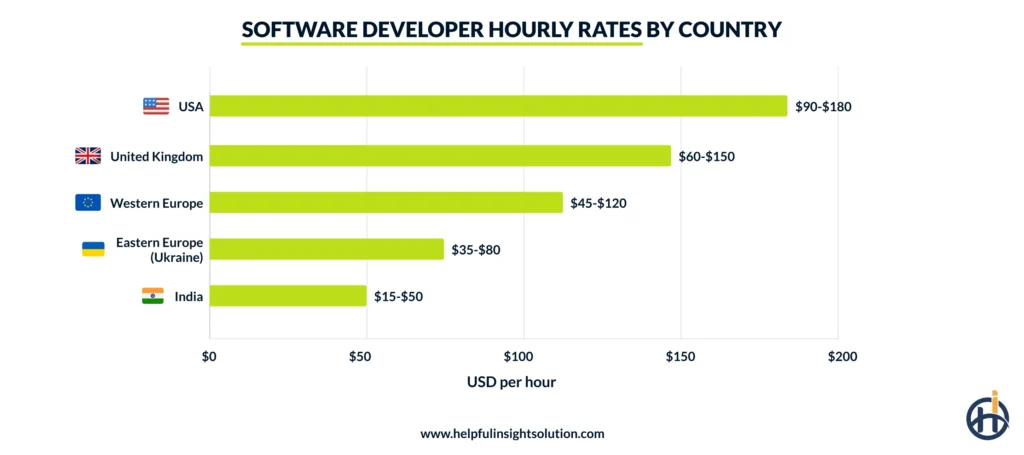
For a startup keeping a close eye on spend, understanding what actually drives the cost matters more than fixating on finding the lowest rate available.
Here’s how remote developer rates compare across countries.
| Country | Average Hourly Rate |
| USA | $90 to $180 |
| United Kingdom | $60 to $150 |
| India | $15 to $50 |
| Ukraine | $35 to $80 |
| Europe | $45 to $120 |
Where to find developers for startups (platforms and channels)
LinkedIn, GitHub, Upwork, and Toptal are among the most reliable places to hire programmers for startups. Each platform works differently and attracts different people. Figuring out how to hire a software development team gets a lot easier once you stop treating every platform the same and start matching the channel to what the role actually needs.
1. Linkedin
For full-time hires, LinkedIn is consistently one of the best ways to find developers directly. The targeting is precise enough to search by tech stack, seniority, and location, though sourcing, screening, and outreach still take real time on your end.
2. Github
When looking to hire a dev with proven technical ability, GitHub cuts through the guesswork. Every repository, commit history, and open source contribution is visible before the first conversation. It’s the one platform where you evaluate what someone has actually built rather than what they claim to have built.
3. Toptal
For startups that hire remote developers and cannot afford to spend weeks vetting candidates, Toptal removes that problem entirely. Every developer on the platform has already passed a strict technical screening. The rates are higher than most freelance platforms, but the quality consistency makes it worth the difference for critical roles.
4. AngelList
AngelList is built specifically for the startup hiring context, which makes it different from every other platform on this list. Startups that want to hire dedicated developers without competing against enterprise salaries can use equity as part of the offer here, attracting candidates who are genuinely interested in early-stage work rather than just the paycheck.
5. Upwork
Upwork tends to be the first stop for startups that need a developer fast without locking into anything long-term. Short tasks, ongoing contracts, fixed projects, the platform handles all of it. The review history on each profile does most of the vetting work for you, which matters when you don’t have weeks to spend on screening.
6. Development agencies and outsourcing partners
Startups that don’t want to manage the sourcing process across multiple platforms, development agencies, and outsourcing partners offer a direct path to vetted technical talent
Engagement is flexible, which involves project-based, part-time, full-time or hourly. Moreover, the agency handles matching the right talent and team structure so founders can stay focused on growing their business.

Common mistakes to avoid when hiring developers
The most common mistakes when hiring developers include prioritizing cost over fit, skipping reference checks, and bringing someone on without clearly defined requirements.
Most founders figuring out how to hire developers for a startup make at least one of these mistakes early, often without realizing it until months later, when the cost shows up as delays or rework.
In this section, we will discuss the common pitfalls to avoid in the software developer hiring process.
1. Hiring fast over hiring right
The pressure to fill a role fast is real, but acting on it usually costs more than waiting. A rushed hire skips the checks that matter, like portfolio reviews, reference calls, and trial tasks. Even when figuring out how to hire offshore software developers, where the talent pool is wider, speed without process still produces the wrong result.
2. Ignoring cultural and team fit
Poor communication, an unwillingness to take feedback, or simply working in a way that clashes with everyone else, these things do not show up in a technical test but they show up fast once someone is actually on the team. Cultural fit is not an additional consideration it directly affects how talent work and how long people stay. Test for it deliberately before onboarding rather than discovering the mismatch after the contract is signed.
3. Sacrificing quality to cut hiring costs
The cheapest option rarely stays cheap for long. When founders hire developers for startup based purely on the cost, what follows is usually slow delivery, poor code quality, and a rework bill that costs considerably more than the savings made upfront. The lower the cost, the higher the risk of paying twice for the same work.
4. Overlooking time zone differences
When you hire remote developers across different time zones without a defined communication plan, small delays compound quickly. A question that should take minutes to answer sits overnight. That’s why it is important to set clear communication expectations before work begins and use tools like Slack, Loom, and Trello.
Why Helpful Insight is the right partner for your hiring?
Whatever role or hiring model fits your stage, the developer you choose will shape how fast your product moves, how it holds up under pressure, and how much rework you face later. If you’re ready to skip the search and want a partner who has done this across industries and team sizes, that’s exactly where we come in.
We have over 10 years of hands-on experience and have served 2,000+ clients worldwide. We know what it takes to match the right developer to the right product.
Our pre-vetted global talent pool covers every major stack so whether you need to hire Flutter developers, React engineers, iOS specialists, or a complete development team, we have someone ready to start. Our engagement models are built around your budget and stage, with cost starting from $20 per hour and no surprises along the way.
FAQs
The cost of hiring a software developer typically falls between $25 to $150+ per hour, while full time salaries differ widely by region and seniority level.
Factors that affect the cost are:
- Developer experience
- Location and regional market rates
- Hiring model chosen
- Tech stack and specialization required
- Freelance vs full time vs dedicated team
The best way to hire developers for a startup starts well before any job post goes live. Know what you are building, what the product needs technically right now, and which hiring model your budget can actually sustain. Most hiring decisions that go wrong can be traced back to skipping that groundwork rather than anything that happened during the interviews.
You can find developers for a startup across several platforms like:
- Job boards like LinkedIn and Dice
- Freelance marketplaces like Upwork and Toptal
- Developer communities like GitHub and Stack Overflow
- Staff augmentation platforms like Clutch and GoodFirms
When hiring a developer check their technical skills, ability to solve real problems, communication skills, past projects and cultural fit.
Healthcare, fintech, e-commerce, logistics and edtech are among the industries with the highest demand for software developers, driven by digital product complexity and rapid user growth.