


Key takeaways
- Generative AI in finance means models that create new outputs, reports, summaries, recommendations, rather than simply analyzing data that already exists.
- Financial institutions applying generative AI to fraud detection and anti-money laundering work have seen accuracy improve by around 25%.
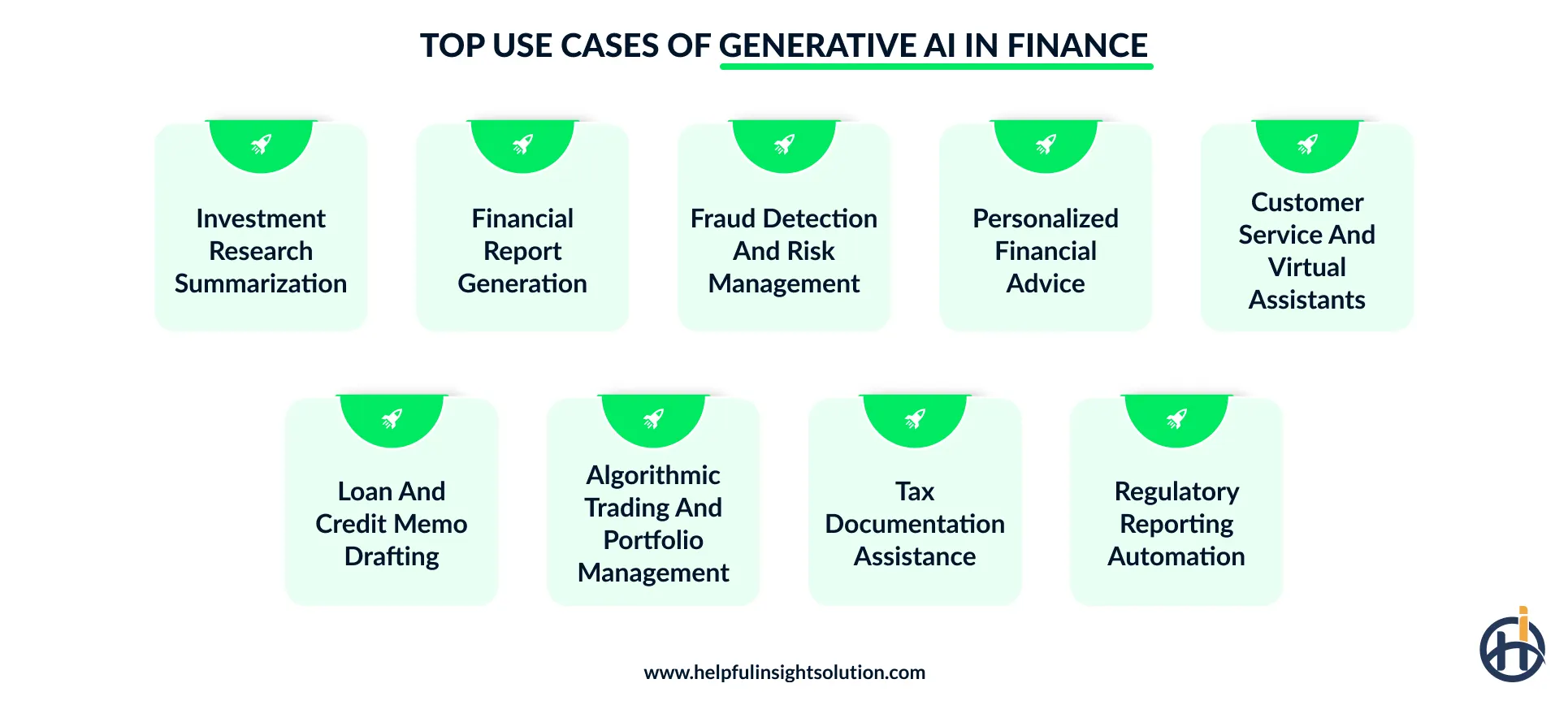
- Generative AI use cases in financial services include investment research summaries, financial report drafting, personalized advice, and loan documentation.
- Faster reporting, sharper decision-making and long-term cost savings are some of the key benefits of gen AI in finance.
Finance teams have never had a shortage of data. The harder part has always been turning that data into something useful without spending days reviewing reports and long documents.
This is where Generative AI in finance is starting to make an impact. Instead of replacing existing systems, many organizations are using it to summarize information, assist with financial analysis, and handle repetitive knowledge-based tasks that slow teams down.
The interest around GenAI is not only because of automation. Financial organizations are looking at it because much of their work involves interpreting information, finding patterns, and preparing insights for others.
From banking and investment firms to Fintech companies are testing where gen AI solutions can fit into existing processes while maintaining control over accuracy, security, and compliance.
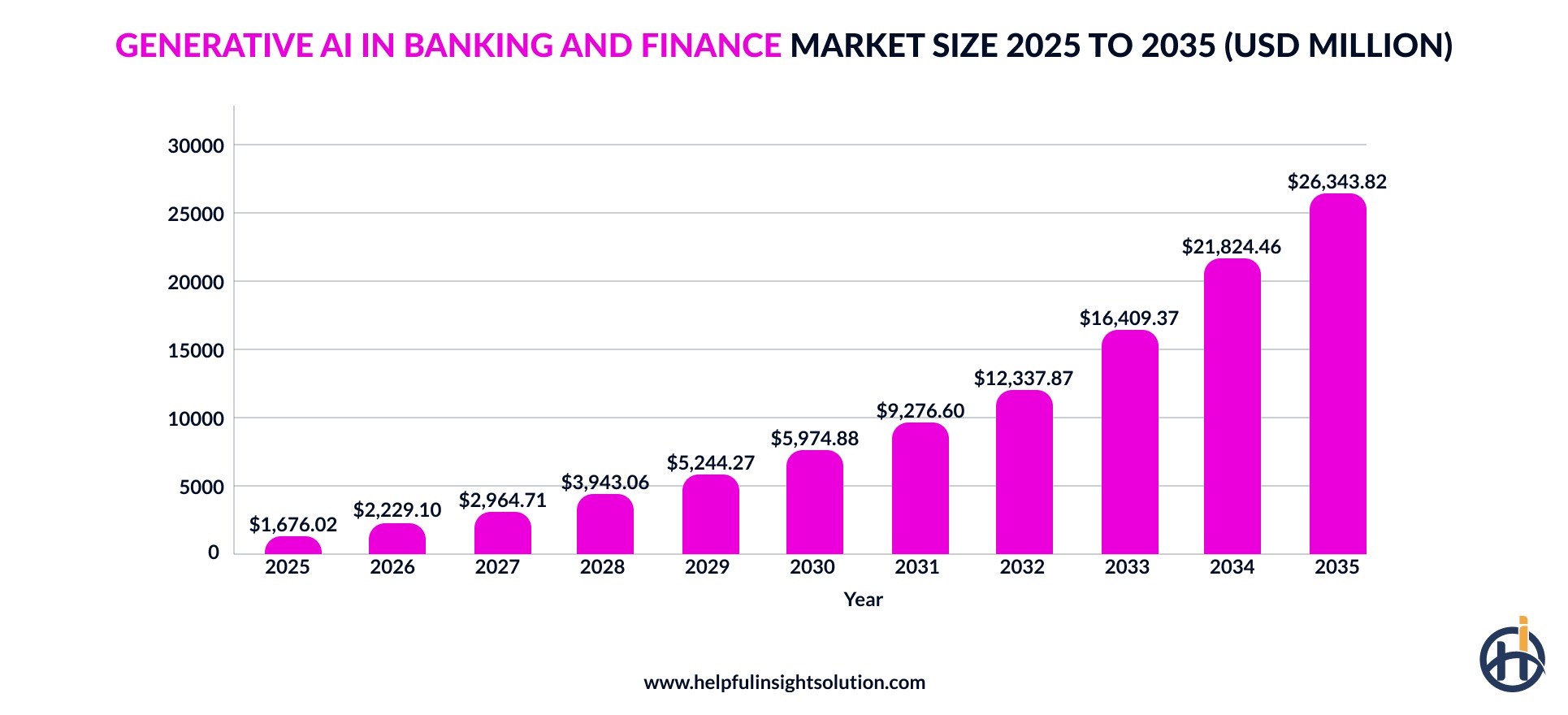
As finance companies ove from exploring possibilities to implementing real use cases, market growth is following the same direction. Precedence Research projects the generative AI in banking and finance market to reach approximately $26,343.82 million by 2035.
However, adopting GenAI is not only about choosing a technology platform. Organizations need the right use cases and a practical implementation approach to achieve measurable value which we are going to discuss in this blog.
What is generative AI in finance?
Generative AI in financial services refers to the use of AI models that can understand information and create new outputs such as a summary, a recommendation, a draft response, built from financial information rather than simply sorted or scored.
Unlike traditional systems that mainly analyze existing data, GenAI can work with unstructured information, including reports, policies, and market documents. These systems use LLMs and machine learning techniques to interpret complex information, understand context, and produce useful outputs.
Key generative AI models in financial systems
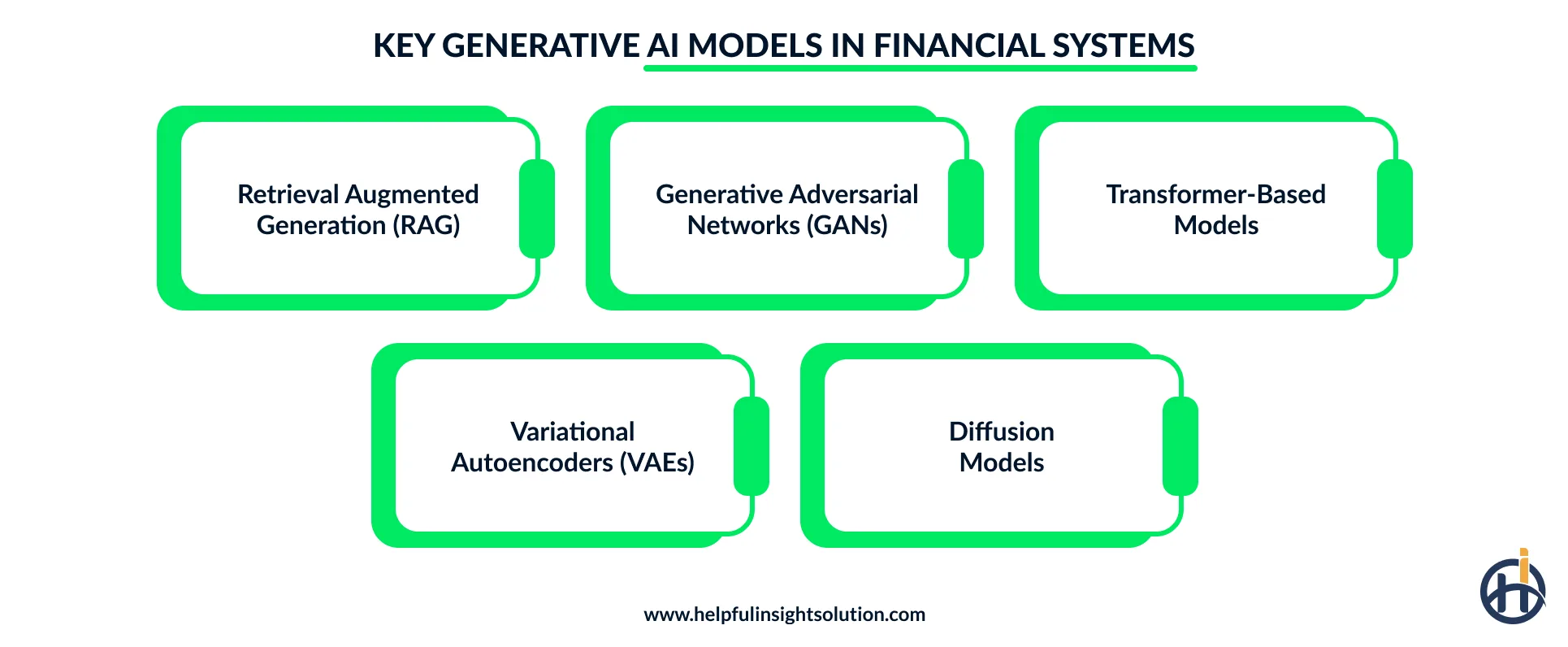
Most finance leaders talk about generative AI in finance as if it’s one technology, but the systems doing the actual work vary widely. Not every gen AI model in finance operations performs the same job.
Some are built for language and reasoning, others for structured data or code, closer to what financial software development actually requires. Understanding these underlying foundation models helps finance teams pick the right one.
1. Retrieval augmented generation (RAG)
Rather than relying purely on what a model “remembers,” RAG fetches verified information from live databases first, then generates the answer around it. Banks use this for conversational banking AI and research tools where factual accuracy can’t be optional.
2. Generative adversarial networks (GANs)
Synthetic financial data gets built through two competing networks; one generating fake transactions, the other evaluating how closely they resemble real ones. This setup lets financial companies train models and stress-test systems against rare scenarios like market crashes, without touching real customer records.
3. Transformer-based models
Self-attention is the mechanism doing the real work here, it lets a model figure out which words in a passage actually drive the meaning instead of reading everything in strict sequence.
Google’s Gemini runs on this approach, and it’s why the outputs hold up in investment research summarization or earnings narrative drafts, even when a customer’s question spans several unrelated points.
4. Variational autoencoders (VAEs)
Variational Autoencoders compress complex financial data into a simplified representation, then reconstruct it, flagging transactions that don’t fit the learned pattern. This makes VAEs useful for AI-powered fraud detection, spotting outliers in credit card activity that traditional rule-based systems tend to miss entirely.
5. Diffusion models
Diffusion models work backward as they start with random noise and gradually refine it into structured output, similar to how tools like Stable Diffusion generate images. AI in finance uses this same reverse process to simulate market price paths and extreme economic shocks for stress-testing.
Top use cases of generative AI in finance
AI in FinTech isn’t theoretical anymore; it’s running inside real workflows. From credit memos to earnings summaries, the shift is visible across teams. In this section, we’ll explore the generative AI finance use cases making the biggest measurable difference right now.
1. Investment research summarization
Analysts spend hours reading earnings transcripts and filings before forming a single opinion. Generative AI for finance drafts a readable brief from all of it, pulling key figures, sentiment shifts, and connecting them into a coherent summary instead of scattered notes.
Some tools go further and flag when a company’s earnings call tone contradicts its written filings, a mismatch analysts usually catch only after manual comparison.
2. Financial report generation
Feed the AI model revenue figures, cost breakdowns, and variance numbers, and it produces a structured report, balance sheet, and performance narrative. Finance teams that once spent hours translating spreadsheets into readable reports now spend that time reviewing and correcting instead, which shortens the reporting cycle.
3. Fraud detection and risk management
Rule-based fraud systems tend to flag activity that’s actually harmless like a large purchase from a loyal customer simply because it crosses a fixed threshold.
The use of generative AI in finance changes that by learning transaction patterns in context rather than against fixed thresholds. Financial institutions applying this to fraud detection and anti-money laundering have reported accuracy improving by roughly 25%.
4. Personalized financial advice
Instead of generic portfolio templates, generative AI for financial services factors in a client’s actual income pattern, goals, and risk appetite to draft a customized recommendation.
This kind of tailored input tends to build more trust with clients too, since the advice ties directly to their own savings and investment goals rather than a one-size-fits-all model.
A real-world example of generative AI in finance for this use case is Morgan Stanley, where advisors use an OpenAI-powered assistant built on the firm’s internal research.
5. Customer service and virtual assistants
Routine banking questions, balance checks, password resets, rarely need a human agent anymore, and an AI chatbot picks up that volume around the clock.
What makes this genuinely useful is that it can also detect frustration or complexity in a customer’s tone and hand the conversation off to a live agent before it turns into a complaint.
6. Loan and credit memo drafting
Banks used to spend hours pulling together a borrower’s financial history, credit score trends, and bank statement patterns into one coherent memo.
Generative artificial intelligence in finance drafts that memo directly, structuring the borrower’s risk profile into a document ready for underwriting review, cutting the time between application and decision.
7. Algorithmic trading and portfolio management
Machine learning models are strong at predicting price movement from historical patterns, generative AI systems add something different. It creates synthetic market scenarios and simulated trading paths a fund manager can test a strategy against before deploying it live.
This helps catch portfolio weaknesses under conditions that haven’t actually happened yet.
8. Tax documentation assistance
Tax documentation is one of the popular generative AI use cases in financial services, and it works by parsing receipts, invoices, and earnings data directly into a pre-filled filing.
The system also flags deductions based on current tax rules, leaving the accountant to review and sign off rather than assemble the return manually, which is where most of the time used to go.
9. Regulatory reporting automation
Generative AI in finance and accounting helps mapping changing regulatory requirements directly against a bank’s internal data, then drafting the compliance forms and audit trail documentation.
It flags what’s changed and generates the updated filing, cutting down the manual entry that regulatory reporting has traditionally required.
Benefits of generative AI in financial services
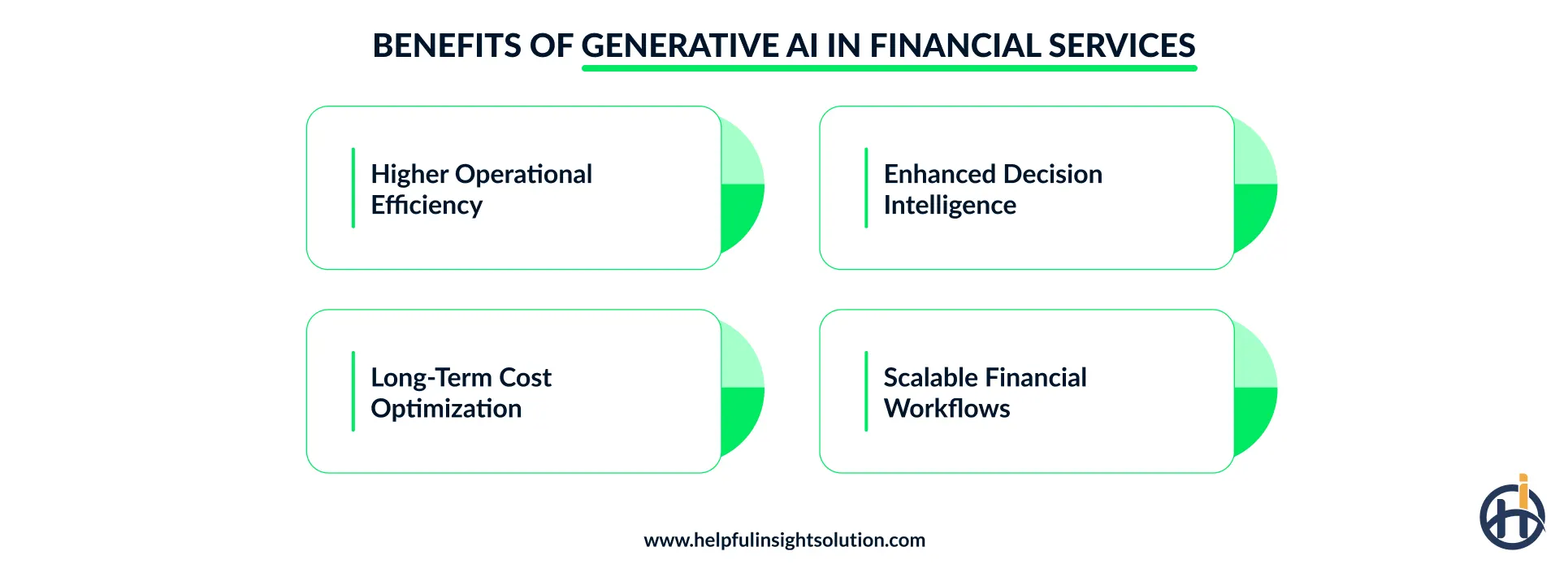
Generative AI for finance shows measurable benefits across different areas of financial operations. From faster reporting cycles to more accurate compliance work, the impact tends to compound once these tools are used in daily workflows across a team.
Below are the benefits financial institutions are actually seeing from generative AI.
1. Higher operational efficiency
Tasks that once required a full team working through documents, loan reviews, compliance checks, report drafts, now move through in a fraction of the time. RPA in finance has long handled the repetitive, rule-based portion of this work reliably, and generative AI extends that further, adapting to variation in the data itself and handling exceptions that would otherwise stall an automated workflow entirely.
2. Enhanced decision intelligence
Market movement, credit behavior, emerging risk signals, generative AI in finance analyzes all of it into one view instead of leaving someone to piece it together by hand. Decision makers end up comparing a few plausible outcomes side by side, not just one forecast built off past trends.
3. Long-term cost optimization
Gen AI in finance and accounting shifts the cost structure of operations in a way that compounds over time. As transaction volume grows, the same AI system absorbs that increase without needing a proportional rise in headcount.
That’s where the real savings accumulate, spread out across quarters rather than showing up as a single efficiency spike early on.
4. Scalable financial workflows
Tax season, quarter-end close, a sudden market surge, these are exactly when manual processes tend to buckle under volume. Banks and finance companies used to respond by bringing in temporary staff or pushing deadlines.
AI-driven finance operations don’t need that workaround anymore as the system scales to the workload on its own and no infrastructure rebuild is required.

How to implement generative AI in your finance operations: Step-by-step
Implementing gen AI in finance and accounting goes smoother with a structured roadmap. It helps institutions adopt the technology without disrupting existing operations or compliance requirements.
Here’s what that process typically involves.
1. Identify finance use cases
Start with a specific workflow problem your company is actually facing, such as invoice backlogs, slow reporting cycles, or repetitive research tasks, and identify where generative AI would create the most impact.
A narrow starting point is easier to validate. Once it proves out, expanding into more complex or sensitive workflows becomes a planned next step.
2. Assess data readiness
Data preparation often gets skipped, but it shapes everything that comes after. Financial teams need to audit where their data comes from. Fix duplicates and inconsistencies across accounting systems and spreadsheets. Confirm it meets privacy and compliance standards too, before any model touches it.
3. Choose the right AI approach
The build versus buy decision comes down to how specific your need actually is. Off-the-shelf tools handle common tasks well like summaries, basic chat support, standard reporting, without a long setup.
Custom AI models earn their cost when the data is sensitive or the workflow doesn’t fit a generic tool. The right choice depends on budget, timeline, and in-house technical capacity.
4. Establish AI governance
Every major AI-driven decision in finance still needs a human checkpoint somewhere in the process. Beyond that, policies around data privacy and bias monitoring catch problems before they turn expensive.
Regulators and clients tend to expect this structure exists from the start, so ensure rules are documented clearly and reviewed on a regular basis.
5. Integrate with workflows
Gen AI developers build the integration directly into your current tools, ERP systems, FinTech platforms, billing software, instead of launching it as a separate application.
This matters because adoption drops sharply when employees have to open a new tool just to use it. If the AI is integrated inside the software employees are already working in, they’ll actually use it day to day.
6. Monitor and scale
Performance shifts after deployment. That’s why review cycles matter as much as the rollout itself. Keep an eye on accuracy over time, ask the people actually using the tool what’s working and what isn’t, and adjust from there.
Once the first use case proves reliable, expanding into more complex applications, like generative AI in lending and for credit decisions, becomes a lot less risky.
Challenges of implementing gen AI in finance and accounting
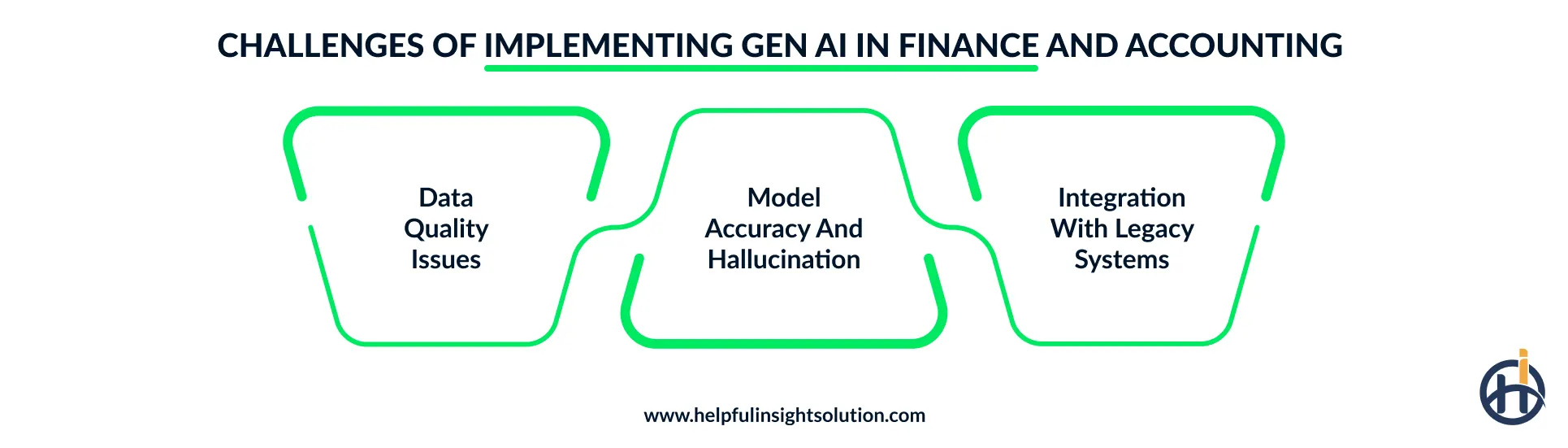
Implementing generative AI in finance involves real challenges that banks and financial institutions need to understand for smooth deployment. Let’s explore the obstacles you may encounter, along with their solutions.
1. Data quality issues
Feed a generative AI model inconsistent or poor-quality financial records, and the output ends up carrying those same flaws forward. When the underlying data reflects historical bias, the model’s recommendations can quietly repeat that bias in lending or risk decisions, turning a data problem into a real obstacle during implementation.
The solution
Audit and clean data first, standardize entry rules, and check training sets for embedded bias before deployment.
2. Model accuracy and hallucination
A generative AI model can state a figure or regulatory reference with total confidence, even when it’s wrong. Nothing in the output flags that mistake automatically. In financial reporting, that single wrong digit can escalate quickly into legal trouble, which is exactly why the output needs verification.
The solution
Build in strict guardrails, automated checks, and human review for every AI-generated financial output before release.
3. Integration with legacy systems
Legacy infrastructure is another challenge of generative AI in financial services that’s easy to underestimate. Core banking software from decades ago wasn’t designed with API connectivity in mind. Deploying something like an AI agent in finance often needs additional integration work before it can actually communicate with these older systems.
The solution
Use middleware or API layers to bridge old systems, rather than replacing core infrastructure outright.

Partner with Helpful Insight to bring Gen AI into your finance workflow
Generative AI in finance already shapes how financial institutions handle reporting, risk assessment, and customer service. The next stretch likely brings more autonomous agents managing multi-step finance tasks rather than single queries, alongside hyper-personalized financial products becoming viable at scale.
Institutions moving early on these developments, with solid data infrastructure and clear human oversight built in, will be the ones defining the pace for everyone else. Getting that implementation right from the start is where the difference is made.
Our generative AI development company has deep expertise in building and deploying a wide range of AI solutions for finance companies of all sizes. Our team works with you to identify where the technology delivers real value, whether that’s fraud detection, reporting automation, personalized advisory tools, or something specific to your operations.
We work with a current, well-tested tech stack suited to the compliance and security demands financial institutions operate under. So, share your project requirements with our team today to see how we can help you adopt Gen AI successfully.
FAQs
Implementing generative AI in financial services costs typically range from $20,000 to $80,000 for a narrowly scoped pilot project, and can climb to $250,000 to $600,000 or more for a full enterprise deployment. The final figure depends on factors like scope, existing data quality, which model is used, and where the development team is based.
Automating financial reporting, fraud detection, predicting market trends and compliance documentation are some of the popular applications of gen AI in finance.
Traditional AI is mostly about prediction and classification from structured data, credit scoring being a common example. Generative AI in financial services produces something new instead like a summary or a conversational reply through virtual assistants, rather than simply analyzing existing numbers.
Not by default, safety here depends heavily on how the system is set up and controlled. Poorly secured tools risk exposing customer data. Banks typically address this through encryption, restricted access, and formal oversight policies before any model interacts with real financial records.