

Key Takeaways
- Mobile app monetization strategies are the decisions that turn a chosen model into revenue.
- Some categories rule out advertising, including kids’ apps and health apps among them.
- The paywall and the trial are separate decisions, one controlling who reaches the offer and the other controlling who keeps paying.
- Price is set market by market, since payer value differs by region and both stores support a separate price per country.
- Lapsed subscribers are reachable through routes both stores already provide.
- Monetization belongs in the build rather than in a later release.
Mobile apps have become one of the biggest earners among digital products. Consumers spent $167 billion on apps in 2025, increasing 10% from 2024. (Sensor Tower)
Yet the earnings across these applications are uneven. RevenueCat studied 115,000 subscription apps and found 69 percent of the revenue still going to apps launched before 2020. Among newer apps, 17.3 percent get to $1,000 a month within two years, and 4.6 percent reach $10,000.
What does that smaller group do that the rest does not? Securing a user base is only part of the answer. Mobile app monetization strategies decide the rest, with the model setting what an app charges for and when it asks the user to pay.
This guide breaks down the top mobile app monetization models and how to choose the right one for your app.
How Do Apps Make Money? A Quick Overview
An app makes money from users either for downloading it or after installation while they use the app. They also make money from outside the user base through in-app ads, and from partner companies that pay for sponsorships or referrals.
Here is a quick overview of different ways through which mobile applications make money, and broadly, how apps make money across most categories:
- Paid downloads: The user pays once to install the application from the Apple App Store or Google Play Store.
- In-app purchases and subscriptions: The download stays free, and payment comes later for extra features or continued access.
- Advertising: Advertisers pay for the space in the app to showcase their brand.
- Transaction fees: Apps that facilitate orders or payments charge a certain percentage of each transaction.
- Partnership revenue: Sponsorships, affiliate commissions, licensing, and anonymized data agreements bring money from other businesses.
These five app monetization methods can be used together. An app can have a free version with advertisements, a paid ad-free experience, or access to additional features.
Still validating the idea itself? Our guide to MVP development for startups covers that step before monetization comes into play.
Core Mobile App Monetization Models
A monetization model is the business decision behind how an app earns money. This choice determines how much a business can afford to spend to acquire a user.
Acquisition cost has to stay below customer lifetime value (LTV), which is the total revenue one user brings over the time they stay. Together, these app monetization models cover most of what today’s mobile app development services are built to earn, and include:
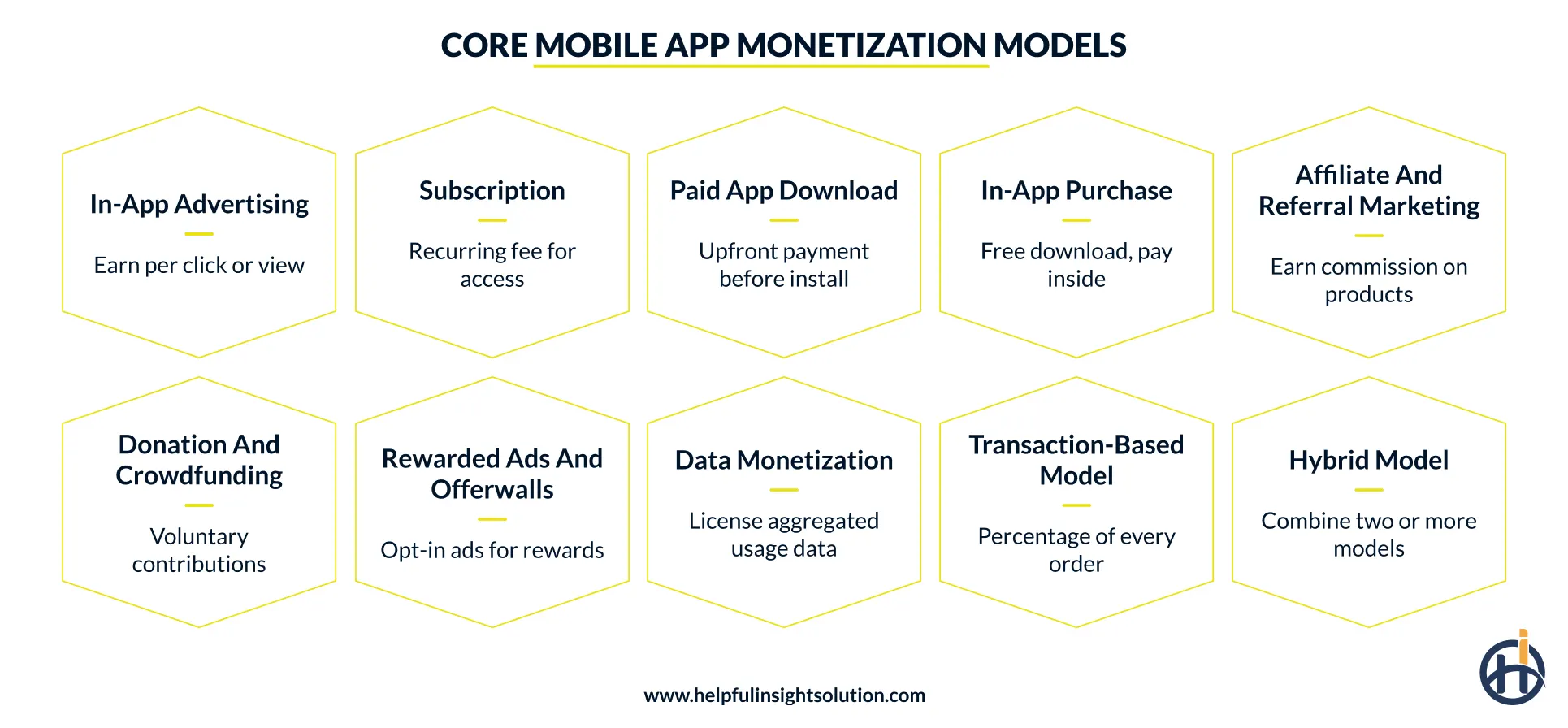
In-App Advertising
In-app advertising sells screen space in the app for advertisers to market their products or services, placed through ad networks like Google Ads or direct brand connections.
The app makes money each time a user clicks on the ad or watches the advertiser’s video. The global in-app advertising market size was valued at USD 229.2 billion in 2025 and is projected to grow from USD 268.2 billion in 2026 to USD 461.4 billion by 2033, at a CAGR of 8.1% from 2026 to 2033.
Instagram, Facebook, Snapchat, and Google Maps each sell in-app ad space. Free mobile games, including Candy Crush Saga and Subway Surfers, show ads between levels.
In-app advertising is the best monetization strategy for applications with high usage and low purchase intent. Getting mobile ad monetization right often comes down to the format mix rather than the total number of ads shown.
Subscription
The subscription model works on recurring fees charged to users weekly, monthly, quarterly, or annually for access to the application.
Streaming mobile apps like Netflix, Hulu, HBO Max, and Amazon Prime Video are built on this model. These apps charge a recurring fee for availability of their on-demand catalog.
The model brings predictable recurring income streams. Global app subscription revenue climbed to $79.5 billion during 2025, with iOS-driven revenue contributing 73% overall. (Business of Apps)
Subscription-based monetization is an ideal choice for applications that deliver regular user engagement to inspire users to keep paying a recurring fee.
Paid App Download
Paid apps ask for upfront payment for downloading applications from the App Store or Play Store. The store keeps a commission on each app download, so the developer receives the remainder of each purchase.
The standard commission rate for the Apple App Store is 30%, with a reduced 15% for small businesses earning up to $1 million. The Google Play Store takes a reduced 15% on the initial $1M in annual developer revenue, which increases to 30% for any earnings above that threshold.
Paid apps are a small part of both stores. 42matters counts 134,035 paid apps on the App Store, 5.04 percent of the catalog, against 75,353 on Google Play at 2.91 percent. (42matters)
Minecraft, Monument Valley, Procreate, and Threema are some of the most paid applications. Paid app monetization models work where value is clear before anyone installs the app.
In-App Purchase
An in-app purchase monetization model keeps the download free, with payment happening in the app for accessing a specific item or feature.
In-app purchases happen in two ways. Consumables are items that get used up through gameplay, such as the in-game currency sold in Real Racing 3 to unlock new cars. Non-consumables are bought once and kept, like removing ads or opening a locked track permanently.
Revenue depends on the share of users who buy anything, so the free version has to keep the rest of the audience installed. Apps that don’t want ads at all can still monetize mobile app usage this way, through purchases instead of impressions.
Affiliate or Referral Marketing
Affiliate marketing makes money by redirecting a user from a mobile application to another company’s product to make a purchase. Revenue comes from the company rather than the user.
Fintech applications work on affiliate or referral marketing for financial products. NerdWallet and Credit Karma are both applications that, along with their core service, offer credit cards and loan offers. Whenever a user of these applications applies for a credit card or loan, NerdWallet and Credit Karma get a commission.
Affiliate marketing is one of the best app monetization methods for applications that already have users willing to purchase specific products.
Rewarded Ads and Offerwalls
Rewarded ads help users to earn in-app currency or premium perks in exchange for watching a video or completing a task. The advertiser pays the ad network for each completed view, and the network passes a share of that to the app owner.
An offerwall lists tasks instead of videos. The user picks one, installing another app, reaching a set level in it, finishing a survey, or signing up for a trial, then collects the promised currency. Payment follows the completed action rather than the impression.
Both formats are a type of in-app advertising, separated by what triggers the payment. A banner earns on the impression alone. A rewarded video or an offerwall task earns after the user finishes it, which is why the rates differ between them.
Data Monetization
Data monetization is the licensing of user behavior data to market research firms and investment funds. The data is aggregated first and anonymized, without users’ personal identities.
Google Play has a User Data policy that says developers must not sell personal and sensitive user data. Sale is defined there as the exchange or transfer of personal and sensitive user data to a third party for monetary consideration. A privacy policy link is also required, both in Play Console and in the app. An in-app disclosure has to come before any consent or permission request.
This monetization strategy can be used as an additional revenue source. The data is already being generated by normal app usage. Apps with large daily audiences are used for this, and mapping, retail, fitness, and travel apps are common ones.
Transaction-Based Model
A transaction-based app is a middleman between two sides of a trade. A percentage of every order is kept by the app.
DoorDash is a good example of this. It has three merchant plans. Basic is 15 percent of the delivery order subtotal, Plus is 25 percent, and Premier is 30 percent. Pickup orders are 6 percent on all three plans. There is no activation fee, no subscription fee, and no separate payment processing charge.
Revenue in this model goes up with the order value passing through the app. Users are not charged for access. Marketplace, delivery, booking, and payment apps are the ones using it.
Hybrid Model
A hybrid app uses two or more models together. The free tier has advertising in it, while the paid tier removes the ads and adds features.
Duolingo has four revenue lines in one app. Its 2025 bookings were $1,158.4 million, and these cover subscriptions, advertising income, Duolingo English Test purchases, and in-app purchases of virtual goods. Subscription bookings were $996.3 million of that. Revenue for the year was $1,037.6 million, up 39 percent. (SEC.gov)
Spotify has a simpler version of this. There is a free tier with ads and a paid Premium tier. Hybrid setups are used by apps with a wide install base.
Top 10 Mobile App Monetization Strategies for 2026
A monetization strategy is the set of decisions that make a chosen model earn. The model decides what an app charges for, and strategy decides the pricing, timing of the prompt, display screen, and the specific offer presented to each user segment.
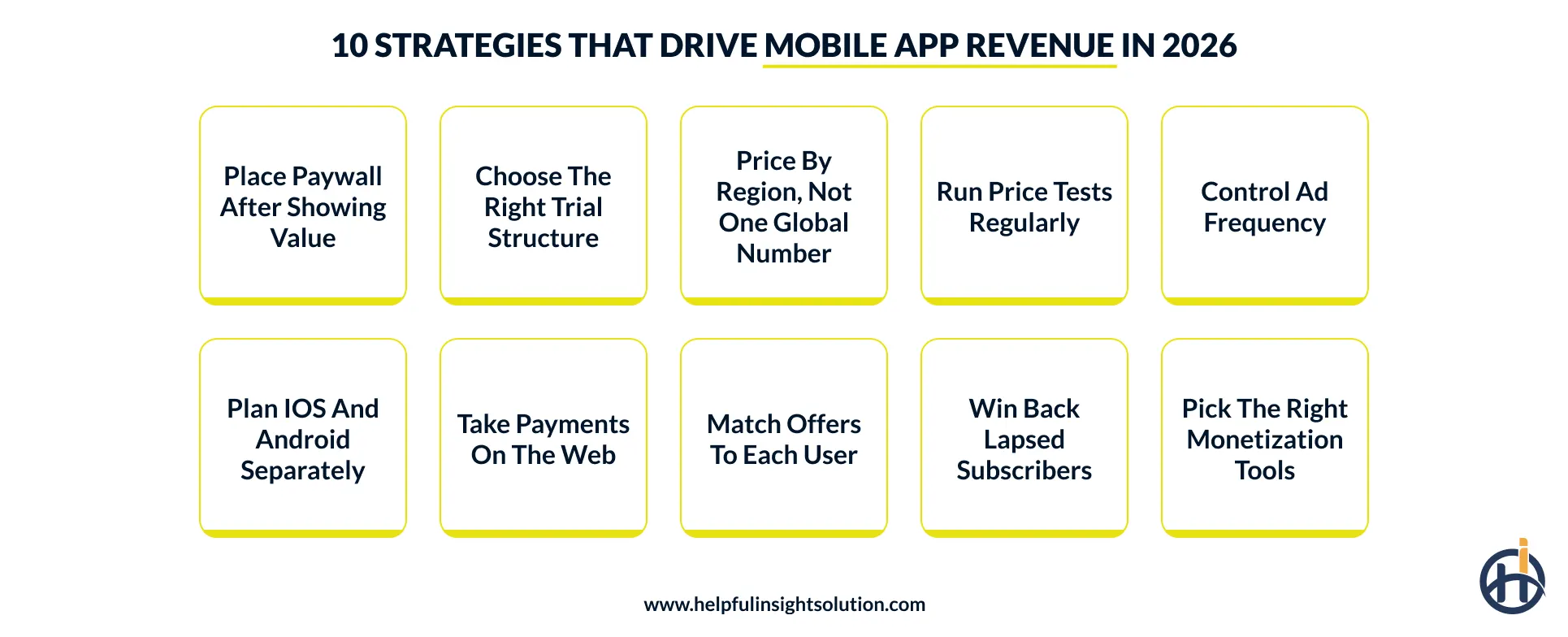
Here are the app monetization strategies driving mobile application earnings throughout 2026:
1. Place the Paywall After the Value Is Shown
A paywall asks the user to pay. Where a paywall appears in the app changes how many people will accept or decline it.
The best practice is to place the paywall after onboarding, giving the user enough time to get familiar with the feature.
A study of 40 million paywall openings between February and May 2026 found that all of them occurred during onboarding. Multi-page paywalls, which walk through the value over several screens before the price, converted at 12.41%. Single-page paywalls, which show the offer straight away, converted at 9.07 percent. (Superwall)
Paywall placement is one of the app monetization tips that does not need a new feature. The screens before the ask are doing the selling.
2. Choose Trial Structure Wisely
A trial gives the user the paid version free for a set time. There are three structures to pick from.
- Hard paywall: Nothing opens until the user starts a trial or pays. The store listing does all the selling.
- Freemium: The app works for free. Some features stay locked until the user pays. A user who never pays can keep the free version for as long as they like, which keeps the install base large.
- Reverse trial: The paid features are free for a set period. The account then drops to the free version unless the user subscribes.
Hard paywalls have a median Day-35 trial-to-paid conversion rate of 10.7 percent, compared with 2.1 percent for freemium apps. After a year, the difference is small. Freemium keeps 28 % of yearly subscribers, against 27 percent behind a hard paywall. (RevenueCat)
Trial length is a separate decision. Trials of 17 to 32 days convert at a median of 42.5 percent, against 25.5 percent for trials under four days.
Freemium app monetization brings in a bigger free audience. Revenue then comes from a small share of it. A hard paywall starts with fewer installs and converts more of them. Getting this decision right is central to how to monetize an app without losing early users.
3. Price by Region Rather Than One Global Number
The global price charges the same amount for every market, while regional pricing sets a different amount for each storefront. Because purchasing power and user expectations vary by location, localized price points let developers adapt their offer directly to regional audience habits.
RevenueCat’s 2026 report measures how far apart the markets are. The figures below are medians across the 115,000 subscription apps in its dataset.
| Region | Revenue per install, Day 60 | Lifetime value per payer, year 1 | Download-to-paid, Day 35 |
| North America | $0.55 | $32 | 2.6% |
| Western Europe | $0.33 | $25 | 2.0% |
| India and Southeast Asia | $0.11 | $14 | 1.4% |
Source: RevenueCat’s 2026 report
A payer in North America is worth 2.3 times a payer in India or Southeast Asia over the first year. Trial-to-paid conversion splits the same way: 34.2 percent in North America versus 15.2 percent in India and Southeast Asia.
Netflix, Spotify, and YouTube Premium each list different subscription fees by country.
- USA: $8.99/month
- India: ₹149/month (~$1.51 USD)
- UK: £7.99/month (~$10.58 USD)
Source: Netflix pricing
4. Run Price Tests Regularly
A price test compares two prices at the same time.
Google Play has built price tests into its console. A price experiment splits users equally between a control and up to two price variants. Each variant reports revenue, orders, buyers, buyer ratio, and average revenue per paying user, so effectiveness can be measured. An experiment can run for six months at most. Prices go back to the original price 14 days after a result becomes statistically significant. (Google Play Console Help)
The same method is used for packaging, which is the set of plans on offer and how long each one runs. In the productivity category, 76.7% of subscriptions are monthly. Those plans are responsible for 90.7% of the revenue. Annual plans are better for retention across categories, but 35% of all annual cancellations happen in the first month. (RevenueCat)
Price testing is one way to increase app revenue without any new development. A test result is read against a baseline, and mobile app category download and usage figures provide that comparison. Running these tests consistently is one of the more reliable app monetization tips teams can act on without shipping a new feature.
5. Control How Often Ads Appear
Ad revenue depends on two things. One is the number of ads shown. The other is what each ad pays.
The rate is set by the format. Banner ads held 36% of in-app ad spending in 2025. Interstitials are the fastest-growing format, at 9.5% a year through 2033. (Grand View Research)
The gap between formats is wide. Rewarded video averaged an eCPM (effective cost per mille) of $15.15 in the US. Banners averaged $0.50. eCPM is the revenue per thousand ad views. (Appodeal, Q4 2024, via Mistplay)
Each format also interrupts the session differently. Rewarded ads are opt-in, and the user starts the ad to get something in return. Interstitials are placed between two actions, like the end of a level. Banners stay on screen while the app is being used. Testing this mix regularly is a simple ad monetization strategy that doesn’t call for any new feature work.
6. Plan iOS and Android App Monetization Separately
The same app earns different amounts on each store. Two things change: one is what the store charges, and the other is what an ad is worth on that platform.
Rewarded video in North America averaged an eCPM of $13.90 on iOS and $9.20 on Android. Banners went the other way, at $0.55 on Android and $0.35 on iOS. (Appodeal, Q4 2024, via Mistplay)
Ad returns are not the same on both platforms, and no single platform wins on every format. Rewarded video pays more on iOS. Banners pay more on Android.
Android app monetization strategies get planned against that split rather than keeping it the same on both platforms.
- Weight the ad formats by platform: On iOS, emphasize the rewarded ads format, and banner ads on Android.
- Start price tests on Google Play: Price experiments run inside the Play Console. On iOS, prices are tested through the paywall in the app instead.
- Plan ad placement around screen size: Android app development covers a wider range of devices and screen sizes, which changes where a slot fits without covering content.
- Report revenue per platform: A single combined figure hides which store is carrying the result, and which one a change actually moved.
7. Take Payments on the Web Instead of Inside the App
Store commission was covered earlier in this blog. Apple and Google both take a share of every purchase made inside an app.
A purchase made on the company’s website works differently since the stores are not involved. A card processor handles the payment instead, and Stripe charges 2.9% plus 30 cents per transaction in the US. (Stripe)
The sale is the same either way. What changes is how much of the price stays with the business.
Apple’s guideline 3.1.3(e) states that physical goods and services used outside the app must not use in-app purchases, which is why taxi booking apps and delivery apps take payments directly. Spotify and Netflix do not sell subscriptions through their web application.
Digital items used inside the app generally need native store billing. Physical goods or services used outside the app can use a regular web checkout instead.
This monetization strategy requires an application to have a payment processor, checkout page, account linking back to the app, and refund handling, which all add upfront app development costs but save on commission.
8. Match the Offer to the User Automatically
Not every user has the same expectations from the app. A user who opens the app daily and someone who opened it once are worth different prices.
Automated offer selection decides which price and offers to show each user. The decision can be made from the data an app collects, like how long the person has used it, what they have opened, where they are, and whether they have paid before.
The revenue comes from each group paying. A discount is applied to everyone, reducing the price for users who would have paid in full. The discounted prices are shared only with the segments that need one.
The stores supply the offer types. Apple supports introductory offers, promotional offers, offer codes, and win-back offers on auto-renewable subscriptions. Google Play supports developer-determined offers with eligibility rules the developer sets.
AI development services enable applications to establish automated decision rules directly within the paywall architecture of an application.
9. Win Back Subscribers Who Left
A lapsed subscriber has already used the app and paid once. Both stores provide a way to reach that person again.
Apple calls this a win-back offer. It gives a free or discounted rate on an auto-renewable subscription, shown to customers whose plan has expired and is not set to renew. Eligibility is set in App Store Connect, using the length of the paid subscription, the time since it expired, and the gap required between offers. It can be limited to chosen countries. (Apple Developer Documentation)
Google Play lets a subscription be paused for one week to three months instead of canceled. Annual plans and free trials cannot be paused. A user who selects Resubscribe gets the subscription restored at $0.00. (Google Play Console Help)
A monetization strategy should focus equally on both lapsed subscribers and securing new ones.
10. Pick the Right Monetization Tools
App monetization platforms are outside services added to an app to run payments and ads. They cover three jobs.
- Billing and access: The platform checks the receipt on a server, decides what the user has paid for, and keeps that access the same on every device the person signs in on.
- Paywall testing: Prices and paywall screens are changed and tested without releasing a new version of the app.
- Ad mediation: For each ad slot, the platform asks several ad networks for a bid and gives the slot to the best one.
An app monetization platform also reports the numbers used to judge a change: trial-to-paid conversion, revenue per install, retention by cohort, and eCPM by format. Picking one early avoids switching billing providers later, in the middle of growth.
Picking a revenue model early, during app development, sets the product up to earn more later.
How to Choose the Right Monetization Strategy for Your App
Selecting the best mobile app monetization strategies relies upon four distinct product characteristics, every one of which should be evaluated before the mobile app development process begins.
- How often the app gets opened: Daily use supports advertising and subscriptions, because both earn again on every visit. Occasional use suits a one-time purchase or a fee on each transaction.
- How soon the user gets something useful: A product that proves itself in the first minute can ask for payment early. A product that takes a week to show its value needs a free version running alongside the paid one.
- What is being sold: Digital content used inside the app goes through store billing. Physical goods and real-world services are paid for outside it.
- Whether the app carries an order or a payment: A marketplace, booking, delivery, or payments app can charge a percentage of each order on top of anything else it sells.
App category determines baseline performance. RevenueCat’s 2026 dataset provides median benchmarks across subscription applications based on 2025 results.
| Category | Download-to-paid, Day 35 | Trial-to-paid | Lifetime value per payer, year 1 |
| Health and fitness | 2.9% | 37.7% | $35.64 |
| Business | 2.6% | 33.3% | $35.48 |
| Education | 2.3% | 30.7% | $22.82 |
| Utilities | 2.1% | 28.0% | $19.31 |
| Photo and video | 1.2% | 22.2% | $17.45 |
| Gaming | 1.0% | 25.0% | $11.22 |
Source: RevenueCat, State of Subscription Apps 2026
Choosing a monetization model is not a one-time decision. Mobile application monetization gets set, shipped, and then checked against what the numbers come back as. The three columns above do not move together, and the weakest one names the change to make next. These four factors, taken together, shape the broader app monetization models and strategies worth testing first.
A low download-to-paid rate is a paywall problem, fixed by changing where and how the paywall is placed, not by adjusting ad settings.
A low trial-to-paid rate is a trial problem. People start the trial and stop before the first charge. Trial length and the structure behind it are what get changed to meet the users’ needs.
A low payer value is a pricing problem. Lifetime value per payer is the price multiplied by how long the subscription runs, which puts both the price and the billing period in question.
App Monetization Strategies by App Category
Mobile application monetization strategies vary across different mobile app categories depending on the nature of digital goods sold, user transaction behavior, and platform compliance guidelines.
Each category operates under specific store rules that influence whether digital purchases must go through native app store billing or if external payment systems can be utilized.
Fintech App Monetization
Fintech applications earn revenue through transaction fees across their network, such as interchange fees collected from merchants per card sale. Additional income comes from referral commissions earned whenever a credit card or loan request gets accepted.
Robinhood is an investing app in the US. Stocks, options, crypto, and ETFs are bought there without a trading commission. There are three sources of money for the company. The first is transaction-based revenue from the trades. The second is interest from cash balances and margin lending. The third is Robinhood Gold, which is a paid tier with a monthly fee.
In 2025, Robinhood’s total net revenues were $4.5 billion, which was 52% higher than in 2024. Robinhood Gold had 4.2 million subscribers. (Robinhood)
Apps in banking and financial services have to be submitted by the legal entity that provides the service. The requirement is set in Apple’s guideline 5.1.1(ix).
Together, these examples cover some of the different fintech app monetization strategies in active use, ranging from transaction fees to referral commissions.
Want to learn more about building a Robinhood-like app? Explore our detailed guide
Healthcare App Monetization
Healthcare mobile applications are paid for in three main ways. A subscription, a one-time fee per consultation, and billing an employer or an insurer.
The global mHealth apps market was valued at $49.9 billion in 2026, up from $37.5 billion in 2024. Medical apps held 73.0% of it. (Grand View Research)
Hims & Hers is a telehealth app in the US. An online consultation is completed, a provider prescribes, and the treatment is shipped to the door. Billing repeats every 30 or 90 days. Revenue for 2025 was $2.35 billion, up 59%, across 2.511 million subscribers. (Hims & Hers)
Teladoc Health charges per visit instead. Self-pay prices are $89 for 24/7 urgent care, $89 for nutrition, $89 for a dermatology review, and $119 for mental health. (Teladoc Health).
The right medical app monetization strategy usually comes down to whether the care is ongoing or a single visit
Sports App Monetization
Sports apps earn money either from viewers or from participants. Subscriptions for accessing regular live content, in-app purchases for fantasy entries and team packs. A few platforms also sell ticketing and merchandising for real-world events.
DraftKings is a renowned USA sports betting and daily fantasy application. It makes money on the deposit amount from contests for placing bets and entering contests. A margin is kept on each transaction.
DraftKings made over $6 billion in 2025, and the average number of unique paying customers in Q4 2025 was 4.8 million. (DraftKings)
eCommerce App Monetization
eCommerce apps earn on the goods passing through them. A marketplace takes a fee on each order. A retailer adds a paid membership, and sellers also pay for advertising inside the app.
Amazon is a marketplace where third-party sellers list products. A referral fee is charged on every item sold, as a percentage of the sale price. Rates are between 5% and 45% by category, with a minimum of $0.30 per item. Home and kitchen is 15%. Computers are 8%. (Amazon)
Shopping apps that sell subscriptions have a download-to-paid rate of 1.3% within 35 days. The trial-to-paid rate is 35.0%. (RevenueCat)
Travel App Monetization
Travel apps earn on bookings, on advertising, and on membership.
Booking.com lists hotels and rentals. The reservation is taken in the app, a commission is then charged to the property on the completed stay.
Advertising runs alongside the commission. Hotels and airlines pay for sponsored placement in search results. Booking.com and Expedia both sell it.
Membership is the third line. The trial-to-paid conversion for travel is the highest in RevenueCat’s 2026 category data, at 43.5%. (RevenueCat)
How to Monetize an App Without Ads
Monetizing an app without relying on traditional advertising means working within strict marketplace regulations while using alternative business models. Certain app categories face outright bans or restrictions on ad networks.
Apple’s App Store Review Guideline 1.3 states that apps in the Kids Category are prohibited from using third-party advertising, tracking SDKs, or behavioral profiling. Only tightly vetted, context-specific ads that comply with COPPA and pass human review are permitted. Similarly, under Guideline 5.1.1(ix) and Google Play’s User Data Policy, apps handling sensitive health or personal data face severe constraints regarding how user interaction data can be collected or processed, effectively eliminating targeted programmatic ad monetization.
Knowing how to monetize an app without ads matters most for kids’ apps and health apps, where ad networks are restricted or banned outright by store policy.
To build sustainable revenue streams without ad networks, developers can deploy specialized non-advertising models tailored to their core audience and product structure:
| Method | How it works | Who pays | Example |
| Organization licensing | Access is bought for a whole group and billed to the organization | Employers, insurers, schools, gyms | Teladoc Health sells to employers and health plans alongside its per-visit pricing |
| White-label licensing | The app is rebranded and shipped by another company under its own name | The licensee company | Common in gym, clinic, and field service software |
| API access | Other businesses call the app’s service or data, billed by request | Developers and partner companies | Google Maps Platform bills by request, with plans at $100 a month for 50,000 calls and $1,200 a month for 250,000 calls |
| Seller subscription | Sellers pay a fixed monthly fee to list, separate from any per-order fee | Sellers on the platform | Amazon charges $39.99 a month on the Professional plan, or $0.99 per item on the Individual plan |
| Physical goods | Hardware or merchandise is ordered in the app and shipped, paid outside store billing | The user | Fitness apps that sell a band or a device alongside the app subscription |
Common App Monetization Mistakes to Avoid
Mobile app monetization challenges are usually found in the reporting, when an application is supposed to make revenue, but numbers are not increasing. Here are five challenges that come up repeatedly:
- Over-monetization: Ads get shown too often, or a feature that used to be free is moved behind a paywall, and the app stays installed while the sessions get shorter. Ad revenue per session falls along with the session length.
- Under-monetization: The free version covers what the user needs, which leaves nothing in the paid tier answering a need the free one has left open. Conversion stays low while server costs are still being paid for every free account.
- No way to reach a lapsed subscriber: Monthly subscribers come back at around 18% to 24% within a year, against around 4% to 6% on annual plans. (RevenueCat) An app with no win-back offer and no record of who lapsed reaches none of that group, which leaves the recovery to whoever returns unprompted.
- A model the usage pattern cannot carry: An app that gets opened twice a year makes a poor fit for a subscription, because the renewal happens once and then stops. How often the app gets opened is what decides which model holds up.
- A price change dropped on existing subscribers: An increase applied without notice turns a renewal into a cancellation, because the subscriber finds out at the moment the charge lands. Both stores have rules covering a subscription price rise, and those rules get checked before the change is scheduled.
These aren’t the only app monetization ideas worth testing, but they cover what tends to move revenue fastest.
How Can Helpful Insight Help You Build a Revenue-Generating App?
At Helpful Insight, we evaluate 4 key factors that guide a mobile app development project: product, target audience, market, and expected usage frequency. These criteria establish an effective framework, drawing directly from proven industry benchmarks.
Our unified development team manages every phase from early discovery through design, implementation, and launch. We integrate native marketplace billing alongside backend receipt validation, cross-device entitlement syncing, and dynamic paywall setups that support remote configuration without requiring app store updates.
Over 2,000 digital products have successfully launched using this framework across 40+ countries and 30+ business domains. Your app could be next in our portfolio of mobile applications built using the best monetization practices.
Frequently Asked Questions
App monetization is the process an app uses to generate revenue after launch, through user payments, advertising, or partnerships, rather than at the point of download.
App monetization is the way a mobile application is used to generate revenue. The app is published for free or for a price. After that, the money is collected from the user, from an advertiser, or from a partner company. Billing for digital items is done through the App Store or Google Play. A commission is kept by the store on those sales. Physical goods are paid for outside the store, through a normal payment page. This is broadly how app monetization works across most categories.
There are five ways that are used most of the time. These are paid downloads, in-app purchases, subscriptions, advertising, transaction fees, and partnership revenue. The category of the app is what decides which of them is used, along with how often the app is opened. More than one of them can be used in the same app.
How you monetize an app usually comes down to combining two or three models, ads, subscriptions, or transaction fees, chosen based on how often users open the app and what it sells. Getting the trial and paywall structure right is a large part of how to monetize mobile app revenue in the first place.
Placement and pricing are what most of the app monetization strategies for 2026 are built on. The paywall is placed after onboarding. The trial structure is matched to the product. Prices are set separately for each region, and they are tested on a regular basis. The set that is used is different for a fitness app and for a marketplace. Regular price testing is often the best app monetization strategy for apps with steady installs but flat revenue.
Fintech apps are used for holding or moving money, and the revenue comes from that activity. A share of each transaction is kept. Interchange is collected on card payments. Referral fees are paid when a loan or a credit card application is approved. Interest is earned on the balances that are held. A paid tier can also be added on top of these. Apple has a requirement that the app is submitted by the legal entity that provides the financial service.
Medical apps are paid for by a subscription or by a one-time fee for each consultation. Billing an employer or an insurer is also possible instead of billing the patient. Advertising is limited for these apps. Health and fitness data is not allowed to be used for advertising under Apple’s rules. The medical app monetization strategy that is chosen depends on whether the care is ongoing or a one-off.