

Key Takeaways:
- Generative AI technology in customer service helps businesses automate conversations, answer customer queries, and deliver personalized support.
- The best use cases of GenAI in customer support include smart virtual assistants, automated email responses, sentiment analysis, and knowledge management.
- Businesses integrate generative AI to improve response times, support scalability, enhance customer experiences, and reduce repetitive workloads.
- From market research to performance monitoring, an entrepreneur must follow dedicated steps to implement GenAI tools for customer service.
Every business depends on customer experience and satisfaction, but what happens when a user turns back, left frustrated? Most enterprises suffer from reduced platform engagement, increased workload, and mismatched user intent due to a lack of technical edge.
Here, the role of generative AI in customer service increases, as it provides tools to automate repetitive tasks, understand user behavior, and enhance retention rates. GenAI platforms understand business goals, train on existing data, follow market trends, and deliver recommended outcomes for growth.
Precedence Research reported that the GenAI market in customer service will reach a value of $1.2 billion in 2028. Additionally, it shows a case study on Delta Airlines that developed a chatbot, “Ask Delta,” using generative AI to assist clients in finding flights, checking in, and tracking their bags. The company has reduced call center volume by 20%, increasing overall engagement.
Businesses can implement GenAI in their existing systems and can experience a similar positive impact. This blog discusses strategic use cases, benefits, and an integration process that will help enterprises create smart customer-centric solutions with generative AI.
What is generative AI in customer service?
The innovation of generative AI for customer service helps businesses create human-like and context-aware responses. It can understand user intent by extracting data from the company’s knowledge bases and personalize support across multiple channels. GenAI uses large language models to provide conversational search, ticket triage, and interactive copilots.
Key market insights
Here, we will study how generative AI has transformed the customer service sector based on revenue growth and regional share.
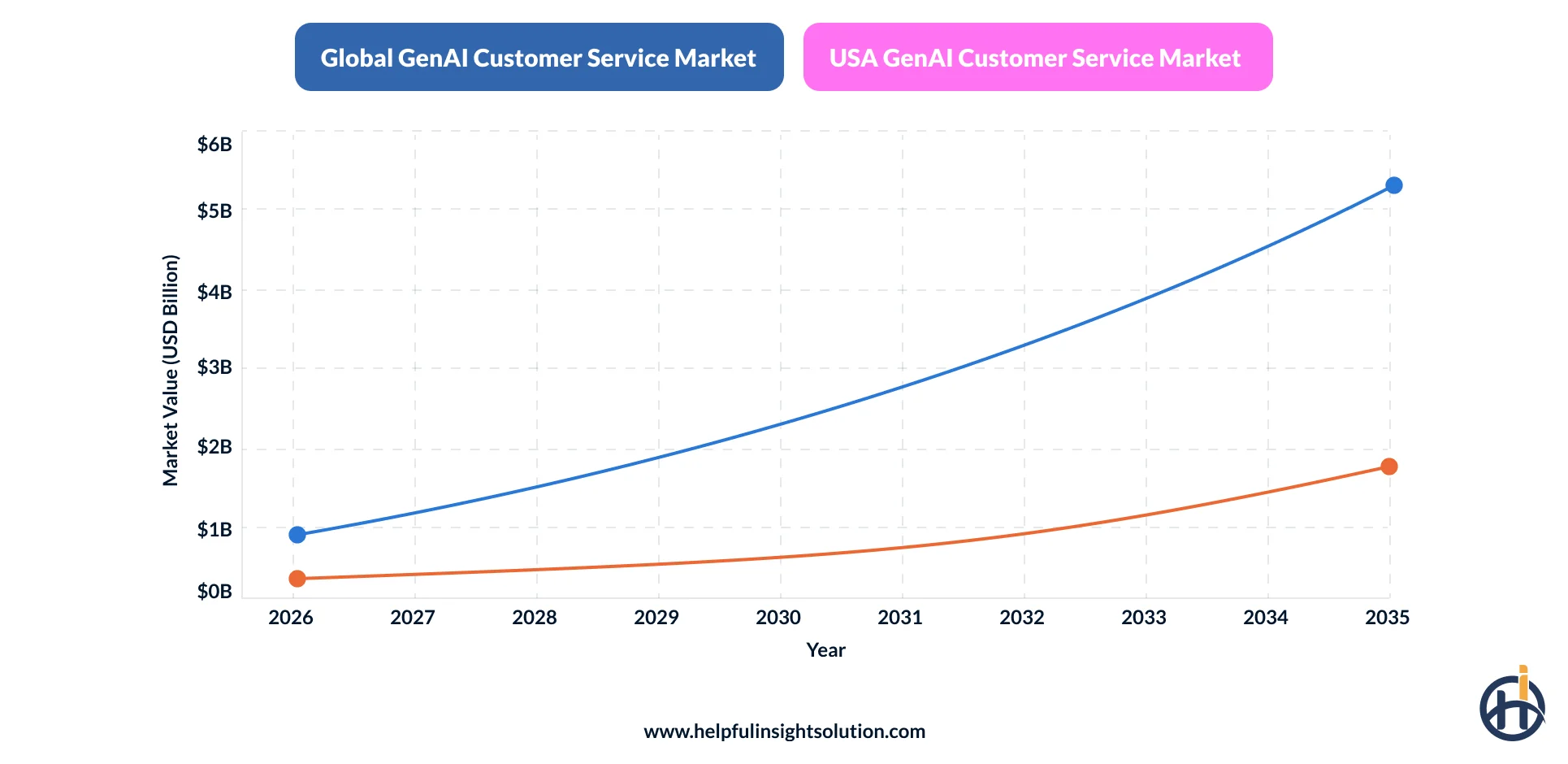
- The global GenAI-powered customer service market volume will be $0.95 billion in 2027, with North America having a share of 48% of the market.
- The overall revenue will reach $5.3 billion by the end of 2035, as the market is growing rapidly at a 24.3% CAGR rate.
- In the USA, the generative AI-driven customer support market is expected to generate revenue of $0.26 billion in 2026, which will reach $1.8 billion by 2035.
- Europe and Asia-Pacific have an overall share of 28% and 21%, respectively, in the GenAI user service segment.
How does it work?
In this section, you are going to study how GenAI for customer experience automation works through the following simple steps.
- The system can read past chat logs, create new articles, and learn company manuals.
- GenAI uses smart LLMs to understand customer queries and predict major goals.
- It generates clear responses by using secure AI patterns learned during model training.
- The algorithm verifies the facts by filtering the content and providing a polite tone.
- At last, the user gets the reply, which is stored in the database for future answers.
Generative AI vs. Traditional AI in customer service: A detailed comparison
Companies using generative AI for customer experience can easily produce dynamic, human-like, and context-aware responses in real time. Traditional AI solutions use rule-based scripts and fixed logic trees to answer repetitive queries, which have a rigid architecture.
For example, generative AI for marketing helps businesses to create automated campaigns and email responses. In this section, we are reviewing a table that differentiates between generative AI and traditional AI models.
| Parameter | Generative AI | Traditional AI |
| Response generation | Creates human-like, context-aware responses based on customer queries and conversation history. | Provides predefined or rule-based responses based on specific inputs and programmed workflows. |
| Handling complex queries | Can understand nuanced questions and generate flexible responses to diverse customer problems. | Performs best with structured, predictable queries that match predefined scenarios. |
| Personalization | Uses customer context and conversation data to deliver more personalized interactions. | Offers limited personalization based primarily on predefined customer data and rules. |
| Scalability | Handles large volumes of conversations while adapting responses across different customer scenarios. | Scales repetitive tasks effectively but requires additional rules and workflows for new scenarios. |
| Use cases | Suitable for virtual agents, content generation, conversational support, summarization, and complex issue resolution. | Commonly used for chatbots, FAQs, ticket routing, sentiment analysis, and automated workflows. |
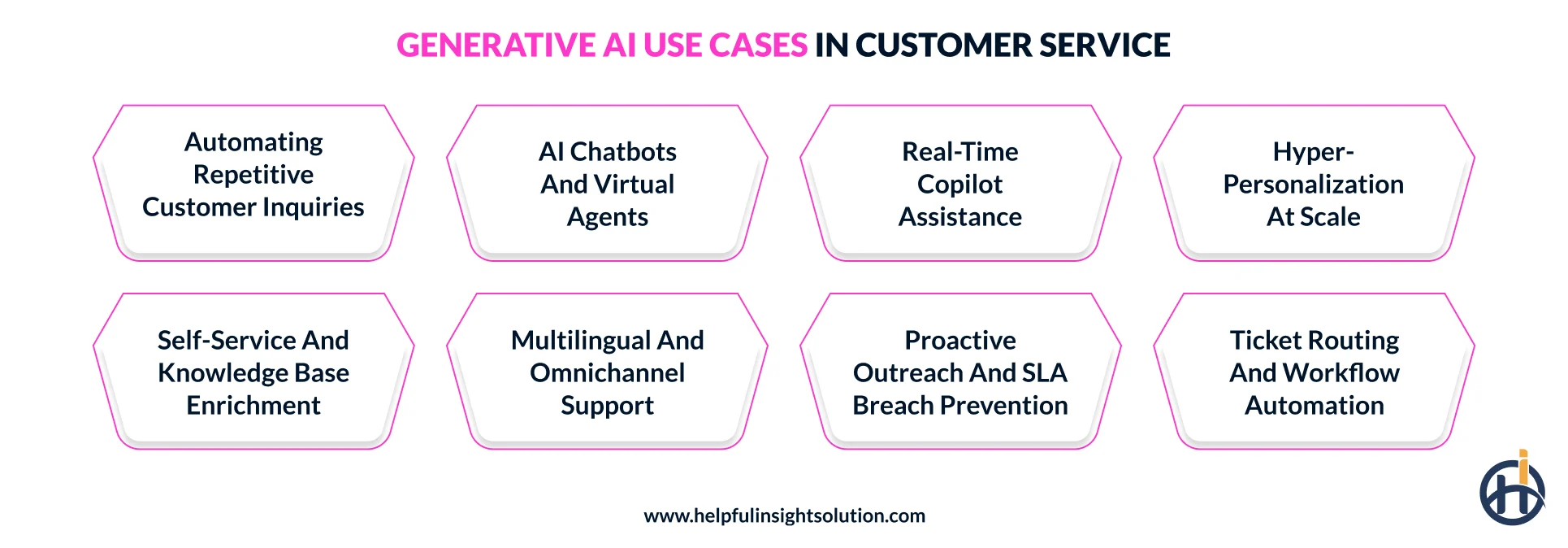
Top 8 generative AI use cases in the customer service sector
Virtual assistants, ticket routing, and query automation are the key generative AI use cases in customer service. You will study all these trends in this section and understand the applicability of this technology.
1. Automating repetitive customer inquiries
GenAI can easily handle high-volume requests, like order status, how to handle returns, account updates, and much more, eliminating the need for human involvement. This ensures that agents can dedicate their time to those high-value, complex tasks that truly require human logic.
- Businesses typically see automation rates for tier-1 queries, directly reducing the average ticket volume reaching human agents.
- This works best when paired with structured data sources like CRM, where accuracy drops significantly without clean backend integration.
2. AI chatbots and virtual agents
Most conversational AI agents can easily understand conversations across multiple chats and can resolve complex issues. Unlike traditional bots, generative AI-based customer service platforms can interact with the customer end-to-end to know the context and generate dynamic responses accordingly.
- Modern virtual agents can easily escalate seamlessly to human agents mid-conversation, passing full context so customers never have to repeat themselves.
- Deployment typically requires guardrails, such as escalation triggers, to prevent the AI from making commitments outside company policy.
3. Real-time copilot assistance
GenAI is used as a co-pilot for human agents by presenting a specific article based on the question, predicting responses, or providing summaries of customer interactions. For instance, a GenAI copilot can pull up a customer’s previous chats and suggest relevant responses, cutting research time during live conversations.
- Copilots reduce average handling time by giving agents instant access to relevant past ticket resolutions, not just static knowledge base articles.
- Many platforms also use copilots for compliance to auto-flag responses that might violate tone guidelines or regulatory requirements before an agent sends them.
4. Hyper-personalization at scale
Generative AI agents achieve hyper-personalization by thoroughly analyzing a user’s history and patterns, resulting in more optimized suggestions and responses throughout every conversation. This task cannot be done manually for numerous interactions due to a high number of customer queries.
- Personalization extends beyond responses to timing and channel, where GenAI can determine the best platform to reach a specific customer.
- Requires strong data governance, since personalization relies on pulling sensitive customer data across multiple systems, raising privacy considerations.
5. Self-service and knowledge base enrichment
The GenAI continuously monitors customer interactions to look for any gaps by proactively generating help center articles and FAQs. This not only keeps the self-service knowledge updated but also helps to decrease the number of repeat tickets over time.
- GenAI can also identify outdated or conflicting articles in existing knowledge bases and flag them for review, not just fill gaps.
- Some platforms auto-generate content in multiple formats, like video scripts and FAQs, from a single support interaction pattern.
6. Multilingual and omnichannel support
This use case of generative AI helps to maintain natural conversations across multiple languages and channels, like chat, voice, and social media, keeping the same context for every interaction. Businesses can therefore cater to customers across the globe without additional regionalized support resources.
- Beyond translation, GenAI adapts tone and cultural context, which is a direct response style that works in one region but may need softening in another.
- Omnichannel memory means a customer can start a conversation on chat and continue via email or phone without losing context or having to restate their issue.
7. Proactive outreach and SLA breach prevention
This technology keeps track of ticket trends and response times by alerting systems if an SLA is going to be missed and ensures any necessary customer updates are sent automatically. It can decrease escalations and build trust by preventing technical issues before the customer complains.
- It often ties into predictive analytics, where GenAI can forecast ticket volume spikes during product launches and pre-allocate resources accordingly.
- Proactive outreach can extend to service disruptions unrelated to a specific ticket, like notifying all affected customers of an outage before they even contact support.
8. Ticket routing and workflow automation
Various generative AI tools can easily analyze user queries based on their intent and priority, which ensures real-time customer service automation. This helps business teams reduce manual triage and speed up resolution times across multiple industries.
- Advanced routing considers agent skill-matching and current workload by ensuring tickets go to the best-equipped available agent.
- This includes automatic priority rescoring for low-priority ticket sentiment shifts, where GenAI can escalate it automatically without manual review.
Comparing generative AI, agentic AI, and agentic RAG
For a business investor, it is crucial to understand the differences between generative AI, agentic AI, and agentic RAG before implementation. Most generative AI customer service examples also follow agentic RAG to rewrite search queries, verify databases, and evaluate data sufficiency.
Additionally, agentic AI is used in AI voice receptionists for planning, execution, and decision-making in real time. The following table helps us to know the key differences between these models.
| Factor | Generative AI | Agentic AI | Agentic RAG |
| Primary function | Generates natural-language responses, summaries, and content based on customer inputs. | Autonomously plans and executes multi-step actions to resolve customer issues. | Combines autonomous action-taking with real-time retrieval of relevant business knowledge. |
| Knowledge access | It primarily relies on its trained model and the provided context. | Can access tools, systems, and data sources to complete tasks. | Retrieves up-to-date information from company databases, knowledge bases, and documents before responding or acting. |
| Decision-making | Responds to prompts but generally does not independently execute complex workflows. | Analyzes situations, makes decisions, and determines the next steps toward a goal. | Makes decisions using retrieved, current information to improve accuracy and task execution. |
| Customer service use cases | Chatbots, FAQ responses, email drafting, conversation summarization, and personalized replies. | Complaint resolution, refunds, order changes, appointment scheduling, and multi-step support workflows. | Policy-aware troubleshooting, product support, account assistance, and complex queries requiring current company information. |
| Key advantage | Delivers fast, natural, and personalized customer interactions at scale. | Reduces manual intervention by autonomously completing end-to-end support tasks. | Combines autonomous action with grounded, up-to-date responses, reducing hallucination and improving reliability. |
Key benefits of using generative AI for customer service
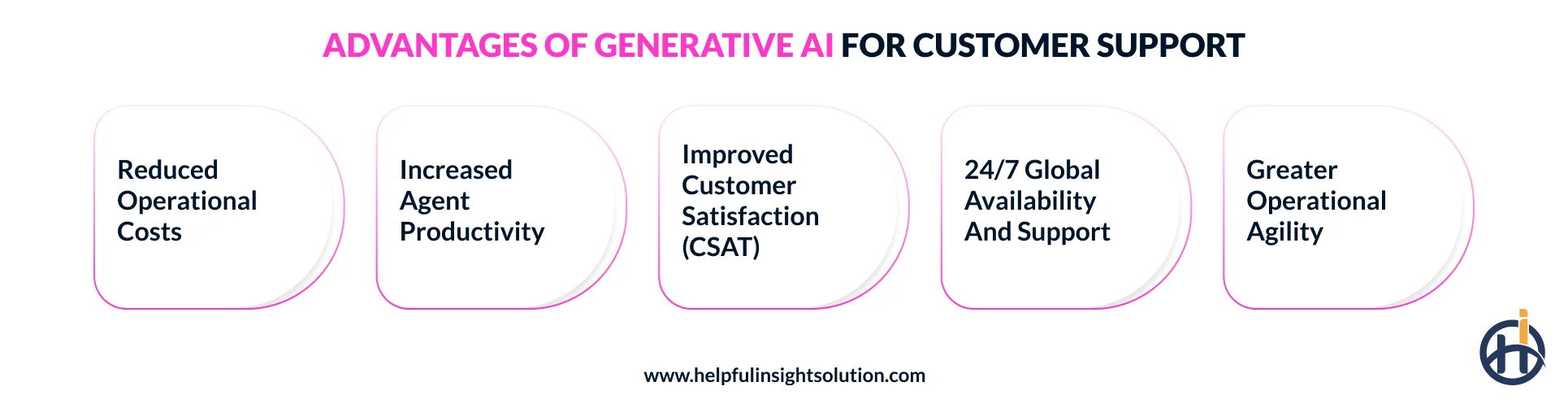
This section describes some important benefits of generative AI in customer service, like cost reduction and support. As an entrepreneur, you must know these advantages before investing in this technology.
1. Reduced operational costs
GenAI is ideal for handling high-volume, repetitive questions such as order status requests and FAQs. It can easily manage agent demand, reduce headcount and training expenditure, and free up capital that can be used for other business purposes.
2. Increased agent productivity
AI agents prevent repetitive tasks and offer real-time knowledge base suggestions to focus on resolving more complex customer inquiries. For example, AI in insurance impacts staffing and drives agent team output while reducing churn amongst agents and supporting greater customer experiences.
3. Improved customer satisfaction (CSAT)
Improved response rates and faster turnaround help to personalize recommendations, reduce the number of customer touchpoints, and lead to enhanced user engagement. When more complex or urgent service is required, customers also note higher levels of loyalty.
4. 24/7 global availability and support
AI agent software provides 24/7 service and is accessible across the globe due to its enhanced working efficiency and high accuracy rate. This facility supports multiple businesses to easily operate in different time zones or countries.
5. Greater operational agility
Various GenAI solutions can easily handle the launch of new products, policies, or consumer demand without any traditional training. It allows businesses to adapt to customer support operations faster than traditional or existing staffing models.

Major challenges with GenAI-powered customer support systems
Enterprises face various challenges, such as data privacy, with generative AI customer support systems. We are going to cover some crucial issues in this particular section with their respective solutions.
1. Accuracy and hallucination risks
LLMs in GenAI systems generate false information, misinterpret complex user queries, and fail to verify real-time facts. These accuracy issues may lead to incorrect troubleshooting steps, false policy promises to users, and customer trust erosion.
Solution: Retrieval-Augmented Generation (RAG) connects AI models to a verified knowledge base that fetches exact facts before generating a response.
2. Lack of emotional nuance
Most generative AI solutions cannot replicate human emotions, as they sound robotic during high-stress situations or environments. This may trigger customer frustration when they deal with sensitive issues due to missed context and rigid scripts.
Solution: With hybrid escalation programs, entrepreneurs can detect complex emotions to transfer the conversation to a human agent with a full summary.
3. Data privacy and security concerns
These challenges include customer data exposure, non-compliance, malicious data poisoning, and unauthorized system access. Various attackers use prompt injection to manipulate AI models to disobey laws like GDPR and share sensitive data.
Solution: It is beneficial to deploy an enterprise-grade framework that uses strict data masking and zero-retention agreements with AI vendors.
4. Integration complexity
The existing tech stacks are old, data is unstructured, and APIs are complex, which leads to various integration issues. These barriers produce high implementation costs, delayed rollouts, and fragmented handoffs between AI systems and human agents.
Solution: Businesses may use a unified middleware API orchestration layer that acts as a bridge between AI models and legacy CRM or ERP systems.
Implementing GenAI in customer service platforms
To implement generative AI in customer support, you need to know the various steps that are commonly used. Here you will study key integration stages, from defining to execution, that most businesses follow.
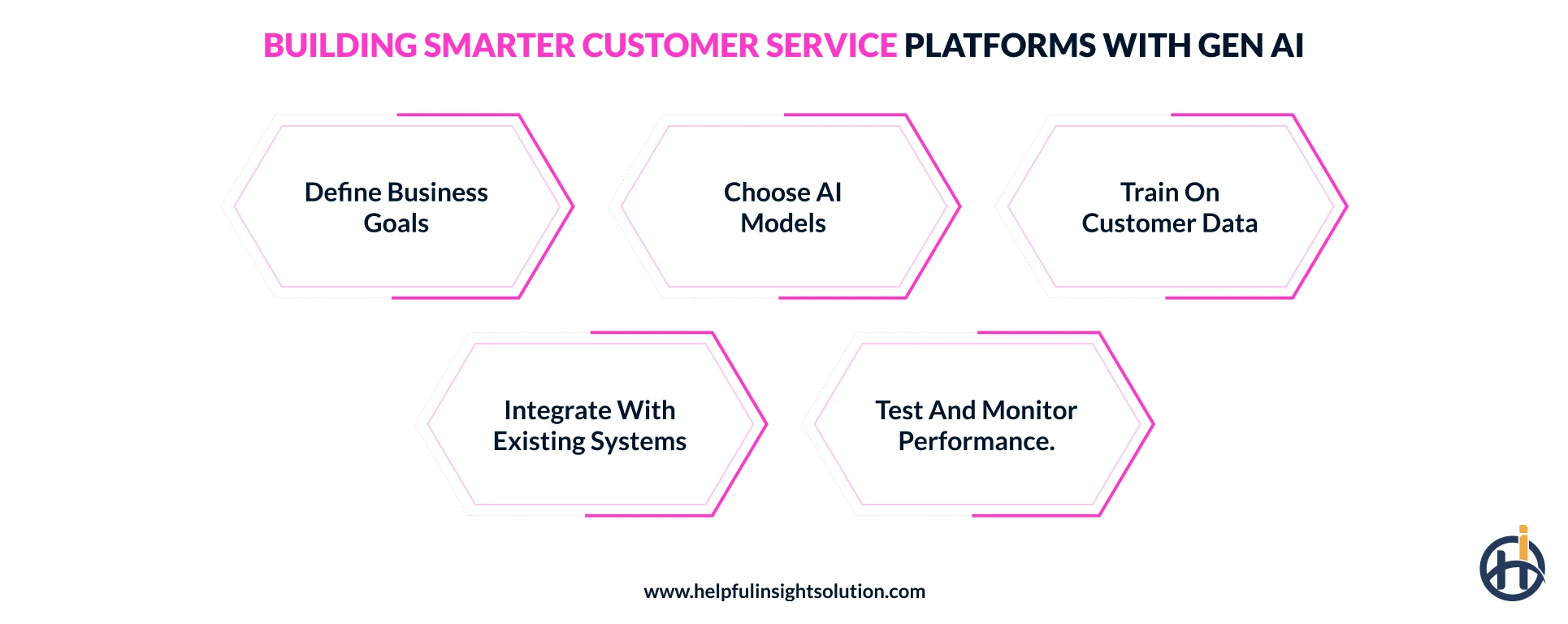
1. Define business goals
First, determine the concrete problems that GenAI needs to solve, such as reducing ticket volume, shortening reply times, or improving customer satisfaction. Set your objective goals to ensure that the effectiveness can be easily traced against the enterprise’s business results.
These parameters can serve as a guide that helps to prioritize which problems to solve based on the requirements and project needs.
2. Choose AI models
Determine which of the available LLMs and platforms is appropriate for generative AI development based on accuracy, customization options, scalability, and compliance.
It is also crucial to consider the total price, average latency, and the need for a single-model or multi-model technology. This probability is highly dependent on the real-time problem statement and user demand.
3. Train on customer data
You should fine-tune AI models by leveraging company documents, historical tickets, and brand visibility to create informative, relevant, and consistent information.
These clean and formatted data inputs can be used as a source to improve output quality and eliminate false assumptions. This step requires close collaboration between AI engineers and support teams who understand real customer pain points.
4. Integrate with existing systems
Integrate the solution with your channels, CRM, ticketing, and helpdesk so that data can flow easily without friction. The impact of generative AI on customer service helps businesses gain access to the information needed to deliver an intelligent and user-specific answer.
This could perhaps be the most technical step, as it enhances legacy systems to operate independently.
5. Test and monitor performance.
Test with a small group of actual users before public launch, carefully watching accuracy, resolution rates, and user feedback. It is crucial to implement ongoing monitoring dashboards that regularly track accuracy drift, errors, or edge cases in real time.
Businesses should iterate on actual customer data so that you continuously improve the system.
How does Helpful Insight assist businesses in integrating generative AI solutions for customer service?
Entrepreneurs must not wait long to search for experienced and reliable partners with expertise in AI technologies. We help clients easily integrate generative AI in customer service platforms by understanding their customer needs and market demand.
Our team is highly focused on delivering smart solutions that can manage email campaigns, revenue cycles, user queries, and delivery handling. They specialize in offering agentic AI, conversational AI, agentic RAG, and predictive AI models to analyze business workflows, process training data, and execute outcomes that match customer requirements.
It is crucial to invest in AI development services that ensure advanced language models to understand user intent and native algorithms for content quality. This can attract more customers for enterprises that were lagging behind other competitors due to technical advantages.
So, it is the right moment to start with GenAI technology for delivering enhanced real-time customer service.
FAQs
Businesses invest between $25,000 and $200,000 in creating smart generative AI solutions for various customer services. The price is dependent on technical complexity, scalability, and data training models. For enterprise-grade platforms, the cost may increase due to large-scale deployment across systems.
Generative AI follows technical safeguards and governance policies like strict access controls and encryption to protect customer data. The system processes inputs within private enterprise channels to prevent data exposure. It uses test data and enforces strict no-training commitments on user prompts.
There are already various generative AI tools available for customer support, which deliver smart services. Some of the major platforms are described in the following manner:
- Zendesk AI: It resolves complex issues across messaging, email, and voice, with 80% automated resolution rates.
- Zoho Desk: This tool offers sentiment analysis, ticket tagging, and visual workflow for Zoho clients.
- Ada: A multi-LLM reasoning engine with strong compliance, best suited for high-volume enterprises with at least 300,000 annual customers.
GenAI technology can automate routine tasks, draft fast responses, and summarize long customer interactions. It reduces handling times, enhances learning, and improves complex problem-solving. Businesses can easily analyze chat logs and search internal company guides with generative AI.
This powerful tool cannot directly replace human service agents, but it will assist them in performing tasks faster and more accurately. In this case, AI will handle repetitive operations, and humans will target complex situations. Some AI tasks will include order tracking, instant answering, and translation.