

Key Takeaways:
- AI-driven voice systems provide 24/7 customer support services, resolving queries and generating business leads.
- They can be easily integrated with advanced CRM platforms with backend services, such as APIs, clouds, and databases.
- These tools serve multiple domains, like healthcare, fintech, and e-commerce, reducing response times and delays.
- Its workflow is efficient with STT to LLM to TTS, ensuring seamless user communication and network interactions.
Have you ever imagined what goes wrong with your customers when they come online on your platform? They connect with the services, get confused by the number of options, and hang up the call. The traditional systems were known as interactive voice response (IVR), which uses keypads to gather user data.
But this process was hectic and time-consuming, affecting overall efficiency and business growth. After observing this, businesses shifted towards modern platforms that used advanced technologies.
Nowadays, AI voice receptionists are becoming popular in different domains that help in lead generation, appointment bookings, and staff management. The finance and healthcare sectors are the top contributors that have implemented AI-enabled voice agents in their systems.
Also, the global market for AI voice agents is expected to reach $35.24 billion by 2033, highlighting the growing use of voice-powered ttechnology in various industries.
So, this is the right time to create an interactive and intelligent AI receptionist for business services, enhancing user engagement and task automation. This blog provides various topics, from benefits to challenges, that you should not miss.
What is an AI-Powered Voice Receptionist?
An AI receptionist provides 24/7 customer support services by using natural language processing to answer phone calls instantly. Additionally, it understands user intent and manages various tasks like scheduling, FAQ handling, and lead verification. These tools are used in various industries, such as healthcare to manage patients, fintech to handle bank queries, and retail to resolve product issues.
They generate automated messages and notifications based on the user preferences and call history. In complex cases, voice-based AI assistants forward queries to expert members, improving domain efficiency and reducing delays.
- These tools help to reduce operational costs as compared to human receptionists.
- They can handle multiple calls in real-time without generating busy signals.
- AI voice software can handle general queries with instant replies.
Why are Businesses Adopting AI Voice Receptionists?
The top benefits of AI voice receptionists include quick query resolution, profit-making, and efficiency. These advantages encourage businesses to invest in the making of AI tools that can boost engagement.
1. 24/7 Availability & Instant Response
The speech-enabled AI assistants help businesses to address various issues like unanswered phone calls, missed leads, and high staffing costs. They help in maintaining quality services, lowering administrative costs, and reducing churn rate.
2. Improved Revenue Generation
Increased lead generation and conversions allow entrepreneurs to easily make profits by understanding user choices and business outcomes. The advanced AI voice platforms offer multilingual support that helps to interact with millions of users worldwide.
3. Cost Efficiency & Savings
In the case of an AI receptionist, there is no need to provide leaves, salaries, training, or additional benefits, reducing operational expenses. Only one time investment is required for development or integration, which increases efficiency and scalability.
4. Repetitive Task Automation
Take an example of healthcare services, where most tasks like patient scheduling, medication, and appointment bookings are repetitive in nature. So, voice-enabled customer service agents provide FAQs, payment reminders, and potential leads, ensuring consistency.
Core Features of Automated Voice Receptionists
We will discuss the best features of AI Voice Receptionists, such as call scheduling and multi-language support. They enhance task automation, reduce response delays, and optimize real-time business models.
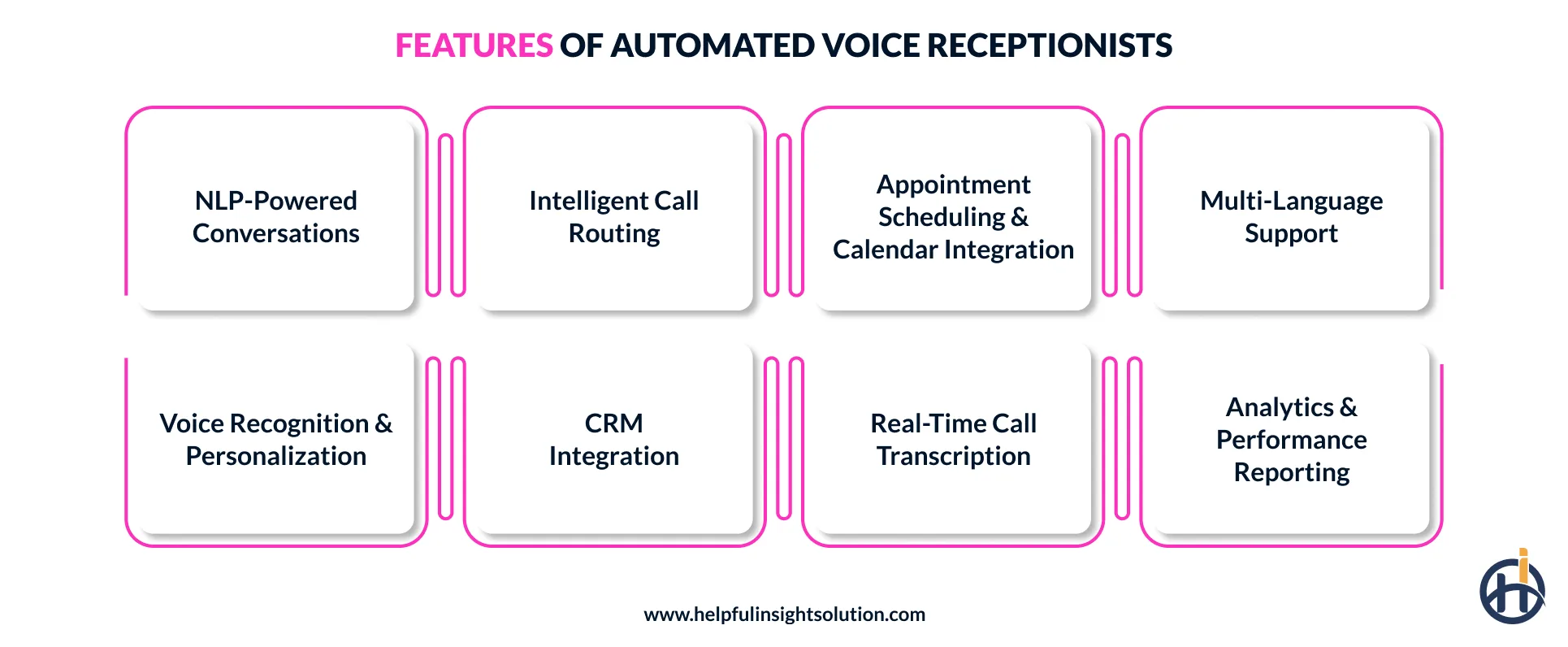
1. NLP-Powered Conversations
The NLP models help to understand different user emotions using contextual language and conversational AI. With this, you can enhance platform features and deliver an engaging workflow environment to users.
2. Intelligent Call Routing
An AI call answering service integrates user data to detect intent and divert the call to expert customer agents. It is suitable in emergency conditions and complex situations, where users need instant responses.
3. Appointment Scheduling & Calendar Integration
AI receptionist systems analyze various user requirements and fix their appointments with doctors or salons. An integrated calendar marks dates and timings after booking, which ensures transparency.
4. Multi-Language Support
These tools understand more than 50 different languages and dialects, supporting multiple regional accents. This increases user interaction, trust, and experiences through multimodal voice support.
5. Voice Recognition & Personalization
The automated AI voice receptionist systems check background noises to filter out different voice patterns. It becomes easy to personalize software features for users by delivering suitable tones.
6. CRM Integration
A CRM platform integrates with AI call management systems to summarize call recordings for future use. It helps in lead generation, workflow automation, and instant response generation through data gathering.
7. Real-Time Call Transcription
By using an AI voice for virtual receptionists, experts help businesses convert speeches into text formats. The system automatically sends the message or generates a notification, maintaining accuracy and trust.
8. Analytics & Performance Reporting
Constant call conversions and sentiment analysis boost performance, increase business sales, and reduce missed chances. It provides various KPIs, like response time, call answer rates, and user satisfaction scores.
Best Industry Use Cases for AI-Enabled Receptionists
Some of the best business use cases of AI voice receptionist software are discussed in this section based on various industries. This will give an idea about the impact of these tools on real-world scenarios.
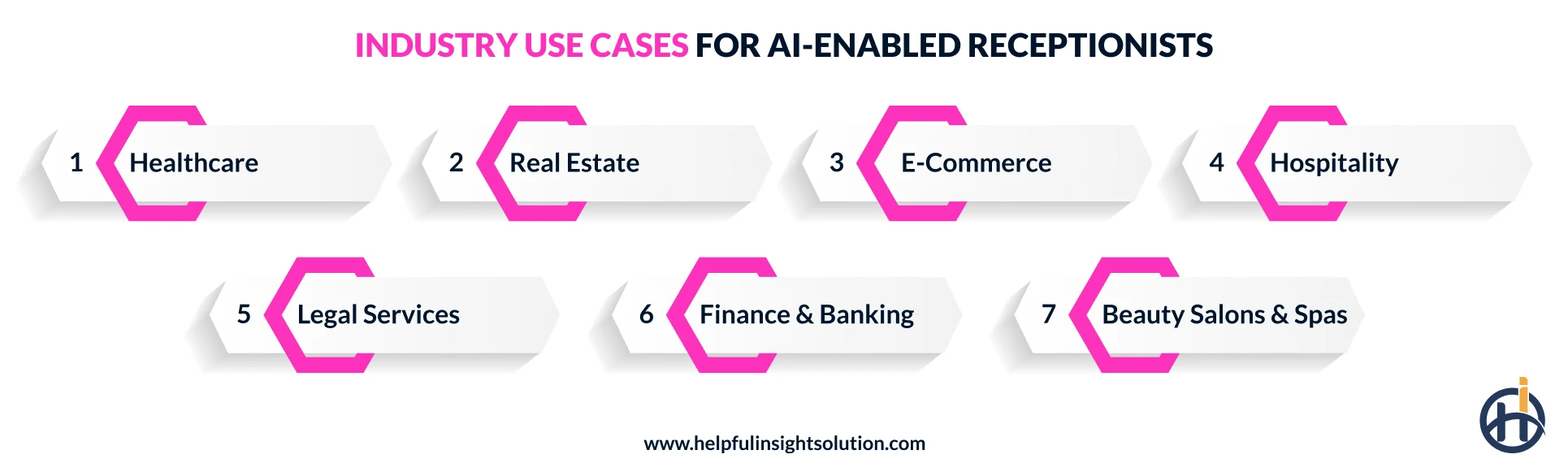
1. Healthcare
The virtual health assistants help to manage front-desk operations, automate routine medical tasks, and improve patient access. They enhance appointment scheduling, patient interactions, prescription management, and insurance verification. These tools handle billings, reducing stress and workload for hospitals or clinics.
Vocca AI: It is an AI voice automation platform that helps hospitals handle calls, bookings, and patient conversations automatically.
2. Real Estate
This is one of the major AI voice receptionist use cases that helps in lead generation and conversion based on property type, budget, and real estate agents. The voice-based AI assistants provide FAQs regarding property descriptions, market rates, and landowners. Businesses get instant follow-ups by updating advanced market listings.
CloudTalk: This is a cloud phone system with AI tools for property sales, support, and call analytics teams.
3. E-commerce
The most common AI voice agents in retail businesses are chatbots that handle various queries regarding order tracking, payments, and cancellations. They regularly monitor the product cart, purchase history, and feedback to deliver accurate responses. With multilingual support, businesses can easily increase sales and generate profitable revenue.
Ringly.io: This AI phone agent platform focused on automating customer support and sales calls for online businesses.
4. Hospitality
Various online hotel, flight, and restaurant booking platforms use highly advanced AI receptionist software to handle late-night user queries. They integrate with PMS/CRM systems to handle increased call volumes, enhancing conversion rates. People can view the seat matrix, book available slots, and make instant payments by connecting with voice AI agents.
PolyAI: It is an enterprise AI voice assistant provider that creates natural-sounding customer service phone agents.
5. Legal Services
Different legal firms build AI-driven voice software that asks clients multiple questions, like case type, jurisdiction, and urgency. These integrated platforms send email confirmations on appointments, reducing missed legal bookings. In case of emergencies, the voice agents are available for 24/7 support and keep all the information confidential from sabotage.
LegalClerk.ai: This is an AI legal assistant designed to automate document review, drafting, and admin tasks.
6. Finance & Banking
The use of virtual calling software in the fintech industry is to perform various tasks, like managing compliance, securing transactions, and onboarding customers. Users can easily discuss their queries regarding credit cards, banking process, and online payments. The AI tools gather user information for KYC, identity verification, document collection, and insurance tracking.
Botphonic AI: It is an AI voice calling tool for creating automated phone agents for finance and customer support.
7. Beauty Salons and Spas
In the salon industry, AI virtual assistants provide conversational and hyper-personalized interactions, enhancing appointment booking and call handling. The AI agents manage customers, set calendar, automate follow-ups, and deliver instant user support. They resolve various queries, like pricing, services, cosmetic shipment, and duration.
BookingBee.ai: This AI appointment booking tool can automate reservations, scheduling, and customer follow-ups.
Difference Between IVR and Conversational AI
Earlier, to resolve user queries, businesses used IVR (Interactive Voice Response) menu systems that were keypad-driven. But now, modern AI receptionist software uses Conversational AI as a key technology to handle user issues and manage various tasks. Let’s understand the differences between these two solutions with the help of the following table.
| Component | IVR (Interactive Voice Response) | Conversational AI |
| Interaction Style | It is menu-driven with predefined options (press or say commands). | It offers natural and human-like conversations using NLP and AI. |
| Flexibility | It is limited to scripted flows and fixed decision trees. | It is highly flexible and adapts dynamically based on user intent. |
| User Experience | It often provides rigid interactions and can feel frustrating. | This offers smooth, intuitive, and context-aware interactions. |
| Technology Used | The examples are DTMF tones and basic speech recognition. | It uses advanced technologies like NLP, ML, and speech understanding. |
| Problem Resolution | This can handle simple, repetitive queries. | It is capable of managing complex, multi-turn conversations. |
How to Build AI-Driven Voice Agents?
In this guide to build an AI voice receptionist, we will now focus on various development stages. They help investors to easily understand business models, budget needs, and resource planning strategies.
1. Define AI Use Cases
To create an AI voice assistant for business services, you must understand various use cases, like customer support and appointment scheduling. Additionally, it is necessary to know the working of these tools in different situations. You should observe the future growth by looking at several market trends that are popular in your domain.
2. Choose Tech Stack
Various AI technologies, like ASR, NLP, machine learning, and deep learning, are used to develop various models based on specific business needs. Top TTS and LLM tools help to transform data formats according to user preferences and demands. They are integrated with effective backend cloud servers that store and deliver instant user responses.

3. Design Conversational Flows
Businesses must use Voiceflow, Dialogflow, or Azure AI to create different conversational flows for voice-enabled AI receptionist systems. For this, you need to list multiple user emotional states, build nodes, and set guidelines based on the inputs. It is crucial to design fallback options for better technical recovery and ensure transitions to handle queries.
4. Integrate APIs & Systems
You should integrate RESTful APIs, CRM portals, and databases that ensure low-latency with real-time voice interactions. They are included in AI development services that help to configure tools and define different AI models, like generative or predictive. Bland AI is the most common tool that defines the role, language, and behavior of AI-powered agents.
5. Train & Optimize Models
Rasa is a common framework that trains different AI models by recognizing multiple industry-specific languages with ASR, NLP, and LLMs. In this last stage of the AI receptionist implementation guide, you will study optimization standards through RAG. This ensures better coordination, reduces response times, and promotes emotional intelligence.
Challenges in the Development of Automated Voice Assistants
You may face various challenges in AI voice receptionist development, such as compliance and system needs. We will discuss some major AI-driven risks with their respective solutions in this section.
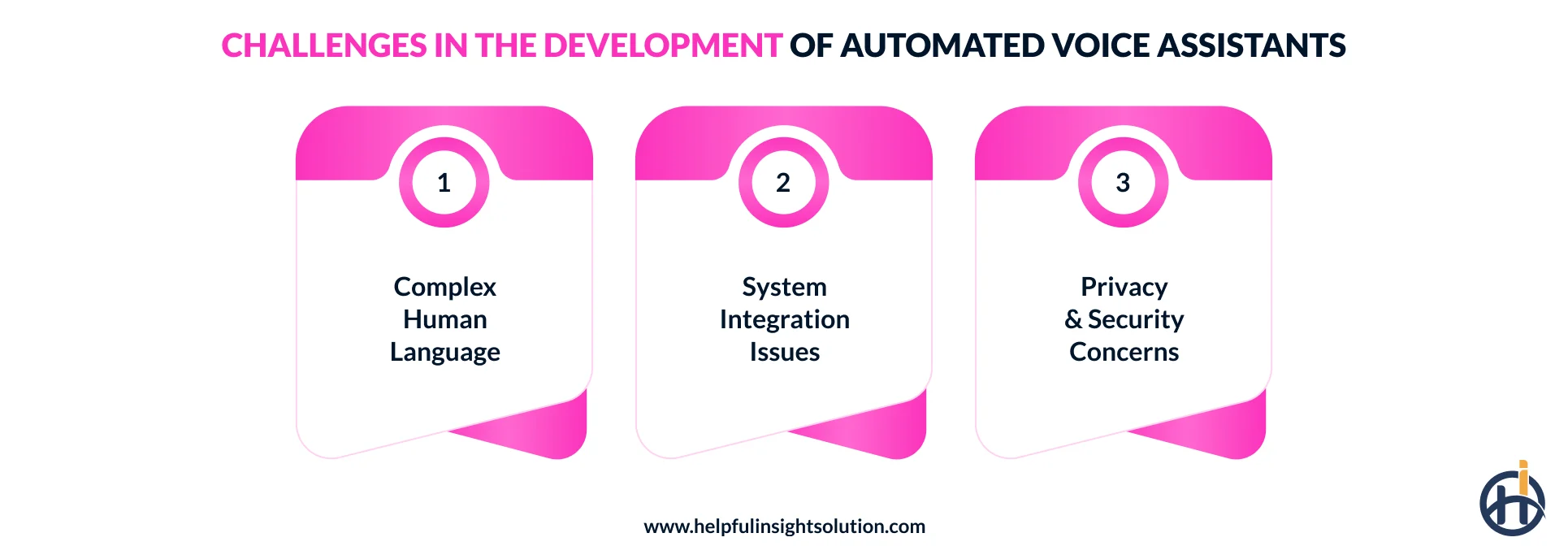
1. Complex Human Language
It is difficult for an AI voice tool to understand various complex regional languages, such as Mandarin. This can impact user experience and preferences, leading to frustration, lack of usability, and trust issues.
Solution: The experts must use conversational AI algorithms that can detect different speech patterns and human tones.
2. System Integration issues
The integration of AI phone receptionist platforms with outdated systems may increase inefficiency and data inaccuracy. Broken API links and disconnected databases also affect the capability of AI-driven tools.
Solution: You should test voice commands on local devices using RESTful APIs, cloud systems, and complex NLP models.
3.Privacy & Security Concerns
The attackers can easily manipulate systems through unidentified voice commands, which may disturb user privacy. They can misuse stored human audio for unethical activities, decreasing compliance.
Solution: It is necessary to implement standard regulations, which include HIPAA, CCPA, and GDPR, for data protection.
Future AI Trends in the Voice-Based Systems
Here, we will study some innovative trends in AI voice receptionist technology, like emotion tracking and Agentic AI. They enhance the overall voice process system, improving user experiences and operations.
1. Agentic AI & Autonomous Action
To integrate AI voice receptionist solutions, businesses must use Agentic AI that ensures strong coordination between different systems. It handles various actions autonomously and is a crucial component in the architecture, managing multiple channels.
2. Emotional Intelligence
The use of Emotional Intelligence (EQ) in AI voice systems can improve conversations, as it can detect human sentiment, tone, and urgency. This model can track acoustic signals, like pitch and volume, to predict behavior and provide suggestions through Neural TTS methods.
3. Multimodal Voice Interactions
Businesses use an AI phone receptionist system to improve different models, like generative, predictive, large language, and deep learning. This helps them to easily identify potential leads, increase revenue, and reduce response time, enhancing the overall efficiency.
4. Hybrid Voice AI
AI-powered virtual business tools can deliver accurate answers through Voice AI technology that tracks conversations and provides real-time modifications. It processes speech and understands intent to generate human-friendly responses, reducing latency.
Scale Your Business with Helpful Insight’s AI Voice Support Solutions
Are you ready to integrate AI voice receptionists in your existing systems or develop new ones? An expert AI consulting and development partner understands your requirements, target audience, user pain points, and current market trends.
We deeply analyze business sales, user conversion rates, and revenue growth by using different parameters. In the company, you can experience a collaborative environment, technical expertise, and consistent support.
Our experts provide the cost of AI voice receptionist development according to your budget needs, user demands, and market situations. With this, you can enhance workflow efficiency, increase brand value, and reduce response time. You must start early to capture necessary resources at affordable rates and boost user trust with real-time services.
FAQs
The time to create AI-enabled voice agents for simple enterprise platforms with standard capabilities may range from 1 month to 3 months. The overall duration may increase to 6 months due to complex technologies, like advanced NLP. With cloud integrations and compliance regulations, the total time may extend up to more than 9 months.
The average price to build voice-enabled AI receptionists is dependent on various market factors like platform complexity, integration needs, and call volume. Businesses can also buy different AI agents, like Smith.ai, that can deliver voice responses for different user queries. The cost is $300 per month, which can reach more than $10,000 for a full-time project.
An AI agent with voice responses uses multiple technologies to gather, process, and execute generative results. The working process of these voice assistants is described in the following manner:
- The AI tool takes the call and starts the conversation.
- It understands user needs by analyzing their behavior.
- Users get accurate information about a particular query.
- These tools help to manage various tasks, like scheduling.
- They can share the request with other agents if it is complex.
Businesses can invest money to integrate artificial intelligence into customer support systems that can enhance user experiences and handle complex queries. The technology uses automatic speech recognition and NLP to understand different voices or accents. Additionally, a text-to-speech conversion tool helps to detect responses and convert them into voice commands.
These tools have no built-in infrastructure for protecting user data, but they integrate with advanced security measures. These include various encryption standards like MFA, RBAC, and compliance regulations, such as HIPAA, CCPA, and GDPR. It is beneficial to use SSL certifications and biometric methods to lock data access for unauthorized users.