

Key Takeaways:
- Businesses can implement generative AI to create content, manage ad campaigns, and interact with customers.
- Various AI tools ensure user personalization, product recommendation, and seamless business communication.
- The role of Gen AI is to enhance digital presence through social media, customer support, and market analysis.
- You must choose the right Gen AI platforms based on business goals, budget, and market demand to maximize ROI.
Marketing is always an important strategy for business growth, revenue generation, and customer engagement. And when it combines with advanced technologies like generative AI, its power increases exponentially, allowing more investments and user retention.
At present, the current growth rate of generative AI for marketing business is 29.1% CAGR, and it will reach $18.3 billion by the end of 2030. In the upcoming years, this segment will expand more due to worldwide adoption and execution.
According to experts, the use of gen AI for marketing campaigns can increase productivity by between 5 and 15 percent of total expenditure. As of now, multiple tools help businesses in content generation, social branding, and user acquisition. Most popular brands have implemented this technology to boost their market visibility and target a large number of customers.
You are going to study various things about generative AI marketing solutions, benefits, use cases, and integration in this blog. This is a complete guide through which you can boost your business growth and enhance profit margins. Let’s dive into the content.
What is Generative AI?
The Gen AI technology is a subset of AI that helps to generate new, multi-format, and original content, such as images, text, audio, and video. It learns patterns from large and complex datasets to create human-like outputs based on user prompts through deep learning algorithms.
Gen AI understands structure, context, and the relationship between elements, which helps in pattern recognition. For automated content creation, this technology uses transformers and GANs that produce instant outputs. It is used in code generation, AI-powered design, and video creation, reducing manual effort and enhancing overall business efficiency.
- Gen AI creates content, such as social media posts and email campaigns, with scalability.
- It analyzes user behavior and preferences to make personalized messages, boosting growth.
- This technology monitors campaign performance, audience response, and market trends.
How Gen AI Technology is Shaping Marketing?
Entrepreneurs have adopted generative AI for marketing, which has shifted the focus from mass-market campaigns to hyper-personalized and data-driven user experiences. It helps businesses to automate various routine tasks, enhance content production, and improve brand identity.
Different Gen AI models allow investors to conduct digital ad campaigns, create engaging product descriptions, and generate synthetic images or videos. They help with AI chatbots and LLMs, increasing market reach, business workflow, and predictive analytics.
Gen AI technology also increased revenue and ROI for most business investors who transformed their marketing strategies. Here, let’s understand the key market stats that changed the business marketing field.
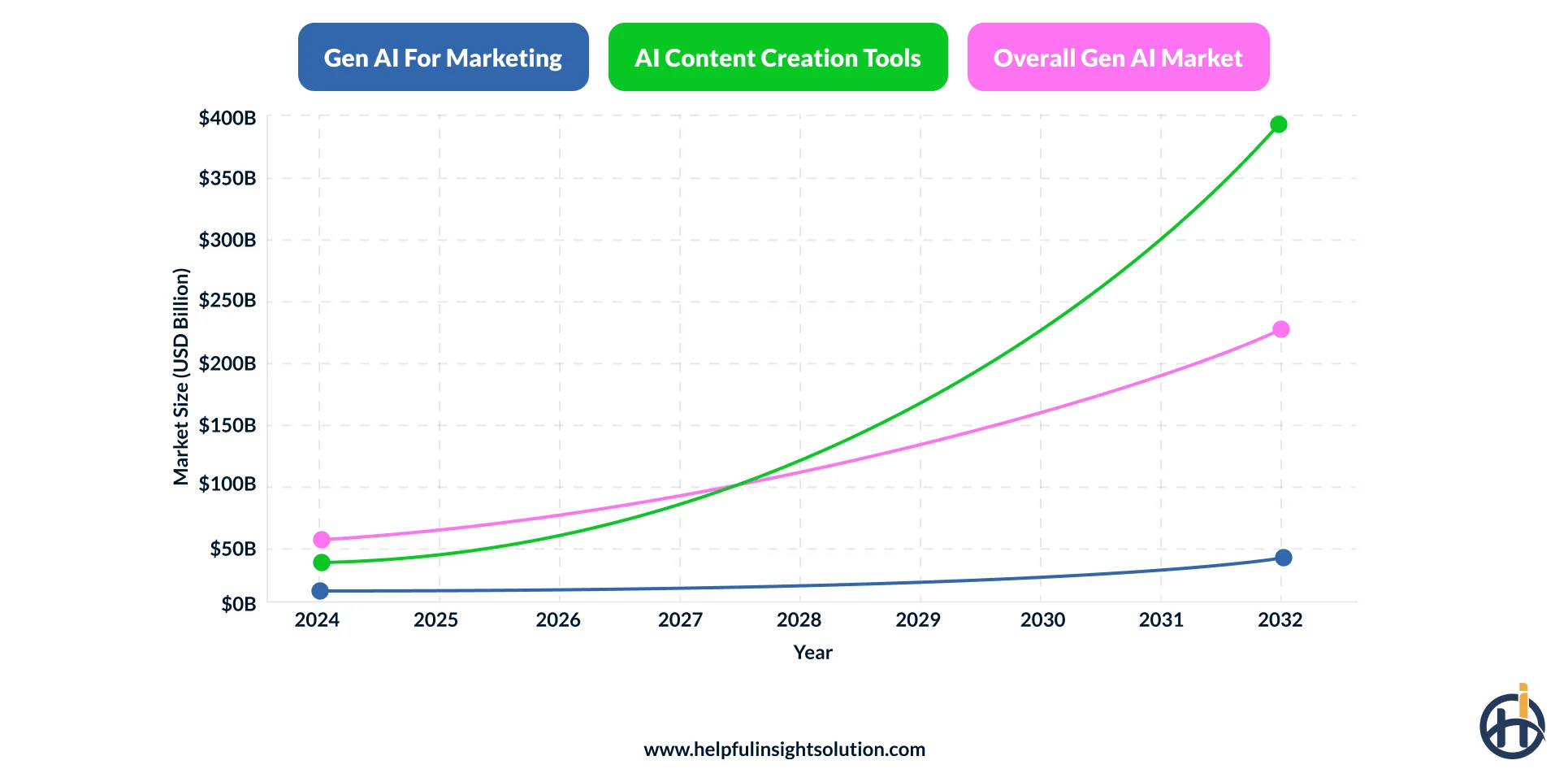
- Gen AI for marketing is generating a revenue of $6.6 billion by the end of 2026 at a rapidly growing rate of 34.7% CAGR between 2025 and 2026.
- For content creation, the Gen AI market will expand to $80.1 billion by 2030 at a rate of 32.5% CAGR during this tenure.
- The market value of AI content creation tools was $54.3 billion in 2025, with North America having a share of 38.5% across the globe. The overall will reach $222.7 billion by the end of 2032 at a whopping rate of 19.3% CAGR between 2025 and 2032.
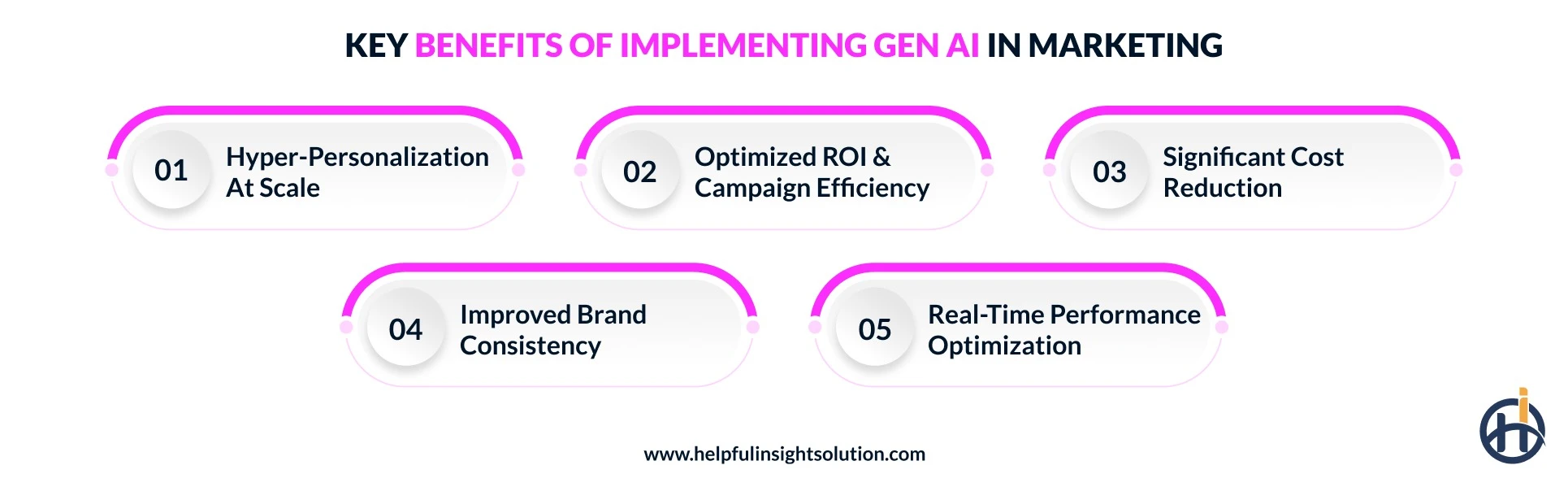
Key Benefits of Implementing Gen AI in Marketing
The benefits of using generative AI in marketing include increasing ROI, user personalization, and business efficiency. We will discuss these major advantages in this section for better understanding.
1. Hyper-Personalization at Scale
Using Generative AI is ideal because it can track customer activities, personal preferences, and business interactions that make marketing messages clear for a lot of people. This can satisfy customer needs, ensure engagement, and increase sales without needing people to do the work.
2. Optimized ROI & Campaign Efficiency
This technology can look at how campaigns are doing and what people think of them to suggest ways to make them better. This information helps people decide how to spend their money to make their systems better and get more out of what they spend on marketing.
3. Significant Cost Reduction
You can spend money on things you need to do every day like making content, talking to customers, and managing campaigns, by using machines to do them. Businesses can make their marketing better without using many resources, which helps make sure everything is good and consistent.
4. Improved Brand Consistency
Brands can improve consistency through strict guidelines, scaling content production, and aligning business objectives with market demand. Gen AI sets various constraints to ensure 100% compliance before publication, increasing overall trust.
5. Real-Time Performance Optimization
With Gen AI technology, you can easily adjust ad campaigns based on market conditions, customer behavior, and live metrics. It focuses on dynamic content adaptation, automated A/B testing, and resource allocation, which reduces execution time.
Best Use Cases of Generative AI for Marketing
Here you will study the top generative AI use cases in marketing that are crucial for every entrepreneur. From content creation to lead generation, we have covered all applications that you must know.
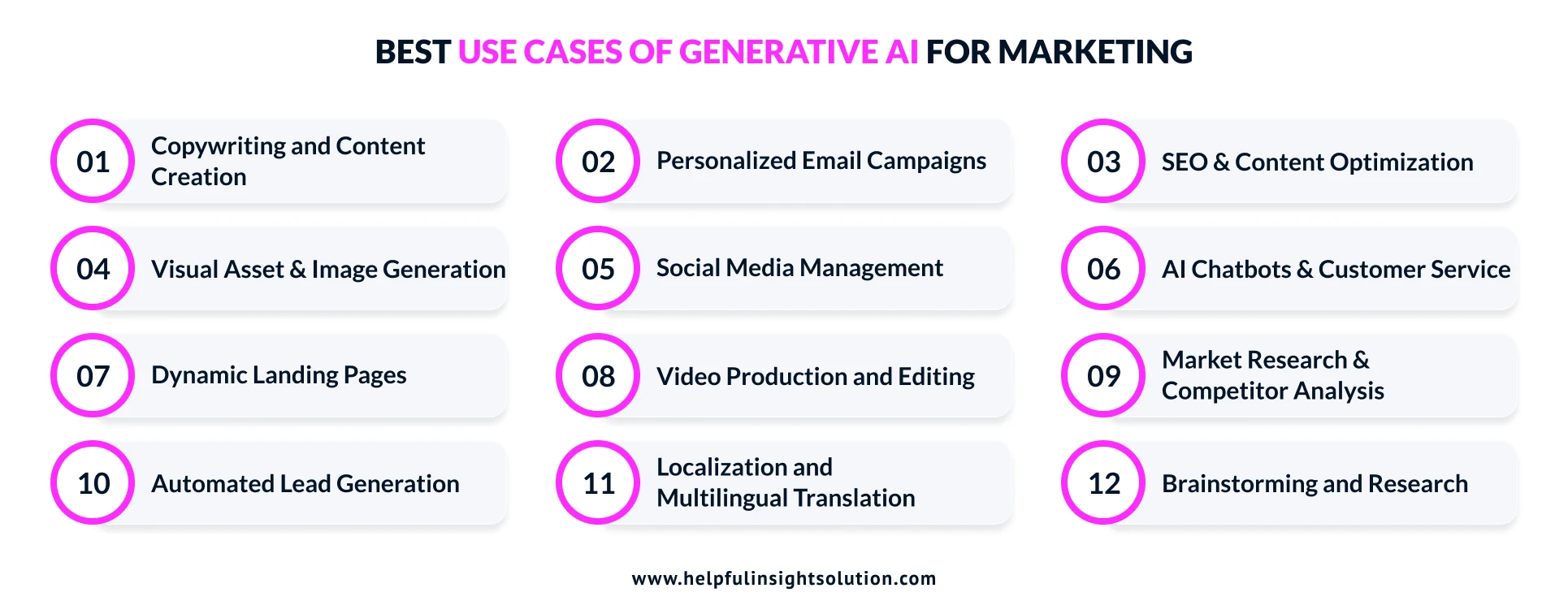
1. Copywriting and Content Creation
The Generative AI technology is really helpful for market experts who create blogs, website copy, product descriptions, advertisements and email content. It makes things easier for them to make content and ensure it is the same across all the different channels.
This way businesses can focus on making their content marketing efforts better without having to add people to do the work. This makes the whole process more efficient. Helps get the campaigns started faster.
2. Personalized Email Campaigns
Artificial intelligence helps marketing experts to prepare user-centric emails that can target specific intent and emotions. Businesses can make sure the subject lines, recommendations, and special offers are just right for each user based on what they like.
This helps keep customers coming back makes them more likely to click on things and actually buy something. It also helps get customers more involved and reduces mistakes that people might make.
3. SEO & Content Optimization
There are ways that Generative AI is used in marketing, like finding the right keywords organizing content making metadata, and making sure it works well with search engines. It also finds out what is popular and suggests ways to make content more visible.
The insights from the AI help market experts make content that people can find when they search for things online. This helps get more people to visit the website and makes the business look better on the internet.
4. Visual Asset & Image Generation
AI-powered design tools can make marketing images, illustrations, banners, and promotional graphics from a few words. These tools use large language models to make it easier to design things without having to be an expert.
Businesses can make custom content for many campaigns quickly. This helps get the message across and makes the brand look more consistent.
5. Social Media Management
Generative AI helps businesses automate various social media tasks, like blog posting. It creates content, writes captions, generates hashtags, and schedules posts through automation.
This tool also analyzes how people engage with the online content and suggests ways to make more profit. Industry experts can keep a social media presence, which reduces the work they have to do.
6. AI Chatbots & Customer Service
AI chatbots help with marketing by answering customer questions in a simple manner. They use a way of understanding language that feels human, making conversations personalized.
This improves customer satisfaction and helps to manage data more easily. As a result, businesses can offer enhanced customer experiences and trust.
7. Dynamic Landing Pages
Generative AI makes landing pages more personal, engaging, and responsive. It uses information about users, such as where they’re from and what they like, to create customized content.
Users see headlines, product suggestions, and visuals that make them trust the brand more. This personal touch increases customer engagement and helps businesses reach more people.
8. Video Production and Editing
Artificial intelligence makes creating interactive videos simple for businesses. It automates tasks like writing scripts, recording voiceovers, and adding subtitles.
Businesses can make high-quality videos without needing to know a lot about video production or invest a lot of money. This saves time and money, allowing businesses to share their videos quickly.
9. Market Research & Competitor Analysis
Businesses use Generative AI to collect and look at a lot of market data, customer feedback, and information about their competitors. This technology can find trends in what customers like and good opportunities with AI models.
This information helps marketers make decisions and stay ahead of their competitors. Research done with AI can make planning better. Help businesses react to the market faster.
10. Automated Lead Generation
There are AI tools that connect with multiple customers, discuss product qualities, and create content-based messages that can attract people. With AI personalization in marketing, you can easily describe services to users and prioritize business assets.
This makes sales more efficient, increases the number of leads that become customers, and makes everything run smoothly. Businesses can build relationships with customers while spending less time on marketing that is not automated.
11. Localization and Multilingual Translation
Generative AI helps businesses make marketing content that’s right for different languages, cultures and what people like in different regions. It also translates content directly to make sure messages are secure and relevant.
This helps brands expand their business into markets more easily. When content is localized, customers. Engage with it more, even if they are from different backgrounds.
12. Brainstorming and Research
Entrepreneurs use AI-powered intelligence to get multiple ideas for asset creation, campaign management, and global branding. This allows teams to easily understand the key motive and solve creative problems using predictive analytics.
Most marketing experts conduct panel discussion, which produces valuable insights. This helps businesses innovate and make decisions with automation. Generative AI is very useful for marketers and businesses because it helps them do their jobs better and faster.
Real-World Examples of Generative AI in Marketing
Some of the top brands, like Nike, have adopted this technology to enhance their marketing standards. In this section, we will examine those generative AI marketing examples to see what changes they have experienced.
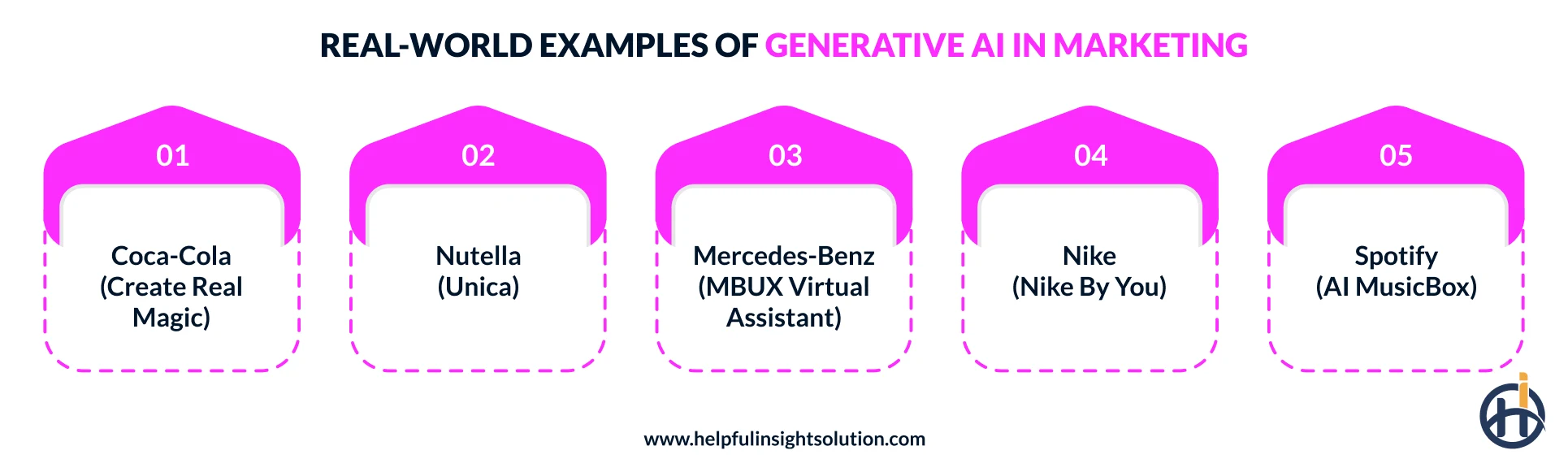
1. Coca-Cola (Create Real Magic)
Coca-Cola started something called “Create Real Magic”. This is a platform where people can make their own artwork using Coca-Cola pictures and Generative AI. The idea was to get people involved and be creative, which would make them like Coca-Cola more. It showed how Artificial Intelligence can change people from looking at things to actually helping make them.
2. Nutella (Unica)
Nutella did something cool with Generative AI too. They made millions of labels for their “Unica” campaign. No two jars of Nutella looked the same. This was a way of doing things that combined Artificial Intelligence with making lots of products. It made people think their jar of Nutella was special. It made users want to buy more with advanced features.
3. Mercedes-Benz (MBUX Virtual Assistant)
Mercedes-Benz used Generative AI to make its Virtual Assistant in cars smarter. The assistant can understand questions and give people personalized suggestions. This makes driving fun. Using Artificial Intelligence like this can help companies talk to customers better without using ways of advertising.
4.Nike (Nike By You)
Nike has a platform called “Nike By You” where people can design their shoes and clothes. Generative AI helps people pick colors and styles they like. This makes shopping on the Nike website really fun. It makes people like Nike more.
5. Spotify (AI MusicBox)
Spotify uses Generative AI to make playlists and music suggestions that’re just right for each person. They look at what people like to listen to and make playlists for them. This makes people happy. They keep using Spotify. It is a way for Spotify to keep people interested and make them happy, with what they hear.
Which Generative AI Tool is Right for You?
Multiple generative AI tools for marketing are available that help in content creation, SEO, web hosting, and image generation. In this section, we will discuss the top 10 Gen AI tools commonly used in marketing in the following table.
| Gen AI Tools | Description | Used For | Category |
| Jasper | An AI-powered content creation platform designed for marketing teams. | Generates blogs, ad copy, emails, landing pages, and social media content at scale. | AI Content Writing |
| ChatGPT | A versatile AI assistant for content creation, research, and ideation. | Creates marketing content, customer responses, campaign ideas, and personalized messaging. | Conversational AI |
| Claude | An advanced AI model focused on long-form writing, analysis, and reasoning. | Produces detailed marketing content, reports, brand guidelines, and content strategies. | AI Writing & Analysis |
| Canva Magic Studio | Canva’s AI-powered creative suite for visual content generation. | Creates social media graphics, presentations, marketing visuals, and branded assets. | AI Design Tool |
| Adobe Firefly | Adobe’s AI platform for generating and editing creative assets. | Produces marketing images, visual effects, banners, and branded creative content. | Generative Design AI |
| Semrush | A digital marketing platform with AI-driven SEO and content optimization features. | Improves search rankings, keyword research, content planning, and competitor analysis. | AI SEO & Marketing Platform |
| Perplexity AI | An AI-powered answer engine that provides real-time research and insights. | Supports market research, trend discovery, audience analysis, and content fact-checking. | AI Search & Research |
| Synthesia | A platform that creates videos using AI avatars and voiceovers. | Produces training videos, product demos, promotional content, and personalized marketing videos. | AI Video Generation |
| OpusClip | An AI tool that converts long-form videos into short, engaging clips. | Creates social media-ready video snippets for platforms like TikTok, Instagram, and YouTube Shorts. | AI Video Repurposing |
| HubSpot AI | HubSpot’s AI-enhanced marketing and customer relationship management solution. | Automates email marketing, lead nurturing, content creation, and customer engagement workflows. | AI-Powered CRM & Marketing |
Major Generative AI Integration Challenges in Marketing
You must know about various challenges that influence the integration of generative AI in marketing. We are going to study all the major risks, like data privacy, in this section, with their respective solutions.
1. Intellectual Property Risks
Most Gen AI platforms for marketing lack copyright ownership, that lead to data infringement. As AI generates millions of images or texts, it may result in copyright issues, affecting the overall brand value.
Solution: AI-driven policies must include digital indemnification bonds that can review copyright and provide predictive suggestions based on evaluation.
2. Maintaining Brand Voice
It is difficult for generative AI to easily understand human emotions, which promotes generic information. For AI powered content creation, it can also generate inconsistent output based on biased user prompts.
Solution: Businesses should use AI assistants that follow strict brand guidelines and ensure a robust human experience through reusable prompts.
3. Data Privacy and Security
The information generated through AI is easily accessible, which can lead to several security and privacy issues. The Generative AI development cost may increase due to the integration of encryption standards.
Solution: You must implement security frameworks like SOC 2 and various compliance, such as GDPR and CCPA, to prevent unauthorized access.
4. Business Workflow Integration
Generative AI accesses historical data and CRM, which are affected due to disconnected legacy systems. It also impacts the content quality, preventing AI models from generating relevant and personalized information.
Solution: It is important to automate data flow through enterprise marketing suites that offer native AI integrations and middleware platforms.
How to Integrate Gen AI for Business Marketing?
Business investors can easily implement generative AI for marketing by following a simple process. They need AI experts who are skilled and experienced in developing advanced platforms or improving existing ones.
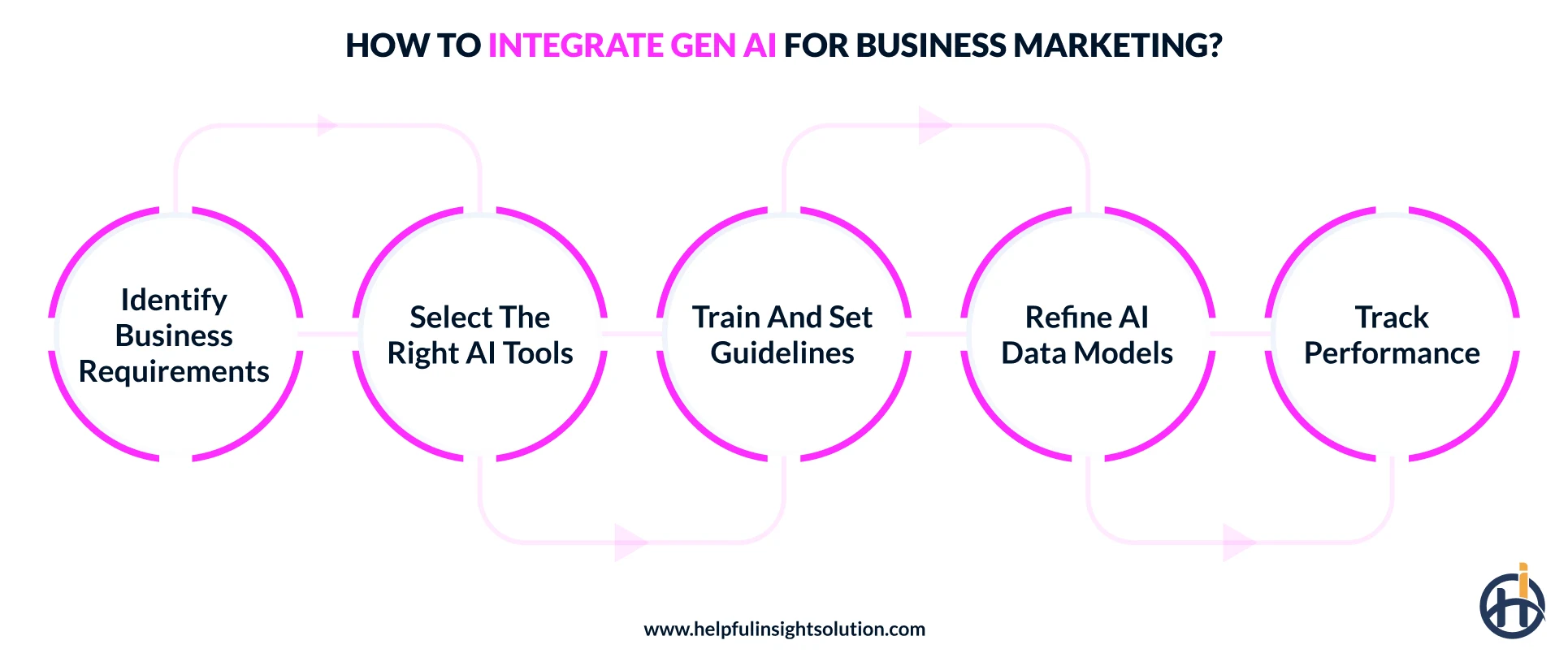
1. Identify Business Requirements
It is crucial to outline your marketing goals, target audience, and main challenges that Generative AI should solve. You need to pinpoint objectives like creating content, engaging customers, or optimizing campaigns with requirements to keep your strategy on track. This helps you launch AI projects that align with your overall business goals.
2. Select the Right AI Tools
You must select the Generative AI platforms that fit your marketing needs, budget and current tech setup. When it comes to AI-driven content creation, consider factors such as content generation capabilities, automation features, scalability, and integration support. The right tools boost efficiency. Lead to better marketing results.
3. Train and Set Guidelines
Businesses need to establish brand guidelines, tone of voice, and content standards to ensure AI-generated outputs are consistent and accurate. You should use natural language processing to train employees on AI tool use while preserving a human experience. Clear governance helps minimize errors and safeguard your brand reputation.
4. Refine AI Data Models
As a business owner, you should regularly enhance AI performance by providing high-quality data and updated models with business info. Regular refinement improves content relevance, personalization, and predictive accuracy. Trained models generate more valuable insights and marketing assets.
5. Track Performance
To track performance indicators like engagement rates, conversion rates, lead generation, and ROI, focus on predictive analytics marketing. Analyze results frequently to identify strengths and areas for improvement in the system. Continuous performance monitoring enables businesses to optimize marketing strategies and maximize business value.
Future Trends of Gen AI for Marketing
With modern innovations, the future of generative AI in Marketing is safe and secure, improving business growth. Let’s understand the key future trends of this technology in the marketing sector, ensuring success.
1. Agentic AI for Campaign Execution
Various AI systems can plan, launch, and optimize marketing campaigns with human help. These AI systems make decisions based on performance data, which improves efficiency and campaign results.
2. Generative Engine Optimization
As AI search engines for content creation grow in popularity, experts will focus on optimizing content for AI responses. They will do this to avoid search rankings. GEO will help brands be more visible on AI platforms and answer engines.
3. Enterprise-Specific Knowledge (RAG)
AI models will use Retrieval-Augmented Generation (RAG) to access company data and documents. This will help them create accurate marketing content. As a result, brands will have consistent and personalized campaigns.
4. Multimodal Content Creation
AI can combine text, images, videos, audio, and media from one prompt. This helps market experts develop campaigns faster and maintain consistent brand messaging across channels. Experts use these AI systems to improve marketing and make sure campaigns are consistent.

Boost your Business Marketing with Helpful Insight’s Generative AI Solutions
It’s your turn to implement generative AI for marketing business campaigns, products, and services. You must approach a reliable partner who has experience in developing AI-powered platforms and integrating generative AI development services into existing systems.
We have a team of dedicated AI professionals who can easily access the latest technologies for content automation and generation. Additionally, they can understand business goals, budget requirements, target audience, and current market trends.
Businesses must use Gen AI in marketing to digitize ad-based revenue, satisfy user needs, and increase market reach. With limited resources, you can utilize various generative AI content marketing tools, such as Claude and Semrush, that ensure better research and deployment. This is the best chance for you to start early and get the benefits of this AI technology for business branding.
FAQ’s
To improve marketing standards, generative AI uses machine learning models that are trained on vast datasets. This enhances workflow by automating various tasks based on data-driven campaigns.
- AI can easily analyze product guidelines, descriptions, and historical data.
- It understands the user requirements and matches them according to the brand.
- The AI models create different assets, such as blog outlines and targeted ads.
- The content is verified by the experts based on accuracy and compliance.
- AI uses campaign data to improve future outputs and deliver feedback.
The average cost of using SaaS-based AI tools ranges from $100 to $1,000 per month due to the lower complexity of features. For embedded integration, the one-time implementation cost is between $25,000 and $150,000. The development cost of custom enterprise AI platforms may increase to $300,000 or more because of advanced integrations.
The generative AI technology helps businesses to create multi-format content based on user preferences, increasing engagement and revenue. It can analyze behavioral data, create user-centric ad campaigns, and target the right audience in real-time. Users get information based on their searches, purchase history, and preferences, improving overall experiences.
Gen AI in content marketing can automate asset production, enhance personalization, and scale business operations through method shifting. Entrepreneurs can plan, build, test, and deploy multiple ad campaigns at a faster rate. This technology improves SEO strategies through email marketing, content moderation, and product recommendations.
The four major components of generative AI include content creation, automated personalization, conversational AI, and customer insights. First, the content is generated in different formats, and then it is set according to user data. The customers interact with smart virtual assistants to get updated results and monitor product recommendations.