

Key Takeaway
- Blockchain gives financial institutions a shared record of transactions, which can reduce disputes and reconciliation work.
- It can speed up settlement and reduce the need for third parties in the payment process.
- Main use cases include cross-border payments, trade finance, KYC and AML checks, smart contracts for lending and insurance, and asset tokenization.
- Compliance, integration with existing systems, scalability and security are the main challenges.
- Tokenization, stablecoins and institutional adoption point to wider use, though adoption is still uneven.
Traditional financial systems often rely on multiple intermediaries to verify transactions and maintain records, which can create delays and inconsistencies across institutions. Blockchain technology helps address these challenges by maintaining a shared, tamper-evident ledger that allows authorized participants to access a consistent transaction history. This can improve transparency, streamline verification, and support more efficient financial operations.
As per Grand View Research, the global fintech blockchain market stood at $6.9 billion in 2025 and is predicted to reach $15.3 billion by 2035. This increase indicates that more sectors of finance are interested in using blockchain technology.
A business will not succeed with blockchain just by picking a platform. Businesses should consider their requirements for compliance, cost of integration, scalability, and business value.
This blog covers key use cases of blockchain in fintech in 2026, benefits, challenges, and opportunities for businesses.
What is blockchain in fintech?
Blockchain in fintech is the use of distributed ledger technology to record, verify and share financial transactions across a network of participants. Instead of relying on one central database, authorized participants work from the same synchronized records, which can improve traceability and reduce reconciliation between separate systems.
Various types of financial institutions use blockchain for processing payments between countries, transferring digital currencies, executing trade finance agreements, and implementing smart contracts. How well it fits depends on the type of transactions, rules set by regulators, security requirements, and costs associated with integration.
How blockchain works in financial technology
Blockchain transactions are validated according to the network’s consensus mechanism before being included in a block. Once accepted, these transactions are recorded in blocks that are cryptographically linked to previous blocks, forming a distributed ledger maintained across participating network nodes. The process for achieving finality varies depending on the blockchain protocol.
Blockchain vs. traditional financial infrastructure
Businesses in traditional financial markets generally use their own databases and work with their own systems to reconcile transactions. With blockchain technology, institutions can share one ledger, which can make tracking and reconciling transactions more efficient.
| Feature | Blockchain Infrastructure | Traditional Financial Infrastructure |
| Recordkeeping | Shared ledger across network participants | Separate databases maintained by institutions |
| Transaction verification | Network consensus or designated validators | Centralized systems and institutional checks |
| Reconciliation | Can reduce mismatches between institutions’ records, so less reconciliation is needed | Often requires reconciliation between institutions |
| Transparency | Visibility depends on network permissions | Access controlled by individual institutions |
| Security | Cryptography and tamper-resistant records | Access controls, encryption, and centralized security |
| Automation | Smart contracts execute predefined rules | Software automates processes through programmed workflows |
| Best suited for | Multi-party transactions and shared recordkeeping | Centralized operations and established banking processes |
Global fintech blockchain market growth (2025–2035)
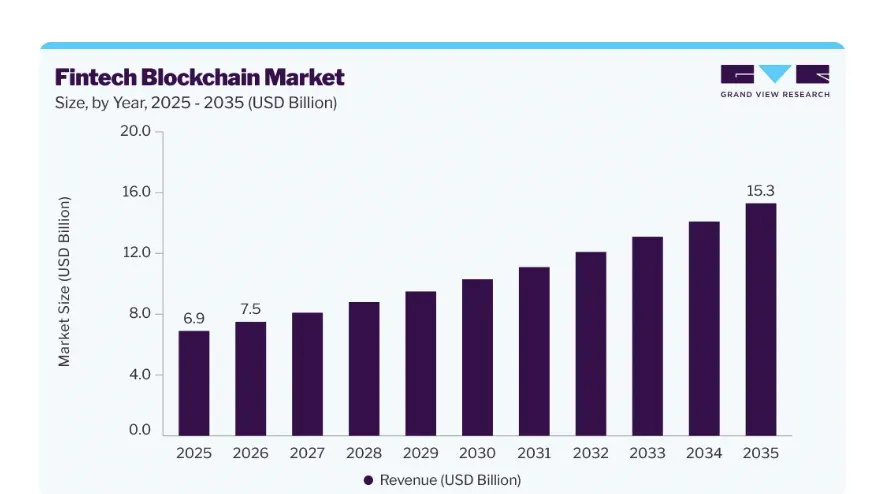
- The global fintech blockchain market was valued at USD 6.9 billion in 2025, which indicates how blockchain technology has been penetrating almost all areas of finance and accounting.
- The market is projected to reach USD 7.5 billion in 2026 due to the increasing demand for blockchain technology for payment systems and financial transactions.
- By 2035, the global fintech blockchain market is expected to reach USD 15.3 billion, showing the potential for long-term development.
- The market is expected to grow at a CAGR of 8.2% from 2026 to 2035.
- North America held 42% of revenue in 2025, indicating that in this region, blockchain technologies are widely used in business.
Why blockchain technology in financial services is gaining ground
Blockchain technology in financial services addresses concerns such as operational inefficiencies, enhances transaction visibility, and upgrades existing systems. Five benefits are enabling the use of blockchain in the fintech sector in 2026.
1. Faster Transaction Settlement:
Blockchain can make payment processing faster, as it reduces the involvement of intermediaries and allows for settlement within networks in near real time, especially for cross-border payments that usually require the involvement of numerous companies.
2. Greater Transparency:
Access to shared ledgers can give authorized users a common set of transaction records, which makes it easier to trace transactions, verify information and spot anomalies across linked institutions.
3. Reduced Operational Costs:
Blockchain can automate document preparation, reconciliation and transaction verification. This cuts administrative work and lets staff focus on higher-value tasks.
4. Improved Security and Traceability:
Automatic transaction verification on a blockchain makes it possible to spot unauthorized changes to information and build a history of each transaction. Blockchain does not remove the need for access control and smart contract testing.
5. Growing Tokenization Opportunities:
Decentralized ledgers such as blockchain can facilitate digital copies of financial assets, which might make these easier to transfer in ownership, subdivide or service, and open up new benefits to financial institutions and fintechs.
Top blockchain use cases in fintech for 2026
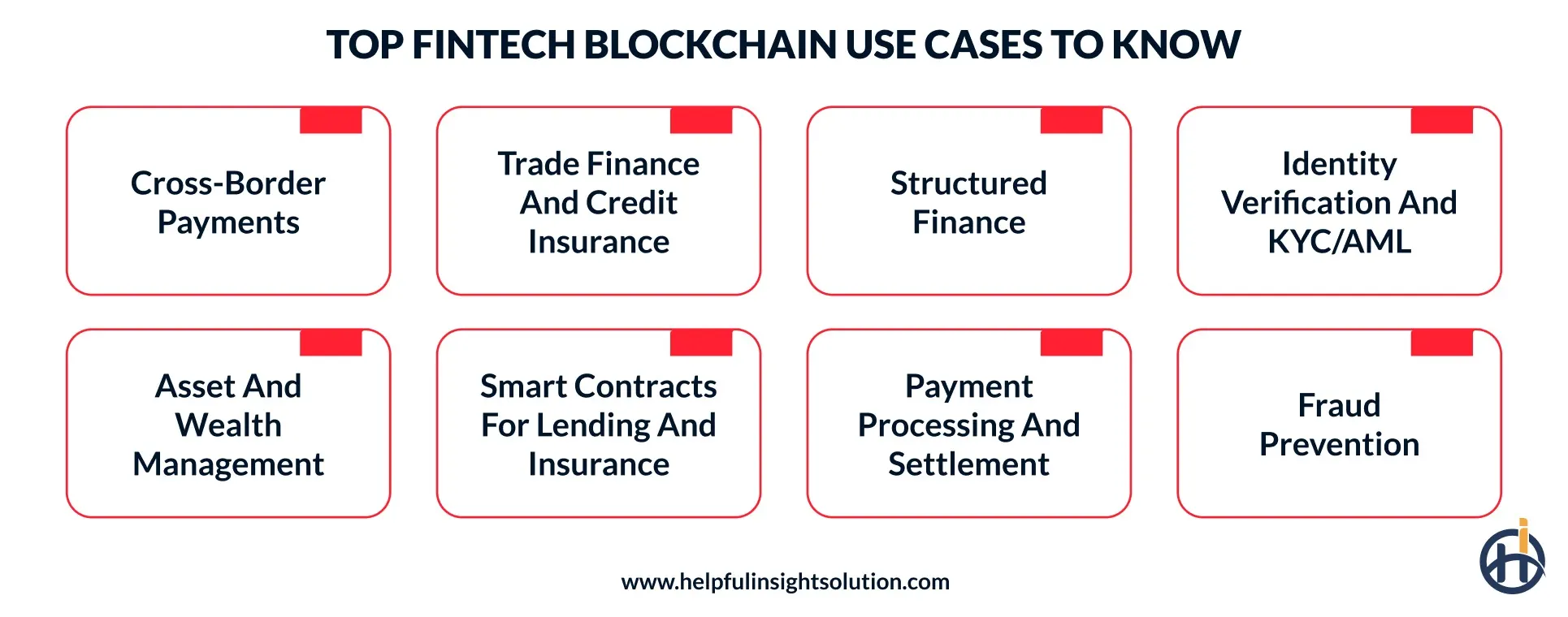
Blockchain in fintech is no longer tied only to digital currency. Banks and fintechs now use it for cross-border payments, lending, identity checks, and record-keeping, where it can improve speed and transparency. Each use case still needs a check on implementation cost and regulation.
1. Cross-border payments and remittances
Utilizing blockchain for payment systems, financial institutions will be capable of transferring value internationally, decreasing the number of intermediaries, and expediting the processes. Stablecoins and tokenized deposits are also supportive of such transfers with real cost and the speed depending upon liquidity, conversion of currencies, compliance checks, and local law. This use case of blockchain in fintech becomes beneficial for both remittance companies and international firms.
2. Blockchain in trade finance and credit insurance
Trade finance involves exchanging documents and confirming transactions between banks, exporters, importers, insurers and logistics companies. Blockchain can create a shared record of invoices, shipping documents and approvals, which reduces repeated checks and makes mismatches easier to spot. In credit insurance, a shared record can support risk assessment and claims processing, subject to data quality and legal requirements.
3. Blockchain in structured finance
Structured finance pools financial assets (like loans or receivables) into securities with specified payment terms. It’s an impressive use case of blockchain in fintech that could generate an unchangeable record of ownership of financial assets and their payments, and facilitate automated execution of certain contractual terms. While legal enforceability and investor protections are critical, blockchain could potentially enhance auditability and servicing efficiencies.
4. Identity verification and KYC/AML compliance
Financial institutions have to complete extensive KYC and AML-related processes, including confirmation of customer identity and tracking transactions. Identity credentials on blockchain could enable authorized entities to carry out identity verification without requesting customer documents multiple times. Privacy, access permissions, and regulatory compliance remain key requirements.
5. Blockchain in asset and wealth management
Blockchain can improve asset management operations by providing a transparent ownership registry, automating investment procedures and tracking transfers. Tokenization refers to the process of representing assets (including fund units and bonds) digitally to facilitate fractional ownership and streamline settlement. The Bank for International Settlements (BIS) has found that tokenized bonds can have lower bid-ask spreads than conventional bonds, but it describes the market as still at an early stage, so results vary by use case.
6. Smart contracts for lending and insurance
Smart contracts are code that runs a set of instructions once specified conditions are met. In lending and insurance, they can help automate several steps. They can facilitate loan transfers, track repayments in loan management software, and handle claim approval in insurance software. For example, an insurance smart contract can release a payout when a verified data source confirms a covered event.
7. Blockchain in payment processing and settlement
Blockchain can record and settle transactions on a shared ledger, which reduces reconciliation between participating institutions. Tokenized deposits and digital, regulated payment instruments could facilitate programmable payments and real-time settlement on appropriate networks. Transaction fees, liquidity, interoperability and regulation will decide how well it competes with traditional payment rails.
8. Fraud prevention and financial data sharing
Blockchain can support fraud prevention by keeping transaction histories traceable and making changes to records easier to spot. Firms can use permissioned blockchains to share validated data with all authorized participants, which can help reduce inconsistencies across organizations’ systems. Blockchain does not stop wrong data from being entered, and it cannot guarantee data quality on its own.
Blockchain in banking vs. blockchain in fintech: What’s the difference?
Blockchain in banking focuses on improving existing banking operations, such as interbank settlement, trade finance and bank-issued digital money. Blockchain in fintech focuses on building digital financial products, such as payment apps, digital lending platforms and tokenized assets. The two overlap when fintech companies partner with banks to offer blockchain-based services.
| Comparison | Blockchain in Banking | Blockchain in Fintech |
| Primary focus | Modernizing traditional banking operations | Developing and improving digital financial services |
| Common applications | Interbank settlement, trade finance, and bank-issued digital money | Digital payments, lending, asset tokenization, and wealth management |
| Main participants | Banks, central banks, and established financial institutions | Fintech startups, payment providers, technology companies, and financial institutions |
| Implementation priorities | Regulatory compliance, legacy system integration, and operational security | Product innovation, scalability, user experience, and rapid integration |
| Key objective | Improve efficiency and coordination across banking infrastructure | Deliver accessible, flexible, and innovative financial products |
How to choose the right blockchain use case for your fintech business
Beginning the selection of the suitable blockchain applications in finance with identifying a real business problem, assessing the technical feasibility and value proposition. These eight steps will guide fintech businesses in making confident implementation decisions.
1. Define the Business Problem:
Check whether delays in payments, errors in reconciliation, fragmented data or manual checks result in quantifiable inefficiencies that blockchain can handle better than current systems.
2. Determine Need for Blockchain:
Does the process need shared records of transactions between several parties that do not fully trust each other? If the same can be accomplished more simply by a traditional database, blockchain is likely not worth the complexity.
3. Define Clear Objectives:
Set business goals (reduce settlement time, improve traceability, reduce the cost of processing, automatically post transactions, etc.) to make sure that the solution provides real business value.
4. Choose the Right Blockchain Type:
Compare public, private, and consortium blockchains across criteria such as visibility of transactions, governance mechanisms, speed and capacity, permissions to participate, and the level of control financial institutions need to exert over the blockchain.
5. Assess Regulatory Requirements:
Examine relevant financial regulations, legal standards for data privacy, KYC/AML rules, and transaction reporting guidelines before choosing an architecture or moving sensitive financial information.
6. Check Integration and Scalability:
Consider integration with banking platforms, payment gateways, APIs, databases and other systems. Estimate transaction volume, network capacity and future infrastructure needs.
7. Estimate Costs and Expected ROI:
Compare development, integration, maintenance, compliance, and transaction costs to anticipated savings or revenue. Establish quantifiable measures of performance before proceeding with implementation.
8. Build a Proof of Concept:
Try out the solution with a small workflow first. Use this opportunity to test assumptions on performance, security, usability, and business outcome, and to improve the solution, ideally with a FinTech consulting partner.
Challenges of implementing blockchain in fintech
Blockchain in finance has many advantages, but putting it into practice brings technical, legal and operational challenges. Fintech companies should weigh these when deciding whether a project is feasible.
Regulatory compliance and data privacy
Financial organizations must meet rules on data protection and KYC/AML. Blockchain records are hard to change, which can make data correction and deletion requests difficult, for example under privacy laws such as GDPR. Organizations should plan strong access controls, privacy protection and data storage rules from the design stage.
Want to Know More? Explore IT Compliance Regulations Shaping U.S. Industries
Scalability and transaction speed
In some cases, businesses may encounter blockchain systems with less capacity in terms of transaction processing. At peak times, transaction fees may rise and payment confirmation delays may occur. Therefore, fintech blockchain companies are required to implement research and collect information about the transactional capacity of the system before choosing a suitable technology.
Integration with existing systems
Integrating blockchain into legacy banking environments, payment gateways, and financial databases would require significant development work. Lack of compatibility in terms of data formats and interoperability can make things even more difficult. Well-designed APIs, performance testing and a phased rollout can reduce disruption.
Security risks and smart contract vulnerabilities
Cryptography protects blockchain data when the code and private keys are handled well, but it does not fix bugs in the code. Errors in a smart contract can cause wrong payments or losses. Independent audits, thorough testing and good key management can reduce these risks.
High implementation costs and adoption barriers
The use of blockchain in finance also requires significant government, technical, and human resources. The success of projects also relies on how well banks cooperate with technology partners. It’s essential for businesses to take into consideration total costs of ownership and return on investment.
Blockchain in fintech: Trends to watch in 2027
Interest in blockchain across finance keeps growing, but adoption is still uneven. The trends below show where progress is most likely in 2027. They do not point to mass adoption.
1. Tokenization of real-world assets
Tokenization represents ownership of assets, such as bonds and funds, as digital tokens. It can facilitate fractional ownership, automate asset services, and speed up the process of transferring assets. The BIS reported that about $8 billion of tokenized bonds had been issued to date. This market is still at an early stage, and its growth will depend on legal recognition, liquidity and investor protection.
2. Stablecoins and cross-border settlement
Stablecoins are digital tokens designed to hold a stable value against an asset such as the US dollar. They can support international transfers, business payments and blockchain-based settlement. According to Visa Onchain Analytics, adjusted stablecoin transaction volume was about $10.2 trillion over the 12 months to [add month and year]. Adjusted volume filters out bot activity and other noise, so it better reflects real payments. The BIS notes that current stablecoin designs fall short on key properties of money, such as redeeming at par. Regulation and redeemability will shape adoption.
3. Institutional adoption of blockchain infrastructure
Financial institutions and banks are looking into blockchain technology for different areas such as tokenized deposits, securities, custody, and interbank settlement. The Project Agorá initiative launched by the BIS involves eight central banks along with more than 40 regulated institutions, exposing the interest of the institutions to make changes to the cross-border payments system.
4. Interoperability between blockchain networks
More financial institutions need blockchain networks that can exchange information and assets securely. The BIS lists interoperability across ledgers as a challenge, especially for stablecoins on public blockchains, and proposes a unified ledger that brings different forms of tokenized money into one venue. By 2027, better connections between networks could help financial institutions reduce fragmented workflows, if security and legal requirements are met.
5. Programmable payments and smart contracts
Smart contracts can carry out financial transactions automatically when set conditions are met. They can process payments, manage collateral and support trade finance. A BIS chapter in its 2026 Annual Economic Report says tokenization can enable programmable payments when it is built into the existing two-tier banking system.
6. Privacy-preserving and compliant blockchain solutions
Financial institutions have to balance transaction transparency with customer privacy. By 2027, privacy tools and permissioned networks may allow controlled data sharing, as long as the data stays secure and reliable.
How Helpful Insight help fintech businesses build blockchain-powered solutions?
Helpful Insight assists companies in developing fintech software in line with their business processes and needs, including digital payment software and secure banking applications. The company supports businesses from planning to building technology-driven fintech solutions, including blockchain-powered solutions.
It is important to choose the right fintech blockchain use cases, assess how feasible the technology is, and make sure that it meets security, scalability, and compliance requirements.
When software decisions are tied to business goals, fintech companies can use blockchain where it adds value and avoid unnecessary technical complexity.
Frequently Asked Questions
Blockchain in fintech is the use of distributed ledger technology to store and validate financial transactions. It supports transparent recordkeeping, task automation, digital payments and controlled data sharing.
Blockchain is used in fintech to record and verify transactions on a shared ledger accessible to authorized participants. When predefined conditions are met, smart contracts can automatically execute actions such as payment releases or settlement, reducing manual processing and improving transaction traceability across participating institutions.
Major use cases of blockchain in financial services include international payments, trade finance, securities settlement, digital identity, asset management, smart contract automation and fraud detection. Financial institutions can gain efficiency, transparency and better coordination with each other.
Financial Technology is technological developments in the fields of commerce and investment, including online banking, lending, and payments. Blockchain is a distributed ledger technology that may be implemented by fintech companies to facilitate transactions, recordkeeping, or automation.
A shared ledger lets authorized participants access transaction records, which helps to validate trade documents, monitor approvals, and reduce delays caused by reconciliation. Some processes can be automated with smart contracts, but accurate data and regulatory compliance are still needed.
No. Blockchain is the technology behind the recording of transactions, cryptocurrency is one of the applications for blockchain technology. Fintech startups can harness blockchain technology for making payments, verifying identity and keeping financial records without having to actually issue or accept cryptocurrencies.
Banks face regulatory and data privacy requirements, scalability limits, integration with legacy systems, security risks and high implementation costs. A bank needs a clear architecture, strong governance, thorough security testing and goals tied to business results before adopting blockchain.