

Key Takeaways
- Fintech is worth entering because the money jobs are still moving onto apps, and this shift is continuing. Building has also become cheaper than before, because banking-as-a-service providers will give you the rails, so you are writing only the product on top of it.
- The market is large enough for new companies. As per Fortune Business Insights, the global fintech market is at $460.76 billion in 2026, and it should reach $1,760.18 billion by 2034 at a CAGR of 16.2%.
- Payments is the largest part of this market. Cross-border payments alone are at $397.37 billion in 2026, with neobanking coming behind it at $322.3 billion.
- The 15+ fintech startup ideas are split on one question only, which is whether you are holding the customer money or not. A compliance tool or an expense management product will not need any licence. Lending, insurance, or escrow needs capital on your own books, or a regulated partner behind you.
- The openings are available in the narrow segments. A BNPL product that is built only for dental clinics can work, because the general BNPL platforms were never designed for that trade.
- B2B ideas will start earning sooner. A company is already keeping a budget for expense management or payroll, however, a consumer expects a budgeting app to be free.
Many smartphones now have several financial applications installed, and each one is a separate business unit built around a single money job such as payments, savings, investing, borrowing, or insurance.
Fintech startup ideas almost always start from one of these jobs being done badly by an existing product, or not being done at all for a specific group of customers.
Which app people open depends on the country. In India, it is a UPI app such as PhonePe or Paytm. In the US, the same job goes to Venmo, Cash App, or Zelle, and in the UAE it is bank apps and the newer instant payment rails. Each market has gaps, and those gaps are where new companies have been built.
Fortune Business Insights puts the global fintech market at $460.76 billion in 2026, and it should reach $1,760.18 billion by 2034 at a CAGR of 18.2%. More of these money jobs will keep moving to apps over those years, so the category still has room for new companies.
This guide covers 15+ fintech startup ideas that are practical to launch in 2026, real companies already working in each category, and how to fund the business once you pick one.
What is Fintech and Why Start a Fintech Business?
Fintech is the software that handles money jobs that banks used to do inside their own branches. When a shop accepts a card through a small reader, when a lender approves a loan in minutes by reading bank transaction data, or when someone pays a friend from a wallet balance, that is fintech doing the work.
Most fintech business ideas come from picking one of these money jobs and doing it faster, cheaper, or for customers a bank does not want to serve.
The worldwide numbers should tell you why founders keep coming back to this category. Grand View Research puts the global digital payment market at $164.8 billion in 2026, and it should reach $682.8 billion by 2033 at a CAGR of 22.5%. The same firm values neobanking at $211.2 billion in 2025 and estimates $322.3 billion for 2026. Most of that money moves through an app on a phone.
Building has also become cheaper than before. Banking-as-a-service providers and payment APIs supply the rails, so you are building the product while the infrastructure underneath belongs to a licensed partner.
Embedded finance has pushed this further; a non-financial app can now offer payments or credit without becoming a bank.
That is why finance business ideas that once needed a full banking licence and a large raise can start today with a small team and a partner bank.
15+ Profitable FinTech Startup Ideas for Businesses
The ideas below are grouped by the money job each one does. Some of these fintech startup ideas need a licence of their own, others need only a partner bank and an API.
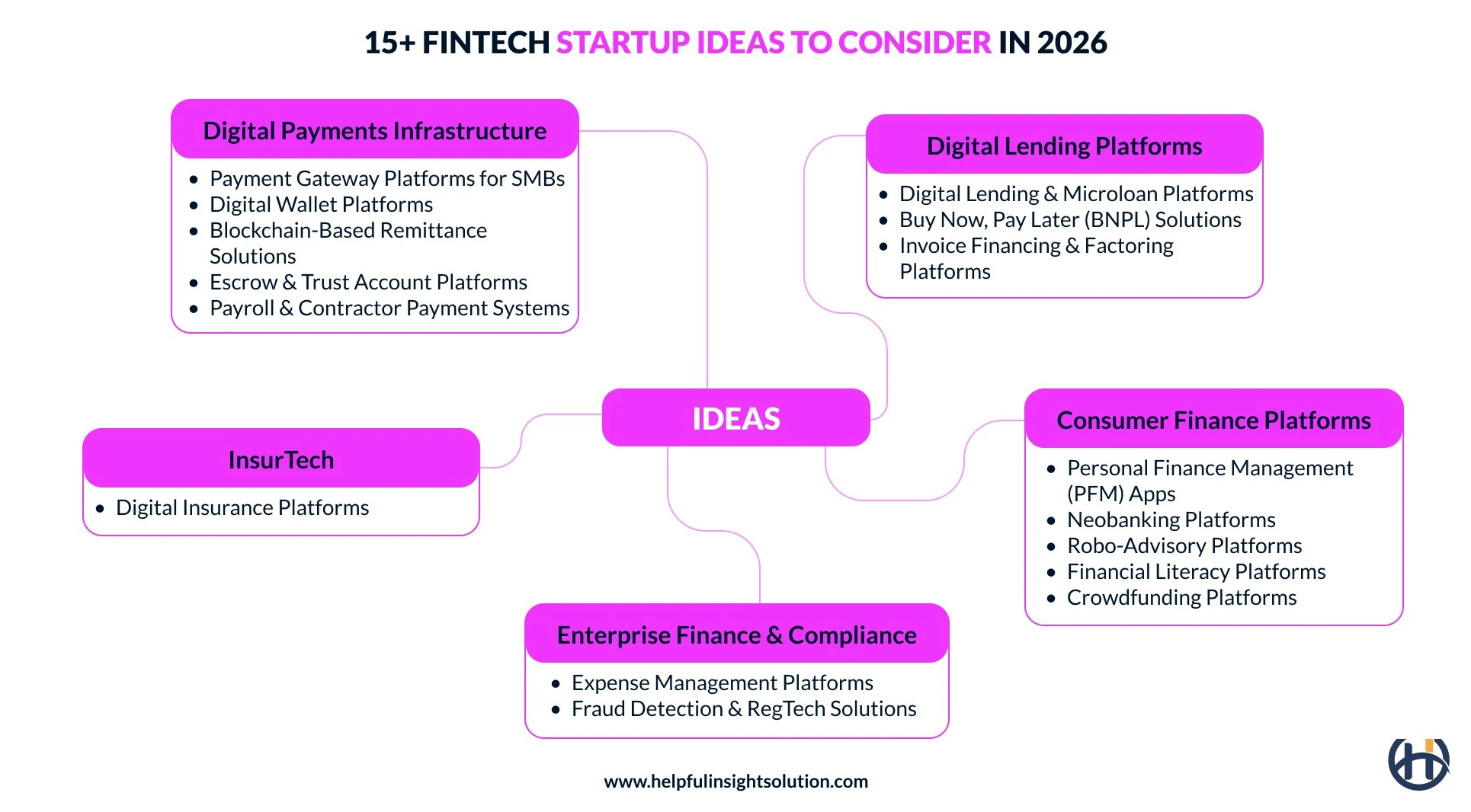
The build effort and the time to first revenue are not the same across these categories, so that context is included with each idea.
If you want a detailed breakdown before picking one, our guide on fintech app cost covers what each type of build typically involves.
1. Digital Lending and Micro-Loan Platforms
Digital lending platforms let people borrow small amounts through an app with minimal paperwork and instant money transfer.
These fintech apps read bank statements and payroll records through APIs and make decisions to approve a loan request or decline the request in minutes, without the wait that comes with a traditional loan application.
Dave and Earnin in the US are the most recognised examples. The global market for these applications is valued at $16.45 billion in 2026, and projected to reach $70.31 billion by 2034 at a CAGR of 19.9%, with the US alone expected to account for $3.23 billion in 2026. (Fortune Business Insights)
To start here, you need a lending licence in each state you operate in, or a partner lender who already holds one. The technology is straightforward. Compliance and the capital to fund the loan book are where the real work is.
2. Buy Now, Pay Later for a Niche Market
Buy now, pay later (BNPL) has already become normal on retail checkout pages, however, the niche categories are still open. These applications split one purchase into small installments without the need for a credit card at checkout.
Some of the big BNPL companies, such as Affirm, Klarna, or Afterpay, are built for retail volume, they do not go deep into any single category.
Sunbit in the US works only with auto repair shops and dental clinics, and that is the kind of gap a fintech startup can still walk into. Categories worth researching include veterinary bills, home repair, legal fees and coaching programmes.
A niche BNPL product needs a lending partner. It also has to carry the default risk on its own books, and that is different from a payments product, where the money passes through and never stays with you.
The merchant relationship is what you should build first, the customer acquisition follows from that.
3. Personal Finance and Budgeting Apps
Personal finance software is a small market compared to payments, but it is growing steadily. The global personal finance software market was valued at $1.35 billion in 2025, and it should reach $2.57 billion by 2034. Budgeting is the largest piece inside it. The demand is real. The challenge is that most users expect this type of app to be free or very cheap.
A personal finance app connects to the user’s bank accounts and cards, brings all the transactions into one screen, and puts every transaction under a category such as rent, groceries, fuel, or subscriptions. YNAB, Monarch Money, and Copilot are the most commonly used personal finance and budgeting apps, and each earns from subscriptions.
Transaction categorisation is the core technical challenge. The data aggregator will send you a merchant name and an amount only, so the labelling logic is your own work, and if that logic is not accurate, the user stops opening the app within a few weeks. This is where most personal finance products lose early users.
4. Neobanks for Freelancers, Students, and Gig Workers
Neobanking is already a large market. Grand View Research valued the global neobanking market at $211.2 billion in 2025 and estimates $322.3 billion for 2026.
The money is moving into these accounts, but most neobanks are still built for people with regular salaries and straightforward banking needs.
Chime and Varo are the most established examples in the US. Both work with partner banks that hold the deposits, which is the model most new entrants use too. The difference for a new entrant is what goes on the first screen, whether tax set-aside on every payment, instant payout, or income smoothing across weeks.
You can develop a fintech app for underserved people that a normal bank finds difficult to serve, such as freelancers, students, and gig workers.
A freelancer has irregular income and no salary slip, a gig worker gets paid by three different platforms in a month, and a student has no credit history at all.
A neobank app purpose-built for these groups can put the features they actually need on the first screen, such as tax set-aside on every payment, instant payout, or income smoothing across weeks.
5. Payment Gateway or Checkout Solutions For Small Businesses
A payment gateway is a need for every business that receives payment digitally, and this is true across the globe. The category is competitive, but most existing solutions were designed for businesses processing large volumes. Small merchants are using products built for someone else.
The pricing issue makes this concrete. Stripe charges 2.9% plus 30 cents per online card payment, and Square charges the same online, with 2.6% plus 15 cents when the card is present.
For a $200 sale, those rates are manageable. For a $12 sale, the fixed 30 cents alone pushes the effective cost above 5%. For a coffee shop, a street vendor, or any business selling small-ticket items at volume, that cost adds up significantly across a day’s transactions.
A payment product built specifically for small merchants that has lower fixed fees, simpler onboarding, and features that match how those businesses actually operate. This is the gap this idea targets.
How you structure the system from day one matters here, and our guide on fintech architecture covers the technical decisions that affect both cost and compliance.
6. Expense Management Tools for Startups and SMEs
The expense management process in small businesses is still running on spreadsheets and email. An employee pays for something from their pocket, submits the receipt to the finance team, and waits weeks or months for reimbursement. The process is slow, error-prone, and takes time from people who should be doing other high-value work.
An expense management product automates this. The company issues a card to each employee, the receipt is photographed at the point of purchase itself, and the entry goes into the accounting software directly, such as QuickBooks, Xero, or NetSuite. Ramp, Brex, and Expensify are doing this at scale in the US.
These applications offer software at no cost and make money by charging a fee on every card swipe. Some applications have monthly subscription fees.
If you are entering this space, you should decide this early, because the free model needs card volume before it earns anything, and the paid model needs you to be clearly better than a free option that is already available in the market.
7. Robo-Advisory and Automated Investing Platforms
Investment advice was available mainly to people who had a large amount to invest. A human advisor usually keeps a minimum balance requirement and charges a percentage of the assets every year, so a person starting with $2,000 was never their target client.
A robo-advisory platform does the same job at a fraction of the cost. The user answers a few questions about age, income, and risk appetite, the algorithm builds a portfolio of index funds or ETFs on that basis, and the allocation is rebalanced automatically whenever it moves. Betterment, Wealthfront, and Schwab Intelligent Portfolios are the known names in the US.
The user base is still tilted towards the wealthy, however, and high-net-worth individuals are expected to be around 44.82% of robo-advisory end users in 2026. The mass market is where the gap is.
8. Insurtech and Digital Insurance Products
In most markets, insurance is still sold through agents, and the buyer has to fill long forms, submit documents, and then wait for the policy to be issued. Claims take even longer.
Insurtech products are removing these steps by moving the policy lifecycle onto an app, from quoting and binding to claim submission and settlement.
The global insurtech market is at $23.54 billion in 2026, and it should reach $132.71 billion by 2034, which is a CAGR of 24.1%.
The bigger fintech opportunity now is in embedded insurance, where the policy is sold inside another product only when it is needed, such as a travel booking, an electronics purchase, or a freelance contract.
This is where a new company can start without building a full insurance business, because the underwriting stays with a licensed insurer and you are handling the distribution and the technology only.
That technology part is not small, and building insurance software needs the policy administration, rating engine, and the claims workflow to work together from the first day itself. Our insurtech software development team has built these systems for carriers.
9. Crypto and Blockchain-Based Payment and Remittance Tools
Cross-border payment is one of the largest markets a new fintech company can enter. The global cross-border payment market is at $397.37 billion in 2026, and it should reach $727.74 billion by 2034. Inside this market, the fintech channel is growing faster than the market itself at a CAGR of 9.1%, and the SME segment is growing at 8.5%.
Blockchain-based payment tools are taking a share of this. The money converts into a stablecoin such as USDC or USDT, moves in a few minutes, and a partner on the receiving side converts it into local currency.
If you are building in this space, our blockchain development services cover the infrastructure layer for payment and settlement use cases.
Circle announced a bank and payment provider settlement network built on this model in April 2025.
For a startup, the opening is in one corridor only, such as the US and Mexico, or the UAE and India.
The blockchain part is the easy one, however, and licensing and the cash-out network is where most of the work goes, because somebody has to hand over local currency at the other end.
This fintech business idea will need money transmitter licences and banking partners in each market also.
10. Invoice Financing and Factoring Platforms
Small businesses that sell on 60 or 90-day credit terms need the money earlier, and a supplier who finances one invoice this month will come back the next month also.
The real question is whether you can pursue this fintech startup idea or not. Invoice financing needs money on your own books, because somebody has to advance that invoice value on day one, and a founder starting out will not have that. You can support such founders in two ways.
The first is the marketplace route. You build the platform and the underwriting, the capital comes from a lending partner or an institutional investor, and you earn a fee on the volume without carrying the credit exposure.
The second is to start as receivables software only, get the invoices flowing through your system first, and add the financing later once you have the data.
The credit risk itself is easier here than normal SME lending, since it belongs to the large buyer who has to pay the invoice. Fraud is your real exposure, so verification against the buyer’s system should be built before you advance a single invoice.
11. Fraud Detection and RegTech Tools for Financial Institutions
This fintech startup idea doesn’t need a license or capital on your own books. You will be selling software to financial institutions such as banks, lenders, insurers, or other fintech companies.
Fraud detection and RegTech tools handle the compliance work every regulated company carries daily. KYC checks verify identity at onboarding, and AML screening runs each transaction against sanctions or watchlist data. Regulatory reporting follows both, since suspicious activity has to be filed with FinCEN within a fixed window.
AI agents for fraud detection are increasingly being used to handle this monitoring layer automatically, which is exactly the kind of capability a RegTech startup can build on top of.
The selling part is where this idea becomes difficult. A large bank takes twelve to eighteen months to buy anything, because of procurement, security review, and model validation.
A small company will run out of money before the first enterprise contract closes. The practical route is to sell to other fintechs and smaller lenders first, since they buy in weeks and they carry the same compliance obligations and are often looking for exactly the kind of flexible, integrable tool a startup can build.
12. Financial Literacy and Fintech Education Platforms
Financial literacy and fintech education platforms help people to get familiar with financial terms such as budgeting, credit score, or how a loan actually works.
You can make revenue from this idea in two ways. Either you can sell it as a white-label application to a bank, credit union, or any other institution that pays for it while end users get free access.
The second is the referral model, the platform is free to all users and earns a fee when a user applies for a financial product through an in-app recommendation.
13. Crowdfunding Apps
A crowdfunding app collects small amounts from a large number of people to fund one project, business, or cause. The platform holds the campaign page, processes the payments, and releases the money when the target is met or when the campaign closes.
Kickstarter and GoFundMe are the most recognised examples in the US, running rewards-based and donation-based campaigns respectively.
The revenue comes from a percentage of the amount raised, with payment processing fees charged on top.
The platform model works at scale. More campaigns running means more revenue without a proportional increase in operational cost, because the same infrastructure serves every campaign.
14. Payroll and Contractor Payment Platforms
Payroll software can calculate wages, deduct taxes, file returns, and schedule payments on a fixed monthly date. Adding contractor payment features extends this into the cross-border use case.
A company hiring in Poland and the Philippines in the same month has to pay in local currency, collect the right tax documentation, then stay within each country’s labour rules.
Deel and Papaya Global are the best-known examples. Some platforms go further with an employer of record (EOR) arrangement, where the platform legally employs the person in the client’s chosen country, handling payroll, benefits, and local compliance on the client’s behalf.
The revenue comes from a monthly fee per worker on the platform, plus a margin on the currency conversion. The EOR model adds a third stream, a premium for taking on the employment relationship itself.
15. Escrow and Trust Account Infrastructure
A freelancer finishes the work and asks for payment. The client wants to see the work before releasing the money, and the freelancer does not want to hand over the files before being paid.
Escrow settles this by holding the money with a neutral party from the start, and releasing it once the agreed condition is met.
The same arrangement is used far beyond freelancing, such as property deals, vehicle sales, or construction work where each payment is connected to a milestone. Escrow.com has been running this for online transactions in the US.
There is also a group of businesses that are legally required to keep client money separate from their own, including law firms, property managers, and real estate brokers, and that money goes into a trust account with strict rules on how it is recorded and reconciled.
This fintech startup idea money transmitter licence or a licensed banking partner to hold the funds. The software layer is where the product is built: ledger, milestone logic, reconciliation and audit trail. The regulated entity holds the money.
16. Digital Wallet App
A digital wallet has the lowest entry cost of any fintech idea. It needs no license as long as the money passes directly from a linked bank or card issuer.
The product is simple and convenient to use for customers. A bank account or card gets linked once, then the wallet pays any merchant from the phone without carrying the card.
Each payment is authorized on the device through a fingerprint, a face scan, or a PIN. Apple Pay, Google Pay, Cash App, and Venmo all work this way in the US.
The revenue comes from interchange on card-linked spending, from float once the wallet holds balances, and from an FX margin on cross-border transfers.

How to Finance Your Fintech Startup?
Financing a fintech company works differently from other startups. You need somewhere to hold the money before any of it can be used, so incorporation comes first, then the bank account, and the fundraising conversations become practical only after that.
Knowing how to finance a startup in this sector also means knowing which investors understand licensing timelines, because a generalist fund will read a six-month approval as a delay rather than a normal step.
Teams that work with a financial software development partner early often move faster through this stage because the technical scope is defined before investor conversations begin.
1. Pre-seed and Seed Banking Options
The first challenge with fintech startup programs is not raising the money, it is finding a bank that will open the account.
Many traditional banks treat anything with the word fintech in it as a high-risk applicant, so the application gets declined at onboarding, or the account gets closed a few months later without much explanation.
Startup-focused providers such as Mercury or Brex are the usual pre-seed banking options for this reason, since they are built for companies that have no revenue yet.
You should open two accounts from the beginning, so if one offboards you, then the payroll and vendor payments can be managed from the second one.
2. Business Banking Features to Look For
At the seed stage, the account has to do more than hold the money. The business banking features which matter for a fintech company specifically are these:
- API access on the account, so transactions can be pulled into your own ledger without a manual export every week
- Sub-accounts or virtual accounts, which let you keep customer money separate from your operating money
- Same-day ACH and a late wire cut-off time, because a delayed payout becomes a support ticket the same afternoon
- Multi-currency payouts, if you are paying contractors outside the US
- An FDIC sweep arrangement, since standard insurance covers $250,000 per depositor per bank only
The sub-account point is the one which gets missed. If you are holding customer funds at any stage, mixing them with your operating balance creates a regulatory problem which is expensive to fix afterwards.
3. Funding Sources: VCs, Lenders, and Grants
Equity usually comes first, from angel investors and pre-seed funds, and after that from VC firms which specialise in fintech. A sector fund is worth approaching because they already understand licensing timelines, so the diligence does not stall on questions a generalist fund will take three months to work through.
There are funds which back trade finance startups specifically also, and they price the working capital risk differently.
Non-dilutive options are worth knowing about too, in which venture debt sits on top of an equity round and carries covenants. Revenue-based financing takes a percentage of monthly revenue until a fixed amount is repaid, and it works once the revenue is recurring and predictable.
One thing decides everything if your product lends money. Your equity round funds the company only.
The loan book needs separate capital, and lenders offering growth capital in the fintech space will want to see loan performance data before they commit, so the first few hundred loans usually come off your own balance sheet.
Advantages of Online Fintech Bank Accounts for Startups
A traditional business account often needs frequent branch visits, physical paperwork, and a lot of time before it becomes operational. An online account can be opened easily once you have the incorporation certificate and the EIN uploaded, it becomes operational within a day or two.
The cost structure also varies between online and traditional bank accounts. Most online providers charge no monthly maintenance fee and keep no minimum balance requirement, whereas a traditional business account waives the monthly fee only above a certain balance.
The other advantages of online fintech bank accounts for startups show up in the daily work. The account can be easily integrated with QuickBooks or Xero, so transactions can be categorised automatically, with no manual effort needed.
Transactions also appear immediately rather than in an end-of-day batch, which means the balance and the burn rate are visible at any moment.
Fintech Solutions for Small Business Automation
Fintech solutions for small businesses are mainly about removing the repetitive finance work, and there are a few tasks where this can be done, such as:
- Invoices generated from a template, sent on a schedule, and reminders should also keep going out on day 7, day 14, and day 30 without somebody following up with the client every time.
- Payroll processes can be automated by ensuring the time is entered into the system automatically from time tracking tools. Also, it will automate the tax calculation and the filing, so the money will move on the same fixed date every month.
- Expense tracking is one more task which should not really need a person, because the card transaction and the receipt photo can be matched automatically and then coded into a category.
- Reconciliation, which most small businesses are doing at month-end only, can become a daily bank feed match instead, and the books will keep staying updated that way.
- There is also the accounting entry itself, which does not have to be typed anywhere again if the tools are connected to QuickBooks or Xero directly.
The savings depend on how these tools are connected with each other. A payroll tool that is not writing into the accounting ledger has only shifted the manual work to some other place.
Real-World Examples of Fintech Companies
The first thousand customers decide whether a fintech company survives, and each of these examples of fintech solved that differently.
Deel
Deel is a known EOR (Employee of Record) company allowing other businesses to hire employees in other countries where they have no legal entity.
It began by offering compliant contractor payments only, and later added payroll, benefits, and an employer of record service where Deel legally employs the person on the client’s behalf.
Revenue comes from a monthly fee per worker on the platform. The company has more than 40,000 customers across 150+ countries and has processed over $20 billion in payroll.
SoFi
SoFi was started as a student loan refinancing for graduates and expanded into personal loans, mortgages, investing, insurance, and credit cards.
The important step was getting a national bank charter, since SoFi Bank, N.A. is a Member FDIC and can fund its lending from customer deposits instead of borrowing the money at a higher cost. That deposit funding is what changed economics.
Acorns
Acorns built on fractional share investing, which removed the minimum balance that had kept small investors out of the market. It rounds a card purchase up to the next dollar and invests the difference. It is targeting customers who have never invested before, so the entry amount is a few cents rather than a minimum balance.
The app makes revenue by charging a flat monthly subscription, helping it have a predictable revenue stream. The company reports over 14 million all-time customers and more than $30 billion invested since inception as of February 2026.
Coalition
Coalition sells cyber insurance to businesses, and every policyholder also receives security monitoring software along with the policy. The software watches the customer’s systems and warns them when an attack is starting, so a lot of attacks get stopped before any damage is done.
An insurance company keeps whatever is left after paying claims, so fewer claims means more profit for the insurer. By stopping the attacks early, Coalition reduces the number of claims it has to pay out on.
The company reports 73% fewer claims than the industry average, $158 million in stolen funds recovered for policyholders, and 64% of closed claims settled with no cost to the business.
BILL
BILL automates the bill payment and invoicing for small and mid-size companies. It has been targeting most of its customers through accounting firms rather than direct sales.
It is the success of BILL’s business model that 98 of the top 100 US accounting firms use it, since the accountant brings the client onto the platform.
It works with close to half a million customers and moves over $345 billion in annual payment volume, which is close to 1% of US GDP. The company listed on the NYSE in 2019 and crossed $1 billion in annual revenue in 2023.

Challenges Every Finance Company Startup Should Expect
The core difficulty in fintech is that you are handling someone else’s money, usually under a licence that belongs to another company. That single fact creates most of the challenges below.
- Licences have to be in place before any revenue starts, and in the US a money transmitter licence is issued state by state, so covering the whole country can mean close to fifty separate applications with their own bond and net worth requirements.
- People will try a budgeting app with little hesitation, but they will not move their salary into a brand they have never heard of, so the first product usually has to be one where the customer is risking nothing.
- Banks fund their lending from customer deposits, which cost them very little, and a startup borrowing the same money will pay a much higher rate, so the difference has to come from speed or from serving a segment the banks are already rejecting.
- Most fintech products run on one partner bank’s licence, and if that bank exits the business or receives an order from its regulator, your product can stop working with no notice.
- Fraud arrives as soon as money movement is switched on, and it usually shows up before there is anybody on the team whose job is to watch for it.
Final Take
The fintech startup ideas covered here vary mostly in what they demand from the founder. A RegTech tool or an expense management product can be built by a small team with no licence at all, while lending, insurance, and escrow need capital or a regulated partner before the first customer arrives.
The useful question is which one you can carry through the first two years on your current resources.
Whichever idea you pick, the build is where most of the time goes. Compliance, integrations, and the ledger all have to work together from the first release, and getting that wrong later costs more than getting it right now.
Frequently Asked Questions
It depends on the product. A compliance tool or an expense management product can be built by a small team, however, anything that lends money will need capital on your own books before it earns. The fintech app development cost itself moves with the number of integrations and the compliance work.
The money comes easier on the B2B side. A business will pay a monthly fee where a consumer expects the same thing free, so fintech opportunities such as expense management, RegTech, payroll, or accounts payable automation start earning sooner.
Personal finance startups usually earn somewhere other than the app, since users will not pay a subscription for budgeting. The revenue comes from referral fees when somebody applies for a card or a loan, from interchange on a debit card, or from selling the product white-label to a bank. A flat monthly fee also works, but that needs a much better product, though.
That depends on the country and on what your product does with the money. In the US, holding or moving customer funds usually needs money transmitter licences state by state, and lending needs a lender licence in each state also. Most fintech startups work around this at the beginning by using a partner bank which already holds the licence, and the fintech architecture then keeps the regulated functions on the bank’s side.
Yes. Fintech startup programs cover general accelerators, bank-run innovation programmes, and regulatory sandboxes, and the sandbox is the useful one, because it lets you test with real customers under the regulator’s supervision before you hold a full licence. The UK, UAE, and Singapore all run one.
The demand is there, the global fintech market is projected at $460.76 billion in 2026. Startups in fintech take longer to launch because of licensing, however, the customers stay much longer once they are on the platform. Teams without fintech engineers in-house often run the build through fintech development outsourcing rather than hiring for it.