


Key Takeaways
- IT compliance regulations require businesses to align their technology systems, data handling and digital operations with the legal standards that apply to their specific industry and market.
- By 2033, the global governance, risk, and compliance market is projected to hit $203.7 billion.
- Regulations look different depending on the sector. HIPAA covers healthcare, GLBA and SOX apply to finance, FERPA governs education, and manufacturers deal with ITAR and EAR.
- Not every regulation is industry-specific. GDPR, CCPA, and NIST CSF apply broadly, no matter what sector a business is actually in.
- Beyond financial penalties, non-compliance with regulations can lead to legal exposure, damaged customer trust, and lost business deals.
- Building compliance into a product from the start is almost always less costly than fixing a non-compliant product after it’s already live.
As businesses rely more heavily on digital systems to store and process customer data, protecting that information has become a serious operational challenge, not just a legal formality. Cyber threats have grown more advanced and cybersecurity in fintech has become a board-level concern.
In response, regulators across the U.S. have introduced IT compliance regulations for industries, setting baseline standards for how companies secure their systems and protect customer information.
The scope of these requirements has expanded significantly. HIPAA and HITECH govern healthcare. SOX and GLBA apply to financial institutions. FERPA covers education. ITAR and EAR regulate manufacturing exports, and cross-sector frameworks like GDPR, CCPA, and NIST CSF apply to businesses across every industry that handles personal or sensitive data.
Any business operating digitally in the US now falls under at least one of these frameworks.
The compliance market reflects how seriously organisations are taking this. Grand View Research puts the global governance, risk, and compliance market at $82.9 billion in 2026, growing to $203.7 billion by 2033.
That kind of growth doesn’t come from businesses doing occasional legal reviews. It comes from compliance becoming a real, ongoing part of how businesses build and run their systems.
This guide covers which IT compliance regulations apply by industry, what each one requires, why non-compliance is expensive, and how to build a compliance programme that holds up as regulations continue to evolve.
What is IT compliance and why does it matter for U.S. businesses?
IT compliance means a business’s technology, data handling practices, and digital operations actually meet the legal and regulatory standards that apply to its industry, not just security best practices in general.
This usually includes rules around data protection, system access, and how information moves through a company’s systems.
It generally addresses how data gets collected, stored, and protected, who has access to it, how long it’s kept, and the steps a business takes if a breach occurs.
Specific requirements shift depending on the industry, company size, and type of data involved, which is why two businesses in the same sector don’t always face identical obligations.
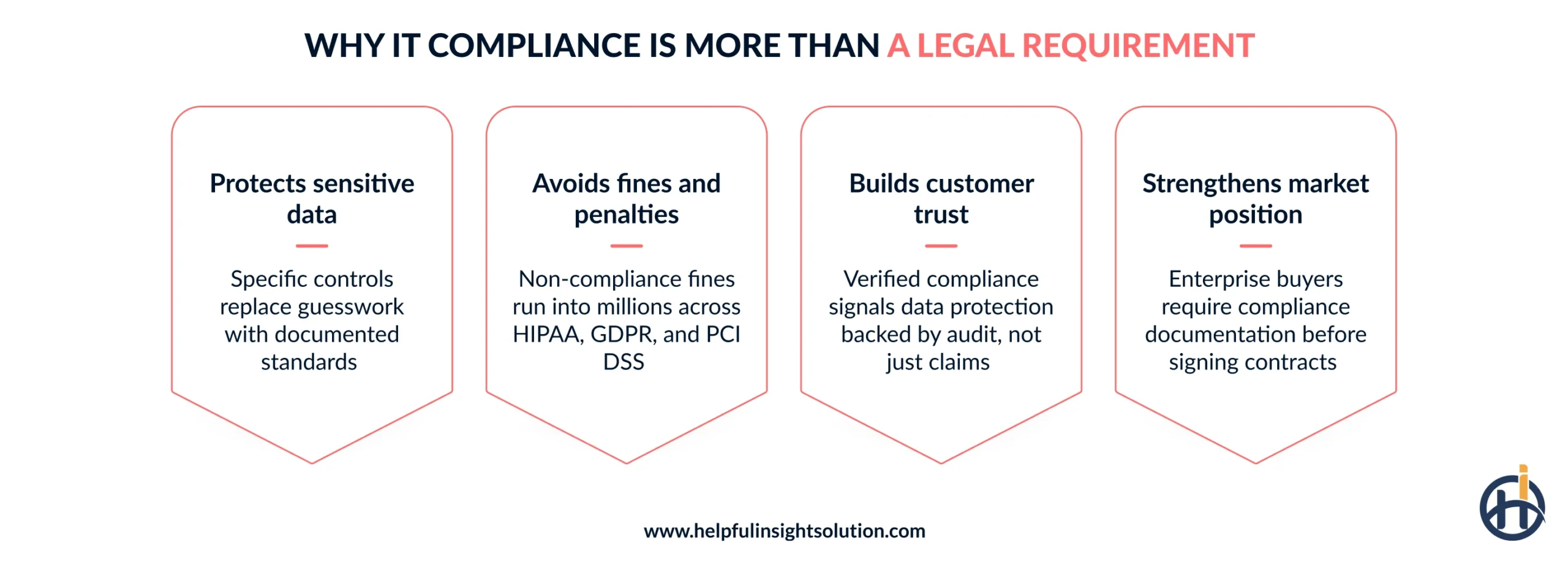
What makes IT compliance more than a legal checkbox is its reach. It directly affects data security posture, financial exposure, vendor relationships, and, in competitive B2B markets, whether a company can win contracts that require compliance certification as a condition of doing business.
Here’s a closer look at why complying with these regulations matters for businesses.
Protects sensitive business data
Rather than leaving data protection to general best practices, most IT compliance frameworks specify exactly what’s required, like encrypted storage, role-based access controls, and documented monitoring.
Many also call for defined incident response procedures, so there’s a clear plan in place if something goes wrong, not something figured out in the moment.
It’s more rigid, but that rigidity is what keeps small gaps from turning into bigger problems.
These same records also tend to work in a company’s favor if a breach ever happens and liability comes into question.
Avoids legal penalties and fines
Falling short of HIPAA compliance standards or CCPA requirements doesn’t end with just a warning; fines, legal costs, and remediation work usually follow. Businesses that meet these requirements consistently sidestep most of that risk.
Regulators often factor in a company’s compliance track record when deciding how severe a penalty should be.
Builds customer trust and credibility
Meeting IT compliance regulations in the US isn’t only about staying out of legal trouble. It’s proof, not just a claim, that a company takes data protection seriously enough to back it up with actual documentation and process. That distinction builds credibility over time.
For B2B companies specifically, compliance documentation has become a standard requirement in vendor due diligence. SOC 2 reports, PCI DSS attestations, and HIPAA Business Associate Agreements are now regularly requested before contracts are signed.
Strengthens competitive market position
In many industries, compliance is a genuine competitive differentiator, not just a background requirement. Enterprise procurement teams, regulated industry partners and government clients all treat compliance certifications as qualification criteria, not a nice-to-have.
A business that cannot demonstrate compliance often loses those contracts to one that can.
FinTech app development is a good example of this. Financial businesses that build compliance in from the start often stand out to customers actively looking for that kind of assurance.
Common reasons businesses struggle with IT regulatory compliance
Compliance gaps usually aren’t about businesses ignoring regulations and legal frameworks altogether. More often, it comes down to operational issues that quietly get in the way.
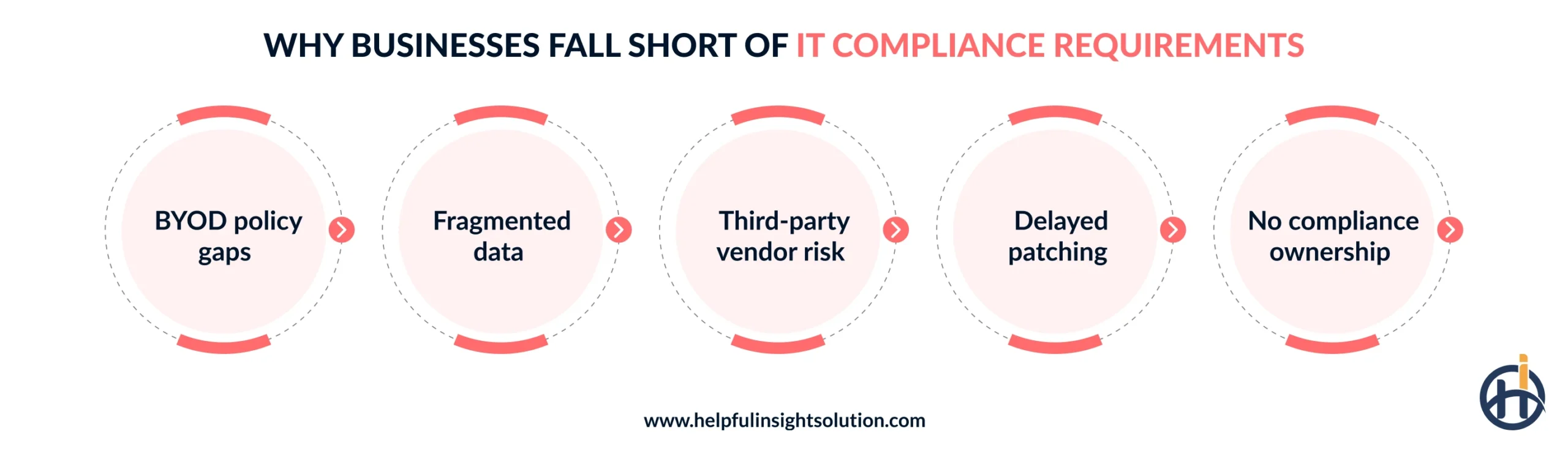
A handful of reasons come up again and again when businesses struggle with compliance in the IT sector, including:
BYOD (Bring Your Own Device) policy gaps
BYOD setups help businesses save on hardware costs, but without a clear device policy, that convenience often comes at the expense of compliance. Security patches get skipped, unapproved apps go unnoticed, and personal devices end up handling company data without proper oversight or encryption.
Individually, these look like minor oversights. Collectively, they are how businesses fail data privacy audits.
Fragmented data
When customer and business data are managed across multiple disconnected systems, maintaining visibility over where regulated data lives and who can access it becomes genuinely difficult.
According to industry research, around 63% of organizations say scattered, disconnected data makes regulatory compliance significantly harder to maintain, and it’s easy to see why. Consolidating data sources, even partially, tends to make compliance work noticeably more manageable.
Third-party vendor risk
Most businesses share data with external vendors as a normal part of operations. Payment processors, cloud providers, HR platforms, and identity verification services are common examples.
That sharing comes with a tradeoff; the risk transfers along with the data. If a vendor’s security fails, the business that shared the data can still face regulatory liability, even without being directly involved in the breach itself.
This is exactly why IT compliance regulations for industries extend to third-party oversight, not just internal systems. HIPAA, for example, requires signed Business Associate Agreements with any vendor that touches patient data.
PCI DSS works similarly, requiring vendors handling card data to prove their own compliance. Responsibility doesn’t stop at a business’s own systems; it follows the data wherever it goes.
Delayed software updates and patching
Skipping software updates might seem minor, but it leaves known vulnerabilities wide open for attackers to exploit.
Regulators generally treat outdated systems as a real security failure, not a technical oversight. With so many patches to track, IT teams often fall behind, and that delay alone can put a business out of step with IT compliance standards.
Unpatched systems come up again and again in compliance audits as a major vulnerability. When a patch is available but not applied, regulators generally don’t treat that as a minor technical oversight; it gets treated as a failure of due diligence.
PCI DSS, HIPAA, and NIST CSF all build patch management into their actual requirements.
IT teams managing large system estates often fall behind on these cycles, and that gap alone is enough to trigger a compliance finding during an audit.
Lack of internal accountability for compliance
Most compliance programs don’t fail because the regulations are too complex; they fail because nobody’s clearly responsible for them.
When compliance monitoring isn’t assigned to someone specific, tasks get assumed instead of owned, and controls end up untested.
Audits then surface problems that ongoing monitoring would have caught months earlier. Appointing a named compliance owner, whether a dedicated role or a responsibility assigned to an existing function, is one of the most effective structural changes a business can make.
IT compliance regulations by industry
Regulatory requirements vary significantly across industries, but IT compliance regulations in the US generally share the same core purpose which is to protect sensitive business and customer data from unauthorized access, misuse, and exposure.
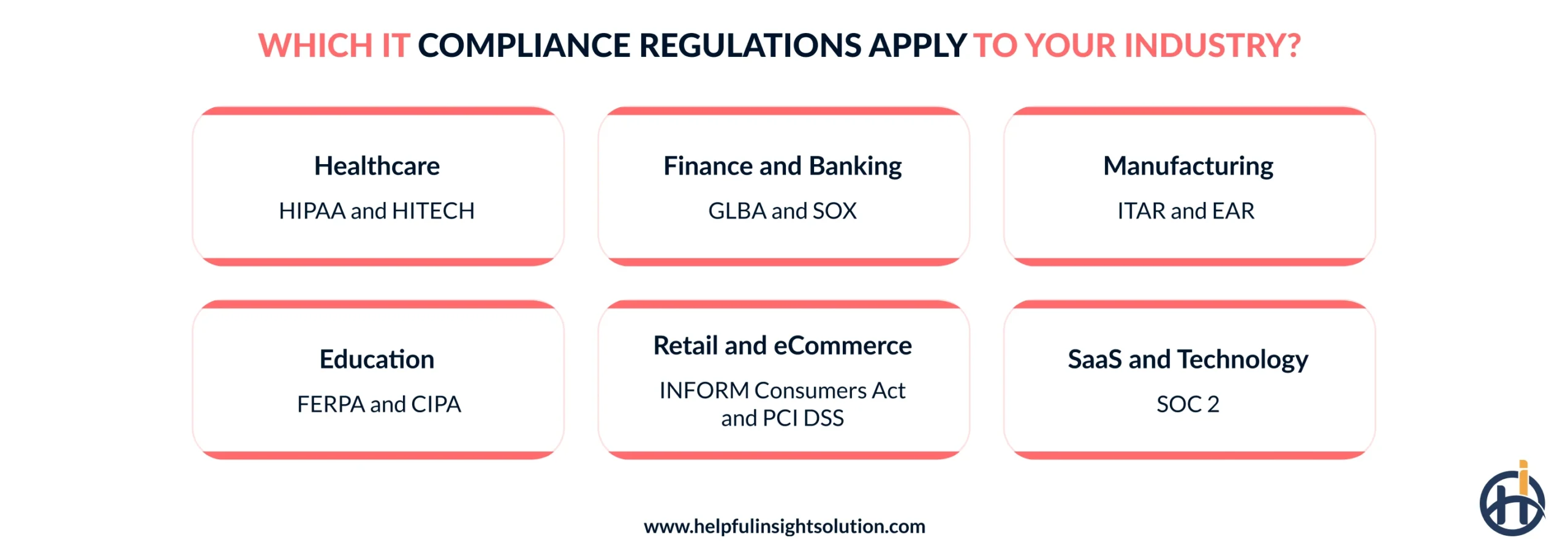
What differs is the specific framework, the enforcement body, and the penalties involved.
Here’s a closer look at the industry-specific IT compliance:
Healthcare
Healthcare deals with some of the most sensitive personal data such as medical records, treatment histories, insurance details, and the regulatory framework around it reflects that.
HIPAA and HITECH are the two primary healthcare IT compliance regulations that organizations in the healthcare sector, along with any vendor handling patient data, generally need to comply with.
HIPAA
HIPAA, the Health Insurance Portability and Accountability Act, sets the baseline for how patient health information gets protected across the US healthcare system.
It applies broadly; hospitals, insurers, and a wide range of other healthcare organizations all fall under it. Moreover, patients themselves can request corrections to their records or restrict how their data is shared.
Businesses in the healthcare sector generally need a few core practices in place to stay aligned with HIPAA, which covers:
- As more providers move to cloud computing in healthcare, encrypting patient data in storage and in transit becomes non-negotiable.
- Access should stay limited to staff who actually need it to do their job
- If a breach happens, patients and regulators need to be notified within HIPAA’s required window
- Keep a log of who’s accessing patient records, and when, in case it’s ever questioned
- Require signed Business Associate Agreements from every vendor that handles PHI
HITECH Act
The HITECH (Health Information Technology for Economic and Clinical Health) Act’s main goal was speeding up the adoption of Electronic Health Records (EHRs) across US healthcare and significantly strengthened HIPAA’s enforcement framework.
It also raised the stakes significantly on enforcement. HIPAA violation monetary penalties range from $145 to $2,190,294 per violation, with the exact amount depending on how the violation occurred and whether it was preventable.
HITECH also introduced stricter breach notification requirements, calling for faster, more transparent reporting than HIPAA alone required.
Businesses subject to HITECH need to follow a compliance checklist covering these core areas:
- Conduct regular risk assessments to identify vulnerabilities in how electronic PHI is stored and accessed
- Have clear policies for handling patient requests, especially those tied to disclosure records
- Include HITECH-specific topics like breach notification rules in mandatory staff HIPAA training
- Document exceptions to the Breach Notification Rule so staff know when reporting isn’t required
- Treat any unauthorized PHI disclosure as a breach by default unless proven otherwise
Finance and banking
Financial institutions handle direct access to money and personal financial data, which is exactly why compliance here runs deeper than in most other sectors.
It’s not just about data protection either; financial businesses also have to account for reporting transparency, consumer protection, and anti-money laundering obligations.
Businesses offering IT services in finance industry work within layers of regulatory oversight that most other sectors simply don’t deal with.
Below are some of the important finance IT compliance regulations:
GLBA
The Gramm-Leach-Bliley Act or GLBA, applies to companies offering financial products or services like loans or investment advice, and requires them to be upfront with customers about how their information gets shared.
One thing to note here is that GLBA doesn’t just cover banks; any business offering financial-adjacent services, even indirectly, can fall under its requirements.
Institutions covered under GLBA need to follow a few rules to stay compliant, which are:
- Every customer should receive a written notice that clearly explains how their personal data gets collected and shared.
- Maintain a documented information security programme; informal practices are not sufficient for GLBA compliance
- Pretexting falls under this too. If someone uses deception to obtain financial information, that’s a violation.
- Don’t treat privacy notices as a once-a-year formality. Update them whenever data-sharing practices actually change.
SOX
The Sarbanes-Oxley Act, or SOX, requires public companies to keep accurate financial records and disclose them transparently to investors and regulators.
It came about after major corporate fraud cases, Enron and WorldCom among them, intending to stop financial misrepresentation at the executive level.
Companies preparing for an IPO, or already trading publicly, fall under this requirement; they have to disclose complete financial information so investors aren’t left working with an incomplete picture.
SOX isn’t just a finance department concern anymore. IT and cybersecurity teams now play a direct role in compliance too, largely because of two provisions.
Section 302, which holds executives accountable for certifying the accuracy of financial reports, and Section 404, which requires companies to maintain and test internal controls over financial reporting.
Both increasingly depend on IT systems, especially as companies adopt RPA in finance to analyze and report data faster. Conduct regular risk assessments to identify vul
The key requirements of SOX that businesses need to meet are:
- Financial reports need to be accurate and certified by the CEO and CFO
- Regular audits are required to confirm that those controls are actually working as intended.
- Any non-compliance found during an audit needs to be documented and addressed.
- IT systems that generate, store or process financial data must meet SOX control requirements
Manufacturing
Manufacturing compliance works a little differently since it centers on what gets built and exported, not on customer-facing data the way most other sectors do.
The main concern here is national security, specifically keeping controlled technology, defense articles, and dual-use goods out of the hands of unauthorized foreign parties.
Here’s a look at the regulations that matter most for manufacturers operating in the U.S.
ITAR
ITAR stands for International Traffic in Arms Regulations, which govern how businesses handle the export and import of defense-related articles, services, and technical data listed on the United States Munitions List (USML).
It’s enforced by the State Department’s Directorate of Defense Trade Controls (DDTC). Any company that manufactures, exports, imports or brokers ITAR-controlled items must register with the DDTC.
Core ITAR compliance requirements include:
- Have a written compliance policy in place, covering employee training, record-keeping, and regular internal audits.
- Store controlled technical data in dedicated, ITAR-compliant environments, rather than standard cloud storage.
- Restrict foreign visitors or employees from areas where defense articles or technical data are present.
- Screen new hires and contractors for citizenship status before granting access to controlled technical data.
EAR
Export Administration Regulations (EAR) cover a wider range than ITAR, such as dual-use items, commercial products with potential military application, and even goods that seem purely commercial.
Even software or technical data sent electronically outside the U.S. can count as an export under EAR.
To build EAR compliance into daily operations, businesses generally need to:
- Items need to be classified against the Commerce Control List (CCL), with the correct Export Control Classification Number (ECCN) assigned before anything gets exported.
- Written compliance policies should cover screening, recordkeeping, and how internal audits are handled.
- Screen customers, partners and transactions against the Bureau of Industry and Security (BIS) denied parties list on an ongoing basis.
- If a violation happens, there should already be a process in place for corrective action, not something figured out after the fact.
Education
Schools and universities manage a genuinely wide mix of data, student records, staff information, research findings, and sometimes government-funded project data.
Education compliance regulations exist largely because a significant portion of this data belongs to minors, which adds an extra layer of legal responsibility.
FERPA
FERPA (Family Educational Rights and Privacy Act) gives parents and students control over education records while keeping that information protected from unauthorized third parties.
It applies to schools and any educational institutions receiving federal education funding.
There’s an important scope limit here too, as only records directly tied to a student’s educational activity actually fall under FERPA protection.
Directory information, like a student’s name, address, or enrollment status, can often be disclosed without consent, unless the student has specifically opted out.
The main FERPA compliance requirements include:
- Written consent is needed before a student’s education records go to any third party.
- Parents or eligible students can inspect and review their own education records at any time.
- There has to be a process in place for correcting inaccurate or misleading record information.
- Access to education records stays limited to officials with a legitimate educational reason.
- Parents and eligible students need to be notified annually about their FERPA rights.
CIPA
CIPA stands for Children’s Internet Protection Act and was passed in 2000 mainly to limit children’s exposure to harmful content over school and library internet connections.
It applies to institutions that receive E-rate funding, a federal program that helps cover internet costs for eligible schools and libraries.
This requirement goes beyond the school’s own network; platforms like e-learning software, LMS, and digital textbooks still need filtering capabilities if they’re accessed through a CIPA-covered connection.
To stay compliant, schools and libraries covered under CIPA need to:
- Implement a technology protection measure that filters or blocks harmful online content on all internet-connected devices
- Hold a public hearing before that policy gets adopted, with reasonable notice given ahead of time.
- Monitor what minors are doing online, and include some form of cyberbullying and online safety education too.
- Cover risks like hacking, unauthorized access, and misuse of minors’ personal information within the same policy.
- Certify CIPA compliance first, E-rate funding doesn’t get released without it.
Retail and eCommerce
Retail and eCommerce businesses deal with payment data in nearly every customer transaction.
Card details typically move through several systems before a purchase is complete, websites, mobile apps, in-store terminals, and payment processors, and each of those points where data changes hands is a potential weak spot.
That’s really what retail IT compliance centers around, protecting that data at every step.
INFORM Consumers Act
The INFORM Consumers Act (Integrity, Notification and Fairness in Online Retail Marketplaces for Consumers Act) requires online marketplaces to verify specific information like tax ID, banking details, and contact information for sellers who meet the law’s high-volume threshold.
Consumers, in turn, get access to identifying details about many of these sellers.
This law also puts the responsibility on marketplaces themselves to secure that data and give consumers a way to report suspicious activity.
Core requirements for online marketplaces under the INFORM Consumers Act include:
- Verify seller information upfront and require it to be recertified as accurate at least once a year.
- Disclose specific seller details in product listings or order confirmations for high-volume sellers.
- Sellers who skip providing the required information get suspended, that’s not optional for the marketplace.
- Give customers a clear way to report suspicious activity right on the seller’s listing.
SaaS/Technology
Unlike industries that mainly collect and store customer data, SaaS companies build and manage the systems that data runs on every day.
That’s a big part of why SaaS compliance requirements center so heavily on cloud security and infrastructure reliability, rather than just data handling policies.
SOC 2
SOC 2, or System and Organization Controls 2, is technically voluntary. In practice, though, it’s close to a requirement for any SaaS or cloud company going after enterprise contracts.
The certification comes from an independent auditor, someone who assesses whether a service organization actually has proper controls in place around security, availability, and data handling.
A lot of enterprise procurement teams now ask for a current SOC 2 Type II report before they’ll even consider a vendor.
SOC 2 reports assess internal controls across five Trust Service Criteria:
- Security covers how systems and data are protected from unauthorized access.
- Availability confirms systems and services stay operational and accessible as agreed with customers.
- Processing integrity checks that system processing is accurate, complete, and properly authorized.
- Confidentiality restricts access to information specifically marked as confidential.
- Privacy covers how personal information gets collected, used, stored, and eventually disclosed.
Cross-sector IT compliance frameworks that apply to every industry
Industry-specific frameworks set the baseline for each sector, HIPAA for healthcare, GLBA for finance, and so on. But several compliance frameworks apply no matter what industry a business is in, covering things like personal data handling, payment processing, or general cybersecurity risk.
These are the ones that most U.S. businesses run into at some point, regardless of their sector.
GPDR
The General Data Protection Regulation (GDPR) is a European Union regulation, but it doesn’t stop at Europe’s borders. Any U.S. business collecting or processing data from EU residents falls under it too, no matter where that company is actually based.
The penalties aren’t small either, fines can reach a maximum of 20 million euros, which is why US businesses with any EU customer base treat GDPR compliance seriously.
Businesses processing data under GDPR generally need to follow a few core principles:
- Data processing needs to stay lawful, fair, and transparent to the person it belongs to.
- Data can only be used for the specific reason it was originally collected for, nothing beyond that.
- Only what’s genuinely necessary gets collected, not more than the purpose actually requires.
- Personal data has to stay accurate, and updated whenever something changes.
- Data doesn’t get kept longer than it needs to be for that original purpose.
- Proper security measures need to be in place to protect data from unauthorized access or loss.
- Organizations need to actually demonstrate compliance, not just claim they’re following these principles.
PCI DSS
The Payment Card Industry Data Security Standard (PCI DSS) establishes a security standard for handling payment card data. It applies to any company that stores, processes, or transmits card information, no matter the industry.
PCI DSS v4.0 tightened things around authentication and continuous monitoring. It became fully mandatory for all businesses back in 2025.
Here’s what PCI DSS compliance requires:
- Get a firewall installed and keep it maintained so it actually blocks unauthorized access.
- Default passwords on routers, POS systems, and similar devices should be replaced with strong ones.
- Encrypt cardholder data itself, and the keys used to protect that data too.
- Data being transmitted across networks needs encryption also.
- Antivirus software should run on any device that stores or interacts with card data.
- Keep software updated regularly, automatic updates work best.
- Access to cardholder data should be limited strictly to employees who actually need it for their job.
- Each person with access needs a unique ID, shared logins across employees aren’t compliant.
- Physical records or devices holding cardholder data need to be stored somewhere secure.
- Every instance of someone accessing cardholder data should get logged and tracked.
- Systems need regular vulnerability scans and testing.
- Document your policies clearly.
CCPA
The California Consumer Privacy Act (CCPA) gives California residents control over their own data. They can ask what’s being collected, request it get deleted, or opt out of having it sold. It applies to for-profit businesses even if they’re not based in California.
This is one reason IT compliance regulations for industries increasingly extend beyond federal law to include state-level rules like this one.
It’s easy to know whether your business falls under CCPA. Generally, it applies if a company has over $25 million in annual revenue, handles personal data for 100,000 or more California residents, or earns 50% or more of its revenue from selling that data.
Here’s what CCPA compliance requires from businesses:
- Let customers know what personal data has been collected, where it came from, and why.
- Delete a customer’s personal data on request, along with informing service providers to do the same.
- Let customers opt out of having their data sold or shared, including through global privacy controls.
- Correct inaccurate personal information whenever a customer flags it.
- Limit how sensitive data, like SSNs or financial details, gets used to only what’s necessary.
NIST CSF
The NIST Cybersecurity Framework (CSF) was developed by the National Institute of Standards and Technology as voluntary guidance for managing cybersecurity risk.
Businesses aren’t forced into a specific structure, but it’s built to work with whatever security setup they already have.
The current version, NIST CSF 2.0, added governance as a core function, reflecting just how central leadership accountability has become in managing cybersecurity risk.
That flexibility is probably why it’s turned into such a common starting point for organizations across nearly every U.S. industry.
Let’s have a look at what businesses need to address to ensure they meet NIST CSF requirements:
- Govern: Setting and monitoring the organization’s overall cybersecurity risk management strategy.
- Identify: Understanding systems, assets, and related risks.
- Protect: Putting safeguards around critical data and infrastructure.
- Detect: Identifying cybersecurity events as soon as they actually occur.
- Respond: Taking the right action once a cybersecurity incident gets detected.
- Recover: Restoring operations and resilience after an incident has occurred.
What Happens When Businesses Fail IT Compliance Requirements
Knowing which regulations apply is one thing. What actually happens when a business falls short in meeting compliance is just as important to understand.
The cost of non-compliance rarely stops at a single fine, it tends to spread further than most businesses expect.
Regulatory fines and penalties
When regulators find that a business has failed to meet data protection standards, the fines that follow usually aren’t small. These penalties are built to make non-compliance expensive on purpose, and they often run into the millions.
Marriott’s case shows just how significant these penalties can be. After a series of data breaches between 2014 and 2020 affected more than 344 million customers worldwide, the company was required to pay $52 million to 49 states and the District of Columbia.
Reputational damage
Trust takes years to build and can be damaged quickly by a single publicised compliance failure. Once a data breach reaches the news, the reputation a company worked to earn starts shifting, from reliable to negligent, in the public’s mind.
This damage doesn’t stay contained to media coverage, it frequently shows up in customer churn and stock price drops that outlast the initial news cycle by months.
Loss of customer trust
Customers generally assume their personal data is being handled responsibly; that’s simply the basic expectation now.
When a business falls short of IT compliance regulations for industries, that assumption breaks, and once it does, users don’t usually wait around. Most switch to a competitor that feels safer.
Contract and business loss
A lot of B2B vendor agreements build compliance requirements right into the contract, SOC 2 reports, PCI DSS attestations, or HIPAA Business Associate Agreements, depending on what industry it is.
Businesses tend to overlook these early on, and the gap usually doesn’t surface until an audit fails or a breach actually happens.
At that point, non-compliance can count as breaking the contract outright. Partners tend to exit fast to protect their own compliance standing, and prospective clients doing due diligence frequently rule out vendors who can’t provide the required documentation.
How to build an IT regulatory compliance program
Building an IT regulatory compliance program can sound overwhelming at first. Once businesses know where to start, though, it usually breaks down into a fairly manageable sequence.
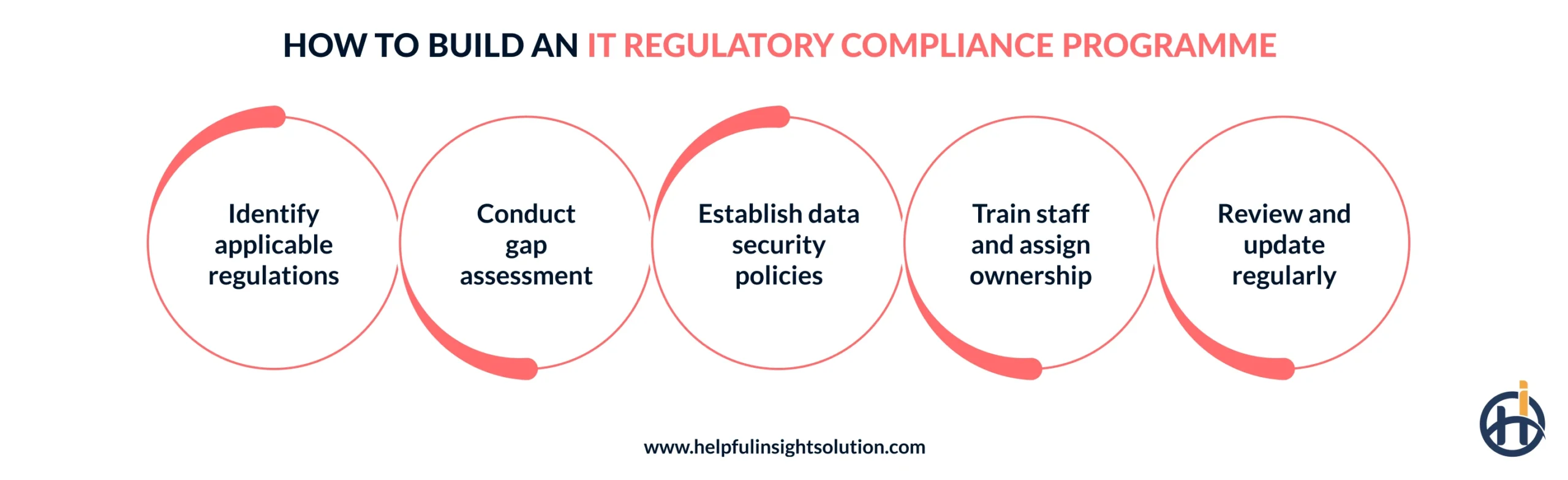
The steps below cover a practical approach that works for most companies.
Identify which regulations apply to your business
The first step is figuring out exactly which regulations apply, based on the type of data handled and where customers are located.
A business processing card payments needs PCI DSS, one handling patient data falls under HIPAA and HITECH, and companies in Finance IT compliance territory usually deal with GLBA or SOX.
If a business serves customers in the EU, GDPR comes into play too. Getting this mapped out early prevents wasting resources over-complying or missing something critical and facing penalties later.
Conduct a compliance gap assessment
Compare what a business currently has in place against what’s actually required. Sensitive data flows, storage, and access need to be reviewed alongside existing systems to catch weak points like missing encryption.
The value here isn’t just finding problems; it’s documenting them by severity so fixes can be prioritized before an official audit exposes them.
Establish data security and access policies
This stage involves documenting exactly how data should be handled, who gets access, and how incidents get responded to. Access typically gets restricted through role-based controls, paired with multi-factor authentication and encryption for data at rest and in transit.
If a business is investing in financial software development, these policies matter even more since payment and account data carry higher risk if mishandled. This is one reason fintech development outsourcing has become common — it brings in teams who already build for compliance.
Train employees and assign compliance ownership
Most compliance failures trace back to human error. Regular training closes that gap, especially around things like phishing awareness and knowing how to report an incident properly.
Giving specific people ownership over specific controls also stops accountability from getting lost. Staff who understand the policies tend to catch mistakes early, before they escalate into actual violations.
Review and update as regulations evolve
Treating compliance as a one-time project is a common mistake. Laws change, threats evolve, and last year’s policy might not hold up now.
Scheduled reviews help catch this in time, letting businesses update their risk assessments before an outdated framework turns into a real liability.
How Helpful Insight helps businesses build compliance-ready digital products
IT compliance regulations for industries apply to nearly every business today, not just the ones in obviously regulated sectors like healthcare or finance.
What separates businesses that handle this well from those that don’t usually comes down to timing, whether compliance gets built in early or gets addressed only after a problem forces the issue.
That’s really the gap most businesses fall into. Understanding the regulations is one thing, actually building them into a product from the start is another.
If you’re developing something new or trying to bring an existing product up to standard, working with an experienced software consulting and development company can close that gap.
We help businesses treat compliance as part of the development process itself, not something added on after launch.
Our team understands how compliance requirements apply across different sectors and builds that understanding directly into the solutions we create, so you get a product that’s compliance-friendly. Beyond development, we support businesses through compliance audits and gap assessments.
To know more about how we can help you, get in touch with our team.
Questions You May Have
IT compliance means keeping a company’s technology systems, data handling, and security practices aligned with legal regulations and internal policies, not as a one-time task, but something ongoing. It covers how data gets collected, stored, and protected, along with the controls needed to catch problems early.
IT security is about actively protecting systems and data against real threats, malware, hackers, and unauthorized access through tools and ongoing practices. IT compliance is different; it’s about meeting specific external requirements like HIPAA or GDPR and being able to prove those protections exist.
Company size doesn’t exempt most businesses from compliance requirements; if a business operates in a regulated industry or handles sensitive data, IT compliance regulations still apply regardless of headcount or revenue.
CCPA is one exception worth knowing, as it only applies to businesses with over $25 million in annual revenue, or those handling personal data for 100,000 or more California residents. A small FinTech startup generally has to meet the same core requirements as a much larger financial institution.
No fixed schedule works for every business, it comes down to how regulated the industry is. Lower-risk sectors can often manage with one audit a year. Healthcare and financial services tend to need more frequent checks, sometimes quarterly, since regulations like HIPAA leave less room for gaps to go unnoticed for months.
Failing an IT compliance audit can lead to several serious consequences. Regulatory fines are the most immediate, but businesses can also lose certifications like ISO 27001, face mandated corrective action plans, and deal with closer scrutiny from regulators going forward. Customer trust often takes a hit too, especially if the failure becomes public.