

Key Takeaways
- Cybersecurity in fintech protects real money and sensitive customer data — making it one of the most targeted sectors for cyberattacks globally.
- A single breach in financial services costs $5.56 million on average in 2025, and for a fintech startup, that figure can decide whether the business survives or shuts down.
- The most common threats are phishing, ransomware, API vulnerabilities, insider threats and account takeover — and most of them exploit people or integrations, not just code.
- Compliance with PCI DSS, GDPR and GLBA is a legal requirement, not a recommendation — violations carry fines that run into millions and trigger investigations that take years to resolve.
- Security built into the product from day one costs less, audits faster and survives longer than security patched in after launch or after a breach forces the issue.
Fintech is growing fast, and the attacks targeting it are growing just as fast. Every year, more of the money and data that fintech products hold come into the sights of attackers. Even one cybersecurity breach can undo the years of work and reputation. This is why cybersecurity in fintech has become important.
In this guide, we will cover the main threats you face, the regulations you must follow, and the best practices that keep your platform and your customers protected.
What is Cybersecurity in Fintech?
Cybersecurity in fintech is the practice of protecting financial systems, customer data, and transactions from unauthorized access, fraud, and cyberattacks.
It covers everything from how customer credentials are stored to how payment flows are secured and how APIs connecting your product to banks and third-party services are protected.
A fintech application is not similar to any other mobile application. The stakes in fintech software development are far higher since you are handling customers’ sensitive details that should never be made public and moving real money, which leaves very little room for error.
A bug in a food delivery app might lead to late delivery or a canceled order, but the same bug in a fintech product might empty a bank or put someone’s sensitive information at risk.
Also, fintech is a highly regulated industry; any security incident can cause your platform to lose credibility and regulators to bring it down.
Cybersecurity in Fintech vs. Traditional Banking — What’s Different
Traditional banks have been protecting money for decades, and their security systems are built on old, heavily regulated frameworks that change very slowly. Also, a bank must follow strict regulations before it launches anything, so it moves gradually.
On the other hand, fintech companies work differently. They often first introduce features, making it their nature to move fast. Also, depending on their licensing model, they might have more flexible compliance compared to a traditional bank.
The speed to evolve is a must for fintech companies to stay competitive in the market, but it also changes how security gets handled. Since many fintech products are pushed to the market quickly, fintech app security often chooses to be fixed later, either when the product has enough users or a security breach takes place. Either way, the product is at risk.
Also, fintech companies depend a lot more on APIs, third-party tools, and cloud services than traditional banks do.
A traditional bank runs most of its systems in-house using its own technology, the way most IT services in the finance industry have worked for years, but a fintech product connects many third-party services to move faster. It does help with flexibility, but at the same time it makes fintech data security more vulnerable.
The other key difference is architectural. A traditional bank runs most of its core systems in-house on its own infrastructure.
A fintech product typically connects to a network of APIs, third-party payment processors, identity verification services, and cloud platforms to move fast.
That connectivity is what makes fintech products flexible and scalable — but every third-party connection is also a potential entry point.
More integrations mean more attack surface, and that attack surface needs to be actively managed.
Why Cybersecurity in Fintech Is Critical
Cybersecurity in fintech is critical because one breach can hit your business in more than one way at the same time. Broadly, there are three risks you carry here, and each of them is costly in its own manner.
- Financial loss: A breach can mean stolen funds and fraud losses, along with heavy fines to compensate customers’ losses. According to IBM’s 2025 Cost of a Data Breach Report, the average breach in financial services now costs $5.56 million, which is the second highest of any industry, right after healthcare. For a large institution, that number is damaging. For a fintech startup, it can decide whether the company survives.
- Legal and regulatory side: When customers’ data leaks, regulators step in, and they can impose heavy fines or drag you into long investigations. Also, the affected customers often file lawsuits, which add even more cost on top of the fine. So the real damage is not the breach alone; it is everything that comes after it. The legal process, the settlements, the compliance remediation, and the reporting obligations can stretch for years after the original event.
- Reputation: In fintech, trust is the product. Your customers hand over their money and personal data based on that trust, and when it breaks, they leave, and they tell others why. The system can be fixed in a few weeks, but reputations take years to rebuild, and some brands never fully recover. The 2022 Revolut breach is a clear example. The company fixed the technical issue quickly, but the phishing campaigns that followed, using the leaked customer data, kept damaging customer trust long after the breach was resolved.
Common Cybersecurity Threats Fintech Companies Face
Fintech is one of the most targeted industries around, and the reason is simple: the reward for a successful attack is money itself. But attackers don’t always invent new ways to hack your application; they mostly reuse the same methods that have worked for long periods of time.
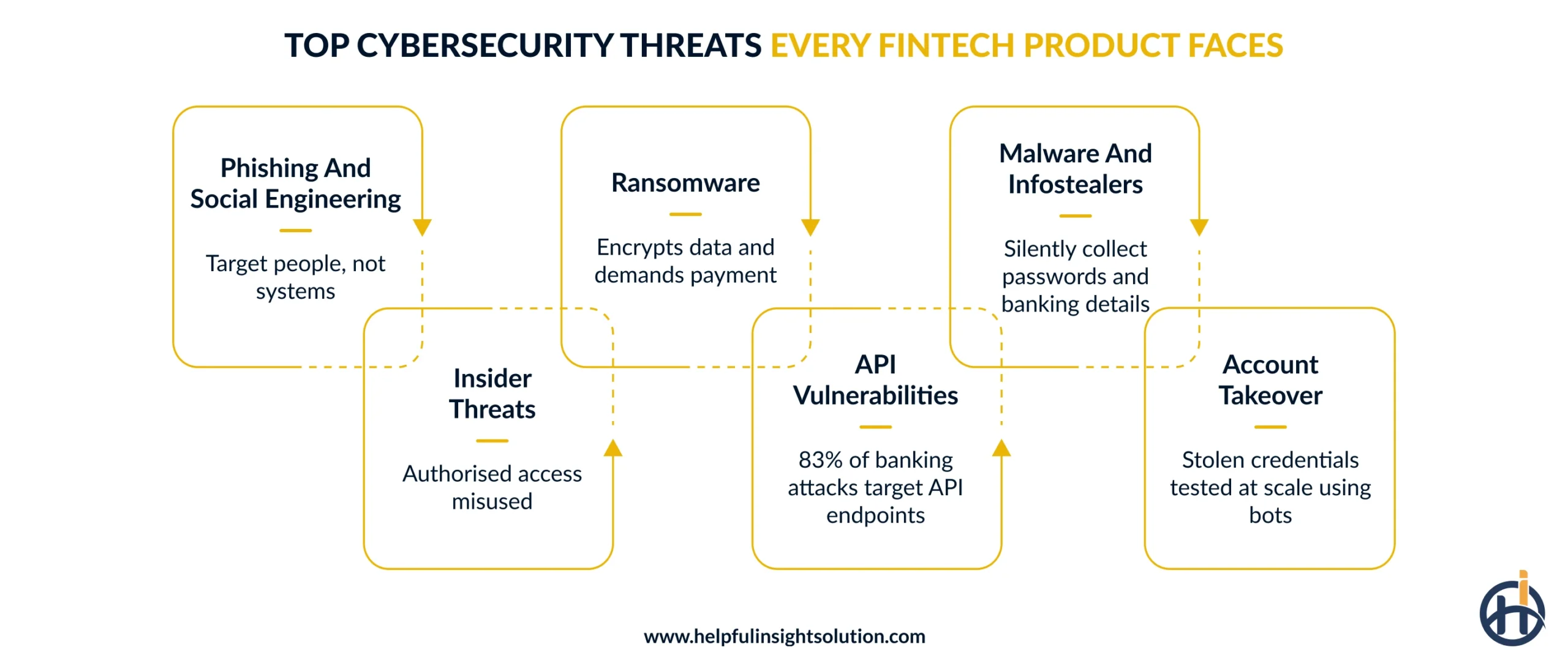
The threats below are the ones fintech companies encounter most frequently. Understanding how each one works gives you a practical map of where your biggest vulnerabilities sit and what to protect first.
Phishing and Social Engineering
Phishing is an attack where someone pretends to be a trusted entity, a bank, a payment provider, or a colleague and then asks you for sensitive information or to approve something you should not.
The method is simple. The attacker sends an email, a text, or a call that looks official enough to be trusted. The target then clicks the link or enters their details, and the attacker gets what they need without touching a single line of your application code.
That is what makes phishing so dangerous; it skips your technical defences completely and targets the person instead.
This attack usually falls at the customer’s side, as there is no application flaw being exploited. In 2025, phishing and spoofing scams resulted in approximately $215.8 million in reported losses, according to the FBI’s IC3 report.
Ransomware
Ransomware is a type of malicious software that encrypts your data or entire systems and then the attacker demands a payment, usually in cryptocurrency, in exchange for the decryption key.
It often gets in through a phishing email, a stolen login credential, or an unpatched software bug. Once it runs, it spreads across the network and encrypts everything it can reach.
Most attackers now use double extortion: they quietly copy your data before encrypting it, and then threaten to leak it publicly if you refuse to pay. So even a company sitting on clean backups can still be pressured into paying, because the threat has shifted from data loss to data exposure.
The impact of ransomware in fintech is more severe. Payments stop, customer accounts freeze, and every hour of downtime results in losing both revenue and trust.
According to Sophos, the average cost for a financial organisation to fully recover from a ransomware attack reached $1.74 million in 2025 — and that figure excludes the business lost during the downtime itself.
Malware
Malware is a broad term used for any harmful software designed to enter your system to steal data or damage it, or create persistent access for the attacker.
There are many types of malware, and each one is built for a distinct purpose.
For example, keyloggers stay hidden on a device and record everything a user types, so attackers can capture passwords.
Trojans work differently, they hide inside software that looks real, so the user installs them without realising it. Then there are backdoors, which quietly create a hidden way for the attacker to enter the system again whenever they want.
In fintech, the most active malware category in 2025 and 2026 is the infostealer; it stays hidden on the infected device and collects saved passwords and banking details, and the user does not even notice it.
Infostealers compromised more than one million online banking accounts in 2025, and attacks on mobile banking users increased by around 1.5 times. (Source: Kaspersky’s 2025 financial threat report)
The most common way for a malware attack to occur is through a fake app, cracked software, or harmful email attachments. Nowadays, both fintech applications and software are vulnerable to malware attacks.
Insider Threats
An insider threat is a security risk caused by people within your own organization who already have authorization to access your system and data.
The person could be a current employee, a previous one whose access was never revoked, or a third party you are working with. Since they are already trusted, it becomes difficult to detect such attacks.
Insider threats usually fall into two types: intentional and accidental. The intentional one is when a person knowingly leaks or steals data, mostly for money or on the request of someone outside the company.
The accidental one happens through simple human error, such as sending a private file to the wrong person, saving passwords in an unsafe place, or falling for a phishing link. In both cases, the outcome stays the same: your customers’ data gets leaked.
The risk becomes even bigger in fintech, as the data an insider can access, such as transaction records, identity details, and account credentials, holds real value for attackers.
So the two cybersecurity practices that can help here are privilege management, which limits what each person is allowed to access, and access logging, which keeps a record of who did what.
API Vulnerabilities
APIs are the bridges that can let your fintech software connect and exchange data with other systems like banks, payment gateways, identity verification services, and other third-party platforms. They are what make fintech products fast, flexible, and scalable.
Every API you use is also a new entry point, and if it is not secured properly, an attacker can use it to reach your data or carry out actions they should not.
Attackers look for API flaws, and once they find one, they can pull out sensitive information or push transactions through without the right permission.
The challenging part is that a broken API keeps working normally, so the problem remains unnoticed for a long-period of time.
According to Akamai, banking remains the primary target for web and API breaches. In 2025, the banking vertical took 60% of all web attacks and 83% of the attacks aimed at API endpoints.
For a fintech product built on API-first architecture, which most are, this is the threat category that warrants the most attention.
Account Takeover and Credential Stuffing
Account takeover is when an attacker gets into the real customer’s account and starts using it as their own. Once they have access, it becomes easy for them to move money, change account details, or make purchases.
All these account activities will be marked normal in your system, so you won’t be able to act on them unless the real user reports it. This risk is even higher for apps that hold money directly, like a digital wallet app.
The most common way attackers do this is credential stuffing. In this method, they take usernames and passwords that were leaked from other platforms, and use automated bots to test those credentials against fintech apps at high volume. Because people reuse passwords across services, a breach on an unrelated platform can become the entry point to a financial account.
Strong passwords help, but they are not enough on their own, because attackers often use real passwords that were already leaked from other sites.
The better way to stop account takeover is to add more layers, such as multi-factor authentication, limits on repeated login attempts, and alerts for logins from a new device or location. So the aim is not just a strong password; it is making a stolen one useless by itself.
What Happens When Customer Data Is Compromised (Real Examples)
The threats above are not hypothetical. They have already hit well-resourced, well-known companies with dedicated security teams.
The following examples show how each breach happened, what it cost, and what the longer-term damage looked like beyond the initial incident.
Capital One (2019)
In 2019, Capital One faced one of the largest data breaches in banking history. An attacker identified a wrongly configured firewall in the bank’s cloud system and used it to get access to the data of more than 100 million customers in the US.
The leaked data included over 100,000 Social Security numbers and around 80,000 bank account numbers. The cost was high, regulators fined the bank $80 million, and later it paid a $190 million settlement to close the customer lawsuits.
Simply put, one small misconfiguration ended up costing hundreds of millions. A single misconfiguration in cloud configuration management cost the institution over $270 million in penalties and settlements alone.
Revolut (2022)
Revolut, a well-known digital banking app, was hit in September 2022. This time the attacker did not break any system; they used social engineering to enter. Since they targeted a person and not the technology, they got access to the data of around 50,000 customers before it was stopped.
The immediate financial impact was limited; no money was taken. The longer-term impact was more damaging. Using the leaked personal data, attackers launched targeted phishing campaigns against the same 50,000 customers.
The messages used real names, real account details and real transaction references to appear credible. Many recipients had no reason to suspect they were not genuine communications from Revolut.
This case illustrates a pattern common across fintech breaches: the data itself is not the final attack. It is the starting point for the next one.
Coinbase (2021)
Coinbase, a big name in blockchain and fintech, faced a flaw in its login system. Between March and May 2021, attackers found a flaw in its SMS account recovery and used phishing to get past the two-factor authentication. This let them get into at least 6,000 accounts and steal the crypto inside.
Coinbase paid back the full amount to affected users and fixed the process later, but the trust it lost was not that easy to get back.
There is one common point in all three cybersecurity threats in fintech. The attack methods were different, but the result was the same, the customers’ trust got hit.
In fintech, trust is basically the product. Also, once it is lost, getting it back can take years, and some brands never really recover from it. So protecting your customers’ trust matters more than rushing the next feature to market.
What Are the Key Fintech Regulatory Compliance Standards to Follow?
Building a secure fintech is not only about stopping hackers, but you also have to follow the rules set by regulators. This part is known as fintech regulatory compliance, and it decides how you store and protect customer data.
The exact rules depend on where you operate and what services you offer. Still, a few of them apply to almost every fintech, so let us go through the main ones.
| Regulation | What it covers | Who must follow it |
| PCI DSS | How card payment data is stored and protected | Any fintech that handles card payments |
| GDPR | Privacy and protection of personal data of EU users | Fintechs serving customers in the EU |
| GLBA | How US financial firms protect customer financial data | Fintechs offering financial services in the US |
Beyond these three, fintechs often deal with a mix of regional rules that change from one market to another.
For example, if you move money, you might need money transmitter licenses, and if you work with a partner bank, you have to follow the compliance terms of that partnership. Since these rules keep changing, keeping up with IT compliance for the fintech becomes an ongoing task, not a one-time checkbox.
The cost of ignoring all this is not small. A GDPR violation can go up to 20 million euros or 4% of your global yearly turnover, whichever is higher. Also, PCI DSS non-compliance can bring fines of $5,000 to $100,000 every month until you fix the issue. So if you want to avoid heavy fines and keep your customers’ trust, treating compliance as a core part of your product is the safer way to go.
Fintech Cybersecurity Best Practices Every Product Should Follow
Knowing the threats is only the first step. The second one is putting the control in place to stop them. Most of the practices below do not require a big budget, what they need is regular and consistent use.
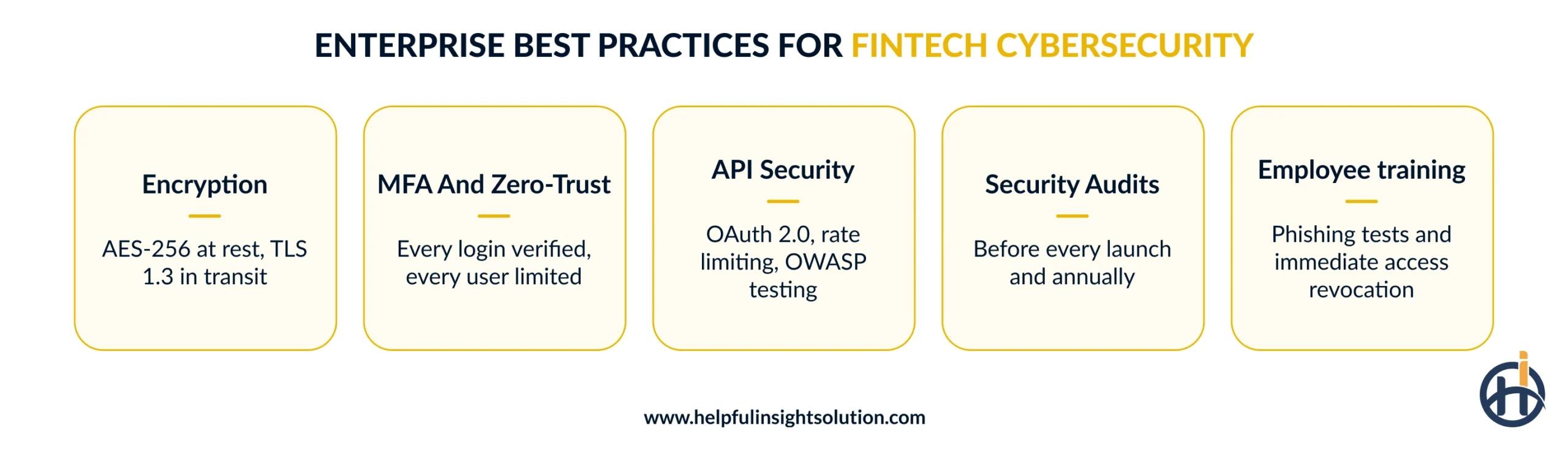
When you follow them together, they cover most of the attacks a fintech product faces. So here are the fintech cybersecurity best practices every fintech should follow.
Encryption and Data Protection
Encryption converts your data into a coded format that stays unreadable without the correct key. So even if someone steals it, all they get is a scrambled file with no value. In fintech, this is a must because you are holding card details and personal data that attackers really want.
You should encrypt the data at both stages, when it is stored and when it is moving. You can use an AES-256 setup for stored data and TLS 1.3 or above for data in transit.
This ensures data is protected at every point in its lifecycle, not just when it is stored.
Multi-Factor Authentication and Zero-Trust Access
A single password is more prone to cybersecurity threats, as it can be hacked using brute force attacks or can be stolen from a leaked website.
This is where multi-factor authentication, or MFA, adds another layer of security before letting anyone access an account. A common example is a one-time code sent to the phone, or a fingerprint check before approving a transaction.
Zero-trust architecture goes further. Rather than granting access based on whether a user is on the network or has logged in, zero-trust verifies every request independently and applies the principle of least privilege: each user, employee, or system can access only what their specific function requires, nothing beyond that.
In fintech, where a single stolen login can move real money, these two are not extra features; they are baseline requirements.
API Security and Continuous Testing
API security starts with authentication and authorisation. Using standards like OAuth 2.0 means every request has to prove it is allowed before the API responds. Also, adding rate limiting stops attackers from hammering your API with millions of requests.
A common technique used in credential stuffing and data scraping attacks.
But securing an API once is not enough, because your product keeps changing. So you have to test it regularly, ideally against the OWASP API Security Top 10, which lists the most common API flaws to check for. Since fintech moves fast, this testing has to be a regular habit, not a one-time job.
Regular Security Audits and Penetration Testing
A security audit is a structured review of your systems to find weak points before an attacker can exploit them. Penetration testing takes this step a further, where you let ethical hackers try to break into your system using the same methods a real attacker would, but this time they report the gaps instead of misusing them.
A standard practice in fintech is to run a penetration test before every major launch, and get audited against standards like SOC 2 or PCI DSS once a year.
Beyond these periodic checks, continuous monitoring tools powered by AI in financial technology keep watching the systems and detect unusual activity in real time.
These tools flag anomalies much faster than a person could, and they catch the issues that a scheduled audit would miss.
Employee Training and Insider-Threat Prevention
Most attacks start with a person and not a machine, so your own team becomes your first layer of defence.
Regular training teaches employees how to identify a phishing email and handle customer data carefully. Many fintechs even run fake phishing tests to see who clicks, and then train those people better.
For insider risks, the best practice is to control access and keep monitoring it. Give every employee access to only what their job needs, and revoke it the moment they leave. Beyond this, keeping an eye on odd activity, like someone pulling large amounts of data at once, helps you catch the issue early. Either way, training and limited access together reduce both the honest mistakes and the intentional leaks.
None of these cybersecurity best practices are difficult to implement.
They must be implemented together, because each one covers a gap that another might leave open. So if you make these practices part of your daily work, your fintech becomes a much more difficult target and a much safer place for your customers’ money.
How Do You Build Security Into Fintech App Development?
In fintech, security should not be something you add once the app is ready. Instead, it must be a part of the development process right from the first line of code. This approach is known as secure by design.
Simply put, security becomes a core part of the build, and not a feature that is added later. Any good fintech app development guide will suggest the same, that security works best when it is planned from the start.
This is the base of secure fintech app development, where the product and its security grow together.
It all begins with the code. Secure coding means your developers write the code in a way that does not leave open gaps for attackers, for example, by checking every user input and handling errors properly.
A single unchecked input field is enough for an attack like SQL injection. Also, code reviews help here, as another developer checks the code before it goes live, so a mistake gets caught early instead of reaching your customers.
Beyond this, security should run inside your development pipeline, not outside it. This is what DevSecOps does. It adds automatic security checks into the CI/CD pipeline, so every new build gets scanned for vulnerabilities before it is released.
As a general rule of thumb, if your fintech team pushes updates every week, a manual check alone will always miss something.
Secure API design is one more important part, as fintech runs heavily on APIs. It means each API is planned with security in mind from the start, by deciding who can access it and how much data it should return. The best way to do so is to apply strong authentication and rate limits at the design stage itself, and not after the API is already live.
Many startups skip all of this because of time, they rush the launch and plan to fix security later. However, this later fix almost always costs more. You end up reworking large parts of the app, which increases your fintech app development cost, and even one breach in that gap can cost you your customers and their trust.
So, doing it right the first time is always cheaper than repairing it after something goes wrong.
Simply put, secure fintech app development is about stopping attacks before they happen, and not reacting after the damage is done. So if you make security a part of every stage, your product stays safer, and you save the time and money that go into fixing avoidable mistakes.
How to Choose the Right Technology Partner for a Secure Fintech Product?
Building a secure fintech product takes real expertise, so the partner you choose to build it matters a lot. The right one can save you from many of the risks we discussed above. So before you decide, there are a few things you should check.
- Finance and compliance experience: A partner who has already built products under regulators like the RBI, SEC, or UAE Central Bank knows what PCI DSS, GDPR, and GLBA actually require in practice, not just in theory. They will not have to learn these rules while building your product.
- Security track record: Check how they handled security in their past projects. Ask what testing they ran, who reviewed the code, and how they managed third-party API security. The details of past work tell you more than any general claim.
- Compliance built into the product: A partner should not hand compliance back to you as a separate job. Instead, they add these requirements into the product from the start, so you do not have to meet PCI DSS or GDPR on your own.
- Post-launch support: Security is an ongoing task, not a one-time job. As rules change and new threats show up, your product needs regular monitoring, patching, and testing. A partner who leaves soon after delivery is not a complete choice.
Helpful Insight builds fintech products with security and compliance added from the start, so you do not have to fix these things later.
If you are planning a secure fintech product, our fintech development outsourcing and fintech app development services cover the entire process, from architecture and compliance setup through to post-launch support.
Final Thoughts
Fintech was and will always be a top target, because this is where the money and the sensitive data are. Also, the threats are not staying the same, they keep changing and getting smarter every year.
So cybersecurity in fintech cannot be processed as a one-time task or something you add after launch, it has to be built into the product from the very start.
Frequently Asked Questions
Not exactly the same way. Fintech companies follow strict rules, but the exact regulations depend on their license and the services they offer. Some work under a partner bank, while others hold their own license. So the level of regulation varies, though data protection rules like PCI DSS and GDPR still apply to most of them.
There is no single biggest risk, but phishing and stolen credentials cause the most damage. Attackers trick employees or reuse leaked passwords to get inside, and from there they can reach money and sensitive data. Also, API attacks are rising fast, as fintech depends heavily on APIs to connect with other systems.
They protect it through several layers. The data is encrypted both when stored and when moving between systems, so it stays unreadable if stolen. Also, they add multi-factor authentication and run regular security tests to catch weak points early. Beyond this, strict access control and staff training help stop attacks that target people instead of systems.
Cybersecurity is a broad term for protecting any system or data from digital attacks. Fintech security is a part of it, focused only on financial apps and platforms. So every fintech security effort is cybersecurity, but it deals with the extra risks that come with handling real money and sensitive financial data.
The cost varies, but it is high. According to IBM’s 2025 report, the average data breach in financial services is around $5.56 million, the second highest of any industry. For a fintech startup, the total cost can be even higher once you add fines, lawsuits, and the loss of customer trust.