

Key Takeaways:
- GenAI helps businesses to analyze security data, identify suspicious patterns, detect emerging threats, and ensure faster incident response.
- With generative AI solutions, it is easy to summarize complex information, correlate data from multiple sources, and provide actionable insights.
- It assists cybersecurity teams with investigating security incidents, generating response recommendations, and accelerating remediation workflows.
- Enterprises require appropriate AI models to protect sensitive data, integrate generative models with existing tools, and establish strong governance.
Digital security concerns are rising gradually, as multiple types of cyberattacks have increased rapidly in the past few years. According to Total Assure, there were 2,086 security attacks per week in 2026, which jumped 18% from the previous year. Additionally, half of the data breaches involve ransomware, data theft, and public extortion.
Here, AI models play a crucial role in identifying various system threats and automating alerts in real-time. The integration of generative AI in cybersecurity and privacy across different domains, like fintech, healthcare, and supply chains, has reduced the risk of unidentified attacks.
As attackers also use GenAI for phishing, vulnerability discovery, and malicious-code development, organizations need appropriate security controls and governance. The risk level is low in North America as compared to other regions due to optimized security policies and increased SOC support. Most enterprises look for these facilities to keep their business and customer data safe from intrusions.
This blog guides you through different GenAI use cases in cybersecurity, its benefits, implementation strategy, and some related challenges. Additionally, we are also going to focus on how attackers use this technology and which organizations are already leading the path.
What is Generative AI in cybersecurity?
The key role of generative AI platforms in cybersecurity is to defend computer systems from security breaches and digital threats. It uses machine learning, LLMs, and other AI models to create new content, code, or data simulations.
The technology can assist with log analysis, draft incident reports, and suggest code or configuration changes for review, while also allowing attackers to create phishing campaigns and write malicious code.
How does GenAI differ from traditional AI in security?
We are going to observe various capabilities of generative AI in cybersecurity that make it different from traditional AI models and technologies. The following table describes key parametric differences between the two terminologies.
| Parameter | Traditional AI in Cybersecurity | Generative AI in Cybersecurity |
| Primary Function | Detects and classifies threats based on patterns learned from historical data | Creates new content, code, or responses such as reports, rules, and remediation steps |
| Output Type | Produces scores, labels, or alerts (e.g., “malicious” or “benign”) | Produces human-readable text, synthetic data, or generated code |
| Interaction Style | Operates through predefined rules, dashboards, or structured queries | Enables natural-language interaction through conversational security copilots |
| Adaptability | Requires retraining with new data to adapt to unseen threats | Can generalize and respond to novel, unseen scenarios using contextual reasoning |
| Primary Use Case | Real-time threat detection, anomaly detection, and predictive analytics | Content generation, analyst augmentation, and simulating attacker/defender scenarios |
Top generative AI use cases in cybersecurity
This section provides leading generative AI cybersecurity use cases, such as threat detection and red teaming. They help organizations focus on specific applications based on their needs and budget.
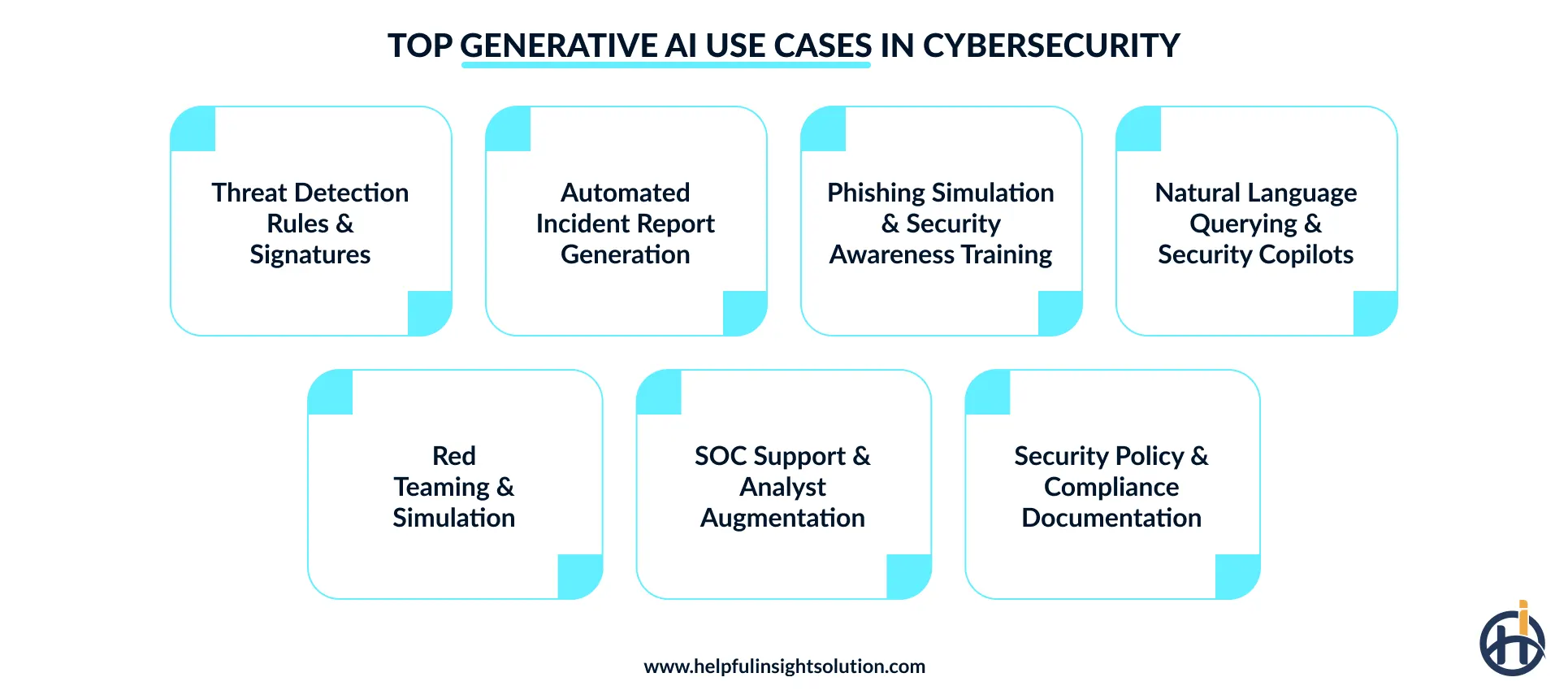
1. Threat detection rules & signatures
Generative AI can help security teams draft detection rules, signatures, and correlation logic that analysts can test and validate before deployment. They are linked with Security Orchestration, Automation, and Response (SOAR) tools, such as EDR technologies, turning threat intelligence into automated defenses.
- Constantly updates detection logic from live threat intelligence feeds, without needing to conduct a review cycle periodically.
- Fine-tunes the sensitivity of existing rules to minimize false-positive alerts based on the accuracy of past alert triggers.
2. Automated incident report generation
Based on raw security data and logs, generative AI tools can automatically draft structured incident reports rather than compiling incident timelines and findings. Automated drafting can produce more consistent incident documentation, but reports should be reviewed for accuracy before being used for audit or regulatory purposes.
- Allows the utilization of a standard format for reporting across departments to readily correlate incidents within the organization.
- Frees senior analysts from documentation tasks so they can focus on active threat containment.
3. Phishing simulation & security awareness training
By using generative AI, businesses can deliver relevant and realistic phishing simulations or training content based on the kind of attacks employees face. This allows security teams to easily implement real-time awareness campaigns rather than sending generic attacks that do not ensure effectiveness.
- Adapts simulation difficulty based on individual employee performance and past click rates.
- Generates regional and role-specific scenarios, such as finance-targeted invoice fraud or HR-targeted resume scams.
4. Natural language querying & security copilots
Advanced generative AI agents enable analysts to question threat data, explore breach incidents, and extract insights using natural-language queries. This makes the threat-hunting process easily accessible to analysts across all experience levels.
- Eliminates the need for a specialization in KQL or SPL to begin preliminary investigations.
- Shortens the ramp-up time for junior analysts who may not have memorized every security tool’s grammar and lexicon.
5. Red teaming & simulation
Various GenAI tools allow red teaming to test systems with realistic attacker simulations that mimic actual behavior, generate attack scenarios, and produce synthetic code. This application of generative AI in cybersecurity helps organizations to easily find system weaknesses and identify security gaps.
- Generates diverse attack paths that human red teamers might not think to test manually.
- Helps validate whether existing detection rules can catch AI-generated attack techniques.
6. SOC support & analyst augmentation
This technology enhances the efforts of a SOC team by summarizing alerts, providing recommendations for next actions, and automating triage tasks for human analysts. This allows security teams to manage higher alert volumes without proportionally increasing headcount.
- Ensures shift-to-shift continuity by briefing the morning teams on everything that happened overnight.
- Depends on the product architecture to improve recommendations or workflows by verifying feedback, prompts, and data stored.
7. Security policy & compliance documentation
Businesses use generative AI in security operations centers to draft and amend security policies, compliance, and regulatory reports based on predefined structures and available data. This allows less manual work to keep documents in check against changing and required industry standards.
- Flags obsolete language in policy documents that is non-compliant with regulations.
- Maps documentation to multiple frameworks, including GDPR, HIPAA, SOC 2, and more.
The other side: How attackers are using generative AI
It is important for security and business leaders to understand how attackers can misuse GenAI so they can strengthen preventive and defensive controls. This helps them to take precautionary steps and prevent data or financial losses before a threat occurs.
1. AI-generated polymorphic malware
With Generative AI, malicious code can automatically evolve, changing its structure and signature but not its intent with each execution. Such variation can challenge signature-based detection, although modern endpoint security also uses behavioral, heuristic, and other detection techniques.
Impact: Makes traditional detection less meaningful, creating a heavier reliance on behavioral/AI defenses to protect assets.
2. Deepfake-based social engineering
Attackers use genAI tools to produce fake audio, videos, or images of executives and employees to trick them into working against their company’s best interests. Additionally, deepfaked content is already used in scams like fraudulent wire transfer requests or fake emergency calls.
Impact: Improves impersonation attack effectiveness, undermining the ability to trust one’s ear to voices and faces on a high-pressure phone call.
3. LLM-crafted business email compromise
Large language models allow attackers to write highly personalized phishing and BEC emails that target a specific tone, role, and communication style. Additionally, it may reduce the spelling mistakes and grammatical errors in the content that were helpful in detecting email scams.
Impact: Improves click and response rates on phishing attacks, removing traditional red flags for email scams.
4. Automated vulnerability discovery
Generative AI can easily scan source code, software, and networks with high scalability to rapidly uncover vulnerabilities that are missed by manual researchers. This helps to decrease the time between the existence of a potential loophole and its active exploitation.
Impact: Reduces the patching window, creating a sense of pressure on the defenders to perform vulnerability management at an equal pace with AI.
Benefits of generative AI for security teams
By understanding the benefits of generative AI in cybersecurity, businesses decide to invest in this technology. Let’s discover some major genAI advantages in securing digital platforms for multiple domains.

1. Faster workflows & reduced alert fatigue
Generative AI helps to organize incoming security alerts, summarize them, and identify crucial ones by eliminating noise so that analysts can focus easily. By reducing the cognitive load and alarm fatigue of reviewing thousands of security alerts a day, it allows SOC teams to respond efficiently.
2. Improved communication between teams
It can easily translate technical and complex descriptions into accessible language so that SOC teams can explain the impact of risk to IT, finance, and legal departments. This helps to eliminate the translation effort that can often lead to misunderstandings between SOC and the rest of the enterprise.
3. Accelerated documentation & reporting
This technology generates incident reports, manages compliance documents, and summarizes write-ups in minutes rather than hours. This helps analysts save time for threat response by ensuring standardized and auditable documentation through defined processes and review across enterprise systems.
4. Lower SOC training and onboarding time
Security copilots developed or configured through professional AI development services can support onboarding of SOC analysts. This helps them in answering questions about approved tools, procedures, and past incidents in real-time.
How are leading companies using generative AI-powered cybersecurity tools?
Various leading organizations have already implemented generative AI to prevent breaches and ensure user safety. Here, we will discuss their key features and how they impact customers across the globe.
1. Microsoft Security Copilot
Microsoft Security Copilot is an AI security assistant that enables analysts to easily explore and respond to threats more efficiently using natural language models. It integrates with tools like Microsoft Defender and Entra ID to support security operations across the enterprise.
Feature: Utilizes native and partner-built AI agents to autonomously discover attack paths, isolate devices, and restrict access to remediate.
Impact: Accelerates analyst response time by eliminating time-consuming manual investigation steps to reduce threat response time.
2. Google (Gemini/Sec-PaLM in Threat Intelligence)
Google integrates its Gemini and Sec-PaLM models into its threat intelligence and operational security offerings to help teams analyze and act on security data faster. This phishing detection AI tool directly manages workflows like malware analysis and threat summarization.
Feature: Leverages natural language processing to consume, correlate, and summarize vast amounts of threat intelligence.
Impact: Enables security teams to understand emerging threats without manual sorting of raw intelligence streams.
3. CrowdStrike Charlotte AI
Charlotte AI is CrowdStrike’s generative AI security analyst, built through advanced AI tools on its Falcon platform to help SOC teams interact with security data. Additionally, it is designed to make advanced threat-hunting accessible to analysts of all experience levels.
Feature: Enables natural-language queries about threats and incidents, with responses using available security data and platform telemetry.
Impact: Shortens investigation time for every analyst and lowers the analyst skills required for junior team members to navigate large and sophisticated incidents.
4. IBM Watsonx for Security
IBM Watsonx for Security applies generative AI technology to help security teams manage and respond to multiple threats across hybrid cloud environments. It is built to support both detection and decision-making within existing IBM security tools.
Feature: Orchestrates threat intelligence with generative AI and automation by relating events across security platforms, enabling context-aware threat correlation.
Impact: Increases response speed by providing a single, AI-powered summary view for the analyst of risk to the enterprise.
How to implement GenAI technology in cybersecurity?
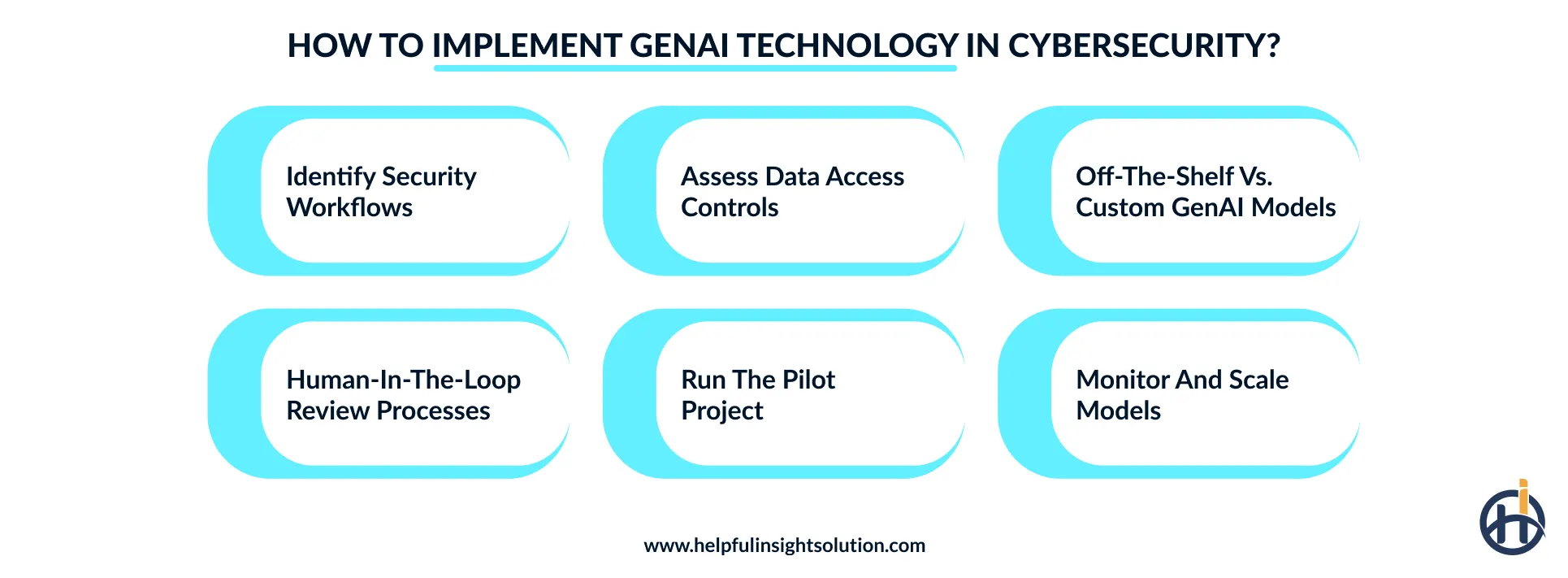
To integrate generative AI in cybersecurity, enterprises need to follow a step-by-step process, including various stages. We are going to study widely used implementation steps that every investor must know.
1. Identify security workflows
Begin by outlining existing workflows, such as alert triage, incident reporting, and threat hunting, to identify where generative AI will provide the most value. Focus on the workflows that are repetitive, time-consuming, and leading to analyst fatigue, which may provide the quickest ROI. The main aim of this initial phase is to solve an operational problem and not simply adopt GenAI solutions.
2. Assess data access controls
Before implementation, identify which data the generative AI models require and ensure that sensitive data like customer details are isolated and protected from model access. Set precise governing policies allowing the AI models to access only data related to the designated functionality. This helps mitigate the risk of exposure and data leakage via model interactions, such as in the input or output of models.
3. Off-the-shelf vs. custom GenAI models
Enterprises must hire GenAI development companies to determine whether they require pre-built security apps or should create AI models. Off-the-shelf tools accelerate deployment and simplify costs, working with common threat scenarios, while custom solutions offer greater control in complex environments. The selection is based on the budget, timeline, and business-specific security requirements.
4. Human-in-the-loop review processes
GenAI can assist with repetitive tasks, allowing analysts to review security classifications, remediation recommendations, and compliance-related outputs before consequential actions are taken. Without human oversight, AI-based hallucinations may lead to expensive security errors. Having formal checkpoints will increase the ability to hold teams accountable and still leverage the advantage of AI speed.
5. Run the pilot project
Test the Generative AI solution with a limited set of workflows or for a single team of analysts, rather than a broad deployment. This will help to monitor its performance against actual processes and data, gain insight from users, and identify gaps between expected and actual outcomes. A successful pilot can build credibility for this new technology and demonstrate its value proposition to broader areas of the business.
6. Monitor and scale models
As the pilot demonstrates successful outcomes, continue to monitor the AI model’s performance, accuracy, and impact on key security metrics like response time. The live data should be incorporated to improve the model and prepare it for full-scale deployment to more teams, tools, and use cases. Scaling should be controlled and measured, with defined evaluation before expanding into more critical security functions.
Key generative AI implementation challenges in cybersecurity
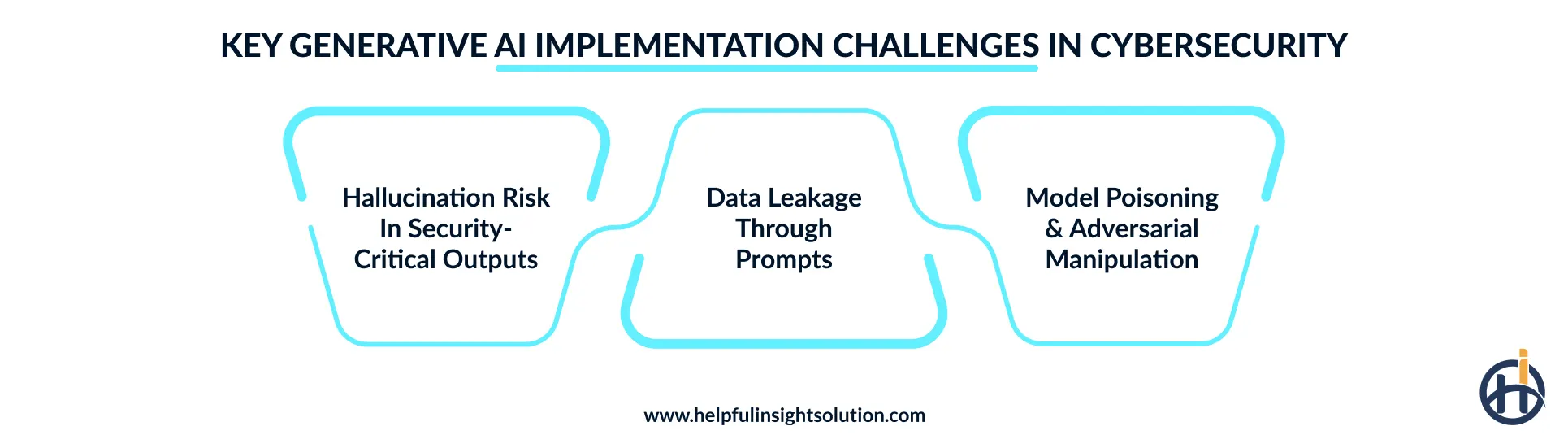
Key challenges include hallucinations, data leakage, prompt injection, privacy risks, and model poisoning. In this section, you will go through a few of the major obstacles with their respective solutions.
1. Hallucination risk in security-critical outputs
In this case, generative AI produces false facts, commands, or code that can lead to severe vulnerabilities or break security systems, as it is trained on patterns. It can also deliver non-existing software libraries, fake IP addresses, or invalid cryptographic functions.
Solution: The experts must gather AI’s responses in verified internal documentation, review AI-generated code or policy changes before execution, and run all configurations.
2. Data leakage through prompts
In high-risk sectors like healthcare, the security issues occur when sensitive information is shared during interaction with a generative AI model. The main reasons include data oversharing, jailbreaking techniques, and indirect prompt injection, making it difficult to remove the information.
Solution: It is crucial to protect PII or confidential data, prevent API keys from being stored in the system, and use specialized security gateways to monitor inputs.
3. Model poisoning & adversarial manipulation
Attackers may poison training data so that a model learns unwanted behaviors, affecting the development pipeline and the controls used to validate data. These generative AI cybersecurity risks trick IT vulnerability scans due to valid interface channels.
Solution: Use strict provenance checks to audit training data, train models on malicious inputs to improve runtime resilience, and track real-time model behavior anomalies.
What is the Future of GenAI technology in cybersecurity?
The future of generative AI in cybersecurity will ensure a safer environment for code sharing and data access due to modern security regulations. This may also reduce the generative AI development cost for enterprises, as the demand is going to increase across various industries. In this section, we will focus on key trends related to GenAI that every investor must know.
- Autonomous and agentic SOCs: AI agents will autonomously discover, triage, and remediate attacks with very little to no human involvement.
- Escalating GenAI vs. GenAI race: Cyber warfare will turn into a battle of attacker-controlled versus defender-controlled generative AI models.
- Stronger governance frameworks: Stronger governance frameworks for generative AI will ensure safe, ethical, and transparent use of these tools.
- Deeper security stack integration: Generative AI will not be treated as an isolated tool but as a built-in capability of SIEM, EDR, and cloud security tools.
Why trust Helpful Insight for developing GenAI-driven cybersecurity solutions?
Now it’s become necessary for enterprises to implement Generative AI in cybersecurity systems with standard privacy and IT compliance regulations. So hiring a reliable and experienced partner who can ensure seamless integration across platforms is beneficial.
We have a pool of skilled consultants and developers who deliver suggestions specific to business requirements, such as budget, future goals, and ROI. Additionally, they have expertise in using advanced AI models and the latest tools, which support real-time changes in legacy systems and data migration.
By following suitable practices for securely adopting generative AI, our experts help organizations become market-ready and prevent security breaches. This will increase trust among their customers and reduce the risk of data exposure, enhancing business visibility.
So, wasting time is not a choice, as there are more innovations being made in GenAI technology in the future.
FAQs
The average cost of integrating generative AI models in cybersecurity ranges from $25,000 to $80,000 for a basic-featured project. The estimate may increase to $150,000 due to incident response tools and SOC assistants. For full-scale platforms, the price may reach $300,000 or increase further because of advanced RAG and LLM models.
Generative AI automates threat detection, generates code fixes, and prioritizes risk based on context. It can translate complex descriptions of Common Vulnerabilities and Exposures (CVEs) into humanized summaries. GenAI helps to prevent manual patching delays and reduces excessive workload for security teams through automated audit logs.
Predictive AI examines historical data, such as network logs and user behavior, to find anomalies and forecast security risks. Generative AI uses LLMs to build realistic simulations of phishing emails and mock attack paths. Businesses use predictive AI to detect malware and network vulnerabilities, but GenAI helps with red-teaming and drafting security policies.
Businesses must not share credentials, proprietary source code, or personally identifiable information with public AI models. These include API keys, OAuth tokens, passwords, architecture maps, server IP addresses, and government ID numbers. The models can save inputs for future training and get exposed during a security breach.
It is important to follow various compliance regulations while using generative AI technology in cybersecurity. The EU AI Act, federal AI laws, GDPR, HIPAA, CCPA, and PCI DSS are some dedicated data privacy rules. Some of the major frameworks are the NIST AI Risk Management Framework and ISO/IEC standards.