


Key takeaways
- Generative AI in legal refers to the use of AI technology to assist with day-to-day legal work, particularly tasks involving complex information, research, and document-heavy processes.
- By 2035, the global generative AI in legal market is projected to reach $1,610.44 billion, pointing to continued growth in demand for AI-driven legal solutions.
- Common applications of generative AI in legal include drafting contracts, summarizing documents, conducting legal research, managing legal intake and triage, and extracting key information from contracts.
- The benefits of generative AI in the legal industry include time and cost savings, improved efficiency, better decision-making, and a stronger client experience.
Digital transformation in the legal industry is moving beyond putting existing services online. Law firms are now looking at how technologies such as generative AI in legal operations can change the way routine work is handled. From working through large volumes of information to supporting research and drafting, GenAI can take on parts of workflows that often require significant manual effort.
The focus, however, is shifting from using AI as an isolated productivity tool to making it work within existing legal operations. AI development services can support this shift by building and integrating solutions around specific workflows and security requirements.
The growing interest in this technology is reflected in the market outlook. Precedence Research projects the global generative AI in the legal market to reach $1,610.44 million by 2035.
For legal organizations considering this technology, identifying the right applications is only the starting point. The bigger consideration is how GenAI can be integrated without disrupting established processes or reducing the human oversight legal work requires.
This guide explores the key use cases, benefits, and practical considerations involved in implementing generative AI in legal workflows.
What is generative AI in legal?
Generative AI in legal refers to AI systems like large language models that use NLP to understand and generate human-like text based on legal information and instructions. These systems can draft, summarize, analyze, and retrieve information from legal documents.
In practice, generative AI tools can be connected to a firm’s knowledge sources and workflows, allowing legal teams to work with contracts, case records, policies, and other information in a more structured way.
Top generative AI use cases for legal operations
The value of GenAI becomes clearer when it is applied to specific legal workflows rather than used as a general-purpose tool. The following generative AI use cases for legal professionals cover practical areas where AI can support day-to-day operations, from contract work and research to intake, compliance, and risk analysis.
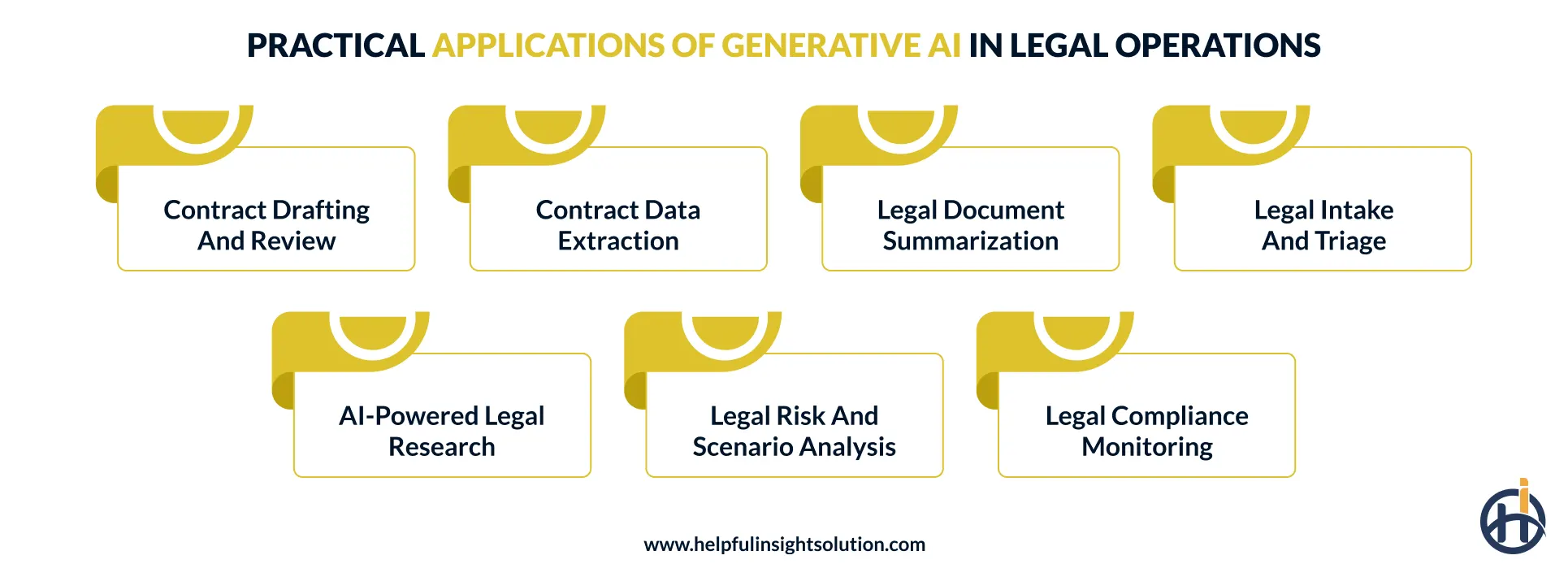
1. Contract drafting and review
Generative AI can assist legal teams at different stages of contract drafting and review. It can work with approved templates and clause libraries to help prepare an initial draft, then flag potential missing provisions or differences from internal standards for a lawyer to review.
When several versions are exchanged during a negotiation, GenAI can highlight important changes, helping lawyers review revisions without manually comparing every section.
2. Contract data extraction
Finding details across a large collection of contracts is not always simple. Important information may appear in different sections or be written in different ways. Generative AI for legal purposes can identify and extract details such as parties, dates, payment terms, renewal conditions, and obligations from these agreements.
The extracted information can be organized into searchable records for contract management and reporting. It can also help convert older contracts into a structured digital format, giving legal teams a better starting point when consolidating contract data.
3. Legal document summarization
Going through a long case file page by page is not always the best use of a lawyer’s time. Generative AI can review different types of legal documents and surface potentially relevant facts, arguments, dates, and references connected to a particular matter.
It can use natural language processing to understand a lawyer’s question and organize the summary around the information that matters to the matter. Where the system includes retrieval and source-linking features, law firms can then trace summarized information back to the relevant passage for verification.
4. Legal intake and triage
Legal teams receive requests through emails, forms, portals, and internal channels, and sorting them can take time. Generative AI for legal services can read incoming requests, identify what the matter is about, and direct it to the right team or workflow. It can also spot missing information at intake, so staff can request the details needed before the matter moves forward.
5. AI-powered legal research
Before forming a view on any legal issue, most lawyers work through multiple sources such as comparing past decisions, confirming which jurisdiction applies, and tracing how the law has evolved. This kind of groundwork takes time, and getting it wrong, even slightly, can shape the strength of an entire case.
Generative AI for legal research can help organize that material around a particular question. It can surface potentially relevant connections between cases and legal provisions, making it easier to decide which sources deserve a closer read before forming an argument.
6. Legal risk and scenario analysis
When advising on a matter, lawyers often need to think beyond the most likely outcome. Generative AI in legal practice can help examine alternative scenarios using relevant laws, regulations, and earlier decisions as reference points.
It can also take a second look at pleadings and flag things such as conflicting statements, overlooked details, or weakly supported arguments before they are relied upon.
Running these checks before a matter progresses can help lawyers identify issues early and decide which risks require closer legal analysis.
7. Legal compliance monitoring
A new regulation may affect several policies, agreements, or internal procedures at once. Another use case of generative AI is to trace those connections and bring potentially affected areas together for review. I
t can also prepare a list of required compliance actions based on the identified changes. This gives legal professionals a clearer record of which requirements were assessed, what needed attention, and where further review was required.
What are the key benefits of generative AI in legal?
For law firms, the benefits of generative AI for legal operations are closely tied to how work gets done across the business. From reducing effort in routine activities to supporting faster access to information, GenAI can improve selected internal workflows and client-service processes.
Here are the main advantages to consider.
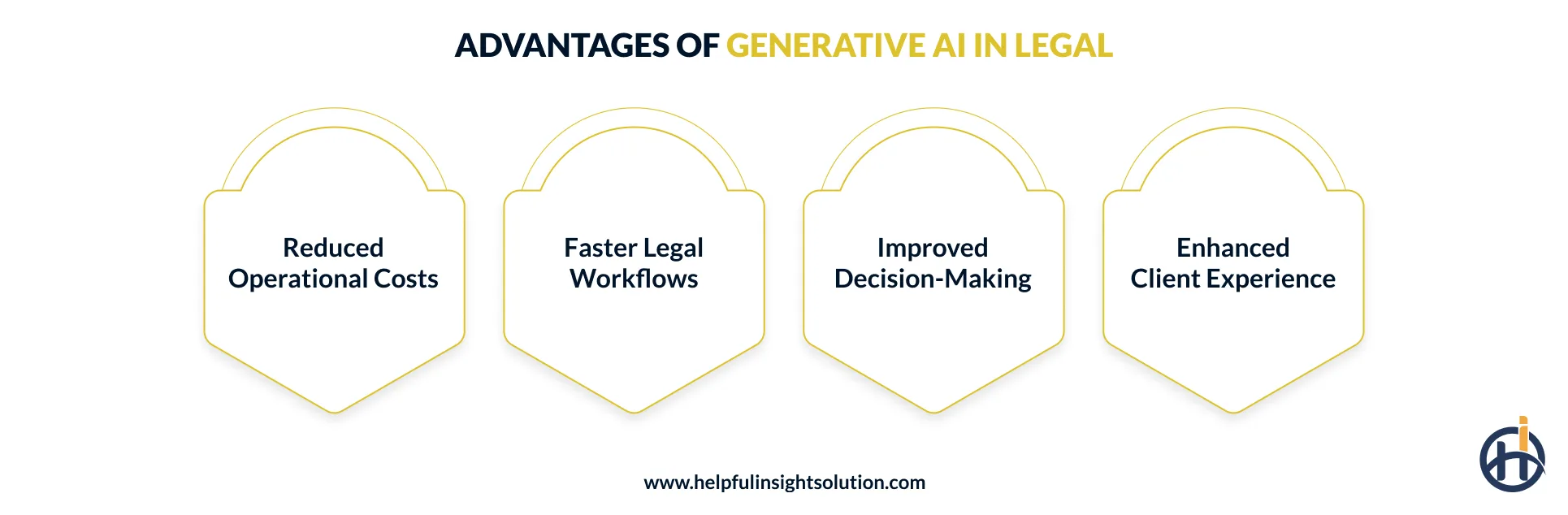
1. Reduced operational costs
Time spent on repetitive work can quietly add to a law firm’s operating costs. Generative AI in legal departments can take care of parts of those processes, giving lawyers and support staff more time for work that needs their experience. Instead of measuring the benefit only through reduced expenses, firms can also look at how much productive time is recovered, particularly when workloads increase or deadlines become tighter.
2. Faster legal workflows
A legal matter does not always move slowly because the work itself is difficult. Often, one pending step holds up everything that comes after it. Generative AI can help legal departments handle selected administrative and information-retrieval tasks, potentially reducing delays, particularly when several matters are moving at the same time and quick responses are needed.
3. Improved decision-making
Good legal judgment depends on seeing the full picture before acting, which is harder than it sounds under deadline pressure. Generative AI in law helps by connecting case history, contract terms, and regulatory signals into one readable view.
This mirrors how generative AI in finance supports faster risk calls without the usual back-and-forth research. What’s new here is that it surfaces counterarguments too, not just supporting data, giving a more balanced basis for decisions.
4. Enhanced client experience
Trust with clients rarely comes from one big gesture. It’s built through smaller, repeated moments like a fast reply and a clear update. That’s exactly where applications of generative AI in legal services tend to make the most visible difference.
A gen AI chatbot manages routine questions around the clock, while legal professionals stay focused on strategy and judgment calls. As a result, clients feel attended to even outside business hours, without adding headcount.
How to implement generative AI in legal workflows?
Bringing generative AI into legal operations is not simply a matter of picking a tool and switching it on. There are existing processes for handling information, reviewing work, and making approvals.
The solution also needs to support these processes while meeting requirements around sensitive legal data, confidentiality, regulatory obligations, and professional standards. A practical rollout usually starts with a clearly defined need and expands as the organization gains confidence.
Let’s look at the key steps involved in implementing generative AI effectively.
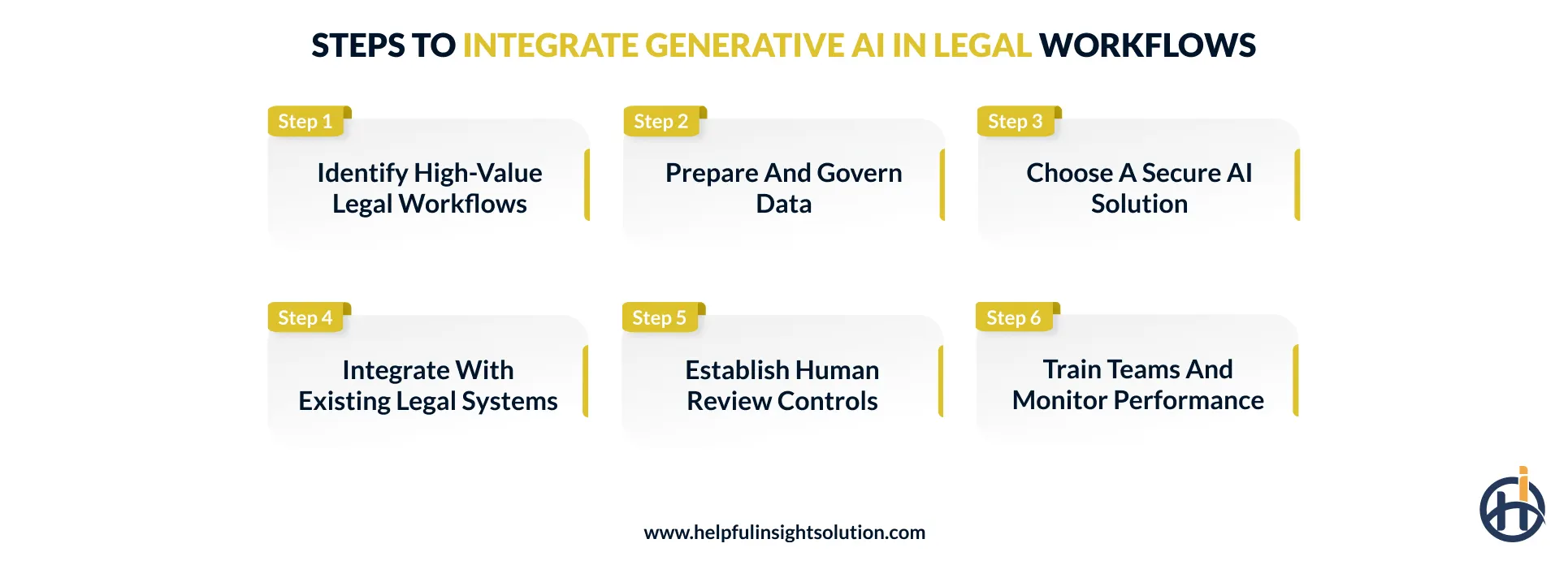
1. Identify high-value legal workflows
The first step is to identify processes where generative AI for legal services can address a clear operational need. Look for repetitive work involving high document volumes, frequent requests, or avoidable delays. It is also useful to check how often the workflow occurs and how easily its output can be reviewed, making it easier to choose a suitable starting point for implementation.
2. Prepare and govern data
Before deploying generative AI, data should be reviewed for quality, consistency, and access controls. Contracts, precedents, policies, and internal knowledge may need to be cleaned and organized before connecting them to an AI system.
Sensitive information should only be available where it is actually needed, which makes clear retention and permission rules important. Predictive analytics can help during the cleanup process by pointing out recurring problems in the data. Records with these issues can then be reviewed before they are brought into the AI workflow.
3. Choose a secure AI solution
Selecting the right platform is an important part of generative AI security in legal. The provider should clearly explain how sensitive legal data is encrypted, accessed, and used for model training.
Data-retention policies and processing locations also need to be verified. Keeping these security details documented can make future audits and internal reviews easier, while helping ensure the solution meets existing security requirements.
4. Integrate with existing legal systems
Connecting a generative AI solution into the existing technology stack helps it fit naturally into established workflows. APIs can connect document management platforms for case files, CRM systems for client information, and billing or matter management software for financial and case details. Defining which information each integration needs to access can limit unnecessary data movement and simplify implementation.
5. Establish human review controls
Human oversight should remain part of any generative AI for the legal industry implementation, particularly for work involving legal advice, filings, or sensitive decisions. Define which outputs require mandatory review and who is responsible for approving them.
Assigning a responsible reviewer for each type of output can also make accountability clearer when artificial intelligence is used in daily legal work.
6. Train teams and monitor performance
It is important to train the legal staff on using the generative AI solution correctly. Training should cover prompts, output review, and when human judgment is needed. Performance should be tracked after rollout, with user feedback and recurring errors used to optimize the workflow over time and keep the technology useful as legal requirements change.
Challenges of adopting generative AI in legal
Adopting generative AI brings practical concerns that need attention alongside the technology itself. Data protection, AI hallucinations, governance, and changes in day-to-day work can all affect implementation. Considering these issues at the outset can help legal organizations set appropriate controls and avoid having to address them after deployment.
Below are the main challenges of implementing generative AI applications in the legal industry and ways to approach them.
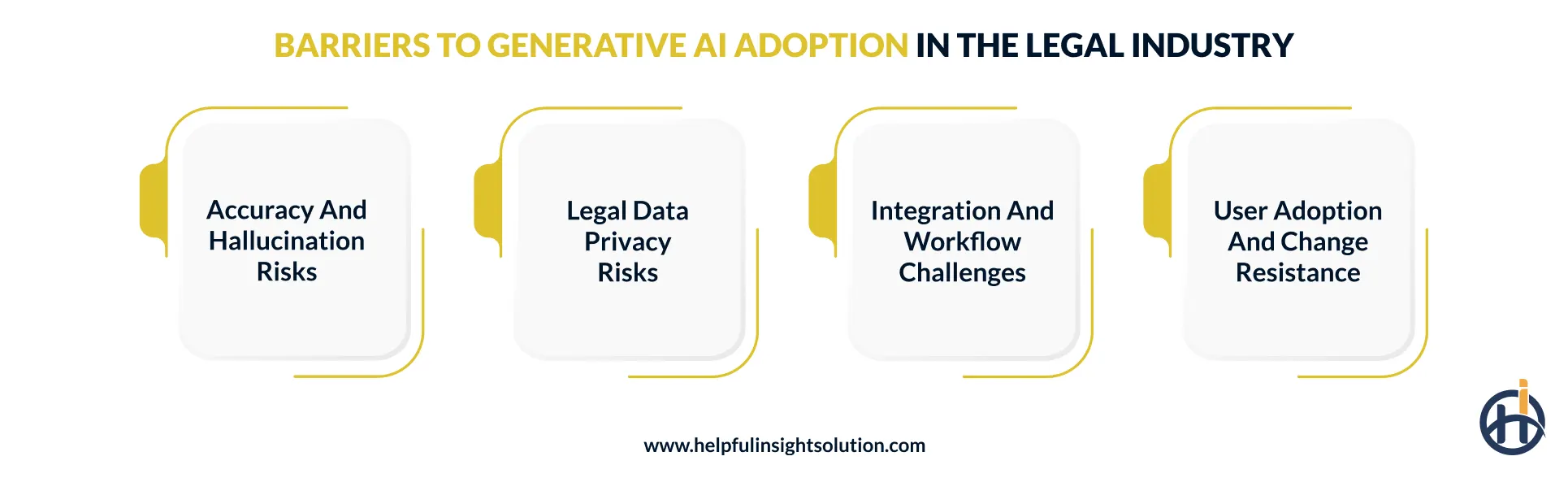
1. Accuracy and hallucination risks
AI-generated legal content can appear accurate at first glance but contain mistakes. A citation may be incorrect, an exception overlooked, or two unrelated rules mistakenly connected. That creates a real concern for legal professionals. Errors can be easy to miss when the wording is clear and confident, making careful verification important before AI-generated content is used in legal work.
The solution
Keep human review in place for legal content that carries higher risk. References, dates, legal provisions, and factual claims should be checked against the original sources rather than accepted as provided. A record of repeated errors can also help refine prompts, review rules, and the workflows where AI is being used.
2. Legal data privacy risks
Privacy becomes harder to manage when legal documents are processed outside the organization’s existing environment. Contracts, case records, and client correspondence may contain information that cannot be shared freely.
The challenge is not only preventing leaks, but knowing exactly what data enters a gen AI system, where it is processed, and who can retrieve it.
The solution
Set clear rules for which legal data can be used with AI and restrict access based on user roles. Keeping a record of data movement can also make privacy reviews easier and help confirm that AI usage remains consistent with applicable IT compliance regulations.
3. Integration and workflow challenges
Many legal organizations still rely on outdated software that has been added over several years, so not every application works well with newer AI tools. Important information may also be spread across different systems. When an AI solution does not fit the existing way of working, information may need to be moved or entered manually, creating extra steps and slowing the workflow.
The solution
Map the existing workflow before integrating generative AI into legal operations. Use APIs or suitable connectors where possible, and test each handoff with real processes.
4. User adoption and change resistance
Getting legal staff to use AI regularly can be a different matter from getting the tool installed. Someone who has worked with the same process for years may simply go back to it. There can also be hesitation around AI making mistakes, changing established roles, or being used for work that still needs a lawyer’s judgment.
The solution
Explain the role of GenAI clearly and provide training around real work scenarios. Start with simpler use cases, gather staff feedback, and address concerns as they arise. Showing where AI supports rather than replaces professional judgment can make adoption easier.
How can Helpful Insight help implement generative AI in legal operations?
Generative AI in legal has opened up new possibilities for handling the demands of modern legal work. That does not mean every process needs to be automated. A more sensible approach is to look at where AI can provide useful support, while keeping accuracy, professional responsibility, and human oversight firmly in place. This balance will shape how effectively legal organizations adopt the technology.
The important step is to identify where AI can make a practical difference and build around that need. This is where the right expertise can make implementation easier.
Our generative AI development company helps law firms build and integrate AI solutions around these practical needs, from defining suitable use cases to developing, testing, and improving the solution for real-world use. This keeps the generative AI solution useful as legal operations continue to evolve.
Connect with our team today, share the details of the project, and let’s discuss how generative AI can fit into the legal workflows and requirements.
FAQs
The cost to develop a generative AI solution for legal operations typically ranges from $15,000 to $60,000 for a simple system and $60,000 to $300,000+ for an enterprise-grade system. The final cost depends on factors such as project complexity, features, integrations, data requirements, and location of GenAI developers.
The implementation timeline can range from roughly 3 months for a focused pilot to 4-12 months for a fully integrated generative AI solution. There are multiple variables that impact the timeline such as scope of legal workflows, data quality, integration with existing systems, model customization, and the level of training required before wider adoption.
Gen AI in legal can be used in different ways, from researching to preparing and reviewing documents. It can help draft contracts, work through discovery material, and bring relevant information together from large document sets.
The future of generative AI in legal is not simply about doing existing work faster. As the technology becomes more familiar, it may change how legal professionals organize their workload, interact with clients, and approach routine processes. New roles around AI oversight and workflow design may also emerge as adoption becomes more common.