

Key takeaways
- Predictive analytics development enables businesses to use historical and current data to anticipate outcomes, identify risks, and make more informed decisions.
- The predictive analytics market is expected to grow significantly, with projections indicating that it could reach $116.65 billion by 2034.
- Businesses can choose from different predictive analytics models, including regression, classification, time-series, and decision-tree models, based on their specific needs.
- Improved efficiency, data-driven decision-making, cost savings, and proactive risk management are key predictive analytics benefits.
- The top predictive analytics use cases include patient readmission forecasting in healthcare, demand forecasting in retail, fraud detection in banking, and predictive maintenance in manufacturing.
Having access to large amounts of data does not necessarily make future planning easier. Businesses still need to work out which patterns matter and what those patterns could mean for the decisions they have to make. Predictive analytics development can help here by using historical and current data to identify likely outcomes across areas such as sales, customers, risk, and operations.
None of this runs on guesswork. Statistical models and machine learning look at data from different time periods and help bring less obvious patterns to the surface. This can be useful when a business is deciding how much stock to keep, where risk is starting to build, or which customers may leave. The growing interest in the technology is also reflected in the market, which Fortune Business Insights projects will reach $116.65 billion by 2034.
Putting predictive analytics into practice raises its own set of questions. Which business problems are worth predicting? What data will the model need? Where should the predictions be used in existing operations? These choices can influence the cost of the solution, how useful it is in practice, and whether teams actually use it.
This complete guide covers the benefits, use cases of predictive analytics, the models used to make predictions, and the practical side of implementation.
What is predictive analytics?
Predictive analytics is a branch of data analytics that uses historical data, statistical models, and machine learning to estimate what is likely to happen in the future. Its role becomes clearer when there is a real decision attached to the prediction.
A retailer can use predictive analytics software for demand forecasting before ordering inventory. A bank can look at the likelihood of repayment, while another company may use similar models to spot fraud, plan maintenance, or identify customers at risk of leaving.
How does predictive analytics work?
There is more to predictive analytics than putting data into a tool and waiting for an answer. The data first needs to be collected and prepared, followed by an analysis of the patterns that may matter to the business. Those findings are used to build a predictive model, which is tested before being used in practice.
Let’s see how this works step by step.
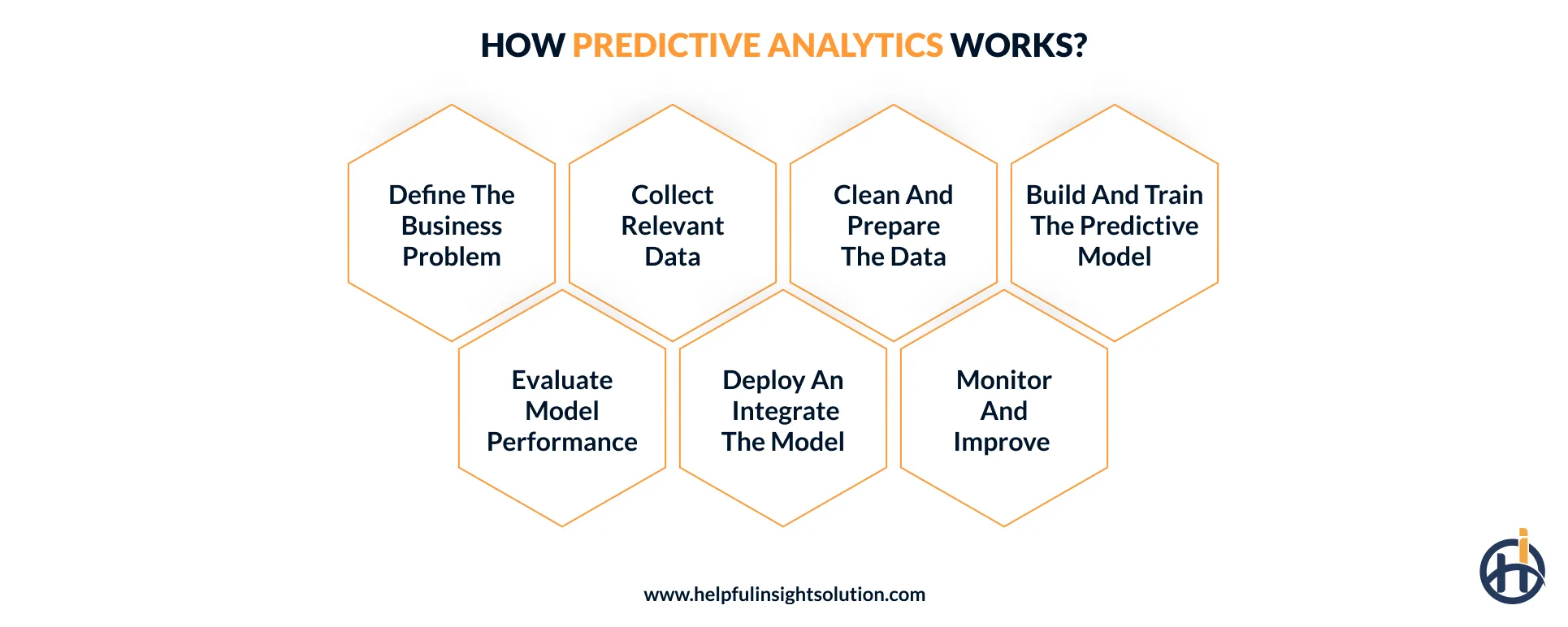
1. Define the business problem
A predictive model needs a specific outcome to work toward. The target could be a customer purchase, an equipment failure, or a possible cancellation. Defining it first helps determine what information the model needs to examine later.
2. Collect relevant data
Good predictions start with useful data. Depending on the use case, this could include customer records, website activity, transactions, sensor readings, or information stored in business databases. Historical records provide the examples needed to identify patterns and understand how earlier conditions relate to later outcomes.
3. Clean and prepare the data
The collected data may contain missing entries, duplicate records, or values stored in different formats. These issues are handled before modeling begins. Through data cleaning and preprocessing, the information becomes easier for algorithms to read and analyze.
4. Build and train the predictive model
At this stage, an appropriate machine learning algorithm is chosen and trained using the prepared dataset. Regression, decision trees, and neural networks can learn different types of relationships in the data. Software solutions can handle much of this training, while the model learns patterns linked to the outcome being predicted.
5. Evaluate model performance
Training alone does not show whether a model will work in practice. It is tested with new data and reviewed using measures such as prediction accuracy, precision, recall, or error. Poor results may mean the model needs adjustment.
6. Deploy and integrate the model
A tested model is moved into the environment where it will actually be used. It can connect with existing applications and process new data, delivering automated predictions when decisions need support.
7. Monitor and improve
As fresh data comes in, teams can compare predictions with actual outcomes and watch for changes. This ongoing model monitoring helps keep predictions useful over time.
Key predictive analytics models and techniques
Data scientists use different approaches depending on what they need a model to predict. In predictive modeling, the choice may come down to the type of data, the outcome being studied, and how complex the problem is.
The sections cover some of the commonly used models.
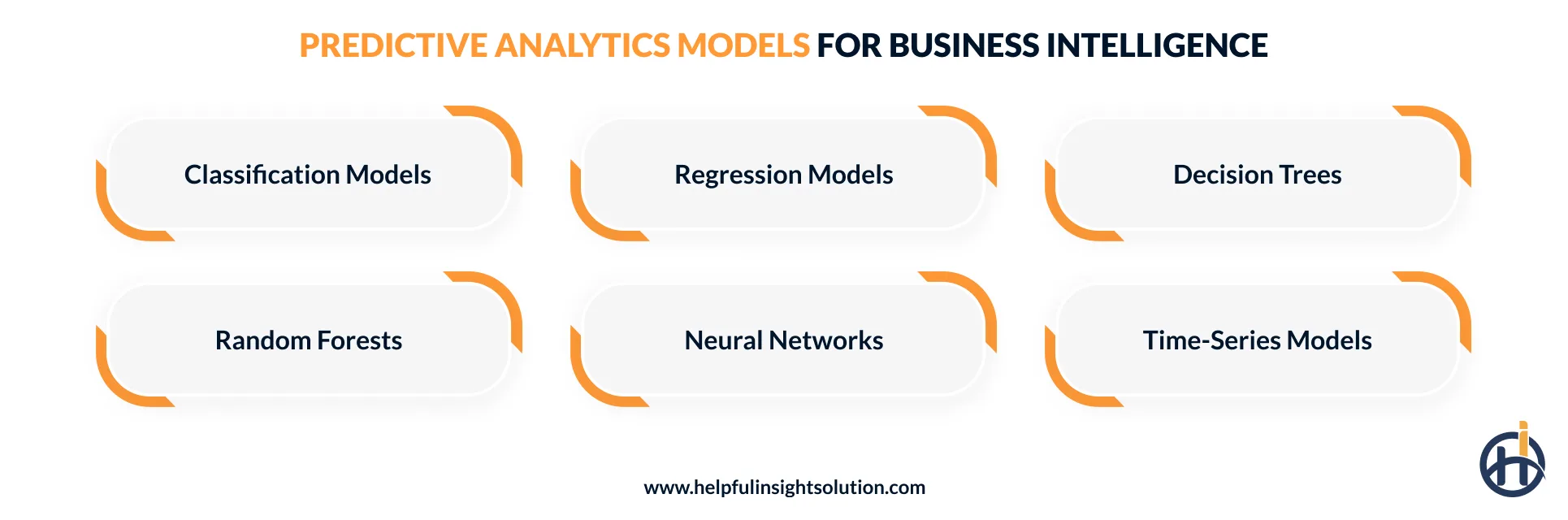
1. Classification models
A classification model is used when a prediction needs to end up in a particular group. The model looks at older records where the outcome is already known and uses them to judge new ones.
For example, a payment could be marked as normal or suspicious. A similar model can help identify customers who may leave, loan applicants who may pose higher risk, or emails that are likely to be spam.
2. Regression models
This approach is useful for questions where the expected answer is something measurable, such as sales, revenue, cost, or property value. The model studies earlier observations and looks at which factors tend to move along with the outcome.
Once those relationships are established, they can be used to estimate another value. Regression analysis can also support scenario planning by showing how the prediction might change when one of the contributing factors is adjusted.
3. Decision trees
With a decision tree, data is gradually divided based on different conditions. A record follows one path when a condition is met and another when it is not. After several such decisions, the path ends at a predicted result.
Unlike some less transparent predictive models, the reasoning can be followed from one step to the next. They are useful across machine learning use cases, including customer segmentation, credit assessment, fraud detection, and predicting outcomes in real time.
4. Random forests
Random forests are a group of decision trees that work together to produce a final prediction. It builds several trees and brings their individual results together for better forecasting. Because each tree looks at the data somewhat differently, the combined result is often more stable. This makes random forest algorithms useful when the data has many variables and a single tree may be too sensitive to individual patterns.
5. Neural networks
Neural networks are models that learn by passing data through several connected layers, gradually picking up relationships within it. They are particularly useful when those relationships are difficult to describe with simple rules.
As one of the predictive analytics techniques, neural networks can be used for image recognition, speech, text analysis, and spotting patterns in large datasets.
6. Time-series models
Time-series models analyze data in the order it was recorded, making them useful when timing can affect the prediction. By examining previous values, these models can identify patterns such as seasonal demand, gradual growth, or recurring fluctuations.
Businesses can then use those patterns to estimate future results. As predictive analytics models, they are commonly applied to sales forecasting, inventory planning, financial analysis, and operational forecasting.
What are the benefits of predictive analytics in business?
With predictive analytics software, companies can look beyond what has already happened and prepare for what may come next. Better planning, earlier risk identification, tighter cost control, and more informed decisions are some of the practical benefits businesses can gain from using these insights.
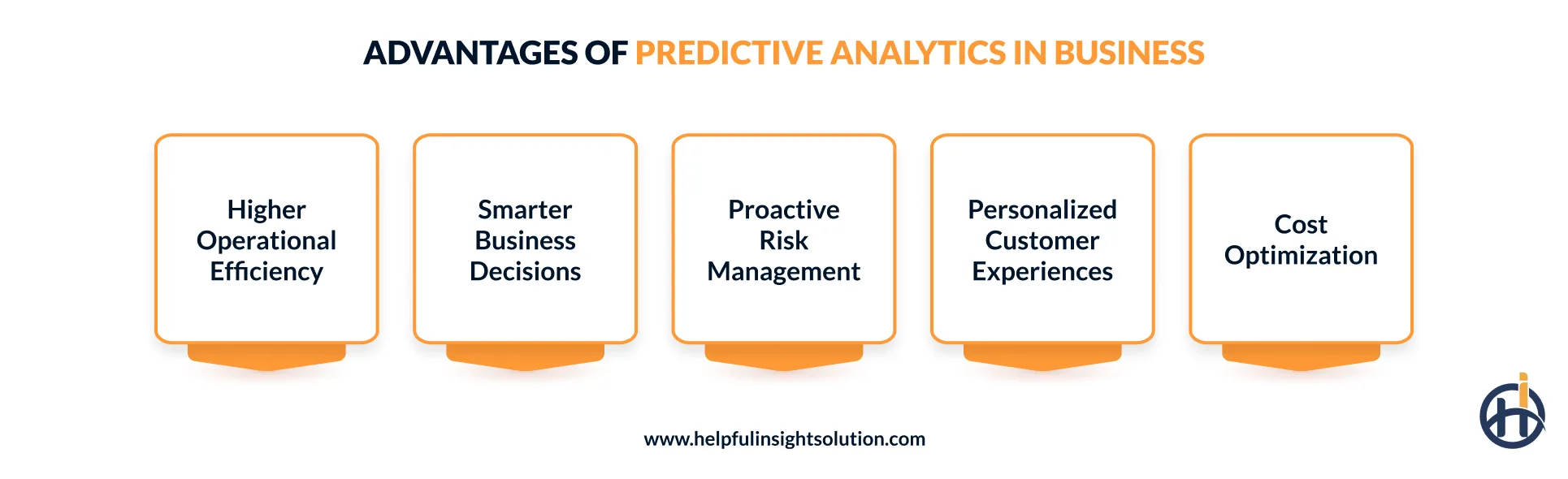
1. Higher operational efficiency
A predictive analytics platform can make routine operations easier to plan by showing where demand, workloads, or equipment issues may change. It can help teams schedule maintenance, prepare inventory, and assign resources accordingly.
It also gives managers a better basis for deciding what needs attention first when several operational issues compete for the same resources.
2. Smarter business decisions
Predictive analytics tools give leaders something useful to consider before a result shows up. Looking through past and current data, the models can reveal patterns that may signal a growing risk, a potential opportunity, or a change that deserves attention.
With the right AI development strategy, these predictions can be built into everyday planning and decision-making. The added value is being able to compare possible outcomes before resources are committed, rather than judging a decision only after the results appear.
3. Proactive risk management
One of the practical predictive analytics benefits is its ability to spot changes that may signal a risk before the situation becomes more serious. This could include unusual transactions, missed payments, or changes in equipment performance.
Rather than waiting for the damage to occur, organizations can investigate these warnings earlier and decide whether they require immediate action or continued monitoring.
4. Personalized customer experiences
Past behavior can provide signals that help estimate what products or services a customer may be interested in next. Predictive analytics in business can bring together purchase history, browsing activity, and previous interactions to find those patterns.
This information can be used to suggest relevant products, shape offers, or adjust support. It also helps move away from sending the same recommendations to every customer.
5. Cost optimization
Keeping operational costs under control is easier when there is some visibility into what may drive them. Predictive analytics technology can identify patterns in spending, resource use, demand, and maintenance needs.
Enterprises can utilize these insights to manage expenses or over-allocation of funds. This can shift cost reduction from cutting expenses broadly to addressing the areas most likely to create avoidable spending.
Predictive analytics use cases across industries
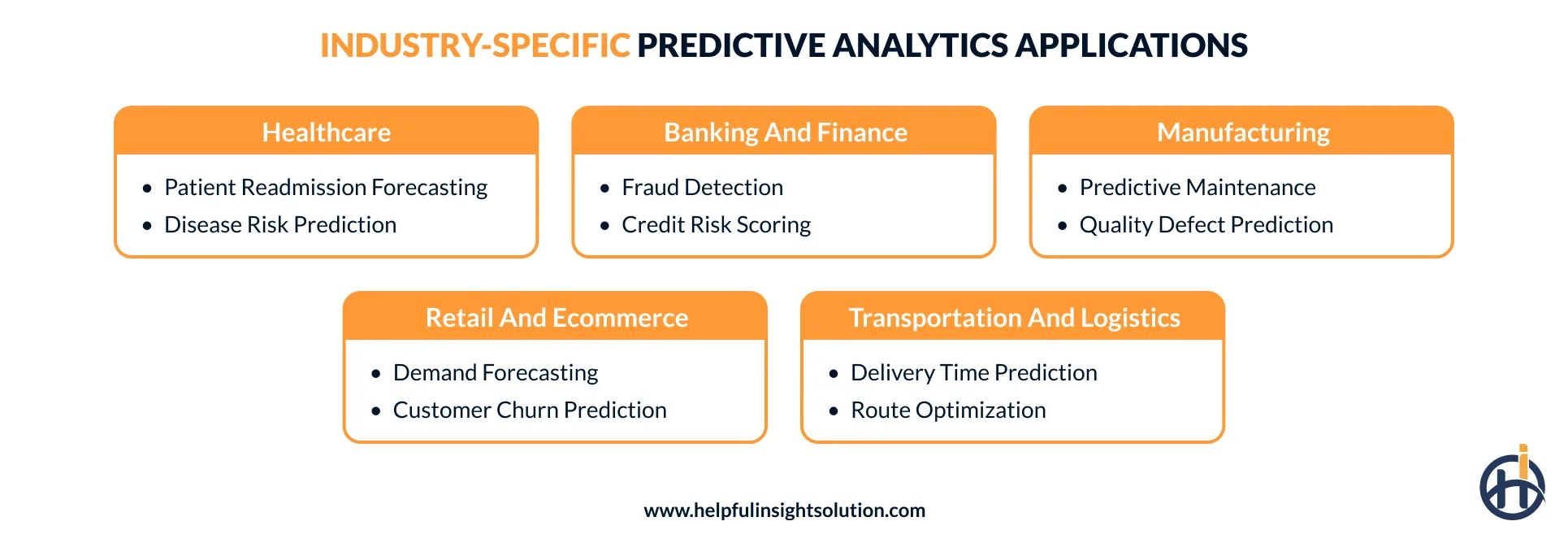
Every industry runs on a different mix of data, risk, and decision speed, so the way predictive analytics gets used doesn’t look the same. A retailer’s demand curve and a hospital’s readmission risk call for different models entirely. Below are the industry-specific predictive analytics applications shaping decisions in practice today.
1. Healthcare
- Patient readmission forecasting
Hospitals often build readmission models based on several clinical variables like labs and vitals. What’s rarely addressed is layering in social determinants of health, such as transportation, housing stability, and caregiver support, since these often predict returns with higher accuracy and negligible errors. This deeper use of predictive analytics in healthcare helps clinicians catch certain risks that charts alone would never reveal before the problem occurs.
- Disease risk prediction
There can be warning signs of a chronic condition well before a diagnosis is made. A gradual rise in blood pressure or glucose, for example, may mean more when viewed alongside other patient information. Predictive analytics software helps connect these details.
The useful part is not simply assigning a risk score, but giving clinicians another reason to investigate a possible problem earlier.
2. Banking and finance
- Fraud detection
Predictive analytics in banking software can compare transaction amounts, spending habits, device information, and location changes to spot activity that falls outside a customer’s usual pattern. A useful advantage is that the system can consider several signals together, helping distinguish a genuine unusual purchase from a payment made through a compromised account.
- Credit risk scoring
Predictive analytics tools use recent financial activity, cash flow, spending habits, and debt obligations to assess a borrower’s repayment risk. Statistical modeling connects these signals to identify potential financial stress earlier, helping lenders assess creditworthiness using a borrower’s current financial position rather than historical records alone.
3. Manufacturing
- Predictive maintenance
A change in vibration or temperature may not seem serious at first, but it can point to developing equipment trouble. Predictive analytics in manufacturing monitor these changes and identify patterns that deserve attention. Instead of replacing parts on a fixed schedule or waiting for a breakdown, maintenance can be based more closely on the machine’s actual condition.
Among real predictive analytics examples in manufacturing, General Motors stands out. The company, one of the largest automakers in the US, relies on its Device Level Analytics system to keep watch over plant equipment, catching early indicators like rising conveyor current and growing vibration so repairs happen before a breakdown.
- Quality defect prediction
Small variations in heat, machine speed, material inputs, or assembly conditions can affect the finished product. Machine learning models can compare these production variables with previous quality results to identify patterns associated with defects.
The prediction can indicate where a process needs closer attention, reducing the chance of repeating the same quality issue based on the actions across multiple units.
4. Retail and Ecommerce
- Demand forecasting
Stocking decisions often have to account for factors that are outside a retailer’s direct control. Predictive analytics platforms can use sales records alongside weather patterns, seasonal demand, promotions, and local buying trends to forecast what customers are likely to purchase. The forecast also tells where excess inventory may build up, giving purchasing decisions a more practical data point.
- Customer churn prediction
In retail, a customer who used to order regularly may slowly start visiting less and buying less. That change is easy to overlook when each interaction is viewed separately. Predictive analytics development brings purchase and engagement behavior together. This gives retailers another way to spot declining interest before a once-regular customer becomes inactive.
5. Transportation and logistics
- Delivery time prediction
Predictive analytics solutions use previous delivery records alongside current road and weather conditions to adjust estimated arrival times. This gives logistics providers a better basis for updating customers when delays develop, rather than relying on an ETA set before the vehicle leaves.
- Route optimization
Distance is only one part of route planning. A road with fewer miles may involve more traffic, longer stops, or repeated congestion. Real-time predictive analytics consider these factors for route decision by comparing current conditions with historical patterns.
The expected delay becomes part of the route decision, giving logistics providers a better basis for choosing between a shorter congested road and a longer but faster alternative.
Predictive analytics tools and platforms
There are various predictive analytics tools available, and they are not all designed for the same type of business use. Some focus on ease of use, while others offer deeper modeling capabilities. Here, we take a closer look at popular platforms.
1. Alteryx One
Most predictive analytics platforms force teams to prepare data in one tool, model it in another, and report on it somewhere else entirely. Alteryx One collapses that into one workflow, using AutoML to build models without coding, geospatial features to add location context, and AI assistants that explain what is driving a prediction.
Manual data prep time has dropped by up to 90% in some deployments. What sets it apart is handling modeling and explanation inside the same platform, not two separate systems.
2. SAS Viya
SAS Viya is built with cloud-native architecture, but it is not limited to public cloud environments. The platform can run across public cloud, hybrid, and on-premises infrastructure, depending on an organization’s setup.
Its in-memory processing approach also keeps frequently used data available during analysis, which can reduce the repeated disk operations involved in some analytics workloads. This tool allows teams to compare model versions side by side, with training data and accuracy attached, before one gets pushed into production.
3. IBM SPSS Modeler
IBM SPSS Modeler automatically reformats raw data into a structure suited for modeling, cutting down the manual cleanup before a decision tree or neural network model can even run.
That same platform also doesn’t lock teams into SPSS-native models alone, since Scikit-learn and TensorFlow models can be brought in and deployed right alongside them.
For organizations already using open-source frameworks, that interoperability is a real reason SPSS Modeler fits into an existing stack instead of replacing it.
4. H2O.ai
H2O.ai combines open-source machine learning tools with enterprise products for developing and deploying predictive models. H2O-3 provides algorithms for tasks such as classification, regression, and clustering, while its AutoML capabilities automate parts of model training and comparison.
Its portfolio also includes Driverless AI, which adds automated machine learning with model interpretability features for understanding how predictions are produced.
How to implement predictive analytics in business operations?
Getting a predictive model into everyday business use involves more than building it and checking its accuracy. The data, business process, existing technology, and way predictions will be acted on all need consideration. Below, we look at the main stages of predictive analytics implementation.
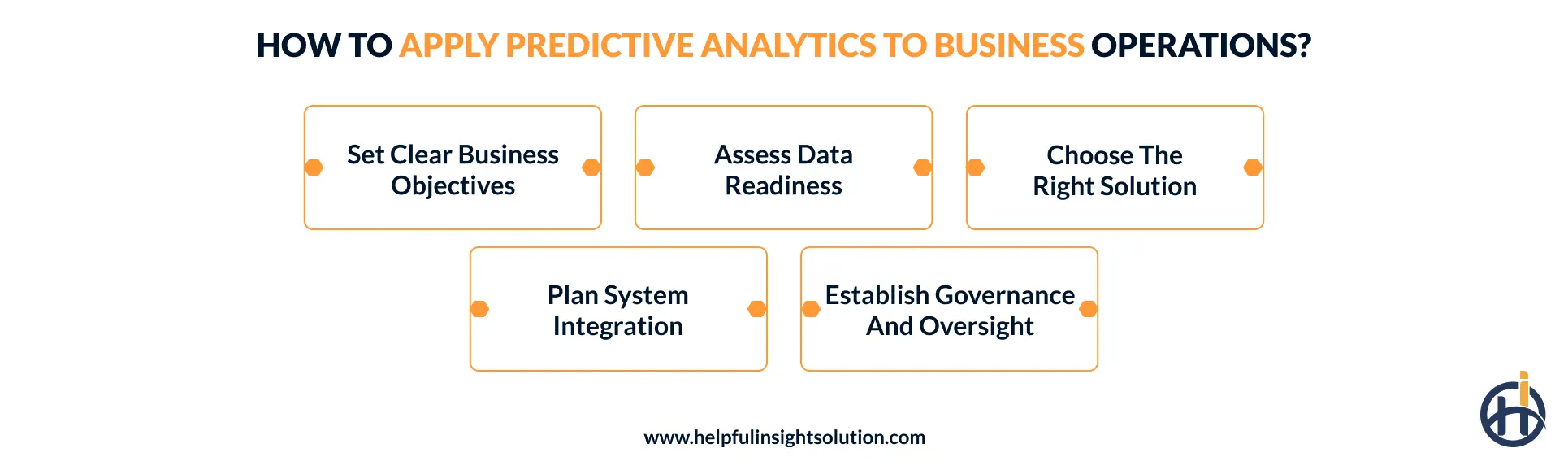
1. Set clear business objectives
Start by defining the business decision that predictive analytics is expected to support. The objective should be specific enough to measure later, rather than simply aiming to “use AI” or improve performance generally.
Predictive analytics development can then be scoped around that objective, including the expected outcome, relevant business constraints, and how success will be assessed after implementation.
2. Assess data readiness
Have a practical look at the data already available inside the business. Customer records, sales transactions, equipment readings, and other sources may contain useful information, but they are not always consistent or complete.
Data preparation brings those records into a usable state. It is also worth checking whether the available history actually matches the outcome the business wants to predict.
3. Choose the right solution
The solution you choose needs to fit the business rather than forcing the business to change its entire technology setup. Review integration options, infrastructure requirements, licensing costs, scalability, and the level of technical support available.
Off-the-shelf platforms can work well for many standard use cases, while specialized requirements may need customization. A business analyzing structured sales or transaction data usually fits standard software fine.
One working with unstructured data, like customer complaints, clinical notes, or contracts, often needs Natural Language Processing-based models, since most out-of-the-box platforms aren’t built to read and score free text. In cases like that, custom development alongside existing platforms is usually the more realistic option.
4. Plan system integration
Integration should fit into the way the business already works. Identify which applications need predictive outputs and how information should move between them. Data pipelines can connect operational systems with the predictive solution and keep the required information updated.
This makes the predictive analytics process easier to incorporate into regular business decisions without adding unnecessary manual work.
5. Establish governance and oversight
Good governance gives a predictive solution clear boundaries after it becomes part of business operations. Define access controls, review responsibilities, data-handling rules, and procedures for addressing unexpected results.
IT compliance regulations should be considered alongside internal policies, while predictive analytics development should include enough documentation to make important changes and decisions easier to track.
Predictive analytics challenges and how to overcome them
Bringing predictive analytics into business operations can raise questions that are easy to miss during the planning stage. Data limitations, integration work, security requirements, and model reliability may all affect the outcome.
A clear predictive analytics strategy brings these factors into the planning process and gives software development teams a better understanding of what the solution needs.
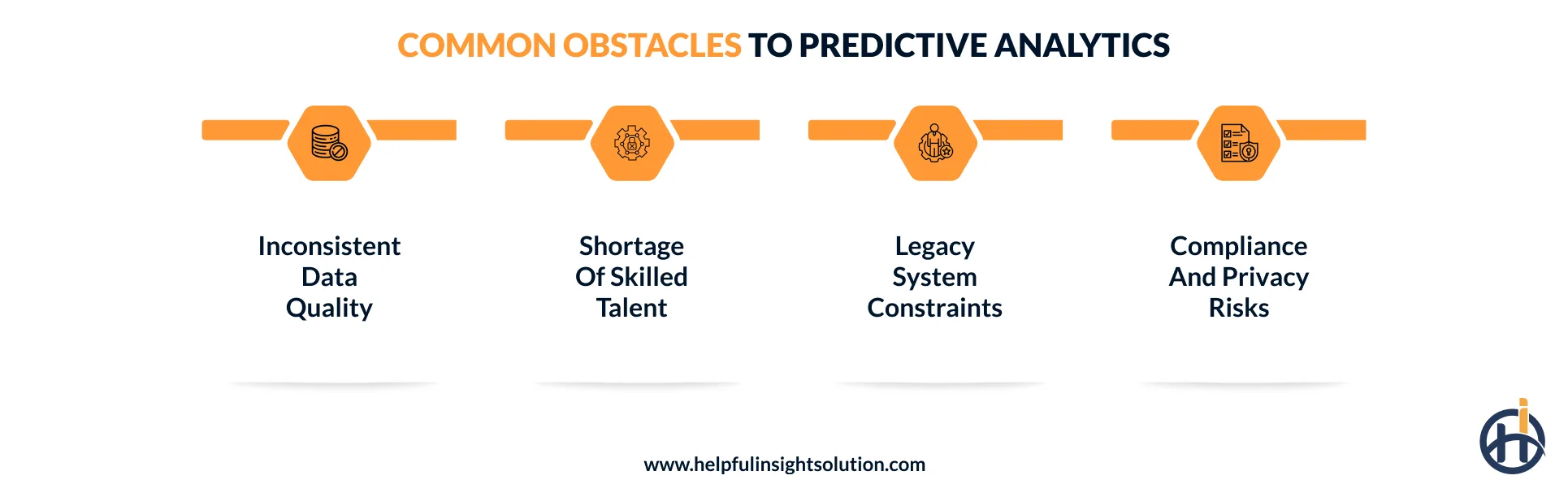
1. Inconsistent data quality
Data often comes from multiple systems, and those sources may not follow the same standards. One system may have missing fields, another may contain duplicate records, while older information can use different formats. When data mining brings these sources together, these inconsistencies can affect the patterns identified and make predictions less dependable.
The Solution
Set common data standards across sources and run regular validation checks. Automated checks can flag missing, duplicate, or conflicting records early, before they influence analysis or predictive results.
2. Shortage of skilled talent
The technical side of predictive analytics can become broader once development starts. Predictive algorithms may involve statistical analysis, machine learning, data engineering, and evaluation. When experience is limited across these areas, projects can take longer and important technical decisions may become harder to make.
The Solution
Start with the skills most important to the intended use case and develop those capabilities internally. External data scientists or dedicated developers can fill specialized gaps while internal expertise grows.
3. Legacy system constraints
Older business systems may still contain valuable operational data, but accessing it is not always straightforward. Different databases, outdated interfaces, and isolated applications can make information difficult to move between systems. This creates extra work when a predictive analytics system needs timely data from several parts of the business.
The Solution
Create reliable connections around the most important systems first, then move selected workloads to newer infrastructure as requirements and capacity change.
4. Compliance and privacy risks
Information gathered from customers, websites, applications, and internal systems can carry different privacy obligations. Using these records together may create complications under GDPR, CCPA, and other applicable regulations.
The hurdle is not simply securing the information; its permitted use, retention period, and access also need to be clear for predictive analytics development.
The Solution
Review the origin and permitted use of personal data before it enters the model. Set clear access permissions, record how information is being used, and check the process against applicable regulations at key stages.
Future trends in predictive analytics
Organizations in different industries already use predictive analytics to find patterns and make informed decisions about what lies ahead. Their next step could be much more effective with advanced AI innovations for forecasting and automation.
New data sources and smarter predictive analytics tools may help businesses spot opportunities, deal with uncertainty, and adjust their plans along the way. Let’s take a look at the trends shaping its future.
Let’s look at the trends shaping the future of predictive analytics.
1. Generative AI-powered forecasting
Rather than producing one expected result, advanced predictive modeling could create multiple scenarios and examine how each might unfold. This combination of generative AI and predictive analytics could make future planning more flexible when conditions keep changing.
2. Autonomous decision intelligence
As AI agents become more capable, future predictive analytics tools may connect forecasts directly with business actions. A system could notice an emerging risk, assess possible responses, and initiate the most suitable one within set boundaries. This would push predictive analytics toward continuous, increasingly self-directed decision-making.
3. Privacy-preserving predictive models
Privacy will become a bigger part of how future predictive analytics works. Instead of moving sensitive data into one place, new approaches such as federated learning could allow models to learn from information stored across different locations. This could make useful predictions possible without exposing as much personal data.
Conclusion
Businesses are finding more value in data when it can tell them what may happen next. Through predictive analytics development, historical and current data can be used to forecast demand, spot potential problems, and understand changing customer needs. This is transforming business planning from reacting to what has happened into preparing for what could happen.
This is where having the right predictive solution can make a difference. We provide custom predictive analytics software development services for businesses that need something built around their own data, goals, and processes. From developing the initial model to deployment, we create custom predictive analytics solutions that fit into existing operations rather than requiring businesses to change everything around the software.
If you are looking to build a predictive analytics model or take an existing one further, our development expertise can turn that idea into a practical business solution.
FAQs
The cost to develop predictive analytics software can range from $20,000 to $60,000 for an MVP, while a large enterprise solution can reach $150,000 to $300,000+. The final price depends on factors such as data complexity, model requirements, integrations, software features, infrastructure, security, and ongoing maintenance.
AI gives predictive analytics another way to look at business data. It can go through information, pick out patterns, and use those patterns to estimate what might happen next. With machine learning, the model can also learn from newer data instead of staying tied to its original predictions.
Core features include data integration, data mining, interactive dashboards, automation, and scenario simulation. They let businesses examine data, spot patterns, track predictions, and test different possible outcomes.
Predictive analytics is the broader practice of forecasting future events from data. Machine learning is one approach used within it, allowing systems to learn patterns and improve predictions.