

Key Takeaways:
- Predictive analytics helps healthcare providers to identify risks and focus on preventive care by analyzing historical data.
- Medical professionals can enhance patient care, optimize resource allocation, and improve operational efficiency through predictive analytics.
- Various predictive healthcare use cases include sepsis prediction, cancer risk assessment, appointment scheduling, and hospital readmission forecasting.
- Healthcare solutions become more accurate and scalable with advanced technologies like explainable AI and wearable integration.
Healthcare not only means providing care to patients, but it also covers a wide range of operations like claim settlement, drug planning, and disease management. As a fact, an average American family spends more on healthcare than food due to growing clinical concerns.
Technologies like predictive analytics in healthcare are improving daily tasks for medical practitioners and hospital staff. It helps to resolve missed appointments, optimize billing cycles, manage administration, and prevent fraud.
Through operational analytics, businesses increased their ROI by 18%, which streamlined inventory levels and emergency department throughput. Additionally, the training methods helped to boost adoption by 40%, allowing nurses to easily predict risk scores. There is a combined role of predictive analytics and healthcare in enhancing clinical operations and improving patient experiences.
As an entrepreneur, you must know how predictive analytics technology is supporting healthcare systems. So, in this blog, we will discuss the best use cases, benefits, challenges, and future trends, targeting different medical departments.
What is predictive analytics in healthcare?
Predictive analytics in healthcare is a leading innovation that most hospitals want to implement to optimize daily tasks and improve patient care. It uses advanced AI and ML models with big data to predict future events, promote proactive care, and enhance medical workflow efficiency. Businesses can resolve both clinical and operational issues by implementing it in healthcare systems.
Why is predictive analytics important for healthcare?
The integration of predictive AI in EHR systems, billing cycles, appointment management, and drug discovery is crucial for healthcare providers. It is necessary to automate data forecasting for patient engagement, supply chain management, and profit-making. It allows systems to make proactive clinical decisions, improve patient outcomes, and reduce administrative expenses.
How does predictive analytics work in healthcare?
Various prediction models in healthcare use historical patient data with AI and statistics to identify disease risks. It helps to fulfill operational needs through treatment planning and personalized care.
- The information is collected through different sources, like electronic health records, wearables, and lab results.
- AI algorithms analyze errors and missing elements to standardize the data based on expected results.
- ML helps to identify complex patterns and correlations, like age, blood pressure, and genetic markers.
- These insights are integrated into the clinical workflow, allowing medical professionals to review risk scores and generate alerts.
Current statistics of predictive analytics-based healthcare market
The healthcare predictive analytics market has the potential to deliver increased revenue growth and ROI on investments. We are going to understand the present market condition based on the annual growth rate and regional share through the following stats.
- The value of the predictive healthcare market is $29.9 billion in 2026 and is growing at a 24% CAGR rate between 2026 and 2030.
- By the end of this tenure, the overall revenue will increase to $67.3 billion, jumping from $27.8 billion in 2025.
- The US healthcare predictive analytics market will reach $57.6 billion by 2035, growing at a 21.2% CAGR rate.
- Descriptive analytics holds a share of 45.9% in the market, whereas life science companies have a 44.6% market share as end users.
- North America dominates the market with a 43.8% market share, but Asia Pacific is growing at 23.6% CAGR through 2031.
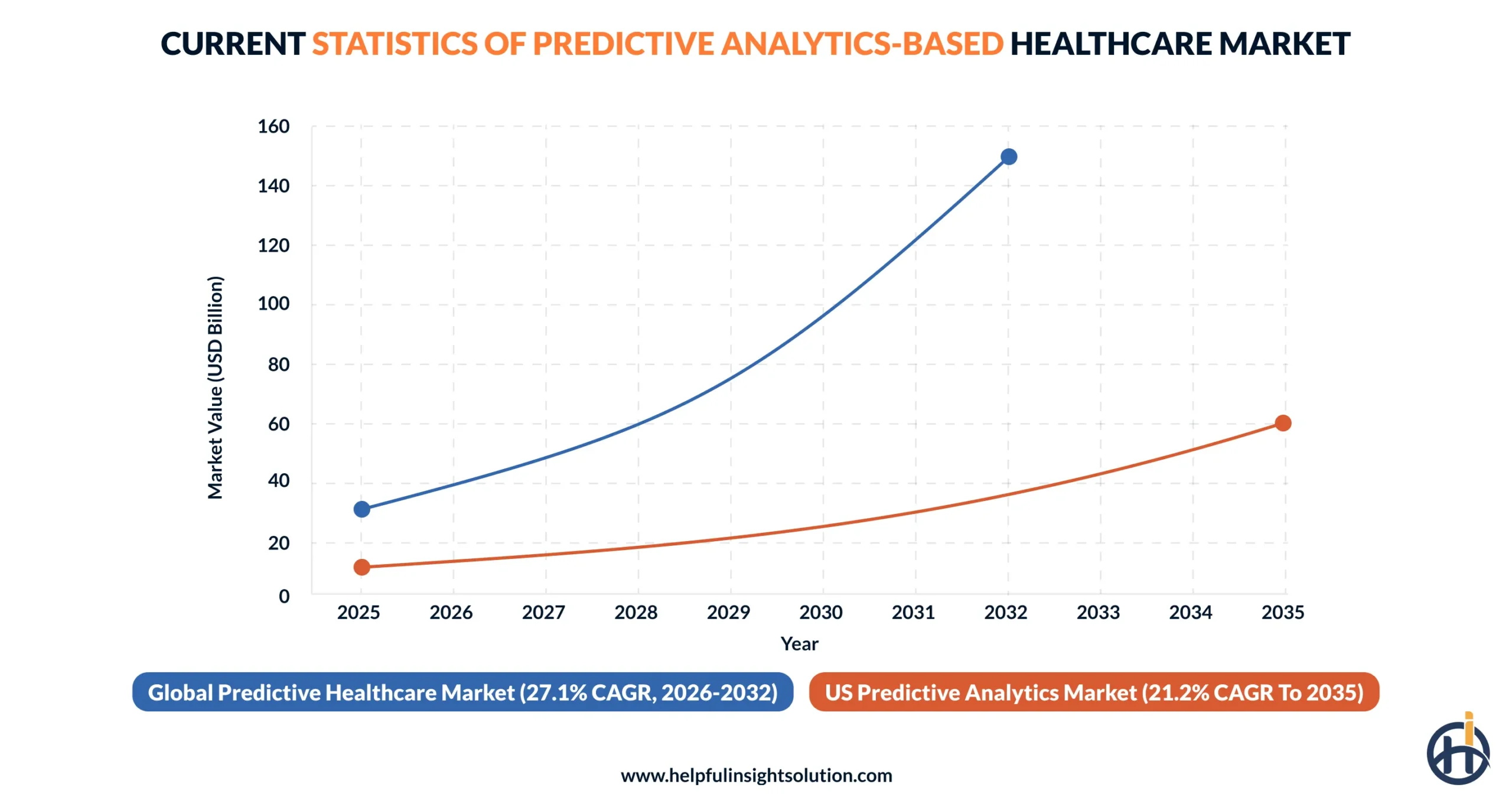
Several opportunities are awaiting healthcare providers that should not be missed and must be utilized to improve medical efficiency. As the market will grow more, it is the right time to invest in advanced AI-driven healthcare solutions.
Key benefits of predictive analytics in the healthcare industry
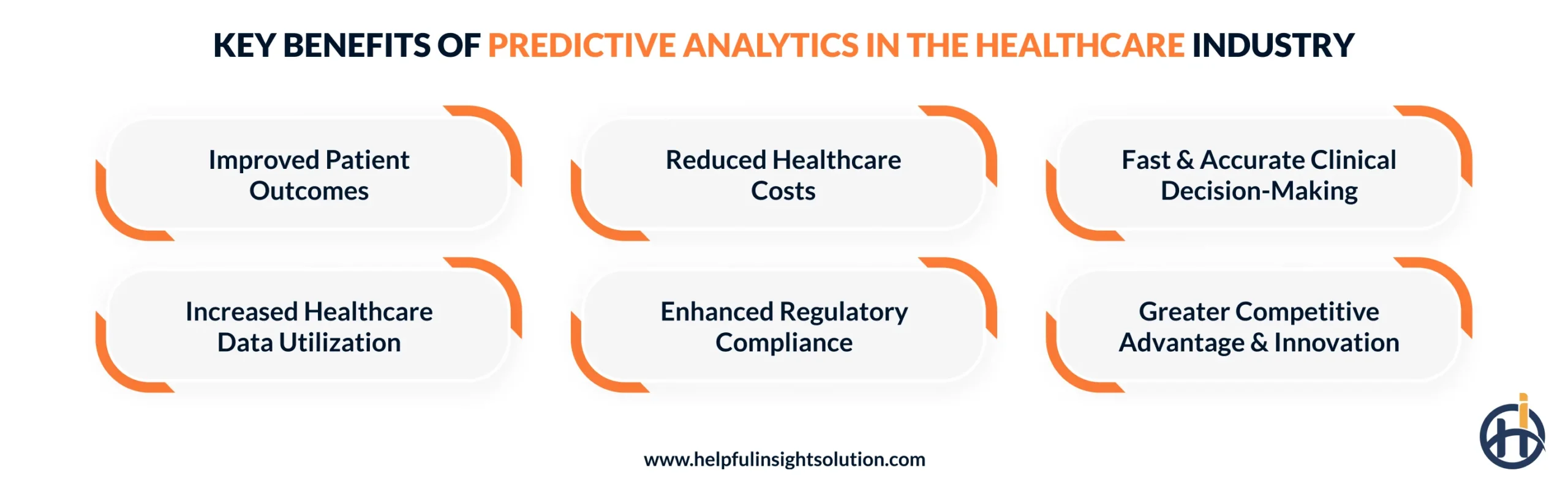
The benefits of predictive AI in healthcare include cost reduction, medical accuracy, and compliance. We will discuss all the major advantages of this innovative technology in this section to get valuable insights.
1. Improved patient outcomes
Predictive analytics helps doctors find risks early and give patients the help at the right time. This leads to treatment results, fewer problems and healthier patients. Predictive analytics helps doctors detect early signs of diseases such as diabetes or heart disease with advanced AI models. This allows for preventative measures or treatments to be administered sooner, potentially saving lives.
2. Reduced healthcare costs
Predictive analytics can spot health problems before they get serious. This prevents hospital visits and saves money on medical bills. It also helps healthcare organizations use their resources efficiently.
3. Fast & accurate clinical decision-making
Predictive models look at lots of data and give doctors useful information in real-time. This data analytics in healthcare helps doctors make smart decisions and get better at diagnosing patients.
4. Increased healthcare data utilization
Predictive analytics turns an amount of patient data into useful insights. This prescriptive analytics in healthcare helps clinical organizations make decisions using patient information.
5. Enhanced regulatory compliance
Doctors can use analytics to keep an eye on their processes find risks and follow healthcare rules. This reduces risks and keeps patient data safe.
6. Greater competitive advantage & innovation
Healthcare organizations that use analytics can improve their services work more efficiently and create new care models. This helps them stay ahead in the market and adapt to changes, in healthcare.
Clinical use cases of predictive analytics
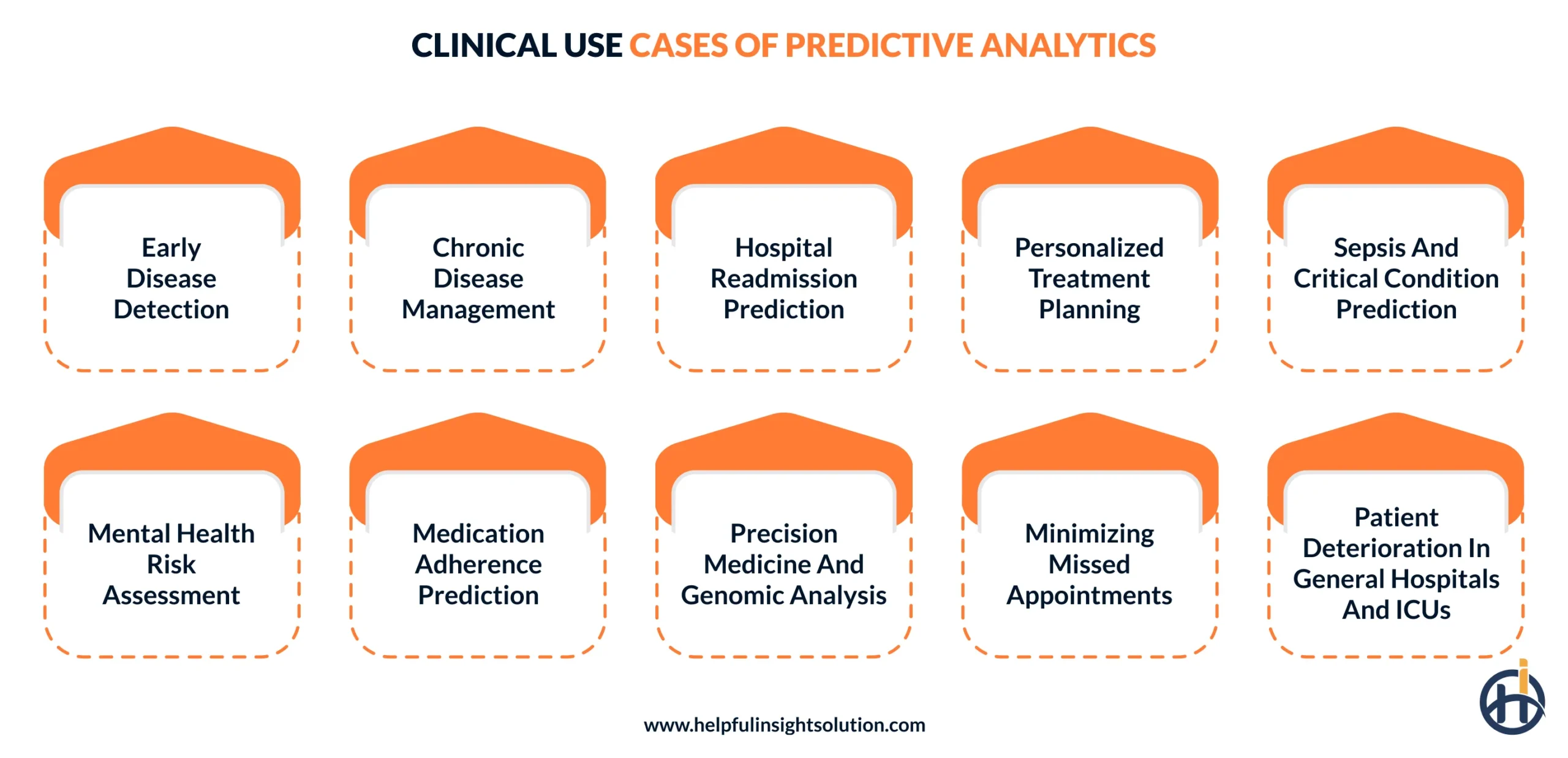
You will study the top use cases of predictive healthcare analytics in this section, which focus on patient care and treatment. These clinical applications ensure improved surgeries, appointments, and medical analysis.
1. Early disease detection
Predictive analytics is a help to healthcare providers. It helps them find people who might get very sick before they even have symptoms. They look at the persons history the way they live their genes and test results. This helps them find patterns that’re not easy to see. If they find something they can do something about it before it gets bad.
They look at a person’s history, lifestyle, genetics, and test results to find patterns that aren’t easy to spot. When something is identified, providers can intervene before the condition worsens. This means people get the help they need and do not have to deal with bad diseases.
2. Chronic disease management
Some people have diseases like diabetes, high blood pressure and heart disease that they have to deal with for a time. They need to be watched all the time and get help for a time. Predictive analytics looks at what happened in the past and what is happening now to figure out what might happen with the disease.
This helps healthcare providers make a plan that’s just right for the patient. They can change the plan if they need to. This means patients are healthier and do not have to go to the hospital much.
3. Hospital readmission prediction
When people have to go to the hospital after they just left it costs a lot of money and it means they did not get the help they needed when they left the hospital. Predictive analytics helps find the people who’re more likely to have to go back to the hospital.
It looks at their records what happened when they were in the hospital and other things about them. You can develop patient management software for hospitals by using advanced AI models like data prediction. This helps people get better and not have to go to the hospital unless they really need to.
4. Personalized treatment planning
Every person is different. They need their own special plan when they are sick. Predictive analytics looks at what happened to the person in the past their genes and what worked for them before. It helps the doctor pick the plan for the patient.
This means the patient gets the help they need and it works better for them. The patient is happy and healthy. Predictive analytics and Personalized Treatment Planning are very important, for patients and healthcare providers.
5. Sepsis and critical condition prediction
Sepsis and other critical conditions can get really bad fast if we do not catch them early. That is why we use analytics to keep an eye on vital signs laboratory results and patient records all the time. We want to find those warning signs before the symptoms get severe.
When we find something we send out automated alerts so healthcare professionals can act quickly and start treatments that can save lives. If we act early it makes a difference in how many patients survive and how many problems they have.
6. Mental health risk assessment
We can use models to look at how people behave their medical histories and how they interact with others to see if they are at risk of having mental health problems. These systems help us find signs of things, like depression, anxiety, substance abuse or thoughts of self-harm.
Then healthcare providers can give them counseling, support and treatment when they need it. This way we can help people have mental health and feel better overall.
7. Medication adherence prediction
A lot of patients do not take their medicine like they are supposed to which means they do not get better and it costs more for healthcare. Predictive analytics helps us figure out which patients are likely to miss doses or stop taking their medicine by looking at how they behave and their medical information.
Then healthcare providers can remind them to take their medicine teach them about their treatments and support them. This helps patients take their medicine like they are supposed to. It makes their treatments work better.
8. Precision medicine and genomic analysis
Precision medicine uses data to give people the possible care. It looks at their genes, medical history and lifestyle to understand what treatments will work best for them.
By using predictive modeling in healthcare to know a patients genes doctors can predict how they will react to medicines. This helps doctors choose treatments that’re more likely to work and less likely to cause problems. This approach helps doctors give people better personalized care.
9. Minimizing Missed Appointments
When people miss appointments it can delay their care. Disrupt the work of healthcare providers. Data analysis can help identify people who’re likely to miss appointments. It looks at their appointments, medical history and how engaged they are with their care.
Healthcare providers can then send them reminders follow up with them and help them reschedule appointments. This helps people show up to their appointments and allows doctors to see more patients.
10. Patient deterioration in General Hospitals and ICUs
Data analysis can easily monitor patients health and identify various symptoms through AI models. It looks at their signs, test results and other data to find small changes that determines their condition.
This allows doctors to help patients before they get very sick and makes patients safer. Helps them get better in both regular hospital rooms and intensive care units. Predictive analytics helps doctors take action early and prevent problems.
Operational and administrative use cases
In this section, we will cover different use cases of AI predictive analytics in healthcare based on operations. These applications focus on the real-time administrative tasks of hospitals or clinics.
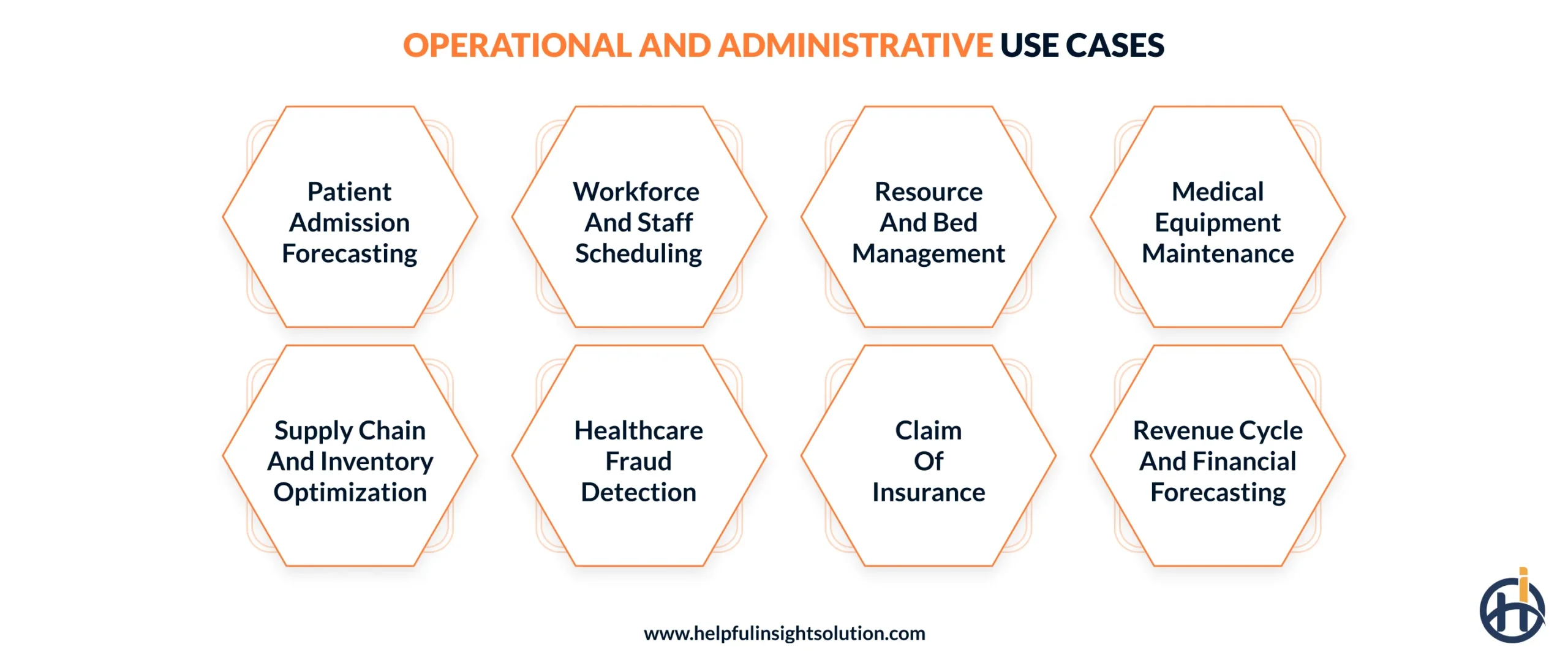
1. Patient admission forecasting
Predictive analytics is a help to hospitals because it helps them figure out how many patients they will have in the future. This is done by looking at what happened in the past like during times of the year and what is going on with the health of the people in the area. Predictive analytics helps healthcare providers identify patients at risk of serious illness before symptoms appear.
By analyzing seasonal trends and community health data, predictive analytics helps hospitals forecast how many patients to expect. When hospitals know what to expect they can get ready for times and make sure they do not get too crowded. This means they can have staff, beds and things they need to take care of patients. As a result hospitals can take care of patients and do things more efficiently.
2. Workforce and staff scheduling
Healthcare organizations use analytics to figure out how many staff members they will need based on how many patients they think will come in. By knowing when it will be busy, managers can make sure staff schedules are just right and accurate for patients. Have too many people working at the same time. This helps the staff get more done and saves money on labor costs. It also helps the staff not get too tired and makes patients happier.
3. Resource and bed management
Predictive models look at how patients move through the hospital how many are leaving and how full the hospital is to make sure beds and resources are used in the way.
Hospitals can see if there might be problems before they happen and get things ready. This means patients do not have to wait long and can get the care they need more quickly. When beds are managed well the hospital runs smoothly and patients get better care.
4. Medical equipment maintenance
Predictive analytics keeps an eye on equipment to see if it might break down. Hospitals can fix equipment before it breaks so it does not interrupt the care of patients. This helps the equipment longer and saves money on repairs.
The health predictive analytics also makes sure that important medical devices are available when patients need them for care. Other areas of the hospital benefit from predictive analytics, like medical equipment maintenance because it helps hospitals take care of patients better.
5. Supply chain and inventory optimization
Healthcare providers use analytics to figure out how much medication, surgical supplies and medical equipment they will need. If they can predict this correctly they can avoid running out of things. They will not have too much extra stuff just sitting around.
The predictive analytics services helps them buy things efficiently and it also saves them money on storage and waste. When they manage their supplies in a way they can make sure they have what they need when they need it.
6. Healthcare fraud detection
Predictive analytics helps find billing patterns, duplicate claims and suspicious money activities that might be fraud. By looking at a lot of healthcare transactions predictive models can point out things that do not seem right. Then people can look into these things closely.
This helps organizations lose money and it also helps them follow the rules better. It also makes the healthcare system more transparent and trustworthy.
7. Claim of Insurance
Predictive analytics makes it easier to process insurance claims by checking if a claim is valid figuring out how likely it is to be approved and finding any mistakes. Insurance companies can decide which claims to look at first and they can process the claims faster.
This reduces the amount of work they have to do. It makes customers happier. Predictive models also help stop incorrect claims from being submitted.
8. Revenue cycle and financial forecasting
Healthcare organizations use analytics to predict how much money they will make, how much they will get paid and how they are doing financially. If they can find out if they might have money problems or if they will get paid late they can do something about it before it happens.
This helps them make decisions, about their budget and plans. It also helps them make money while still taking good care of their patients.
Financial and strategic impact on healthcare businesses
Businesses use predictive analytics in healthcare to automate claims processing, reduce admission penalties, and ensure financial savings. Additionally, it helps in staff management, optimizes inventory levels, and promotes value-based care models.
The AI development services allow healthcare providers to manage revenue cycles, prevent fraud, and reduce missed appointments. With predictive AI models, it is easy to personalize patient treatment, enhance supply chain efficiency, and allocate resources with precision.
By reducing financial penalties, medical professionals can focus on remote patient care, dynamic genome development, and drug modeling. Additionally, they can also improve medical surgeries through data analysis based on diverse human parameters.
Top examples of healthcare predictive analytics
Some of the best examples of healthcare predictive analytics are discussed in this section, covering various areas. They help you to understand how medical professionals are handling complex tasks.
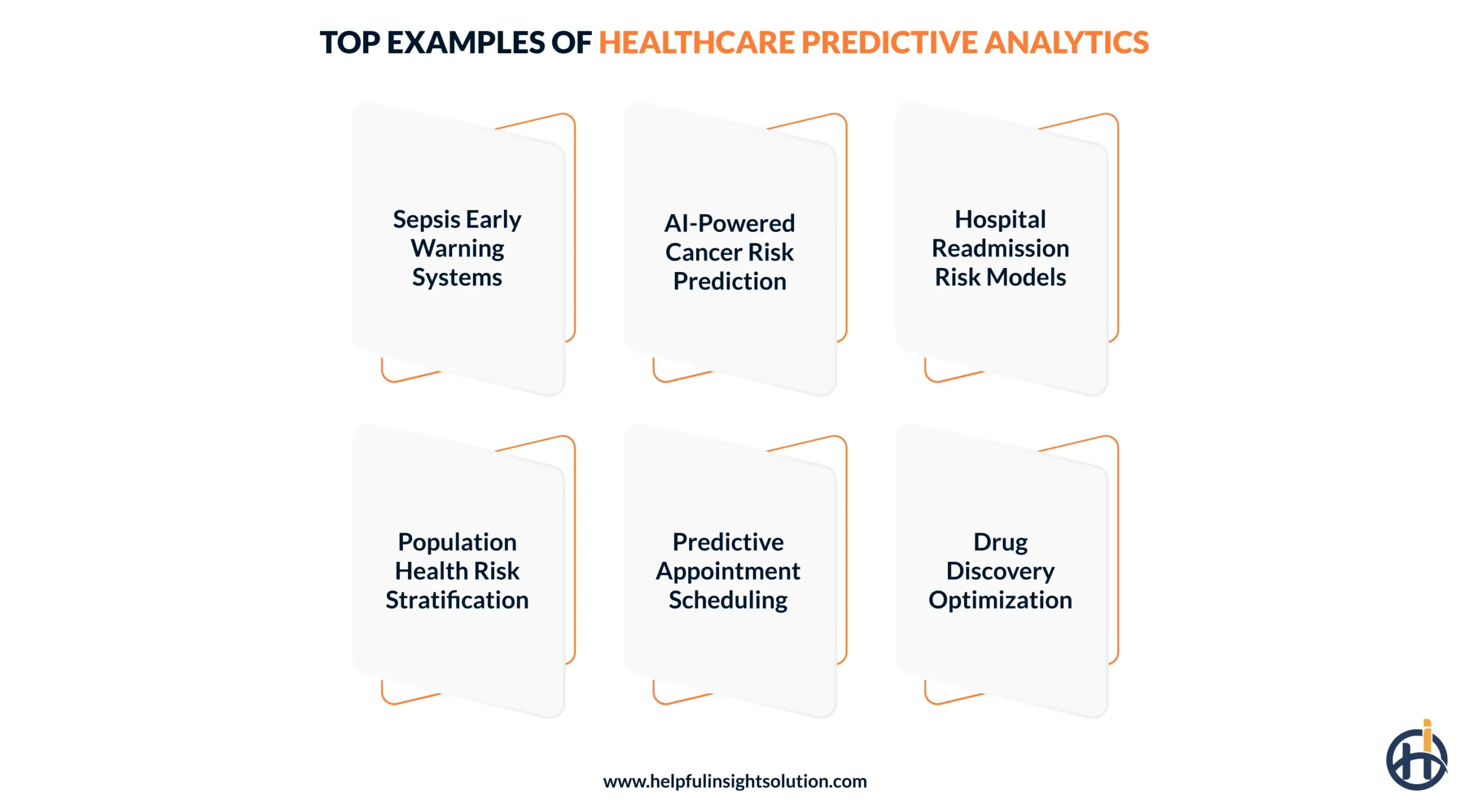
1. Sepsis early warning systems
Sepsis early warning systems use computers to watch patient vital signs, lab results and medical records. These systems can spot signs of infection and getting worse and alert doctors and nurses before sepsis gets bad. When doctors act fast more patients can have fewer problems.
2. AI-powered cancer risk prediction
AI systems look at information, medical history, lifestyle and images to figure out cancer risk. These systems help doctors find people at risk and suggest right tests. Finding cancer early gives patients a chance of getting better.
3. Hospital readmission risk models
Hospital readmission risk models look at patient information, treatment history and discharge details to predict if a patient will return to the hospital. Doctors can use this information to make a plan, for follow-up care and support. This helps patients get care and reduces hospital returns.
4. Population health risk stratification
Population health risk stratification is a way to figure out which patients are more likely to get very sick. It does this by looking at lots of information and using that to put patients into groups.
The groups are based on how likely they’re to have health problems. When we know which patients are at risk we can make sure they get the care they need to stay healthy. This means we can use our resources in a way and help more people.
5. Predictive appointment scheduling
Imagine you could guess which patients will not show up to their appointments. Predictive appointment scheduling is a way to do that. It looks at what patients have done in the past. Uses that to figure out what they might do in the future.
This helps clinics make the most of their time and space. When clinics are used efficiently they can see more patients and waste less time.
6. Drug discovery optimization
Finding medicines is a long and hard process. Predictive analytics can help make it faster and cheaper. It looks at lots of information to find the medicines that’re most likely to work. This means companies can focus on the ones and not waste time on the bad ones.
It analyzes large volumes of data to identify the medicines most likely to succeed, allowing companies to focus on promising candidates instead of wasting time on ones unlikely to work. When we can find medicines faster, we can help people who are sick get the treatment they need sooner. We can be more sure that the medicines will actually work.
Major challenges in integrating predictive analytics for healthcare
While integrating predictive analytics into healthcare systems, you may face some typical challenges. Here, we are going to study these security and interoperability risks with their respective solutions.
1. Data quality and interoperability issues
This includes fragmented, inconsistent, and unstructured data that affects accuracy, creating data silos. It also influences communication between legacy systems due to outdated information and missing data.
Solution: Businesses should use natural language processing to parse unstructured data and build robust ETL models to monitor quality.
2. Data privacy & security
Strict regulations, system limits, and data vulnerabilities affect the integration of predictive analytics in medicine. Various third-party APIs allow security breaches and manipulate the protected health information.
Solution: Multi-factor authentication, role-based access, and data encryption are the key measures that businesses implement for security.
3. High implementation and maintenance costs
The cost increases due to the IT infrastructure, software licensing, and custom healthcare models. The overall price is also affected by data cleaning tasks, maintenance, algorithms, and data structuring.
Solution: You must use cloud-based healthcare SaaS tools, which increase scalability and deploy faster, reducing upfront costs.
4. Adoption and trust issues
Healthcare providers do not integrate predictive analytics if it is difficult to understand the working model. Technical complexity, black box problem, and algorithmic bias are the key issues in adoption.
Solution: It is important to use explainable AI models to validate clinical data and align medical workflow with the technology.
Future trends in predictive analytics in healthcare
The future of predictive healthcare will change through modern innovations, like xAI, generative AI, and digital twins. Let’s discuss the emerging future trends in this section for better healthcare execution.
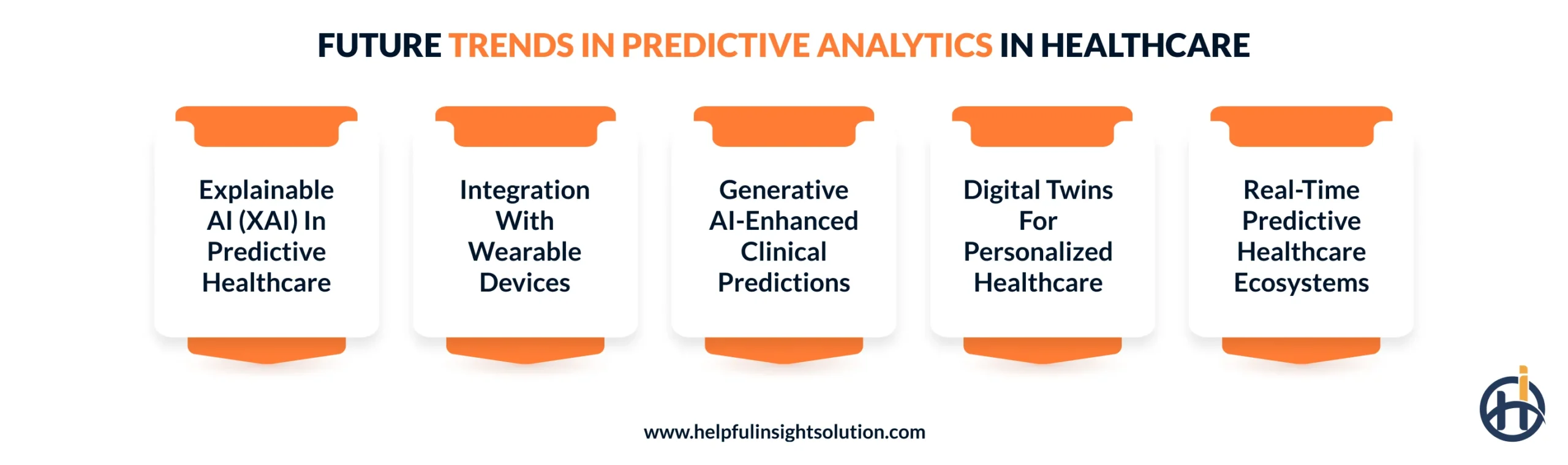
1. Explainable AI (XAI) in Predictive Healthcare
As AI models get more complicated hospitals and clinics will want to know how predictions are made. Explainable AI helps doctors understand why AI suggests treatments making them trust AI more. This will be important for following rules and making sure decisions about patient care are fair.
2. Integration with wearable devices
People are using smartwatches and fitness trackers more and more. These predictive analytics solutions in healthcare give a flow of health data. Predictive analytics will use this data to find health risks and help prevent problems. This will help patients get personalized and preventive care.
3. Generative AI-enhanced clinical predictions
Generative AI will help make predictions by looking at lots of medical data and finding patterns that other models might miss. This will help doctors predict how diseases will progress how treatments will work and what risks patients might face. This means hospitals can make decisions faster and with information.
4. Digital twins for personalized healthcare
Digital twins are, like copies of patients made from their medical, genetic and behavioral data. Hospitals will use these to see how diseases might progress, test treatments and predict outcomes before treating patients. This could make medicine and treatment planning much better.
5. Real-time predictive healthcare ecosystems
In the future healthcare systems will connect hospitals, clinics, labs, pharmacies, insurance companies and wearable devices. By looking at data in time these systems will help respond faster to health issues and improve care coordination. This will make healthcare delivery more efficient, proactive and focused on patients.
Ensure seamless healthcare systems with our predictive analytics solutions
The use of predictive analytics in healthcare has increased rapidly over the past few years, improving clinical operations and reducing overhead costs. It is beneficial to approach an experienced and reliable healthcare app development company that ensures smooth integration within a limited budget.
We cater to specific business ideas by delivering a collaborative environment and working with authenticity. Our experts have access to advanced tools, technologies, and frameworks, offering effective solutions.
With healthcare predictive analytics, you can easily focus on improved patient care and increased revenue cycles, decreasing manual errors. Additionally, healthcare providers can streamline claim settlement, resource utilization, and appointments in real-time.
So, you must grab the emerging market opportunities and invest in predictive AI technology for healthcare enhancements.
FAQs
Various predictive models in healthcare include regression, decision trees, neural networks, and support vector machines (SVMs). They use historical data and machine learning algorithms to forecast future health events and patient needs. These models identify risks, analyze medical images, manage complex datasets, and store patient information.
Businesses can implement predictive analytics in multiple healthcare systems through a certified process. The key integration stages are described in the following manner:
- It is important to understand existing data issues and operational overloads.
- The data is extracted from EHRs, medical imaging, and patient billing.
- AI engineers build predictive models and train them based on various patterns.
- Now, you must verify the accuracy and efficiency of the AI-powered model.
- After testing, businesses can deploy the models into their healthcare systems.
Data silos are the disconnected repositories of patient information that cannot share data with other systems. They disturb healthcare communication between hospitals or clinics, preventing access to patients’ medical history. This problem occurs due to technical issues in EHR systems, privacy regulations, and irregular medical practices.
The generative AI technology helps to transform traditional care into proactive care in the medical domain. It can predict disease progression, enhance diagnostic imaging, and optimize drug discovery for health professionals. This promotes dynamic resource allocation and improved clinical documentation, reducing administrative load.
The estimated cost range for simple healthcare platforms is from $40,000 to $90,000 due to limited integrations. For predictive analytics and risk detection, the overall price of healthcare integration may increase to $200,000. The enterprise-grade AI solutions may cost $500,000 because of advanced EHR systems and wearable devices.