

Key takeaway
- Offshore software development means bringing in a technical team of developers, QA engineers, and designers from another country to build or support your software.
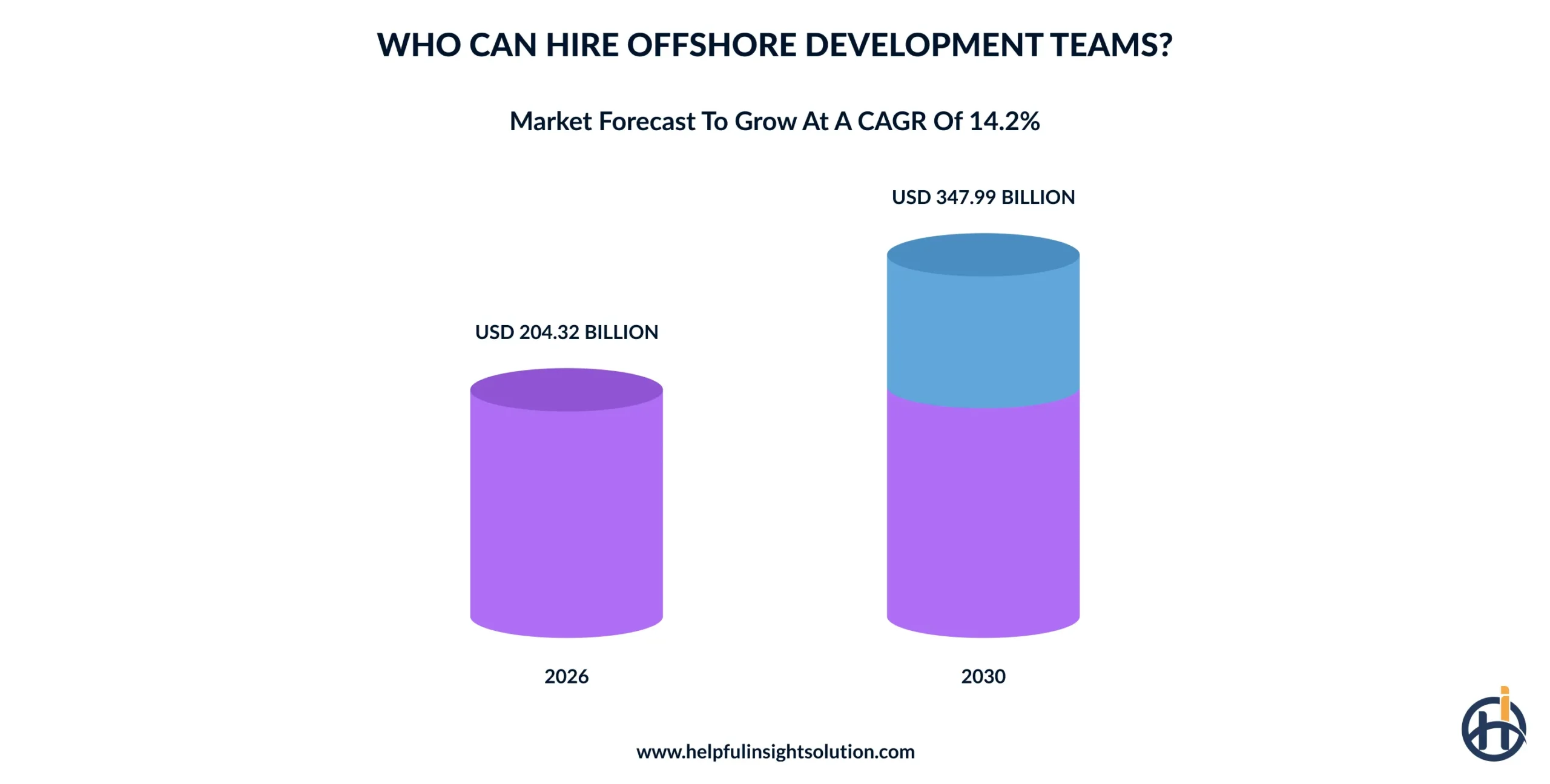
- The offshore software development market is expected to grow from $204.32 billion in 2026 to $347.99 billion by 2030.
- Startups, enterprises facing talent shortages, and businesses without in-house tech teams all benefit differently from offshore development arrangements.
- A reliable offshore development team should take the time to understand your business and what you’re trying to achieve. They shouldn’t jump straight into recommending a solution based only on your tech stack.
- Businesses commonly outsource services such as custom software development, UI/UX design, cloud infrastructure, and QA testing to offshore teams.
Offshore software development has become a practical strategy for businesses that need specialized expertise without building every capability in-house. Earlier, most companies approached it purely as a cost-cutting tactic.
That thinking has shifted considerably. Global enterprises now treat offshoring as a longer-term engagement, often through models like a dedicated development team. This team stays involved as the product evolves, handling new features, fixes, and regular updates.
The numbers point in the same direction. Research and Markets report projects the global offshore software development market will reach around $347.99 billion by 2030.
Growth like that isn’t just about lower rates anymore; it’s businesses looking for partners who actually understand business objectives, recommend the right technology approach, communicate transparently, and remain accountable throughout the development lifecycle.
That makes the choice of an offshore team worth looking at carefully. Before getting started, it is worth understanding how offshore software development works in practice. This guide covers the benefits, costs, and challenges involved, along with what actually matters when you’re selecting an offshore software development partner.
What is offshore software development?
Offshore development means hiring a team of dedicated developers, QA specialists, designers, and project managers who work out of a different country than yours, often in a different time zone with a different working culture.
For example, a US company might team up with developers in Asia. A UK business might go with a tech firm in Eastern Europe. Either way, location isn’t really the deciding factor. The bigger question is whether the team sticks around for the entire software and mobile app development lifecycle, not just the build, including planning, deployment, and ongoing support once the app is live.
Onshore vs nearshore vs offshore software development: Key differences
The difference between onshore, nearshore, and offshore development comes down to mainly where your development team is geographically located. That one factor drives cost and communication ease more than businesses expect.
With onshore, collaboration is simple since the team’s local, though that convenience costs more. Nearshore lands somewhere in between, slightly pricier than offshore but easier on time zones. Offshore brings costs down the most and gives access to talent well beyond your own borders.
The right choice is based on your budget, how complicated the project is, and how much live collaboration actually matters to you.
| Factors | Onshore software development | Nearshore software development | Offshore software development |
| Team location | Same country as the business | Nearby countries or regions | Distant countries and regions |
| Cost | Higher due to local hiring costs | Lower than onshore, but above offshore | Usually lower than local hiring costs |
| Time zone difference | Same working hours | Some overlap in working hours | Larger time difference |
| Communication | Easier real-time communication | Usually easy to coordinate | Needs more structured communication |
| Talent pool | Mostly limited to local professionals | Access to talent in nearby markets | Access to a much wider talent pool |
| Cultural compatibility | Easier cultural understanding | Often similar working practices | May require more cultural adjustment |
| Project control | Direct and simple to manage | Relatively easy to manage | Needs clear processes and oversight |
| Best for | Projects needing close and daily collaboration | Businesses balancing cost and communication | Projects needing scale or specialized skills |
Benefits of offshoring software development for global businesses
Offshoring can offer more than access to developers in another location. With the right partner, businesses can extend their engineering capabilities, fill specialist skill gaps, speed up delivery, and build products without expanding every capability in-house.
In this section, we’ll explore the key advantages of working with offshore engineering teams.
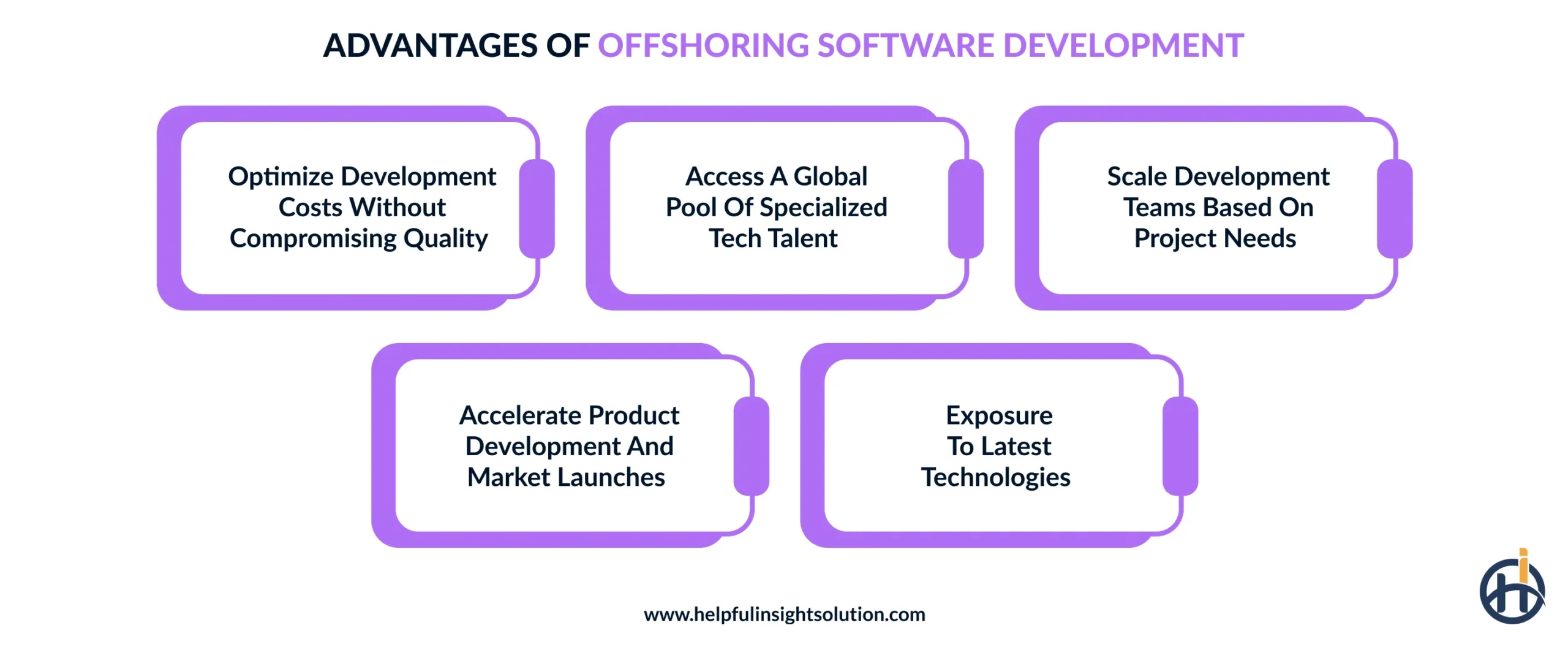
1. Optimize development costs without compromising quality
Cost is still a big part of the outsourcing decision. In fact, 48% of companies point to cost savings as a primary reason. When a company works with an offshore team, it can avoid some of the expense and effort involved in hiring and maintaining the same capabilities internally. For many businesses, that makes the development budget go further.
2. Access a global pool of specialized tech talent
A very specific skill set can make local hiring genuinely hard. Offshore product development widens the search considerably, giving businesses access to skilled AI developers, data scientists, ML engineers, and cloud specialists across markets they wouldn’t normally tap into.
This makes sense when a project needs that expertise temporarily, without the business building it in-house long-term.
3. Scale development teams based on project needs
Project requirements can change once software development is underway. An offshore team gives businesses room to adjust the team as the workload changes. You can bring in more offshore software engineers when development picks up and reduce the team when that work is done.
Picking the right engagement model up front, whether a dedicated team or staff augmentation, makes this flexibility easier to manage.
4. Accelerate product development and market launches
A tight launch window with limited internal bandwidth is exactly where offshore software development proves useful. Offshore teams can take on different parts of the project, from UI/UX design and frontend development to API integration and testing, while the core team stays focused on higher-priority tasks.
This gives businesses the flexibility to bring in the right expertise at different stages without slowing down the overall development process.
5. Exposure to latest technologies
Offshore software developers often work with different products, industries, and technical setups. That experience can be useful when your project needs a newer software framework, cloud service, or development approach.
They may have already worked through similar technical problems, which can help your team assess new options without adopting technology simply because it is trending.
Who should consider hiring offshore development teams?
Offshore software development isn’t limited to one type of business. Startups, enterprises, and everything in between turn to it for different reasons, though the ones who benefit most usually know exactly what problem they’re solving, not just what role they’re trying to fill.
In this section, let’s have a look at who can hire offshore developers.
1. Startups scaling digital products
For startups, the development workload can change quickly after the product goes live. One month may be about fixing early issues, and the next may involve new features or integrations.
If small businesses hire software developers, they can add development capacity as those needs come up, without changing the entire product development setup.
2. Businesses facing local talent shortages
A project can slow down when a business cannot find the right technical skills locally. Offshore software development services give companies another option when local recruitment takes too long. Instead of putting a project on hold, they can look for specific skills in other markets and keep the work moving.
3. Companies with tight launch deadlines
When a product has a fixed launch date, delays in one part of development can affect everything that follows. Working with a software development outsourcing company can help take specific tasks off the internal team’s plate while both teams work toward the same deadline.
Clear priorities and communication are essential when every week matters.
4. Organizations without an in-house tech team
Some businesses have a product idea but no developers or technical team to build it. Working with offshore teams for software development gives them a way to get the project started without hiring a complete team internally.
Depending on the project, the team can handle development, testing, and the work needed after launch.
What type of services are best suited for outsourcing?
Not every business outsources the same slice of work. Some just need help building something new. Others need extra hands for testing, cloud setup, or keeping things running once it’s live.
An offshore custom software development company can take on one narrow task or a much bigger chunk of the process, depending on what’s actually needed.
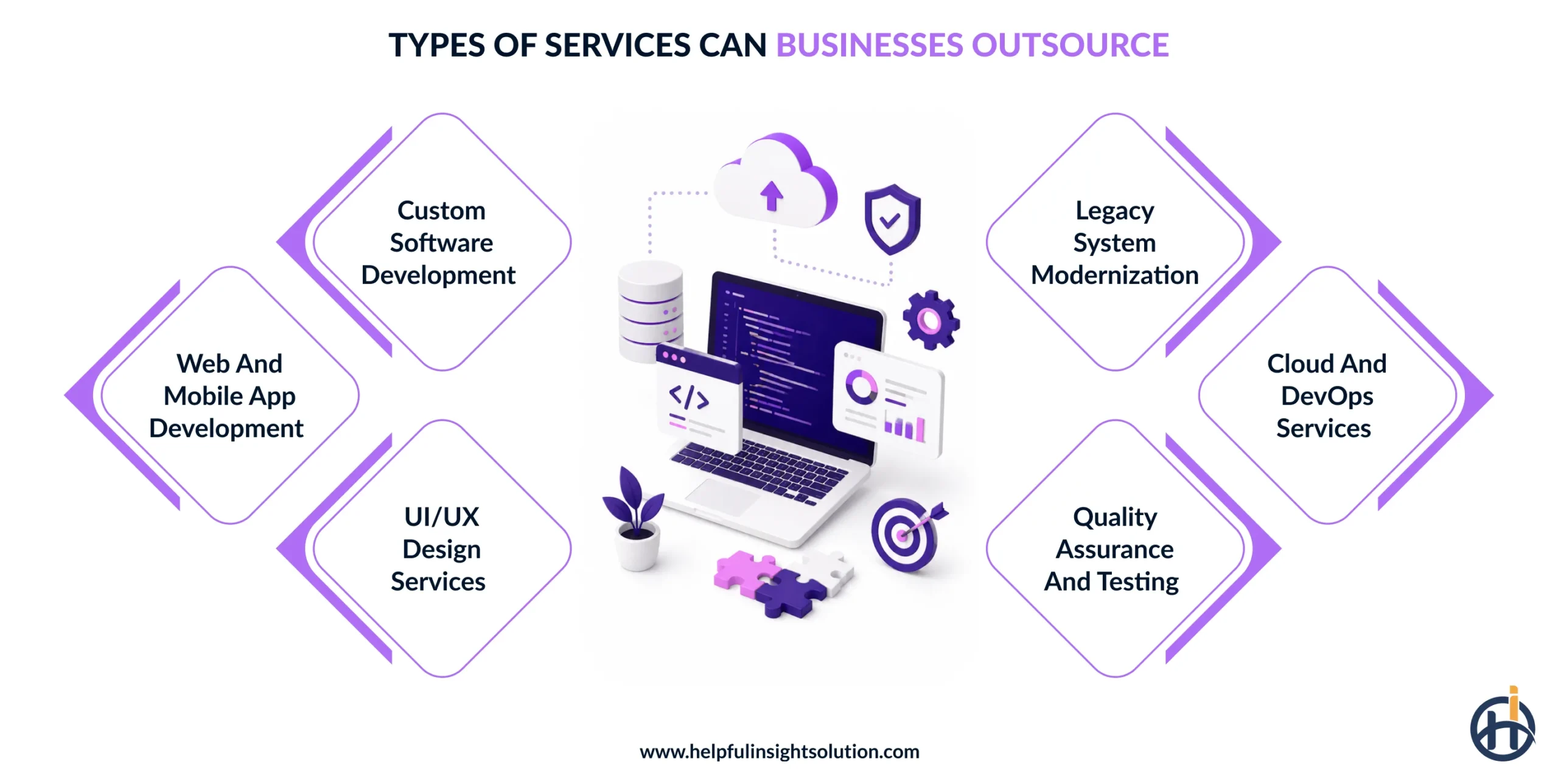
1. Custom software development
Custom software often needs specific expertise that businesses don’t always have enough ongoing work to justify hiring for full-time. Outsourcing this to an external team gives you customized offshore software solutions built around your actual workflows, without carrying a large in-house engineering team year-round.
2. Web and mobile app development
Platform-specific skills make web development services and app builds a natural fit for outsourcing. External teams cover design and coding end-to-end, moving faster than assembling an in-house team for what’s often a temporary project need.
3. UI/UX design services
Bringing in offshore UI/UX designers gives your project a fresh perspective, professionals who study user behavior and build interfaces around it. This covers everything from wireframes through final layouts, without requiring a permanent in-house design hire.
4. Legacy system modernization
Legacy systems often run on code your current team never learned, making modernization a rare skill to find internally. An offshore development team can safely migrate these systems to modern platforms and cut security risks.
5. Cloud and DevOps services
Cloud infrastructure needs constant attention. Outsourced DevOps support covers deployments, monitoring, and scaling, cutting overhead so your team spends time building the product instead of maintaining servers.
6. Quality assurance and testing
QA works well as an outsourced function since an outside team catches issues your own developers might overlook, having built the code themselves. Offshore software services bring automated testing and a genuinely independent review before launch.
Engagement models for offshore software development services
There’s no one right setup for software offshore development. A quick skill gap and a full product build need completely different arrangements. You may also need specialized capabilities, such as AI development services, without expanding your in-house team.
What actually works comes down to how long the project runs, how much control you want to keep, and what your budget allows.
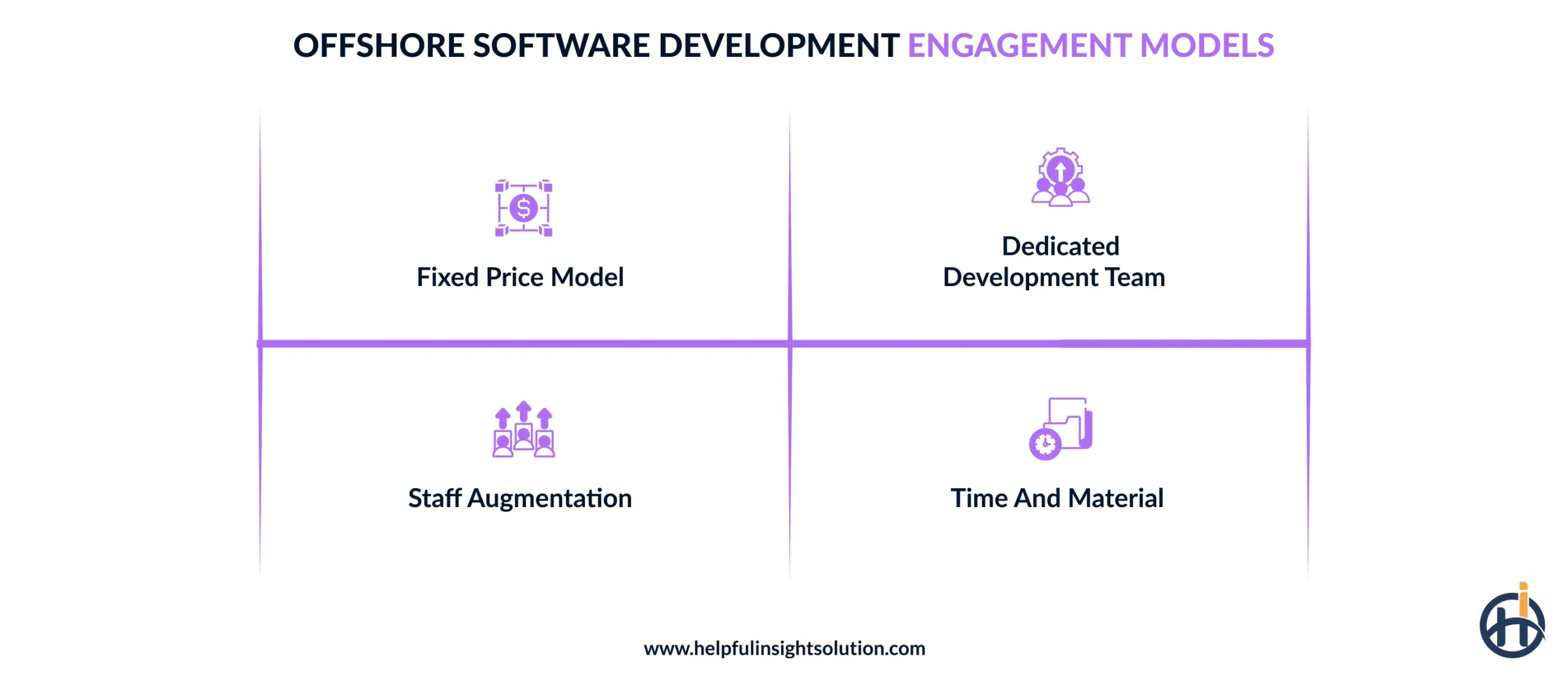
1. Fixed price model
The total cost is agreed upfront and doesn’t move, regardless of how long the work takes. Best fit for offshore software development outsourcing with a stable and well-defined scope.
2. Dedicated development team
This model gives you a full remote team focused solely on your product, with no attention split across other clients. The offshore partner handles recruitment and infrastructure, while you retain control over direction.
3. Staff augmentation
With staff augmentation, you add external experts directly into your existing team and manage them like regular employees. You pay a flat rate per person. Useful when you need to hire software developers fast, for short-term gaps.
4. Time and material
This model bills based on actual work done, hours and resources, rather than a set price upfront. Best suited to projects where scope shifts as you go, not fixed-requirement builds.
How to hire the right offshore software development company for your business
Hiring an offshore software development partner is not just about checking technical skills or comparing prices. You want a team that understands what your business is actually trying to achieve, asks the right questions before starting, and can explain its approach clearly. Good communication and a clear understanding of the business need also make a big difference once the work begins.
Here is what to look for on a discovery call:
1. Do they ask what you’re actually trying to build, or just pitch?
The first few conversations can tell you quite a bit. See whether the team asks about your users, goals, and how the business works before talking about development. A partner who listens first and then recommends an approach is more likely to build something that fits the actual requirement.
2. Do they push back on your tech choice if it doesn’t fit your stage?
Ask why they’d use a particular tech stack for your project specifically. The answer should connect back to your product, your timeline, where you’re headed long-term, not just a default recommendation.
A good partner won’t just nod along to whatever you suggest either. If a different approach makes more sense, they should be willing to say so.
3. Can they explain how they’d handle a live system during scale-up or migration?
Changes to a live platform need more care. Ask what happens if a deployment causes a problem and how they would restore the previous version. An experienced offshore software development outsourcing team should have a practical deployment and rollback process rather than treating production changes as routine.
4. Do they talk about team retention, or just their bench size?
A large offshore developer pool sounds good on paper, but continuity matters a lot more once work actually starts. Ask specifically who’ll be on your project and how that team gets managed over time. A team that sticks around builds real understanding of the product, and that makes everything down the line easier.
5. How often will they communicate once development actually begins?
Ask them straight up what communication looks like after development kicks off. Update frequency, where you track tasks, who you contact when something needs fixing. Once that’s clear from the start, raising changes or catching issues gets a lot simpler, and the work stays closer to what you actually need.
6. What do their past clients actually say about working with them?
Don’t judge outsourcing dedicated development teams only by the projects shown on its website. Look for work that’s relevant to your own requirements and spend some time reading client feedback. It can reveal things that a portfolio often doesn’t, such as how the team communicated and handled the project day to day.
7. Is their pricing model clear and explained during the first call?
Before agreeing to anything, ask how the cost to develop software actually gets worked out and what’s included in it. A cheaper quote can be misleading if it’s missing work you’ll end up needing anyway. Remember, that first conversation should be about your project and the right approach for it, not the price tag.
Hear from Helpful Insight’s CEO on a consulting-first offshore development approach
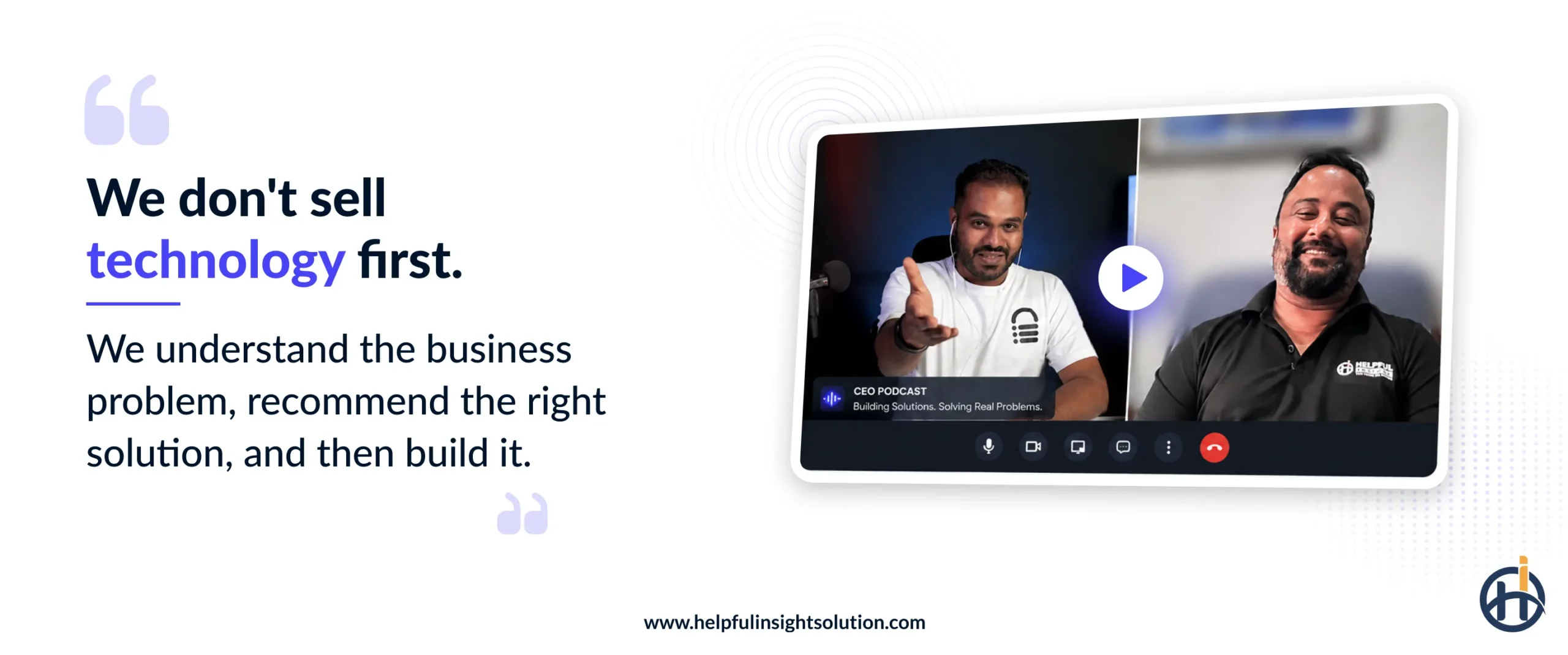
Tarun Vyas, CEO of Helpful Insight Pvt Ltd, discussed this approach in a conversation with WPDev about how an offshore software development company can build long-term relationships with clients across the USA, UK, Australia, and UAE.
According to Tarun, offshore agencies should not spend their discovery calls trying to convince prospects that they are not competing only on price. Instead, the conversation should move toward understanding what the client is actually trying to achieve.
One example he shared involved a US-based client who approached the company with a broad requirement for a real estate business system. Rather than immediately proposing a standard property listing platform, the team asked questions about how the business would actually operate and what the client intended to achieve.
The discussion revealed that the business model was focused on generating and selling buyer data to property sellers rather than simply selling properties.
Understanding that distinction changed the technology conversation and allowed the team to architect a solution around the actual business model.
Offshore software development challenges and how to manage them
It’s normal for an offshore project to have a few bumps at the beginning. Maybe communication isn’t as smooth as expected, or the first few deliveries need more attention. Trust can also take time when everyone is working remotely. None of this is unusual, and with the right working process, these problems can usually be sorted out.
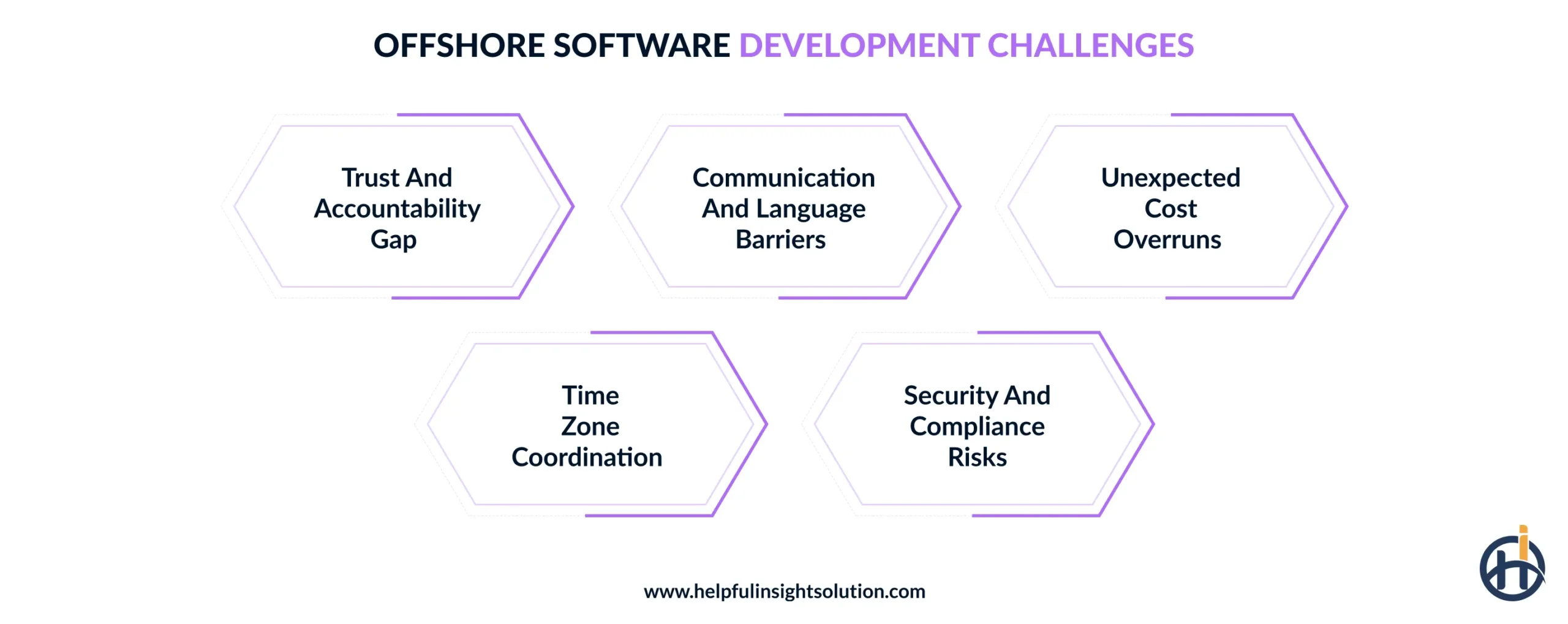
1. Trust and accountability gap
You can’t just walk over and check on things when a team’s on the other side of the world, so trust gets built differently here. A lot of businesses end up relying entirely on status updates in the early weeks, without much way to verify any of it. That uncertainty is usually what holds companies back from going offshore in the first place.
The solution
Trust builds faster when offshore developers show how they think before any contract is signed, the questions they ask, how they approach your problem. Pair that with clear milestones and shared tracking tools once work begins, and judge progress by what’s delivered.
2. Communication and language barriers
Time zone limits make live discussions tricky to begin with, and language differences don’t help. A missed nuance in a requirement or a slow reply seems minor at first, but it piles up over a project without a defined communication process.
The solution
Fix overlapping work hours for real-time discussions. Reliable offshore software solutions also include standardized documentation, so instructions don’t depend on memory or a single conversation.
3. Unexpected cost overruns
The initial quote is not always the final cost. Requirements can change as enterprise product development moves forward, especially when new needs come up during testing. Businesses should agree on what is included, how extra work will be priced, and how project costs will be reviewed before the work begins.
The solution
Split the project into phases and be specific about what each one includes. Reviewing progress at each stage makes it a lot easier to catch scope creep early, rather than realizing it once the budget’s already gone.
4. Time zone coordination
Different time zones aren’t automatically a problem, but they can turn into one when quick answers are needed mid-development. A developer might wrap up their part while your team’s offline, so the next step just sits there until the following day. Those small delays add up over time and start affecting the schedule.
The solution
Set a few hours for real-time discussions and use project tools for everything else. Clear handoffs also help work continue without waiting for the next team to start.
5. Security and compliance risks
Security needs real attention whenever software and mobile app development work touches business data or production systems. Get clarity upfront about who has access to what, where information is actually stored, and how it’s protected. This matters even more when the project has specific compliance requirements.
The solution
Set access rules before development starts, and give people only the permissions they actually need. Back this with secure practices, signed agreements, and regular access reviews.
Tips to effectively manage an offshore software development team
Managing a team of remote developers can get difficult when everyone is working from different places and time zones. In this section, we’ll give you some quick tips that will help you manage the team.
- Set real deadlines with actual milestones attached. Vague timelines are usually where things quietly start slipping, and you won’t notice until it’s late.
- Walk the team through the full product vision early on. Offshore teams that understand where the product is headed tend to make smarter calls on the project.
- Decide which choices the remote development team can make independently and which need approval. This prevents unnecessary delays and keeps smaller technical decisions moving.
- Write things down as you go, decisions, requirements, changes. Offshore teams lean on documentation more than in-house staff would, since they can’t just lean over and ask.
- Don’t measure productivity by how long developers appear online. Look at completed work, code quality, resolved issues, and progress against agreed project milestones.
Emerging trends in offshore software development
How enterprises work with offshore teams is shifting. AI, machine learning, cloud computing, modern engineering practices, all of it’s changing the equation. Businesses now look more closely at development expertise, security, adaptability and whether the partner actually understands their business requirements.
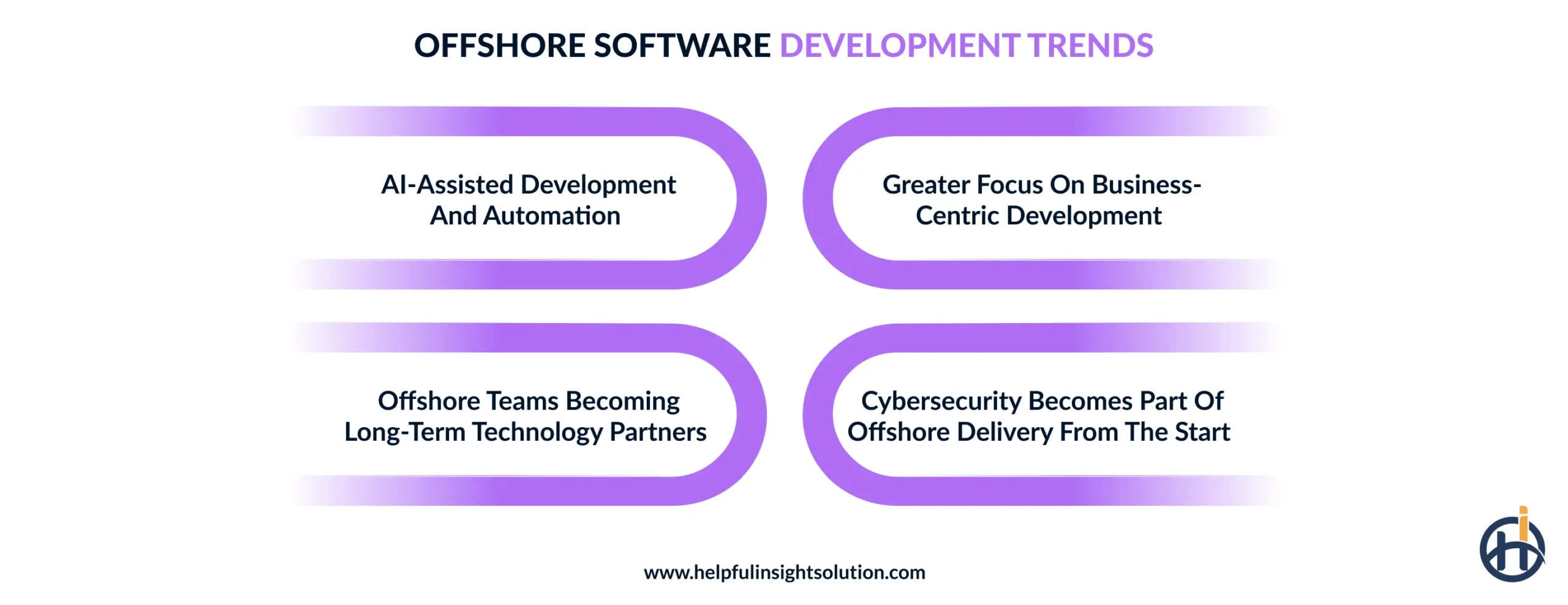
Below are some of the latest offshore software development trends:
1. AI-assisted development and automation
Artificial intelligence is finding a place in offshore software development in fairly practical ways. Developers now use it for coding support, testing, debugging, and documentation. This helps offshore teams deal with routine work more quickly while keeping experienced developers focused on complex technical decisions.
2. Greater focus on business-centric development
The offshore model is becoming less about completing assigned development tasks and more about understanding the problem behind them. Teams that take time to learn the client’s business model, processes, and priorities can suggest solutions that fit the way the business works, rather than forcing requirements into a standard approach.
3. Offshore teams becoming long-term technology partners
Offshore development has quietly become part of the in-house tech function for a lot of businesses. Instead of bringing offshore software engineers on for one project and moving on, companies want to keep working with the same team, through updates, maintenance, scaling, whatever comes next as needs shift.
4. Cybersecurity becomes part of offshore delivery from the start
Security is becoming something teams need to consider throughout the software development lifecycle, rather than address near the end. Businesses cover secure coding, access controls, data protection, vulnerability testing, and how offshore teams handle sensitive business information.

Conclusion
Offshore software development isn’t just about adding developers from another location anymore. What actually works better is finding the right expertise, understanding the business behind the product, and having a team that stays involved as requirements shift. It’s not only about what gets built, but how the whole transition and ongoing work gets handled.
At Helpful Insight, this approach is the foundation of how we work, and it’s why businesses across the globe trust us as their offshore custom software development company.
Our team of pre-vetted experts can step into projects from the early planning stage, whether you need a small feature developed or an entire product built and maintained. We don’t simply build whatever is written in the requirement document. We talk through the idea with the client, understand where the product needs to go, and point out areas where a different approach could make the end product work better.
We’ve seen this approach work in real projects. One of our US-based clients who run a floral business had a system built on WordPress for several years, but the growing volume of data made a more scalable architecture necessary. So, we suggested moving to the MERN stack.
The client didn’t want to take a chance with a system that was already serving their business. We understood that. Rather than switch everything at once, we kept the old platform running and built the new system alongside it.
Our team stayed on around the clock to make sure nothing broke or slowed the business down. Once the new system was tested and the client was genuinely happy with it, we made the switch. That’s the kind of low-risk, practical approach we bring to offshore work.
Have a software idea in mind, or an existing product that needs some work? Talk to our team today.
FAQs
Offshore software development typically costs between $15 and $150 per hour, influenced by a range of factors. These include the location of the offshore agency, the developer’s experience level, and the complexity of the project.
There isn’t one fixed onboarding time for every offshore team. A small team of developers with widely used skills can often be hired within a week or two. If you’re looking for several people or need less common expertise, it may take around 3 to 4 weeks. For standard requirements, Helpful Insight can onboard developers in as little as 48 hours, because we already have a pool of vetted talent.
Working with an offshore development team doesn’t automatically mean putting your data at risk. Before the project starts, make sure the company has proper security measures in place, including NDAs, controlled access, documented processes, and any standards that apply to your business, such as GDPR or SOC 2.
Outsourcing is when you hand work over to an external team. Offshore outsourcing takes that a step further, with the team working from another country. In other words, offshore is one form of outsourcing.