

 engineers, data scientists, natural language processing (NLP) developers, and MLOps experts solve different problems. Experienced developers understand Python and various ML frameworks that help them to create.</p>
"Pinterest")

Key Takeaways:
- You must define business goals before hiring, as machine learning (ML) engineers, data scientists, natural language processing (NLP) developers, and MLOps experts solve different problems.
- Experienced developers understand Python and various ML frameworks that help them to create smart generative AI and large language model (LLM) solutions.
- By preparing a budget, choosing the right engagement model, and testing candidates with practical assessments, businesses can reduce hiring mistakes.
- The hiring cost depends on in-house, freelance, and agency outsourcing, so it is crucial to choose the right option before you hire ML talent.
As the technologies are changing rapidly, from full-stack to AI and ML, the need for selecting skilled engineers is increasing. Businesses now hire machine learning developers to transform foundation models into scalable products through accessible tools, open-source libraries, and plug-and-play APIs.
According to Fortune Business Insights, the global machine learning market size is $65.3 billion in 2026, which will reach $432.6 billion by 2034. The growth shows that investment in ML-powered apps and software is going to multiply every year because of a 26.7% CAGR over this period.
To build advanced platforms, from chatbots and generative AI tools to computer vision solutions, enterprises need constant support, expertise, and reliability. They hire AI developers to determine maturity levels, check readiness, prepare ML models, execute CI/CD pipelines, and deploy products efficiently. Product teams require proper guidance on how to hire ML experts for business transformation.
This blog provides detailed information on a dedicated hiring process, what skills a machine learning developer must have, and expected hourly rates. Additionally, we focus on some crucial challenges and major comparison tables in the content.
What does a machine learning developer actually do?
A machine learning engineer designs, builds, tests, and deploys AI models that allow software or apps to learn from data and make predictions. Businesses hire dedicated machine learning developers who can prepare datasets, choose suitable algorithms, test performance, and integrate models into applications.
They turn machine learning use cases into reliable and scalable solutions, from recommendation engines to fraud detection, supporting better business decisions. To hire the best machine learning (ML) developer, it is important to understand their core responsibilities.
Data collection and preparation: They gather, clean, and organize raw data so models learn from accurate, reliable information.
Model development and training: The experts select suitable algorithms, then build and train models to solve defined business problems.
Testing and optimization: ML developers evaluate model accuracy using key metrics, then fine-tune performance and reduce errors.
Deployment and maintenance: They integrate models into apps and monitor performance to predict results over time.
Machine learning developer vs. Data scientist vs. AI engineer
Business investors find it difficult to differentiate between ML developers, AI engineers, and data scientists. Each focuses on different goals, from analyzing data and supporting predictive analytics to building models.
To hire machine learning app developers, you must go through the following table that will help you to match the right role specific to your project needs and budget.
| Parameter | Machine learning developer | Data scientist | AI engineer |
| Primary focus | Building, training, and deploying machine learning models into real applications | Analyzing data to uncover insights and support business decisions | Integrating AI capabilities into products and scalable software systems |
| Main responsibility | Developing algorithms and optimizing model performance for production environments | Running experiments, building predictive models, and presenting findings to stakeholders | Designing end-to-end AI solutions, including chatbots, agents, and automation |
| Core skills | Python, software engineering, model optimization, and machine learning algorithms | Statistics, data analysis, visualization, and hypothesis testing with strong math | Pre-trained models, APIs, prompt engineering, and system architecture knowledge |
| Common tools | TensorFlow, PyTorch, Scikit-learn, Docker, and cloud platforms like AWS | Pandas, R, SQL, Jupyter Notebooks, Tableau, and statistical modeling libraries | LangChain, Hugging Face, OpenAI APIs, vector databases, and cloud services |
| Key deliverable | Production-ready models and pipelines that run reliably at scale | Reports, dashboards, and predictive models backed by data-driven insights | Working AI-powered applications, features, and intelligent automation workflows for businesses |
| Data handling | Prepares and engineers features specifically to train and improve models | Explores, cleans, and interprets large datasets to find hidden patterns | Connects data sources and models through APIs and application workflows |
| Best suited for | Projects needing custom models deployed and maintained in production | Businesses needing data analysis, forecasting, and insight-driven strategic decisions | Companies adding generative AI, chatbots, or agents to existing products |
Types of machine learning developers you can hire
Businesses can hire a machine learning developer based on different roles, from model building to natural language processing solutions. In this section, we will discuss various types of ML experts that you can hire for your project.
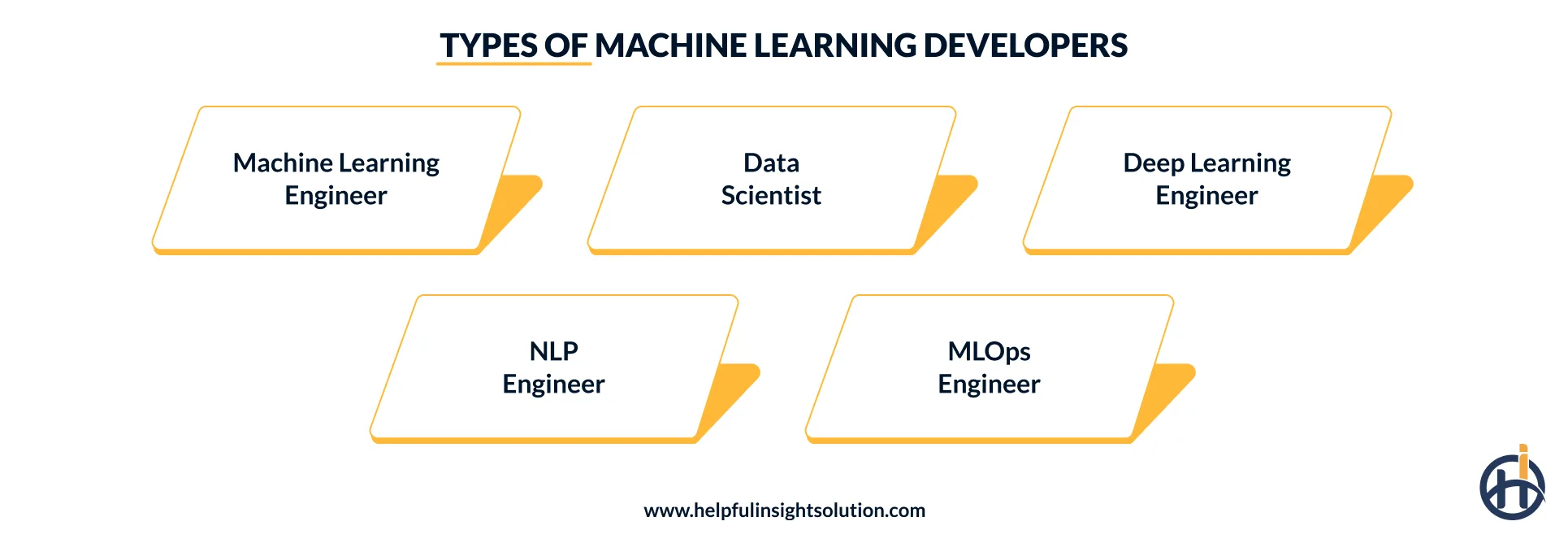
1. Machine learning engineer
Machine learning engineers create, train, and implement models based on the given business data that can be applied in real-life scenarios. They combine the best practices of coding and machine learning to develop smart products for market launch.
2. Data scientist
Data scientists analyze various types of data to find different trends and patterns that guide business objectives. Additionally, they suit multiple projects that require research, experimentation, and forecasting, improving accuracy and decision-making.
3. Deep learning engineer
You can hire deep learning experts to create neural networks that perform complex tasks, such as image recognition, speech modeling, and gait monitoring. These specialists are good at projects involving large amounts of unstructured data.
4. NLP engineer
Natural language processing (NLP) engineers build systems that process and generate human language, such as chatbots, sentiment analysis tools, and search. They are also essential for products that are developed using large language models (LLMs).
5. MLOps engineer
MLOps engineers take care of the complete model lifecycle, which ranges from model pipelines to system infrastructure. They manage model deployment, monitoring, version control, and scaling, which keeps costs under control and models reliable over time.
Must-have skills to look for while hiring machine learning developers
Strong candidates have technical depth and practical delivery experience in generative AI, ML frameworks, and SQL. You can evaluate and hire dedicated machine learning developers based on the following checklist.
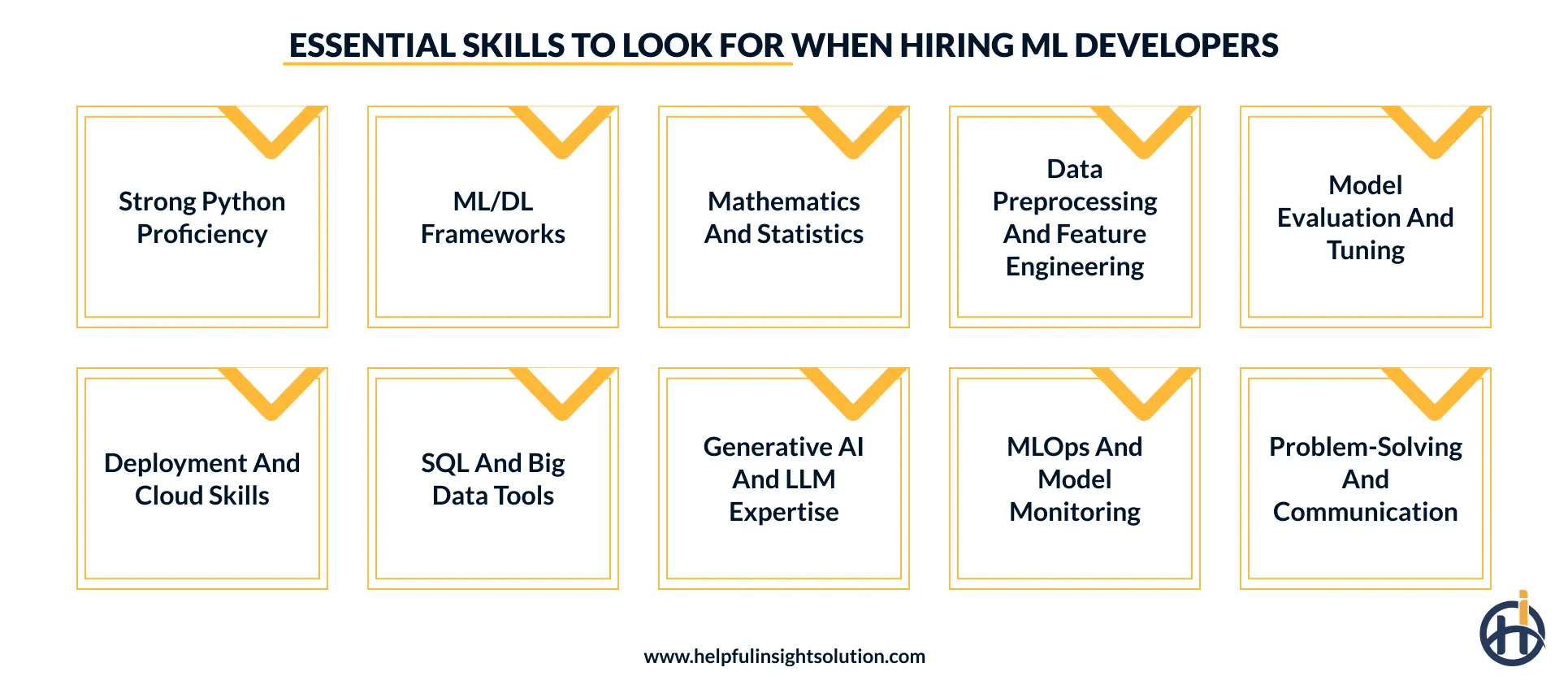
1. Strong Python proficiency
Python is the most popular programming language in machine learning, so candidates must have a strong understanding. Experience with data science libraries, including NumPy, Pandas, and Scikit-learn, is also crucial.
2. ML/DL frameworks
You can hire a machine learning engineer who uses ML frameworks to build models faster and more easily. Candidates with experience in TensorFlow, PyTorch, or Keras and knowledge of model execution are preferred.
3. Mathematics and statistics
Developers must have mathematical knowledge to understand how machine learning in healthcare and other industries works. Experience with linear algebra, probability, calculus, and optimization algorithms helps them to implement ML models.
4. Data preprocessing and feature engineering
Most real-world datasets require cleaning and preprocessing before training the model. Candidates with data preprocessing and wrangling skills are capable of improving model performance through feature engineering.
5. Model evaluation and tuning
Models need proper scoring and evaluation to ensure that they deliver accurate predictions. Candidates with an in-depth knowledge of ML metrics, cross-validation techniques, and hyperparameter tuning build reliable models for businesses.
6. Deployment and cloud skills
Building a model is necessary, but developers must know how to operationalize it in production. You can hire machine learning experts with experience in ML infrastructure and model deployment, including AWS, Azure, Google Cloud, Docker, and CI/CD.
7. SQL and big data tools
Various machine learning projects involve data stored in databases and data lakes. Therefore, developers with strong SQL skills and experience with data warehousing, BI, and big data tools, like Hadoop, are preferred.
8. Generative AI and LLM expertise
An increasing number of companies utilize generative AI solutions to replace entire functions. Candidates with knowledge of LLMs, including prompt engineering, fine-tuning, RAG, and LangChain, have an advantage.
9. MLOps and model monitoring
Developers must have experience in monitoring different AI/ML models based on data quality and technical drift. They use various tools, which include MLflow, Kubeflow, or Apache Airflow, helping experts to track inefficiencies.
10. Problem-solving and communication
Machine learning experts can translate business requirements into accurate and efficient AI models. They can communicate with business analysts, software experts, and market strategists to discuss and explain their findings.
How to hire a machine learning developer: Step-by-step process
A structured process to hire machine learning developers allows enterprises to save time and reduce mistakes. This section discusses 7 major steps, from planning to onboarding, with detailed information.
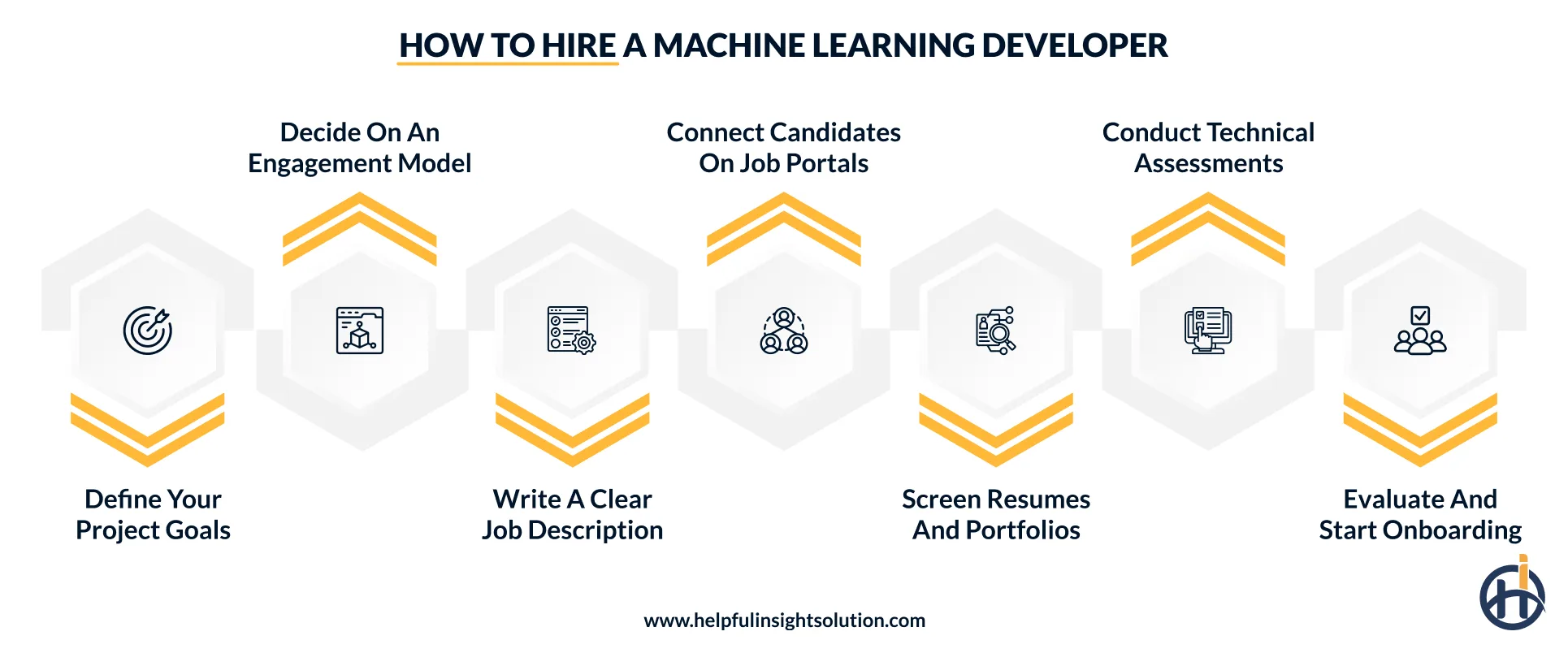
1. Define your project goals
As a business investor, you should determine the business problem, expected outcomes, available data, and success metrics. Whether you need predictive models, AI agents, or agentic solutions, clear goals help you hire the right expertise.
- Identify risks early, such as data privacy, bias, and compliance.
- Decide if a proof of concept should precede full development.
2. Decide on an engagement model
It is crucial to choose between a full-time hire, a freelancer, or an outsourcing agency based on your budget, timeline, and project size. Many businesses prefer to hire dedicated developers for flexibility without long-term hiring overhead.
- Consider who owns the intellectual property, the final code, and source files.
- Evaluate time-zone overlap for smooth day-to-day coordination with your team.
3. Write a clear job description
Businesses should list the responsibilities, required technology stack, experience level, and expected deliverables in simple terms. A specific job description helps them to attract qualified candidates and remove those who are not suitable for the role.
- Mention the work mode, such as remote, hybrid, or onsite, ensuring transparency.
- Add nice-to-have skills separately from non-negotiable requirements for clarity.
4. Connect with candidates online
Organizations can reach potential candidates through LinkedIn, GitHub, Kaggle, freelance platforms, and specialized hiring partners. Referrals and AI communities also help them to hire skilled and experienced developers who are not actively searching for jobs.
- Post on niche AI job boards to attract targeted applicants with quality skills.
- Highlight learning opportunities and interesting problems to attract top talent.
5. Screen resumes and portfolios
In this stage, enterprises must review past projects, production experience, publications, and open-source contributions to analyze real-world skills. By observing execution and deployment strategy in production, you can easily hire machine learning mobile app developers.
- Verify claimed skills through reference checks with past employers.
- Shortlist candidates whose experience matches your industry and use case.
6. Conduct technical assessments
It is beneficial to approach third-party agencies to verify ethical integrity, analyze case studies, and evaluate projects to determine practical ability. These firms also conduct in-depth interviews to observe their skills, like AI agent development, problem-solving, or system design.
- Test their ability to debug and improve underperforming models.
- Share a real dataset and ask for their ML integration approach.
7. Evaluate and start onboarding
The last stage helps assess communication, collaboration, and cultural fit before finalizing compensation and terms. After this, businesses can set up a structured onboarding plan with clear early milestones to get faster product delivery within the deadline.
- Grant secure access to data, tools, and cloud environments early.
- Assign a point of contact to guide experts through various systems.
What is the cost to hire machine learning developers?
The cost to hire machine learning developers depends on several factors like experience, specialization, location, and hiring model. They add up to the AI and machine learning integration cost, which includes infrastructure, data preparation, and ongoing maintenance. In this section, we will study two major factors that influence the overall hiring cost of ML experts.
1. Based on the engagement model
You can hire freelance machine learning developers, build in-house teams, or partner with third-party agencies. These hiring models affect the total hourly rate, the level of control, and project delivery times.
| Engagement model | Hiring cost range/hour | Description |
| Full-time in-house developer | $55–$90 | Full control and long-term commitment with asset management skills |
| Freelancer or contractor | $110–170 | Flexible for short-term tasks, but availability and continuity can vary |
| Dedicated remote developers | $30–$80 | Developers working exclusively on your project, scalable as requirements change |
| Software development agency | $200–$350 | End-to-end delivery with project management and a full team included |
2. Based on the location
The location of a machine learning engineer also affects the hourly rate for a particular skill set, like data cleaning. This section covers a table based on different regions, helping you to understand the cost breakdown.
| Region | Hiring cost range/hour | Description |
| North America (US, Canada) | $120–$180 | Highest global rates, driven by strong demand and competitive salaries |
| Western Europe (UK, Germany, France) | $60–$100 | Mid-premium pricing with mature talent pools and strong regulatory familiarity |
| Eastern Europe (Poland, Romania, Ukraine) | $35–$80 | Strong applied math talent, offering notable savings without compromising quality |
| Latin America (Brazil, Mexico, Argentina) | $60–$90 | Mid-range rates with excellent time-zone alignment for US-based teams |
| South Asia (India) | $30–$70 | Large talent pool with some of the most budget-friendly rates |
| Southeast Asia (Vietnam, Malaysia, Singapore) | $25–$100 | Fast-growing hubs with wide rate variation across individual countries |
| East Asia (China) | $40–$120 | Deep AI expertise, especially in computer vision and deep learning |
Hiring deep learning experts vs. General ML developers
Deep learning experts are hired for specific roles, such as computer vision development, whereas ML developers support structured data modeling. Wrong hiring choices can increase expenses for a product team, as not all AI projects integrate with deep learning technology. The table below helps you to hire AI and machine learning developers based on various parameters like data, infrastructure, timeline, and cost.
| Factor | Deep learning experts | General ML developers |
| Data requirements | Requires massive labeled datasets, often millions of images or text | Performs well on smaller structured datasets like tables and records |
| Infrastructure needs | Depends on GPUs or TPUs and costly cloud training environments | Runs on standard CPUs and affordable cloud or local machines |
| Project complexity | Handles complex tasks like image recognition, speech, and language understanding | Suits well-defined problems like forecasting, classification, and recommendation systems |
| Development timeline | Longer cycles due to heavy training, tuning, and experimentation requirements | Faster delivery with quicker training, testing, and deployment cycles overall |
| Model interpretability | Works as a black box, making decisions harder to explain | Models like decision trees are easier to interpret and explain |
| Average hiring cost per hour | The rates for senior developers range from $150 to $250+ in the USA | $40–$120 per hour offshore and $120–$180 per hour in the US |
Challenges in hiring machine learning developers
To hire machine learning engineers, you need to know various challenges that most businesses face during the process. Here, we will study some key hiring issues that are common with their respective solutions.
1. Talent shortage and high competition
A small fraction of data experts have experience with machine learning, whereas others lack skills in deploying, scaling, and maintaining models. This prevents managers who hire remote machine learning developers from accurately evaluating complex or niche specializations.
Solution: You must follow practical coding and system-design simulations to target regional talent pools where specialized technical expertise is more accessible.
2. High cost and retention risk
Most ML experts charge 30% to 50% more than standard software engineers due to advanced math, data engineering, and framework knowledge. Additionally, developers leave if the legacy system is not suitable for AI development and integration because of poor infrastructure or unstructured data.
Solution: It is beneficial to use pre-trained APIs, fix data pipelines, provide GPU resources, and upskill internal software engineers to reduce expenses and retain developers.
3. Difficulty assessing real skills
Organizations combine data science, MLOps, and full-stack development into a single ML Engineer title, making it hard to choose the right candidate. Standard programming does not include actual ML workflows like feature engineering, hyperparameter tuning, or model evaluation.
Solution: Businesses should adopt real-world projects or code-review exercises that represent the company’s actual data and deployment environment.
Why should businesses hire dedicated ML developers from Helpful Insight?
To hire machine learning developers for enterprise AI solutions, businesses should approach an experienced and dedicated partner like Helpful Insight. We help our clients with staff augmentation, skill assessment, interview rounds, and expert onboarding.
At Helpful Insight, you can connect with skilled developers who provide machine learning development services for building NLP, chatbot, and generative AI solutions. From startups to large enterprises, our experts help businesses of all sizes to build market-ready platforms that target customers across regions and demographics.
Our machine learning engineers focus on reducing system failures by using third-party APIs, cloud-driven platforms, and consistent monitoring. Whether you are an emerging organization or an existing market leader, integrating machine learning is necessary to stay competitive in the future. So, you must not waste time and immediately hire our experts to build ML-powered platforms.
FAQs
Non-tech enterprises approach third-party agencies to evaluate the skills and knowledge of ML developers. Experts from these firms review whether experts achieve real business goals, reduce processing time, and ensure model accuracy. Additionally, they monitor relevant coding experience through various platforms and track their ability to deploy ML models.
The average time to hire machine learning developers for a full-time in-house role ranges from 25 to 70 days. Businesses can use different models like in-house, staff augmentation, and freelance hiring, according to their budget. The timeline also depends on the region because of the talent pool, hiring process, and onboarding.
The choice completely depends on the project requirements, budget specifications, and future outcomes. You can hire freelance ML developers for a short-term project, whereas full-time engineers are suitable for long-term platforms. Businesses go for freelancers if they want to deploy faster and reduce costs, but for continuous updates and maintenance, full-time experts are beneficial.
To shift AI projects from prototype to the production stage, businesses need to hire experienced and skilled experts. This includes MLOps engineers, data engineers, forward-deployed engineers, and AI system architects. They analyze internal systems, databases, and custom APIs to initiate the transition process between platforms.
ML developers and AI development companies provide various custom and cloud-based services. Some of the major AI/ML services are described as follows:
- Conversational AI services: It involves developing chatbots, virtual assistants, and sentiment analysis tools.
- Predictive Analytics & forecasting: The system analyzes historical data to predict customer churn, market trends, and revenue.
- Generative AI solutions: They help to build LLM tools for content creation, automated summaries, and custom enterprise RAG systems.