

Key Takeaways
- Coursera and edX are worth considering for university-backed courses and structured professional learning.
- Udemy offers individual courses for learners who want to develop specific skills, while LinkedIn Learning focuses on career and workplace development.
- Khan Academy and freeCodeCamp provide free learning resources for academic subjects and programming, respectively.
- Compare course costs, certificate options, teaching formats, and practical exercises before choosing a platform.
- The best online learning platform depends on your learning goals, budget, and whether you need a recognized qualification or practical skills.
Nowadays, learning has become more accessible and faster with smart innovations and growing trends. The use of advanced technologies like cloud computing, AR/VR, and artificial intelligence in education is transforming the way people learn.
The rise of the best online learning platforms has not only helped learners but also shaped the path for educators and instructors across the region. According to Market Data Forecast, the valuation of the US e-learning market is $158 billion in 2026. The volume will increase to $303.4 billion by 2034 as the market is growing at an 8.5% CAGR over this period.
Various e-learning platforms provide courses, from design and coding to business and languages. A learner’s choice depends on personal goals, features offered, pricing model, and content relevance.
This blog covers 11 online learning platforms in 2026 that offer courses, quizzes, and certificates. Each review lists features, pros, and cons. The guide also explains how the platforms were compared and how to choose one.
What is an online learning platform?
An online learning platform is a website or application where people access educational content, take courses, practice skills, or complete structured learning programs. Depending on the provider, it may include video lessons, quizzes, assignments, progress tracking, instructor feedback, and certificates.
Online learning platforms serve different purposes. Some offer courses from universities and industry professionals, while others focus on free academic resources, coding practice, or professional development. Understanding these differences helps you choose a platform that matches your learning goals and budget.
How we compared the online learning platforms
We compared the platforms using criteria relevant to learners in the USA. These include the range of courses, pricing and free-access options, certificate availability, learning format, practical exercises, and suitability for different learning goals.
- Course range: how many subjects the platform covers and who teaches them.
- Price and free access: subscription costs, per-course fees, free trials, and free audit options.
- Certificates: whether the platform offers certificates and who backs them.
- Learning format: video lessons, projects, quizzes, and discussion.
- Practical exercises: hands-on projects and practice tasks.
- Best fit: which learning goal each platform suits.
11 best online learning platforms in 2026
The table below compares the 11 platforms by best use, starting price, and free trial. Prices change often, so check each platform’s website before paying.
| Platform | Best For | Starting Price | Free Trial |
| Coursera | University and company-backed certificates (Google, IBM, Meta) | Free audit; Coursera Plus $59/month or $399/year | Yes, 7 days (Plus) |
| edX | University courses, MicroMasters, and degrees | Free audit; paid certificates for roughly $50–$300 per course | No trial; free audit available |
| FutureLearn | Short courses and microcredentials from UK and global universities | Free access; Unlimited plan from about $27.99/month | Yes, 14 days (Unlimited) |
| Udemy | Affordable, skill-based courses on almost any topic | About $12.99–$200 per course, often discounted to $10–$20 | No (pay per course) |
| LinkedIn Learning | Career and business skills tied to your LinkedIn profile | About $39.99/month or $239.88/year | Yes, 1 month |
| Khan Academy | School subjects and test prep | Free | Not needed (free) |
| OpenLearn | Free university-style courses from The Open University | Free | Not needed (free) |
| freeCodeCamp | Learning to code and building a portfolio | Free | Not needed (free) |
| Duolingo | Beginners and casual daily language practice | Free with ads; starts at about $6.99/month | Free version available; Super trial offers vary |
| Babbel | Structured, conversation-focused language learning | From about $9/month on the annual plan; monthly plans cost more | No standard trial; the first lesson of each course is free, plus a 20-day money-back guarantee |
| Rosetta Stone | Immersion-style, listening-first language learning | From about $11/month on the 12-month plan | No standard trial; 30-day money-back guarantee |
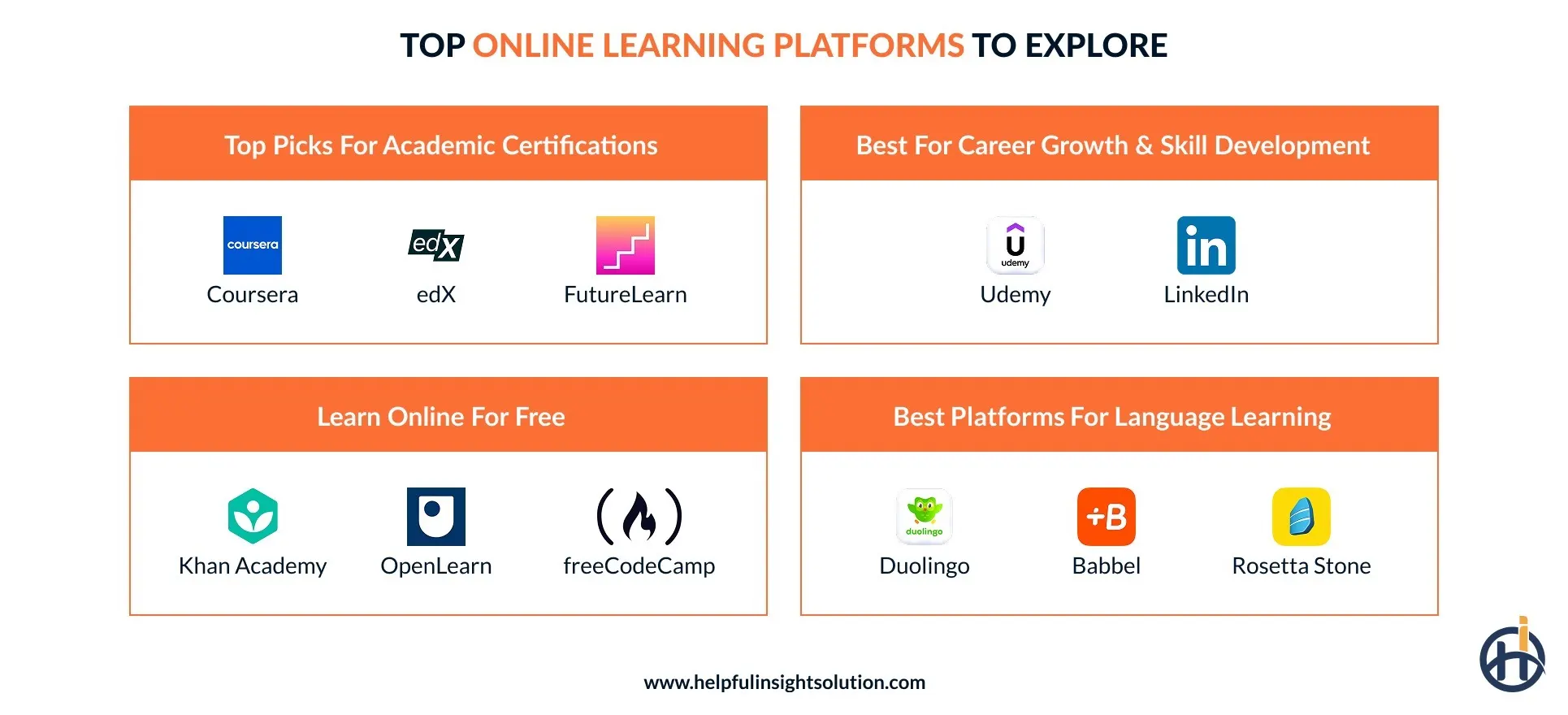
The right online learning platform depends on what you want to achieve. Some platforms focus on university-backed courses and professional certificates, while others offer practical lessons, coding exercises, or creative classes.
Below, we have grouped 11 online learning platforms by their main strengths to help you compare their features, learning options, and limitations before choosing one.
Best platforms for university-level courses and certifications
These are the best online learning platforms that partner with leading universities or companies to offer recognized certificates and degrees. They are most widely used by learners who are looking for job placements and to get higher education.
Coursera
Coursera partners with top universities and companies like Google, IBM, and Meta to offer courses, professional certificates, and degrees. It is one of the world’s largest online learning platforms with structured programs, hands-on projects, and strong credentials. Its mobile learning app and flexible schedules make it easy to learn alongside work or study. For more options, see our list of sites like Coursera.
Features:
- Peer-reviewed assignments and graded quizzes
- Financial aid applications for eligible learners
- Subtitles and translations in multiple languages
Pros:
- Very large catalog across many fields
- Free audit option to preview courses
- Well-known brand names add credibility
- Clear learning paths for specialized courses
Cons:
- Certificates and graded work usually require payment
- Teaching style and workload vary widely between courses
edX
It offers university-level courses, MicroMasters programs, and online degrees from respected institutions around the world. Its content is academic and in-depth, covering fields like computer science, business, data, and engineering. It is one of the most widely used online education platforms that suits learners who want to study continuously and earn a credential backed by a recognized university.
Features:
- Verified certificates with shareable links
- Self-paced and instructor-paced course options
- Discussion forums within courses
Pros:
- Founded by Harvard and MIT, which adds academic credibility
- Free audit access to various courses and subjects
- Strong credit pathways toward higher-level degrees
- Rigorous, university-quality teaching by experts
Cons:
- The course interface offers less progress tracking than others
- Discussion forums can have limited chat activity
FutureLearn
FutureLearn is a UK-based online learning platform offering short courses, microcredentials, and degrees in partnership with universities and institutions. Its learning format emphasizes discussion, so learners can share ideas and ask questions alongside course content. It works well for curious beginners who want easy-to-understand material over long online learning programs.
Features:
- A to-do page for tracking progress
- Comment threads on each learning step
- Short weekly time commitments
Pros:
- Clean and beginner-friendly interface
- Short courses that are easy to complete
- Strong partnerships with European universities
- Wide range of topics for casual learners
Cons:
- Credentials may carry less recognition than Coursera or edX
- Smaller course catalog with limited access to expert lessons
Best platforms for professional and practical skills
If your goal is to improve your work skills, learn new software, or explore a career path, these platforms offer courses across business, technology, and creative subjects.
Udemy
Udemy is among the best online course platforms where independent instructors teach everything from coding and design to music and language learning. Courses are self-paced, and learners keep lifetime access once they purchase a course. Quality varies by instructor, so checking reviews and previews helps you choose the right course.
Features:
- Preview videos before enrolling
- Q&A sections with instructors
- Downloadable resources and practice exercises
Pros:
- Huge range of niche topics for varied profiles
- No deadlines or fixed schedules for learners
- Offline viewing through the mobile application
- Many instructors are working industry practitioners
Cons:
- Certificates of completion carry limited weight with employers
- Rating systems can favor older popular courses over updated ones
LinkedIn Learning
LinkedIn Learning offers video courses in business, technology, and creative skills, taught by industry professionals. Completed courses can be added to your LinkedIn profile, helping you showcase new skills to employers and recruiters. This e-Learning solution is a strong fit for professionals who want short and career-focused lessons.
Features:
- Curated learning paths for specific niches
- Recommendations based on your profile and job interests
- Quizzes and downloadable exercise files
Pros:
- Consistent and professional video quality
- Short lessons that fit into a busy workday
- Strong soft skills and software training services
- Often available free through employers or libraries
Cons:
- Limited interactivity compared with project-based platforms
- Less suited to deep academic or advanced technical learning
Best free online learning platforms
Free learning platforms can help students and professionals build knowledge without committing to a paid subscription. Some focus on school subjects, while others specialize in university-style learning or technical skills.
Khan Academy
Khan Academy is a nonprofit educational platform offering lessons, practice exercises, and quizzes across subjects such as mathematics, science, economics, and history.
It is among the best educational apps in the USA, especially strong for school subjects and test preparation, with instant feedback on exercises. Students, parents, and teachers can track progress and fill learning gaps at their own pace.
Features:
- Mastery-based progress that adjusts to user level
- Content aligned with school curricula and academic courses
- Supports multiple languages across various regions
Pros:
- Completely free for all learners, with no ads
- Trusted non-profit with a clear educational mission
- Step-by-step explanations that are easy to follow
- Suitable for learners from schools and colleges
Cons:
- Limited advanced or professional-level content
- No formal course certificates or accreditation
Read Also: Build an EdTech App Like Photomath: A Complete Guide
OpenLearn
OpenLearn is a free learning portal of The Open University in the UK, offering short courses across many subjects. Learners can earn digital badges after completing selected courses, and content is easy to browse by subject. This free online learning platform works well for anyone who wants university-style content without a formal enrollment commitment.
Features:
- Provides courses, articles, videos, and interactive activities
- Self-assessment quizzes to evaluate learning progress
- Downloadable course materials for offline study
Pros:
- Backed by Open University’s long experience in distance learning
- Entirely free platform for students and professionals to access
- Wide subject range, from science and business to languages
- Easy for beginners to start without commitment
Cons:
- Short courses offer less depth than full degree modules
- No dedicated mobile app for OpenLearn content
freeCodeCamp
freeCodeCamp is a nonprofit platform that teaches coding through interactive challenges, projects, and certifications in web development, data science, and AI app development. Learners build real portfolio projects as they progress, which helps when applying for jobs. This is one of the large open-source e-learning websites that offer support, tutorials, and a clear path for beginners.
Features:
- In-browser code editor with instant feedback
- Project-based certifications for consistent learners
- Active community forum to discuss coding problems
Pros:
- Beginner-friendly with a clear step-by-step curriculum
- Open-source and transparent with community-built lessons
- Fully self-paced learning path based on learners’ level
- Large library of free video tutorials on varied topics
Cons:
- No live classes and focused mainly on coding and tech
- Limited one-on-one mentoring and student interaction
Best platforms for language learning
Users can easily learn new languages through short lessons, speaking practice, and instant feedback from these platforms. They are suitable for students, professionals, and travelers who want to learn different languages for study, jobs, or communication.
Duolingo
Duolingo is a US-based language learning platform that teaches through short, game-style lessons covering vocabulary, grammar, and listening. Streaks, points, and daily reminders keep learners motivated and help them practice consistently. It is the lowest-cost choice of the three language platforms here, and a popular pick for beginners who want to build a daily learning habit.
Features:
- Weekly leagues for friendly competition
- Short interactive Stories to practice reading and listening
- Speaking and matching exercises with quick feedback
Pros:
- Beginner-friendly design that makes starting easy
- Large range of languages, including less common ones
- Easy-to-use mobile app with adaptive learning
- A free version that covers a lot of content
Cons:
- Limited speaking depth and real conversation practice
- The free version includes ads and usage limits
Babbel
Babbel is a language learning platform with practical, conversation-based lessons created by language experts. Lessons are short and built around real-life situations, such as travel, work, and everyday dialogue. It is suitable for learners who want a structured path toward speaking with confidence in a new language.
Features:
- A review tool that uses spaced repetition for vocabulary
- Speech recognition to check pronunciation accuracy
- Downloadable lessons and notes for offline study
Pros:
- Clear grammar explanations in your native language
- Well-organized levels from beginner onward
- Ad-free lessons
- Progress syncs across devices and operating systems
Cons:
- Fewer languages than some competitors
- Very little free content, and a subscription is required
Rosetta Stone
Rosetta Stone is one of the best-known language learning brands, built on an immersion method that avoids translation. Learners connect words with images and audio, and speech recognition helps them improve pronunciation. It suits learners who prefer a listening-first approach and want to think directly in the new language.
Features:
- An audio companion for learning on the go
- A phrasebook with useful travel phrases
- Stories for reading and listening practice
Pros:
- Suitable for complete beginners with no prior knowledge
- Consistent and uncluttered lesson design
- Vocabulary learned in context rather than memorized in lists
- Mobile access with offline study options
Cons:
- Few explicit grammar explanations
- Lessons can feel repetitive over time
Read Also: How Much Does It Cost To Develop A Grammar Checker App Like Grammarly?
How to choose the best online learning platform
Choosing a platform is hard when so many e-learning sites offer different features and courses. These points help learners compare platforms by price, format, and personal goals.
- Know your learning goal: Decide whether you want a certificate, a new skill, a free course, or to learn a language. The goal decides which type of platform fits best.
- Try on multiple devices: Open the platform on a phone and a desktop before paying. Smooth navigation, fast loading, and offline access make studying easier.
- Check course relevance: Review instructor backgrounds, ratings, and partner institutions.
- Compare course pricing: Look beyond the headline price to check fees, renewals, and refund terms. Free trials or audit options let you test the platform without risk.
- Test the platform support: Reliable support and active communities help learners stay on track.
Partner with Helpful Insight to build smart e-Learning platforms
Whether you run a school or are a renowned educator who wants to build the best online learning platforms for students, hiring a reliable partner is a must. Helpful Insight is one of the leading education application development companies that delivers smart solutions for online course training. Our experts use market-ready tools and technologies, which allow businesses to create interactive learning platforms with minimum investment. We specialize in generative AI, machine learning , and chatbot-based solutions that provide content based on learners’ behavior and choices.
You can deploy futuristic solutions, from smart e-learning websites to faster educational apps, that offer personalized course content and adaptive learning methods. The examples that are discussed in this blog are tough competitors for those who are new to this industry. So, it will be a beneficial move if course creators hire our skilled and dedicated experts for upward growth.
Frequently Asked Questions
Top options include Coursera, edX, Udemy, LinkedIn Learning, Khan Academy, and freeCodeCamp. They offer university courses, professional certificates, and free lessons. Learners can enroll in highly rated courses, interact with experts, take tests, and track progress.
AI helps platforms adapt lessons to each learner. The main benefits are:
- Personalized learning paths: Platforms analyze learner behavior, adjust lesson difficulty, and recommend custom content.
- Conversational AI tutors: They provide academic support, answer questions, and help explain complex concepts.
- Automated educator workflows: AI helps teachers and instructors generate practice problems and draft course materials.
Education companies that want these features in their own product can work with an AI development company to build them.
An effective e-learning platform offers features that deliver engaging content, track progress, and support interaction. These include course management, automated grading, quizzes, certificates, and progress tracking. Most learning platforms ensure cross-device accessibility and user-friendly navigation, improving the experience for students and professionals. Clear UI/UX design keeps navigation simple, and schools often add a teacher-parent communication app for updates and messages.
Udemy, Coursera, freeCodeCamp, and edX are strong options for learning coding and technical skills. They offer guided tutorials on building websites and apps, working with APIs, and cloud deployment. freeCodeCamp also lets learners practice in an in-browser code editor, and learners can get answers from instructors or community forums.
Prices vary by platform. Udemy courses have higher list prices but are often on sale for about $10 to $20. Coursera Plus costs $59 a month or $399 a year, and edX certificates cost roughly $50 to $300 per course. Khan Academy, OpenLearn, and freeCodeCamp are free. Duolingo has a free version with ads, while Babbel and Rosetta Stone charge a subscription.
Go beyond off-the-shelf tools. Our e-learning app development experts build custom platforms that offer live classes, quizzes, certificates, and AI-powered learning paths, tailored to your audience. Explore our e-learning services.