

Key Takeaways:
- Startups build a reliable product by following effective development stages, from idea validation to design, integration, testing, and deployment.
- Various factors, such as project complexity, features, tech stack, and ongoing maintenance, affect the cost of making software for startups.
- It is crucial to know and manage various challenges, which include limited budgets, changing requirements, talent gaps, and scalability.
- For an efficient software launch and future expansion, startups must choose the right architecture, technology, and development partner.
Being digitally visible is now necessary for businesses, as the market is growing, new technologies are evolving, and user demands are rising. The idea of software development for startups has helped multiple enterprises across various industries to build market-ready platforms for their audience.
Businesses that are already providing software services integrate advanced technologies like AI and cloud to enhance existing features. This allows them to retain customers, automate tasks, reduce redundancy, and increase ROI. Additionally, users get a seamless experience while navigating through different features and tabs.
According to Precedence Research, the global custom software development market will reach $147.5 billion in 2030. The market for all types of software solutions will generate revenue of $1,439.1 billion in the same year. This is the main reason why most product teams are investing heavily in the development of software to boost their business cycle.
This guide covers the tech stack, development process, estimated costs, and common challenges involved in building software for startups. So, let’s focus all your thoughts on the content and explore the necessary insights in detail.
What is software?
Software allows computers or hardware devices to perform specific tasks according to a collection of instructions, data, and programs. It is written in high-level programming languages, converted into machine-readable code, and executed in RAM to run the program. System, application, programming, and utility are four broad software categories. Users can perform various operations, from writing code and playing music to managing system files through software.
-
Various types of software available
Product teams can build different types of software solutions based on their requirements, budget, and user demands. They can connect with a dedicated development team to understand each category and its specific use cases. The following table provides key software types with their descriptions.
| Type of software | Description | Best for |
| Web Applications | Browser-based software accessible from any device, anywhere. | SaaS startups, e-commerce stores, and online service businesses. |
| Mobile Apps | Native or cross-platform apps for smartphones and tablets. | Food delivery, ride-hailing, fitness, and retail startups. |
| Enterprise Software (ERP/CRM) | Systems managing operations, sales, finance, and customer data. | Manufacturing, logistics, and fast-growing mid-sized B2B companies. |
| AI-Powered Software | Smart software that automates tasks and predicts trends. | Fintech, healthcare, retail, and other data-driven businesses. |
| Cloud-Based SaaS | Subscription-based software hosted and maintained in the cloud. | B2B startups offering CRM, HR, or accounting tools. |
-
Worldwide software development market
The software market is huge, generating massive revenue across industries, app segments, regions, and age groups. The following market figures will help you understand the overall growth in terms of revenue, market share, and compounded annual rate.
- The global software market size is valued at $926.3 billion in 2026, which will reach $2212.2 billion by 2034 at a rate of 11.5% CAGR over this period.
- North America has a maximum share of 44%, followed by Europe with 28% and Asia Pacific with 22%, among other regions.
- Large enterprises have a share of 62.4% based on organization size, whereas IT and telecom hold 21.4% in the end-user segment.
- The US market is expected to generate $305.7 billion in 2027 and will reach $743.8 billion by the end of 2035.
- The custom software development market generated revenue of $53.5 billion in 2026, which will reach $178.9 billion by 2033 at a rate of 18.8% CAGR.
These figures show why startups may consider software development as part of their digital growth strategy for user engagement and increased brand visibility. By making a proper strategy, businesses can execute their plan with the help of software developers and aim for market advantages.
Why do startups need software more than ever?
With the help of modern tools, software development for startups becomes easy, as they lower costs, automate daily operations, and provide instant access to users. Various no-code platforms and SaaS solutions allow businesses to test ideas fast without hiring large engineering teams. AI tools write code and automate testing, enabling investors to improve efficiency, minimize effort, and focus on their main product.
1. Benefits of building startup software
Building software can support scalability, operational efficiency, and customer experience when the product is aligned with genuine business needs. A detailed software development strategy helps to achieve these benefits and increase the overall value.
Competitive advantage: Unique features and overall experience will differentiate one company from another and establish a strong brand image in the market.
Operational efficiency: Automating repetitive processes and entire functions will save the small team’s time and effort and reduce human errors.
Scalability: Proper software will scale with the business and not fail due to a high load of data or users.
Better customer experience: The customizable interface and convenient tools will ensure the satisfaction of existing users and attract new ones.
Investor appeal: A successful product with actual features and a great user experience will help in funding the startup, proving its concept to investors.
2. Things to consider before development
Before starting with the software-making process, it is important to define your goals, budget, timeline, and team roles. You should compare in-house hiring against offshore software development, which will allow startups to approach skilled engineers at a lower cost.
Clear Business Goals: Define the problem you are solving and the metrics that show success, so every feature supports measurable business outcomes.
Realistic Budget: Plan costs for development, testing, hosting, and maintenance, and keep a buffer for unexpected changes as requirements evolve.
Right Team and Partner: Decide whether to build in-house, hire freelancers, or work with an experienced development partner based on skills, speed, and cost.
Scalability and Security: Choose an architecture that handles future growth and protects user data, because fixing these gaps after launch is costly.
Custom software development vs. off-the-shelf solutions
Choosing custom development for startups is beneficial when there is a need to adapt to business workflows and other internal systems. Off-the-shelf solutions offer lower upfront costs through shared subscription or licensing fees, allowing product teams to buy and use immediately.
You can hire software developers to build custom software platforms instead of using a generic tool. The table below describes a few important criteria that differentiate between these two development approaches.
| Criteria | Custom software development | Off-the-shelf solutions |
| Cost | Higher upfront investment, but better long-term value and returns. | Lower initial cost, though recurring license fees add up. |
| Customization | Built entirely around your unique workflows, features, and business goals. | Limited to preset features, with minimal room for changes. |
| Time to Launch | Takes weeks or months because development starts from scratch. | Ready to deploy almost immediately after purchase and setup. |
| Scalability | Designed to grow and adapt as your business expands. | Scaling often requires costly upgrades or switching to another tool. |
| Integration | Integrates smoothly with your existing systems, tools, and databases. | Integration depends on available plugins and may be restricted. |
| Ownership and Control | The client may own the code and control future updates and direction. | The vendor controls updates, pricing, features, and the product roadmap. |
How can modern-day startups develop software?
This section discusses the software development process for startups, from defining use cases to market launch and monitoring. These stages are presented in a logical sequence to make the development process easier to understand.
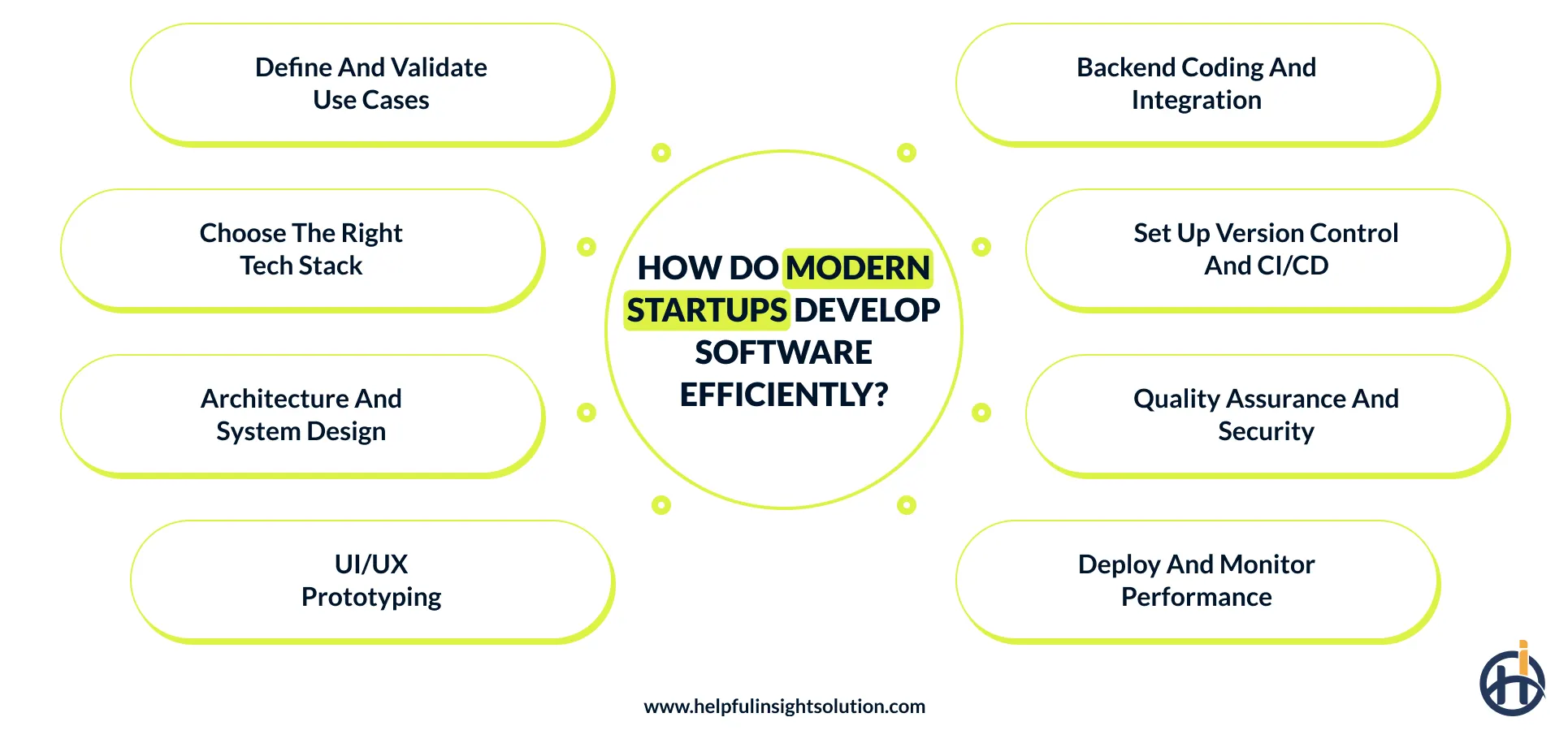
1. Define and validate use cases
To begin MVP development for startups, define the problem you want to solve for your target audience and prioritize business-specific use cases. Then, validate them through surveys and competitive research to invest the money in the right features.
- Interview real users to confirm the problem is worth solving.
- Rank use cases by business impact to shape the MVP.
2. Choose the right tech stack
It is important to choose the languages, frameworks, and platforms that best suit your product, team, and region of interest. The more practical the technology stack is, the less time and effort you spend on development and maintenance, increasing time-to-market.
- Match technology choices to your team’s existing skills and experience.
- Prefer widely supported tools to simplify hiring and long-term maintenance.
3. Architecture and system design
Define how you want your application’s components to interact and scale up before you do any production coding. With a properly drafted blueprint, you can save yourself headaches at later stages of development and avoid expensive reworks.
- Choose a modular monolith according to complexity before considering complex microservices.
- Design data models and API contracts for smooth integrations.
4. UI/UX prototyping
Translate requirements into mockups, wireframes, and clickable prototypes that effectively convey how your product will be used and facilitate the early discovery of UX problems. Testing the design allows you to address any issues while changes are still easy and cheap to make.
- Use Figma to build interactive screens stakeholders can review easily.
- Apply consistent design systems to keep interfaces uniform and scalable.
5. Backend coding and integration
Develop the core business logic, databases, and APIs for the product you’re building. Set up connections to third-party services like payment processors, messaging channels, or analytics platforms instead of having to build everything from scratch.
- Write clean, documented APIs that frontend teams can consume easily.
- Build in short cycles and release a working model that fits the team and products.
6. Set up version control and CI/CD
Utilize Git-based repositories for tracking version control, collaborative work, and code changes. Set up CI/CD pipelines to automatically build, test, and deploy your changes to production, reducing manual errors and speeding up releases.
- Adopt branching strategies that keep the main branch stable.
- Enforce code reviews before merging to maintain consistent quality.
7. Quality assurance and security
The experts combine unit, integration, and end-to-end testing to identify and resolve bugs before they affect the user experience. Finally, take the right security measures into your development process, instead of waiting until launch.
- Scan third-party dependencies regularly to detect known vulnerabilities early.
- Protect user data with encryption, authentication, and secure secrets management.
8. Deploy and monitor performance
Now, release your product on a scalable cloud infrastructure and monitor your performance constantly to understand what changes you need to make. Additionally, it is mandatory to keep track of system uptime, error rates, and user behavior.
- Use staged rollouts and feature flags to reduce launch risk.
- Set alerts so your team fixes incidents before users notice.
Tech stack required to build software for startups
In the complete software development process, experts use top programming languages, tools, frameworks, and coding environments. A tech stack is formed through multiple components such as frontend, backend, database, and testing.
Each component has different tools that help developers to create market-ready software solutions. Here, we will focus on a table that discusses modern tools and what they do in short.
| Component | Common tools | Description |
| Frontend | React, Next.js, Vue.js, Tailwind CSS | Builds the interactive interface users see and use in browsers. |
| Backend | Node.js, Python (Django), Laravel, Spring Boot | Handles business logic, APIs, and communication between app components. |
| Database | PostgreSQL, MongoDB, MySQL, Redis | Stores, organizes, and retrieves application data securely and efficiently. |
| Mobile Development | Flutter, React Native, Swift, Kotlin | Creates iOS and Android apps from one shared codebase. |
| Cloud Infrastructure | AWS, Google Cloud, Microsoft Azure, Firebase | Provides scalable hosting, storage, and computing without owning servers. |
| Version Control | Git, GitHub, GitLab, Bitbucket | Tracks code changes and enables smooth collaboration across development teams. |
| CI/CD | GitHub Actions, GitLab CI, Jenkins, Docker | Automates building, testing, and deploying code with every update. |
| Testing and QA | Jest, Selenium, Cypress, Postman | Catches bugs early through automated and manual quality checks. |
| Monitoring and Analytics | Sentry, Datadog, Google Analytics, New Relic | Tracks errors, performance, and user behavior after your product launches. |
| UI/UX Design | Figma, Sketch, Framer, Miro | Creates wireframes and prototypes to validate user experience early. |

What is the cost of software development for startups?
Investing money in software development for startups is a crucial move, which requires proper planning, estimation, and execution. The cost to develop software is affected by various factors, such as the choice of location, developers’ experience, team hiring model, and maintenance charges.
But project complexity is the key cost-affecting factor on a large scale. In this section, we are going to study different levels, from basic to advanced, with their specific budget and timelines.
| Complexity level | Estimated cost | Timeline | Description |
| Basic MVP | $15,000 – $30,000 | 2 – 3 months | Simple app with core features and basic design. |
| Standard application | $30,000 – $60,000 | 3 – 4 months | Custom features, user accounts, payments, and admin dashboard. |
| Mid-complexity platform | $60,000 – $110,000 | 4 – 6 months | Multiple integrations, role-based access, and polished UI/UX. |
| Advanced platform | $110,000 – $180,000 | 6 – 8 months | Complex workflows, AI features, and high-security architecture. |
| Enterprise-grade solution | $180,000 – $250,000 | 8 – 9 months | Large-scale systems with advanced compliance and heavy customization. |
Top software development methodologies for startups
Businesses can choose a software development strategy based on their needs, target audience, and budget. Commonly, agile, lean, and waterfall methodologies are used to design system workflow and architecture.
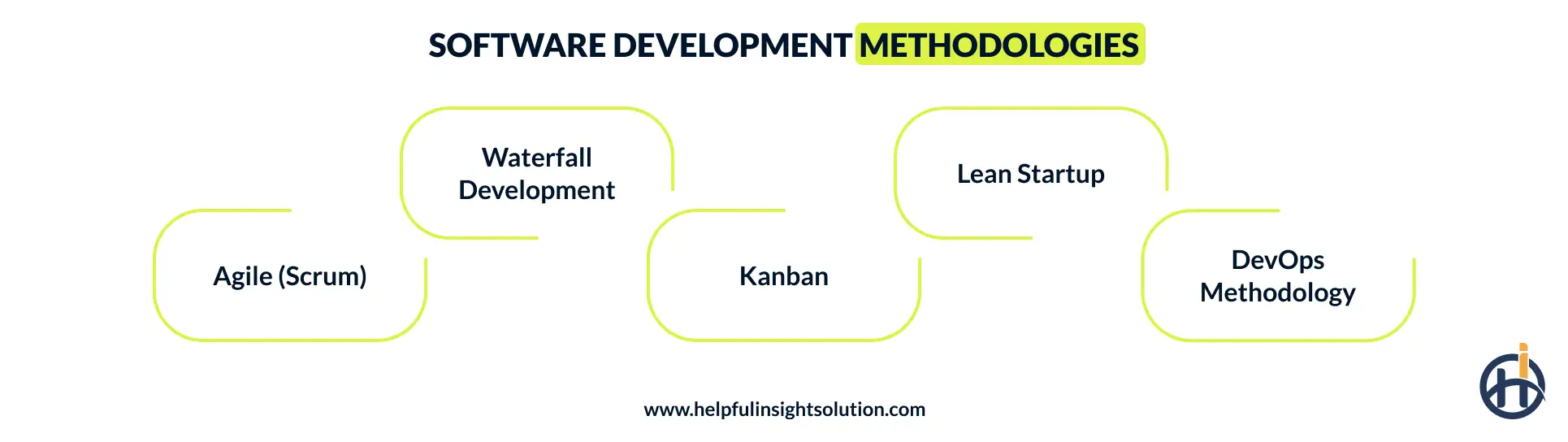
1. Agile
Agile breaks development into short sprints, usually one to two weeks, with each cycle delivering a working product increment. Daily standups, sprint reviews, and retrospectives keep teams aligned and let startups adapt quickly to changing priorities.
- Defined roles: Most product owners and expert consultants clarify team accountability.
- Backlog prioritization: Ranks features by business value for focused delivery.
- Velocity tracking: Measures team output to forecast realistic release dates.
2. Waterfall development
Waterfall follows a linear sequence of phases, from requirements and design to development, testing, and deployment. Each phase must be completed and signed off before the next begins, making it suitable for projects with fixed, well-defined scope.
- Detailed documentation: Thorough records simplify onboarding, audits, and future maintenance.
- Predictable budgeting: Fixed scope enables precise upfront budget estimates.
- Compliance readiness: Structured controls suit regulated, compliance-heavy industry requirements.
3. Kanban
Kanban visualizes tasks on a board with columns such as To Do, In Progress, and Done. Most mobile app development teams gather various tasks continuously and limit work in progress, which prevents bottlenecks and overload.
- Cycle time analysis: Identifies slow stages to improve delivery speed.
- Flexible prioritization: Urgent tasks can jump ahead without disrupting planning.
- Minimal setup: Requires no new roles or ceremonies to begin.
4. Lean startup methodology
Lean Startup follows a Build-Measure-Learn loop, launching a minimum viable product to test ideas with real users. Several founders use system feedback and data to decide whether to fix or persevere before investing heavily in the product.
- Innovation accounting: Tracks meaningful metrics instead of misleading vanity numbers.
- Waste reduction: Eliminates features customers never use or request.
- Capital efficiency: Stretches limited funding by validating before scaling spend.
5. DevOps methodology
The DevOps model combines development and operations teams through shared ownership, automation, and continuous delivery. Additionally, it shortens release cycles while maintaining stability, security, and quality at every stage.
- Infrastructure as code: Provisions servers through version-controlled scripts, not manual setup.
- Real-time monitoring: Detects incidents instantly with alerts and performance dashboards.
- Rapid rollbacks: Reverts faulty releases quickly to minimize user impact.
Major challenges in making startup software and tips to overcome them
The development of software comes with multiple challenges, including budget constraints, changing requirements, technical debt, and scalability. We are going to study some of the major issues with their respective solutions in this section.
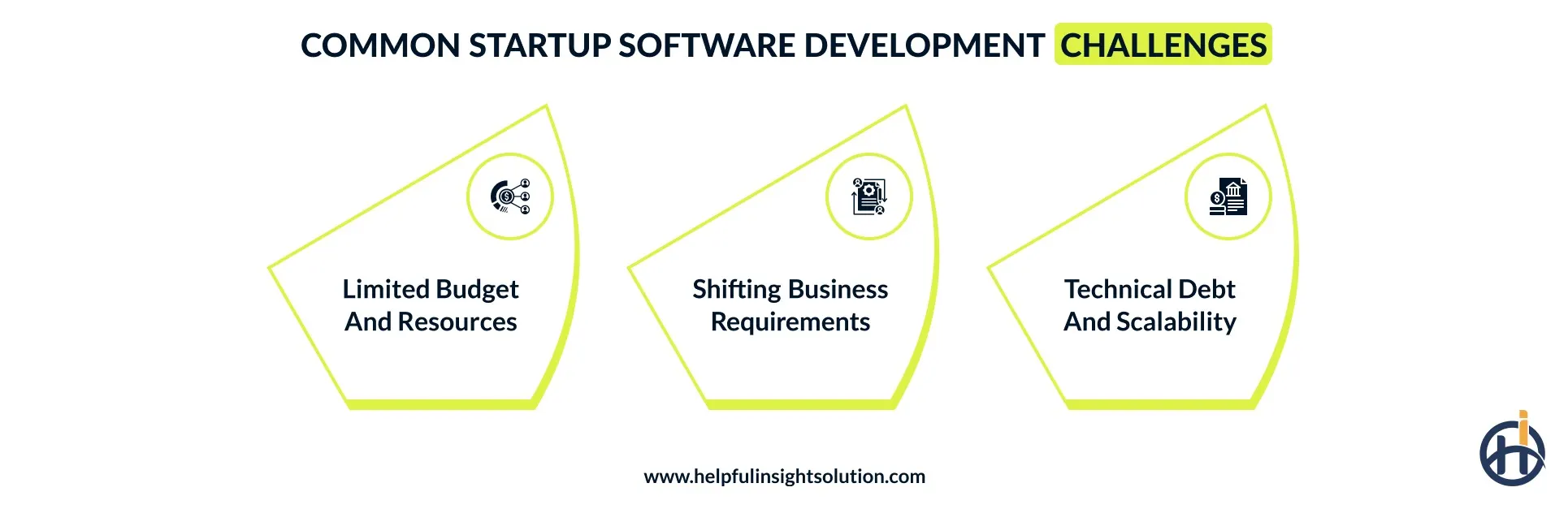
1. Limited budget and resources
Businesses that ignore operational funds and hidden software licensing costs may face feature creep, cash mismanagement, and team burnout. Most traditional on-premises hardware and proprietary systems also lead to additional expenses for startups.
Solution: Cloud services can reduce the need for upfront on-premises hardware investment and provide managed infrastructure services.
2. Shifting business requirements
In this, founders experience delayed timelines, wasted code, and unnecessary rework, which increase team frustration and reduce quality. Recurring UI/UX design changes, unresponsive API integration, and wrong testing methods may stretch deadlines.
Solution: You should break down the process into short segments to evaluate priorities and use toggles to prevent unstable code from breaking the software.
3. Technical debt and scalability
MVP shortcuts, single-tier codebases, and unoptimized databases can slow down feature delivery and trigger hidden design flaws. Overridden code wastes developer hours on system maintenance instead of creating new user-specific features.
Solution: It is important to reserve time for refactoring and technical debt reduction based on the project’s needs, alongside appropriate automated testing.
Emerging technologies in the software development process
Various advanced technologies are allowing emerging businesses to plan, build, and scale their products efficiently. Partnering with a software development company for startups helps in early adoption of cloud-native architecture and automation. Enterprises that want smarter platforms can also invest in AI development services to add features like predictive analytics, chatbots, and intelligent decision-making.
AI and machine learning: Tools built with AI write code, run tests, and catch bugs in the development cycle. Businesses use machine learning to add intelligence to their products for personalization, predictions, and more intelligent automation.
Low-code and no-code platforms: Applications are built faster by teams with minimal hand-coding using visual builders, which accelerate prototype and internal tool development. They’re also used by startups for quick validation to build custom applications.
Cloud-native and serverless: Containers, Kubernetes, and serverless functions enable applications to scale based on demand. Cloud and serverless services can offer usage-based pricing, although total costs depend on traffic, architecture, storage, and other services.
Blockchain: Blockchain records are visible and irreplaceable, as smart contracts do not require middlemen. Blockchain is for startups that are working on fintech, supply chain, and digital identity products where trust and traceability are important.
Best practices for startups while building software
By following business-oriented practices, you can save time, money, and rework effort. Many startups use internal software development services to implement these practice strategies from the start.
Whether they build a marketplace or delivery products, on-demand app development is beneficial, which allows faster launches with ready-to-adapt features.z
Start small and ship early: Launch the product in the shortest possible time and focus on its continuous improvement rather than trying to build perfect features.
Automate testing and deployment: Automated testing and CI/CD pipelines increase the quality of the code and the speed of development, allowing the small team of developers to focus on more important tasks.
Prioritize security from the start: The implementation of authentication and encryption should be done from the start, as during a security breach it will be much more expensive to fix than to prevent problems.
Document technical debt: The documentation should be written to ensure that the code can be maintained for as long as possible, and time should be spent during sprints to refactor code.
Why is Helpful Insight the right software development partner for startups?
Helpful Insight is a market leader that mainly focuses on technical expertise and a startup-first mindset, guiding founders from idea to launch. Our experts deliver custom MVP software development for startups, so enterprises can easily validate their product without expending more on unnecessary resources.
With a collaborative environment at Helpful Insight, founders can transform their business ideas into practical solutions that solve real market problems. We help entrepreneurs to integrate predictive analytics, hyper-personalization, smart contract-based security, and cloud-hosted architectures.
Building smart software for coding, documentation, resource management, and customer relationships is now required to support operational efficiency and business growth.
Businesses can hire experts who utilize cost-effective tools and technologies, keeping a balanced budget for future integration. So, start early to get more benefits, implement third-party services, and deploy user-centric enterprise software.
FAQs
A software requirements specification (SRS) document describes the working and performance of a software system. It is an agreement between the client and the development team that outlines specific features and data processing. An SRS has multiple components, such as project scope, non-functional attributes, external interfaces, and constraints.
Startups use legal agreements, registration rights, and technical security measures to protect software intellectual property (IP). Major legal agreements include PIAs and NDAs, while copyrights, trademarks, and patents are forms of IP protection. Small businesses also perform encryption and auditing to manage resources with high security.
For proprietary software, startups can build an in-house team to gain a competitive advantage and long-term IP control. They can outsource development for rapid execution, lower upfront costs, or to get MVP solutions. A hybrid model combines both approaches, allowing businesses to keep product architecture and build with an external agency.
Software development focuses on building and validating an initial product to test various business ideas. A SaaS solution is scalable and cloud-hosted and is used by multiple customers who pay through a recurring subscription. SaaS-based platforms require more investment due to a multi-tenant architecture, user billing, and account permissions.
Startups ensure secure coding practices to implement automated controls and role-based access in the development lifecycle. Various compliance standards include SOC 2, ISO 27001, GDPR, CCPA, HIPAA, and PCI DSS. Businesses follow a phased implementation strategy, from design to deployment and monitoring, for better data protection and security.