

Key Takeaways:
- Enterprises can identify their current maturity level by evaluating the organization’s data, technology, governance, and AI adoption.
- It is crucial to compare the AI capabilities with competitors and industry benchmarks to find gaps and opportunities for improvement.
- To implement AI models, enhance infrastructure, and achieve measurable goals, businesses should analyze and process assessment results.
- By ensuring strong security, compliance, and continuous monitoring, investors can gain sustainable business value and boost AI innovation.
Is my system capable of handling complex AI algorithms and models? And if not, what do I need to increase the maturity level? These are some basic questions that executives or organizations looking to adopt artificial intelligence and other technologies must know.
AI maturity assessment helps them to understand their system inefficiencies, mitigates risk, and builds the right strategy for AI implementation. According to BCG research, 22% of organizations worldwide have moved beyond the proof-of-concept and are scaling value. This also reports that only 4% are able to operate value engines due to a high maturity level.
A Gartner survey conducted in 2025 shows that 63% of leaders in high-maturity organizations focus on financial analysis, ROI mapping, and customer impact.
Additionally, 91% of them appointed AI leaders to prioritize AI innovation (65%), deliver AI infrastructure (56%), and design AI architecture (48%). The role of an AI maturity model is important in gaining these capabilities across enterprise systems.
To understand how you can implement AI development services according to your business maturity level, this blog provides key insights. From a 5-stage AI model discussion and framework to the process and challenges, we will cover everything in the content. So, let’s come along and get more information on AI assessment.
What is an AI maturity model?
An AI maturity model is a structured framework that allows enterprises to evaluate current capabilities, identify gaps, and plan a strategy for adoption. It consists of various maturity stages that help investors to evaluate their position in the AI infrastructure.
Additionally, it involves several pillars, such as data and technology, that support the AI implementation and assessment. It is widely adopted by businesses for tracking and evaluating organizational capability within the existing system.
-
AI maturity assessment vs. AI readiness assessment
It is crucial for investors to understand the differences between AI maturity and AI readiness. The following table describes key parameters on which these two assessment practices are distinguished.
| Basis | AI maturity assessment | AI readiness assessment |
| Purpose | Evaluates existing AI capabilities and the progress made so far | Checks whether your organization is prepared to start adopting AI |
| Ideal stage | Suited for companies already running AI pilots or live solutions | Suited for companies planning to launch their first AI initiatives |
| Core question | Answers where we stand today and how advanced we are | Answers whether we have what is needed to start AI |
| Scope of evaluation | Scores strategy, data, technology, talent, and governance across defined stages | Reviews data availability, infrastructure, skills, and budget before any implementation |
| Outcome | Delivers a maturity level score and roadmap to advance further | Delivers a clear decision on model adoption with a gap checklist |
-
Who needs one: Guiding CXOs and transformation leaders
Today, most CIOs, CTOs, and other business leaders are looking to implement a model that can assess AI maturity and guide strategic decisions.
With this, enterprises can identify their current position, possible gaps that can slow down the process, and investment needs, from machine learning development to generative AI solutions. Through AI capability assessment, entrepreneurs move beyond pilots and scale AI services for workflow automation.
AI maturity in business: Why it matters now
Most leaders in different industries, from healthcare and fintech to education, want artificial intelligence as a core technology in their systems. With growing top AI trends like user personalization, automated content generation, and computer vision-based analysis, the demand is increasing rapidly.
For this, it is necessary to evaluate relevant use cases, user demand, and system functioning with a strategic approach. AI maturity in business determines whether an organization can adapt to advanced AI models and streamline its operations without affecting the legacy infrastructure. Here are some crucial points that we must look at before moving forward.
- Several competitors scale AI faster, widening the gap for slower adopters.
- New AI regulations demand stronger governance, transparency, and risk controls.
- Leaders and investors expect measurable ROI from every AI investment.
- Customers expect faster, personalized experiences that only mature AI delivers.
The five stages of an AI maturity model
Organizations leverage AI maturity models to assess their current position and determine their next strategic steps. This section outlines the developmental phases that enable businesses to progress along the maturity curve.
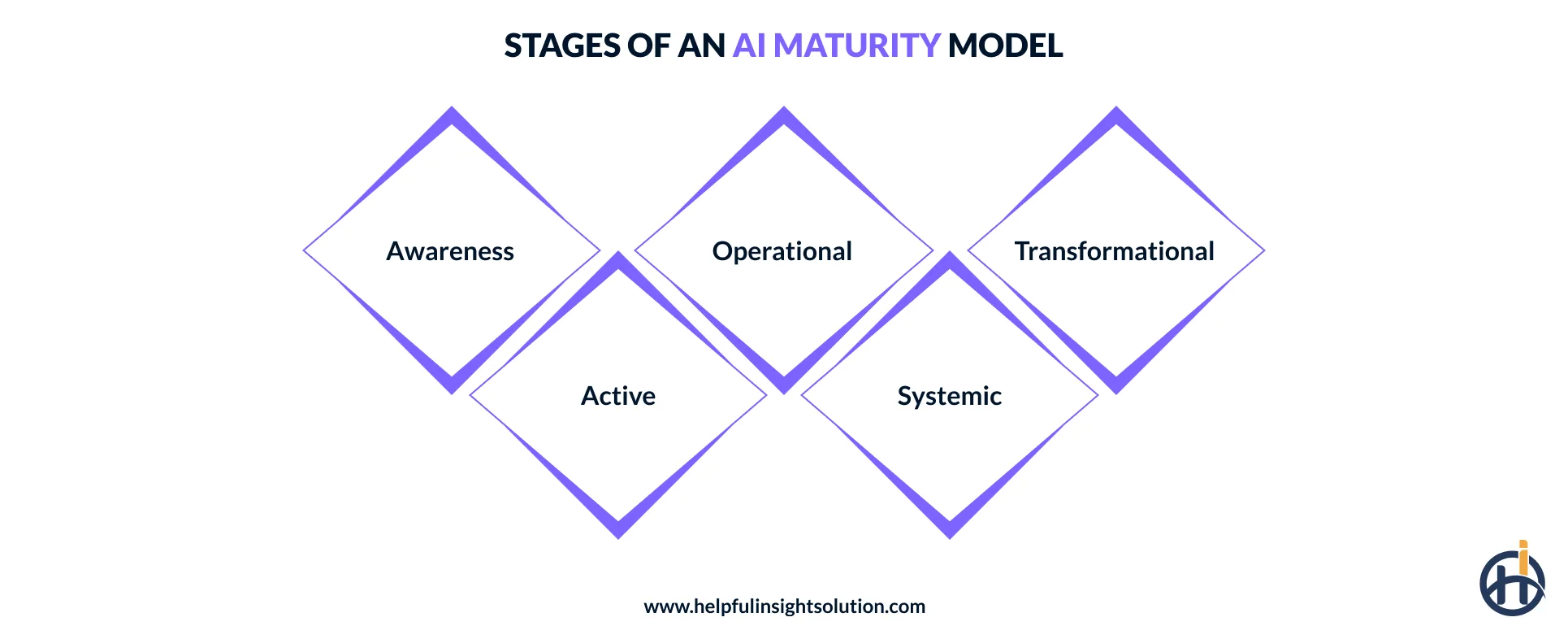
1. Awareness
During this stage, the organization is just starting to explore AI through research, informal experiments, and leadership discussions. There’s no formal strategy, budget, or governance, so efforts stay scattered and depend on individual curiosity.
2. Active
In some areas, teams conduct pilot projects and proofs of concept in a handful of departments to identify where AI could be most useful. But such initiatives have disconnected data, as they are built with inconsistent tools and lack mainstream organization-wide collaboration.
3. Operational
AI production is achieved for defined use cases, such as genAI, chatbots, or AI agent development, with dedicated teams and initial governance. Outcomes are gained, but scaling becomes hard, as processes, infrastructure, and data practices are not consistent across the business.
4. Systemic
AI is implemented in various business areas with a solid strategy, unified data assets, and advanced MLOps capabilities. Governance is established and continuously monitored by executives to observe how the data maturity model performs in terms of revenue and customer experience.
5. Transformational
The enterprise is becoming AI-driven, which is used to build products, support decision-making, create business models, and identify business operations. They keep evolving, learning, and innovating with AI as a core competitive advantage while remaining committed to high standards of ethics and responsible AI.
Enterprise AI Maturity Benchmarking Pillars
Before you know how to assess AI maturity, it is crucial to first understand the key pillars on which an enterprise stands. From strategy building to governance and compliance, we will discuss everything in this section.
1. Strategy and leadership alignment
This pillar determines whether the leadership has an AI vision aligned with business outcomes, for which ownership and funding have been defined. Good alignment translates into uniform sponsorship and monitoring of results, not discrete technology experiments.
2. Data readiness and quality
This AI readiness evaluates the quality, governance, availability, and consistency of your data across systems and lines of business. No matter how good your algorithms are, they won’t work well with low-quality, incomplete, or inconsistent data.
3. Technology infrastructure and MLOps
This pillar covers your cloud, computing, and integration capabilities, as well as production deployment and monitoring processes. Advanced MLOps practices enable teams to accelerate model rollout, including those powering Predictive Analytics Services, while maintaining performance, scale, and security.
4. Talent, skills, and AI culture
It measures the size of your data science, data engineering, and AI-literate business user community, along with the openness of teams to change. An AI culture with constant learning helps organizations to accelerate AI adoption and maintain momentum for the long term.
5. Governance, ethics, and compliance
This pillar assesses the governance policies, controls, and oversight that ensure AI is fair, transparent, and compliant. Good governance minimizes the legal, reputational, and ethical risks and creates trust among customers, employees, and regulators for every AI system you deploy.
Benefits of AI maturity assessment in organizations
The benefits of AI maturity assessment include business alignment, progress tracking, and lower market risk. An entrepreneur must know these advantages before implementing AI into their existing systems.
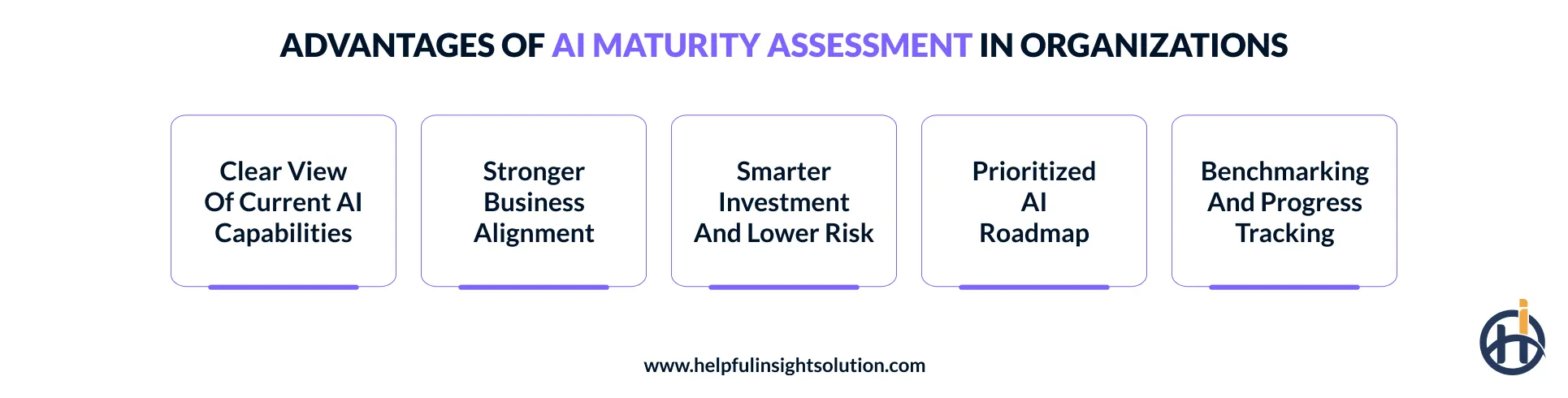
1. Clear view of current AI capabilities
AI capability assessment provides precise insight into your state of data, technology, talent, and governance. It replaces assumptions with an evidence-based view of where you are and empowers leaders to make informed choices about what to address next.
2. Stronger business alignment
Most AI projects are tied to quality-driven business results and strategic priorities, which enhance the overall enterprise goals. Teams are no longer conducting isolated experiments because they are working on use cases that sustain value.
3. Smarter investment and lower risk
The early diagnostics identify the failing areas, such as poor quality data or weak governance, enabling you to minimize costly failures before the projects begin. Resources are directed to the critical areas, reducing waste, overspending, and compliance risk.
4. Prioritized AI roadmap
Translation of assessment results leads to a pipeline of quick wins and strategic long-term priorities, such as developing agentic AI for high-impact workflows. Teams will understand how to extend the pilot projects into enterprise-wide scale-up.
5. Benchmarking and progress tracking
Measuring your scores against other businesses in a particular industry identifies your strengths and opportunities in the market. Frequent re-evaluations enable you to monitor your progress over time and provide data to support AI ROI to your leadership.
Top AI maturity models and frameworks compared
To pick a suitable AI maturity model for your business, you must go through different frameworks available in the market. Here, we are going to observe the 4 most widely used models with some crucial points after them.
1. Gartner AI Maturity Model
The Gartner AI maturity model defines five levels, from Awareness to Transformational, to show how far an organization has progressed with AI adoption. These are assessed in areas such as strategy, product, governance, engineering, data, operating models, and culture.
2. Microsoft AI Maturity Framework
Microsoft’s framework enables organizations to evaluate their AI adoption across strategy, culture, technology, and data. It mainly focuses on responsible AI and scalable cloud infrastructure for large language models, RPA, and other services to guide teams at every level.
3. MIT CISR Enterprise AI Maturity Model
The MIT CISR enterprise AI maturity model is composed of four stages, from experimenting and preparing to becoming fully AI-future-ready. It is based on research connecting AI maturity to financial outcomes and can serve as a guide in crafting an investment case for businesses.
4. Deloitte AI Maturity Framework
This AI maturity assessment framework measures organizations by their AI maturity and results in areas including strategy, talent, technology, and risk management. It examines the performance of top adopters, guides enterprises across the market, and finds concrete opportunities for improvement.
How to choose or adapt a framework for your enterprise?
Enterprises must know various aspects that help in selecting the right framework for assessing AI maturity. The following table lists various parameters that help you to identify a suitable model for your business.
| Consideration | Description |
| Business goals alignment | Select a framework that supports your strategic goals and outcomes. |
| Industry and compliance needs | Ensure the model addresses sector-specific compliance, risk, and data requirements. |
| Organization size and complexity | Match the framework’s depth to your company’s scale and structure. |
| Coverage of key pillars | Verify it covers strategy, data, technology, talent, and governance pillars. |
| Actionable outputs | Prefer frameworks offering clear scoring, benchmarks, and actionable next steps. |
Common gaps in off-the-shelf models
If you are choosing a specific model to use AI for business process automation, then it is crucial to explore various gaps in the off-the-shelf frameworks. Some of the major points are discussed here.
Lack of industry specificity: Generic models rarely reflect sector-specific regulations, data challenges, or use cases, so scores can misrepresent real readiness.
Limited coverage of generative and agentic AI: Many frameworks were built before generative AI and agents, so they overlook newer capabilities, risks, and operating requirements.
Little actionable guidance: Most models describe maturity levels but offer little practical direction on how to close gaps or sequence next steps.
Minimal customization to business goals: Standardized scoring criteria often ignore your company’s size, goals, and priorities, making benchmarks less relevant to your strategy.
AI maturity assessment Process: A step-by-step roadmap
Following a sequential process for AI maturity assessment is beneficial for every business investor. In this section, you will study different steps, from defining use cases to reassessment, with detailed information.
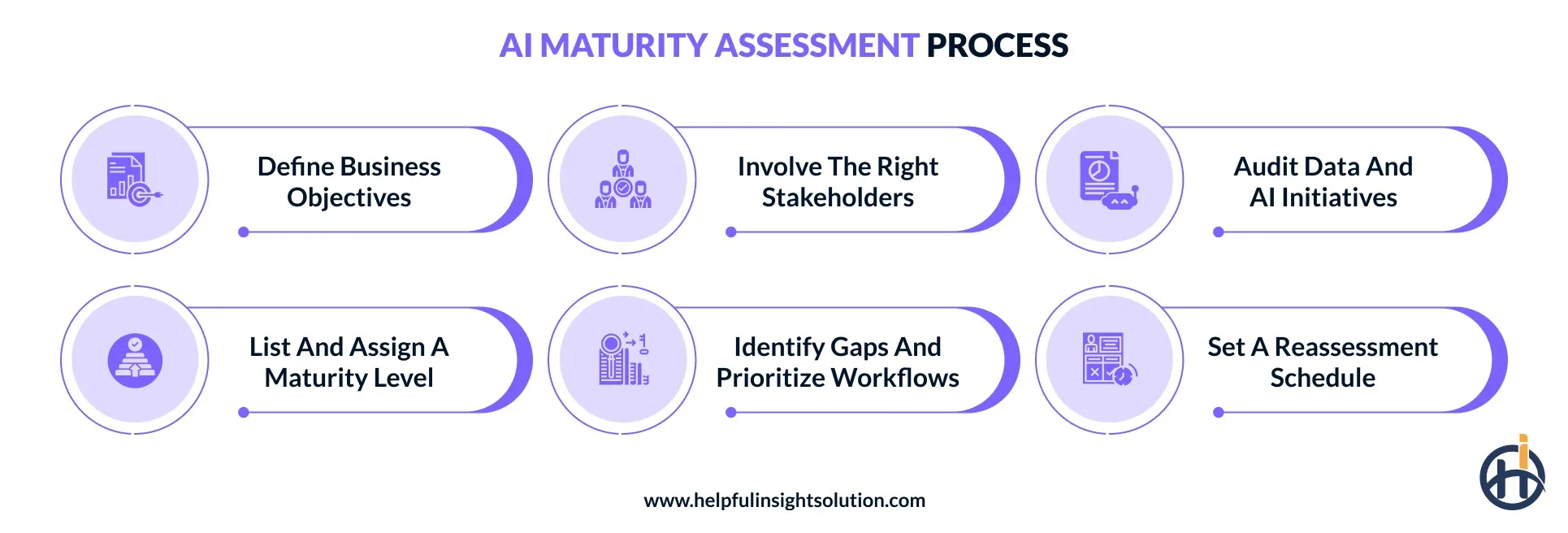
1. Define business objectives
Begin with the outcomes you want AI to achieve, whether that’s cost reduction, agility, or improved customer experience. Having a well-defined goal gives the assessment focus and means all the scores are linked back to tangible business objectives.
- Set measurable KPIs and success metrics before assessment begins.
- Secure executive sponsorship and budget approval for the assessment.
2. Involve the right stakeholders
Connect with leaders across business, IT, data, security, and operations to review current AI efforts and results. Working with stakeholders across the organization helps to prevent siloed scoring and ensure that ownership is shared across the organization.
- Use structured surveys and interviews to gather candid input.
- Appoint a dedicated project lead to coordinate assessment activities.
3. Audit data and AI initiatives
Audit your sources, quality, infrastructure, and all live AI initiatives in the organization, including robotic process automation, from pilots to production. This helps to identify your existing strengths, duplications, and systemic weaknesses that may affect future AI scaling.
- Document security controls, data privacy practices, and access policies.
- Review vendor tools, licenses, and existing third-party AI dependencies.
4. List and assign a maturity level
It is beneficial to evaluate each pillar, from strategy and technology to governance, using selected frameworks. Experts can merge the scores to estimate AI maturity levels that provide leaders with an evidence-based starting point for comparison.
- Apply weighted scoring to reflect each pillar’s business importance.
- Validate results with independent reviewers to reduce scoring bias.
5. Identify gaps and prioritize workflows
Identify where the largest gaps exist in data, skills, and infrastructure by correlating existing scores against target maturity. Then assess all AI workloads in terms of business value and implementation priority to fill these gaps, ensuring resource management and longer-term investments.
- Estimate the budget, timelines, and resources needed for each initiative.
- Assign accountable owners and delivery teams to every priority workflow.
6. Set a reassessment schedule
Schedule periodic reviews, usually 6-12 months, to assess how far you have come from the starting point and the extent to which you have progressed in each of the pillars. Continual reviews will ensure the roadmap remains current as technologies and regulations evolve.
- Share results with leadership to sustain funding and momentum.
- Capture lessons learned to refine the assessment process itself.
Major challenges to avoid in AI maturity assessment
Enterprises face multiple challenges while ensuring AI readiness for their business, which may affect progress. Some of the major maturity issues are discussed with their respective solutions in this section.
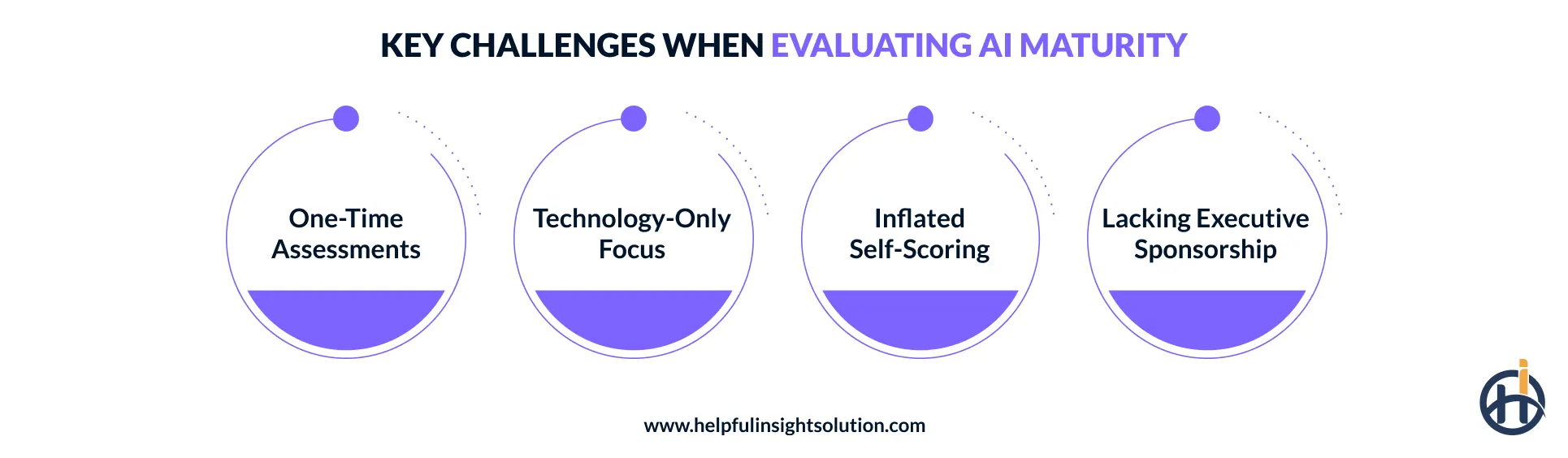
1. One-time assessments
This is a major challenge that treats AI readiness as a static milestone instead of a constant operational capability. It leads to performance issues, outdated baselines, vendor bias, and weak data governance or missing security controls.
Solution: Connect maturity evaluations to assessment cycles and convert them into actionable risk scenarios. It is crucial to track live operational metrics and align them with specific business goals.
2. Technology-only focus
If a generative AI maturity model only evaluates algorithms, data infrastructure, and computational power, then it can misinterpret AI readiness. It can overlook change management, ignore core processes, downgrade governance, and affect business strategies.
Solution: Product teams should focus on business-specific use cases, ROI tracking, and training programs. They can implement agile workflows, deployment pipelines, and bias mitigation, or other strategies.
3. Inflated self-scoring
Overdependency on subjective internal questionnaires may force teams to ignore their capabilities due to optimism bias or a lack of objective benchmarks. This leads to the launch of complex AI platforms before they have the foundational data architecture.
Solution: Businesses must verify numeric AI scores through data lineage maps, uptime metrics, or standard operating procedures. This allows them to build an AI app based on the assessment, audit, and documentation.
4. Lacking executive sponsorship
A lack of leadership may restrict investment in talent, data infrastructure, and tools, affecting the real-time assessment for AI compatibility. Without expert teams, it is difficult to adopt changes, understand new workflows, and manage organizational silos.
Solution: It is crucial to represent AI maturity as a driver for financial growth, competitive advantage, or cost savings. You must focus on metrics like efficiency gains, time-to-market, and risk reduction.
How to future-proof your AI maturity strategy?
To future-proof AI maturity for enterprises, you should build capabilities that can match new technologies, regulations, and business demands. The progress depends on the evaluation of high-value AI or ML use cases and investments in scalable functions. This section provides key points that every organizational AI decision-maker must know.
Treat maturity as continuous: Reassess your AI maturity every six to twelve months instead of treating it as a one-time exercise. Regular reviews keep your roadmap aligned with evolving technologies, regulations, and business priorities.
Build scalable infrastructure: Invest in cloud-based, modular platforms and strong MLOps practices that can support new models, tools, and workloads. Flexible architecture lets you adopt emerging technologies without rebuilding existing systems from scratch.
Strengthen data foundations: Maintain high-quality, well-governed, and accessible data across all business systems, teams, and departments. Reliable data is the main foundation that allows every new AI capability to perform with high accuracy and scalability.
Invest in talent and AI literacy: Upskill employees continuously and build cross-functional teams that combine technical skills with business and domain expertise. A learning-focused culture helps your organization adapt quickly as AI tools and expectations change.
Embed responsible AI and governance: Update governance policies regularly to reflect new regulations, ethical standards, and risks such as bias and data privacy. Proactive oversight builds stakeholder trust and supports compliance for your AI initiatives as they scale.
Partner with Helpful Insight to achieve AI maturity and deploy smarter solutions.
Now, you have learned that to integrate artificial intelligence, it is important to evaluate your business capabilities and find the right implementation strategy. For a seamless AI maturity assessment, enterprises should approach a reliable and experienced partner who specializes in performing system analysis.
Our team at Helpful Insight helps you to identify the maturity level, find different use cases, choose the suitable development method, and ensure continuous maintenance. The developers provide varied solutions from generative AI development to smart computer vision and RAG-based apps.
We enable product teams to build machine learning, NLP, and Agentic AI maturity models, which makes the integration process easy and fast. As a business investor, it is crucial to start early by analyzing system capabilities to handle complex AI computations and gain a competitive edge over others. In this journey, we are ready to help you with standard compliance, governance, deployment, and monitoring.
FAQs
An online self-assessment may take 30-60 minutes through interactive tools that offer multiple-choice questions. Internal workshops that involve stakeholder interviews across business units may take 2 to 3 weeks. Enterprise audits range from 4 to 8 weeks, during which external advisors analyze technical architecture, organizational readiness, and strategic alignment.
AI maturity requires real-time data processing, massive computational power, and scalability, which is not possible with legacy systems. Their architecture depends on batch processing and physical hardware limits, preventing AI decision-making. They cannot process unstructured data and automate feedback loops to keep AI models accurate.
Modern AI maturity models focus on autonomous decision-making, multi-step orchestration, and human-in-the-loop governance. Agentic AI assesses systems based on reasoning, planning, and executing multi-step workflows. Various frameworks evaluate organizations across distinct capability pillars rather than just tracking technical infrastructure.
For self-guided assessment tools, which offer internal alignment and initial capability screening, the cost is $0. Specialized consultant review may range from $5,000 to $40,000 due to external workshops, stakeholder interviews, and gap analysis. The cost may increase to $100,000 for enterprise engagement based on data infrastructure, governance, MLOps, and workforce readiness.
A model that assesses AI maturity impacts enterprise ROI through predictable and value-driven operational capabilities. Some of the most crucial methods are discussed in the following manner:
- Invest in high-yield workflows, remove redundant software licenses, and avoid disconnected tools.
- Connect AI models to clean data pipelines and performance metrics to ensure revenue growth.
- Use structured model governance to catch accuracy decay before it damages operations.