

Key Takeaways:
- Traditional MIS reporting depends on manual reports, while a healthcare business intelligence platform delivers a unified and real-time view.
- A BI platform for healthcare may include EHR integration, analytics, and security controls along with dashboard representation.
- Shared metric definitions, patient identity matching, and clear governance ensure reliable healthcare data analytics across multiple facilities.
- A healthcare provider should start with high-impact use cases, measure results against a baseline, and choose the buy, build, or hybrid approach.
Data has become a valuable asset for healthcare businesses that require constant patient monitoring and seamless resource allocation in the era of digital transformation. The introduction of a healthcare business intelligence platform helps them to make better clinical, financial, and operational decisions.
With advanced technologies like AI, ML, NLP, computer vision, and generative AI, these systems can predict results faster, reduce manual errors, and enhance care management. It is beneficial to invest in healthcare app development to create smart platforms for precise decision-making and workflow optimization.
According to KBV Research, the North America-based healthcare BI market will generate revenue of $6.4 billion in 2027, which will reach $13.8 billion by 2033. Another report by SNS Insider says that the US market is growing at a rate of 9.2% CAGR, reaching from $3.3 billion in 2025 to $7.9 billion by 2035. This substantial growth is a huge advantage for emerging startups in health tech for care and administration.
To know more about a healthcare BI platform, this blog provides key insights on various use cases, architecture, the implementation process, and cost. Additionally, we will explore some more topics in the content with detailed information. So, let’s jump in.
What is a healthcare business intelligence platform?
A healthcare intelligence platform is a software tool that gathers, organizes, and analyzes real-time data. The information is collected from clinical, financial, and operational systems, helping providers to make better decisions.
These systems turn raw data such as EHR, insurance claims, billing files, and patient surveys into clear dashboards and interactive reports. The use of AI in healthcare allows these platforms to use advanced models for data analysis, result prediction, and decision-making with high accuracy.
How does it differ from traditional hospital reporting/MIS?
This section differentiates between a healthcare reporting platform and legacy MIS based on various parameters. Let’s observe their key differences and understand how smart healthcare platforms are more advanced.
| Parameter | Traditional MIS reporting | Healthcare BI platform |
| Reporting Speed | Delivers scheduled or manually generated reports, depending on the organization’s MIS setup. | Delivers real-time or near real-time insights as events happen. |
| Data Scope | Pulls from one or two isolated departmental source systems. | Unifies clinical, financial, and operational data across the organization. |
| Analysis Type | Shows only what already happened through historical descriptive summaries. | Forecasts what happens next using predictive and prescriptive analytics. |
| Accessibility | Requires IT or analysts to generate and distribute fixed reports. | Offers self-service dashboards accessible to non-technical staff directly. |
| Decision Support | Provides raw numbers without recommended actions or next steps. | Recommends specific actions and triggers workflow automation where needed. |
Why do healthcare organizations need a business intelligence platform?
Most hospitals or clinics have a massive volume of patient and administrative data that is difficult to handle with a standard reporting system. A business intelligence platform in healthcare helps to collect and process data seamlessly, which improves patient care and lowers costs.
The adoption of BI with BPM in healthcare supports faster returns, enhanced workflows, and more consistent data for analysis.
- Rising data volume: Clinical, financial, and operational data now exceeds manual analysis capacity.
- Outdated reporting: Monthly MIS packets arrive after key decisions are made.
- Fragmented systems: Disconnected EHR, billing, and scheduling tools create conflicting numbers.
- Compliance pressure: Thinner margins demand faster, more accurate financial visibility.
- Increased patient expectation: Patients expect faster, more personalized, data-informed care experiences.
Understanding the maturity model to enable medical intelligence
To enable healthcare business intelligence in existing systems, providers must know at which stage they are. Here we will explore a table that discusses 5 different stages with their specific features and use cases.
| Stage | Best for | What it provides |
| Fragmented Reporting | Small clinics early in their data journey | Basic spreadsheets and manual data pulls |
| Standardized Reporting | Organizations centralizing scattered department reports | Scheduled reports from a shared warehouse |
| Self-Service BI | Teams needing faster, independent access | Governed dashboards with certified shared metrics |
| Predictive Analytics | Organizations ready to forecast outcomes | Risk scores for readmission and denials |
| Decision Intelligence | Enterprises automating recommended actions | Real-time recommendations written into clinical workflows |
Core capabilities to look for in a healthcare BI platform
Medical teams should know the capabilities of a healthcare business intelligence platform. It integrates with EHR, ensures data compliance, provides dashboards to analyze real-time data, and manages the revenue cycle.
The use of machine learning in healthcare supports BI to predict outcomes, forecast no-shows, and score claims, but it requires clean and consistent data. Here is a table that represents various capabilities of a BI platform with specific explanations.
| Capability | Description |
| EHR/EMR and billing integration | Connects Epic, Cerner, and billing systems into one unified view. |
| FHIR and HL7 interoperability | Exchanges data across systems using FHIR R4 and HL7 standards. |
| Enterprise master patient index (EMPI) | Matches duplicate patient records so every metric stays accurate. |
| Real-time dashboards | Refreshes clinical, financial, and operational metrics continuously for faster decisions. |
| Predictive analytics and AI | Forecasts readmissions, no-shows, and denial risk before problems occur. |
| Revenue cycle and denial analytics | Tracks claims, denials, and payer reimbursement patterns to help identify revenue-cycle issues. |
| Value-based care and quality reporting | Supports CMS, MIPS, and HEDIS measures for quality and reimbursement. |
| HIPAA-compliant security and audit trails | Enforces encryption, role-based access, MFA, and complete activity logging. |
| Self-service reporting | It allows non-technical staff to build reports without waiting for the information. |
| Multi-facility scalability | Standardizes definitions and drill-downs across hospitals, clinics, and regions. |
Key use cases of healthcare business intelligence
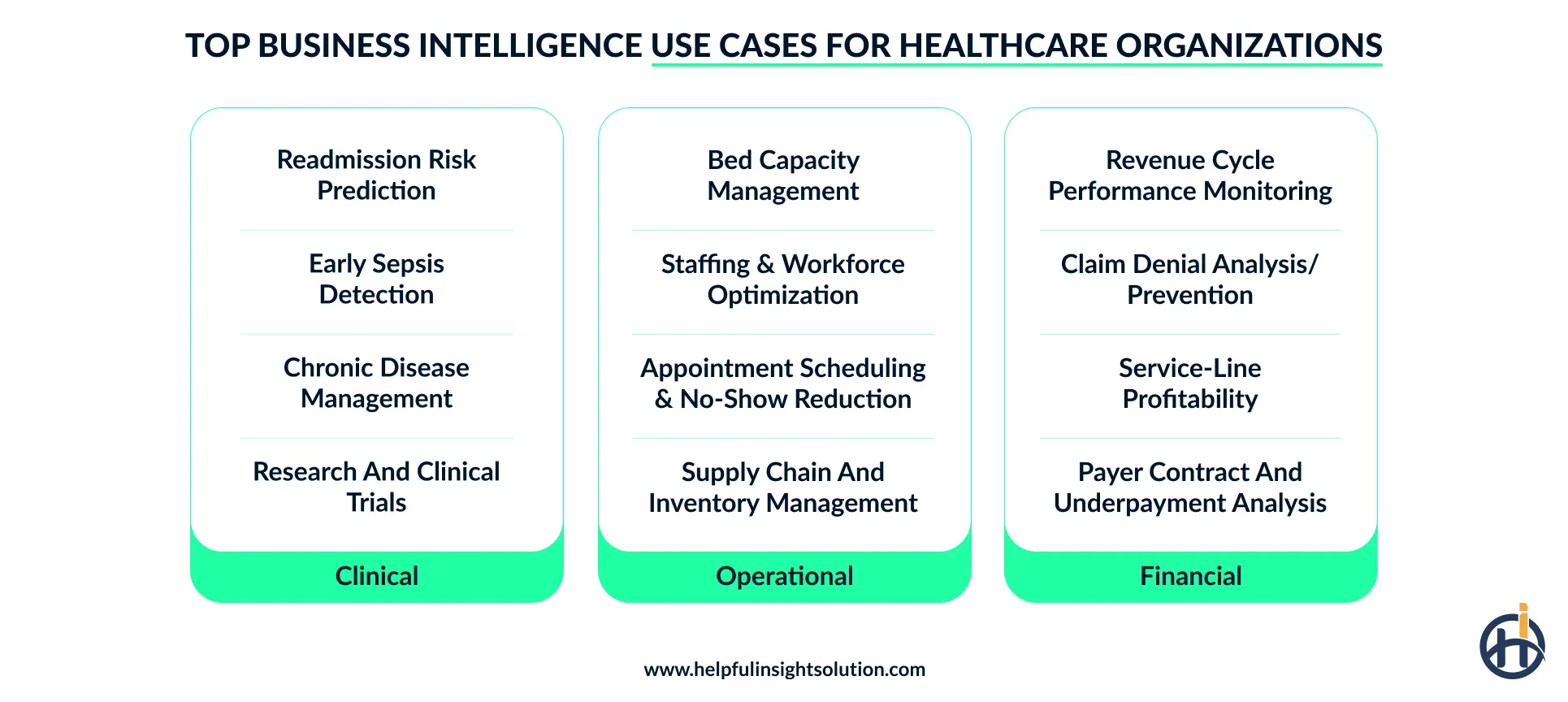
Business intelligence is used across various healthcare tasks, such as clinical, operational, and financial. The following use cases show where BI can support these functions, offer smart patient care, and ensure smooth decision-making.
A). Clinical
1. Readmission risk prediction
Predictive models can identify which patients can return within 30 days using diagnoses, previous admissions, and social determinants of health. Care teams can set up follow-up visits and deliver care accordingly.
2. Early sepsis detection
Vitals, lab values, and EHR data are analyzed using predictive analytics in healthcare to identify patients with subtle signs of infection. Alerts can notify clinicians, which leads to earlier intervention and better survival.
3. Chronic disease management
The BI task library enables teams to categorize patients by condition and level of risk, such as diabetes, high blood pressure, or COPD. They can decide which patients to reach out to and monitor improvements in adherence to care plans.
4. Research and clinical trials
Consolidated clinical data enables researchers to find qualifying patients more quickly, define patient cohorts, and easily monitor results. This cuts down recruitment time, leading to more evidence-based and robust results in research.
B). Operational
1. Bed capacity management
Dashboards include detailed profiles of census, admissions, and discharge barriers for every unit. They allow teams to monitor capacity, identify bottlenecks, shorten patient wait times, and free up beds more quickly.
2. Staffing & workforce optimization
Patient demands are predicted through business intelligence to match schedules for nurses and physicians across departments. This saves on excess overtime, limits premium labor costs, and prevents staff burnout.
3. Appointment scheduling & no-show reduction
Business intelligence in healthcare can predict which patients are likely to miss appointments based on timing and demographics. Clinics can send reminders constantly and adjust scheduling to manage the provider calendar.
4. Supply chain and inventory management
Dashboards track usage, stock levels, and vendor pricing across departments and facilities. Purchasing teams can use inventory models and usage data to identify potential shortages, waste, or supply-chain issues across departments.
C). Financial
1. Revenue cycle performance monitoring
Various healthcare revenue cycle analytics tools track accounts receivable days and clean claim rates across every stage of billing. Finance teams can easily locate bottlenecks and speed up the reimbursement process.
2. Claim denial analysis/prevention
BI tools can study denial patterns by payer, cause, and department to reveal recurring errors. High-risk claims are flagged before submission, reducing costly rework and protecting revenue.
3. Service-line profitability
Procedure-level cost and revenue data can help healthcare organizations to easily assess service-line financial performance. Finance leaders can take corrective action on pricing, workforce deployment, and capital expenditure.
4. Payer contract and underpayment analysis
Actual reimbursements are compared against contracted rates to catch underpayments that would otherwise go unnoticed. These insights also give organizations stronger data for payer negotiations.
How should multi-facility health systems structure their data architecture?
Multi-specialty hospitals are a mix of modern and legacy source systems, which may lack modern APIs. Here, RPA in healthcare helps to automate data extraction, feeding it into the shared architecture without any system replacement.
They can use a hybrid Medallion Lakehouse framework combined with Data Mesh governance to eliminate data silos and optimize medical insights. To build a business intelligence platform for healthcare, the following architecture will help you identify different stages and resources.
Interoperability and ingestion layer: This layer connects to every source system using HL7, FHIR, and claims data feeds across all facilities. It captures clinical, financial, and operational data as close to real time as possible.
Storage layer: A cloud-based lakehouse stores structured and unstructured data, including notes, images, and claims, in one scalable environment. Separating compute from storage prevents heavy workloads from slowing down routine reporting.
Common data model and semantic layer: Every facility maps its data to shared definitions of patient, provider, and encounter, regardless of local system differences. This is the highest-ROI layer, since it can improve consistency through shared definitions.
Intelligence layer: ML models and clinical NLP tools analyze structured and unstructured data to generate predictions, such as readmission or denial risk. It uses raw, unified data to deliver decision-ready insight to healthcare experts.
Governance and Observability Layer: Role-based access, audit trails, and lineage tracking enable compliance and access to data in every facility. Ongoing monitoring of data quality and model drift maintains insights as the system grows.
Popular business intelligence platforms in healthcare
Various systems use AI for business process automation that provides more than dashboards and reporting, such as claims routing, appointment reminders, and data validation. Before you integrate an intelligence platform for healthcare businesses, let’s discuss some of the most commonly used business intelligence services for medical in this section.
Epic (Cogito, Cosmos, SlicerDicer): Built natively into the Epic EHR ecosystem, these tools give hospitals self-service reporting and access to aggregated, de-identified benchmarking data. Cosmos also supports research across Epic health systems.
Innovaccer: This health cloud platform focuses on population health management and value-based care analytics. It unifies clinical and claims data to support care coordination and risk stratification at scale.
Health Catalyst: Health Catalyst combines a data platform with pre-built analytics applications and consulting services. Hospitals use it to accelerate implementation while building a unified enterprise data foundation.
Arcadia: Arcadia aggregates clinical and claims data from multiple source systems into a single analytics layer. It’s widely used for risk stratification, quality reporting, and population health initiatives.
Oracle Health (Cerner) Analytics: Designed for Cerner-based health systems, this platform offers tightly integrated reporting and analytics within the existing EHR environment. It suits organizations consolidating operations on a single vendor stack.
Build vs. buy vs. hybrid development: A comparison
The choice of building, buying, or using both approaches for a healthcare intelligence platform depends on various parameters. This includes time-to-market, speed, data security, customization, and long-term cost.
To get more control over business processes, teams may select custom software development, whereas off-the-shelf tools ensure standard reporting with limited access.
A hybrid strategy combines both methods, which includes buying the core components and building custom modules. This section describes a table that differentiates between all these models in detail based on multiple criteria.
| Criteria | Build (Custom development) | Buy (Off-the-shelf) | Hybrid |
| Upfront cost | High initial investment covering design, development, testing, and compliance setup. | Lower upfront cost, but recurring license fees grow with users. | Moderate upfront spend, buying core components and building only differentiators. |
| Speed to deploy | Slowest route, typically taking many months before first production use. | Fastest launch, since prebuilt modules and templates are ready-made. | Balanced timeline, with core tools live while custom modules follow. |
| Customization | Complete freedom to tailor dashboards, workflows, and analytics to needs. | Limited to vendor configuration options, with restricted workflow changes. | Strong flexibility where it matters, with standard features elsewhere. |
| EHR and system integration | Custom connectors built for your EHR, billing, and legacy systems. | Prebuilt connectors suit popular EHRs but may miss niche systems. | Vendor connectors handle standard sources, and custom integrations cover the gaps. |
| Scalability and maintenance | Scales as designed, but your team owns upgrades and maintenance. | Vendors manage updates and scaling, but they also control the product roadmap. | Shared upkeep, with vendor updates and partner-supported custom modules. |
| Data control and lock-in | Full ownership of data, models, and code, with no lock-in. | Higher lock-in risk, with data egress terms depending on contract. | Moderate lock-in, reduced by owning custom layers and data models. |
How to implement a healthcare BI platform?
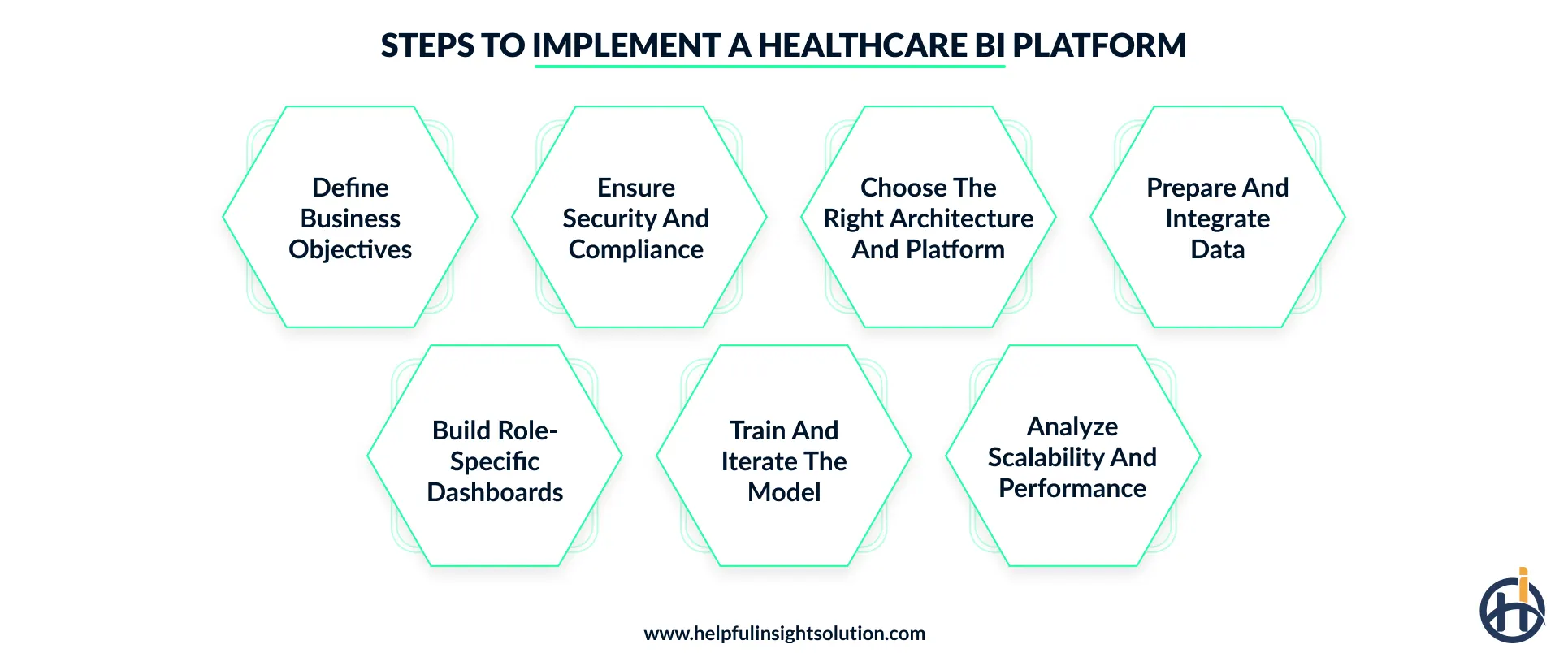
To understand complex patient data and improve workflow management, product teams should implement a smart healthcare business platform into their existing systems. In this section, we will study a dedicated, step-by-step process of integrating BI solutions in healthcare.
1. Define business objectives
Begin with the decisions that the platform should support, such as reducing claim denials, increasing OR utilization, or decreasing readmissions. It is necessary to select high-impact use cases that are most critical and document a baseline for each before implementation.
- You can involve clinical, finance, and IT leaders in setting shared priorities.
- This helps to translate broad ambitions into specific, measurable KPIs with target dates.
- Businesses can rank potential projects by expected value against effort required.
2. Ensure security and compliance
Businesses can implement role-based access, encryption, audit logs, and business associate agreements before moving patient healthcare data. Also, it is beneficial to adjust platforms to ensure HIPAA compliance and other local regulations, like the GDPR or data residency laws.
- Map every data flow to applicable regional privacy regulations.
- It is crucial to run regular vulnerability scans and penetration tests before launch.
- The experts should hide sensitive fields in non-production testing environments.
3. Choose the right architecture and platform
A healthcare provider should decide whether to buy, build, or combine both strategies before selecting the data warehouse, cloud environment, and BI layer. An AI development company helps enterprises to understand the EHR footprint, data volume, and internal technical capacity.
- Compare vendor roadmaps, support terms, and total three-year ownership costs.
- Favor open standards to avoid future vendor lock-in risks.
- Validate the shortlisted option through a small proof of concept.
4. Prepare and integrate data
The experts can extract data from EHR, billing, scheduling, and claims systems to clean and standardize it into a single trusted view. Additionally, they can add patient identity matching and shared metric definitions, which will allow every department to read the same information.
- Profile source data to uncover gaps, duplicates, and inconsistent formats.
- Automate ingestion pipelines so refreshes happen without manual exports.
- Set automated quality checks that alert teams to broken feeds.
5. Build role-specific dashboards
Healthcare investors should build a unique individual view for executives, clinicians, finance, and operations rather than one busy dashboard. They can also connect each portal to an individual owner and an action so the insights help them to make informed decisions.
- Interview end users first to learn their daily decisions.
- Use drill-down filters so leaders move from summary to detail.
- Limit each view to essential metrics to prevent visual clutter.
6. Train and iterate the model
The experts use business intelligence in healthcare to train predictive models on validated data, test them against your baseline, and refine them using clinician feedback. It is highly recommended to train end users as well and incorporate appropriate domain-expert feedback.
- Split historical records into separate training and testing sets.
- Check models for bias across age, gender, and ethnicity groups.
- Retrain on fresh data at scheduled intervals to stay accurate.
7. Analyze scalability and performance
In the last stage, it is crucial to determine how the platform will handle more users, data sources, facilities, load times, and data accuracy. Businesses can use the results to plan a phased rollout, adjust infrastructure before scaling, and enhance communication across systems.
- Simulate peak user traffic to reveal bottlenecks before expansion.
- Review cloud spending regularly to keep growth costs predictable.
- Confirm new facilities can onboard using existing data templates.
Cost of building a healthcare business intelligence platform
While developing a healthcare intelligence platform, businesses must know the cost, which is influenced by multiple factors. These include data complexity, integration of AI/ML models, cloud infrastructure, and regulatory compliance.
The overall budget may rise due to the implementation of machine learning development services to forecast patient demand or claim denials. It is crucial to improve old reporting tools into smart and faster decision-support systems, but underestimating the cost is not an option for healthcare providers. Here, we are discussing a table that includes various cost factors and their illustrative ranges with explanations.
| Factor | Estimated cost range | Description |
| Data Complexity | $4,000 – $40,000 | Number of sources, formats, and integrations required. |
| Team Composition and Location | $5,000 – $45,000 | Developer rates vary by team size and location. |
| Dashboard and UI/UX Design | $3,000 – $25,000 | Role-based dashboards, visuals, and user experience design. |
| Predictive Analytics and AI/ML Models | $6,000 – $60,000 | Custom models for risk, demand, and forecasting. |
| Security and HIPAA Compliance | $4,000 – $30,000 | Encryption, access controls, audit logs, and compliance testing. |
| Cloud Infrastructure and Storage Volume | $3,000 – $20,000 | Hosting, storage, and compute scale with data. |
| Multi-Facility Scaling | $5,000 – $30,000 | Extending shared definitions and pipelines across locations. |
The total estimated cost ranges from $30,000 to $250,000, which depends on the overall business scope and project complexity. Clinical teams should decide on key analytics, dashboard, security, and scaling features before investing in business intelligence platforms for healthcare.
What is the future of healthcare BI?
Business intelligence in healthcare is transforming the visualization of static, historical data into predictive, real-time, and AI-driven decision support. Various innovations in healthcare, like predictive analytics for revenue management and AI-powered appointment scheduling, are enhancing patient care and workflow efficiency.
In the future, this scenario will change completely due to more advanced technical integration in healthcare systems. Some of the major upcoming trends are discussed in this section.
Agentic AI and decision intelligence: Platforms are moving from dashboards to systems that recommend and even trigger actions automatically. Early steps show AI proposing interventions, with clinicians and administrators still approving each step.
Ambient clinical documentation: Voice-based tools that capture conversations during patient visits are beginning to feed structured data into analytics platforms. This could reduce manual entry and improve data completeness over time.
Federated learning for health systems: Hospitals are testing methods to train shared AI models without moving patient data outside their own systems. This approach could improve accuracy while addressing privacy and compliance concerns.
Natural language querying with generative AI: Vendors are building chat-style interfaces that let staff ask questions in plain English instead of building reports manually. Early versions still require human review before decisions are made.
Multi-omics and genomic data integration: Some research hospitals are exploring how genomic and molecular data could feed into BI platforms alongside clinical records. Full integration remains limited by cost, standardization, and data complexity.
How does Helpful Insight develop enterprise-grade medical business intelligence platforms?
Now, developing a medical intelligence platform becomes crucial, as technologies are changing faster over time. Medical teams need a reliable partner that can deliver constant support, ensure technical expertise, and help them to follow standard data privacy compliance.
We have a dedicated and experienced team of developers who specialize in machine learning, NLP, generative AI, and predictive analytics services, enhancing healthcare systems. Experts at Helpful Insight help clients to build a detailed blueprint by analyzing various business models before starting the process.
Healthcare providers can integrate BI in patient care, administrative, and insurance claim systems to get results quickly and take actions with better precision. There is no need to search for other teams, as we maintain business credibility, work authenticity, and time flexibility. So, it’s time to get ready to experience healthcare intelligence with smart AI-driven platforms, offering automated services.
FAQs
Hospitals must shift from batch-processed reports to cloud-enabled analytics platforms to enhance legacy MIS. The following steps will help with better system transformation across medical facilities:
- First, list existing databases and reports to find undocumented data pipelines.
- Now, put them in modern APIs so tools can pull data without rewriting the code.
- Move all the data into scalable cloud warehouses to unify different datasets.
- Use advanced BI dashboards that offer role-based access and interactive visualization.
- To ensure data integrity and track regulatory metrics, build automated logging.
Top healthcare business intelligence tools provide data visualization, secure compliance, and deep EHR integration. Some of the major BI tools for healthcare are discussed in the following manner:
- Microsoft Power BI: It connects fragmented medical data sources and provides interactive dashboards for tracking clinical outcomes.
- Tableau: This platform ensures HIPAA compliance, provides drag-and-drop filters, and tracks data to monitor hospital performance with proper access controls and a BAA.
- Qlik (Qlik Sense): It allows users to understand complex data connections across multiple medical and financial sources.
These systems ensure strict access controls, robust encryption standards, and immutable audit logs supported by BAAs. They perform data masking to implement tokenization, dynamic masking, or the Safe Harbor method for safe analysis. Other strategies include Single Sign-On (SSO), Multi-Factor Authentication (MFA), and automatic session timeouts.
Healthcare BI solutions allow providers to report, organize, and visualize historical data that has already happened. With data analytics, medical teams can forecast future outcomes and understand processes through predictive models. Various parameters like data granularity, technical complexity, and volume help to understand the key differences between them.
BI tools for healthcare process raw medical, financial, and operational information into clear data insights. They improve patient care through early risk detection, fewer readmissions, and better chronic care. Additionally, these platforms deliver informed clinical choices, ensure revenue tracking, and streamline operations for enhanced decision-making.