


“Create a new medical ecosystem with increasing RPA innovations in healthcare.”
Have you ever wondered why healthcare businesses use various technologies, such as AI and IoT? This reduces their burden, ensures patient engagement, and streamlines workflow efficiency.
You will be surprised to know that the impact of RPA in healthcare industry is so high that it can influence inventory operations, doctor appointments, and insurance claims. Additionally, the software segment has an overall share of 78.6% in the RPA-enabled healthcare market.
The need to build healthcare RPA solutions has increased suddenly due to a rise in patient volume, a lack of data security, and operational expenses.
This technology is a part of AI, which helps in task automation, result prediction, and optimization for various hospitals or clinics. To experience its power, you need to understand various use cases that are popular across the globe.
In this blog, you will study different RPA trends in healthcare, with benefits, implementation, and challenges. After going through every topic, you can easily make plans to deploy this technology in your existing systems or build new ones.
What is RPA and How Does it Affect the Healthcare Market?
The RPA is an AI-powered technology that helps to automate various repetitive and rule-based tasks through virtual bots. The operations it handles include data entry, invoicing, and scheduling across various industries.
For example, the role of robotic process automation in healthcare is to improve patient engagement, reduce administrative expenses, and enhance clinical workflow.
After the use of AI in healthcare has increased rapidly, this industry has experienced a sudden rise in investments and revenue. Businesses must go through the following market stats to understand the growth potential and future opportunities in this sector.
- At present, the global RPA-enabled healthcare market volume is $3.5 billion in 2026, with North America having 43% market share.
- By the end of 2034, the overall revenue will increase to $22.6 billion at a growing rate of 26.1% CAGR between 2025 and 2034.
- In the USA, the current market value is $840 million, which will gradually reach $6,920 million by the end of 2034.
- The cloud technology is holding 74.6% market share, whereas the claim settlement platforms have 31.8% share in the app segment.
- Among various industries, the healthcare RPA market is growing at a rate of 30.9% CAGR, which is the maximum at present.
The development of various medical RPA solutions for hospitals, doctors, and patients is highly beneficial for modern startups. They should know about the trending options available in the RPA-based healthcare segment for increasing business ROI.
Key Benefits of Using RPA for Healthcare
There are various benefits of RPA in healthcare, including error reduction, increased efficiency, and data security. Before moving forward, you are going to study all these crucial advantages in this section.
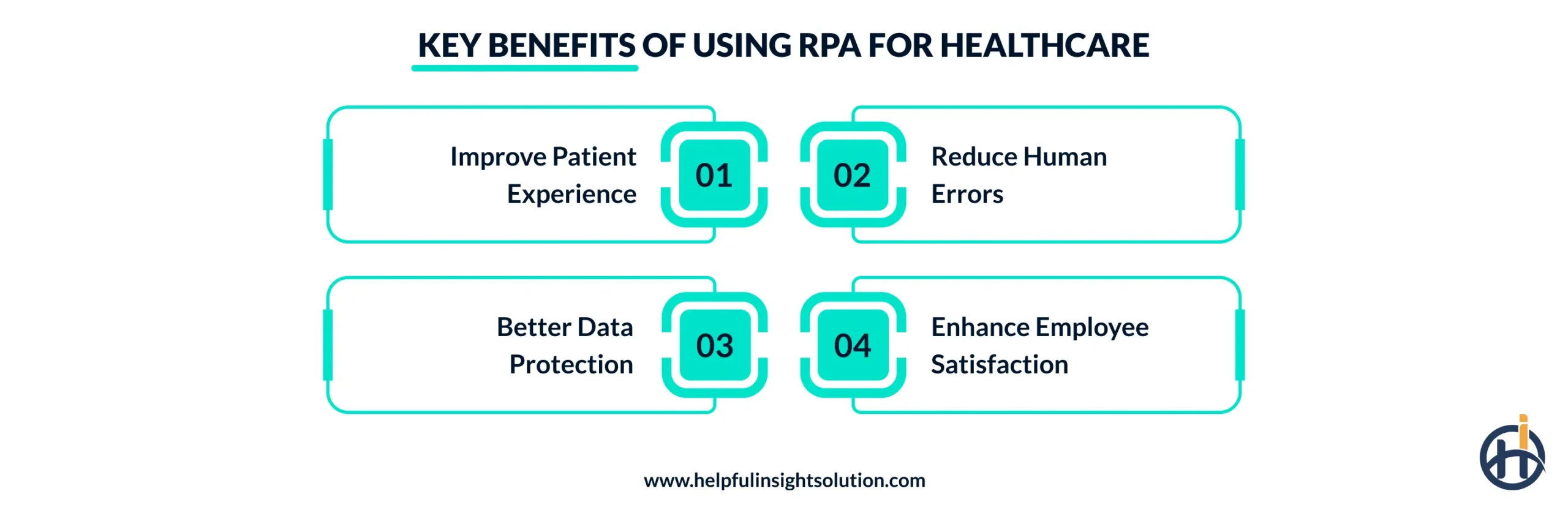
1. Improve Patient Experience
The use of RPA in medical billing, appointment booking, and remote care management helped patients to improve their experiences. It also increased the rate of getting insurance claims by enhancing data security and end-to-end communication.
2. Reduce Human Errors
This technology automates repetitive tasks, like patient registration and medical scheduling, with a 99% accuracy rate. The RPA workflow in healthcare helps hospital staff to decrease manual data handling and increase clinical efficiency through integrated bots.
3. Better Data Protection
It uses digitally encrypted security audits that prevent data breaches and ensure transparency across various healthcare devices. The use of RPA in medical science is to avoid unauthorized access, reduce inconsistency, and maintain regulations like HIPAA.
4. Enhance Employee Satisfaction
Businesses can integrate RPA for healthcare, as it enhances staff performance and productivity by reducing monotonous tasks. This allows them to easily focus on different clinical operations, control stress, and ensure patient care.
Top Use Cases of Robotic Process Automation in Healthcare
We will explore the best applications of RPA in healthcare for patient management, billing, insurance, and data security. They enhance medical workflow, reduce expenses, and increase overall traffic engagement.
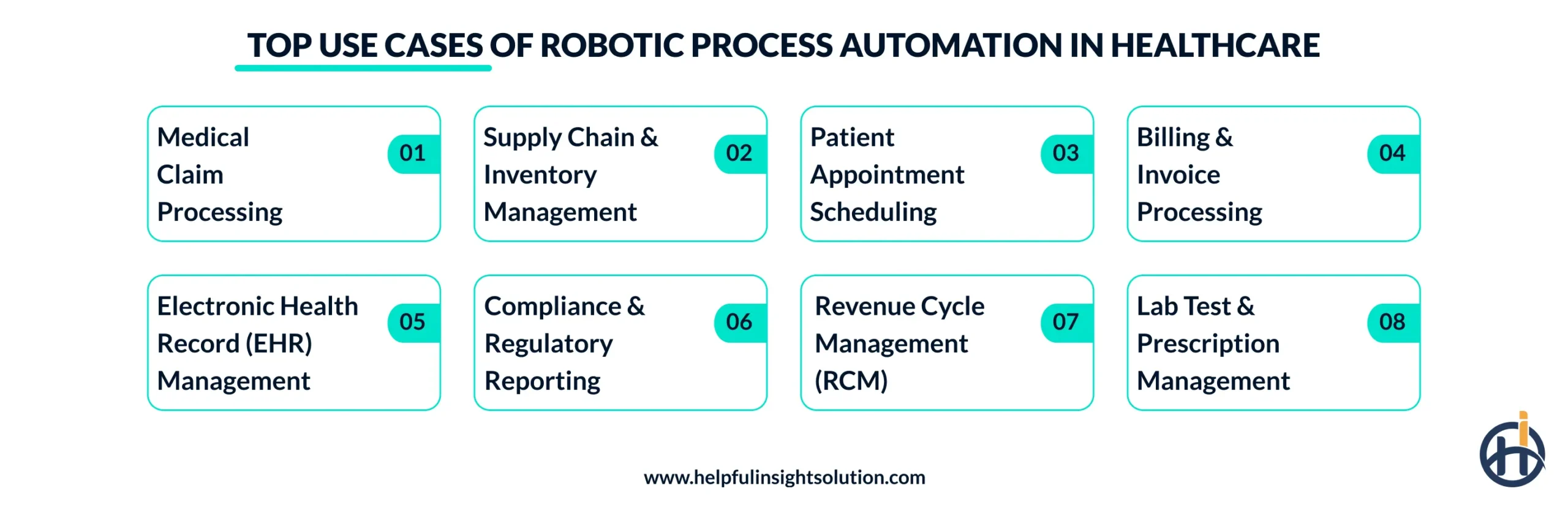
1. Medical Claim Processing
The use of RPA in healthcare claims processing helps to manage data entry tasks, eligibility verification, and policy management. This helps to reduce time consumption, manual errors, and administrative costs, increasing the overall efficiency for agents and patients.
Additionally, it also helps in tracking the insurance status through real-time services. Various bots are used to handle claims by removing repetitive entries and approving actual policies.
2. Supply Chain & Inventory Management
The role of RPA in the healthcare industry is to overcome stock replacement issues, track inventories, and generate order numbers for each booking. Additionally, it also manages supplier records, monitors medicine deliveries, and prevents expired products.
This helps in cost savings, reduces manual errors, and enhances clinical operations with a smooth workflow. The bots help to increase data accuracy and optimize vendor services in real-time.
3. Patient Appointment Scheduling
It is one of the best RPA use cases in healthcare that automates appointment bookings, rescheduling, and confirmation by managing administration. The integrated bots are used to process patient requests, check doctors’ availability, and update EHR records regularly.
This improves communication through automated emails and messages that are highly secure. It ensures better patient experience, healthcare efficiency, and compliance by reducing overall medical disturbances.
4. Billing & Invoice Processing
In the healthcare systems, businesses use robotic process automation for medical billing, payment processing, and product invoicing. The bots collect various data, like name, diseases, and treatment facility, from EHR systems.
After this, the platform generates billing codes and invoices based on the patient information that are directly sent to the vendors. It increases speed, saves expenses, improves accuracy, and ensures standard healthcare compliance.
5. Electronic Health Record (EHR) Management
You can use RPA services for healthcare industry to manage medical records, update patient information, and check repetitive entries. The EHR monitors multiple sources, like lab reports, to collect patient data, which reduces time consumption.
It reduces operational costs and improves accuracy through document digitization, which helps to create structured reports. The digital logs are used to increase productivity and ensure security across various healthcare systems.
6. Compliance & Regulatory Reporting
As an entrepreneur, you must implement RPA for healthcare compliance management, which ensures accuracy and security through regulations like HIPAA. The bots can generate and track audit logs that interact with PHI to gather Electronic Clinical Quality Measures (eCQMs).
It increases speed and efficiency by monitoring employee certifications and medical licenses. This may reduce human errors with real-time monitoring of electronic transfers between devices.
7. Revenue Cycle Management (RCM)
With RPA-based healthcare systems, businesses can easily manage revenue cycles, reducing administrative costs and increasing medical accuracy. You can invest in healthcare software development and build solutions that can manage claims, payments, and records.
Additionally, they should identify disapproved bookings for instant processing. The bots can read medical codes and update accounts, which helps to enhance business revenue.
8. Lab Test & Prescription Management
This is considered one of the best robotic process automation use cases in healthcare, which allows lab report processing and pharmacy tracking. The bots in RPA help to detect abnormal results and alert doctors about instant patient care and medication.
Additionally, they monitor medical stock, expiry dates, and deliveries, preventing shortages and delays. It enhances efficiency and allows medical experts to focus on the necessary healthcare operations.

How to Implement RPA in Healthcare Systems?
As a business investor, you need to know the process of integrating robotic process automation in healthcare. Here, we will discuss some important steps that are generally used and accepted worldwide.
1. Assess Business Requirements
To implement RPA in the healthcare industry, you should identify various business needs, patient requirements, and current market trends.
Additionally, it is also important to create a budget that includes all objectives and future goals. This is a necessary step that helps investors to easily manage business expenses and resources at later stages.
2. Hire RPA Experts
You can connect with professional RPA software platform experts through different hiring models, like freelancing and outsourcing.
It is important to follow an efficient hiring process that includes project assessment, technical interviews, and a final discussion. Businesses should ensure that the developers provide secure and scalable automated solutions.
3. Develop Pilot Projects
The pilot projects are developed to test the ROI, efficiency, and durability of RPA software based on different repetitive tasks. It is a low-risk method that helps to understand the overall value of healthcare RPA solutions at the enterprise level.
They are known as Proof of Concept (PoC), which shows that the system will work properly in a real-world environment.
4. Testing and Security
The RPA systems are tested through various methods, such as unit testing, user acceptance testing, and regression testing. They are secured with various data protection standards, like HIPAA, that ensure compliance and constant monitoring.
Through access control and audit trails, you can easily reduce human errors and prevent system attacks.
5. Monitor System Performance
It is important to track chatbot activities, the system’s resource usage, and workflow efficiency in real-time. The RPA-powered healthcare processes are monitored through dedicated dashboards that ensure accuracy and consistency.
It uses SLAs that are widely used for handling EHR, patient monitoring, and medical scheduling systems.
What are the Challenges in Integrating RPA with Healthcare Solutions?
Various challenges, like cost and complexity, may occur while implementing robotic process automation for healthcare. You will study a few RPA integration risks with their respective solutions in this section.
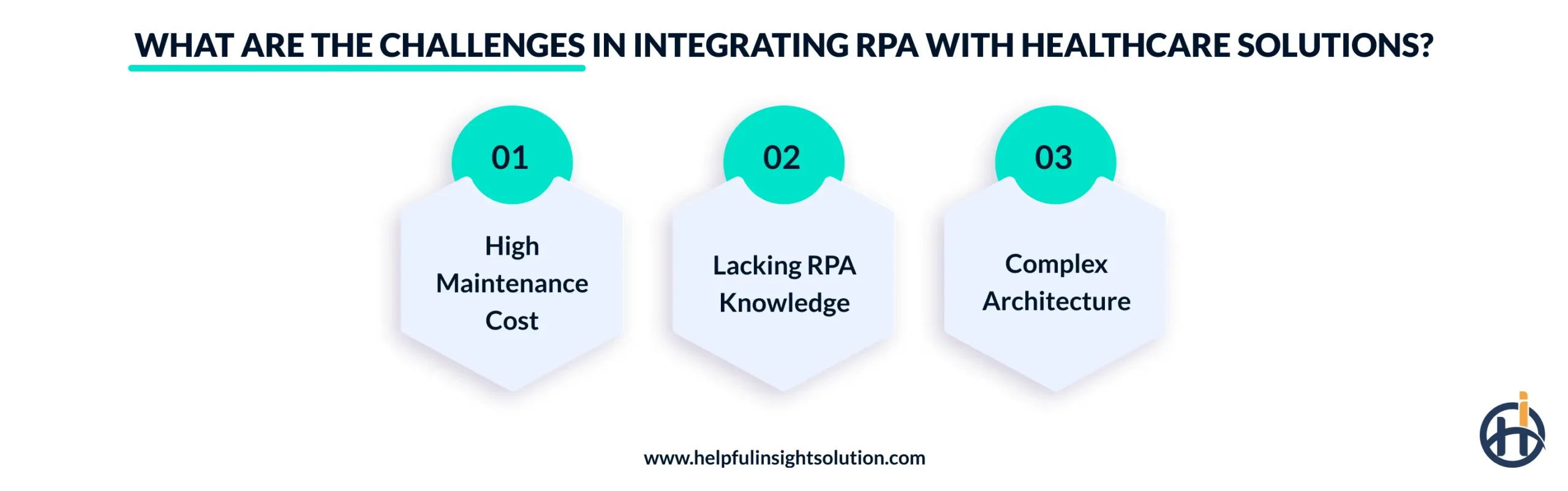
1. High Maintenance Cost
Various maintenance tasks, like fixing bot issues and system changes, affect the cost of RPA implementation in healthcare. The troubleshooting of automated EHR solutions is a major technical challenge for business investors.
Solution: You should define an automation plan and include cloud-based solutions that ensure high scalability, flexibility, and governance.
2. Lacking RPA Knowledge
An entrepreneur may experience that most experts are not aware of RPA technology because it is highly advanced and requires time to understand. The automation process is complex, which includes multiple integration and development stages.
Solution: Businesses should outsource professional teams that can build RPA-enabled healthcare solutions with expertise and support.
3. Complex Architecture
The RPA technology includes the screen-scraping method for automation, which can be easily affected by minor UI changes. Additionally, the system may show an unpredictable nature due to limited processing power, which may lead to bot failure.
Solution: It is beneficial to use hybrid AI/ML services, mapping methods, middleware APIs, and iPaaS solutions for system automation.
Final Thought: Future Role of RPA-Based Healthcare Platforms
The use of RPA medical platforms will surely increase across the globe because this industry needs more improvement in terms of technology and innovation. Some operations are still manual at various clinical centers, which require modern technologies to become automated.
The future of RPA in healthcare will include agentic models, FHIR-compatible resources, and data process mining. Additionally, the use of Cognitive AI and IoT will also increase for better patient care management.
As you know, RPA is revolutionizing healthcare platforms, so it is the right moment for you to invest in this technology. You need to select the best robotic process automation services that can improve business efficiency and ensure a great return on investment.
This process is gradual, but it will provide consistent growth, visibility, and user engagement.
FAQs
The RPA technology uses integrated bots to replicate human tasks, like data entry, billing, and scheduling. The working mechanism of robotic process automation is discussed in the following manner:
- It extracts patient information and adds it to the EHR system.
- They connect the patient dashboard with billings and medication portals.
- The bots regularly update the system based on the user actions.
- The RPA handles insurance claims, appointments, and patient particulars.
- It authorizes user data through standard healthcare protocols like HIPAA.
The cost of integrating RPA in the healthcare industry is very high because it is an advanced AI technology that helps in system automation. The overall price is dependent on various factors like platform complexity, licensing, and maintenance. The total cost can be between $50K and $250K, which may increase due to additional requirements.
Businesses can implement RPA in their healthcare systems to enhance various medical operations, such as appointment booking, insurance claim settlement, and compliance. This technology helps to decrease clinical errors, operational costs, and workflow restrictions. It enhances patient care, which results in increased healthcare efficiency and experiences.
Various RPA tools and technologies allow businesses to easily handle complex healthcare tasks, unstructured data, and regulatory standards. These include Intelligent Document Processing (IDP), AI/ML models, Agentic AI, and cloud solutions. Some compliance tools are FHIR connectors, IoT sensors, security audits, and data encryption methods.
Yes, small startups can easily integrate scalable RPA solutions into their existing healthcare systems for practice management and outpatient clinics. It helps them to manage increasing patient volume and administrative tasks by reducing hiring expenses. This allows entrepreneurs to track EHRs and billing cycles without disturbing the infrastructure.