

Key Takeaways:
- BPM automates and standardizes clinical operations, which leads to faster data processing, improved coordination, and better patient experiences.
- Healthcare providers can optimize resource utilization, reduce manual administration, and improve decision-making through real-time monitoring.
- For seamless BPM integration, you must ensure compliance with healthcare regulations, staff training, and ongoing workflow orchestration.
- AI and BPM provide predictive analytics, hyperautomation, and low-code workflow management across the healthcare ecosystem.
Do you know that a hospital faces severe challenges, such as patient administration, unbalanced billing, increased wait time, miscommunication, and regulatory compliance? All this happens due to a lack of a proper system that can force patients to move back, reduce medical workflow efficiency, and increase operational costs.
The use of BPM in healthcare is the only solution to all these problems, ensuring automation of clinical processes and predicting resources, like medical beds and equipment, in real-time.
According to Mordor Intelligence, healthcare is the fastest-growing industry with a rate of 10.6% CAGR after implementing BPM. This technology is allowing hospitals to orchestrate appointments, diagnostics, and billing with renewed HIPAA compliance. Healthcare has a share of 18% in the BPM software segment, which shows that organizations are rapidly adopting it.
To integrate BPM for healthcare systems, it is better to know various features, use cases, and challenges before moving ahead. This blog delivers the best insights about business process management, which we explore and understand deeply.
What is business process management (BPM) in healthcare?
BPM for healthcare helps medical professionals to automate clinical operations and streamline administrative workflows. It can analyze, process, and execute complex healthcare data, optimizing coordination between staff, technology, and patients. This reduces additional expenses and ensures regulatory compliance with strict medical standards.
Businesses can easily create workflow models to measure and transfer patient outcomes at initial stages. The integration of BPM in healthcare management software shifts the control from reactive to digital decision-making. The medical staff can focus on patient care, as BPM handles different clinical operations without any human interference.
- From appointment scheduling to queue management, BPM enhances various medical tasks.
- It reduces manual data entry errors by automating claims processing and payment cycles.
- BPM helps healthcare providers create auditable records to manage patient information.
- This allows optimization of the supply chain, preventing out-of-stock or overstocking conditions.
Key advantages of BPM in healthcare
BPM in healthcare allows medical professionals to optimize existing operations, such as patient admission and insurance. In this section, we are looking at some of the best BPM advantages in the healthcare domain.
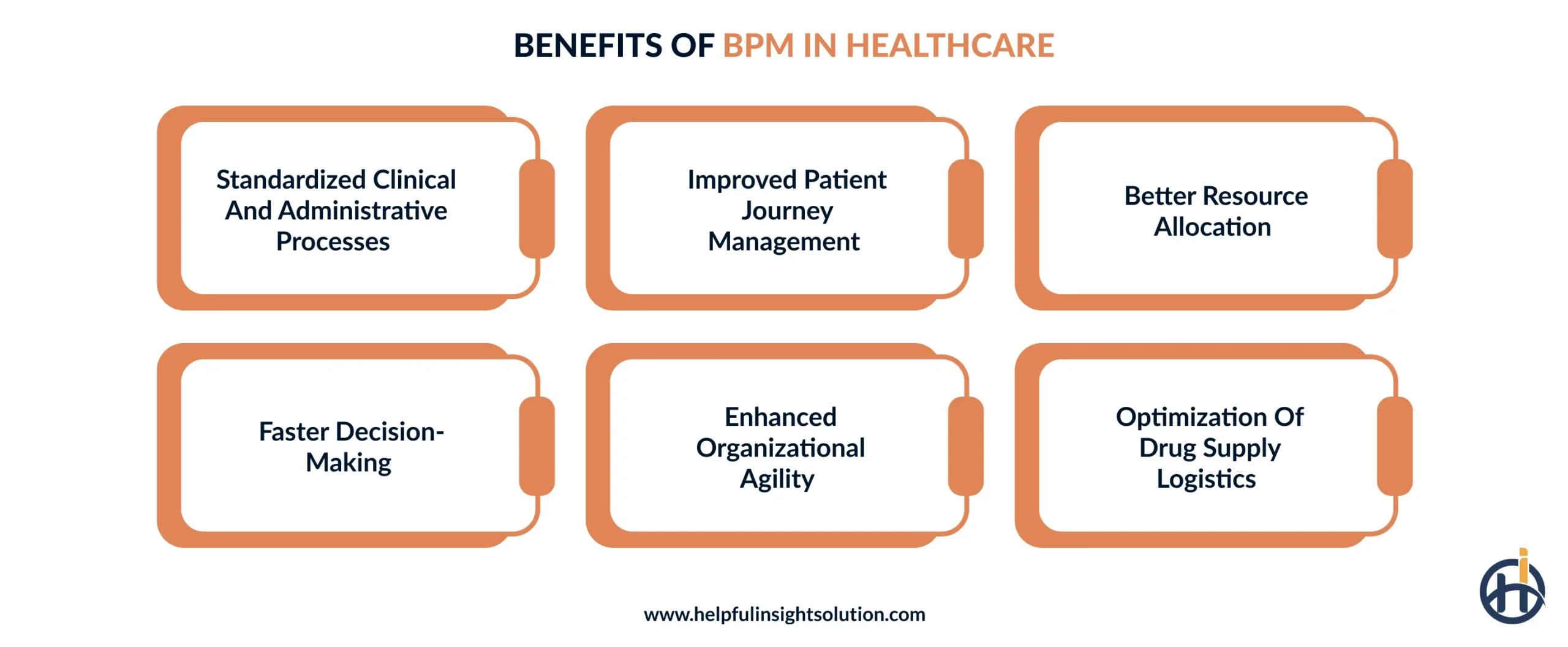
1. Standardized clinical and administrative processes
BPM reduces medical errors, improves operational efficiency, and increases stability by standardizing both clinical and administrative tasks. This allows healthcare providers to enhance patient diagnosis, ensure personalized treatments, and optimize claim processing.
2. Improved patient journey management
From appointment scheduling to post-discharge, BPM enhances cross-departmental care coordination, automates healthcare delivery, and improves data management. Integrated EHR systems provide instant data access, ensuring safe check-ins, payments, billing, and medication.
3. Better resource allocation
Healthcare providers can analyze historical data and optimize resource allocation, such as bed allotment and medical equipment facilities. Smart BPM systems prevent understaffing by analyzing seasonal trends and predicting the number of doctors or nurses required.
4. Faster decision-making
Medical professionals use healthcare BPM platforms to centralize data from different sources, which helps in making faster clinical decisions. The use of predictive analytics in healthcare allows doctors to analyze patients and deliver treatments or therapies instantly.
5. Enhanced organizational agility
Business process management in the medicine sector helps to quickly adapt to industrial shifts, regulatory updates, and changes in patient volume. It regularly monitors the system dashboard to track workflow modifications and test operational strategies.
6. Optimization of drug supply logistics
It prevents drug shortages, triggers stock reorders, reduces manual logistics, and ensures overstock management through IoT-driven supply chain tracking. BPM also helps in temperature monitoring for medicines and provides instant delivery of drugs, reducing treatment delays.
Types of BPM in the healthcare industry
Various healthcare BPM solutions are divided into 3 major categories that target different aspects. You will observe the key metrics, which include patients, medical integration, and clinical documents.
1. Human-centric BPM
It handles workflows that focus on human experience and collaboration, such as patient check-ins, lab test reviews, and physician approvals. This model enhances efficiency and communication by empowering medical staff, like nurses or doctors, and streamlining regular assignments, which is often why hospitals also look to build healthcare communication platforms that connect these workflows in real time.
2. Integration-centric BPM
This BPM type focuses on system-to-system process automation by securely connecting enterprise software, improving interoperability and data synchronization. It targets EHRs, RCM, and laboratory information systems that store high volumes of healthcare data across departments.
3. Document-centric BPM
In this, insurance claims, authorization forms, audit reporting, and patient consent forms are the most crucial documents that require automated management. It reduces file-handling errors, administration time, and operational overhead through document version control and compliance tracking.
Must-know features of BPM solutions in healthcare
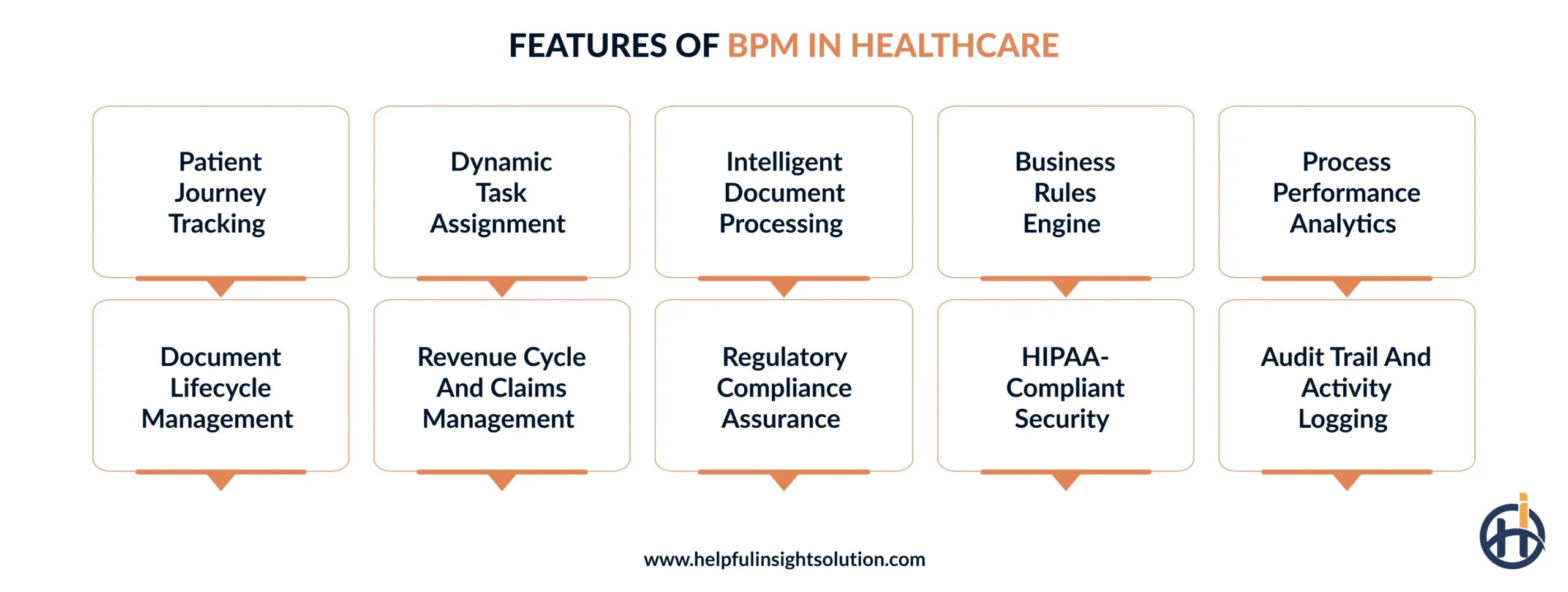
Here we are going to study various healthcare BPM features, such as patient tracking, RCM, and compliance. They ensure constant patient engagement, system security, and enhanced growth.
1. Patient journey tracking
This feature tracks every stage of a patient’s journey from appointment to discharge. It tracks the patient’s treatment, follow-ups, treatment progress, and care coordination.
2. Dynamic task assignment
The system assigns tasks to the people on the healthcare team by checking their availability to do the task. This prevents delays and ensures the workload is balanced based on priority.
3. Intelligent document processing
A healthcare BPM system monitors medical records to extract the information at any time. This reduces manual data entry processes and ensures accuracy across the clinical ecosystem.
4. Business rules engine
It can easily make workflow decisions by following standard healthcare automation rules. This means every process is done sequentially, allowing organizations to change them whenever required.
5. Process performance analytics
The system tracks performance by monitoring workflow patterns based on healthcare tasks. This helps the healthcare organization find problems and make things work better.
6. Document lifecycle management
This feature helps manage documents from source to destination with real-time API integration. It makes sure the documents are organized, secure, and easily accessible during verification.
7. Revenue cycle and claims management
The system provides healthcare revenue cycle analytics for automated billing and insurance. This helps healthcare providers get paid on time and reduces problems with insurance claims.
8. Regulatory compliance assurance
The system makes sure that healthcare organizations are following standard regulations. The system also tracks data exchange, makes reports, and helps service providers to ensure compliance.
8. HIPAA-compliant security
The system protects information by using encryption and other robust security measures. It only allows authorized people to review the information and supports patient privacy.
9. Audit trail and activity logging
Healthcare BPM systems create data history and generate reports to identify system logins. This helps with audits and investigations, increasing transparency between doctors, patients, and staff.
Top BPM in healthcare use cases and examples
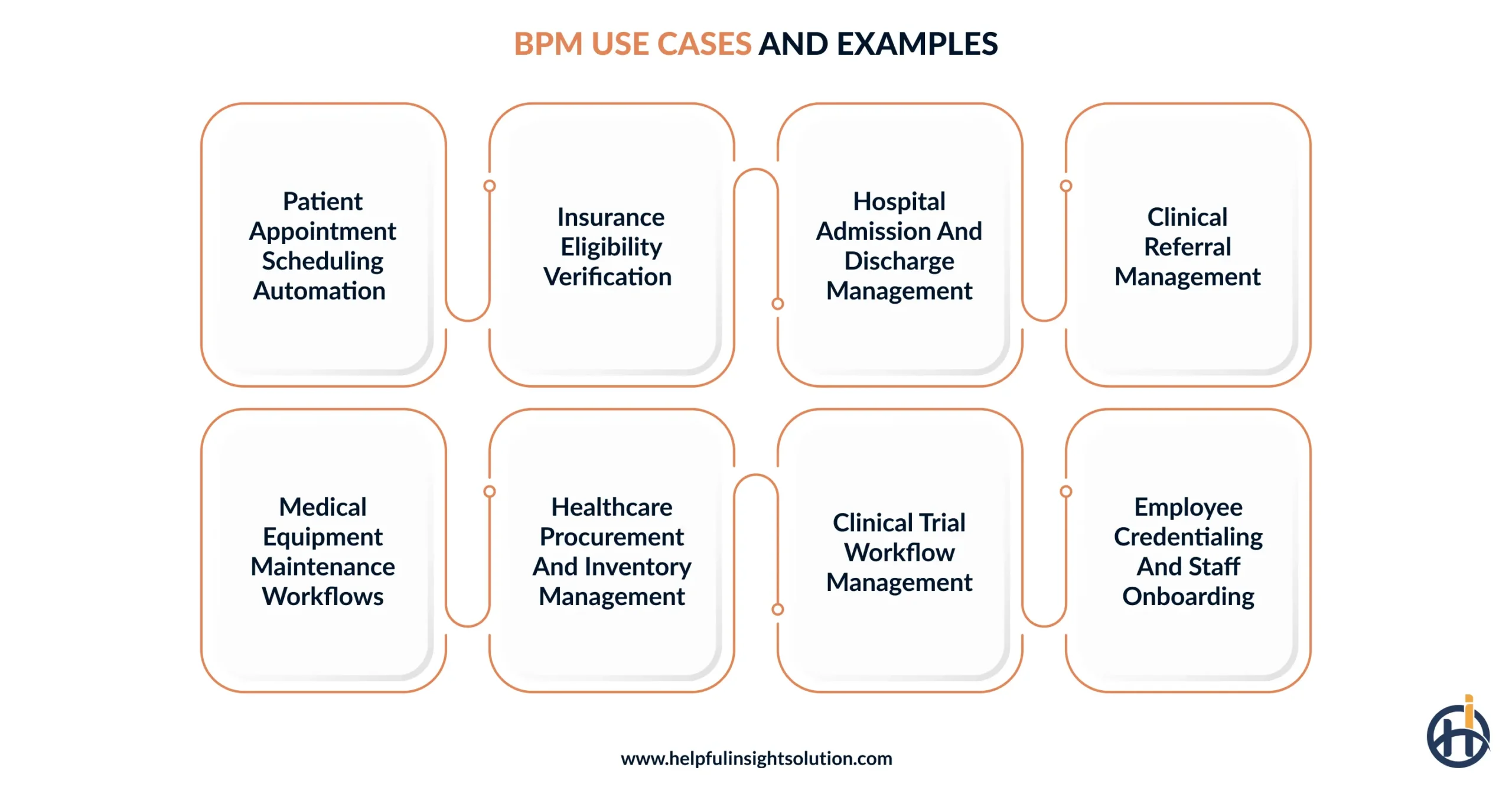
Use cases of BPM in healthcare cover all departments, from patient management to insurance and staff scheduling. Here you will encounter the best BPM use cases with their examples for better understanding.
1. Patient appointment scheduling automation
BPM automates appointment booking and also takes care of things like allocating physicians, sending reminders, handling cancellations, and rescheduling. The patient management software can minimize conflicts with schedules and reduce the number of no-show patients through BPM. This makes the clinic run efficiently, and it provides patients with a better experience when it comes to scheduling.
Real-world example: Mayo Clinic uses tools to make it easy to book appointments, send reminders, and coordinate care across many specialties. BPM helps reduce delays in scheduling, makes it easier for patients to get in, and makes sure doctors are available when needed.
2. Insurance eligibility verification
Business Process Management checks to see if patients have insurance coverage and what benefits they are eligible for before they get treatment. It can directly connect with the insurance providers and automates the process of requesting authorization. It checks the details of the policy, which helps to reduce the number of claims that are rejected, and it speeds up the process of billing.
Real-world example: Cleveland Clinic checks if insurance covers treatment before it happens by using a system that verifies insurance. This reduces denied claims, shortens the time it takes to register, and speeds up getting paid.
3. Hospital admission and discharge management
BPM software for healthcare enhances the process of admitting patients, allocating beds, getting approvals for discharge, clearing bills, and scheduling follow-up appointments. Additionally, it reduces the delays that are caused by tasks, and it improves the way that different departments in the hospital work together. As a result of this, patients are able to get admitted and discharged quickly.
Real-world example: Mount Sinai Health System uses automation to manage admissions, assign beds, approve discharges, and plan follow-ups. This improves the flow of patients, reduces wait times, and helps use beds.
4. Clinical referral management
It can automate the process of requesting referrals between primary care physicians and specialists and also between laboratories and diagnostic centers. This technology keeps track of the status of these referrals and makes sure that medical records are shared with the right teams. This helps to improve the way that people work together and reduces the amount of time that patients have to wait.
Real-world example: Kaiser Permanente manages referrals between care doctors and specialists using standard digital processes. This improves communication, tracks referrals, and helps patients see specialists on time.
5. Medical equipment maintenance workflows
With a business process management system, healthcare providers can schedule things like maintenance for medical equipment. It also handles inspections, calibration, and repair requests, tracking all the maintenance that has been done in the past. This sends out alerts, helping doctors to make sure their equipment is working properly and reducing operational expenses.
Real-world example: GE HealthCare provides solutions that help hospitals schedule maintenance and track medical equipment performance. These automated processes reduce equipment downtime and improve reliability.
6. Healthcare procurement and inventory management
The BPM system is also useful for managing inventories by automatically sending purchase requests and getting approval from suppliers. It also keeps track of how many supplies are in stock so it can order more when they are running low. This means that healthcare facilities will always have the medicines and equipment they need, and it reduces the chance of stockouts.
Real-world example: NHS Supply Chain uses management to streamline buying, restocking, and distributing medical supplies to healthcare facilities. This helps keep inventory levels right and reduces delays and extra stock.
7. Clinical trial workflow management
The BPM system is used in clinical surgeries and helps to manage things like enrolling people in the trials and getting their consent. It also handles things like approving the plan for the trial and keeping track of all the documents. This helps to make sure that everything is done correctly, and it makes it easier to follow the rules.
Real-world example: IQVIA helps companies and research groups manage clinical trials with workflow-driven solutions. These workflows make it easy to enroll participants, document studies, track regulations, and coordinate trials across sites.
8. Employee credentialing and staff onboarding
The BPM system is also used to manage the people who work in healthcare and checks to make sure they have the licenses, and it does background checks. It also assigns training, collects documents, helps to make sure that all the staff is qualified to do their jobs, and gets them ready to work quickly. The BPM-driven healthcare platforms help to keep them updated with the rules and regulations.
Real-world example: HCA Healthcare uses onboarding to manage staff verification, compliance documents, training, and onboarding activities. This reduces work and helps new healthcare professionals start working quickly.
Manual vs. BPM vs. BPM+AI workflows: A quick comparison
It is crucial to understand the differences between traditional management, BPM, and automated BPM. So, businesses can easily implement the right workflow in their healthcare systems.
The integration of AI in healthcare can enhance existing clinical processes, like scheduling, billing, and documentation. Medical professionals can choose business process automation in healthcare, as it is faster, more affordable, and more scalable than BPM. Here is a table describing the key variations based on the following parameters.
| Parameter | Manual Workflows | BPM Workflows | BPM + AI Workflows |
| Process Execution | Performed manually by healthcare staff with paper or digital records. | Standardized workflows automate routine tasks using predefined business rules. | AI continuously optimizes workflows by making intelligent, data-driven decisions. |
| Decision-Making | Depends entirely on human judgment and experience. | Rule-based decisions follow predefined workflow conditions. | AI analyzes patient and operational data to support faster, smarter decisions. |
| Operational Efficiency | Slow processing with frequent delays and duplicated efforts. | Streamlines workflows to improve turnaround times and productivity. | Continuously improves efficiency by predicting bottlenecks and optimizing resource allocation. |
| Error Management | Higher risk of manual mistakes and inconsistent processes. | Reduces errors through standardized automation and workflow validation. | Detects anomalies, predicts risks, and minimizes errors using AI-powered insights. |
| Scalability | Difficult to manage increasing patient volumes efficiently. | Easily scales standardized workflows across departments and facilities. | Supports enterprise-wide scaling with adaptive automation and continuous process optimization. |
Major BPM integration challenges in healthcare
While implementing BPM for healthcare, businesses may face some crucial challenges, like data interoperability. We will discuss the major medical BPM integration issues with their respective solutions in this section.
1. Legacy system compatibility
Outdated EHR and ERP systems lack native APIs, creating a problem in automating medical workflows. BPM tools cannot extract, map, and transform real-time clinical data, which increases data corruption risks.
Solution: It is beneficial to use platforms like Mirth Connect and API wrappers to handle legacy systems and allow seamless patient interaction.
2. Data standardization issues
This issue occurs due to discrete data models, variations in medical terminology, and system constraints. Data duplication and inaccurate patient history also affect data standardization across healthcare systems.
Solution: FHIR helps to create standardized and API-first data exchange systems that ensure smooth communication and generate unified models.
3. Interoperability across multiple platforms
Multiple healthcare systems create the problem of secure data interchange between doctors and patients. It can delay treatment approvals, claims processing, and appointments, increasing the chance of failure.
Solution: Enterprises are integrating cloud-native platforms (iPaaS) with mobile app development that offer connectivity and routing across systems.
4. Workflow adoption and reliability
Data migration, system downtime, and cognitive load increase the complexity of healthcare workflows. It leads to compliance and governance issues that reduce reliability among patients or doctors, affecting deployment.
Solution: Businesses must adopt low-code workflow design to automate healthcare integration through middleware and security upgrades.
Future business process management trends in healthcare
Healthcare business process management will become more advanced with future technologies, like AI. Some of the best trends are discussed in this section that you should adopt to boost the business economy.
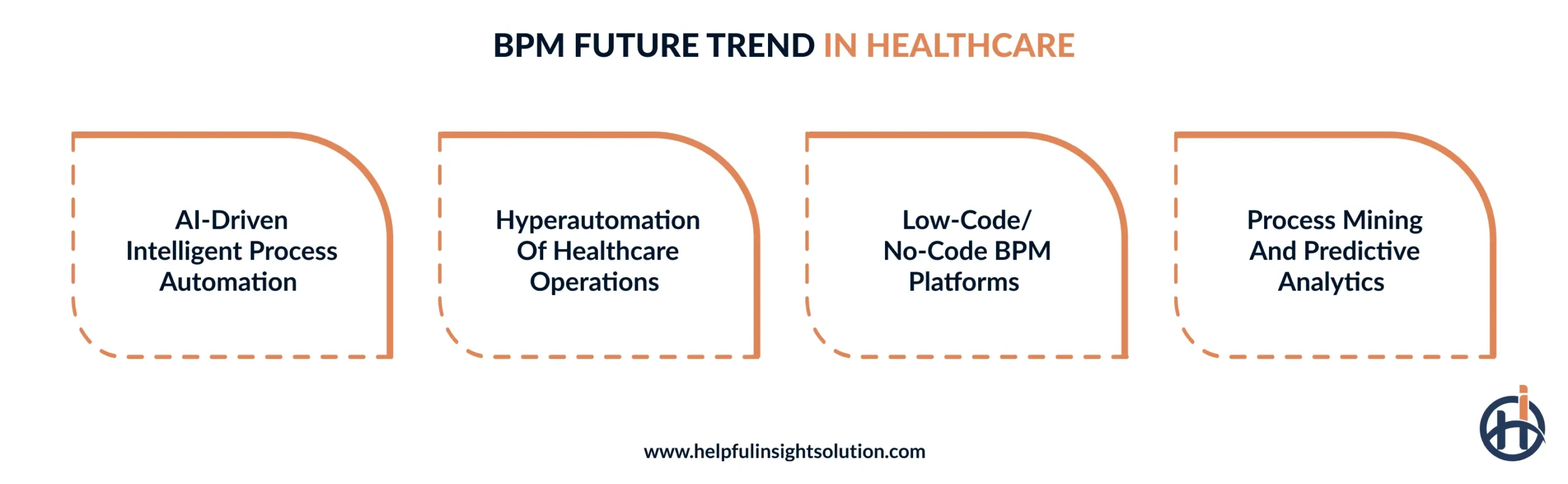
1. AI-driven intelligent process automation
Healthcare organizations are using BPM and AI together to automate tasks like deciding which patients to treat first, processing documents, and helping doctors make decisions. This allows faster data processing and ensures more accuracy, reducing the amount of work that healthcare professionals have to do.
2. Hyperautomation of healthcare operations
BPM integrates with AI and RPA to eliminate manual bottlenecks for revenue cycle management, patient scheduling, and supply chain, allowing staff to focus on care coordination. This helps medical scheduling software work efficiently, saves business revenue, and takes better care of patients in real-time.
3. Low-code/No-code BPM platforms
There are platforms for business process management that are easy to use and do not require a lot of programming knowledge. The use of low-code and no-code solutions can empower healthcare providers and department heads to easily design, edit, and optimize their own patient records in real-time.
4. Process mining and predictive analytics
Looking at workflow data helps identify problems like things that are not working well and differences in how things are done in healthcare. When this is used with analytics, it helps organizations predict problems, plan how to use resources, and constantly improve how well workflows are performing.
How does Helpful Insight help healthcare businesses with process management?
Before concluding the blog, let’s discuss the importance of hiring a reliable and experienced team who can integrate BPM in healthcare without replacing the existing system. We deliver sophisticated clinical solutions that help healthcare providers to automate revenue cycles and increase patient retention rates.
The developers in our healthcare app development company ensure smooth EHR, ERP, and API integration. Our experts analyze existing issues in patient handling, administration, medical operations, billing, and insurance claims, providing enhanced services at affordable rates.
We perform business process modeling in healthcare to examine the complete infrastructure and predict corresponding implementations based on the analysis. This increases visibility among patients and doctors, reducing manual workload, long wait times, and human errors. For healthcare experts, it is a great move to integrate BPM with modern technologies like AI for better results.
FAQs
BPM is the mapping, automating, and optimizing of clinical workflows to reduce errors and improve patient care. The working of healthcare BPM systems is discussed in the following manner:
- BPM scans patient data, such as insurance claims and appointments.
- It identifies various compliance risks and system delays in real-time.
- The system works on automated rules to prevent manual operations.
- The data is directly transferred to the EHR system through a secure channel.
- BPM monitors wait times and treatment cycles for security audits.
AI transforms standard workflows into Intelligent Process Automation (IPA), ensuring self-optimizing capabilities for BPM systems. It can track healthcare data to predict potential delays and compliance issues by using NLP and machine learning. AI and BPM can easily handle routine tasks, like customer monitoring and fraud detection, which reduces overall costs.
Businesses must know the process of implementing BPM in clinical systems to increase operational efficiency. The key integration stages of business process automation are described as follows:
- It is crucial to identify clinical workflows and gather patient data.
- You must create visual charts to understand tasks and HIPAA regulations.
- The system requires automation technologies to handle medical operations.
- Now, you should train staff, update systems, and deploy healthcare workflows.
- Businesses must use an analytics dashboard to monitor performance and KPIs.
BPM is the process of mapping and analyzing patient information, whereas BPA is the automation of different workflows within a system. With BPA, businesses can align clinical operations and integrate EHR with billing and pharmacy. Business process automation uses RPA to extract data, reduce human errors, and increase productivity.
The average cost of implementing BPM in medical solutions depends on software licensing, EHR integrations, and maintenance. It ranges from $20,000 to $400,000 for a complete enterprise-grade solution with EHR integration and customization. For SaaS-based applications, the subscription cost is between $100 and $500 per user per month.
The best BPM platforms for medical use ensure HIPAA compliance, EHR/EMR integration, and complex clinical orchestration. The top tools for healthcare BPM are described in the following manner:
- Appian: It is known for case management with intelligent automation and HL7 FHIR standards.
- Pega: It provides pre-built healthcare frameworks for claims processing and care management.
- Bizagi: It is used for visual process modeling and analytics to map out healthcare workflows.