

Key Takeaways:
- The cost of making ML-powered apps depends on model complexity, data requirements, platform, integrations, and scalability needs.
- Businesses must know that data collection, cleaning, labeling, model training, testing, and optimization may affect their overall budget.
- Cloud infrastructure, ML frameworks, APIs, databases, security measures, and third-party services also influence the operational costs.
- After launch, machine learning apps require retraining, infrastructure management, security updates, and performance monitoring.
As new technologies like machine learning and NLP are emerging, their adoption among businesses is also increasing worldwide. This shift from traditional platforms to smarter and faster applications has helped a lot of investors across various domains, like healthcare, fintech, and supply chain, to attract more users on their platform.
But most startups and mid-sized enterprises may delay adoption, as the machine learning app development cost increases due to additional data, infrastructure, and maintenance. Additionally, many are unaware that third-party APIs and ML frameworks can help reduce overall expenses.
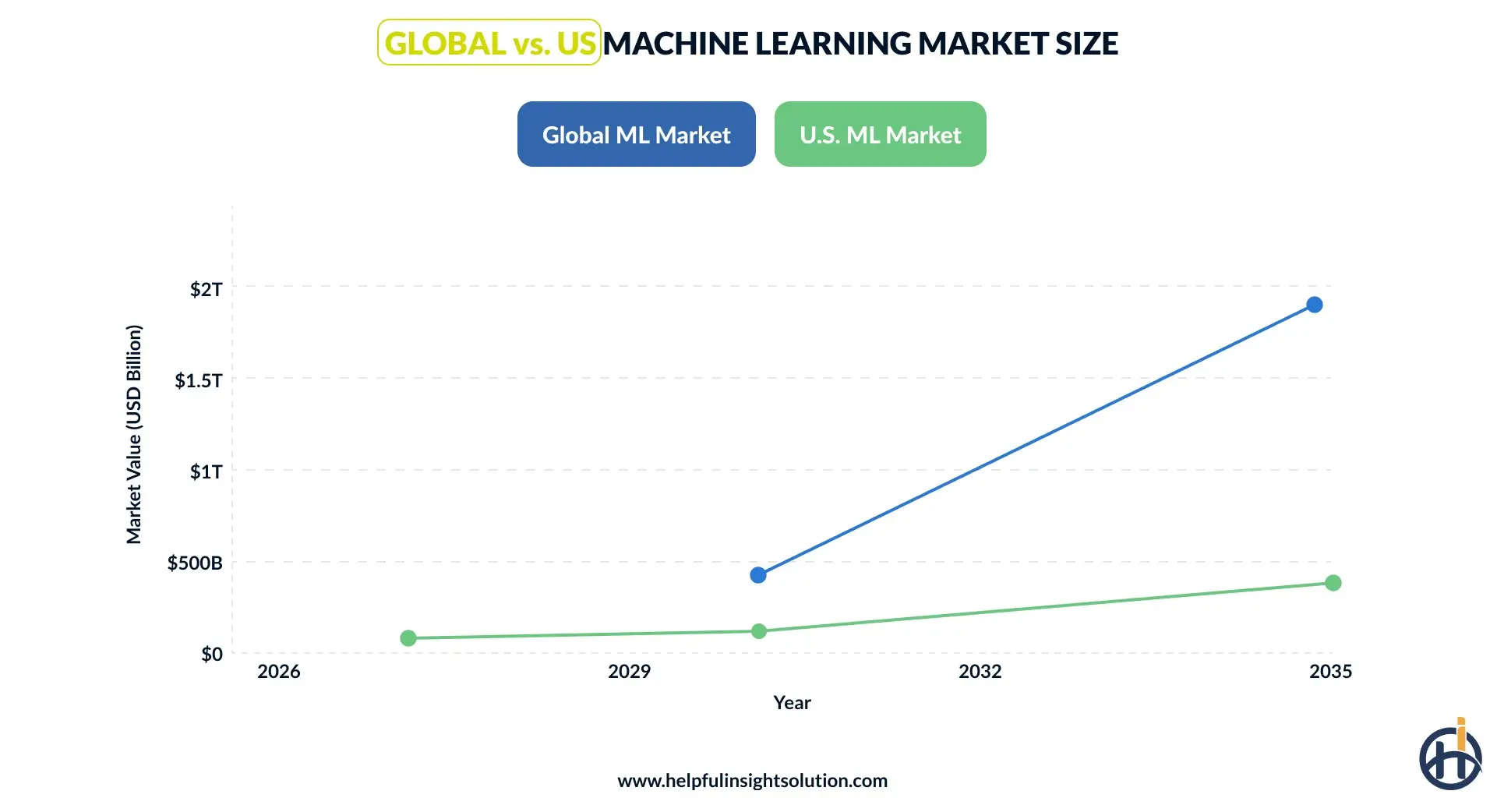
In a report, Precedence Research states that the global machine learning market will reach a volume of $422.7 billion by 2030. Also, the US-based ML market will experience revenue of $91.7 billion in the same year. This is the right time for emerging businesses to invest in AI development services for developing ML-driven mobile apps that offer task automation, user personalization, and data analytics.
This guide breaks down costs by complexity, project stage, infrastructure, data, staffing, integrations, and post-launch maintenance. Additionally, we will study some future trends and understand how enterprises can reduce costs through various methods.
Machine learning market size and demand in 2026 and beyond
Before we get into the cost to build custom machine learning applications, this section brings key market stats. The global ML market is growing across multiple industries like healthcare, finance, retail, and manufacturing.
They involve a wide range of machine learning use cases, from automation and personalization to predictive analytics. Let’s focus on some crucial figures that will help us to understand the growth in terms of different parameters.
- The machine learning market size is $126.9 billion in 2026, with North America having a share of 32% across the globe.
- The current market growth rate for ML platforms is 33.7% CAGR globally, which will reach $1,710 billion by the end of 2035.
- In the USA, the machine learning market will generate $37.2 billion in 2027, reaching a volume of $380.6 billion by 2035.
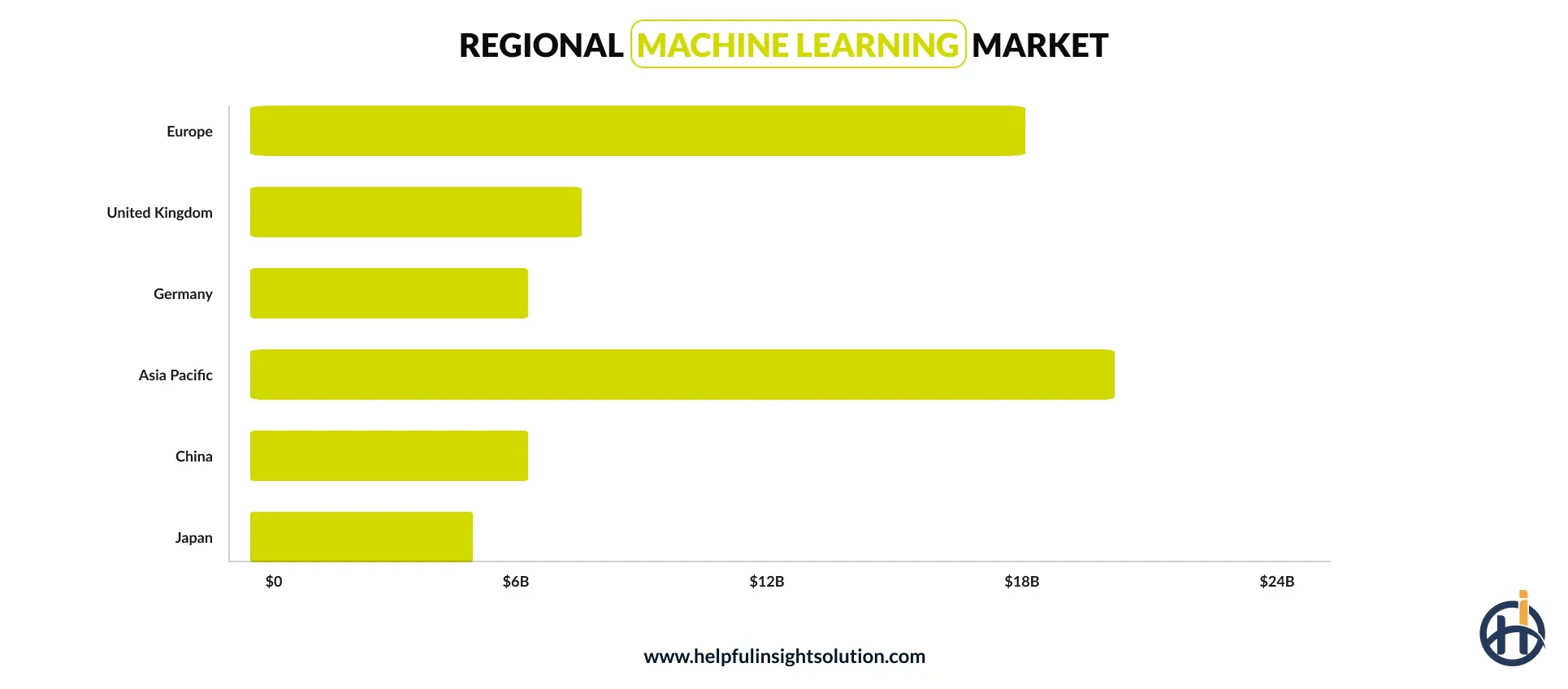
- In Europe, the current market value is $18.2 billion (28.1%) in 2026, with the UK generating $6.6 billion and Germany with $6.02 billion in the same year.
- Asia Pacific has a global revenue of $19.6 billion (29.7%), where China holds $6.1 billion, and Japan has $5.2 billion in 2026.
The integration of machine learning in mobile apps is increasing rapidly, enabling various domains to understand user needs and pain points. This will allow enterprises to invest more in this technology and get desirable benefits, as it utilizes generative AI models and NLP capabilities for better performance.
How much does it cost to build a machine learning app?
The cost to build ML apps depends heavily on the platform complexity, which increases according to the business needs. For an MVP or a moderate machine learning app, the price is lower than the cost for advanced and complex AI applications.
Businesses focus on utilizing cost-efficient machine learning development services to avoid budget expansion at later stages. Before going through the following table, we will discuss a general formula that most enterprises use to estimate the overall cost.
Total Cost = (Team Cost × Project Duration) + Infrastructure Cost + Data Cost + Third-Party Integration Cost + Post-Launch Maintenance Cost
This equation allows businesses to find the estimated cost by considering infrastructure, project duration, third-party integration, and maintenance. Now, let’s move ahead and explore the table below, which includes costs based on different complexity levels with key descriptions.
| Complexity Level | Cost Range | Description |
| Basic ML app (MVP features) | $40,000 – $70,000 | Simple predictive features using pre-trained models and limited datasets |
| Moderate complexity (Custom algorithms) | $70,000 – $130,000 | Custom-trained models with moderate data processing and integration needs |
| Advanced ML app (Deep learning) | $130,000 – $200,000 | Complex neural networks requiring large datasets and extensive computing power |
| Enterprise-grade ML solution | $200,000 – $280,000 | Multi-module systems with advanced automation, security, and scalability needs |
| Highly complex AI ecosystem | $280,000 – $350,000 | Multiple integrated models, real-time processing, and enterprise-wide deployment |
This machine learning app development cost breakdown includes basic, advanced, and complex AI/ML platforms. All these levels deliver various features that make up the overall price, influencing budget and business goals.
So, it is crucial to plan your strategy around them and implement it with evolving market trends.
Factors influencing the cost of building a machine learning app
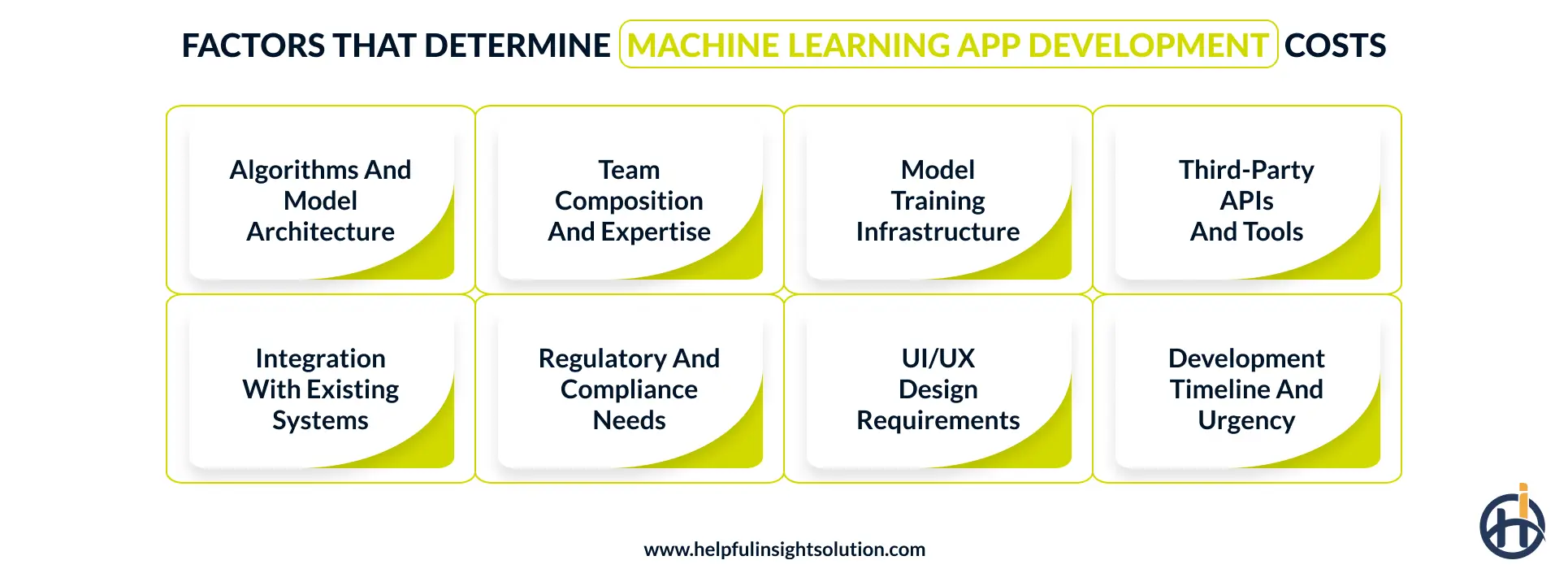
Other than complexity level, there are more factors influencing the cost to build a machine learning app. In this section, we are going to study each cost-affecting aspect, from team expertise to design and integration.
1. Algorithms and model architecture
Machine learning algorithms for app development, which range from a simple regression model to a deep neural network, have a direct influence on the time and cost. Various complex architectures demand more computing, data feeding, and testing effort to train various ML models.
Key point: Complex neural networks require more computing power and expert fine-tuning.
Average cost: $10,000 – $50,000.
2. Team composition and expertise
The cost of building an ML application depends heavily on the involvement of data scientists, ML engineers, app developers, and QA specialists. Highly experienced professionals or niche expertise in areas like NLP or computer vision demand higher rates.
Key point: Project duration, team’s expertise, location, and composition may increase overall cost.
Average cost: $15,000 – $90,000
3. Model training infrastructure
Training ML models requires multiple computing resources, such as GPUs, storage, and cloud processing, especially when working with massive datasets. Model development cost can increase as the model grows with the dataset size and the number of training iterations.
Key point: GPU usage and cloud computing scale with dataset size and iterations.
Average cost: $5,000 – $50,000
3. Third-party APIs and tools
The implementation of third-party APIs for tasks, such as speech recognition, image processing, and translation, helps to reduce the timeframe. Depending on the ML app development framework, licensing fees, and API endpoint consumption, the overall cost may increase for the project.
Key point: Licensing fees and usage-based pricing add to development expenses.
Average cost: $2,000 – $25,000
5. Integration with existing systems
Custom development and testing are required to integrate the machine learning app with databases, CRM platforms, AI chatbots, or enterprise software. The complexity of legacy systems and data compatibility issues may also impact the cost of integration.
Key point: Legacy system compatibility and custom testing increase integration complexity.
Average cost: $3,000 – $35,000
6. Regulatory and compliance needs
Various industries follow strict data privacy regulations like HIPAA or GDPR for healthcare and PCI DSS for finance. These compliance standards and laws increase costs for tasks like security audits, data encryption, and legal consultation.
Key point: Security audits and legal consultation ensure HIPAA or GDPR compliance.
Average cost: $4,000 – $30,000
7. UI/UX design requirements
A clean, intuitive interface takes additional time and requires more effort for design resources, wireframing, and usability testing. More powerful interfaces with complex, custom visualizations will also increase ML app design and development costs.
Key point: Custom visualizations and usability testing raise design and development costs.
Average cost: $2,000 – $20,000
8. Development timeline and urgency
Strict deadlines may require extra resources and necessitate working extra hours, leading to higher project costs. A realistic, conservative, and phased machine learning app development timeline tends to result in lower overall costs and high-quality output.
Key point: Tight deadlines can require additional resources and may increase project expenses.
Average cost: $3,000 – $40,000
Machine learning app development cost breakdown by stage
The machine learning app development cost is also influenced by various app-building stages, from project analysis to testing and deployment. Model training and data preparation costs for machine learning platforms are the major drivers in the overall process.
It is important to understand these factors while combining mobile app development with advanced ML capabilities and architectures. In this stage-wise breakdown section, we will explore different steps, each having a specific cost range and explanation. This will allow product teams to adjust budget requirements, review business models, and prioritize machine learning technologies before investing.
| Stage | Cost Range | Description |
| Discovery & requirement analysis | $5,000 – $20,000 | Defining project scope, objectives, and technical feasibility with stakeholders |
| Data collection & preparation | $10,000 – $50,000 | Gathering, cleaning, and labeling data forms the model’s core foundation |
| Model selection & architecture design | $8,000 – $35,000 | Choosing algorithms and designing architecture suited to business requirements |
| Model training & validation | $10,000 – $60,000 | Training models on data and validating the performance through rigorous testing |
| App development & UI/UX design | $5,000 – $80,000 | Building the application interface and integrating trained models seamlessly |
| Testing & quality assurance | $2,000 – $30,000 | Identifying bugs and performance issues and ensuring reliable, secure functionality |
| Deployment & ongoing maintenance | $5,000 – $75,000 | Launching the app and providing continuous updates, monitoring, and support |
Hidden and ongoing cost factors after a machine learning app launch
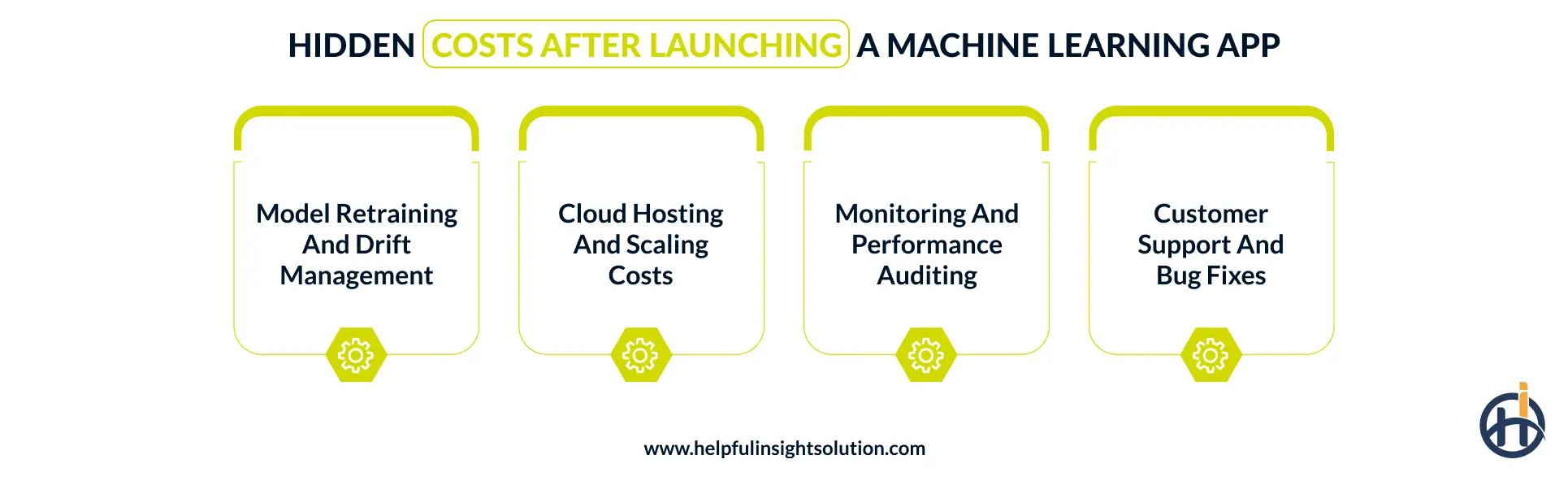
The cost of building a machine learning app also depends on some hidden factors, like bug fixes and cloud hosting. Some of the crucial points are explained in this section that businesses must not ignore.
1. Model retraining and drift management
As the real-world data diverges from the historical data on which the model was originally trained, the overall accuracy begins to drift, which is known as model drift. This requires retraining, revalidating, and updating training sets, increasing the ongoing cost after launch.
2. Cloud hosting and scaling costs
Running machine learning in healthcare, fintech, or logistics applications requires model-specific cloud infrastructure for storage, computing power, and GPU usage, especially as user traffic grows. Costs can rise sharply during scaling, real-time inference, or when handling large volumes of patient data.
3. Monitoring and performance auditing
It is critical to track model performance, latency, and overall system health to understand the machine learning maintenance cost. By regularly auditing models for degradation, bias, or anomalies, it is easy to avoid expensive failures and compliance problems across regions.
4. Customer support and bug fixes
After launch, businesses require dedicated support teams to respond to user requests, technical problems, and app crashes as they arise. Additionally, they require ongoing maintenance and updates to fix minor bugs and ensure a seamless user experience.
Cost comparison of a custom-built ML app vs. ready-made solution
Businesses can build an ML-powered mobile app from scratch or buy third-party services for deploying a ready-made solution. Both approaches depend on budget, market constraints, and user needs, affecting the cost to build a machine learning application.
Additionally, it is beneficial for investors to evaluate the total cost of ownership (TCO), time-to-market, and long-term maintenance. For niche use cases in NLP, agentic AI, generative AI, or computer vision development, most enterprises adopt custom-built solutions, having a higher upfront cost, rather than off-the-shelf tools, because of high accuracy. In this section, we will discuss some build vs. buy machine learning cost differences based on key parameters.
| Parameter | Custom-built ML app | Ready-made solution | Description |
| Initial development cost | $120,000 – $350,000 | $200 – $1,500/month | Custom builds require full-scale development from scratch, driving costs up. |
| Customization & features | $60,000 – $150,000 | $300 – $2,000/month | Tailored models and workflows cost more than pre-built configurable templates. |
| Third-party integrations | $30,000 – $70,000 | $100 – $800/month | Connecting custom APIs takes longer than using pre-integrated, ready-made connectors. |
| Data security & compliance | $40,000 – $90,000 | $150 – $1,200/month | Custom compliance frameworks cost more than vendor-provided standard security measures. |
| Maintenance & support | $50,000 – $120,000 | $100 – $900/month | Ongoing custom updates require dedicated teams compared to vendor-managed support. |
| Scalability upgrades | $70,000 – $180,000 | $250 – $2,500/month | Custom architecture scaling costs more than upgrading existing subscription tiers. |
In-house vs. outsourced ML development: Cost comparison
The in-house vs. outsourced ML development cost depends on the financial model, infrastructure, and project management needs. If businesses own AI tools, then building an in-house team is recommended, but outsourcing is more suitable for MVP or pilot project testing. Also, the integration of NLP, chatbot, and generative AI development services may increase outsourcing expenses, allowing businesses to build in-house teams.
This section provides an overview of the cost of machine learning app development based on different criteria. The following table provides estimated rates for each hiring model with their respective explanations.
| Criteria | In-house development | Outsourced development | Description |
| Hiring & recruitment | $60,000 – $150,000 | $40,000 – $70,000 | In-house hiring involves salaries, benefits, and lengthy recruitment cycles. |
| Infrastructure & tools | $50,000 – $120,000 | $20,000 – $50,000 | Outsourced teams use vendor-owned infrastructure, reducing upfront setup expenses. |
| Training & skill development | $40,000 – $90,000 | $15,000 – $35,000 | In-house teams need continuous upskilling for evolving ML technologies. |
| Project management overhead | $45,000 – $100,000 | $25,000 – $55,000 | Outsourcing partners handle management, cutting internal coordination costs significantly. |
| Long-term maintenance | $80,000 – $200,000 | $30,000 – $90,000 | In-house maintenance demands dedicated staff versus flexible outsourced contracts. |
Cost reduction strategies for machine learning app development
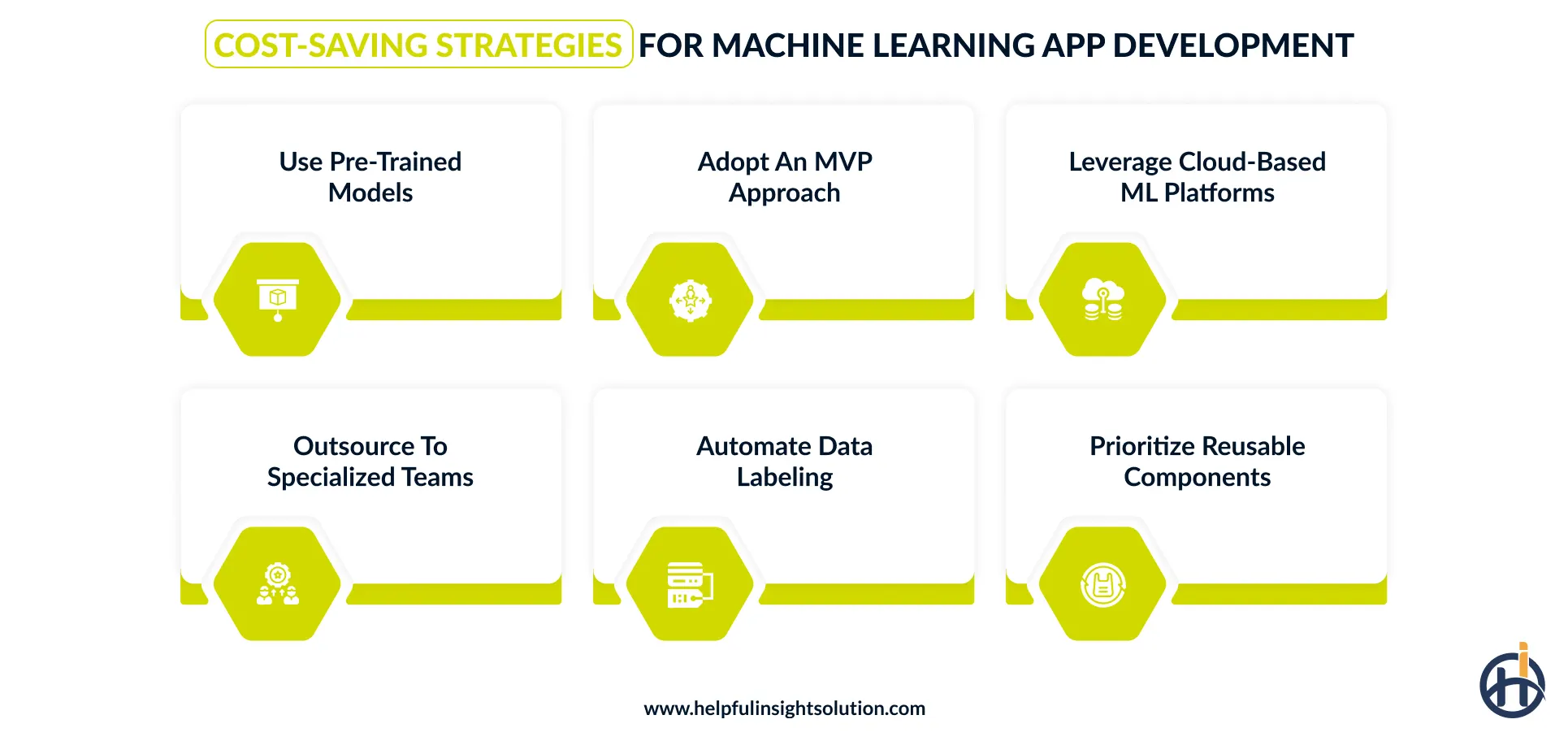
Enterprises use various methods like the MVP approach or pre-trained models to reduce the ML app development cost. Here, you will study key cost-reducing strategies that help in managing budgets at all stages.
1. Use pre-trained models
Businesses can use pre-trained models for fairly standard functions such as image recognition, speech processing, or natural language processing instead of building models from scratch. This reduces development time, computing cost, and the need for large proprietary data sets.
2. Adopt an MVP approach
It is beneficial to build an MVP to reduce investment risks and enhance models based on real user feedback. For ML projects, it is important to start with a basic version first, enabling the core ML features that confirm the concept before progressing to full development.
3. Leverage cloud-based ML platforms
Various cloud platforms like AWS, Google Cloud, and Azure offer a pay-as-you-go pricing model for computing power, storage, and pre-existing predictive analytics services. This alleviates the need for buying expensive on-premises infrastructure and reduces maintenance costs over time.
4. Outsource to specialized teams
Businesses can work with a machine learning app development company and access specialist knowledge without building, training, and paying a full-time team. They mainly experience cost efficiencies and faster delivery by collaborating with offshore teams.
5. Automate data labeling
Automated or semi-automated data labeling tools speed up the data preparation process while reducing manual labor costs in real time. This allows teams to handle larger datasets efficiently, perform data migration, and focus on priority tasks.
6. Prioritize reusable components
By building reusable code components and model architectures, businesses can easily reduce redundant development work across future projects. This approach saves time and cost when scaling the app or adding new ML features at later stages.
Future trends impacting ML app development cost
Several future trends impacting machine learning app development costs include low-code platforms, API-first integration, and edge computing. As ML infrastructure cost may increase due to these trends, this can affect budget planning and model selection for businesses.
For example, the rise of AI agent development supports more autonomous capabilities in apps, which can influence both development complexity and long-term costs. In this section, we are looking at major technology trends that will impact ML apps in the future.
Shift toward MLOps and automation: Automated MLOps pipelines reduce long-term costs through model deployment, monitoring, and retraining. Initial setup requires investment in various tools, infrastructure, and advanced DevOps services.
Growth of pre-trained models: Open-source LLMs and pre-trained models are reducing initial development costs for common use cases. Fine-tuning these models for niche applications requires specialized expertise and additional budget.
Focus on data privacy regulations: Various global data privacy laws are raising compliance and security costs across ML projects. At the same time, standardized compliance frameworks are streamlining audits and reducing repeated legal overhead.
Edge AI and on-device processing: Edge computing reduces long-term cloud hosting costs by processing data directly on user devices. Initial development costs rise, though, due to hardware optimization and specialized model compression requirements.
Low-code/No-code ML platforms: No-code platforms are lowering development costs for simple ML use cases and faster prototyping. Complex, enterprise-grade applications still require custom development, keeping overall project costs relatively high.
Choose Helpful Insight to build cost-effective and smart machine learning applications
We have studied all the major factors and market aspects that influence the machine learning app development cost in this blog. Now, it’s time to approach an expert team who can help in managing the budget and prioritizing key features.
Helpful Insight ensures constant support across the complete development lifecycle and provides talented experts with specialized skills. Our developers have experience with NLP, chatbots, computer vision, and large language model development, enhancing the accuracy, speed, and performance of the systems.
Whether you are a leading firm across various industries or a new startup in the market, it is highly recommended to know the cost of developing an ML app. This strategy will help you make a precise budget plan, focus more on repeat users, and increase visibility in different regions.
So, wasting time is not an option for you, as your competitors also aim to deploy machine learning-enabled solutions. Connect with us and get clear insight into ML technology and its integration with mobile apps.
FAQs
Machine learning-powered mobile apps require data engineering, high-performance cloud infrastructure, and continuous model retraining. The cost is higher than traditional platforms because of advanced GPU clusters, massive data cleaning, and drift correction. Complex neural networks depend on trial-and-error and algorithm tuning, increasing the overall price.
Various generative AI models, deep learning architectures, and ML classifiers are used to build mobile applications. They are implemented in the cloud or directly on-device to minimize latency and ensure multimodal features. Major algorithms include CNNs, RNNs, linear regression, random forests, decision trees, and support vector machines (SVMs).
The ongoing operational costs are high due to intense compute power, specialized infrastructure, and massive datasets. Various factors like GPU utilization, retraining cycles, constant debugging, and ETL pipelines affect the expenses. GPUs help to avoid latency or app crashes during traffic spikes, and vector databases allow faster data search.
ROI is calculated by dividing net financial gains by total project costs, factoring in model accuracy and error penalties. For ROI estimation, a few steps are discussed in the following manner:
- It is crucial to identify the baseline by including labor, error correction, and downtime expenses.
- You should consider data preparation, software, infrastructure, and model retraining.
- Multiply tasks by face value, subtract manual reviews, and apply performance benchmarks.
- Test for scenarios like higher cloud costs or lower accuracy and adjust ongoing maintenance.
The initial setup cost of RAG ranges from $350 to $2,800, whereas the upfront cost for fine-tuning is between $2,500 and $18,000+. Fine-tuning models is expensive because they require full, repetitive dataset clean-up and repeated training cycles. In RAG, businesses pay for embedding API calls and vector database storage, but in fine-tuning, the cost depends on human data labeling and GPU cluster hours.