

Key Takeaways
- Ready-made quoting tools come with the vendor’s rating rules and carrier connections fixed. A custom build lets a carrier load its own filed rates, own the API, and add partners without a change request.
- A single-product build starts near $30,000; a multi-market platform runs past $300,000. The feature list, the integrations, the team’s location, and the compliance work in each market move that number.
- Carrier connections repeat the cost. Each carrier sets its own request format, its own authentication, its own limits, which means every connection gets built and maintained separately.
- The insurance line decides the rating work. Life waits on medical and driving records, auto rates the vehicle alongside each driver, commercials start from a class code, group health prices a whole census.
- More than one market means more than one rulebook in the same engine, with a state department of insurance in the US, IRDAI in India, and the Central Bank of the UAE each holding its own filed versions.
- Choose a partner for insurance-specific answers: stored rate versions, a passed carrier sandbox certification, and a regression suite that checks premium outputs each release.
Quoting experience is one of the four core factors for customers who purchase a policy digitally. The other three are design, information, and system performance.
92% of customers who had excellent digital interactions with an insurance carrier, like fast and seamless quoting, say they will return to them for future needs. 84% of insurers that enhanced customer experience increased revenue. (CX Pilots)
Insurance quoting software is the layer that is responsible for delivering this customer experience. It is used to collect the applicant’s details. The rating logic is applied to those details, and a price is returned within a few minutes, or even in seconds.
In 2026, nearly half of the policies (47%) are now brought online. Insurance quoting software development is the way to stay relevant and meet customers’ expectations. (CX Pilots)
Cost is among the most significant questions for insurance carriers that are planning to build quoting software.
Insurance quoting software development cost depends on the features. It also depends on integrations, on the location of the development team, and on the compliance work.
This blog will help with understanding all these factors in detail, along with an estimated cost.
What Is Insurance Quoting Software?
Insurance quoting software is used to calculate the price of an insurance policy. It collects the applicant’s information and applies the rating rules to it. The rating rules decide the premium and coverage terms, sending them back to the applicant’s screen to review.
The software is responsible for a few steps in order. It collects applicants’ details from a web form or an agent screen. These details are checked against the rules that the carrier has filed with its state regulator. Outside data is also pulled at this stage, like a motor vehicle record or a claims history report.
Insurance quoting software is helpful for two kinds of users. Carriers can use it on their website to collect applicants’ information, and the price is shown on the next screen. Brokers can use it to feed applicants’ details to several carriers, and the premiums are shown together.
What Is an Insurance Quoting Engine?
An insurance quoting engine is the part of the software that does the actual premium calculation. The quoting software covers the whole product, which includes the forms, carrier integrations, and the screen the price is shown on. The engine is only the component where the rating rules are stored and applied.
The engine holds the rate tables and the rating factors the carrier has filed. A set of applicant details is passed into it, the rules are applied against the rate tables, and a premium is returned. The same engine is used for every quote, which is the reason two applicants with the same details are given the same price.
An insurance quoting engine can be built as part of a custom development project, or it can be licensed from a rating provider and connected to the rest of the software.
Why Businesses Are Investing in Custom Insurance Quoting Software
Ready-made quoting tools come with the rating rules already built in, and the carrier connections are fixed by the vendor as well. With custom insurance quoting software, the carrier is able to put in its own filed rates.
- Faster quote turnaround: John Hancock brought down the time taken for a preliminary underwriting assessment on simpler life cases. The assessment used to take about a day; it now takes around 15 minutes after a GenAI tool was added to the process in January 2026. (Source: John Hancock)
- More quotes per buyer: Customers are now collecting an average of 3.5 quotes before they buy, which is the highest number in the history of the study. A carrier able to return a price quickly will be in that set of quotes. (Source: J.D. Power 2026 U.S. Insurance Shopping Study)
- Easier work with partners: Car dealers, retailers, and lenders want the premium to be shown inside their own checkout, and this is generally called embedded insurance. With a custom build, the API belongs to the carrier. A new partner can be connected by the in-house team, without a change request going to a vendor. Settings can also be different for each partner. The questions, the products, the branding, the rate version- all of it can be varied.
- A record for the regulator: A custom engine can keep a record of which version of the field rate was used for which premium. State insurance departments ask for records like this in a market conduct exam, which is a review of how a carrier prices and sells its policies.
Key Features of Insurance Quoting Software
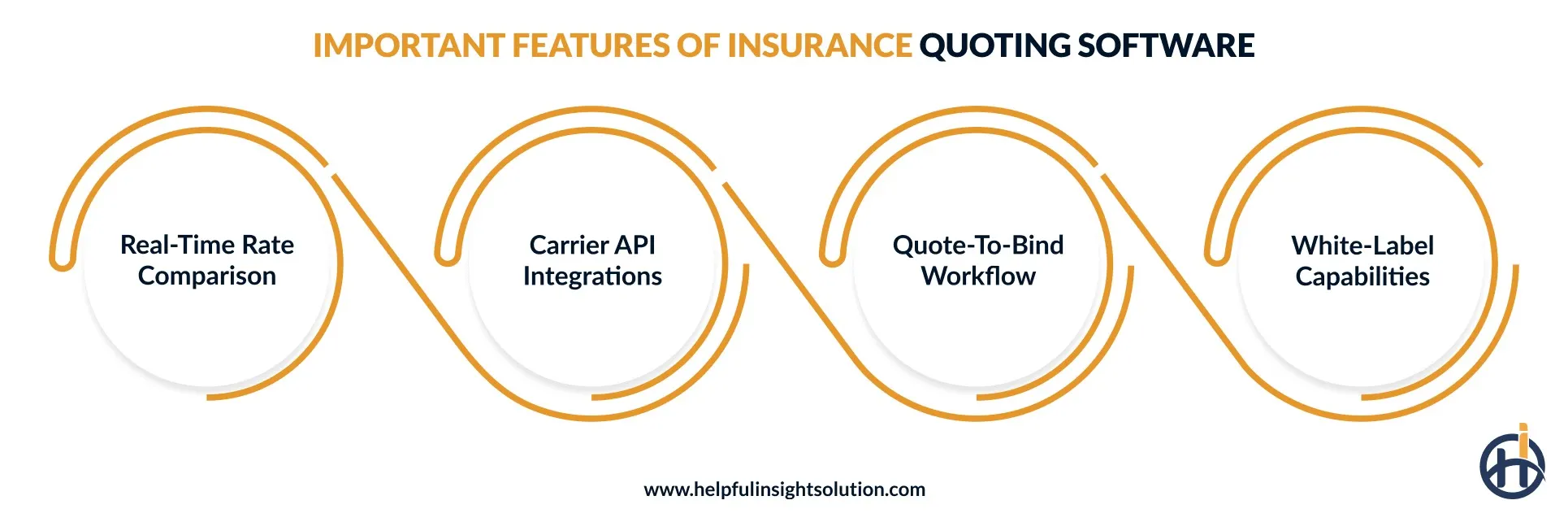
The application form and the final premium are the two things an applicant actually sees. On the carrier’s side, there are rating tables, integration with each carrier, a referral queue for the cases that stop, and templates for the documents.
An estimated cost to develop insurance quoting software is calculated based on both sides.
Real-Time Rate Comparison
Real-time price comparison works by sending applicant details to every rating source at the same time, returning the premium.
The responses don’t have the same coverage. One carrier might have a different coverage limit; the next one returns a different deductible. Quoting software for insurance brings them all into a common format, facilitating a side-by-side comparison.
Carrier API Integrations
An API is a bridge between two software systems to pass information to each other. A quoting software API has a job to submit an applicant’s answers to a carrier’s rating system and bring back the premium.
Each carrier sets its own terms for that exchange. The request has to be laid out the way that the carrier expects it. The software has to prove who it is before the carrier will answer, which means meeting authentication protocols. Carriers also cap how many requests can be sent in a minute, and each one runs a test environment where the connection is checked before it goes live.
Since none of that is shared between carriers, connecting to five carriers means building and maintaining five separate APIs. As rates get revised and APIs are upgraded to newer versions, every change on the carrier’s side means the connection has to be updated. This part of building insurance software carries on for as long as the carrier stays connected.
Quote-to-Bind Workflow
Quote-to-bind covers what happens between an accepted price and an issued policy. Once the applicant accepts, the software goes back for the details a policy needs that a quote did not.
At this stage, the system collects payment and issues the policy documents. Applications failing outside the insurance quoting engine rules can be automatically approved and are routed to an underwriter, and insurance underwriting software is where the review happens. The quote remains open while the underwriter makes a decision.
White-Label Capabilities
White-label means one company builds the quoting software and another company sells it under its own name. Customers using it see the seller’s brand; the insurance software development company that built it stays out of sight.
Agency networks buy quoting software this way, and so do MGAs. An MGA, or managing general agent, is a firm that prices and issues policies on a carrier’s behalf. Both put their own logo and colors on the screens. The web address is theirs as well, while the software running underneath is the same for everyone.
A decision to develop white-label insurance quoting software changes how the system is put together. One copy of the software now serves several selling companies at the same time, which means each company’s records have to be stored apart from the others.
Every company also gets its own set of user logins, and the products on offer can be different from one company to the next. Those differences are handled through settings rather than a separate build, which means a new selling company can be added without the development work starting again. This same settings-driven approach is common across fintech app development, where one build serves several branded partners.

Factors Affecting Insurance Quoting Software Development Cost
The overall project cost depends on the development efforts. Scope is estimated in working hours or days, then multiplied by the developers’ hourly rates to determine the final estimate.
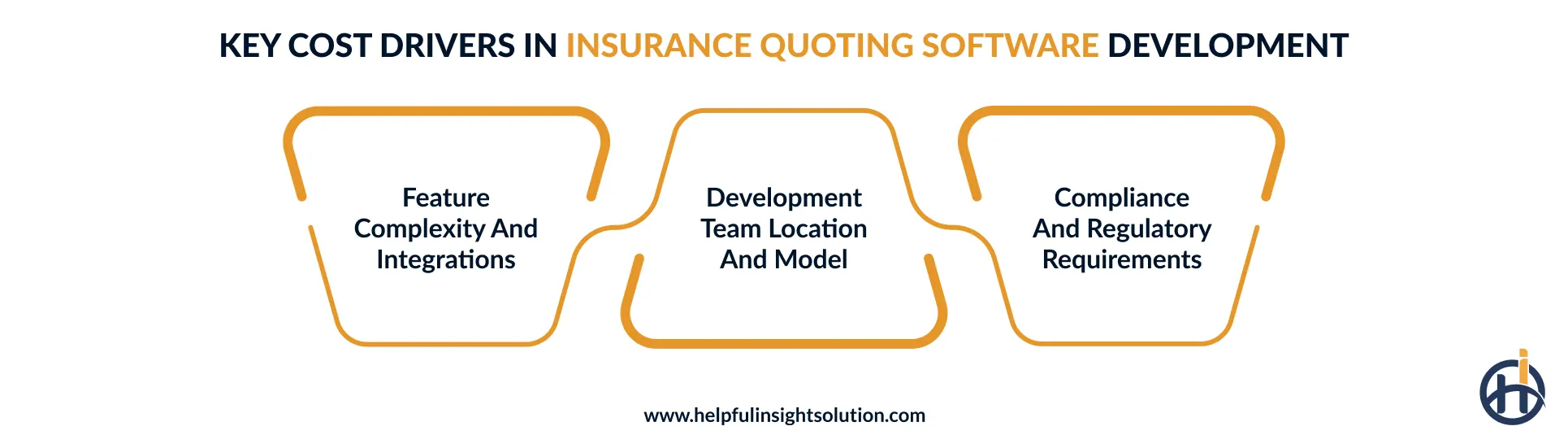
Feature Complexity and Integrations
The number of features and their complexities directly impact the development cost. A basic quoting platform asks a fixed set of questions and calculates the premium. Expanding beyond the core functionality requires additional screens to design, develop, and test.
Features such as storing quotes for future reference, adjusting deductibles for real-time premium updates, an administrative portal for agents, or analytics tracking each add additional development hours.
Integrating external services such as policy administration systems, payment gateways, and data providers increases the complexity further. Each third-party system expects information in different formats and orders, and returns a different response, so each integration has to be built separately.
Development Team Location and Model
The hourly rate of development teams varies from one region to another. A developer in India costs far less than one in the United States at the same seniority. An identical insurance software development project produces two different quotes from Indian and USA teams.
Offshore software development services are priced against these ranges.
| Region | Hourly developer rate |
| India and South Asia | $25 to $45 |
| Eastern Europe | $30 to $75 |
| United States | $100 to $250 |
The engagement model decides how this hourly rate gets applied. A fixed-price contract works against a scope decided at the beginning of the project, whereas a time and materials model suits a project with evolving requirements.
A dedicated team billed monthly fits carriers that keep releasing after the first version is live.
Compliance and Regulatory Requirements
Every market a quoting product sells in has its own regulators. Rates go to the state department of insurance in the United States, to IRDAI in India, and to the Central Bank of the UAE.
The insurance quotation system has to hold whichever version the regulator has on file and apply it to the applicant. A carrier selling across multiple markets has to run a set of rules for each market in one system.
A filed rate applies from a set date, which is why the engine keeps earlier versions and selects the one that was live when the quote was run.
Reviews ask which rate version produced a given quote. Recording the rule version, the inputs, and the premium against every quote issued is the job insurance compliance software does.
Meeting these compliance and regulatory requirements is upfront work that has to happen during development, and it affects the cost.
Also read: IT Compliance Regulations for Industries in the U.S
How Much Does Insurance Quoting Software Development Cost?
Cost to develop insurance quoting software ranges between $30,000 and $300,000, and platforms built for several markets run past that. This estimated cost covers design, development, testing, and deployment. Beyond this, hosting, data provider fees, and per-quote costs will continue as long as the software is live.
Cost by Project Tier
| Tier | Timeline | Estimated cost |
| Basic | 3 to 5 months | $30,000 to $75,000 |
| Mid-complexity | 6 to 9 months | $100,000 to $300,000 |
| Enterprise | 10 months and beyond | $300,000 and above |
Basic quoting software supports one product for one company. The applicant fills in a form, one rating source returns a price, and the quote is saved or emailed. A carrier starting with auto or term life insurance can start at this tier.
Mid-complexity software has to work with three products with several rating sources, an agent screen alongside the customer form, stored quotes, and payment. Carriers replacing an older rating tool build here.
Enterprise software has multiple products across more than one regulator. This includes white-label access for partner brands, along with integrations to policy administration, billing, and document generation. Each carrier or data provider connection beyond the base scope adds $8,000 to $30,000.
Insurance Quoting Software Development by Insurance Line
Quoting software varies by product line, though features like user authentication and stored estimate records stay largely the same across lines.
The classification systems and rating standards named below are the US ones. An insurer quoting in India works from product structures filed with IRDAI, and one quoting in the UAE works from rates held under the Central Bank of the UAE.
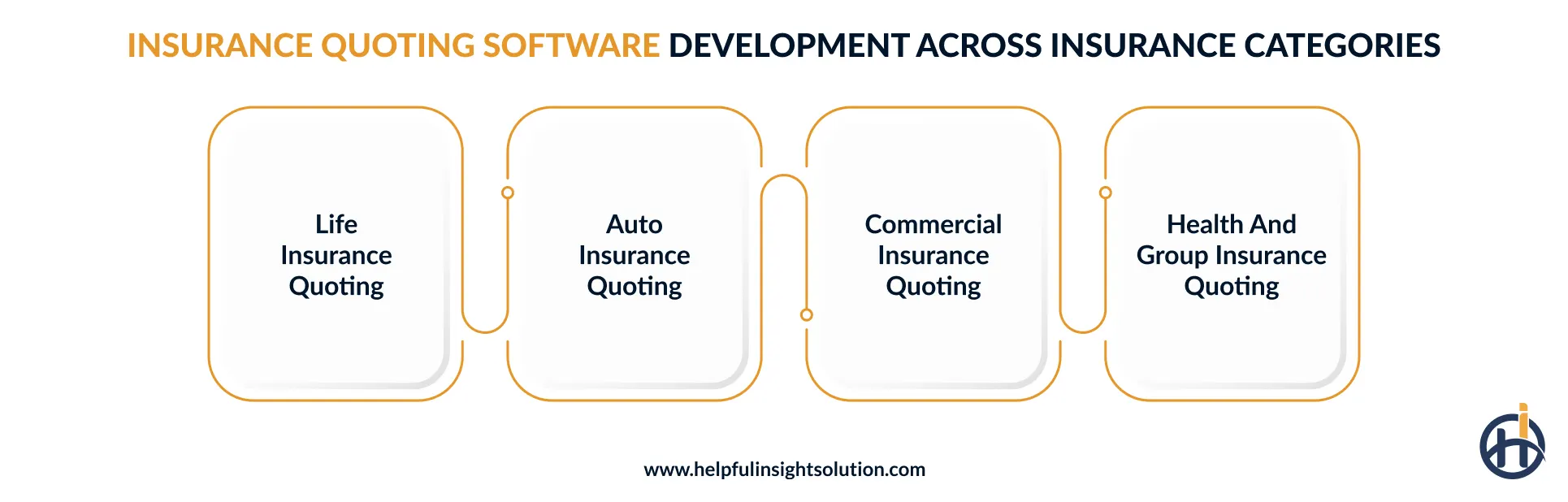
Life Insurance Quoting Software Development
Life insurance quoting works on band-rate pricing, in which premium rates per thousand dollars of coverage decline as the total coverage amount crosses specific policy thresholds or band limits.
The software asks the applicant for information like age, gender, tobacco usage, height, weight, medical history, and family health background. Since self-reported data cannot be verified immediately, the engine executes a two-stage underwriting process:
- Stage 1 (indicative pricing): Calculates an initial estimated quote based on self-reported inputs.
- Stage 2 (record verification): Automates third-party API queries to pull Motor Vehicle Records (MVR), prescription drug histories, and Medical Information Bureau (MIB) reports to validate risk factors before issuing a final, binding offer.
Auto Insurance Quoting Software Development
Auto insurance quoting software calculates the premium by combining location, vehicle attributes, driver profiles, and applicable discounts in real time. The primary calculation steps include:
- Garaging address and territory Rating: Premium calculation begins with the ZIP code where the vehicle is parked. Territory factors account for localized loss history, traffic density, and theft risk before individual driver details are entered.
- Vehicle rating symbols: Each vehicle manufacturing year, model, and variant is assigned a numeral rating symbol derived from ISO or proprietary carrier tables. This symbol reflects historical repair costs, safety ratings, and claim frequencies for comprehensive and collision coverages.
- Multi-driver and multi-vehicle assignment logic: When multiple drivers and vehicles exist on a quote, the rating engine evaluates all driver-vehicle combinations, then assigns drivers to vehicles under the carrier’s filed assignment rule, which varies by state.
Also read: How to Develop a Car Insurance App
Commercial Insurance Quoting Software Development
Commercial insurance quoting software works on multi-variable risk models where premiums are calculated using the industry class codes, dynamic exposure bases, experience modifiers, and schedule rating adjustments.
- Class code classification (NAICS, SIC, and ISO/NCCI): The system maps business operations to standardized class codes to retrieve base rates and rule sets filed with state regulators. The engine automatically filters eligible coverages, policy forms, and underwriting questions based on primary and secondary operational codes.
- Dynamic exposure base calculation: Rating logic applies specific exposure factors depending on line of business, like gross annual payroll for Workers’ Compensation, gross sales/revenue for General Liability, square footage for Commercial Property, or vehicle count/fleet composition for Commercial Auto. The engine calculates base premiums by multiplying rated exposure units against filed class rates.
- Experience Modification Rate (EMR) and loss run parsing: The software ingests prior loss history (typically 3 to 5 years) to apply Experience Rating Modifications. Integration with OCR and parsing APIs automatically extracts claims history, valuation dates, and loss totals from PDF loss runs, calculating credit or debit modifiers directly within the rating pipeline.
- Schedule and individual risk rating logic: Underwriter discretionary credits and debits (e.g., safety programs, premises condition, risk management practices) are applied as percentage adjustments against the modified premium, automatically maintaining audit trails for state compliance exams.
Health/Group Insurance Quoting Software Development
Health and group insurance quoting software evaluates risk at the group population level. The premium calculation pipeline depends on processing member census files, executing dual rating methodologies, and modeling multi-variable plan designs in parallel.
- Employee census file ingestion: The software ingests employer census files (CSV or Excel) having record-level demographic data like employee age, home ZIP code, and dependent coverage tier (Employee Only, Employee + Spouse, Employee + Children, or Family). The engine validates data formats, maps county rating areas from ZIP codes, and flags missing entries before calculating premiums.
- Age-banded vs. composite rating logic: The engine supports two distinct rating algorithms. Age-banded rating calculates an individual premium for each employee and covered dependent, using ACA-standardized age curves and rating regions for individual and small group business, then sums the total. Composite rating converts those individual premiums into one fixed average rate per coverage tier, which means every employee in the same tier is charged the same amount.
- Plan design and benefit modeling: To generate multi-option proposals, the quoting engine applies census data against multiple plan variations simultaneously. It computes pricing across varying deductible thresholds ($500 to $8,000+), copay structures (PCP/specialist rates), coinsurance splits (80/20, 70/30), and network types (HMO, PPO, EPO). The output presents side-by-side cost comparisons across all selected benefit combinations.
Insurance Quoting Software for Brokers and Agencies
Insurance broker quoting software functions as a comparative rater that automates multi-carrier submissions and streamlines agent workflows.
- Multi-carrier submissions: The platform collects a single set of risk and applicant details. The information is shared with multiple insurance carriers simultaneously using APIs or web-scraping adapters. This eliminates the need to manually enter data into each carrier’s portal and returns the quotes within seconds.
- Data and coverage normalization: Each carrier returns quotes with variable deductibles, endorsement structures, and coverage limits. The platform brings all the responses into a unified taxonomy. Disparate terms are aligned into a side-by-side proposal format, allowing agents and clients to compare coverages, exclusions, and premiums.
- AMS and CRM Integration: Bi-directional integration with Agency Management Systems (AMS) and CRMs eliminates duplicate data entry. Client demographic and policy details flow directly from the CRM/AMS into the rater to generate quotes, while bound quote records, attachments, and premium breakdowns write back automatically to maintain central policy records and audit histories.
How to Choose a Development Partner for Insurance Quoting Software
A carrier is the one that knows its own products and the rates it has filed. Custom insurance software is what the development partner is brought in for. The points below are the ones to check to hire the right insurance development company:
- Rate filing and versioning: Effective-dated rate versions are part of nearly every insurance build. Ask which past project stored them. Ask also what happened when a refiling came in during that project.
- Carrier API certification: Every carrier has a sandbox certification that is used to approve a connection before it goes live. The list of carriers a team has already been through is worth requesting.
- ACORD and agency systems: ACORD forms are used across broker and agency work. IVANS download is used to move data into an agency management system. A team that has worked on them earlier will help to launch your software confidently.
- Testing of rating logic: Premium calculations are not something a general QA engineer is able to verify. There has to be a regression suite where known inputs are run against expected premium outputs on every release. Request one from an earlier build.
- Security assessments: Carriers run a vendor security assessment before production access is granted. Ask if the partner has been through one. Encryption and access control are part of it. In some states, the NAIC Insurance Data Security Model Law applies as well.
- Audit trail: Every quote is logged against the rule version, the inputs, and the premium returned. Regulators ask for this record.
- Rate maintenance: After go-live, somebody has to keep the rate tables current. It is worth knowing whether the carrier’s own pricing team is able to do that, or whether every rate change becomes a ticket to the vendor.
- More than one regulator: IRDAI product filing in India and the Central Bank of the UAE requirements are not the same as US state filings. A partner working across those markets has to know all three.
Conclusion
Developing custom insurance quoting software is a strategic investment enabling carriers and brokers to deliver fast, accurate, and seamless pricing experiences.
The initial insurance quoting software development costs range from $30,000 to over $300,000 depending on feature complexity, carrier integrations, team location, and compliance requirements. Custom solutions eliminate vendor limitations, support multi-market scalability, and ensure regulatory compliance for long-term sustainable growth.
With over a decade of experience, Helpful Insight has built software for regulated sectors including insurance and finance, and knows what a compliance review actually asks for at go-live.
Partnering with our experienced engineering team ensures your business stays ahead with robust digital infrastructure built for sustainable growth.
Frequently Asked Questions
The cost to develop insurance quoting software is $30,000 to $75,000 for a basic build, and $100,000 to $300,000 for a mid-complexity one. Enterprise platforms go past $300,000. That figure covers design, development, testing, and deployment. Hosting and the per-quote charge each carrier bills are separate.
The quoting engine is the component that holds the rate tables and applies the rating rules. Applicant details go in, a premium comes out. Everything around it- the forms, the screens, and the carrier connections- makes up the rest of the insurance quotation system.
Four things account for most of it. The feature list, the number of outside systems connected, the location of the development team, and the compliance work required in each market. A one-product insurance quote system in a single state is not priced the same way as a multi-line platform selling across several regulators.
White-label work is priced above a single-tenant build, since one installation has to serve several selling companies at the same time. Separate data, separate user accounts, and a separate product set per client are all required. That places white-label projects in the $100,000 to $300,000 range or higher.
The base set in any insurance quotation software is a question form, a rating engine, and a quote output that the applicant is able to save. Insurance quotes software sold to brokers adds multi-carrier comparison and a side-by-side proposal. Payment, document generation, and a policy system connection are added where the quote has to become a policy.
A ready-made tool is faster to launch and costs less upfront, but the rating rules and carrier connections stay fixed by the vendor. A custom build costs more at the start, but the carrier owns the rates, the API, and every future integration. Carriers running one product in one state often start with a ready-made tool. Carriers filing their own rates, selling in more than one market, or planning to add partners usually move to a custom build within a year or two.
Yes. Quote software for insurance brokers and agents is built for that, sending one set of applicant details out to several carrier rating engines and returning the prices together. Each carrier connection is built and maintained on its own, which is why the number of carriers shows up in both the timeline and the cost.