


Key takeaways
- Car insurance app development means building a mobile platform for auto insurers and policyholders to manage quotes, policies, payments, and claims digitally.
- The market is growing rapidly. The automobile insurance apps market is projected to reach $48.9 billion by 2034, signaling sustained, long-term investment in the space.
- Quote generation, claims management, automated claims filing, and digital insurance cards are among the core features of a modern vehicle insurance app.
- The cost to develop a simple car insurance app starts at $30,000, while an advanced app with AI, telematics, and deep integrations can exceed $120,000-$300,000.
- The benefits of an auto insurance app go beyond customer convenience. Faster claims processing, higher renewal rates, and stronger cross-sell opportunities directly improve retention and revenue.
Car insurance mobile app development is changing how auto insurance agencies manage everyday interactions with policyholders. Quotes, policy documents, payments, and claims management can now be handled through one mobile application instead of separate channels.
This gives customers quicker access to routine services while giving insurance businesses a more direct way to manage policyholder interactions.
The shift toward mobile-first insurance is also reflected in the market. According to a Data Intelo report, the global automobile insurance apps market is projected to reach $48.9 billion by 2034.
As insurers invest in digital channels, the focus is moving beyond simply offering an app. The bigger task is building one that fits existing insurance processes and remains easy to use as the business grows.
An insurance app also needs to work beyond the customer interface. It must connect with the systems insurers already use. Getting this foundation right can directly impact the app’s long-term performance.
At Helpful Insight, we bring more than 10 years of experience in insurance app development. Our work includes solutions covering policy management, claims, customer support, and related insurance workflows.
This guide draws on that practical perspective to cover what it actually takes to develop a car insurance app that holds up as your business grows.
Benefits of car insurance app development for insurers
For many insurers, the push toward vehicle insurance app development comes down as much to efficiency as to customer experience.
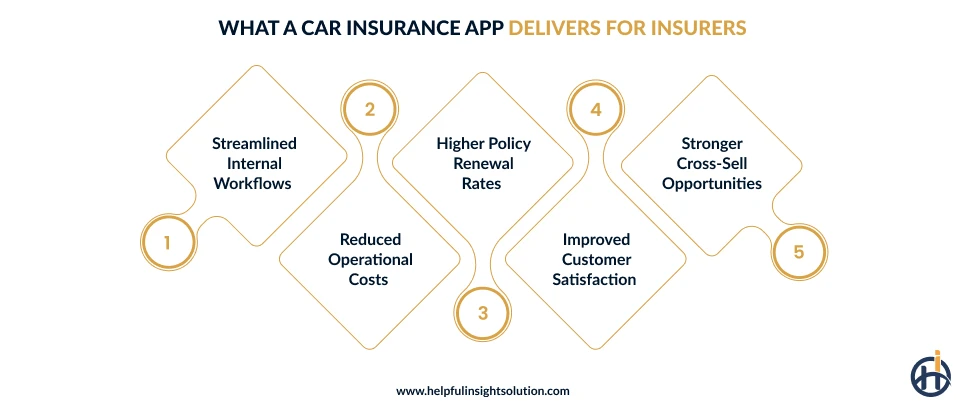
Moving routine tasks to mobile can reduce paperwork, shorten response times, and make policy servicing easier to manage while giving policyholders quicker access to the services they use most.
Streamlined internal workflows
A mobile auto insurance app takes over the repetitive parts of daily operations like claims submission, document verification, and policy updates, so staff isn’t manually re-entering the same data across systems.
It also means customers can handle routine tasks themselves, like checking a policy or requesting a document, which reduces the number of basic calls reaching your team. Underwriting and support staff end up spending their time on complex claims and disputed coverage questions instead.
Reduced operational costs
A bespoke car insurance app can reduce the cost of handling routine service requests. Digital policy documents, online payments, and self-service claim updates mean fewer paper-based processes and less staff time spent on repetitive queries.
Over time, this can lower servicing costs without making basic insurance support harder for policyholders to access.
Higher policy renewal rates
Missed renewals often come down to timing, not intent; customers simply forget. In-app alerts and instant renewal options close that gap by removing extra steps between reminder and payment.
Insurers relying on automobile insurance apps for this see fewer lapses and steadier retention across their policyholder base.
Improved customer satisfaction
An insurer’s reputation with customers often rests on small things. Did they get a renewal reminder on time? Was the policy update relevant to them? Did the service feel personalized or generic?
A mobile app handles that consistently, sending timely reminders and adjusting to customer activity without extra effort from staff. Over the course of a policy, that steady attention is usually what builds trust and keeps someone renewing year after year.
Stronger cross-sell opportunities
Cross-selling works better when it’s based on actual usage. An auto insurance app gives access to useful customer insights, such as driving patterns, renewal timing, and claims activity. So, insurers can make more relevant offers instead of sending the same promotion to everyone.
Essential features of an auto insurance app
Not every feature belongs in a first release, and adding too many at once usually slows development without adding real value.
The features of a car insurance app below reflect what policyholders actually use day-to-day, along with what insurers need to keep claims and policy management running smoothly.
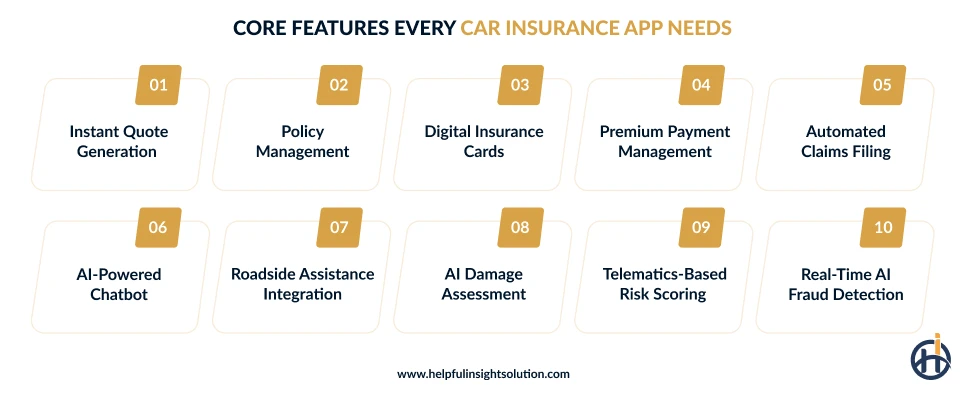
If you’re unsure where to draw that line, our team of dedicated developers can help you shortlist the right features for your specific use case.
Instant quote generation
When you build a car insurance app, instant quotes can remove much of the waiting involved in getting coverage.
Customers can enter vehicle details, choose coverage options, and receive an estimated premium within the app, giving insurers a faster way to turn interest into completed policies.
Policy management
Policyholders shouldn’t need a call to check coverage limits or add a vehicle. In-app policy management gives them direct access to update details, view documents, and renew coverage, cutting the small requests that usually pile up on support teams.
Personalized coverage recommendations
Generic coverage suggestions rarely fit real driving habits. Use of AI in insurance underwriting lets an app analyze vehicle type, location, and driving data to recommend coverage that actually matches risk, instead of pushing the same tiered options to every customer.
Digital insurance cards
Paper cards get lost, damaged, or left in another vehicle sometimes. Modern car insurance solutions replace that with a digital card stored right in the app, so policyholders always have valid proof of coverage on hand, wherever they’re driving.
Premium payment management
Switching payment methods or setting up auto-pay no longer requires visiting or calling a call center. This feature lets customers manage billing directly, cutting missed payments and reducing account-related support requests.
Automated claims filing
This functionality of vehicle insurance applications lets customers submit photos, damage details, and supporting documents straight from their phone, cutting the time between an accident and a filed claim.
AI-powered chatbot
An AI chatbot can handle many routine support requests, reducing the workload for an insurer’s team. A customer can ask about coverage, find policy information, or get help with a basic request right inside the app.
Agents can then spend their time on cases that actually need their input.
Roadside assistance integration
For car insurance app development, roadside assistance features can add practical value during an unexpected breakdown.
A driver can request help from the app, share their GPS location, and track the responding service vehicle while the insurer coordinates the assistance.
AI damage assessment
Instead of waiting days for an adjuster visit, policyholders photograph the damaged vehicle and the app, using AI capabilities, analyzes it instantly, identifying affected parts and estimating repair costs. That speed alone can cut claim resolution time significantly for simple cases.
Telematics-based risk scoring
For auto insurers building their own app, telematics adds a competitive layer. It picks up on things like harsh braking, speeding, and sudden acceleration, then turns that into a driver score insurers can actually use, particularly for setting usage-based premiums
Real-time AI fraud detection
Fraudulent claims cost insurers billions every year, and catching them manually is slow. Adding real-time AI fraud detection to your app’s features list means suspicious patterns, duplicate claims, and staged accidents get flagged before payout.

Security and regulatory compliance for car insurance mobile app development
Thinking about how to develop an insurance solution? Security and compliance need to be considered from the start.
An auto insurance app handles personal, payment, vehicle, and claims data. If those records aren’t handled properly, the insurer can face penalties, legal claims, and security incidents that proper safeguards would have prevented.
Below are the compliance and regulatory standards to follow when building an auto insurance app.
Data privacy regulations (GDPR, CCPA)
A motor insurance app can handle sensitive information, from driver details and location data to claims records. So, ensuring the privacy of customers is very important and non-negotiable.
Depending on where the platform operates, this may include GDPR or CCPA requirements, along with clear consent, opt-out options, and limits on unnecessary data collection.
PCI-DSS for payment processing
Once an app allows policyholders to pay by card, PCI-DSS requirements need to be considered as part of the payment setup. Rather than storing card details within the app or insurer’s systems, payments can be handled through a PCI-DSS-compliant gateway with tokenization.
This reduces exposure to sensitive card data while supporting both recurring premiums and one-time payments.
State-level insurance compliance (NAIC standards)
State-level rules are one of the trickier parts of insurance app development. Every state regulates things differently, which can affect rates, policy wording, disclosures, underwriting, and claims.
What works in Texas might not be applicable in New York. NAIC model laws provide a useful baseline, but insurers still need to check what each state’s regulator actually requires.
End-to-End Data Encryption
Car insurance solutions handle sensitive material, accident photos, personal identifiers, and payment details that shouldn’t be readable if it’s ever intercepted.
Data in storage gets protected with AES-256, and TLS 1.3 secures information while it’s moving between the app and backend servers.
That combination means even a successful breach attempt doesn’t actually get usable data, just encrypted noise they can’t do anything with.
Need Help Building a Compliant Car Insurance App? Let’s Talk
Technology stack for building auto insurance mobile app
For car insurance app development, the technology stack should be selected around the app’s actual requirements. Security, scalability, third-party integrations, and data processing all matter.
The following stack covers the main technologies needed to create a car insurance app.
| Component | Tools and Technologies |
| Frontend | React Native, Flutter, SwiftUI, Kotlin |
| Backend | Node.js, NestJS, .NET, Spring Boot, Go, Python |
| Database | PostgreSQL, MySQL, MongoDB, Redis |
| Cloud Infrastructure | AWS, Microsoft Azure, Google Cloud |
| AI and Machine Learning | OpenAI API, Google Gemini API, PyTorch, TensorFlow, Hugging Face |
| Payment Processing | Stripe, Adyen, Braintree, PayPal |
| Identity and Authentication | Auth0, Okta, AWS Cognito, Microsoft Entra ID, Firebase Authentication, Keycloak |
How to build a car insurance app: Step-by-step
Every stage of the car insurance app development process needs real planning. What you decide early, from the app’s core purpose to its features, shapes the final product just as much as later stages do.
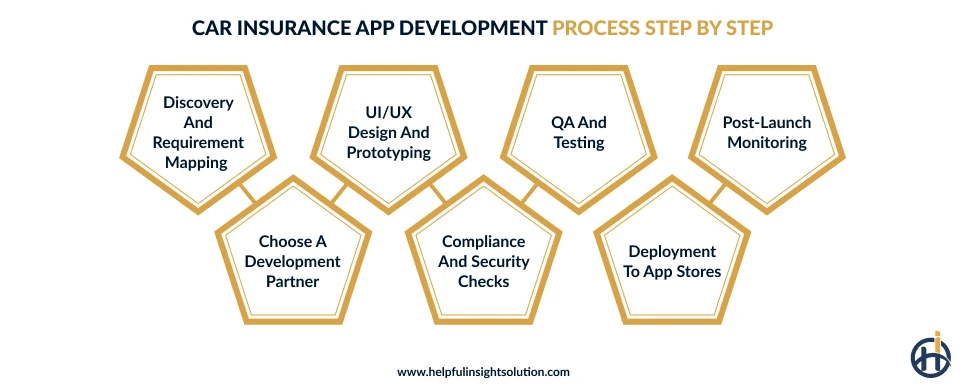
A structured approach also helps avoid costly changes later.
Discovery and requirement mapping
Before building a vehicle insurance app, define what the product needs to solve. Map customer journeys, insurer workflows, key integrations, and business goals.
This is also the right stage to identify gaps in an insurance legacy system modernization plan, so the new app fits existing operations instead of creating another disconnected system.
We’ve worked on insurance application development projects where connecting a new mobile app with existing policy and claims systems was a key requirement.
The early discovery work helped us understand how information moved across those systems and where integrations were needed. Identifying these dependencies upfront gave the development team a clearer direction and reduced the chances of workflow issues appearing later.
Choose a development partner
Work with a development team that understands insurance workflows, underwriting rules, and compliance requirements. Choosing the wrong partner can cost months in rework. Look for proven experience in mobile app development. Ask to see relevant insurance projects as well.
Helpful Insight has built solutions for insurance companies, covering underwriting and claims management. Since every insurer’s setup is different, we offer flexible engagement models rather than a fixed way of working.
Whether you need a dedicated team, staff augmentation to support an existing team, or full project ownership from start to finish, we adjust to whichever fits how you actually want to build.
UI/UX design
At this stage, the UI/UX design team turns planned features into actual screens people will use. Wireframes come first, mapping out how someone buys a policy, files a claim, or checks coverage, before any real visual design begins.
That way, the flow gets tested and fixed early, while changes are still cheap to make.
Clickable prototypes usually follow next, helping catch confusing steps before development locks anything in.
For insurance apps specifically, this matters more than it might for other industries; claims flows involve stressed users who need the shortest path possible, not a polished screen that takes six taps to file a report.
Compliance and security checks
A car insurance app handles sensitive personal, financial, and vehicle data. That makes verification essential before testing even starts.
An app or software development specialist checks that GDPR, CCPA, and relevant state-level requirements are actually built into the app.
Encryption, biometric login, and secure payment processing all get confirmed too.
QA and testing
QA engineers will run the app through both manual and automated testing before it goes anywhere near production.
This part of the car insurance app development process involves checking every screen and flow for bugs, glitches, or anything that breaks under normal use, across different devices and operating systems, so issues get caught and fixed quickly.
Deployment
Once testing wraps up, the app moves toward launch. App store listings get configured for both Google Play and the Apple App Store, metadata gets optimized for search visibility, and server infrastructure scales up to handle initial traffic without slowing down.
For larger launches, a phased release can be useful. It gives the team time to watch performance, user activity, and early technical issues.
Our car insurance mobile app development team handles this stage end-to-end, coordinating submission timelines, so nothing gets rushed out the door before it’s actually ready for real users.
Post-launch monitoring
After launch, monitor the app performance closely. Crashes, response times, feature usage, customer complaints- these all point to what’s working and what isn’t. Teams that ignore this data usually end up guessing at what to fix next instead of knowing.
Regular updates from there keep the app secure, working across newer devices, and useful to the end users.

How much does it cost to develop a car insurance mobile app?
Before moving ahead with application development, it is worth having a realistic idea of what the project could cost. Building an MVP can cost $30,000 to $60,000, a mid-level app $60,000 to $120,000, while an advanced solution can reach $120,000 to $300,000+.
These figures provide a starting point for estimating the car insurance app development cost. The actual price depends on a range of factors, including:
App feature complexity
Feature scope has a direct effect on car insurance software development cost. A simple app with policy management and payments needs fewer development resources.
Advanced features such as AI assessment and automated claims workflows add technical complexity and increase both development and testing costs.
UI/UX design requirements
A more customized UI/UX can add to the overall car insurance app development cost. A basic interface needs less design time, while detailed user flows, prototypes, accessibility testing, and custom interactions require more resources.
Platform selection
Building for one platform costs less initially, but insurers almost always need both iOS and Android eventually. This is where Flutter or React Native can help.
Both frameworks allow teams to use a shared codebase for iOS and Android, reducing duplicated development effort and keeping overall costs more manageable.
Third-party integrations
The cost to create a solution for vehicle insurance can rise with every external service you add. Payment gateways, maps, vehicle databases and CRM tools all require integration work. Some also involve subscription or usage fees, along with ongoing maintenance.
Security and compliance needs
Security requirements can affect the cost to develop software for insurance. Sensitive policy and customer data may require encryption, secure storage, and regular security testing. Compliance checks and audits can further add to the costs.
Development team location
Where your insurTech software development company is based can change the project cost considerably. Hourly rates vary across regions, with North American and Western European teams tending to charge the most per hour, while teams in Asia usually come in a lot cheaper for the same quality of work.
Here’s a quick breakdown of average hourly rates by region:
| Region | Developers’ Hourly Rate |
| North America | $90 to $150 |
| Easter Europe | $35 to $70 |
| Western Europe | $70 to $100 |
| Asia | $20 to $60 |
| Australia | $45 to $90 |
How to measure car insurance app success: Key KPIs
A lot of insurance companies track downloads and call it success, but that number says nothing about ROI. Once a bespoke car insurance app is live, the real question becomes what to measure next. These are the indicators that actually reflect performance.
Claims processing time
If claims still take days to resolve after launch, the platform isn’t doing its job. Track the average time between a filed claim and payout, and compare it against pre-app numbers. A real drop here is one of the clearest signs your claims management software and app investment is actually paying off.
App retention rate
A high number of downloads for a car insurance app doesn’t necessarily mean it’s succeeding; what matters more is whether people keep opening it after their first claim or renewal. Tracking 30, 60, and 90-day retention tells you whether the app is becoming a habit or just sitting unused on someone’s phone.
Customer support ticket volume
If support tickets barely drop after launch, self-service features aren’t being used the way they should be. A real decline in routine queries, coverage checks, and billing changes is one of the clearest benefits for vehicle insurance solutions to actually show up post-launch.
Cost per acquisition
Worth checking what it actually costs to land one paying customer through the app compared to the old channels. If that number keeps going up instead of down, the app isn’t pulling its weight yet.
Real-World examples and use cases of successful car insurance apps
Real-world apps offer a better reference point than simply following a list of standard features. Leading vehicle insurance companies like State Farm have taken different approaches to policy management, claims, and customer service through mobile.
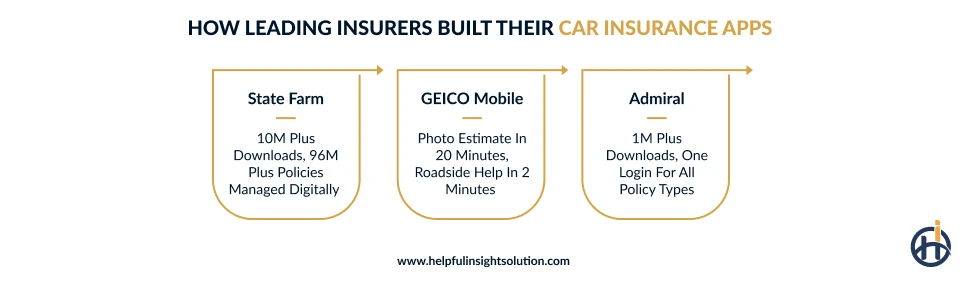
Below are some of the popular examples that can help car insurance carriers identify practical use cases, avoid unnecessary features, and make better decisions when building their own app.
State Farm
State Farm is an award-winning insurance app that lets customers manage insurance and financial services directly from their phone. It covers the essentials like digital insurance cards, payments, claims, and roadside assistance, along with safe-driving programs that offer eligible customers potential discounts.
With 10M+ downloads and State Farm managing 96M+ policies and accounts through more than 19,000 agents, the app’s reach reflects just how widely it’s actually used.
GEICO Mobile
Available across Android and iOS, GEICO Mobile covers most of what a policyholder needs without calling an agent, which includes insurance cards, payments, claims, and roadside assistance.
What sets it apart is an easy photo estimate, which turns a few damaged photos into a repair estimate within roughly 20 minutes, paired with 24/7 tow and emergency roadside help available in as little as 2 minutes through the app.
Admiral
Admiral is a UK-based app that lets customers check on their car, van, and multi-cover policies without having to log into separate accounts. It’s picked up over 1M downloads on the Play Store so far. Register once, and you can update your details, check your current policy, or grab a copy of your documents whenever you need it.
Roadside assistance is built directly into the app, so help is available without needing to search for a contact number when it’s actually needed.
Car insurance app development trends to watch
New technologies are giving insurers more ways to improve how their digital solutions work. In car insurance app development, trends such as AI-driven decisions, usage-based insurance and automated claims are gaining attention.
Understanding where these technologies fit can help insurers decide which capabilities are worth adding to their next app.
Artificial intelligence and automation
Artificial intelligence and automation in car insurance apps are moving beyond simple use cases like chatbots and photo-based damage assessment into something that changes how core processes actually work.
Underwriting now adjusts dynamically as new data comes in, instead of following static rules set months ago. Automation handles a lot of what happens behind that, routing documents and triggering renewal steps, without someone manually pushing each one forward.
For a motor insurance app, this means pricing and risk models that actually improve over time instead of staying fixed until the next manual review. It’s a shift from AI as a feature to AI as infrastructure.
Embedded insurance APIs
Embedded insurance is becoming a practical trend for insurance carriers exploring new distribution channels. APIs allow coverage options to appear inside mobility, vehicle rental, financing, or marketplace apps.
Adding this capability to a new mobile product can create additional purchase points and reach customers when insurance is directly relevant to the service they are using.
Telematics-powered driving insights
More insurers are turning to telematics as usage-based insurance becomes the norm rather than the exception.
A car insurance app can pull driving data from smartphone sensors or a connected device, with no extra hardware installation needed in some cases.
Speed, mileage, harsh braking, all of it feeds into premiums that actually reflect how someone drives.
Wearable and IoT data integration
Wearables and connected devices are opening new data sources for vehicle insurers. With wearable app development, smartwatches and IoT devices can connect with relevant insurance services where appropriate.
These connections can provide useful signals around driving, location, or emergencies, giving insurance teams more data for risk assessment and faster assistance.
Conclusion
Car insurance apps are becoming more useful as insurers move beyond basic policy management. The bigger opportunity is to bring the right services together, from digital claims and roadside assistance to telematics.
The aim should be to solve real customer and business needs, rather than simply adding more features. A well-planned car insurance app development strategy also leaves room to add new capabilities as expectations and insurance models change. And that’s where we can help.
We are a trusted insurance software development company with a team of 100+ specialists serving clients across 40+ countries. We build custom insurance apps around your business needs, from features and UI/UX design to integrations that make the platform more useful and stand out.
When you work with us, you get:
- Custom insurance app architecture built around your specific workflows
- AI-ready insurance solution models that scale with your data
- Scalable API integrations
- Post-launch product support covering ongoing updates, fixes, and monitoring
Here’s a recent case study showing how we helped an auto insurer improve claims handling through mobile technology.
A client in the USA came to us with a claims process still running largely on phone calls and manual paperwork. This was slowing down claim resolution and affecting customer experience.
We moved the process to a mobile-first app with photo-based damage assessment and real-time claim tracking. Within a few months, average claim resolution time fell by over 40%, while claims-related support calls also dropped sharply.
Have an idea for a new insurance app or want to upgrade your current platform? Our team can help with both. Get in touch with us today, share your requirements, and let’s work out the right approach for your project.
FAQs
Developing a car insurance app usually takes 3 to 12 months, depending on its scope. A basic MVP may take around 3 to 4 months, while an advanced platform with AI integration and custom workflows can take 4 to 12 months or more. Project scope, technology choices, testing, and regulatory needs also affect the timeline.
The core features of an auto insurance app should make everyday policy tasks simple. These usually include digital ID cards, policy management, online payments, claims filing and tracking, and 24/7 roadside assistance. Depending on the business model, insurers can also add telematics, AI-powered tools, automated claims, and real-time support to extend the app’s capabilities.
There are plenty of practical ways to use AI in a car insurance app. It can help estimate vehicle damage from photos, handle routine customer questions, identify suspicious claims, and understand driving behavior. It can also use customer and policy data to suggest relevant coverage, helping teams make quicker decisions without turning every task into a manual process.
To keep a vehicle insurance app aligned with GDPR and CCPA, first get a clear picture of the customer data it collects and how that data is used. Give users simple consent and opt-out options, protect their information, and make it easy to request access, changes, or deletion of their personal data.