

Key Takeaways
- A legacy insurance system can no longer keep up with the business. It is usually a monolithic core built in old languages like COBOL, with claims and billing in silos and everything running on-premises.
- The cost of running a legacy system does not stay the same, it keeps rising every year, and it takes up the IT budget that could go into new products.
- An old core also holds back real-time data, AI, automation, and faster product launches, and it widens the gap with what customers expect in 2026.
- Replacing the whole core at once (the big-bang approach) fails often. According to BCG, only 3 out of 10 big technology programs finish on time and within budget.
- The safe way is a phased approach: start with a modernization audit, wrap the legacy core with APIs, modernize the customer-facing layers first, migrate data in small batches, and run the old and new systems in parallel before retiring the old one.
- For most carriers, incremental microservices replacement offers the best balance of risk and cost, while adding AI and automation at the edges keeps the core safe.
Using a legacy insurance system in 2026 is a lot like using a featured Nokia phone in a world that has moved on to smartphones. It still makes calls and sends a text, so the basic work gets done, but you miss out on almost everything the internet now makes possible.
Old insurance cores work the same way, which is why many carriers keep delaying insurance legacy system modernization.
The cost of maintaining insurance legacy systems does not remain the same; it keeps accumulating every year. Carriers that have moved to modern insurance IT services are already seeing the difference in what their budgets can do.
Most carriers, however, assume modernization means replacing the entire core in one go, and that’s usually where projects go wrong. Carriers succeeding in 2026 are doing it in phases, wrapping the old core instead of ripping it out.
This blog covers why you need to modernize a legacy insurance system, and how to do it safely at scale.
What counts as a legacy insurance system?
A system becomes “legacy” when it can no longer keep up with what the business needs today. It might still run every day without any issue; however, making even a small change to it becomes slow and expensive.
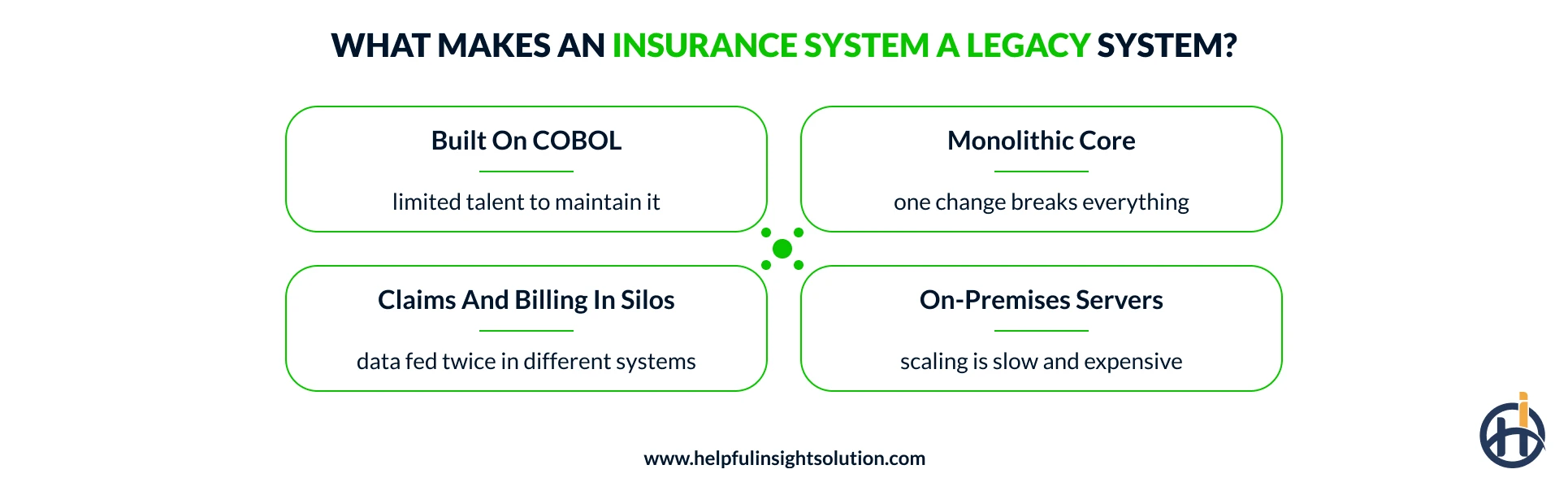
Most insurance legacy systems share a few common signs. The first is a single, monolithic core where policies, endorsements, and renewals are all built into one tightly connected system.
When everything is connected like this, even a minor update means testing the whole system again,which makes simple changes take weeks.
Many of these systems are also developed using older programming languages such as COBOL, which has limited talent available to work on them.
Beyond this, claims and billing work in silos that do not communicate with each other. So, the same customer information has to be fed twice in different systems, resulting in a single update taking much time and also creating duplicate data.
Another sign of an insurance legacy system is that it is hosted on an on-premises server, which makes scalability difficult and costly. Also, these systems cannot be integrated with advanced technologies like AI or machine learning without a lot of work.
Why you need to modernize a legacy insurance system in 2026
In 2026, an aging core doesn’t just affect the IT team, it shapes what the business can offer and how quickly it can respond.
This is why insurance legacy system modernization has become a priority you can no longer keep pushing back.
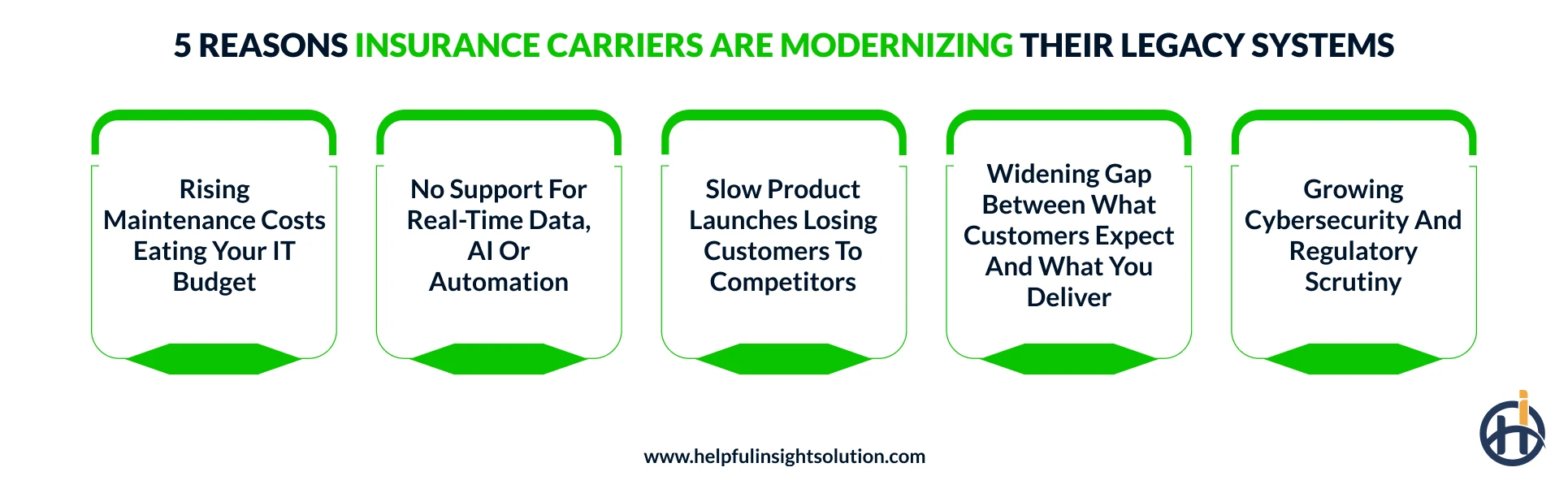
Rising maintenance costs consuming IT budget
With any legacy system, most of the IT budget goes into simply keeping it running, and that share keeps growing every year.
Old software needs more paid support and more people to stay stable, which pushes the cost of running it up on its own, even when you add nothing new to it.
Additionally, when a regulation changes or you launch a new product, that work still has to be built on top of the old system, which adds more technical debt. The longer you wait, the more of your budget gets tied up in maintenance, and the less you have left for anything that actually moves the business forward.
Modernization starts to make sense on cost alone at this point. Once the running cost comes down, the budget you free up can go straight into new products and faster changes, the very things an old system keeps holding back.
Inability to support real-time data, AI, and automation
Real-time data is needed for almost all insurance apps today, but legacy insurance systems struggle here. The reason is simple: these systems were built in a time when nobody was really thinking about instant updates, which is why they process the data in batches only.
Consider what customers expect now: an instant quote, real-time underwriting decisions. An old core system simply isn’t built to deliver that.
The same problem shows up with AI and automation. AI is only as good as the data and system feeding it. It needs to read data in, and then write decisions back out.
Legacy systems are built for one-way data sync, so supporting this two-way data exchange is challenging. Carriers end up spending more time wiring up the integration than actually benefiting AI in insurance.
RPA in insurance is typically used for repetitive manual work like data entry or claims checks, it will only help when the data under it is clean and properly connected. Until the core is fixed to share its data openly, most of these AI and RPA initiatives will not really move ahead from the pilot.
Slow product launches and regulatory response times
Launching a new product is how insurers stay competitive, but a monolithic legacy core forces teams to touch and retest the whole system for even a single new product. This slows everything down. A carrier on a modern platform ships the same product in a fraction of the time, and reaches the customer first.
Regulatory response works the same way. Pricing rules and policy forms change regularly. A hardcoded legacy system needs development work for each change, and delays there carry penalties or additional regulatory scrutiny.
Widening customer expectation gap
Today’s customer expectations are rising. They expect instant quotes and real-time claim updates from their insurer, driven largely by insurtech innovation that has shown customers what is possible. Legacy systems, without open APIs, can’t easily connect to a mobile app or any new channel.
This is where a carrier falls behind the customers’ expectations. The customers are living in their digital world, but the legacy system is still working the old way. So, the customers compare you with a modern insurer, and slowly the trust is lost.
Omnichannel service is now standard. A customer starts a claim on the phone and finishes it on a call without repeating themselves. Legacy systems keep that data in silos, which leaves the agent without the full history in one place.
Increasing regulatory and cybersecurity scrutiny
System stability is part of compliance too. Regulators and auditors look closely at core system stability and security, including uptime and how customer data is protected. Legacy systems running on old, often unsupported software stop receiving regular security patches, which makes them an easy target. Once vendor support ends, known vulnerabilities simply don’t get fixed.
A single breach on a legacy system can bring heavy penalties and real reputational damage with regulators.
Cybersecurity standards are also getting stricter every year. Newer requirements, like data localization or breach reporting, expect systems to maintain proper logs and controls. Legacy systems were never built with this level of audit and security in mind, which makes compliance an ongoing struggle.
Why does full replacement often fail?
Most carriers think that insurance platform modernization means replacing the whole core system at once, known as a “big-bang” replacement.
Big-bang fails many times. As per BCG, only 3 out of 10 big technology programs finish on time and within the budget, which makes the failure rate of this kind of core transformation very high.
Before attempting a full replacement, carriers need a complete map of how all the legacy systems are connected to everything else, and that map often doesn’t exist. Modernizing the whole core at once means things break in ways nobody predicted.
A full insurance platform modernization also takes very long, so you might fall behind the competition as they will keep introducing new features while you are awaiting a new system.
The hidden part of modernization is the “dual-system trap” often called the bubble. Many times the replacement never finishes fully, so the carrier has to run the old core and the new core together, and pay for both.
How to modernize a legacy insurance system safely at scale?
The real question is how to modernize a legacy insurance system without breaking what is already running. The safest path is always step by step, where you keep the old core working while modernizing around it gradually.
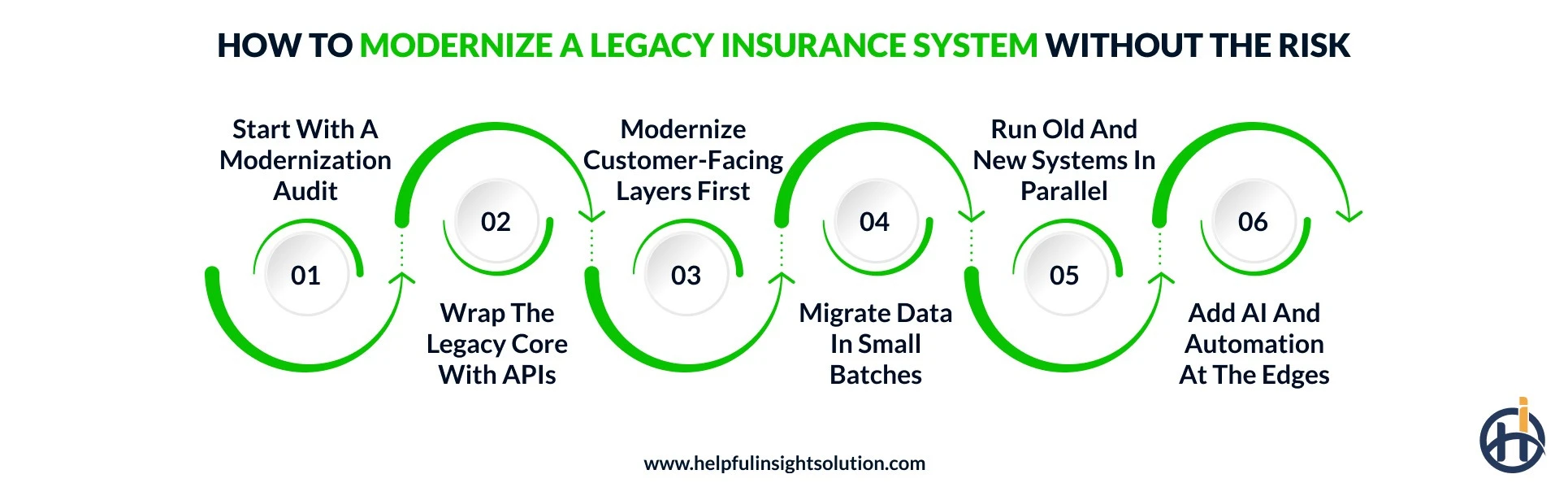
This is the phased approach, and it keeps your risk low while still moving the business forward.
Start with a modernization audit
Before you touch anything in your legacy system, you should start with a proper modernization audit. A modernization audit is a full study of your existing legacy system, where you map all the dependencies and see what is connected to what.
The legacy system has many hidden connections, and often nobody in the team has the full picture of them.
This audit is the base of your whole insurance legacy modernization strategy. Once you know which parts depend on each other, you can decide what to modernize first and what can wait. Without this step, you will keep hitting surprises in the middle of the project, and each surprise costs you time and money.
Wrap the legacy core with APIs
Instead of replacing the whole legacy core, a safer way is to wrap the legacy core with APIs. You build an API layer on top of the old core, and this layer lets your new systems talk to the core without changing the core itself. Your mobile app or website can connect through these APIs, and the legacy core keeps running as it is underneath.
This is often called the “skinny core” approach, and it is the foundation of a proper phased modernization strategy. You should wrap the legacy core first, because it gives you speed with very low risk.
Since the legacy core is not touched, nothing breaks, and customers can start getting new features on the app or website right away.
Modernize customer-facing and high-change layers first
Customer-facing layers should be the first target in any insurance legacy modernization strategy. Quoting and claims intake are what customers interact with every day, shaping the overall experience. Modernizing these layers first means improvements are visible almost immediately, which helps build support for the bigger work ahead.
These layers also change most often, whether it’s pricing updates or new claim settlement terms. Policy administration and accounting, by contrast, can often keep running as-is. Those get modernized later, once the higher-impact layers are done.
Migrate data incrementally, not in one transition
Data modernization in insurance is the most sensitive part, which includes customers’ sensitive information. So, you should never migrate all the data at once, because if things go down, the whole system goes down and sensitive data too.
The best insurance legacy modernization strategy is migrating data in small batches. This is what makes data modernization in insurance safe.
You can start with one line of business or one set of policies, move it, check that everything is working, and then take the next batch. Keep the old and new system in sync during this time. Even if something goes wrong, only a small part is affected, and the rest of the data stays safe.
Run legacy and modern systems in parallel during transition
When you are transitioning, you should never retire the legacy system all at once. The safe way is to run both legacy and new systems in parallel for some time. This will help you identify the issues in the new system, and customers can fall back to the legacy system for uninterrupted services.
Running both systems in parallel is also a smart part of insurance platform modernization. You can compare the two systems and check whether the new one is giving the same output as the old one, such as the same premium or the same claim amount.
Only when you are fully sure should you move everything to the new system and retire the old one. Till then, nothing critical is at risk.
Add AI and automation at the edges, not inside the fragile core
Adding AI and automation at the edges is one of the safest steps in insurance modernization.
The core stays exactly as it is, and new intelligence is built around it, mostly through the APIs. AI models and automation scripts talk to the core from outside, rather than being embedded within it. That means even if an AI component fails, the core keeps working as before.
You can use AI and edge AI, such as document summarization, fraud checking, underwriting, or claim settlement. The repetitive manual work can also be handled by automation, so your team gets free from the mundane tasks.
All of this is a safe part of insurance modernization, because everything is happening outside the core. You get all the benefits of AI, and still your core system stays fully safe.
Choosing the right insurance legacy modernization strategy
The right insurance legacy modernization strategy depends a lot on where your core system is today. There is no single answer that works for everyone. Carriers usually pick between three common paths, and each path makes sense in a different situation.
In the end, the insurance core system replacement vs modernization choice comes down to your risk appetite and your budget.
| Strategy | What it means | When it makes sense |
| Cloud lift-and-shift | You move the existing core to the cloud as it is, without changing the code much. | When you want quick cloud benefits like scaling, or as a first step before deeper modernization. It does not fix the old architecture, though. |
| Incremental microservices replacement | You wrap the core with APIs and replace it in small parts, one service at a time. | The safest option for most carriers who want to modernize at scale with low risk. This is the phased approach. |
| Full core replacement | You replace the whole core system at once with a new platform. | Only when the old core can no longer be supported, and you have a big budget and appetite for the risk. The failure rate here stays high. |
For most carriers, the incremental microservices replacement gives the best balance, because you get the modern features without betting everything on one big project.
Technologies powering safe insurance legacy system transformation
A safe insurance modernization always runs on a handful of technologies underneath. These are the tools that let you wrap the old core and add new features without touching it. Without them, the phased approach is very hard to do in practice.
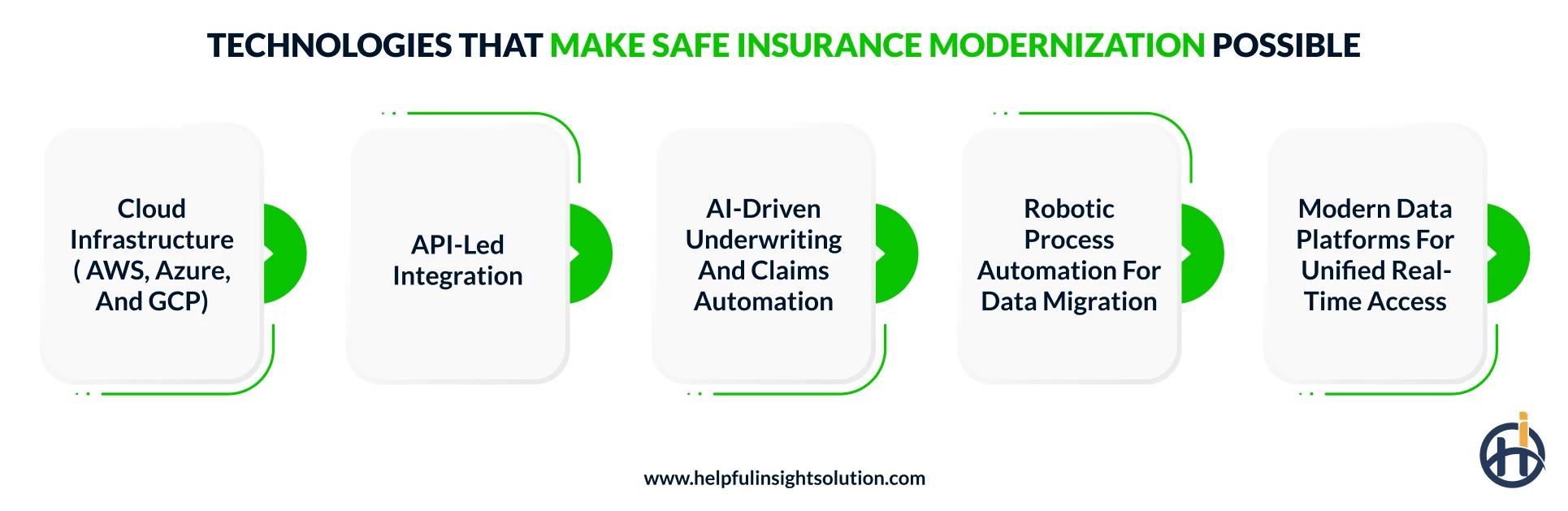
Cloud Infrastructure (AWS, Azure, GCP)
Cloud migration in insurance is usually the first big step towards modernization. So, instead of running your systems on in-house servers, you run them on a cloud platform such as AWS, Azure, or GCP.
Capacity scales on demand, which matters during renewal season or a large campaign when volumes spike. Hardware procurement and maintenance move to the provider, shifting that spend from capital expenditure to operating cost.
Most modern services, including AI or data analytics platforms, run natively on the cloud too, so once workloads are there, connecting new capabilities becomes much easier.
API-led integration
API-led integration is what makes a phased migration approach possible. For example, when a customer checks a policy on an insurance mobile app, the app fetches the data from the legacy core system.
API helps you build a bridge between the new and legacy systems so they can communicate with each other securely. This is why in any insurance platform modernization, the API layer is built quite early, because almost everything else depends on it later.
AI-driven underwriting and claims automation
AI is one of the most promising technologies in insurance modernization, and underwriting is where it shows its value most clearly.
A typical underwriting process needs reading many documents, risk assessment, and then premium calculation. With AI, the system can read those documents on its own, fetch the risk signals, and give a suggested premium in seconds.
Modern underwriting software is built to handle exactly this kind of decision flow alongside the existing core. So your underwriter only reviews the complex cases, and the simple ones move much faster.
Similarly, claim automation can also be applied to insurance companies. From claim logging to verifying policy, fraud detection to claim passing, AI can execute all the steps with no manual intervention needed.
Robotic process automation for data migration and reconciliation
Migrating data from legacy to new is time-consuming and risky. Doing it manually leaves plenty of room for human error and can take months.
Robotic Process Automation (RPA) uses software bots to handle data migration faster and more reliably than manual work. The bot logs into your old system, reads the records field by field, and then enters the same data into the new system, based on the mapping rules.
RPA is also useful for reconciliation after the migration. The bot compares the records in the old system and the new system, and checks whether every value matches the policy number or the premium amount and flags anything that does not.
All the flagged records go into one exception report, so your team only checks the few that actually need attention.
Modern data platforms for unified, real-time access
Data silos are common across insurance legacy systems. Policy data is stored in one, and claims in another, which leaves no unified view of the customers.
A modern data platform might help to get rid of data silos by bringing all the data in one place, so every team has access to the same data. Beyond this, they support real-time access, keeping all the relevant data updated to support decision-making. Teams or AI models can read the same live data at the same time.
Common risks in modernizing a legacy insurance system and how to avoid them
Even a phased modernization carries some risks, but the good part is that all of them can be managed if you plan early. Most of these risks in an insurance legacy system transformation are known already, so you can prepare for them from the start.
Data loss or corruption during migration
During a data migration, data can get lost or corrupted in many small ways. A field from the old system may not map to the right field in the new one, or a long value may get cut short during the transfer.
These errors are easy to miss, but in insurance, one wrong premium or policy details might create a huge problem later.
This is exactly why a parallel, phased approach matters for validation. You keep the old system and the new system running together for some time, and after each batch, you compare the records on both sides, including record counts and the key values. If something does not match, you fix it before moving ahead, so the bad data never reaches the live system.
Employee resistance
Your employees are the real users of the new system, so they must feel comfortable with it. If your team is not comfortable, even the best system will not give the results you expect. This is why employee resistance becomes a big risk in many modernization projects.
People have used the old system for years, so migrating to one should be backed with training and insights on how it will help them in their day-to-day activities.
You should involve your team from the early stage, take their feedback, and give them enough training before the new system goes live. When they are involved, they will put their best efforts to make the new system work for you.
Compliance gaps mid-transition
Compliance is a non-negotiable part of the insurance industry. When one part is on the new system and another one is in one, there might be some compliance issues.
Continuous compliance review throughout the project at every phase. So, you can make the relevant changes to ensure that compliance is always met.
Vendor lock-in
Vendor lock-in is the risk that is often realized later. If you have your whole system built around one vendor, then migrating from it later on will be another hassle and costly endeavor.
The safer path is designing API-first and modular from the start. When each part of the system is a separate module connected through APIs, any single vendor or component can be replaced later without touching the whole system.
Conclusion
Insurance legacy system modernization is no longer a choice that can be delayed. Your legacy system might be running, but you are falling behind a lot of things that set a competitive bar between you and competitors.
A phased migration keeps risk low while moving toward a modern system with minimal downtime along the way. Our insurance software development services cover every stage of this process, from the initial audit through to post-migration support.
This shift is bigger than insurance alone. It is part of the larger change we are seeing across banking, finance, and insurance as a whole. Carriers who start early get the real advantage, while the ones who keep waiting only pay more for the old system.
FAQs
The simple answer is that legacy systems handle their critical work, and failure might lead to disruption to the whole business. Additionally, the data is also old and complex, so migration becomes more critical. The risk of change is also a concern for carriers.
The insurance modernization project time varies depending on the volume of data and the complexity of the core system. If you have been following a phased approach, each phase might take from a few weeks to a month. A full insurance legacy system modernization, on the other hand, can run for a few years. This is why most carriers prefer the phased path, so they get value early instead of waiting till the end.
The cost of insurance legacy system modernization depends on a few things, such as the data volume and the strategy you choose. A full migration usually costs the most, while a phased, API-based approach spreads the cost over time. So instead of one big spend, you pay as you modernize each part. It is always better to start with an audit, because that gives you a clear cost picture before you commit.
In a core system replacement, you remove the old core completely and put a new system in its place. Modernization is different, here you keep the old core running and improve it in parts, mostly by wrapping it with APIs. So replacement can be faster, but it carries much higher risk, and modernization is slower but far safer. For most insurance companies, insurance core modernization gives a better balance of risk and value.
If it is done in a phased and safe way, the disruption stays very low. Since the old system keeps running during the transition, your daily operations and existing policies are not affected. You move one part at a time and test it before going live, so there is no big shutdown at any point. The risk only becomes high when a carrier tries a full replacement in one go.