

Key Takeaways:
- Around 70% of IT spending in financial services goes to maintaining legacy platforms.
- FinTech supplies payments, identity checks, open banking data, and lending decisions through APIs institutions connect to.
- Banking, lending, capital markets, and insurance each modernize around a different bottleneck, like duplicate customer records or hardcoded underwriting rules.
- Incremental modernization runs through an API layer over the core, with dual-run operations before anything is retired.
- 2026 brings agentic AI into production, RegTech rules held as configuration, and fraud controls built for real-time payment rails.
Digital channels, mobile apps, and online platforms are now essential across financial services. The foundations behind them have not kept pace.
Legacy systems are proven, reliable transaction engines, but they lack the flexibility to adopt modern capabilities. About 70% of IT spending goes to maintaining these platforms, which leaves little room for new capabilities. (Accenture)
Digital transformation in financial services was held back for years because cost and complexity outweighed the benefits. That has changed. AI adoption, embedded finance, and real-time payments now make the shift necessary to stay competitive.
This article covers what the shift means for banks, lenders, capital markets, and insurers, the role of fintech, the technologies behind it, a practical strategy, common challenges, and the trends for 2026.
What Is Digital Transformation in Financial Services?
Digital transformation in financial services is the update of the systems a financial institution uses to run its business. These systems hold accounts, move money, record every transaction, and power the channels customers use.
Three terms are often mixed up. Digitization in financial services is the narrowest one. It means turning paper or analog records into digital files, such as scanning a paper loan file into a PDF. Digitalization in financial services, also called financial digitalization, goes a step further. It uses those digital files to change how work gets done, such as routing the loan file to an underwriter automatically. Digital transformation is the broadest term. It changes how the decision on that loan gets made, and which systems hold the data behind it.
How FinTech Is Driving Digital Transformation in Finance
Fintech is the combination of technology and financial services. Technology has moved faster than the systems most institutions run on. Here is how fintech is changing the landscape of financial services:
- Digital payments and wallets: Customers prefer to use financial services from a phone instead of visiting a branch. Digital wallets made up 56% of global e-commerce value and 33% of point-of-sale value in 2025, which came to more than $13.8 trillion in combined spending. (Worldpay Global Payments Report 2026)
- Embedded finance: Financial institutions partner with non-financial businesses so a payment, a loan, or an insurance policy is offered inside the retailer’s own checkout. The market is valued at USD 193.27 billion for 2026, against USD 145.03 billion in 2025, with a forecast of USD 1,921.96 billion by 2034. Embedded payments hold 38% of that market and embedded lending 27%. (Fortune Business Insights)
- Automated lending and decisions: Rules and models approve, price, or refer a credit application without a person reading the file first. 54% of financial services firms have put AI into credit risk and underwriting. (Cambridge Centre for Alternative Finance)
- Automated compliance, identity, and fraud checks: Screening a person was done once at onboarding. The same check now runs against each transaction in real time. Fraud detection reaches 57% deployment across surveyed firms, with AML and KYC screening at 52%. (Cambridge Centre for Alternative Finance)
Fintech digital transformation works because each capability arrives as its own module. Digital fintech tools can be added without replacing the underlying system, which keeps the core in place while the institution stays competitive.
Fintech software for financial institutions is built in modules for that reason, so one module can be swapped when a payment rail, reporting format, open banking standard, or compliance requirement changes. A fintech digital strategy therefore starts with a simple question: which module should be added first?
Why Digital Transformation Matters for Financial Services in 2026
Digital transformation in banking and financial services is driven mainly by two factors. The first is customers, whose expectations have changed. The second is the set of regulatory requirements an institution has to meet.
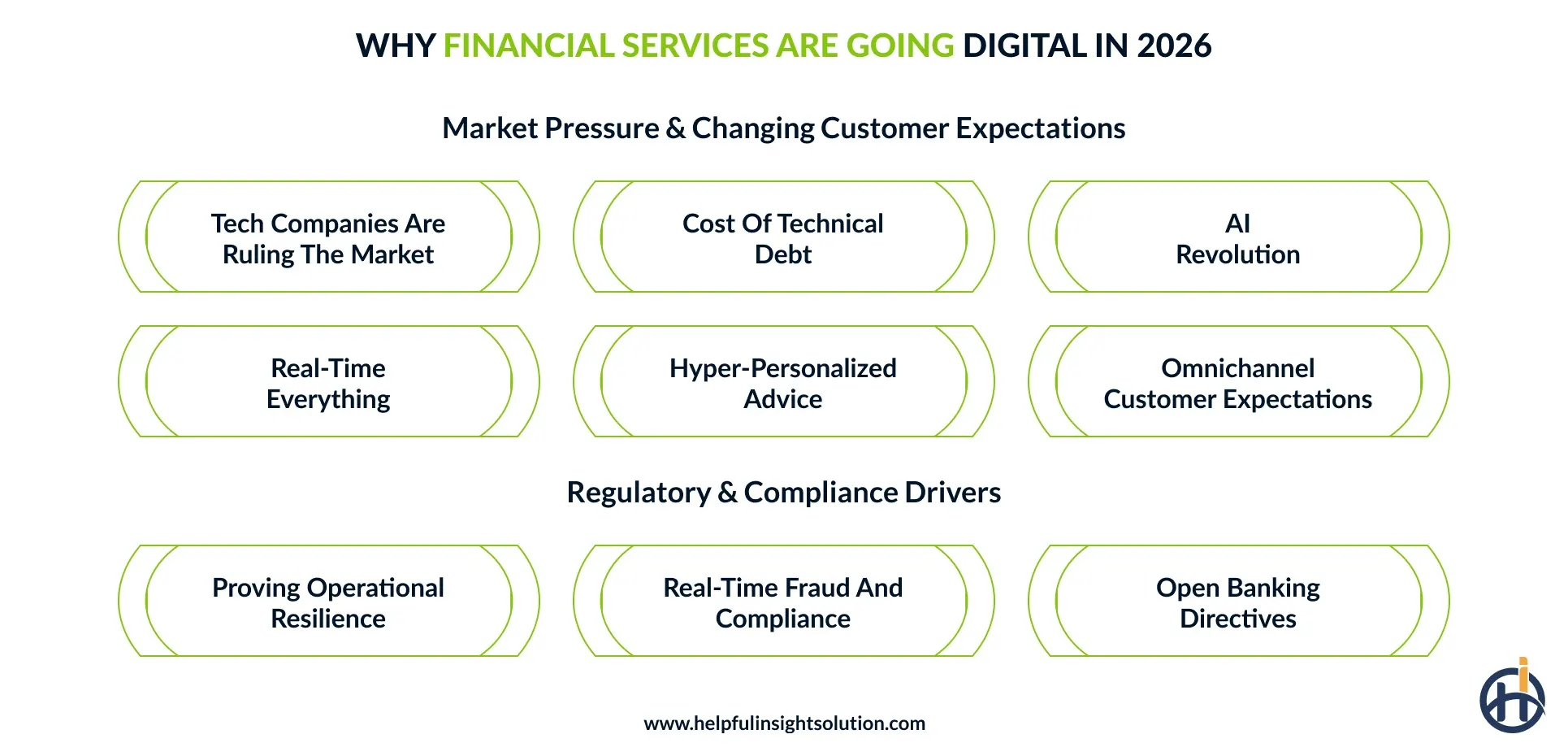
Market Pressure & Changing Customer Expectations
Customer expectations are not what they were when most core systems were written. A branch visit was the normal way to handle money then, digital-first service is the new normal today.
Tech Companies Are Ruling the Market
Apple Pay, Venmo, and other apps handle payments, transfers, and savings the way a bank does, with less waiting. PayPal reported total payment volume of $486.4 billion for the second quarter of 2026, a 10% increase, across 439 million active accounts. (PayPal) A traditional system releases changes on a schedule set by the core, so matching that pace means upgrading the system underneath.
The Cost of Technical Debt
Many core banking systems were written in COBOL, a programming language from 1959. Banks still run that software, so they still need people who can read the code, and finding those people is getting harder. A 2026 survey of mainframe users found about 39% were short on these skills, mostly in the teams that build and change software. (Arcati Mainframe Users Survey) Maintenance takes the share of the budget that would otherwise pay for new work.
The AI Revolution
AI is being used to cut operational costs and answer customer questions in context. A model needs a large volume of history in one place, in a consistent format, and available on request. Legacy cores hand data over as an overnight extract, with a separate file for each product line, each in its own format. Data availability and quality are the leading obstacle to AI adoption, named by 40% of industry respondents in a 2026 survey. (Cambridge Centre for Alternative Finance)
Real-Time Everything
Digital transformation financial services programs now treat real-time payments as a baseline. Customers move money at any hour without waiting for a batch run. FedNow reached 1,600 participating financial institutions across all 50 states by the end of 2025, running about 30,000 transactions a day, with volume up 460% against 2024. (Federal Reserve) A batch system applies entries overnight, so the balance a customer sees lags a payment that has already settled.
Hyper-Personalized Advice
Selling financial services is harder than before. A generic mailer offering a credit card the customer does not need gets ignored. J.D. Power found customers hold three deposit accounts at different institutions on average, and 20% moved money away from their primary bank within the past three months, up from 17% a year earlier. (J.D. Power) Legacy systems store customer data product by product, so the checking record and the mortgage record sit in separate places. An offer built from one of them misses what the customer already holds elsewhere.
Omnichannel Customer Expectations
A customer starts an application on the web, then continues it in the app. Each legacy channel keeps its own session and its own copy of the customer record, so work started in one place is not visible in the other. The customer is asked for the same information twice.
Regulatory & Compliance Drivers
Regulators want proof, and the proof has to come out of the system itself. Digital transformation financial services teams therefore need to know where legacy systems fall short.
Proving Operational Resilience
Operational resilience used to be mainly about capital. Now it covers technology too. In Europe, the Digital Operational Resilience Act, in force since January 2025, requires institutions to prove their technology keeps running through cyber incidents and outages. (European Banking Authority) The US also has a federal rule that requires banks to notify their regulator of a significant cyber incident within 36 hours. (FDIC)
Legacy systems make this hard because data sits in silos, which makes it difficult to report which part failed.
Real-Time Fraud and Compliance
In April 2026, FinCEN put out a proposal asking for anti-money laundering programs built around risk, with a view of the customer as a whole. (Federal Register)
Old systems are made of several products, each of which keeps its own data, and checks run in scheduled batches. Activity across those products reaches the compliance team only after the batch finishes, which makes real-time fraud and compliance work difficult.
Open Banking Requirements
Open banking is the customer-permissioned sharing of financial data with third-party apps through APIs. A customer can see accounts from several providers in one app, and each provider shares only what the customer approves.
In the US, Section 1033 of the Dodd-Frank Act requires banks to release transactions, balances, payment details, and upcoming bills when a customer asks, or when the customer gives an app permission. Under the 2024 rule, the app must renew that permission every year and delete the data once it ends. (Federal Register) A federal court has since paused enforcement of the current rule, so the final requirements may change. (American Bankers Association)
Legacy core systems struggle with open banking for three reasons:
- They process data in bulk overnight instead of answering individual customer requests instantly.
- They have no process to track which third-party app a customer has authorized, so customers cannot tell which apps use their data.
- They lack a way to stop sharing or delete data once a customer revokes permission
Key Technologies Powering Digital Transformation in Finance
Digital transformation in banking and financial services is mainly driven by four technologies: artificial intelligence, cloud infrastructure, open banking APIs, and blockchain.
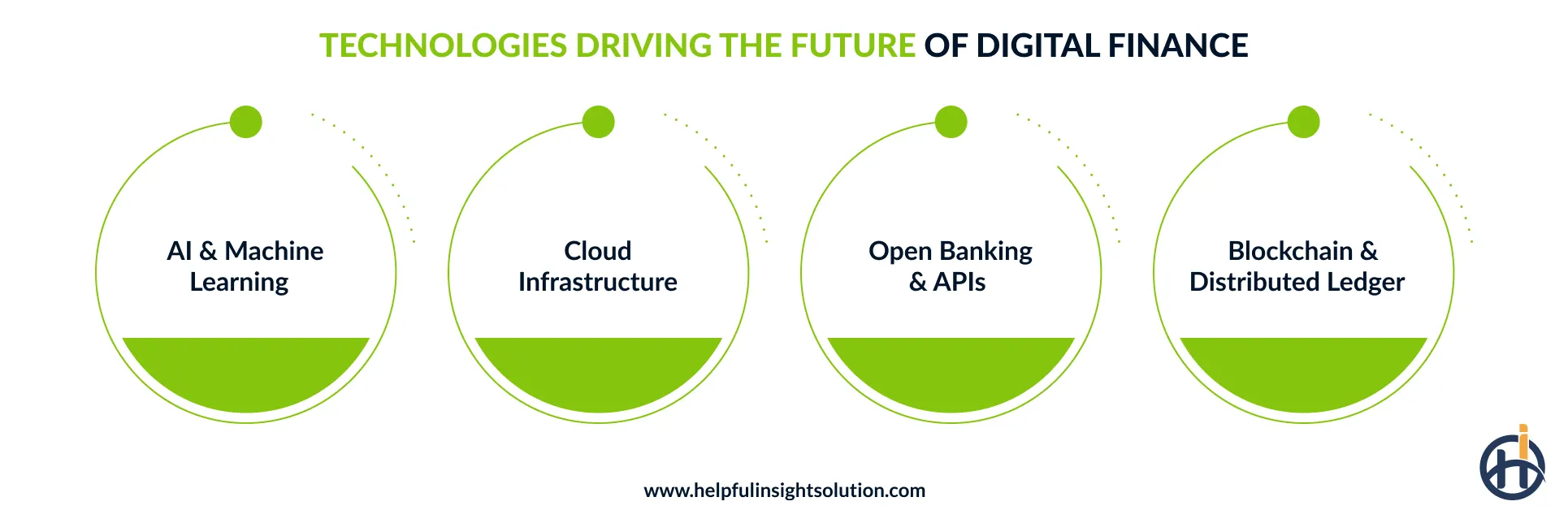
AI & Machine Learning
AI and machine learning are changing how financial institutions work. A legacy system can only do what a development team programmed into it. AI and machine learning read large amounts of data and act on it without a person in the middle.
For customers, the benefit is a personalized experience. For the institution, an application can check a new client’s identity, review loan documents, and approve a straightforward case with very little human involvement. The same technology reads data while a card is being used, which is how fraud gets caught before the payment goes through.
AI development services for a regulated business must keep records of model versions, the data used, and how each decision was made, so the institution can meet compliance requirements.
Cloud Infrastructure
Older systems kept data on on-premises servers. The hardware had to be big enough for peak load, and adding capacity meant upfront planning.
Cloud infrastructure is rented from a provider instead, and what the bank uses can scale up or down within minutes. The difference shows most when demand is uneven. Training a model, running fraud checks at payment speed, or closing the books at quarter end all need a lot of computing for a short time.
A financial services digital transformation involves running old and new systems in parallel so business continues without interruption. Software development for a financial institution has to be planned so the move to a new system causes little or no downtime.
Open Banking & APIs
A customer who holds accounts at three providers wants to see them in one app. Open banking and APIs make that possible.
Legacy systems exchange files overnight, so adding a partner means agreeing on a file format and a schedule first. An API works differently. One system asks another for one specific thing, and the answer comes back straight away.
In the UK, open banking APIs handled 2.81 billion calls in June 2026, at an average response time of 349 milliseconds. (Open Banking Limited)
A lot of digital transformation in fintech depends on this. A partner’s product can be added to a bank’s own app without touching the core, which is how fintech software for financial institutions is put together.
Blockchain & Distributed Ledger
Every institution in a trade keeps its own copy of the record, and afterwards the copies get matched against each other. A distributed ledger replaces those copies with one shared record that each party writes to and reads from. Most of the matching work goes away with it.
Both sides of a trade can move at the same moment, so neither is left waiting and carrying the risk. The ledger also runs around the clock, so there is no daily cut-off time.
A stablecoin is a digital token tied to a currency like the dollar. The issuer holds reserves to back it, and it moves on a shared ledger at any hour. Cross-border payments are one use, because the normal route passes through several banks and stops at each one’s cut-off time.
Banks are building their own version, called a tokenized deposit. The money stays in the customer’s bank account, and the bank records it on a shared ledger so it can move the same way. The deposit stays on the bank’s own books while moving at that speed.
Digital Transformation in Finance Industry Sub-Sectors
No single digital transformation financial industry plan fits every sub-sector. AI, cloud infrastructure, and real-time APIs apply broadly, but each sub-sector faces its own operational bottleneck and regulatory requirements, which drive different priorities.
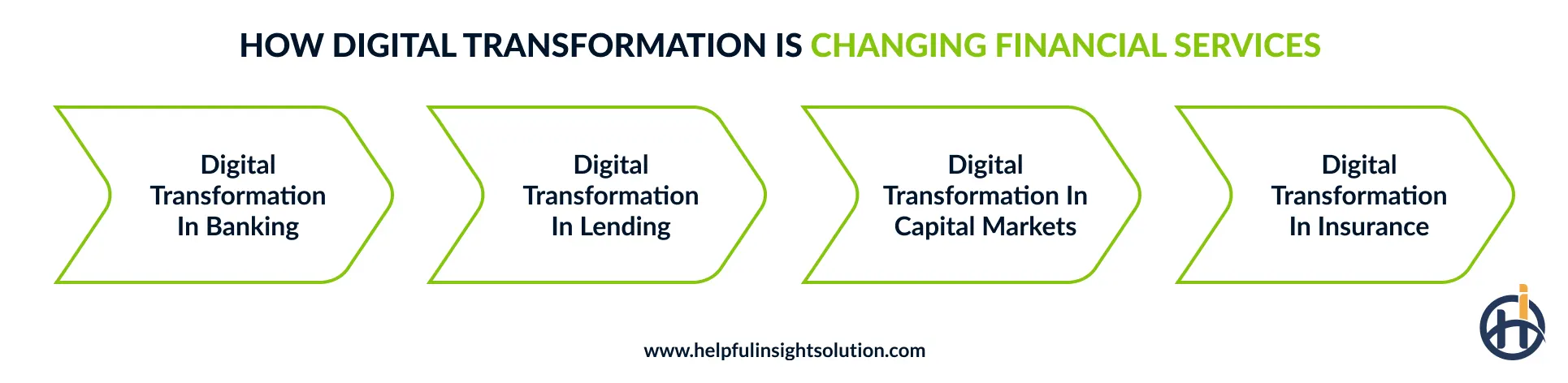
Digital Transformation in Banking
Legacy core banking platforms were built on mainframe architecture, where balances and transactions were processed in overnight batch runs. Checking accounts, personal loans, and credit cards each work in silos and keep duplicate customer records.
Modernization focuses on building an API and microservices layer over the legacy core. Mobile apps, web channels, and partner integrations can then reach a single real-time view of customer data and account balances.
Digital Transformation in Lending
The loan origination process relies heavily on documents, which hold both structured and unstructured data. Checking each document by hand is slow and takes staff time. Selling loans on the secondary market adds physical shipping and manual review, which slows the movement of capital.
Digital transformation in lending removes manual work, even where a paper note still exists. Automated underwriting can evaluate payroll, tax, and other data in real time and return fast credit decisions. APIs connect to credit bureaus and other third parties to verify key information with little or no human involvement.
Digital Transformation in Capital Markets
Traditional capital markets infrastructure relies on end-of-day batch processing, which creates multi-day settlement windows. Under T+2 or older settlement cycles, trade confirmations and portfolio reconciliations run overnight, and back-office teams fix mismatches the next morning. These delays force market participants to lock up liquidity and hold buffer collateral against counterparty credit risk across open trades.
Digital transformation in capital markets is now shaped by the move to T+1 settlement in the US (and Europe in 2027). T+1 gives firms one day instead of two to match and settle trades, which leaves little time to fix mismatches. (DTCC) European same-day trade match rates reached 98% in Q1 2026, up from 92% in 2024. (DTCC) Modernization focuses on real-time trade matching engines, automated trade allocation workflows, and AI-driven exception handling. These systems flag trade discrepancies right after execution, which improves use of collateral, frees up liquidity, and lowers clearing risk.
Digital Transformation in Insurance
Legacy policy administration systems ran each line of business (life, auto, property) on a separate software core. Underwriting rules were hardcoded into application logic, so even minor policy changes needed custom engineering. Information such as medical records or driving histories was processed by hand from scanned documents.
Modernization moves business rules into cloud-native rules engines, so underwriters can adjust risk parameters without a code deployment. Direct API integrations with medical databases, motor vehicle registries, and IoT devices enable faster underwriting. Today, 59% of US individual life applications use automated underwriting paths (Gen Re), which lowers acquisition costs and speeds up decisions.
With modern insurance software, carriers centralize data feeds and audit logs, which supports transparent and compliant decision-making across all distribution channels.
How to Build a Digital Transformation Strategy for Financial Services
Modernizing financial services infrastructure requires a balance between the reliability of core engines and the need to deploy new capabilities quickly. The best approach to digital transformation in finance industry projects is incremental modernization instead of a high-risk, all-at-once platform replacement. Start by decoupling customer touchpoints, compliance tools, and analytics through microservices while managing technical debt and operational risk.
Deploy an API Integration & Microservices Layer over Legacy Cores
A digital transformation strategy financial services teams can trust should begin with an API integration and microservices layer. The layer works as an intermediary between the legacy mainframe and modern applications.
- API gateway: Deploy an API gateway (MuleSoft, Apigee, or Kong) that exposes standardized RESTful APIs and GraphQL endpoints to modern web and mobile apps.
- Microservices architecture: Break legacy monolithic functions into independently deployable, lightweight microservices running in containers on Kubernetes and Docker.
- Data decoupling and event-driven architecture: Use event streaming platforms like Apache Kafka to capture real-time core database updates without straining the mainframe with direct database queries.
This approach lowers risk and avoids major downtime during rollout. Digital transformation in financial sector projects can then release new digital features in weeks rather than months, without disrupting core banking operations.
Centralize Siloed Product Data into a Unified Cloud Data Lakehouse
Finance and digital transformation depend on data that sits in one place. Centralizing data means moving information from siloed systems such as mortgages, credit cards, and wealth management into a unified cloud setup called a data lakehouse. Unified data gives each department a single, complete view of every customer relationship in near real time.
The work begins by moving data out of transactional databases, such as mainframe databases or relational SQL databases. Structured, semi-structured, and unstructured data land in a Delta or Iceberg format on a platform such as Databricks or Snowflake. With ELT (Extract, Load, Transform) pipelines and change data capture (CDC) through Kafka, data can be copied from legacy cores without hurting transaction performance.
Embed Automated Compliance, AML/KYC, and Resilience Controls Directly into Workflows
Replace static, manual regulatory checks with automated compliance, identity verification, and operational resilience controls that run continuously. Legacy systems check after periodic batch audits. Modern platforms build these safeguards into their logic and API pipelines, so audits happen in real time.
With event-driven frameworks such as Apache Kafka, every customer interaction, transaction, and authorization change creates an immutable event record. Audit logs are written continuously to tamper-proof, append-only storage, which supports fast verification and full traceability for internal governance and regulatory inquiries.
Execute Incremental Modernization with Dual-Run Parallel Operations
Treat modernization as a step-by-step process instead of a rip-and-replace overhaul. A dual-run strategy keeps the old and new systems running side by side, so the new one can be validated against the old before the switch. It follows three steps:
- Shadow testing: Route real transactions to the new platform, which has no operational control and shows nothing to customers. The technical team validates data consistency, system performance, and edge cases, while business leaders compare accuracy for the same transaction on both sides.
- Controlled traffic shift: Send traffic to the new platform in stages. Start with internal users, then 5% of real users, then 25%, 50%, and 100%.
- Automated fallback: The new platform drops back to the legacy core on its own when something goes wrong, so the rollout can keep moving.
Legacy retirement is the last decision. The business and technical leads make it together once the platform has held at full load. Insurance software development follows the same sequence, because a carrier cannot stop quoting while a core is replaced.
CTA
Common Challenges in FinTech Digital Transformation
The imperative for digital transformation of financial services is obvious, translating vision into execution brings significant challenges between legacy infrastructure and modern demands.
Legacy Data in Old Formats
Legacy systems hold customer records and transaction logs in rows and columns built for mainframes. Moving them into cloud storage requires understanding what each field contains, then fixing the errors already in it.
Each field has to be mapped to the new structure, with an audit trail recording each change. A data lakehouse holds a copy taken from the core, so testing runs on the copy while the original records stay in place and customers keep their access.
Multi-Market Regulatory Compliance
An institution working across multiple regions has to comply with more than one rulebook. Each regulatory market has specific requirements regarding data storage and how much data can be collected.
A policy engine holds those rules in one place. Each customer record carries a region tag, and the software checks that tag before applying the rule belonging to it.
Real-Time Core Synchronization Bottlenecks
New services built on events respond the moment something happens. The old core updates its records in an overnight run, so the app can show a customer one balance while the ledger holds another.
Querying the core more often takes the capacity that overnight run needs. The fix is for the core to publish each change into a stream the app reads, with the time of the last ledger update carried alongside the figure. A checking job compares both systems while they are running.
High Capital Allocation and Uncertain ROI
Infrastructure, security, and hiring drive the cost at the start, while the return arrives only after rollout. Several budget cycles can pass in between, so the business case has to be defended before there is evidence for it.
A digital transformation strategy financial services boards can approve is split into stages. Each stage has a measurable result that is agreed before the stage starts and met before the next one is funded.
Digital Transformation Trends to Watch in 2026 and Beyond
As regulatory demands tighten and technological capabilities matures, financial institutions are shifting from exploratory pilots to systemic implementation. The finance digital transformation trends for 2026 point toward autonomous decisioning, continuous compliance, and deeply embedded infrastructure.
AI Agents Moving From Pilot to Production
Generative AI writes and summarizes, an AI agent goes further, taking an action rather than suggesting one. In a bank, the agent is pulling a tax return, running the figures, and preparing the file for a lending review, with a person approving the result at the end.
Bank Director’s 2026 Technology Survey found 72% of institutions using generative AI, while 30% are deploying agentic AI. The longer view is further out, with 81% of surveyed financial firms expecting meaningful agentic deployment by 2030. (Statista)
This trend is defining digital transformation in fintech, but governance remains a major issue for every institution adopting AI. The Federal Reserve’s model risk guidance, SR 26-2, states that generative AI and agentic AI are outside its scope. A bank that puts an agent into a credit or servicing process is therefore working outside the framework examiners apply to other models. AI agent development for a regulated business has to keep its own record of what the agent did, which model version it used, and why.
AI Chatbots Handling Front-Line Services
A chatbot answers customers’ questions in natural language, checks balance, or explains a charge, and passes the case to a person when it cannot resolve one.
The chatbot market is valued at USD 10.42 billion for 2026, against USD 8.37 billion in 2025, with a forecast of USD 60.21 billion by 2034. (Fortune Business Insights) What changed is the connection behind it. A chatbot reading live account data through an API answers questions about the customer’s own account, which a scripted menu cannot do.
RegTech for Compliance
RegTech is software that handles regulatory work a compliance team used to do manually, including reporting, sanctions screening, and evidence for an examination.
The market is valued at USD 23.43 billion for 2026, against USD 19.06 billion in 2025, with a forecast of USD 105.23 billion by 2034. Regulatory compliance accounts for 39.91% of it. (Fortune Business Insights)
The rules themselves are being rewritten faster than before. An institution with a rule hard-coded into its application waits for a development release each time a requirement moves, while a RegTech tool holds the rule as configuration, which turns that into a settings change. Technology built for banking, finance, and insurance is expected to carry that separation between the rule and the code.
Embedded Finance
Embedded finance puts a financial product inside a non-financial company’s own checkout or software. Payments at a retailer’s checkout is the most established form of it.
The customer relationship moves to whoever owns the software business already uses. A fintech app built for this has to hand over the product through an API while the bank keeps the regulatory responsibility.
Decentralized Finance and Tokenized Money
Decentralized finance runs financial services on a shared ledger through code instead of an intermediary. The institutional version of it is tokenized money, where a deposit or fund holding is recorded on that ledger so it can move at any hour.
Fraud on Real-Time Payment Rails
A payment that settles in seconds cannot be recalled. Fraud has moved toward the type that uses this, where the customer is persuaded to send the money themselves rather than having an account taken over.
UK Finance recorded £1.28 billion of fraud losses in 2025. Unauthorised fraud, where the payment is made without the customer’s consent, came to £703.4 million and fell by 5%. Authorised push payment fraud came to £576.4 million and rose by 19%. (UK Finance)
A payment the customer has approved looks legitimate to those controls, which is why detection has to move to the behavior around the payment rather than the payment itself. 83% of these cases start online or through telecoms. (UK Finance)
AI development for a regulated business is where that detection is built, with the model reading session behavior and payment history instead of the transaction on its own.
How Helpful Insight Supports Digital Transformation for FinTech & Financial Services
Digital transformation in financial services needs two kinds of knowledge at the same time. The institution knows its own business, which products carry the margin, which regulator asks which question, and which process the auditor will look at first. The technology partner knows how to build the systems that carry that business. Helpful Insight works on the second half, and it works on that half for institutions that are regulated.
We have spent more than a decade building software for finance, insurance, healthcare, logistics, real estate, and retail, delivering over 2,000 projects across more than 40 countries.
Ready to accelerate your digital transformation? Partner with Helpful Insight’s experienced team today to modernize your financial systems with confidence and agility.
Frequently Asked Questions
Digital transformation in financial services is the process that banks and insurers use to replace the systems their business runs on. It is applied across four parts of the technology, which are the customer channels, the core system where accounts are held, the data layer, and the decision layer where approvals happen. A new website or a mobile app update is only a change to the first part.
There are several common examples in banks and in insurance companies. Account opening that is completed on the same day with identity verification is one of them. Lending decisions that are returned within a few minutes, with the applicant data collected through an API, are also an example. Other examples include payments that are settled on real-time rails, claims that are registered from a photograph, and compliance checks that are run on every transaction instead of a monthly sample.
The benefit that most institutions look for is the ability to change a product faster. Pricing and eligibility are held as configuration, which is helpful for product teams, because the change does not have to wait for an IT release. There is also a reduction in the cost per transaction once batch processing is retired. The audit record is generated by the system itself.
Legacy data is responsible for most of the delay in these programs, as the records stored in mainframe formats have to be mapped before a new system can read them. The cost and the timeline are also revised once the discovery work finds processes that were never documented. Other challenges are the limited availability of engineers who know COBOL along with modern platforms, data rules that are different in each country, and the need to keep the old system available while the new one is being tested.