


Key Takeaways
- AI in the insurance market stands at $13.45 billion in 2026 and is growing 35.7 percent a year, while Gartner expects 40 percent of enterprise applications to carry task-specific AI agents by the end of this year.
- An AI agent is given an outcome and works out the steps to reach it. It reads the policy record, calls whatever system holds the next answer, then stops where a decision needs a person.
- Claims intake, underwriting submission review, risk assessment, fraud referral, and policy servicing are where carriers are putting agents first, because those processes carry volume and a wrong step gets caught at the next desk.
- Allianz cut claim processing and settlement time by 80 percent using seven task-specific agents. Aviva halved the time an underwriter spends on a medical report, while QBE brought quote-to-bind on a specialty product under ten minutes.
- The benefits of AI agents for insurance land on loss ratio, expense ratio, turnaround time, and retention, all of which a carrier already reports on every month.
- Building AI agents for insurance starts with the autonomy level, then the data layer, and the write path into the core. Guardrails and the audit trail belong in the first release.
In insurance, an agent has always been a person who sells a policy. AI agents for the insurance industry are taking this further.
An AI agent is software that runs a piece of a workflow on its own. It reads the policy record and checks a claim against it, then moves to whichever system holds the next answer. It stops when a decision needs a person.
What changes is the work that comes before that professional sees the file. The file is already assembled.
What changes is the work that comes before that professional sees the file. The file is already assembled.
The AI in the insurance market stands at $13.45 billion in 2026, growing 35.7 percent a year through 2034. Gartner expects 40 percent of enterprise applications to carry task-specific AI agents by the end of 2026, up from 5 percent in 2025.
This guide covers what AI agents in insurance do, where carriers are running them, the real results from Allianz, Aviva, QBE, and Zurich, and what building one actually takes.
What are AI Agents in Insurance?
An AI agent in insurance is software that is given an outcome and works out the steps to reach it. Nobody writes those steps in advance. The agent decides which system to open first, and what it finds there tells it where to go next.
AI agents in insurance run on a loop of four steps. The loop repeats until the task is finished or a person has to take over. A motor claim shows how it runs. The agent is told to get the claim ready so an adjuster can approve or reject it.
- Plan: The agent lists what needs confirming: coverage on the date of loss, damage documents, and repair estimate.
- Act: It starts with coverage, opening the policy record to read start and end dates.
- Verify: The incident date is confirmed against the coverage date, and it either fails inside the coverage period or not.
- Repeat or hand over: A pass sends the agent back to act for the next check, the damage photos. A fail sends the file to a claim professional, with the reason recorded.
What separates an agent from a chatbot is what the software is allowed to hold. An agent holds a goal and the credentials for the systems it is permitted to open. It also keeps a record of the case as that case changes, which is what lets it return to the claim.
Insurance picked it up early because the workflows run long and the inputs arrive as documents rather than as filled form fields.
Carriers who have already worked through RPA insurance use cases will recognize where the older approach stops.
| Rule-based automation | Conversational AI | AI agent | |
| Trigger | A scheduled run or a fixed event | A customer opening a chat window | A goal handed to it, or an event inside the workflow |
| Decision authority | None, the decision was made when the rule was written | None, it answers inside a script | Chooses the next step within limits somebody set |
| System write access | Writes only where the script points | Read-only in most deployments | Writes to every system it holds credentials for |
| Failure mode | Stops when a field or screen changes | Answers confidently outside what it knows | Takes a wrong action, at speed |
| Audit trail | The script log | The chat transcript | The plan, every call made, and the reason recorded for each |
The failure mode row is the one that sets how much freedom a carrier gives an agent, and it is the main reason agentic AI in insurance starts on low-value work.
The Role of AI Agents in Insurance Across the Policy Lifecycle
The role of AI agents in insurance changes at every stage of the policy lifecycle, because what an agent is allowed to produce is not the same at quote as it is at settlement.
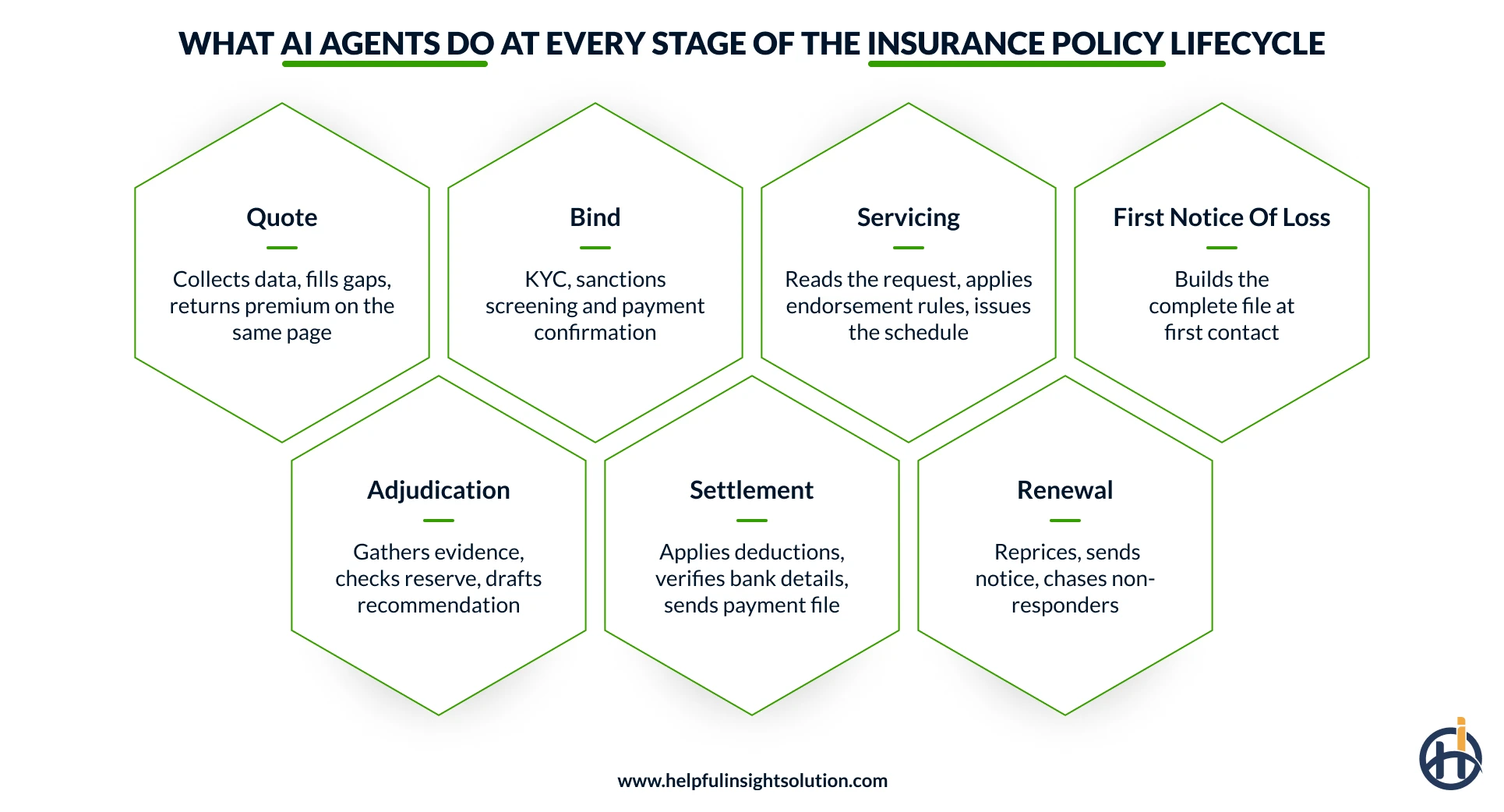
The permission that the agent holds is what actually differs, and the systems behind each stage are also different.
Quote:
At quote, the agent collects the information the rating engine needs to make a personalized quote. It reads the proposal form, pulls the vehicle or property details from external sources, and fills the fields that the customer has left blank. The premium comes back while the customer is still on the page.
Bind:
AI agents can handle pre-issuance checks from KYC documents, sanctions screening, and payment confirmation autonomously.
Servicing:
Servicing is the only stage where an agent will run a request from start to finish on its own. It reads what has been asked for, applies the endorsement rules, then issues the revised schedule.
First notice of loss:
The agent’s job at first notice of loss is building a complete file at the first contact. It asks the follow-up questions that the claim type needs, chases the documents that are missing, and opens the claim in the system before anybody has looked at it.
Adjudication:
The agent gathers the evidence against the policy conditions and checks the reserve, then drafts a recommendation with the reasons written out. The claims professional who signs the file gets a complete case, not a data collection task. Approval or denial stays with a claims professional, because the insurer has to give the customer a reason which it can defend afterwards.
Settlement:
The agent works out what is actually payable. Excess, depreciation on parts, salvage value, each deduction gets applied against the assessed amount, then the bank details get verified before the payment file goes to the billing system.
Renewal:
At renewal, the agent runs the full cycle. It reviews the claims experience on that policy, applies the no-claim bonus, produces the repriced premium, and sends the notice out. Non-responders get chased.
AI Agent Use Cases in Insurance
AI agents for insurance are placed on volume first. A process that runs a thousand times in a month will pay for the build, and a process where a wrong step gets caught at the next desk keeps the exposure small while the model is still settling.
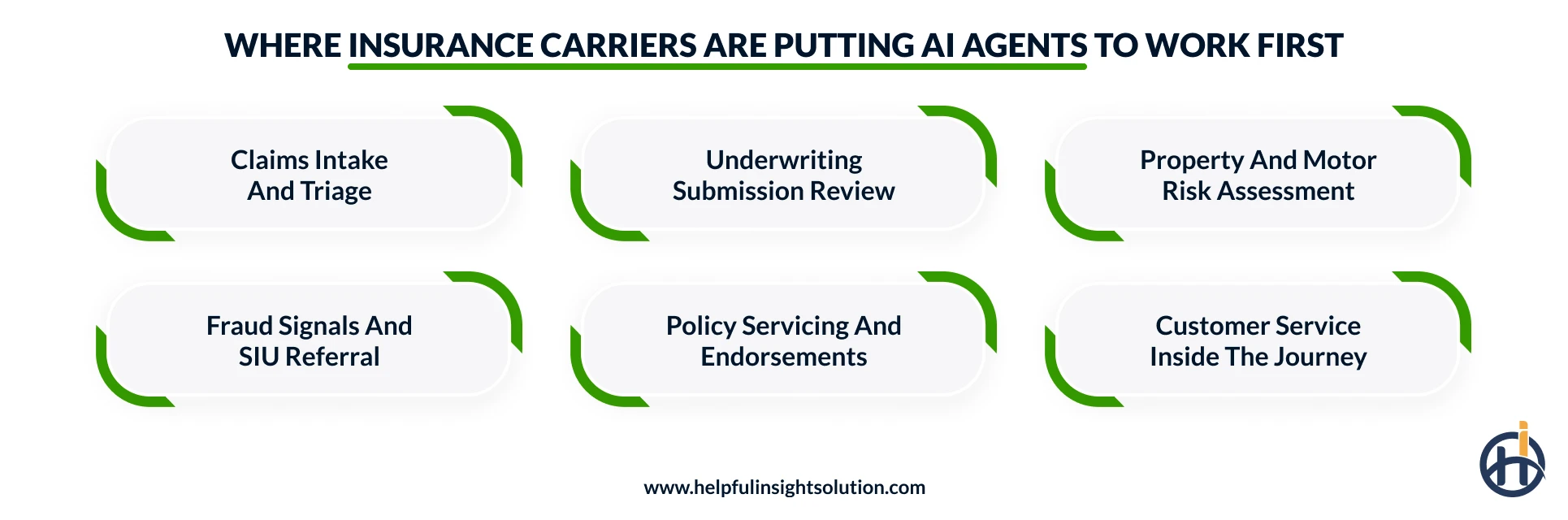
The AI agent use cases below follow that order only. Each one also carries the thing that should already exist inside the carrier before the build starts, because most of these projects stall on data access. Broader use cases of AI agents run across industries; however, in insurance, they run against a policy record and a regulator.
Claims Intake and Triage
The role of AI agents in insurance claims covers the process from first notice of loss to the routing decision. The agent takes the intake, reads the documents that arrive with the claim, confirms coverage against the policy record, and assigns a severity score. Intelligent document processing and computer vision handle the document reading layer underneath.
What changes is the state of the file when a human first opens it. The adjuster gets an assembled case with cover confirmed, a severity score, and the claims that need the final judgment rather than collecting information.
Two prerequisites decide whether this use case can be applied. First, the claim coverage should exist in a machine-readable format, and insurance claims management system has to accept a write from outside the adjuster’s screen.
Underwriting Submission Review
Underwriting submission review often takes more hours than the pricing does. The hours go on pulling data from different sources and putting it into a usable format, not on evaluating it. AI agents extract the data and normalize it into one view, helping underwriters to evaluate it and make an informed decision.
AI agents document every step in the underwriting process and keep a record of who accepted each summary in the insurance underwriting system.
Property and Motor Risk Assessment
Risk assessment is what an underwriter needs before pricing a property or a vehicle insurance policy. On property, that used to mean a surveyor visiting the site.
Insurance AI agents give underwriting a risk picture without a site visit. On property, the agent scores roof condition, construction class, and the distance to standing water from aerial imagery, then maps those attributes to the risk address.
A surveyor visit can still follow for the risks that score above the referral threshold.
Motor works off telematics instead. In motor insurance, the agent collects data related to harsh braking, cornering, and night driving to enable a personalized quote for each customer. Collection runs off the accelerometer and GPS in the policyholder’s phone, or a device fitted in the vehicle.
Fraud Signals and SIU Referral
Insurance fraud costs the US market on average $308.6 billion a year, and most of it arrives as ordinary paperwork. A fake photograph, one reused from an earlier claim on another policy, or an invoice where the amount has been edited. A claims handler has to separate these from the genuine ones, which protects the customer and the carrier together.
A carrier will review the large claims however, a small motor or contents claim never justified a manual document check, so those went through on trust.
Agentic AI changes that arithmetic. The agent checks every claim at the same cost, reading images for signs of editing and matching them against claims already on file. Linking the claim to the repair garage, the treating hospital, and the bank account behind it gives the cluster a score.
An agent will score, and the special investigation unit will decide, because a denial resting on a score alone gives the ombudsman an easy decision against the insurer. Carriers who are running AI agents in fraud detection on the lending side hold that same line.
Policy Servicing and Endorsements
Policy servicing covers everything that happens to a policy after issue and before renewal. Address change, nominee update, NCB transfer, vehicle substitution, each one arrives as a request and ends with a reissued policy schedule.
A request reaches the agent through email, customer portal, or call center. Insurance portal development gives the customer the first of those routes. The agent identifies the policy and reads what has been asked for, then checks it against the endorsement rules for that product. A missing document gets requested back before anything moves.
Premium is where these requests separate. A nominee update changes nothing, however, an address change in the motor can move the vehicle into a different zone, and a vehicle substitution replaces the policy completely.
The agent works out the difference and writes the change into the policy administration system. The endorsement schedule gets generated from there.
Customer Service Inside the Journey
Insurance customer service runs through a screen for most customers now. 47 percent of new auto and home policies are bought digitally, and the same channels carry the servicing questions afterwards.
The questions that arrive most often are predictable: claim status, whether a treatment is covered, when the premium is due, a copy of the policy. The same questions reach the contact center every day.
AI agents answer these questions against the customer’s own record. The policy is identified first, then the question is read in that context. A coverage question gets answered from the wording on that specific schedule, so the reply quotes the clause that applies to that customer rather than a generic policy summary.
Claim status is the most common request, and the agent gives the stage the claim has reached plus whatever is still pending from the customer. The agent can also complete the task, sending the policy copy, generating a payment link, or booking the surveyor visit.
When an AI agent fails to answer questions, the request gets escalated to a human agent with the policy, question, and everything already checked so far.
AI Agents in Insurance: Real-World Examples from Carriers
AI agents carry real potential for insurers, and several of the largest carriers in the market have already moved first on it. Settlement time, underwriter hours, and renewal retention are all in the results below, from workflows running at scale.
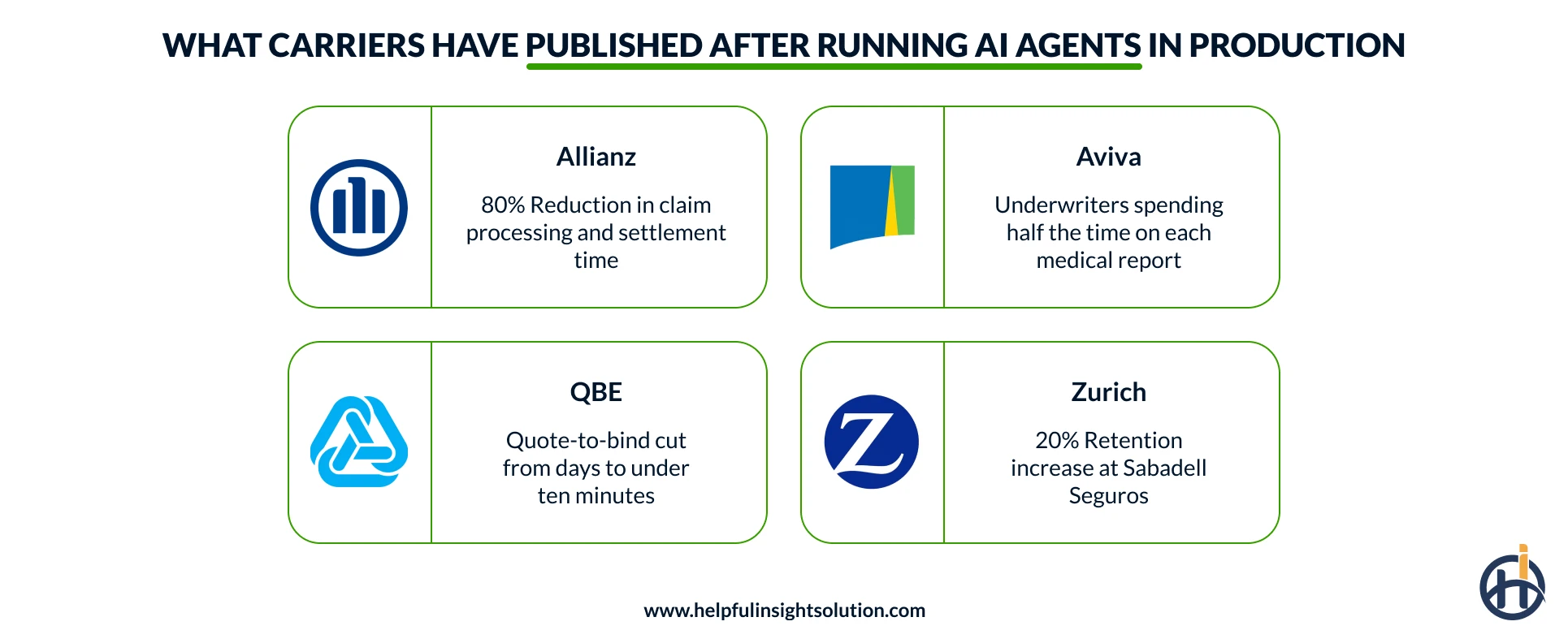
Their programs give a useful reference to any insurer planning the same.
Allianz Puts Seven Agents on One Claim Type
Allianz is one of the largest insurers in the world, working in almost 70 countries with around 97 million customers, across property, life and health.
On the AI side, the group is ahead of its peers. Allianz was ranked first in the Evident AI Index for Insurance 2026, which covers 30 global insurers, and over 900 AI use cases are registered inside the organization only.
Project Nemo is the first agentic AI solution that Allianz put into production. It is running in Australia on food spoilage claims. These are the claims that come after a storm knocks out the power, the refrigerator stops working, and the food inside it is lost.
Cover for this comes under a standard home contents policy, with AUD 500 as the threshold.
Seven agents are handling the work, each with one job and one set of systems.
- The planner sequences the run and hands off between agents
- The cyber agent protects the data moving between them
- Coverage reads the policy to confirm food spoilage cover
- Weather checks that a real weather event matches the claim date
- Fraud looks for the usual signals
- Payout calculates the amount owed
- Audit writes up every decision the others made
- Cyber runs across all of it, watching data security
The human reads the audit summary rather than having 7 different outputs. All the processes get completed in under 5 minutes. Allianz reports an 80 percent reduction in claim processing and settlement time.
The solution went live in under 100 days. Payout decisions are never automated, though, so the final call on every claim stays with a claims professional.
Aviva Puts Generative AI In Front Of Underwriters
Aviva is the UK’s only diversified insurer, with 25.2 million customers across the UK, Ireland and Canada.
Aviva launched an AI underwriting tool for individual life insurance in November 2025. By March 2026, Aviva had extended the same tool to critical illness cover, becoming the first insurer to bring AI underwriting into the critical illness) market.
The tool reads medical reports. When a protection application needs a GP report, that report comes back long and complex. An underwriter has to work through all of it to find the conditions which change the rating, and Aviva’s tool summarizes the report down to those conditions.
Underwriters are now spending about half the time they used to on each case.
QBE Cut Quote-to-Bind From Days to Under Ten Minutes
In the Yacht P&I (Protection and Indemnity) market, a certificate is needed before the vessel can leave the port, and it is needed again to enter one. The speed of issuing that certificate is the service, more or less.
Quote-to-bind on this product was taking days at QBE. It now takes under ten minutes.
QBE launched this in March 2026 with Aurora, and described it as embedded lead algorithmic underwriting. What happens is, a broker sends an email with the submission in it, and from that point nothing is manual.
The email gets ingested even though it is unstructured. Data validation runs, then QBE’s own appetite, pricing, and tax checks, then the quote document is generated. The certificate comes out at the end of it.
Zurich Lifted Retention by Guiding Its Call-Center Teams
Zurich’s Voice IQ tool runs inside contact centres during live calls. It listens while the customer speaks and puts recommendations on the agent’s screen in real time, specific to that customer and that conversation.
Retention is where Zurich has been using it. When a customer calls about canceling or about the renewal price, the agent gets a suggestion that has been worked out for that customer, rather than reading from a standard script.
Voice IQ, a generative AI tool built in-house, lifted retention by 20 percent at Sabadell Seguros, Zurich’s joint venture in Spain. There was a 2025 Qorus Innovation in Insurance Award for the tool.
Zurich has published five principles that govern its agentic AI work. Four cover security, explainability, interoperability and standardization.
The fifth says the company’s own knowledge, its policies, workflows and data, should be handled as a managed asset, because a general model has no access to that context.
Zurich itself is a global multi-line insurer of more than 150 years, with over 82 million customers across more than 200 countries and territories.

Benefits of AI Agents For Insurance
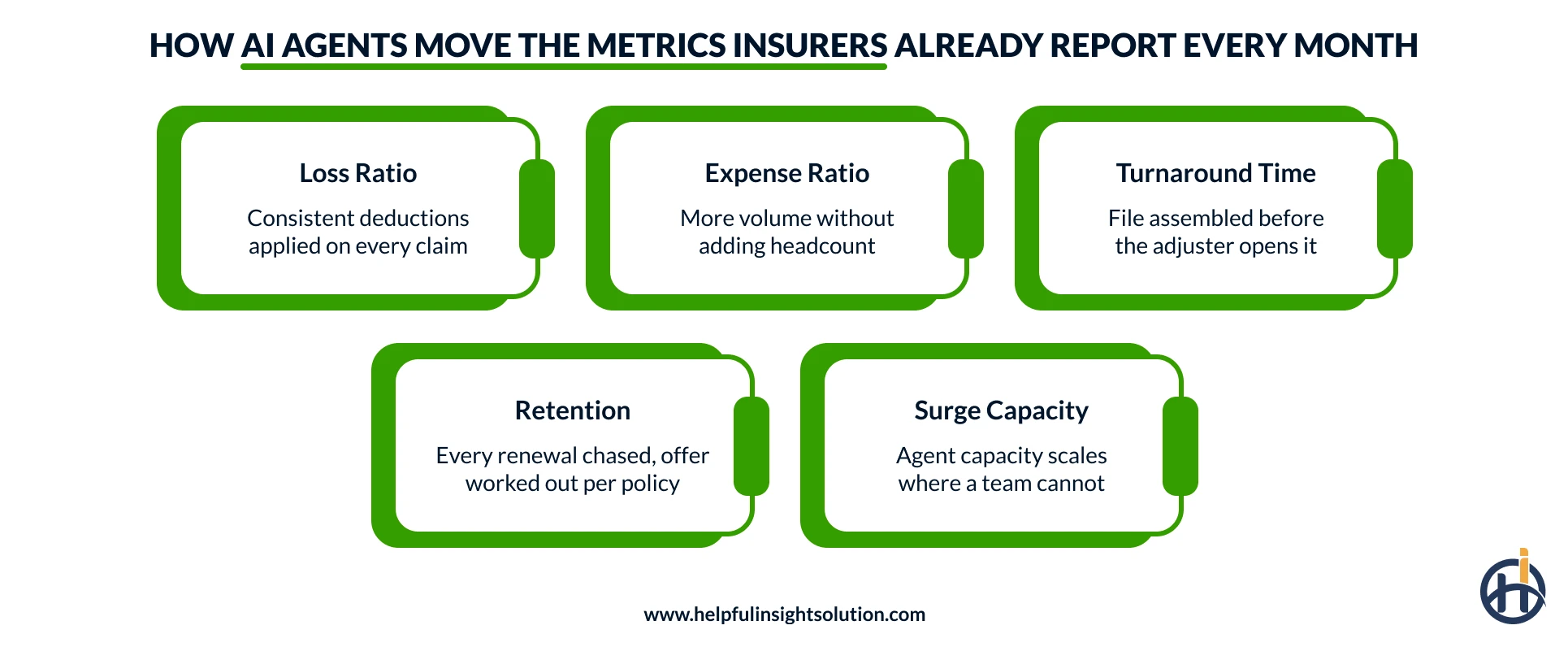
Insurers are already measuring everything that matters here, so the benefits of AI agents for insurance can be checked against the numbers that are there in the monthly pack.
Loss ratio:
A claim has deductions on it, like the excess, depreciation on the parts, or salvage value, and each has to be applied correctly to every file. An agent applies them consistently across every claim, so leakage from a missed deduction drops across the book rather than case by case.
Expense ratio:
Expense ratio does not improve by cutting costs alone, it improves when the premium you are writing grows faster than what it costs to write. Insurance AI agents work on that side, so volume can go up while the headcount stays where it is.
Turnaround time:
FNOL to first decision, submission to quote, request to endorsement, all of these come down when the file is already assembled before a person opens it. The customer notices, and so does the broker, who places the business elsewhere when quotes come back slowly.
Improved retention:
Renewals and servicing are the moments a customer decides whether to stay. An agent handles both consistently, working out the renewal offer per policy, sending the notice, chasing non-responders, and clearing endorsements without a queue behind them.
A customer served fast and accurately at renewal stays, but the one who waits does not always.
Capacity when it is needed most:
A claims team cannot become double the size for four weeks after a catastrophe. Agent capacity can go up like that, however, which is the reason turnaround time holds in a surge instead of going up.
| Function | Metric that moves | What changes |
| Claims triage | Loss ratio | Same deductions applied on every file, so leakage from a missed term drops |
| Claims intake | TAT | FNOL to first decision, the file being ready before an adjuster opens it |
| Fraud referral | Loss ratio | Cases reach the SIU before the payment goes out, while recovery is possible |
| Underwriting | Expense ratio | More submissions cleared per underwriter, without adding underwriters |
| Servicing | Expense ratio | Endorsements close without a back-office touch behind them |
| Renewal | Persistency | Every renewal gets chased, offer worked out per policy |
Building AI Agents for Insurance: A Step-by-Step Guide?
Insurance AI agent development stalls in the same three places: cover rules held only inside a policy wording, a core system with no write path from outside, and appetite thresholds living in one underwriter’s head.
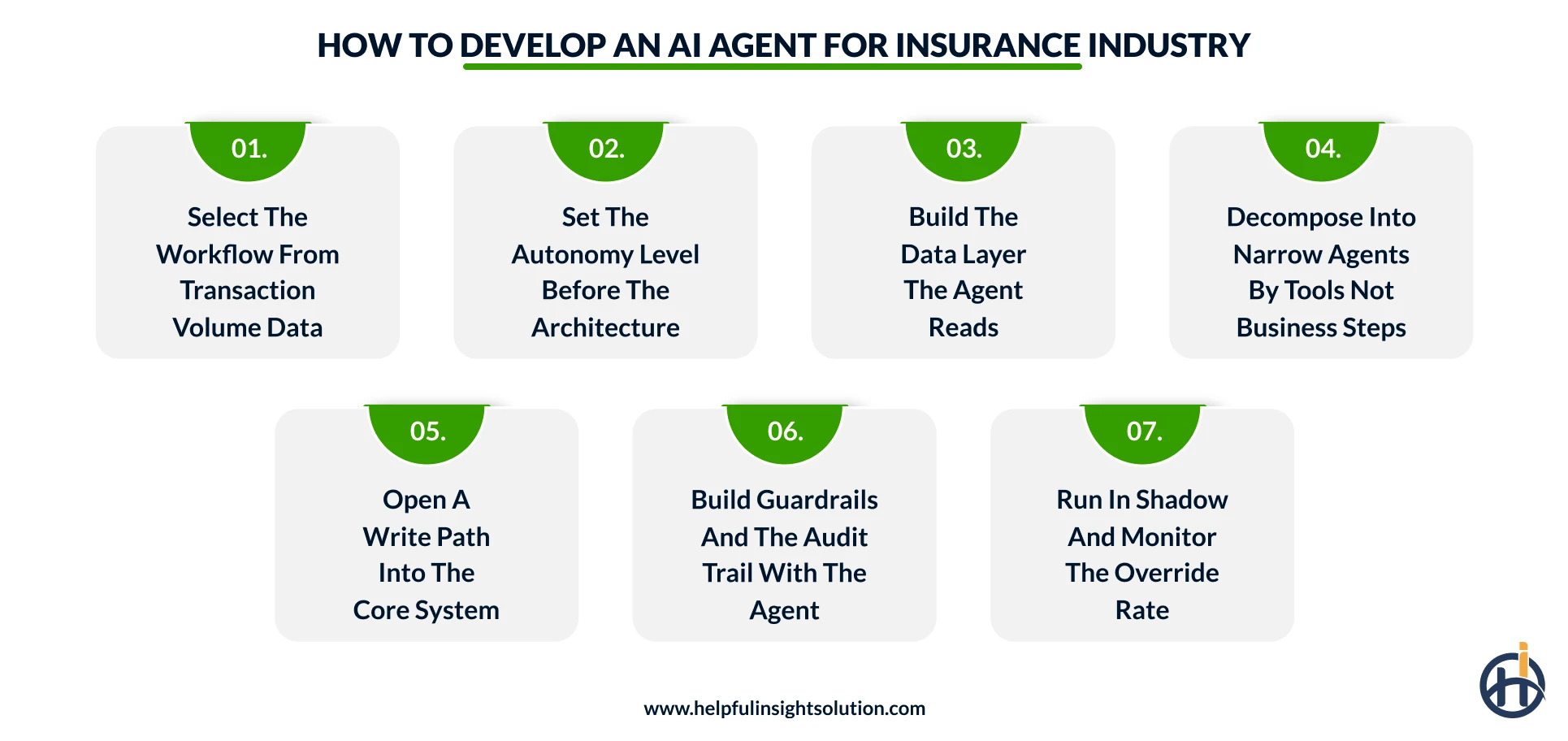
None of those three is a model problem, and all of them come before the first line of agent code.
Choose the Right Workflow to Start With
The AI agent development starts with a process that runs many times a month, volume pays for the build.
The next consideration is a standard operating procedure the team has been following, and the rules exist there that can be encoded. If the procedure was written years back and nobody is following it now, rewriting it becomes the first work package, and the coding starts only after that.
One more check before the selection is confirmed. The process should already be clearing most of its cases without exception handling, otherwise, the rules underneath are not stable, and the agent will inherit that instability.
A set of closed cases from the process should be pulled at this stage, taken from across the full year rather than a single quarter. The same set will serve as the requirement document and the test set later.
Decide How Much the Agent Can Do on Its Own
Once the workflow is fixed, the next decision is how much the agent will be allowed to do on its own. Gartner has put AI agents on four autonomy levels, and applying the same controls across all four is the reason Gartner expects 40 percent of enterprises to demote or decommission their agents by 2027.
| Level | What the agent does | Insurance example | Controls needed |
| Observe | Reads only, output returns to the requester | Policy lookup, claims history summary | Scoped data access, authentication, usage logging |
| Advise | Produces a recommendation, a person executes | Underwriting referral note, claim recommendation | Hallucination testing, guidance on reliance |
| Act with approval | Writes or sends, after approval on each action | Endorsement prepared, servicing officer releases it | Approval queue, audit trail, incident response |
| Act autonomously | Executes inside guardrails, humans review exceptions | Quote issue, claim routing | Continuous monitoring, circuit breakers, rollback |
The level should be settled before the architecture. An agent that only recommends will need read credentials, while an agent that acts needs a rollback path and a circuit breaker behind it.
Most first releases will be at the approval level, and the design problem there is the approval queue itself. An approver clearing a long list every day is not really a control anymore, so the volume reaching that queue should be capped by value or by confidence score.
Prepare the Data the Agent Will Read
With the autonomy level set, the data work begins. The same customer will be holding a different identifier in the policy administration system, in claims, and in the CRM.
Reconciling those identifiers is AI and ML development work, and it should be finished before any agent gets written. Some records will not reconcile at all, and an unmatched queue should be there from the first release.
Policy wording needs chunking and indexing next, at the clause level. The definitions are kept in an early section of the wording, and they apply throughout it, so a chunk carrying an exclusion can arrive without the definition of the term that exclusion depends on.
Those definitions should be carried into every chunk they govern.
Document intake is the third piece. The unreadable scan is not the real risk there, it fails visibly and routes to a person.
A misread digit on a claim amount is the greater risk, because the value looks reasonable and passes every check after it, so confidence thresholds should run field by field with tighter tolerances on anything monetary.
Split the Work Across Narrow Agents
Agents should be split by the tools they need, not by business steps. Two steps reading the same system can be one agent, splitting them will only add a model call without adding anything else.
Every boundary between agents is a call to the model, therefore, the cost goes up with each one. A generative AI development budget cost against a single prompt will read differently once the workflow is split into seven.
What is bought with that cost is testability, plus the ability to keep different autonomy levels inside the same workflow.
The output schema of each agent should be versioned as well. The agent after it will break quietly when a field changes, and without versioning nobody finds out till a claim has gone out wrong.
Connect the Agent to Your Core Systems
Most policy administration systems are read-heavy when the API list is reviewed. Closing the write gap is where most of the insurance software development effort actually goes.
Older cores are running batch windows too. A write sent during that window can be accepted and then lost, so a reconciliation job should confirm every write from the agent has actually landed.
Idempotency keys belong in the initial deployment as well, a retried call without them raises a second endorsement on the same policy.
The test environment should run on masked production data. Synthetic data will never contain the malformed records that break the agent, and those records are the reason people are still doing the process by hand.
Set the Guardrails and the Audit Trail
Guardrails belong in the initial deployment. Value thresholds are the control everybody configures. A velocity threshold is the one that gets forgotten, and an agent issuing a long run of payouts inside a minute is a defect at any value.
The audit record should carry the retrieved context, the tool calls, the model version, the prompt version, the output, and the approver into a store the agent has no permission to edit.
Reason codes should map back to the clause identifiers from the wording index. That list is better built with the complaints team than the underwriting team, since complaints handlers are the people answering the ombudsman.
Test in Shadow Mode, Then Watch the Override Rate
Before going live, the agent should run against the closed case pulled at the start. Agreement with what the human decided is measured case by case, and that number is a diagnostic rather than a target. Two people handling the same case do not always agree either.
A senior adjuster should review the disagreements, and some of them will be the agent reading the wording more carefully than the original handler did.
An adversarial set runs alongside: missing documents, conflicting values, and risks outside appetite. Both sets should run again on every prompt version and every model version.
Shadow mode comes after that, with the agent working real cases in parallel and writing nothing. It should cover one full cycle including a peak, since an agent holding up in an ordinary month tells nothing about the weeks after a catastrophe.
Once it is live, the number governing everything is the override rate. A rising override rate means the autonomy level was set too high, and dropping a level is the correction.
Challenges in Building AI Agents for Insurance, and What Gets Past Them
Most of these are not technical problems, they show up after the first agent is already running. Insurance AI agent development gets harder at the second agent and harder again at the third.
Write-Back Into a Legacy Core
Write-back means the agent putting something into the system of record, an endorsement into the policy administration system, or a reserve into the claims platform. Reading out of those systems is the easy half of it.
The write API belongs to the core vendor. A missing one is a commercial conversation before it is an engineering task, and the vendor roadmap is not the carrier’s to move.
Where the API will not be provided, an orchestration layer above the core becomes the route. A reconciliation job then has to confirm that every write from that layer has landed correctly.
Fragmented Policy Data
The same policy is there in several systems, and none of them agree on the key. An agent hits this on its second workflow, the first one having stayed inside a single system.
A crosswalk table reconciling the policy, claims, and CRM keys will carry the first few agents, plus an unmatched queue for records that fail to reconcile, because some of them always will.
Explainability When the Regulator Asks
The regulator will ask about one decision, taken months back, and the answer has to satisfy the customer as well.
An agent log by itself does not answer that. What is needed is the reason code mapped to a clause identifier from the wording index, stored together with the recorded rationale of whoever approved it. One without the other leaves the file half answered.
Agent Sprawl Across Teams
Sprawl begins with the second team building the second agent against the same policy system, different credentials, and duplicated tools.
Gartner puts half of AI agent deployment failures by 2030 down to weak runtime governance and poor interoperability between systems.
A registry is the answer, recording each agent with its owner, its autonomy level, the systems it touches, and the tools it can call. Enforcing that registry at runtime is the part that gets skipped.
Building AI Agents With Helpful Insight
Helpful Insight builds AI agents into the systems a carrier is already running. Most engagements start at the write path and the data layer, because those are the two places where a build stops when they get left till later.
The autonomy level gets settled with the compliance and underwriting teams before any architecture is drawn. Agent decomposition follows, then the guardrails and the audit record, and a shadow run against closed cases so the numbers are known before go-live.
The carrier brings the appetite rules, the wordings, and the claims history. We bring the agent architecture, the integration into the core, and the governance around it. Insurance work runs inside our wider AI development services, and the same patterns carry across finance builds.
Frequently Asked Questions
Cost follows three things. How much data remediation is needed before the agent can read anything, how many systems it has to write into, and the level of compliance evidence the workflow demands. A single workflow with clean rules and one write path costs a small share of what a multi-line rollout does.
On timeline, Allianz took its first agentic claims solution live in under 100 days, on one claim type in one country. That is the working benchmark for a scoped first agent. A programme covering a whole claims function will not finish in that window.
Yes, though the write path decides how much work it takes. Read access exists on most older cores. Where no write API is exposed, an orchestration layer above the core or an event bus becomes the route, with a reconciliation job confirming each write has landed. Building AI agents for insurance on a legacy core is normal, the integration is where the time goes.
An agency places business across several carriers, so the same client data gets rekeyed into a different portal for every quote. AI agents for insurance agencies compare quotes across carriers, then package each submission into the format that the carrier expects. Renewal chasing runs off the same agent, and commission statements get reconciled against the policies actually issued.
No. AI agents for customer service in insurance handle the requests that repeat, claim status, a policy copy, a premium due date, and they complete the task instead of describing it. Anything the agent cannot close goes to a person with the policy, the question, and the checks already done attached to it. Zurich runs its contact center tool the other way round, guiding the person on the call rather than replacing them.
Agentic AI use cases in the insurance industry’s compliance need two records stored together. A reason code mapped to the clause identifier from the policy wording, and the recorded rationale of whoever approved the decision. Both should be retrievable from one place. An audit trail reconstructed after the question arrives carries no weight with IRDAI or the NAIC.