


Key Takeaways:
- Generative AI platforms in manufacturing help to optimize production planning, predictive maintenance, quality control, and product design.
- Businesses integrate GenAI to reduce operational costs, minimize downtime, accelerate innovation, and make faster data-driven decisions.
- It is crucial to have quality data, secure AI infrastructure, compatibility with existing ERP/MES/IoT systems, and defined use cases before scaling GenAI.
- A step-by-step integration process includes validating pilot projects, establishing human oversight, and progressive scaling across manufacturing operations.
The manufacturing sector is now becoming digitally active due to advanced AI technologies, which help workers to reduce inspection errors and maintain more accuracy. Businesses are able to manage unstable supply chains, severe labor shortages, and complex production environments on a large scale.
Additionally, they use generative AI in manufacturing to automate design processes, ensure predictive maintenance, and optimize energy consumption. These benefits increased the adoption of this technology across various industries, such as electronics, food, automotive, and aerospace.
Based on a report published by Precedence Research, the GenAI-powered manufacturing market will reach a revenue of $1.8 billion by 2028. It is important to know that these systems will not replace the current software like ERP, MES, or PLM tools but rather enhance their functionalities. This will allow businesses to make faster decisions across production, quality control, and supply chain operations.
This blog discussed the best 7 use cases of generative AI technology for manufacturing businesses, with crucial benefits, challenges, and the implementation process. So to get more information, let’s come along on this journey and explore valuable insights.
What is generative AI in manufacturing?
Generative AI in the manufacturing industry helps businesses to automate product design, predict machine failures, optimize supply chains, and inspect product quality. This technology links engineering files with factory data to help teams make faster decisions and reduce operational downtime.
The increased use of AI in the automotive, electronics, and food production industries enables factory owners to maintain sustainability and productivity across manufacturing units. Various GenAI tools deliver strategies for predictive maintenance, production planning, and market research, allowing workers to understand modern innovations through simplicity.
- Automotive: With GenAI, vehicle designs are rapidly produced, assembly line failures are predicted, and production scheduling is streamlined.
- Aerospace: Structurally optimized designs for aircraft parts are generated with GenAI, enabling predictive maintenance of critical components.
- Electronics & Semiconductor: Micro-level defects on circuit boards and chip surfaces are identified, maximizing production yield on assembly lines.
Leading stats on generative AI in the manufacturing industry
As businesses have started integrating generative AI in the manufacturing industry, they have experienced growth in revenue and customer acquisition. We are going to observe some important market figures and stats in this section based on regional parameters.
- The market size of GenAI in manufacturing will be $1.3 billion in 2027 globally, with North America having a 45% share in the market.
- By 2034, the overall revenue will reach $13.9 billion, as the market is growing rapidly at a rate of 41% CAGR over this period.
- In the USA, generative AI-powered manufacturing businesses will have a total revenue of $395 million in 2027, which will reach 4.5 billion by 2034.
- The supply chain segment is expected to grow at a 35.5% CAGR based on manufacturing, whereas the electronics segment will grow at a 36.4% CAGR based on the industry.
- Europe and Asia Pacific have respective shares of 26% and 23% in the market due to technical backlogs and delayed integrations.
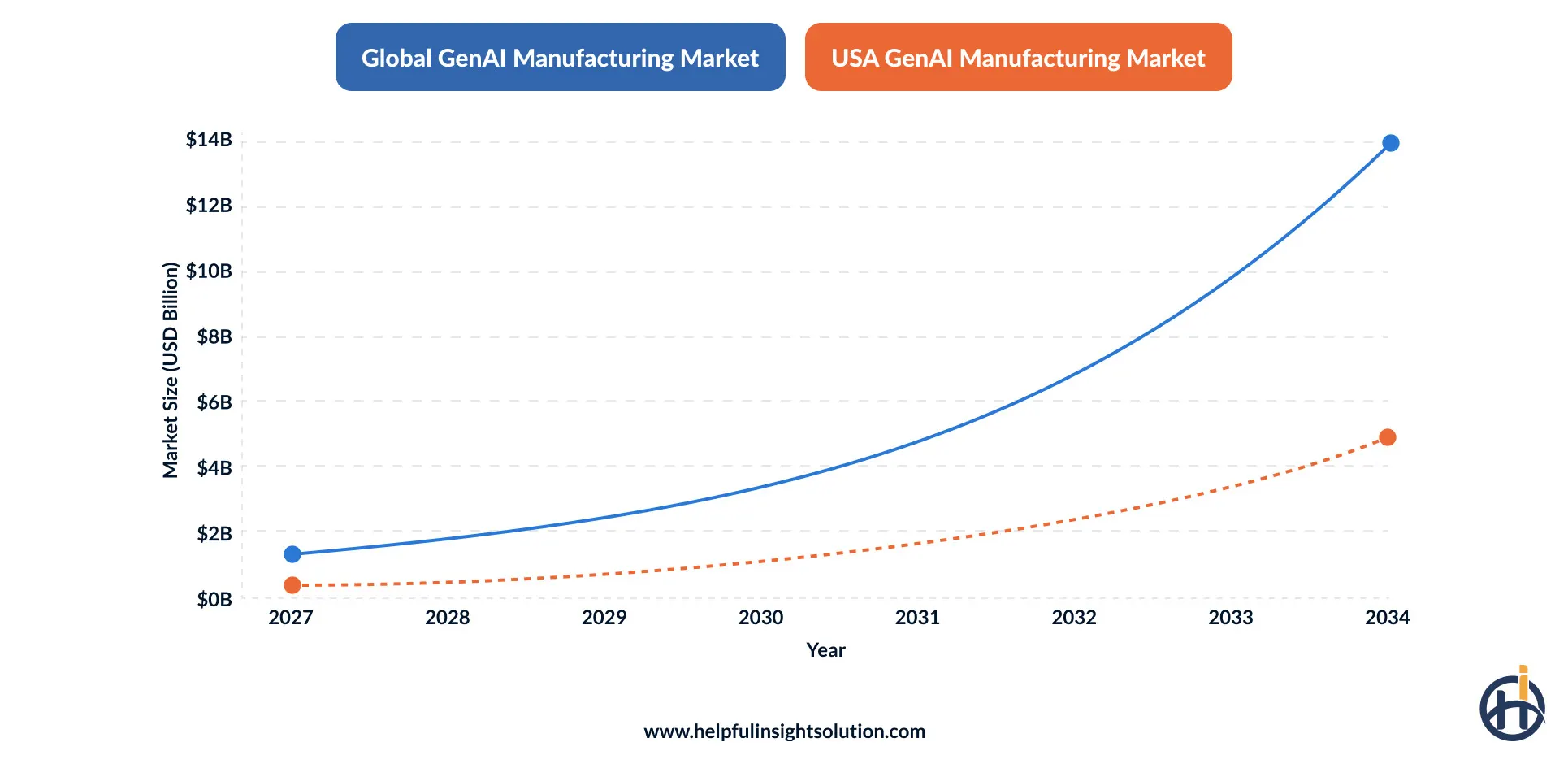
This shows that GenAI technology is creating multiple opportunities for manufacturing enterprises, allowing them to invest more. So, focusing on business integrations and platform optimization is necessary for entrepreneurs across the globe.
Top generative AI use cases in manufacturing
The best generative AI use cases in manufacturing include quality control, predictive maintenance, and more. In this section, we are going to explore these important trends in detail with their real-world examples.
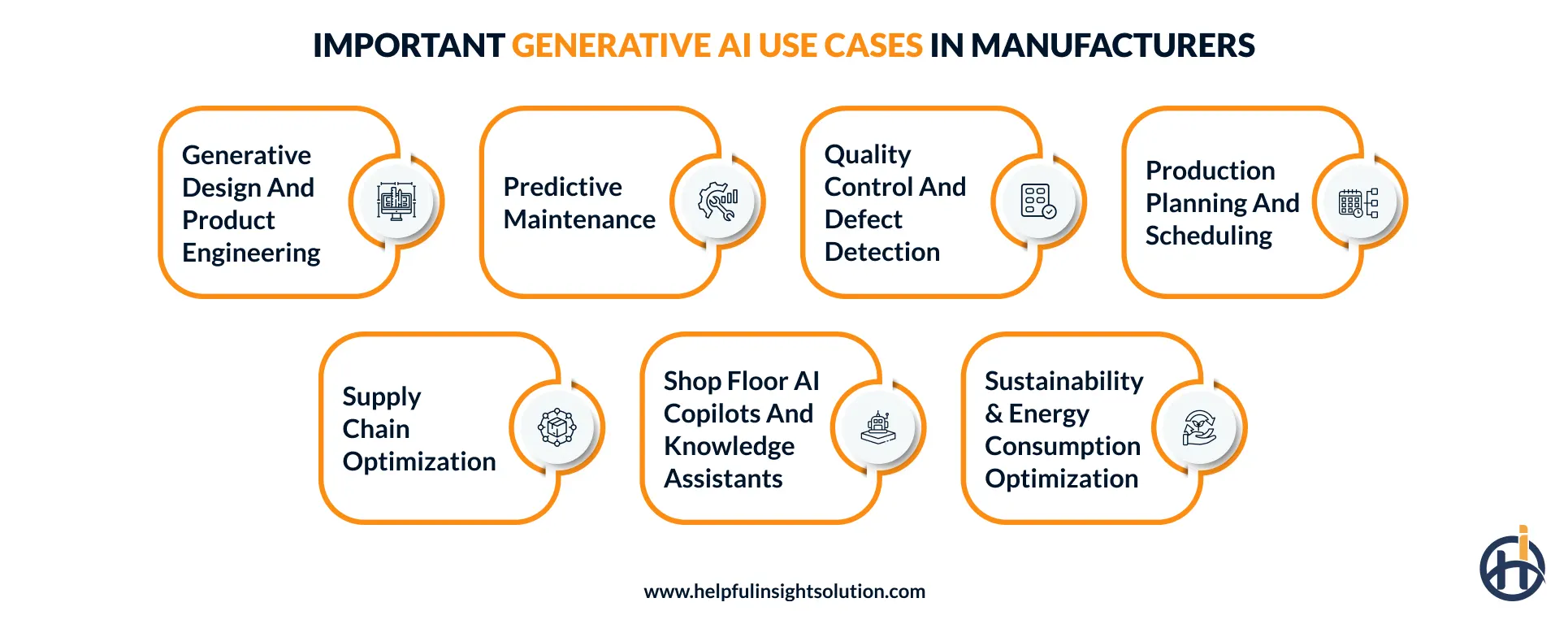
1. Generative design and product engineering
Using defined criteria such as material, weight, strength, and cost, GenAI produces a range of alternative design options, enabling engineers to assess various possibilities.
This can easily reduce the ideation stage from concept to an optimized prototype. In turn, this leads to far lighter, stronger, and more economical designs achieved in a considerably reduced time scale.
- Allows engineers to simulate thousands of variations of a design before building physical prototypes, drastically reducing the material used in R&D processes.
- Enables generative topology optimization, removing the majority of unused material from a part while maintaining structural integrity for additive manufacturing (3D printing).
2. Predictive maintenance
Using sensor data and performance history, generative AI for predictive maintenance in manufacturing is able to predict future failure possibilities long before a breakdown can occur.
This enables early machine maintenance by preventing delays in the monitoring processes. It helps to reduce equipment downtime, increase operational life, and achieve massive savings on emergency repair call-out costs.
- Replication of wear-and-tear through a digital twin, thereby enabling maintenance window preparation along with the production schedule rather than taking it on during the cycle.
- Maintenance alerts, according to their failing status and safety risk, are given high importance, making sure that the main equipment doesn’t wait too long.
3. Quality control and defect detection
Computer vision in manufacturing powered by GenAI enables real-time product monitoring, allowing systems to instantly detect defects or inconsistencies that are missed by humans.
This leads to greater accuracy while considerably increasing throughput on high-speed manufacturing tasks. The ability to instantly identify anomalies removes the risk of expensive product recalls and builds brand value.
- It is scalable to learn and apply new defect types over time without reprogramming, unlike conventional rule-based systems.
- High-level defect reports with root cause recommendations that aid engineers in isolating deviations to particular processes or material properties.
4. Production planning and scheduling
This technology can easily process consumer demands, resource enquiries, and production capacities to create optimized models that reduce delays and enhance throughput.
It recalculates the schedule to maintain production flow during material shortages or equipment downtime. AI creates dynamic schedules that ensure continued efficient manufacturing operations despite unforeseen circumstances.
- The software coordinates with an accurate sequence of operations, allowing humans to allocate resources, manage machine capacity, and prioritize orders.
- Provides factory simulations, which enable workers to test conditional situations, like a rush order, before making changes to the live schedule.
5. Supply chain optimization
Manufacturers leverage GenAI to manage supply chain events, predict disruptions, manage inventory, and define sourcing plans to gain optimal value.
This Gen AI use case in manufacturing helps simulate the outcomes of altering supplier relationships, delivery methods, or shifting demands. This optimizes inventory, prevents stockouts, eliminates excess inventory, and minimizes the overall supply chain costs.
- Recognize potential alternative suppliers as soon as supply chain and delivery disruption events occur, which can reduce the vulnerability associated with sole suppliers.
- The supply chain management software also develops demand forecasts for individual regions or customer segments, ensuring more accuracy than standard forecasts.
6. Shop floor AI copilots and knowledge assistants
GenAI-powered copilots offer workers immediate access to technical manuals, troubleshooting guidance, and machine-specific information. This can limit dependence on senior members of staff for everyday queries, increasing the speed of problem resolution. Additionally, it can accelerate new worker onboarding and knowledge transfer of unfamiliar and complex machinery within production.
- Helps diverse workforces from all countries easily understand the same technical information through multi-language search functionality.
- Tracks frequent questions from staff and provides insight to management about gaps in team training or equipment manual updates.
7. Sustainability & energy consumption optimization
GenAI can analyze energy usage trends across machines and buildings to pinpoint where waste exists, suggesting concrete, actionable ways to reduce those inefficiencies.
Manufacturers can easily schedule equipment use and energy consumption without reducing output or productivity. Beyond direct cost savings, this also feeds into larger corporate goals for sustainability and carbon neutrality.
- Tracks the carbon emissions per unit of production, facilitating manufacturers to accurately report against ESG and regulatory sustainability targets.
- Pinpoints the best windows to run energy-intensive processes when grid demand is lower and electricity costs are volatile, further minimizing utility spend.
Key benefits of generative AI for manufacturing
Businesses experience digital transformation in manufacturing operations due to advanced GenAI solutions. This section provides the key advantages of generative AI technologies for factory owners.
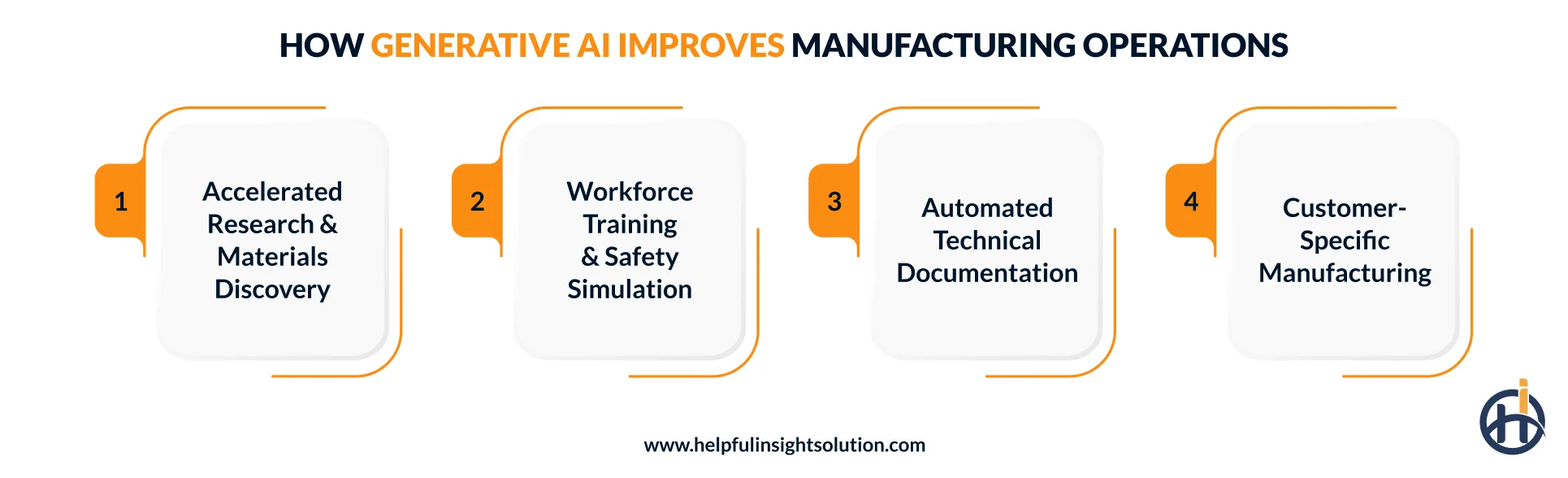
1. Accelerated research & materials discovery
The ability of GenAI to mimic and predict material behaviors assists in spotting potential material mixes that have promising outcomes before undergoing costly lab experimentation. Therefore, manufacturers develop better materials rapidly that may be lighter, stronger, or more eco-friendly.
2. Workforce training & safety simulation
AI training case scenarios and simulations enable employees to undergo machine training and work on safety precautions without increasing disastrous risks. Businesses use generative AI services to save time in training new workers, reducing injuries caused by inexperience with real equipment.
3. Automated technical documentation
All the required documentation, like manuals, compliance reports, or safety data sheets, is produced by GenAI, reducing human-driven processes. Every object has been accurately drafted and audit-ready documented with AI due to changing standards that the manufacturers are complying with.
4. Customer-specific manufacturing
GenAI enables manufacturers to produce customized products by generating design variations based on individual customer specifications. This makes mass personalization commercially viable, moving businesses beyond rigid, one-size-fits-all production models without disrupting existing workflows.

Challenges of implementing GenAI in manufacturing
While creating generative AI manufacturing platforms, enterprises face multiple challenges, such as increased costs. You are going to study various market risks with their respective solutions in this section.
1. High infrastructure costs
The cost to implement generative AI in manufacturing is high due to powerful GPUs, edge devices, and low-latency internet. Also, the processing of large factory data in cloud models and the enhancement of older systems require additional expenses.
Solution: Test AI models on a simple assembly line, process data on cheaper devices, and target third-party vendors at a lower price point.
2. Data quality & integration issues
Factories store data in fragmented systems that degrade the quality, making it hard for GenAI models to use it safely and accurately. Legacy systems cannot share data easily, as they have multiple errors and lack data standardization with limited network power.
Solution: Implement a centralized data integration platform with standardized formats and ETL pipelines to unify legacy systems before feeding data into GenAI models.
3. Workforce skill gaps
A lack of GenAI knowledge among factory workers and difficulty in hiring ML experts lead to slow adoption and low trust in AI. The employees are not able to read complex data and use smart tools because onboarding programs are poorly structured.
Solution: Businesses should run GenAI-oriented training programs and hire tech experts who know both factory operations and coding.
How to implement generative AI technology in manufacturing?
To build the best generative AI platforms for manufacturing factories, businesses must know a dedicated process. Here, crucial GenAI integration stages are discussed that you must go through before moving ahead.
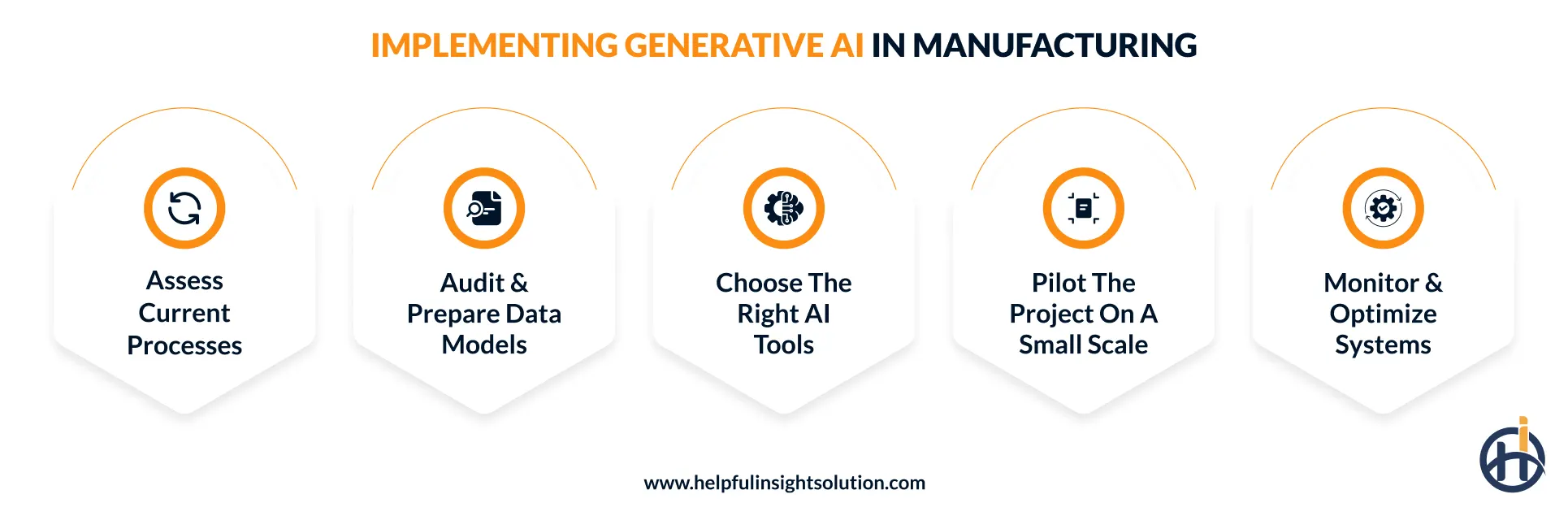
1. Assess current processes
Map present manufacturing processes and find areas with inefficiencies, like redundant activities and bottlenecks, where you can improve operations with GenAI. Include input from workers involved in production, quality control, and maintenance to understand areas of greatest opportunity for applying the technology. That sets you up for success in implementing technology at crucial points.
2. Audit & prepare data models
Enterprises must ensure that the data collected from machines, sensors, and old systems is structured, accessible, and of high quality. Collect, clean, integrate, and organize this information to remove data silos and build consistency so AI models can learn successfully without inaccurate patterns. This is where businesses can create the best environment possible for their GenAI tools.
3. Choose the right AI tools
It is crucial to hire an AI development company that helps to choose the right AI technology platforms, ensuring efficiency in the manufacturing workflow and infrastructure. Understand scalability needs, solution architecture, and strategy to manage the overall cost of ownership. Not choosing appropriate tools will result in significant changes in the future that you can easily make today.
4. Pilot the project on a small scale
Businesses must initiate a rollout plan on a single production line, machine, or process before introducing it to a wide range of businesses. This way, teams can easily measure actual results, uncover hidden issues, and predict worker concerns. By focusing on small trials, they can enable teams to build confidence within the organization, laying the groundwork for expansion.
5. Monitor & optimize systems
With increased data collection, enterprises can improve production models with more up-to-date and recent manufacturing operations. A continuously optimizing program that leverages best practices based on this historical information can maximize efficiency gains. Integrated GenAI platforms ensure sustained brand value for long-term growth after initial implementation.
How does Helpful Insight assist manufacturing businesses in building intelligent generative AI solutions?
You must be looking for a reliable partner who knows how to integrate generative AI in manufacturing platforms without disrupting existing models. We are here to help you develop advanced solutions that can easily improve inspection on production lines, reduce errors, and deliver smart manufacturing AI assistance.
Entrepreneurs can hire experienced and skilled automation experts who assist in understanding current market innovations and implementing them with ease. Additionally, they ensure businesses follow strict data compliance standards and security regulations.
With optimized budget and resource planning, manufacturers can easily reduce the generative AI development cost and invest more in supply chain efficiency. It enables brand consistency, increased customer engagement, an enhanced supply chain, and reduced factory errors.
If you don’t want to lag behind your competitors, then it is the right moment to start with generative AI.
FAQs
A pilot project costs between $15,000 and $40,000 due to RAG models that focus on a specific use case. The cost of a single workflow model increases to $100,000 because of live production tools, such as a smart procurement agent. On average, the total cost may reach $200,000 for factory-grade GenAI platforms.
Future generative AI solutions for manufacturing will be more advanced, efficient, and synchronized. Some of the major futuristic trends are discussed in the following manner:
- Digital twins: GenAI integrates with virtual factory models to run simulations and predict issues before execution.
- Autonomous operations: AI agents interpret videos, sense data, and manage inventories to deliver self-optimizing factories.
- Adaptive robotics: The algorithms guide robotic arms to handle fragile parts that traditional cameras miss.
The merger of generative AI and manufacturing enhanced product quality, customer experience, and business revenue. Enterprises can build GenAI-powered manufacturing solutions through the following process.
- First, you need to identify key issues and prioritize major business tasks.
- Gather and organize data from sensors and ERP systems to remove errors.
- Now, choose LLMs and RAG models that help to reduce false results.
- Integrate AI tools and build a simple interface for better interaction.
- Train factory workers and monitor performance with real-time metrics.
GenAI tools process unstructured emails, news, and weather reports to spot early disruptions. Supply chain optimization is one of the use cases for generative AI in manufacturing that analyzes market trends to prevent shortages. It uses financial statements and sensor data to build risk profiles, predict errors, and test models.
This technology provides generative design, predictive maintenance, and energy management facilities to reduce manufacturing waste. It analyzes factory data and forecasts precise material needs to prevent excess power consumption. Businesses use GenAI to monitor factory heating, ventilation, and machinery loads in real time.