

Key Takeaways:
- The cost of making Walmart-like retail applications ranges from $15,000 to $200,000, depending on complexity, integration, and platforms.
- The overall development cost is increased by advanced features like AI recommendations, real-time inventory, and omnichannel capabilities.
- Technology stack, cloud infrastructure, payment gateways, and logistics APIs also affect the total investment for business investors.
- Businesses can reduce expenses by planning for maintenance, security updates, third-party APIs, scalability, and feature enhancements.
The dynamics of the retail landscape are changing due to varied customer preferences and technology advancements. A mobile retail app like Walmart is leading this revolution from the front, as it offers user-centric e-commerce features with advanced capabilities.
Also, it has major divisions for the US and other worldwide countries, focusing highly on repeat-buying customers. Entrepreneurs aim to create similar platforms but mostly fail due to improper guidance that leads to overestimation of costs and wrong selection of retail business models.
According to Statista, Walmart USA has registered a revenue of $99.6 billion in 2026, showcasing the potential of the retail market. Businesses need to consider various cost-driven checkpoints before investing their assets in the development of an online e-commerce platform. This not only gives them a reality check but also ensures a competitive edge over other enterprises.
This blog helps investors understand the cost to develop a Walmart app, including related factors, cost-reducing agents, and monetization strategies. It is a complete guide that will surely allow retailers to manage resources wisely and increase investment returns.
What is the Walmart app?
Walmart’s grocery delivery application is an all-in-one shopping platform that allows users to buy clothes, electronic goods, household items, medicines, and more.
This mobile platform helps people track deliveries, manage pharmacy prescriptions, check local store inventory, schedule curbside pickup or home delivery, and pay contactless in stores using Walmart Pay. The integration of AI in retail also transformed Walmart’s services, as it provides a Sparky AI assistant, in-store navigation, and AR visual tools.
Current worldwide market
The retail market is growing rapidly due to increased consumer demands, business expansion, and technical innovations. Let’s observe some market stats to understand the growth of this industry in detail.
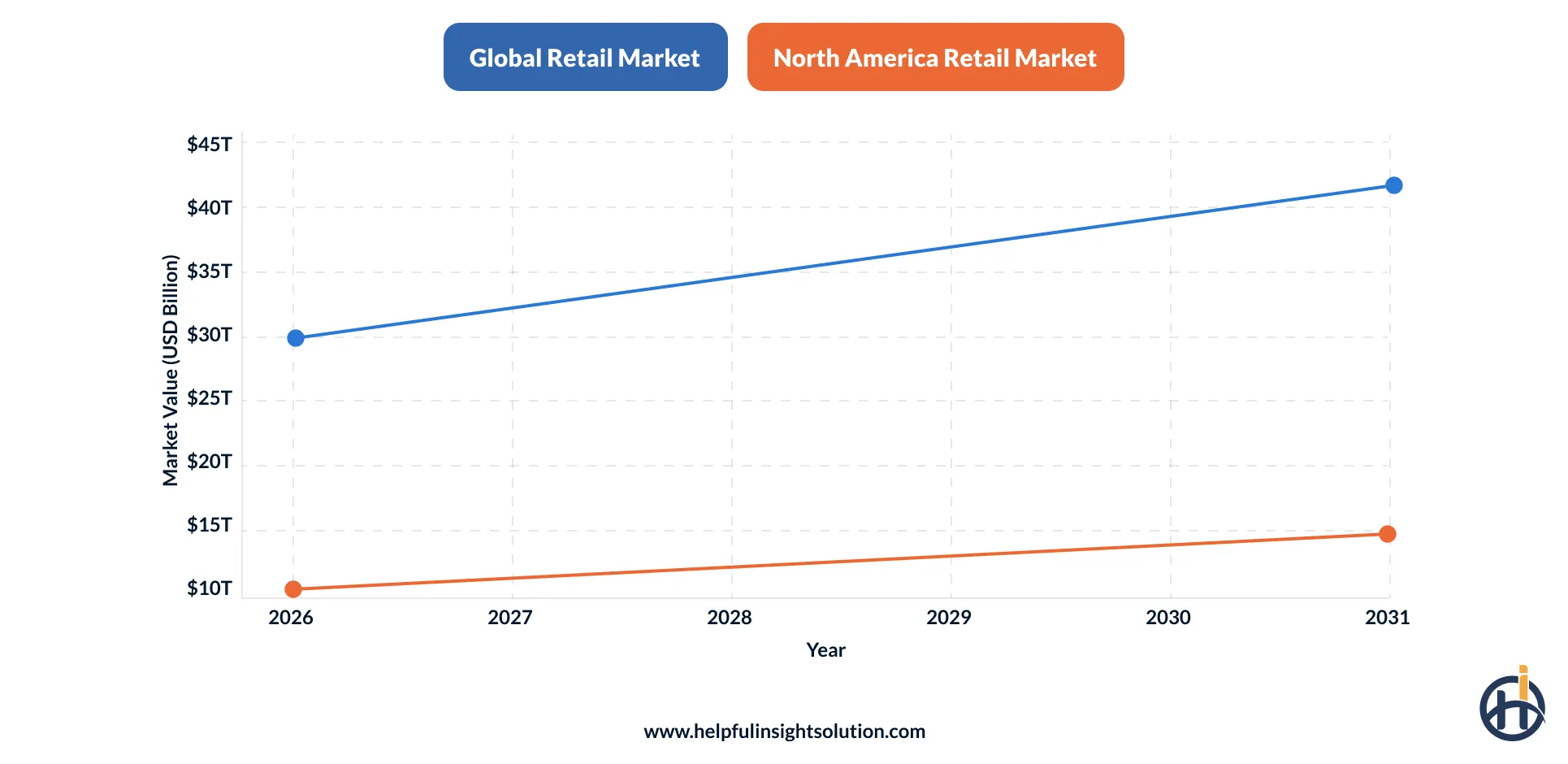
- The size of the global retail market is $29.8 trillion in 2026, with North America having a share of 34.4% of the market.
- By 2031, the overall revenue will increase to 41.5 trillion, as the industry is growing rapidly at a rate of 6.9% CAGR over this period.
- Talking about Walmart, it has 5,212 stores in the USA, with Texas having a maximum of 593 stores across the region.
- There are more than 270 million weekly shoppers worldwide, through which Walmart has earned $713 billion in 2026.
- Mexico and Central America have a combined revenue of $52.5 billion in 2026 for the Walmart International segment.
How does the platform work?
The workings of a retail app like Walmart are discussed in this section, so businesses can easily understand the need to invest in this solution. The key steps are described as follows:
- Customers download the app, create a personal account, and set location preferences to connect with stores.
- They use the search bar to find products, view stock availability, compare prices, and read product reviews.
- The app provides multiple options for home delivery, curbside pickup, and in-store shopping lists.
- Users can apply discount coupons or use Walmart Cash to get offers and rewards in various categories.
- It is easy to pay from the app or by credit card, allowing customers to track orders and contact delivery partners.
Top advantages of building retail apps similar to Walmart
The Walmart app for delivery and shopping offers multiple benefits, helping business investors boost ROI. Some of the major advantages of this retail and e-commerce platform are discussed in this section.
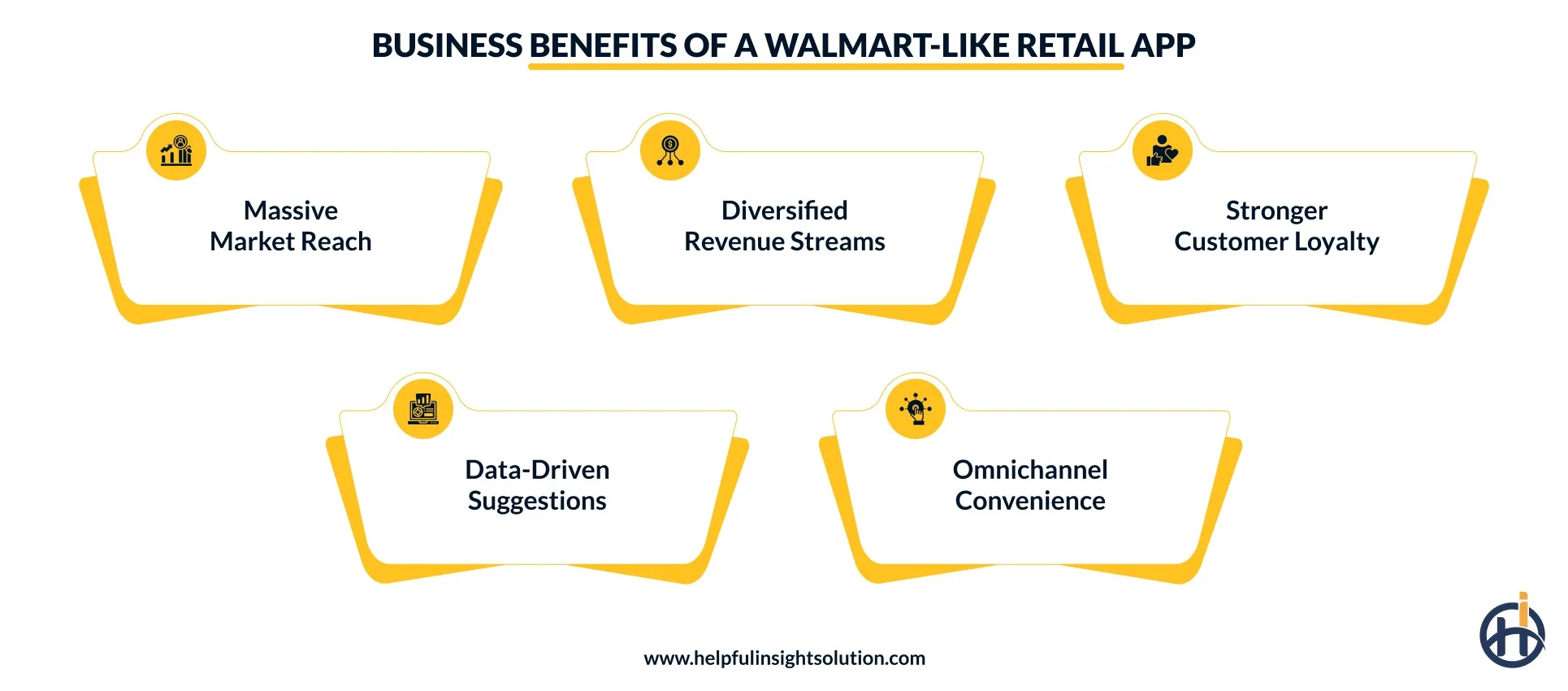
1. Massive market reach
The app has a large customer base with an appetite for one-stop shopping for groceries, electronics, and household basics. A Walmart app clone automatically reaches a wide array of customer segments that a specialized app could never access.
2. Diversified revenue streams
Product sales, delivery fees, third-party seller commissions, and in-app ads help ensure that the business doesn’t depend on one source for income. The Walmart app for groceries ensures a stable and supportive revenue source for retail merchants or marketplace owners in inefficient sectors.
3. Stronger customer loyalty
Personalized offers, loyalty points, and special member benefits similar to Walmart+ encourage repeat purchases and help cultivate loyalty. This long-term relationship is also beneficial, as loyal customers tend to be less costly to acquire than brand-new retail services.
4. Data-driven suggestions
The data gathered from e-commerce apps like Noon or Walmart feeds AI to offer product recommendations and enable hyper-personalized experiences. This information is also used to optimize inventory, pricing, and other operations with higher precision.
5. Omnichannel convenience
A Walmart retail app lets customers move between browsing online, ordering via mobile, and picking up or returning items in-store, with a single connected experience. This unified approach removes friction between digital and physical shopping, encouraging repeat purchases and stronger customer loyalty.
Features you need to include in Walmart-like applications
Here, we are focusing on the core features of the Walmart grocery delivery application, which also provides retail services. The following table will easily help us understand key elements with their descriptions.
| Feature | Description |
| User Registration & Profiles | Allows customers to sign up and save preferences, addresses, and payment methods for faster checkout. |
| Product Catalog & Search | Displays categorized products with filters, sorting, and a smart search bar for quick discovery. |
| Shopping Cart & Checkout | Enables users to add multiple items, apply coupons, and complete purchases in a few simple steps. |
| Multiple Payment Options | Supports credit/debit cards, digital wallets, BNPL, and cash-on-delivery for flexible checkout. |
| Order Tracking | Provides real-time updates on order status, from processing to delivery or in-store pickup. |
| In-Store Pickup Option | Allows customers to order online and collect items from the nearest store, saving delivery time. |
| Personalized Recommendations | Uses AI to suggest products based on browsing history, past purchases, and preferences. |
| Loyalty & Rewards Program | Rewards repeat customers with points, discounts, or membership perks to boost retention. |
| Push Notifications & Alerts | Sends updates on order status, price drops, restocks, and personalized deals. |
| Ratings & Reviews | Allows customers to rate products and leave reviews, building trust and aiding purchase decisions. |
Factors related to the cost to develop a retail app like Walmart
Entrepreneurs must know the cost of building a retail app like Walmart, which depends on several factors. In this section, we will explore these aspects with their respective cost tables and detailed information.
1. Mobile app complexity
The app-making price depends on the project complexity, ranging from basic product browsing to advanced capabilities such as AI recommendations, AR try-ons, or multiple vendor support. The mobile app development cost is much lower for simple applications that offer product search and checkouts.
| Tier | Scope | Cost Range |
| Basic | Single category, simple browsing & checkout | $15,000 – $35,000 |
| Mid-Level | Multi-category catalog, filters, order tracking | $35,000 – $80,000 |
| Advanced | AI recommendations, AR features, multi-vendor support | $80,000 – $150,000 |
2. Platform choice
Building for only one platform, like iOS or Android, is cheaper than multi-platform or both native development, which impacts the price and amount of engineering resources required. Comparing native vs hybrid frameworks also affects both performance and the overall maintenance cost.
| Option | Scope | Cost Range |
| Single Platform (iOS or Android) | Native app for one OS | $15,000 – $50,000 |
| Cross-Platform (React Native/Flutter) | Shared codebase for both OS | $30,000 – $90,000 |
| Native for Both (iOS + Android separately) | Two fully native codebases | $60,000 – $150,000 |
3. UI/UX design
Standard templates cost less than custom wireframing, prototyping, and branding-oriented user experiences with good interfaces. This impacts the Walmart mobile app development cost, driving high conversion rates, retaining existing users, and optimizing navigation through accuracy.
| Tier | Scope | Cost Range |
| Template-Based | Pre-built UI kits with light customization | $15,000 – $25,000 |
| Custom Design | Original wireframes, prototyping, branding | $25,000 – $60,000 |
| Premium Experience | Extensive user research, micro-interactions, AR/UI innovation | $60,000 – $100,000 |
4. Backend infrastructure
A single-server solution is cheaper than that of scalable cloud architectures or microservices that handle a large number of requests, high transaction loads, and synchronized information. The hosting should align with the anticipated level of user load and real-time payments.
| Tier | Scope | Cost Range |
| Basic | Single-server setup, standard database | $15,000 – $30,000 |
| Scalable Cloud | Multi-region cloud hosting, load balancing | $30,000 – $80,000 |
| Enterprise-Grade | Microservices architecture, real-time data sync, high-availability setup | $80,000 – $200,000 |
5. Developers’ experience
Junior teams have a lower hourly rate because they take more time and iterations, but senior developers or specialists have the added benefit of speed and a higher success rate. The cost of making a Walmart grocery delivery app clone depends on the overall complexity, priority, and time constraints.
| Tier | Scope | Cost Range |
| Junior/Mid-Level Team | Standard development, moderate complexity | $15,000 – $45,000 |
| Senior Team | Complex architecture, performance optimization | $45,000 – $100,000 |
| Specialized Experts | Niche skills (AI/ML, AR, large-scale systems) | $100,000 – $180,000 |
6. Security & compliance
Minimal security measures like SSL authentication are less expensive, but they do not address advanced needs like PCI-DSS compliance, encryption, and fraud detection. The cost to build a Walmart app with credit card information will increase to ensure user data safety.
| Tier | Scope | Cost Range |
| Basic | SSL, standard authentication | $15,000 – $25,000 |
| Standard Compliance | PCI-DSS compliance, data encryption, fraud detection | $25,000 – $60,000 |
| Enterprise-Level | Multi-layer security, regular audits, advanced fraud prevention systems | $60,000 – $120,000 |
7. Team composition & location
Businesses hire skilled and experienced offshore developers because they are more affordable than experts within the same country. Additionally, time-zone differences impact overall communication, collaboration, and synchronization between enterprise services and resources.
| Option | Scope | Cost Range |
| Offshore Team (Asia) | Cost-effective development with experienced teams | $15,000 – $50,000 |
| Nearshore Team (Eastern Europe/Latin America) | Balanced cost and time-zone alignment | $40,000 – $110,000 |
| In-House/Onshore Team (US/UK) | Premium rates, direct oversight | $100,000 – $200,000 |
8. Post-launch maintenance
Long-term costs for bug fixing, feature upgrades, and performance monitoring are added to the budget after initial launch. A maintenance plan that includes constant 24×7 monitoring for security risks and downtime would carry an increased cost, reducing the ongoing investment for disaster recovery.
| Tier | Scope | Cost Range (Annual) |
| Basic | Bug fixes, minor updates | $15,000 – $30,000 |
| Standard | Regular feature updates, performance monitoring | $30,000 – $70,000 |
| Comprehensive | Continuous enhancements, scaling support, 24/7 monitoring | $70,000 – $130,000 |
Tips for reducing the cost to create retail apps like Walmart
It is beneficial to follow important strategies to reduce the expense of making a Walmart-like retail shopping app. Here, you are going to study some common cost-reducing methods, like MVP and hybrid platforms.
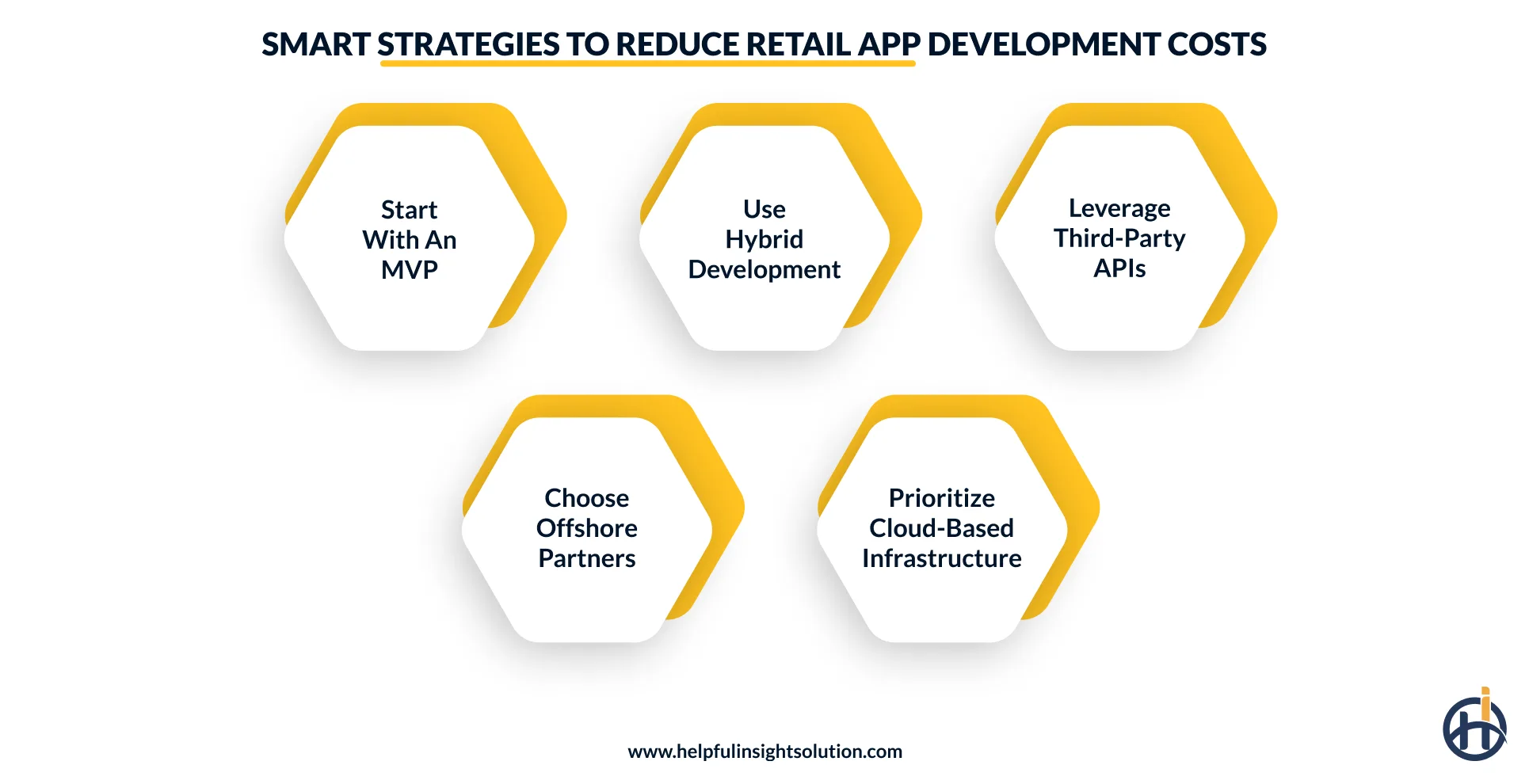
1. Start with an MVP
Launch with a minimum viable product with basic functions such as product view & checkout, rather than creating all possible advanced features upfront.
This will test the market and collect feedback from actual users before implementing high-cost features such as AI-driven recommendations or AR try-ons. This will save excessive expenditure on features that are not adopted by the users.
2. Use Hybrid development
Frameworks such as React Native and Flutter enable cross-platform development, thus reducing the development costs by half compared to building native apps individually.
Additionally, future maintenance will become easier, with only one update required rather than two. The performance implications have been considered minor for a Walmart grocery app clone with common use cases.
3. Leverage third-party APIs
Leverage external platforms to develop payment authorization, maps, and logistics-related functions rather than building them in-house. The use of AI in grocery delivery apps like Walmart can effectively reduce the development time considerably since all these functions involve great complexity. They also rely on standard services that are tested and proven, ensuring faster market reach.
4. Choose offshore partners
With an experienced Walmart mobile app development company, you can save heavily on labor costs without losing quality. Regions like India or Eastern Europe include technically talented developers who have the track record to develop Retail and E-Commerce applications.
Make sure to carefully consider previous projects or references, as well as their communication skills, before hiring a partner.
5. Prioritize cloud-based infrastructure
A scalable cloud hosting platform such as AWS or Google Cloud with a pay-as-you-go model requires little investment in infrastructure and resources.
The entrepreneur pays only for those resources and services that are being consumed, which are economical during the first phase of a startup. Additionally, scaling systems up or down is based on usage, compatibility, scalability, and efficiency.
How can businesses monetize Walmart-like retail apps?
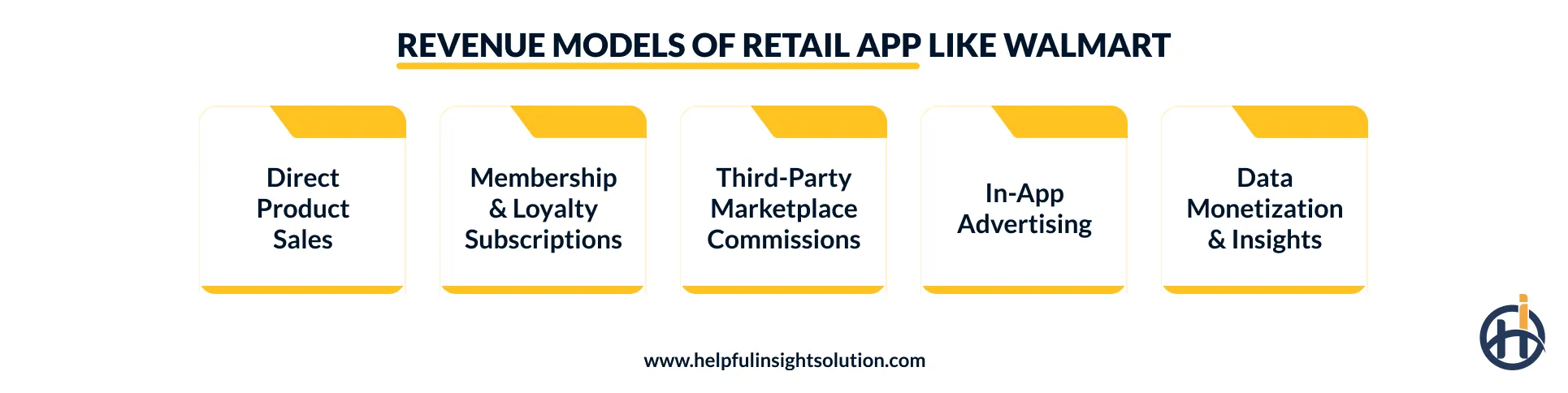
Multiple ways are available for businesses to monetize a Walmart grocery pickup app clone, such as advertising and subscriptions. This section describes significant money-making strategies that enterprises must follow.
1. Direct product sales
Earn core revenue through markup on products sold directly through a Walmart grocery delivery application clone across categories like food, electronics, and groceries. It is always the core revenue-generating source of any large online retail store application.
2. Membership & Loyalty Subscriptions
Offer a premium experience through Walmart+ that offers varied benefits like free shipping, special offers, and expedited delivery at the expense of a recurring fee. This would bring in predictable recurring revenue, also adding a lot of retention and lifetime value.
3. Third-Party Marketplace Commissions
Other sellers or vendors offer multiple third-party products in exchange for a percentage-based commission on each sale on the retail platform. Businesses invest in e-commerce development, as it helps them sell and expand e-commerce services without inventory management.
4. In-app advertising
Get product sponsorships, banner ads, and featured placement in search results for multiple brands that want access to your users across the globe. It will allow investors to create a revenue stream dependent on the market growth and engagement level.
5. Data monetization & insights
Brand partners offer different market trends, buying behavior, and purchase history in their database to companies for a fixed amount of money. The income is backed by strict data anonymization, system privacy, and terms of service with customers in real time.
Partner Helpful Insight for developing smart retail and e-commerce applications like Walmart
Are you ready to create a user-favorite retail app like Walmart? You need an expert team that can deliver the best services, from consulting to maintenance, at reasonable costs. We provide skilled and reliable experts to help our clients understand growing retail trends, enhance the future of grocery shopping, and engage more customers.
They specialize in advanced technologies, such as AI and AR/VR, which ensure hyper-personalization, inventory optimization, and improved buying experiences. Additionally, we enable businesses to reduce the cost to create a Walmart app clone through various techniques.
In our collaborative and supportive environment, enterprises can excel in various departments like technology, sales, marketing, and analytics. As the Walmart grocery delivery app has limited competition, we also deliver platforms that have unique designs and audiences.
So, it is the right time for investors to enter the retail market with a highly intuitive e-commerce platform.
FAQs
From planning to maintenance, a retail mobile app development process includes various stages. Some of the important steps for creating an app similar to Walmart are discussed in the following manner:
- Enterprises identify core features and choose a business model.
- The experts select cloud solutions, backend tools, and APIs.
- You can build a user interface and integrate dynamic databases.
- It is crucial to ensure compliance and connect to safe payment gateways.
- Testing is performed, and features are updated to maintain efficiency.
Businesses can build smart retail applications like Walmart’s for $30,000 to $150,000 by targeting various features. The price is low for MVP-focused e-commerce applications, which range from $15,000 to $35,000. On average, the total cost for an enterprise-grade app may increase to $200,000 or more.
For an MVP-driven retail platform with core features, it may take 1-2 months. The design and development stages are longer due to advanced integrations, taking between 3 and 8 months. The final steps include testing, security, and deployment, which may range from 9 to 12 months.
Retail enterprises can integrate advanced AI chatbots and shopping agents that help with automated order tracking and customer support. They can connect with backend APIs to monitor inventory and product catalog with accuracy. The experts use LLMs, train on business data, and build modern APIs for chatbots.
Walmart follows three major business strategies, which include cost leadership, high volume, and low margin. The app connects directly with manufacturers and ensures advanced supply chain optimization. With an omnichannel retail footprint, it expands across various regions in the USA and globally.