

Key Takeaways:
- A healthcare CRM centralizes patient data, streamlines communication, automates follow-ups, and manages appointments to deliver enhanced experiences.
- CRMs in healthcare provide features like EHR/EMR integration, lead management, analytics, and billing support that ensure clinical effectiveness.
- Businesses must prioritize data encryption, access controls, audit trails, and compliance with standard regulations like HIPAA while creating CRM software.
- A seamless medical CRM development process includes requirement analysis, UI/UX design, testing, deployment, and ongoing maintenance.
The success of medical institutions is solely dependent on how well they know their patients and ensure care with consistency. Most clinical teams know that they require better patient relationship management, but traditional CRMs built for sales don’t work for healthcare.
Here, the need for healthcare CRM software development rises to ensure that medical staff know patient history, understand their preferences, and deliver unique value to each casualty. A CRM platform in healthcare must be HIPAA-compliant for patient data privacy, adherence to standard laws, and secure legacy system migration.
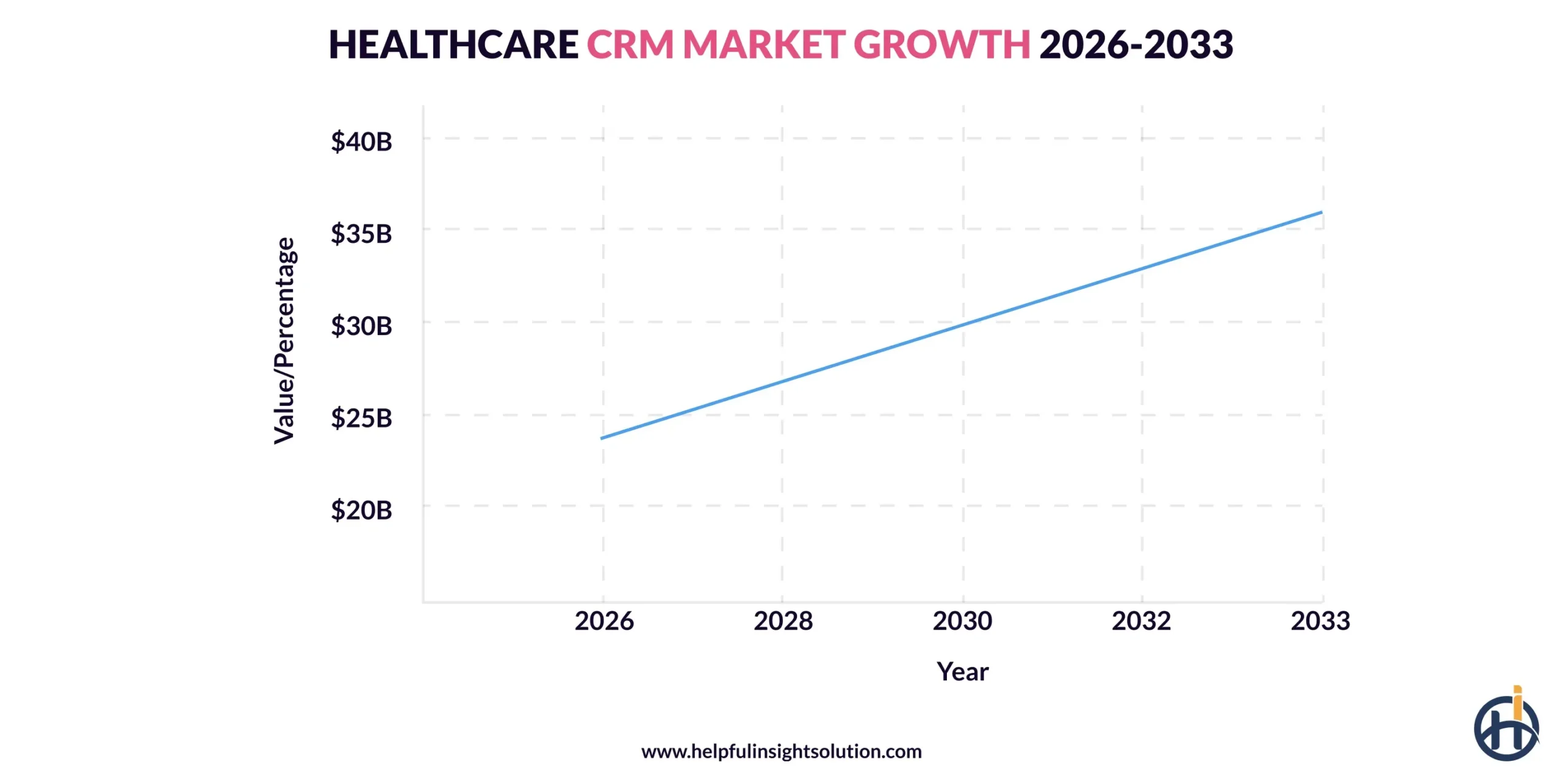
Studies conducted by Grand View Research show that the healthcare CRM market is valued at $23.3 billion in 2026. Additionally, it will reach $35.7 billion by the end of 2033, as the market is growing at a 6.2% CAGR over this period. Based on the regional analysis, North America has a maximum share of 53% in the CRM-focused healthcare market.
There are a lot more things for enterprises to understand, such as development, features, cost, and challenges, before investing in the CRM software. This blog explains every topic with additional use cases and benefits, with detailed information. Shift all your focus towards the content and get useful insights.
What is healthcare CRM software?
CRM software for healthcare helps medical organizations centralize data, improve communication, and manage patient outcomes across departments. It ensures data privacy while maintaining the relationship between patients, clinical teams, and administrative staff.
A CRM platform sends automated email appointment reminders to reduce no-shows and enables secure messaging with personalized health outreach. Additionally, it can be easily integrated with various healthcare systems, such as EHRs, billing, and insurance.
How does it differ from EHR software?
Businesses may get confused about what a customer relationship management system does and how it is different from electronic health record software.
So, it is crucial for healthcare organizations to understand the differences between these two platforms. In this section, you will observe a table that discusses various points, such as the purpose of use, primary function, and more, describing each software.
| Parameter | CRM Software | EHR Software |
| Primary purpose | Manages patient relationships, communication, and engagement | Manages clinical patient data and medical treatment history |
| Core users | Front-desk staff, marketing teams, and patient coordinators | Doctors, nurses, and clinical care providers |
| Data focus | Contact details, preferences, appointment, and interaction history | Diagnoses, prescriptions, lab results, and treatment plans |
| Primary function | Drives patient acquisition, retention, and outreach campaigns | Supports clinical decision-making and treatment documentation |
| Compliance focus | Ensures secure communication and marketing consent compliance | Ensures strict clinical data privacy under HIPAA regulations |
| Integration role | Often integrates with EHR for a complete patient engagement view | Serves as the primary source of truth for clinical records |
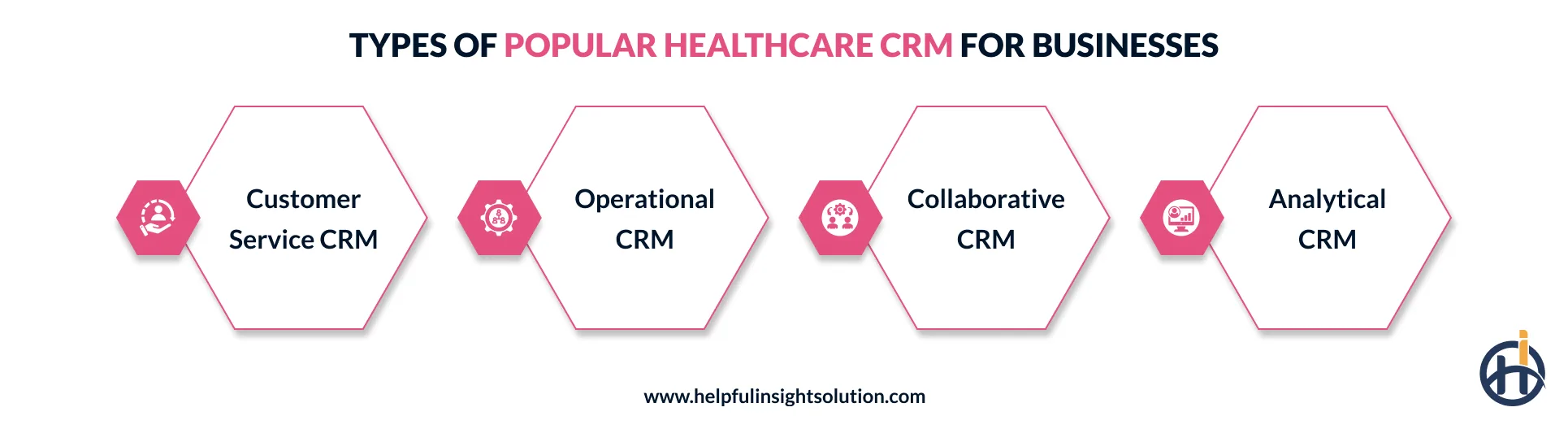
Types of healthcare CRM available for businesses
Businesses use healthcare CRM systems according to their daily operations, patient volume, and feasibility. This section discusses various types of CRM software that target multiple processes.
1. Customer service CRM
Customer Service CRM handles communication, inquiries, and needs of patients to guarantee a seamless and timely service experience at all points of interaction. It keeps a record of patient complaints and supports faster resolution by maintaining a service history.
2. Operational CRM
Operational CRM in hospitals is related to daily tasks like appointment booking, billing cycles, and patient onboarding by automating manual scheduling. This one is really efficient for medical businesses in order to get work done efficiently at the front desk and back office levels.
3. Collaborative CRM
These types of healthcare software allow information sharing between departments, experts, and care teams so the appropriate people in a patient’s care have access to the latest information. Communication between specialists and providers is improved, resulting in better team-based patient care.
4. Analytical CRM
Analytical CRM gathers and analyzes patient data to discover trends, identify health risks, and enable informed decision-making. It supports healthcare organizations in the delivery of better outcomes, optimized utilization of resources, and fostering proactive and customized patient involvement.
Best use cases of CRM software in healthcare
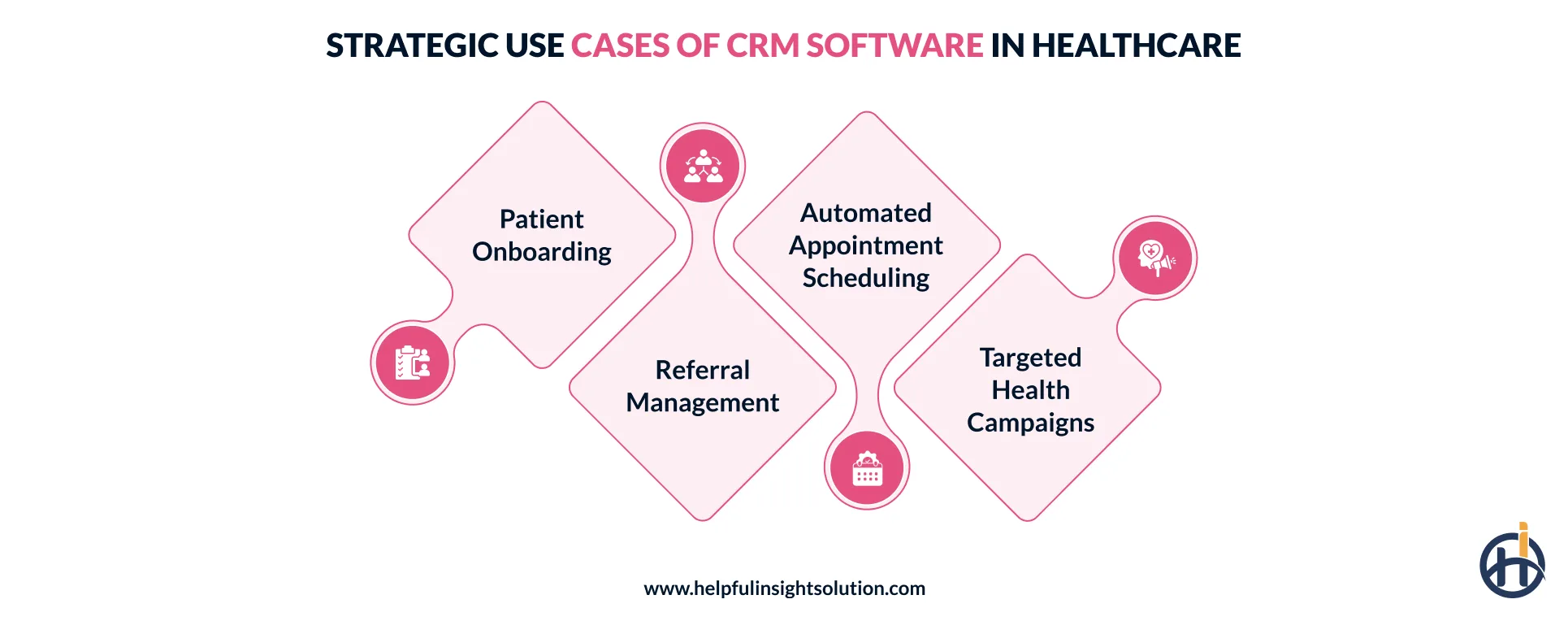
A CRM for healthcare is designed to handle different tasks, from patient care to appointment scheduling. We will observe the top healthcare-driven use cases of CRM software, ensuring better management.
1. Patient onboarding
CRM integrates with patient management software to collect personal information, insurance details, and medical history into a secure digital patient file. This can be easily extracted directly from health records, reducing manual paperwork and improving the new patients’ first impression.
Example: Epic Systems’ CRMs help hospitals digitize patient intake forms and insurance information prior to the first visit and dramatically decrease registration time.
2. Referral management
If a patient is referred to a specialist, a healthcare CRM can send and receive information, providing patient care along with primary care providers, specialists, and lab technicians. This facility helps to avoid any missed appointments and create greater continuity in care.
Example: Salesforce Health Cloud assists care coordinators in monitoring specialist referrals from one click to the next, ensuring patients don’t get dropped during the process.
3. Automated appointment scheduling
A medical scheduling platform drives patient engagement by sending automated alerts and reminders via SMS or email, which will allow them to reschedule and cancel their appointments. This CRM functionality helps businesses minimize no-show rates across medical departments.
Example: With Solutionreach, clinics can decrease the no-show rate and ensure patients stay organized on their schedules through the use of customized SMS and email reminders.
5. Targeted health campaigns
Healthcare providers can easily utilize patient history to run automated outreach campaigns for annual checkups, vaccinations, or chronic disease management. This practice promotes and enhances patient adherence to the care plans, improving the patients’ relationship with the organization.
Example: Klara’s CRM-driven messaging can enable doctors to send customized reminders for vaccinations or annual checkups by reading patient records.
How does healthcare CRM software transform patient care and operations?
CRM software for healthcare helps medical professionals to make faster decisions and manage various tasks. In this section, some of the major advantages of customer relationship management systems are discussed.
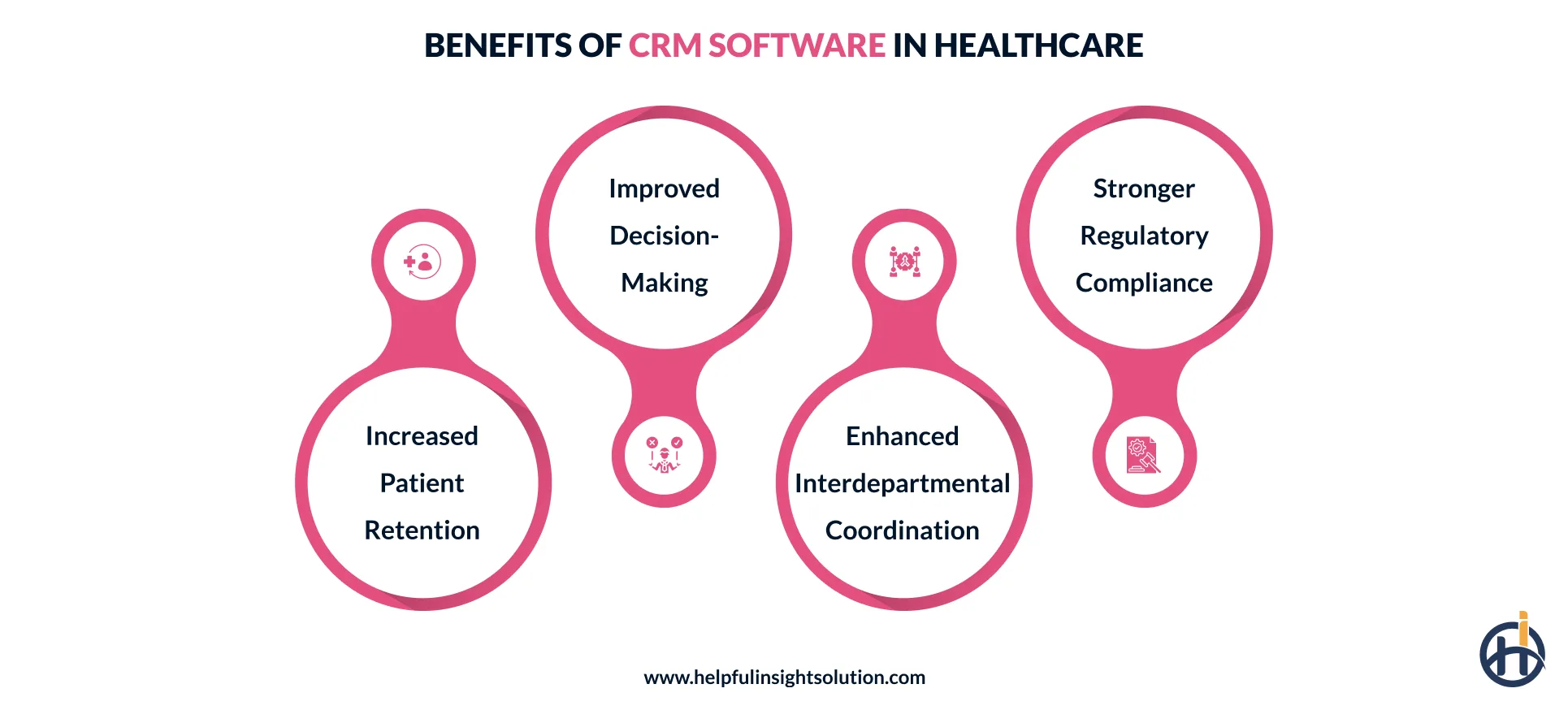
1. Increased patient retention
By monitoring each patient’s history and preferences through patient relationship management software, providers give a reliable experience to patients. This consistent relationship builds loyalty and enhances the care journey, helping organizations to retain them for a longer period of time.
2. Improved decision-making
A CRM for healthcare providers collects and centralizes patients’ overall information in personalized reports so that administrators and physicians can access data easily. They can make smarter and quicker choices about patient flow, staffing levels, and improvement areas through these insights.
3. Enhanced interdepartmental coordination
Disconnected systems, like health insurance software, are a common problem that leads to missed communications, inefficient internal processes, and a broken patient journey. CRM connects doctors, nurses, and administrative staff on a single hub where they can access patient records to provide synchronized care.
4. Stronger regulatory compliance
Healthcare CRMs are built using various compliance frameworks, such as HIPAA and GDPR, to store, monitor, and audit patient data securely according to legal standards. This helps healthcare providers prevent more data breaches and financial penalties associated with these actions.
Essential features every healthcare CRM should have
Medical CRM software provides multiple functionalities that help healthcare providers to organize their daily routine tasks. Here, we are going to explore the top features that are divided into core and advanced versions.
1. Core features
Core features of a CRM in healthcare systems include patient data management, appointment scheduling, secure communication, and integrated billing systems. They allow daily operations while safeguarding the patient data and the regulations of the institution.
| Feature | Description |
| Patient data management | Centralizes patient records, medical history, and contact details in one secure, easily accessible system. |
| Appointment scheduling | Enables automated booking, rescheduling, and reminders to reduce no-shows and streamline front-desk operations. |
| Secure communication tools | Provides HIPAA-compliant messaging and email between patients, providers, and staff. |
| Referral management | Tracks and automates patient referrals between specialists, labs, and primary care providers. |
| Billing and payment integration | Simplifies invoicing, insurance claims, and payment processing directly within the platform. |
| Role-based access control | Restricts data access based on staff roles to maintain security and regulatory compliance. |
| Reporting and dashboards | Offers real-time insights into patient engagement, staff performance, and operational metrics. |
2. Advanced features
Various advanced features of healthcare CRMs are AI-powered insights, EHR integration, and telehealth functionalities. With cloud computing in healthcare, organizations deliver more personalized patient care and stay competitive in a digital healthcare market.
| Feature | Description |
| AI-powered patient insights | Uses predictive analytics to identify at-risk patients and recommend personalized care plans. |
| EHR/EMR integration | Seamlessly connects with existing electronic health record systems to eliminate data silos. |
| Telehealth integration | Supports virtual consultations directly within the CRM for a unified patient experience. |
| Automated patient outreach campaigns | Triggers personalized health reminders, such as checkups or vaccinations, based on patient history. |
| Cloud-based data storage | Allow providers to securely store and access patient data anytime, anywhere, across devices. |
Healthcare CRM software development process
An entrepreneur can create smart healthcare CRM solutions by managing their budget and maintaining consistency. This section helps us to understand a generally used development process with crucial steps.
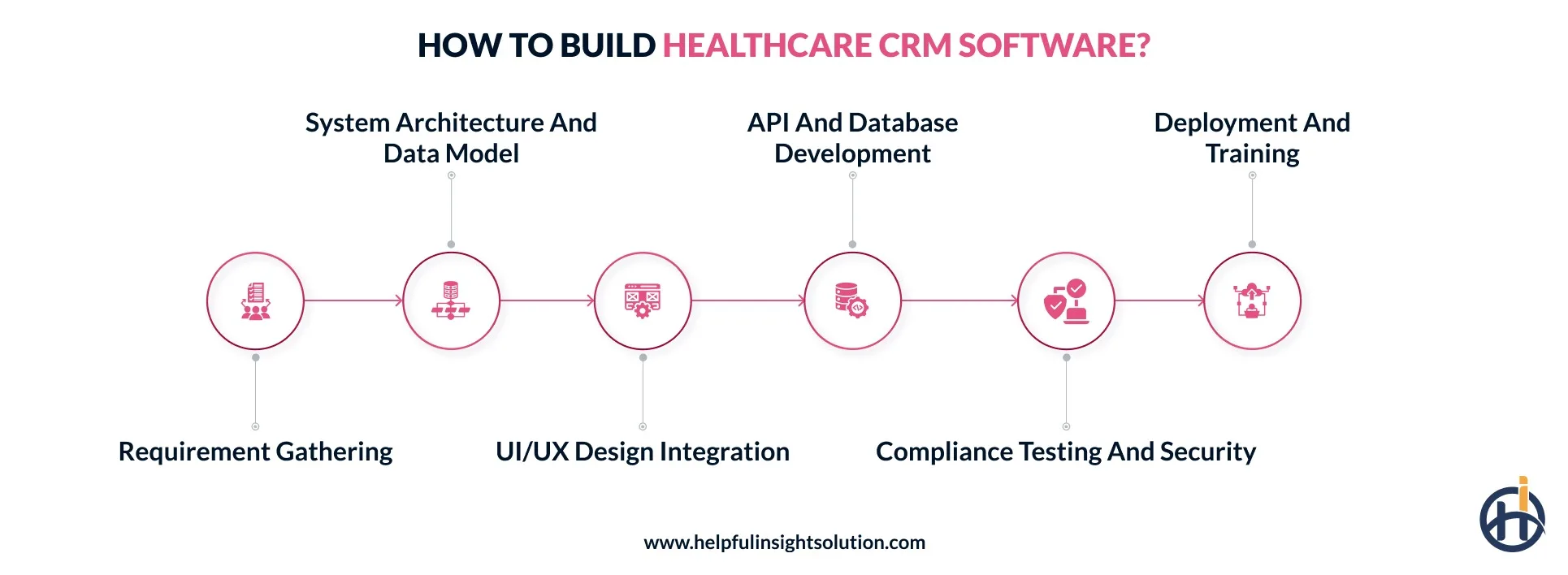
1. Requirement gathering
During the first stage, a clear vision is formed for the CRM by understanding the goals of all stakeholders. The development team establishes relevant regulatory requirements and integrates all necessary measures into the design, such as HIPAA compliance.
- The analysis of patient workflows and business processes is the key to determining the scope of the CRM.
- Onboarding doctors, admin staff, and IT experts brings out real issues overlooked in most high-level documents.
2. System architecture and data model
The foundation architecture for the healthcare CRM application is designed by an experienced healthcare CRM development company. This helps to determine the structure and connection between patient records, communication data, and appointments.
- The healthcare data model should be structured in a coherent, secure, scalable, and readily available manner.
- Decisions taken on cloud, on-premises, or hybrid architecture can affect future scalability and integration.
3. UI/UX design integration
A user interface is created based on different user roles, such as doctors, nurses, and administrative assistants. This ensures enhanced workflow efficiency, engages more people in a healthcare system, and delivers improved experiences.
- Interactive UI/UX design reduces training time and improves daily usability across various clinical departments.
- Role-based dashboards ensure each user is presented with data and tools to avoid confusion and clinical mistakes.
4. API and database development
In this phase, the CRM’s core functionalities are developed, and APIs are integrated with EHRs, billing platforms, and telehealth applications. By using healthcare app development services, databases are set up, ensuring safety and accessibility in real-time for healthcare providers.
- A well-documented API simplifies later integrations such as wearables or AI modules, ensuring no functionality has to be rebuilt.
- Optimized database indexes speed up response times despite patient records and data historic growth over time.
5. Compliance testing and security
An intensive testing stage is conducted to ensure the CRM can adhere to healthcare data protection standards, such as encryption, role-based access control, and security compliance like HIPAA. This helps medical professionals to easily identify system weaknesses before going live.
- Penetration testing simulates and exploits weaknesses in the code before they happen in a live environment through simulated attacks.
- Regular compliance checks ensure that healthcare organizations meet evolving legislation on an ongoing basis, not just at launch time.
6. Deployment and training
After quality checks, the CRM platform is deployed on the server, and the health workers are given training for optimal usage based on their specific roles. Post-deployment support and system monitoring ensure optimal usability, seamless adoption, and system effectiveness.
- Phased rollouts across departments prevent disruption to patient care procedures during the transition to the new systems.
- Continuous feedback to users post-deployment highlights practical system deficiencies in a testing environment.
What is the cost to develop a CRM platform for healthcare?
This section helps you to understand the healthcare CRM software development cost based on various market factors. These include platform complexity, API integrations, AI features, and teams’ location. The cost to develop software for healthcare relationship management also depends on medical tools like EHR, telemedicine, and billing.
Here is a table that describes key parameters with their estimated cost ranges and functions. This will help you to prepare a flexible budget according to the business requirements, market needs, and user demands.
| Factor | Cost Range | Key functions |
| Basic CRM with core features | $25,000 – $45,000 | Patient data, scheduling, basic reporting only |
| Development team location | $20,000 – $60,000 | Varies by region, agency, or freelancer rates |
| EHR/EMR integration | $15,000 – $35,000 | Connecting CRM with existing health record systems |
| Advanced AI features | $20,000 – $40,000 | Predictive analytics, automated patient insights, recommendations |
| Telehealth integration | $15,000 – $30,000 | Virtual consultation and video-call functionality |
| Third-party API integrations | $10,000 – $30,000 | Payment gateways, insurance systems, wearable devices |
| Cloud infrastructure and scalability | $15,000 – $40,000 | Hosting, storage, and future scalability setup |
Common CRM integration challenges in healthcare
While investing in healthcare CRM development, businesses face various challenges that restrict growth. You will study a few important integration issues with their respective solutions in this particular section.
1. Interoperability with legacy systems
Most legacy systems lack APIs, using closed data formats and slow communication protocols that restrict external software integration. This can prevent data flow, create isolated information silos, increase security breaches, and violate privacy laws.
Solution: Organizations must address these gaps through modernization strategies like API wrapping and middleware adoption to ensure secure data exchange and regulatory compliance.
2. Resistance to workflow changes
Implementing CRM for the healthcare industry without proper training can disrupt employees’ traditional habits and increase their workload. For nurses, admins, and other hospital staff, it is difficult to understand how CRM can make their daily tasks easier.
Solution: With structured change management in healthcare, interactive system design, and active staff involvement, businesses can organize a systematic plan.
3. Uninterrupted system migration
Various issues like data inconsistency, system incompatibility, and operational downtime may affect the migration of medical information. Additionally, the use of BPM, RPA, or any other technologies in administration also harms data quality and reliability.
Solution: It is important to perform pre-migration audits, phased testing, and data mapping with a robust middleware that ensures seamless data transfer across systems.
How does Helpful Insight assist healthcare businesses in developing smart CRM software?
If you are looking for a suitable custom healthcare CRM software development team, then Helpful Insight is the right choice. Here, businesses experience a collaborative environment with constant technical support, effective market research, and feasible resources.
Our experts help with specialized tools and technologies that ensure task automation across various medical departments. Additionally, they assist institutions in following healthcare regulations, knowing current market trends, and studying different business models that cater to patient care.
With agile methodology and customized design initiatives, it is easy to develop advanced CRM software for the healthcare industry. Enterprises can reduce patient churn, increase trust, enhance brand visibility, and ensure secure, faster communication.
It is the right time to share the idea with an experienced and dedicated partner so that businesses can start immediately and get a competitive edge.
FAQs
CRM in healthcare manages non-clinical patient interactions, connecting data with billing and EHR systems. The working process of healthcare CRM is described in the following manner:
- It gathers information from various sources and centralizes it on a digital hub.
- The software can trigger appointment reminders and follow-up alerts.
- This platform integrates with different platforms to maintain consistency.
- CRM tracks call logs, messages, and visits into a single chronological timeline.
- It can evaluate different metrics like patient drop-off rates and no-show trends.
CRM software for healthcare can be compliant based on the development cycle, configuration, and usage pattern. Businesses can approach experts who follow HIPAA and GDPR regulations for data safety standards. Additionally, they can sign Business Associate Agreements (BAAs) and use medical add-ons.
For developing advanced CRM systems in healthcare, businesses must choose the right technologies. Some of the major technical integrations in healthcare CRM are discussed as follows:
- Cloud computing: AWS, Microsoft Azure, and Google Cloud ensure online stability.
- API integration: Follow standards like FHIR and HL7 for enhanced connectivity.
- Mobile framework: Tools like React, Flutter, and Django for a smooth interface.
AI in healthcare CRM automates various platforms with conversational agents and predictive analytics. Enterprises can integrate artificial intelligence through the following process:
- It is crucial to link EHRs, billing systems, and patient portals with the CRM.
- Experts must deploy secure clouds for data tracking and access controls.
- They should create smart chatbots to handle tasks, scheduling, and appointments.
- Generative AI and LLMs summarize patient interactions and draft follow-ups.
- Deploying ML models helps to map health journeys and optimize contact routing.
Businesses that want a fast setup, no maintenance, and easy growth at a fixed cost should choose cloud-based solutions. Custom CRM software provides total control, no license fees, and ongoing support at a high upfront cost. This selection is based on various factors, like team size, business model, and operations.