

Key Takeaways:
- Cloud computing enables secure data storage, real-time data exchange, AI integration, and improved patient care across systems.
- It modernizes the IT infrastructure by ensuring greater scalability, cost efficiency, workflow management, and disaster recovery.
- EHR systems, remote patient monitoring, medical imaging, and healthcare analytics are enhanced through cloud computing technology.
- Businesses should make an actionable plan, choose the right cloud model, ensure regulatory compliance, and implement cybersecurity measures.
Every second, healthcare organizations generate enormous volumes of patient records, medical images, prescriptions, insurance claims, and diagnostic data. Managing this information securely while ensuring instant access has become one of the industry’s biggest challenges. This is where cloud computing in healthcare is transforming the landscape. It provides the scalability, security, and flexibility that modern hospitals and diagnostic centers need to manage growing data efficiently.
From electronic health records (EHRs) and billing cycles to telemedicine, real-time analytics, and patient-centric care, cloud-based healthcare solutions are helping providers improve operational efficiency while delivering faster, smarter, and more connected healthcare services.
According to Persistence Market Research, more than 80% of hospitals in the USA have implemented cloud-based EHR systems. With AI and machine learning, cloud solutions can improve predictive analytics and chronic disease management, which will drive market growth by 20% by 2032. There is more to explore about cloud computing and its current market.
This blog provides the best insights on cloud technology in healthcare, covering all major aspects, like benefits, use cases, and challenges. You will also observe the implementation strategy with future projections in this write-up.
What is cloud computing?
Cloud computing in the healthcare sector refers to the delivery of remote servers, software, and storage over the internet to manage medical data. It replaces on-premises data centers with scalable, on-demand digital infrastructure.
Additionally, it reduces human interaction with the systems, preventing data entry errors and enhancing the overall system performance. This decreases upfront costs because of different pricing models based on user requirements. It can scale resources depending on the current need to handle market drops and optimize experiences.
-
How does cloud computing work in healthcare?
Cloud technology in healthcare involves internet-hosted servers to store, manage, and process medical information. The working mechanism of cloud-driven healthcare platforms is discussed in this section.
- First, the clinical data from various sources, like EHR and medical imaging, are collected.
- The information is encrypted with security measures and transmitted over the cloud server.
- The server can store information for the long term and can process heavy workloads in real-time.
- It allows easy access to doctors and nurses through an authorized channel, reducing threats.
- Cloud servers use AI algorithms and predictive analytics to determine future changes.
Cloud computing-driven healthcare market: A global view
This section provides insights into the cloud-based healthcare market, which is growing rapidly due to advances in data management and patient care. Let’s focus on some key metrics that will help you to understand the revenue growth, market share, and future opportunities.
- The valuation of the healthcare cloud computing market in 2026 is $74 billion, with North America having a share of 45.4% in the market.
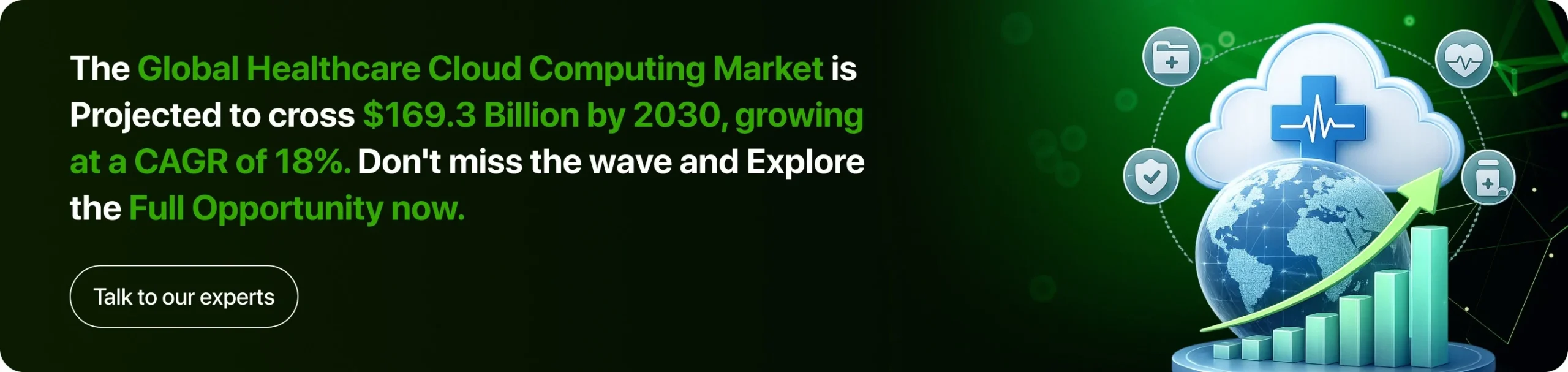
- This revenue will increase to $169.3 billion by the end of 2031, as the market is growing at a rate of 18% CAGR over this tenure.
- By 2034, this market value will reach $251.2 billion because the SaaS model has a share of 49.5% in 2026.
- Clinical information and private cloud systems have a market share of 45.1% and 55.1%, respectively, in 2026.
- In 2026, the revenue generated by North America is $29.5 billion, and in the USA, the value of the cloud-based healthcare market is $20.9 billion.
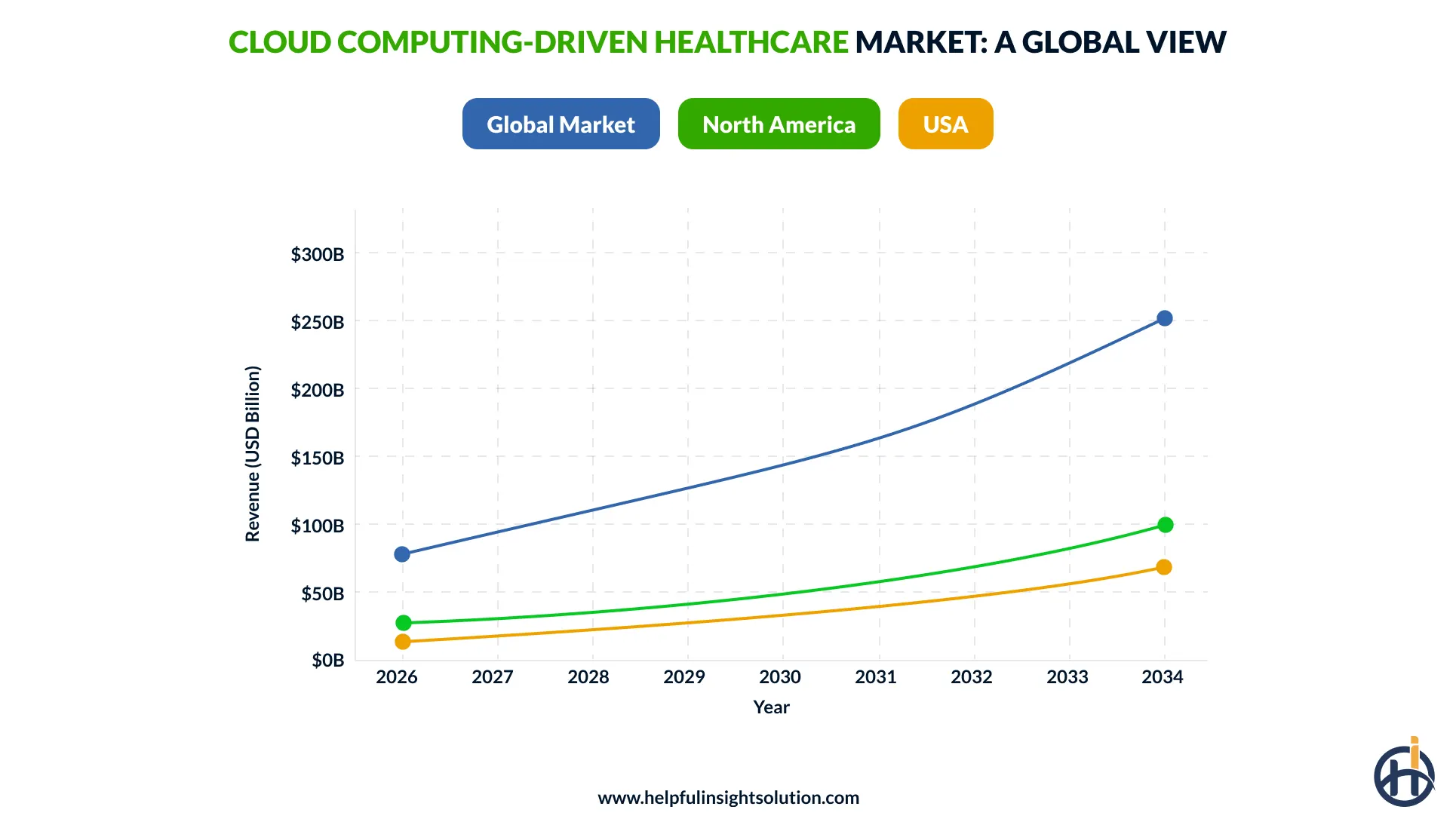
The above market figures show that the healthcare industry can easily adapt to modern innovations and technologies, allowing businesses to invest more. So, it is highly beneficial to implement cloud computing in your existing clinical systems for better care management.
Key benefits of cloud computing in the healthcare industry
Do you know any of the benefits of cloud technology in healthcare? If not, then this section brings you the key advantages of cloud-enabled healthcare platforms that reduce costs and enhance patient care.
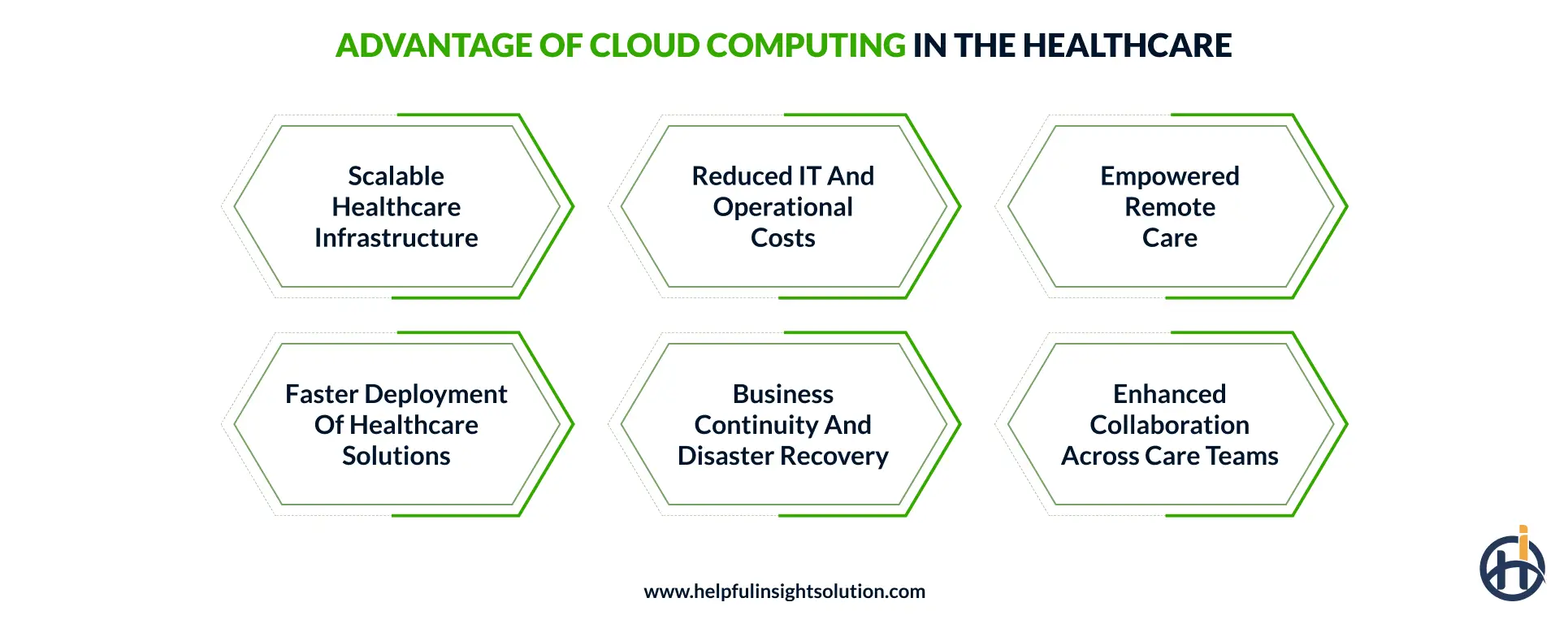
1. Scalable healthcare infrastructure
Cloud platforms allow healthcare organizations to easily scale storage, computing power, and applications according to the system requirements. It is dependent on patient volumes and operational demands that change without committing capital to physical hardware.
2. Reduced IT and operational costs
When healthcare providers use cloud-based services instead of traditional systems, they can save money on hardware, maintenance, and IT staffing. Investors only pay for required services, which allows them to easily save their budget for future use.
3. Empowered Remote Care
Cloud technology makes it easy for healthcare workers to get to information use telemedicine and keep an eye on patients from almost anywhere. This makes healthcare more available to people. This helps patients get the care they need, even when they are not in the hospital.
4. Faster deployment of healthcare solutions
Cloud platforms make it easier to create, test and put healthcare applications into use. This means healthcare organizations can get digital health services up and running quickly. They can also change things as needed to keep up with what patients and the industry need.
5. Business continuity and disaster recovery
Cloud computing automatically backs up healthcare information, has plans in place in case something goes wrong and stores extra copies of the information. This is one of the most crucial advantages of cloud computing in healthcare that ensures instant record access in case of an emergency.
6. Enhanced collaboration across care teams
Cloud-based systems let doctors, nurses and other healthcare workers share information in real time. This helps them work together better make decisions faster and give patients care. Cloud computing is really good, for healthcare organizations because it helps them take care of patients better.
Types of cloud computing in healthcare
Enterprises use different types of cloud computing in healthcare, which are commonly divided into 2 segments. We will discuss them in this section and understand their architecture with detailed information.
1. Deployment
The model is based on the user specifications and data transmission channels, which focus on security provisions. Mainly, it is divided into four major categories that are discussed in this segment.
- Private: A single business or venture uses cloud resources for data processing and execution. They are situated at on-site data centers or can be handled by third-party service providers.
- Public: It is owned by third-party operators that provide services on the internet for public use. These servers, databases, and networks are shared with other organizations for data access.
- Community: This model is owned by healthcare organizations that depend largely on data mobility. It is highly cost-effective for startups and mid-sized enterprises, as it is scalable.
- Hybrid: It combines both public and private channels, allowing easy data sharing between systems. This provides businesses with greater flexibility and more deployment options.
2. Distribution
This model represents the computing stack that depends on service architectures, enhancing data delivery. Here, it is divided into three important categories that target various system requirements and needs.
- Software as a Service (SaaS): Complete and fully functional software applications are hosted by providers and accessed by web browsers. Key examples include Google Workspace, Microsoft 365, and Salesforce.
- Platform as a Service (PaaS): It is an on-demand environment for developing, testing, and managing software platforms. AWS Elastic Beanstalk and Google App Engine are the best examples of this model.
- Infrastructure as a Service (IaaS): Businesses can rent IT infrastructure, like virtual machines, servers, and networks. The top examples of this model are Amazon EC2 and Microsoft Azure Virtual Machines.
Real-world cloud computing use cases and examples in healthcare
You will study the best use cases of cloud computing in healthcare with their respective examples in this section. From EHR to population management, we will focus on each medical department with the top platforms.
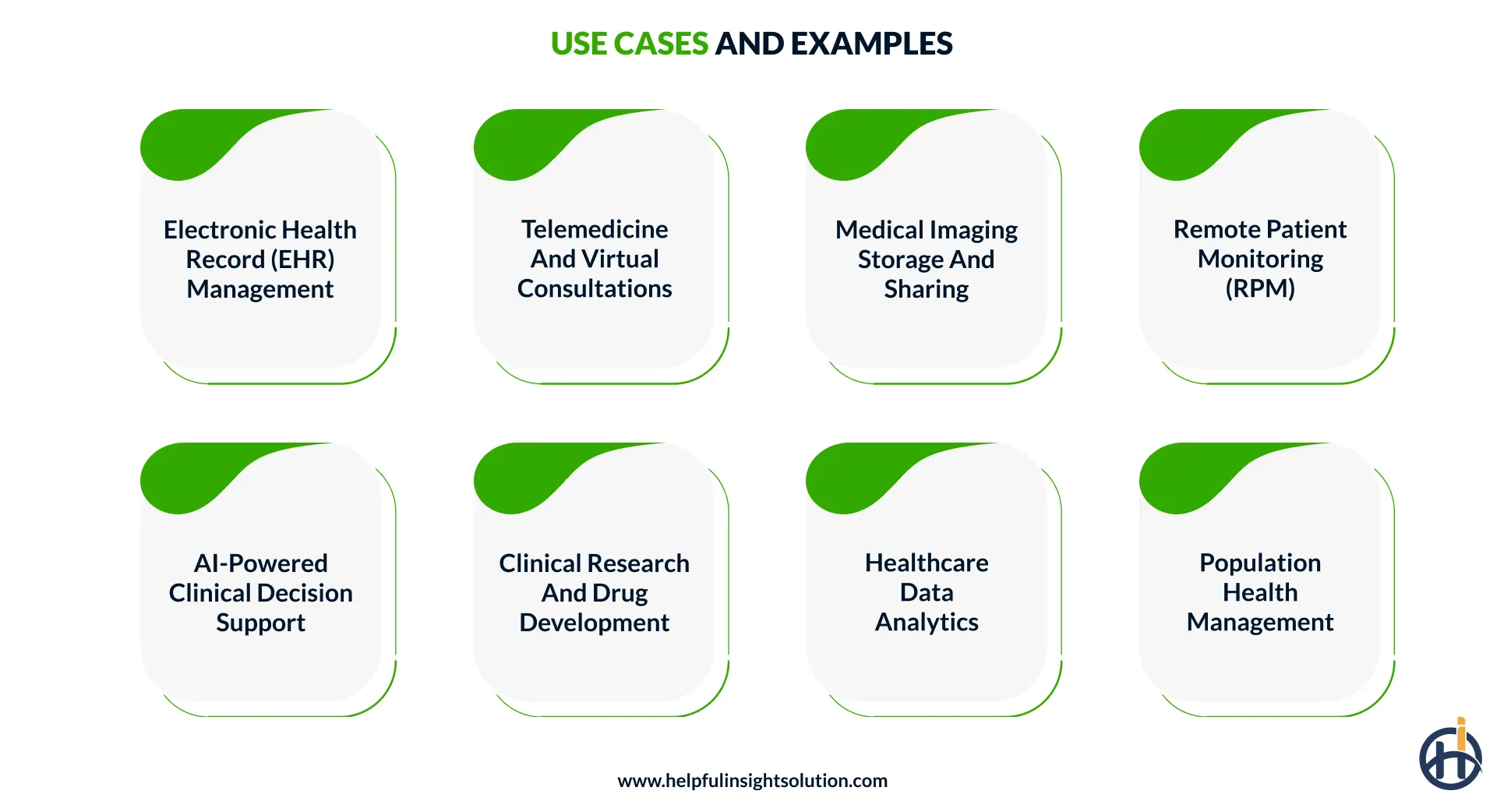
1. Electronic health record (EHR) management
Cloud computing is really good for health records, as it puts all the information in one place so healthcare professionals can use it from anywhere. This makes the records more accurate and helps healthcare professionals make better decisions. They can update the patient records in time so everyone has the latest information. This means they can diagnose problems faster, and the patient can get the care they need.
Mayo Clinic: The Mayo Clinic uses cloud-enabled systems to keep records safe across all their hospitals and clinics. Doctors can analyze histories in real time which helps them work together better and not do the same tests over and over.
2. Telemedicine and virtual consultations
People can even use cloud-based platforms to talk to their healthcare professionals from home. They can have video consultations and get digital prescriptions, which is really helpful for people who live away from their healthcare professionals.
They can access the patient records during the consultation so they have all the information they need. This combination of healthcare and cloud computing makes it easier for people to get care, and they do not have to go to the hospital as much.
Teladoc Health: Teladoc Health uses the cloud to let doctors and patients talk to each other from anywhere. Patients can talk to doctors from their homes and still get to their health records easily.
3. Medical imaging storage and sharing
Cloud technology is also good for storing medical images like X-rays and MRIs. Healthcare professionals can observe these pictures quickly and share them with other professionals if they need to.
This helps them work together better and saves money in real-time. They can also identify the pictures faster, which means they can diagnose problems faster.
GE HealthCare: GE HealthCare has a system that lets hospitals store and share pictures from things like MRIs and CT scans. Doctors can work together from places, which helps them figure out what is wrong with patients faster and take better care of them.
4. Remote patient monitoring (RPM)
Various healthcare cloud solutions can even send information to healthcare professionals all the time. They can track things like heart rate and blood pressure, and the information goes to the healthcare professionals, who can analyze it in real time.
If something is wrong, the healthcare professionals receive an alert so they can help the patient. This is really helpful for people with diseases because their healthcare professionals can keep an eye on them all the time.
Philips HealthSuite: Philips HealthSuite gets health information from things like fitness trackers and other devices that patients use. Doctors can watch patients from away and get alerts if something is wrong with the patients health.
5. AI-powered clinical decision support
Cloud computing gives healthcare people the power they need to look at large amounts of healthcare data using artificial intelligence. AI systems help doctors identify disease patterns, recommend treatment options, and assess patient risk in real-time. This information helps doctors make diagnoses and reduces mistakes. Healthcare professionals can make decisions faster with more information and accuracy.
Aidoc: Aidoc uses special computer programs to analyze medical pictures and find big problems like strokes. This helps doctors to find the important cases and take action faster according to the need.
6. Clinical research and drug development
Researchers use healthcare cloud services to securely store, process, and analyze large volumes of clinical trial and genomic data. Cloud infrastructure lets researchers from around the world work together with pharmaceutical companies. This helps find medicines and makes medical innovation happen faster. It also makes research faster and helps make new treatments available sooner.
Moderna: Moderna uses the cloud to identify information, work on new vaccines, and develop new medicines. The cloud helps them understand team requirements and setup around the world.
7. Healthcare data analytics
Cloud computing helps healthcare organizations put together and analyze data from different places like patient records, wearable devices, and hospital systems. Advanced analytics finds patterns related to how patients are doing, how well things are working, and how common diseases are.
This information helps healthcare people make decisions based on facts and use resources wisely. This allows healthcare providers to improve both patient care quality and business performance simultaneously.
Kaiser Permanente: Kaiser Permanente uses cloud-based tools to find information, make their hospitals run better, and help patients get better. These tools help doctors make decisions based on the information they have, which makes patient care better.
8. Population health management
Cloud-based platforms can analyze health data across large patient populations to identify public health trends and high-risk groups. Healthcare organizations can make special programs to prevent people from getting sick and see if they are working. Analytics in time helps allocate resources better and plan for community health. This improves the health of populations and reduces the cost of healthcare.
NHS England uses cloud platforms to analyze population health data and identify areas with higher disease risk. This helps them design targeted prevention programs and allocate resources more efficiently.
Essential features of cloud computing in healthcare
It is crucial to know the various features, like data security and scalability, that cloud computing provides for healthcare. In this section, we will understand the key cloud-based healthcare features with the help of the following table.
| Feature | Description |
| Electronic Health Record (EHR) Management | Securely stores and provides authorized access to patient records from any connected healthcare facility. |
| Data Encryption and Security | Protects sensitive healthcare data using advanced encryption, authentication, and access control mechanisms. |
| Scalable Cloud Infrastructure | Dynamically adjusts computing resources and storage to accommodate changing patient volumes and workloads. |
| Interoperability and Data Exchange | Enables seamless sharing of healthcare information across hospitals, laboratories, pharmacies, and insurance providers. |
| Disaster Recovery and Automated Backup | Ensures critical healthcare data is regularly backed up and quickly restored during system failures or emergencies. |
| Telemedicine Support | Powers secure video consultations, remote diagnosis, and virtual patient care through cloud-based platforms. |
| AI and Big Data Analytics Integration | Processes large healthcare datasets to generate predictive insights, clinical recommendations, and operational intelligence. |
| Remote Patient Monitoring (RPM) | Collects and analyzes real-time patient data from wearable devices and connected medical equipment. |
| Compliance and Audit Management | Helps healthcare organizations maintain regulatory compliance with built-in audit logs, monitoring, and policy enforcement. |
| Multi-Device Access | Allows healthcare professionals to securely access applications and patient data from desktops, tablets, and mobile devices anytime. |
Major challenges in cloud computing integration with healthcare
The development of cloud-based healthcare systems may give rise to several challenges, like system migration and compliance. Here, you will go through key issues with their respective solutions in detail.
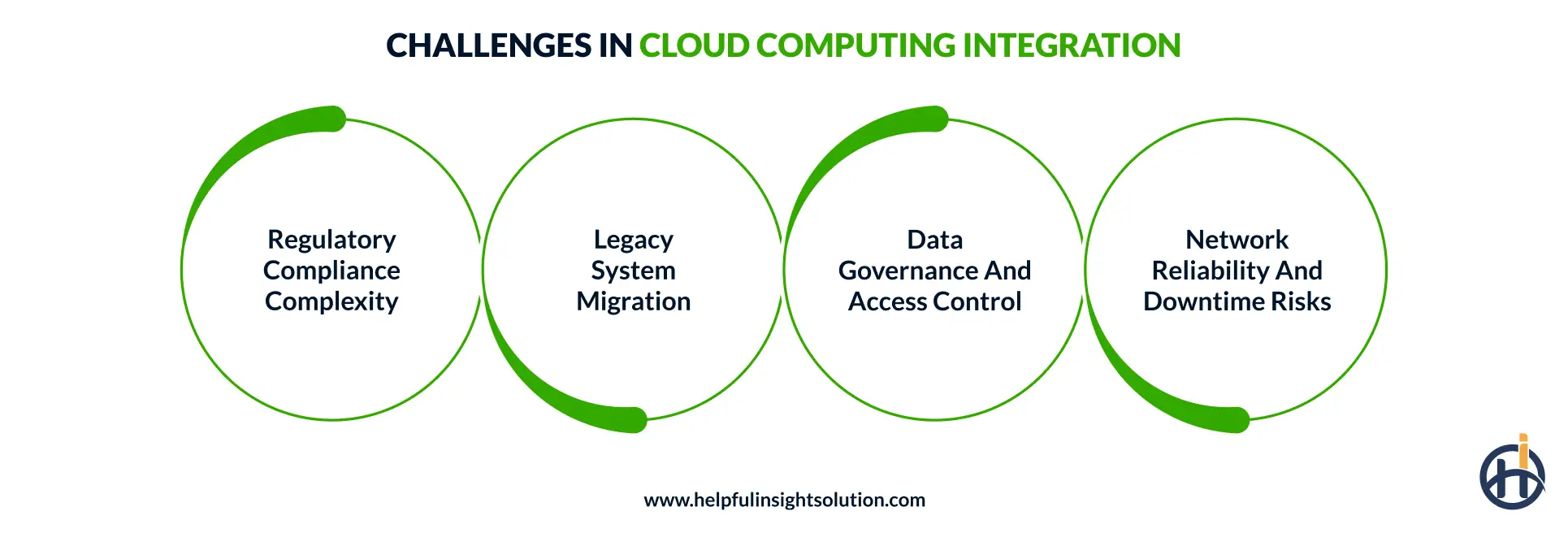
1. Regulatory compliance complexity
This includes data residency & localization issues, multi-framework compliance, and audit gaps. It can affect medical inventory, give rise to supply chain risks, and may lead to massive financial penalties.
Solution: The integration of Identity and Access Management (IAM) systems ensures healthcare-compliant cloud hosting, such as AWS-based HIPAA regulations.
2. Legacy system migration
The key challenges are increased financial costs, system compatibility, and a lack of interoperability during transition. Inefficient IT teams can prevent data migration issues and may decrease overall trust.
Solution: You can implement middleware-driven phased API solutions that ensure zero interference and seamless data communication.
3. Data governance and access control
The use of multiple cloud services makes it complex for healthcare systems to operate in a scalable manner. It is difficult to implement various access control methods due to context-specific permissions.
Solution: Businesses can use Zero Trust Architecture with role-based and attribute-based access control methods to enhance governance.
4. Network reliability and downtime risks
During offline networking, it is easy to compromise patient data and crash the server through unbalanced data traffic. System downtime prevents doctors from accessing medical information and using EHR portals.
Solution: It is beneficial to utilize multiple Internet Service Providers (ISPs), local caching and robust Service Level Agreements (SLAs).
How to implement cloud computing technology in healthcare?
Businesses must follow a certified process to integrate cloud computing in healthcare systems. We are discussing key stages that are common and widely accepted by enterprises for cloud data integration.
1. Assess clinical requirements
You should begin the process by reviewing your organization’s existing workflows, objectives, and IT systems. It is important to identify the required healthcare applications, data specifications, and regulations. This ensures that the system works well for both patients and healthcare providers.
2. Choose cloud deployment model
It is crucial to choose various cloud models, like public, private, hybrid, or multi-cloud platforms. This selection is based on security requiremmnets, project size, and speed. Think about following the rules your budget and how sensitive your work is before you decide. You must hire healthcare cloud computing companies to implement advanced architecture and grow in the long term.
3. Develop data migration strategy
Make a plan to move records, applications and databases to the cloud in a way that is safe and does not disrupt things too much. Check that the data is correct make backups and have a plan to go back if something goes wrong. Moving things to the cloud-based healthcare systems a little at a time helps make the change smooth.
4. Implement security and compliance controls
You must use security measures like encrypting data, managing who can access what using many ways to check who someone is, and always watching for problems. For secure healthcare app development, set up the cloud to follow standard rules and regulations. Regularly checking for problems and risks helps keep everything secure and following the rules.
5. Monitor, optimize, and scale
Analyze usage patterns to reduce costs, improve application performance, and identify problems before they affect operations. Change the cloud resources as the number of patients and what the organization needs change over time.
Future of healthcare with cloud computing technology
Cloud computing in the healthcare industry is already making patient care easier for doctors by reducing data management. Future innovations, such as edge computing and connected systems, will enhance these tasks more.
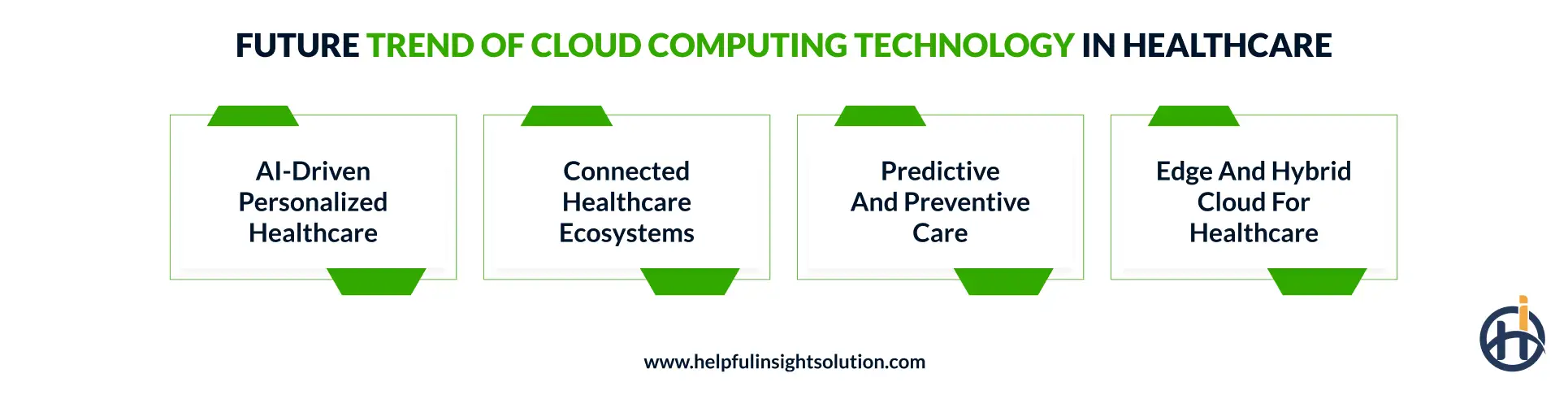
1. AI-driven personalized healthcare
Cloud computing will help AI analyze lots of data to create treatment plans based on history, genetics and current health. This will make diagnoses more accurate and will also help provide care that is focused on the patient.
2. Connected healthcare ecosystems
Cloud technology will connect hospitals, clinics, labs, pharmacies, insurers and wearable devices through platforms that work together. This will help different healthcare providers work better and will also make it easier to share data with patients.
3. Predictive and preventive care
Cloud analytics helps medical professionals to predict various diseases through clinical data, images, and prescriptions. It will also suggest ways to prevent problems before they get severe, as this approach can improve outcomes and can also reduce healthcare costs.
4. Edge and hybrid cloud for healthcare
Edge computing and hybrid cloud will work together to process healthcare data faster and identify where it is created. It will be stored securely in the cloud, which will make healthcare systems more reliable and also help doctors make decisions in time.
Partner with Helpful Insight to build healthcare solutions with cloud computing
Entrepreneurs investing in software or mobile app development for their healthcare business must approach the right partner, who has experience and reliability.
We are a leading firm, developing advanced cloud-based healthcare solutions for medical practitioners, clinical labs, and pharmacies. Our experts help investors to build market-centric business models that include a flexible budget, key features, revenue streams, and marketing strategies.
We implement effective mobile or web services that ensure project security, data transparency, workflow efficiency, and patient care management. You can integrate cloud computing in healthcare by following a dedicated process and hiring skilled talent.
They help you to build trust among patients, manage medical operations, and increase brand value across regions.
FAQs
The cost of integrating cloud computing in the healthcare industry is dependent on project requirements, security, data interoperability, and maintenance. On average, the overall cost ranges from $20,000 to $200,000 based on EHR integrations and data analytics. With AI-driven staff management and advanced patient care the total investment may increase to $400,000.
Various cloud services like AWS, Azure, Google Cloud Services, and Salesforce help healthcare systems to secure patient and clinical information. They ensure data privacy, seamless communications, and private medical data exchange with real-time features. It is easy to store medical images, insurance data, and billing information with these cloud platforms.
Cloud computing centralizes EHR systems and uses universal APIs to reduce fragmented data silos, enhancing patient care. This allows hospitals, labs, and pharmacies to securely exchange patient data, improving diagnostic accuracy in real-time. It provides global data access through centralized repositories and semantic normalization.
Businesses can implement cloud computing to store healthcare and patient data, as it is highly secure, scalable, and compliant with modern regulations. It uses advanced infrastructure, physical protection, and data encryption, like MFA or RBAC, according to the need. Various types of data from EHR, diagnostic images, and wearables can easily be stored in cloud-driven healthcare systems.
It manages patient data, allows real-time access across devices, and reduces physical IT infrastructure costs to boost EHR systems. This technology allows healthcare providers to focus on patient care, ensuring robust disaster recovery and scalability. Cloud computing enhances system collaboration and reduces overhead expenses through AI integration.