

Key Takeaways:
- The Robinhood app provides real-time market data, portfolio management, order execution, and analytics for a seamless trading experience.
- To ensure data security, these platforms include strong authentication, KYC/AML processes, fraud prevention, and financial compliance.
- Businesses implement reliable trading APIs, secure backend infrastructure, cloud services, and databases to deliver fast and accurate transactions.
- The development cost and timeline are influenced by features, security requirements, team location, hiring models, and regulatory needs.
Do you trade in stocks or crypto? Are you on the winning side or the losing side? According to eToro, 54% of global traders invest in locally listed stocks, whereas 34% of traders invest in the crypto market.
But only a few of them, who understand market conditions, have a proper capital investment strategy, and have enhanced analytical skills, are able to make a profit. A stock trading app like Robinhood has changed this scenario for investors who are unaware of market deviations through its quality-rich educational content. Also, it allows users to trade in multiple assets, track stock performance, get price alerts, and invest securely.
Now, the race to invest in fintech app development has become crucial, as innovations in the online trading market are increasing. According to Precedence Research, the USA’s digital stock investing market will generate revenue of $9.2 billion, whereas the world’s volume will reach $31.6 billion in 2030. This will act as a core income generator for both investment clubs and retail investors in the future.
By going through this blog, businesses will understand the importance of standard compliance before developing a Robinhood app clone. Additionally, it provides key insights on the features, development process, cost, and monetization strategies. So, let’s begin and dive deep into the content.
What is Robinhood?
Robinhood is one of the leading platforms for online brokerage and financial services, which allows users to trade stocks, ETFs, and cryptocurrencies with zero commission. Along with this, users can buy fractional shares and use advanced tools, such as options trading, margin investing, and Roth IRAs.
For businesses, it is highly recommended to develop a fintech app similar to Robinhood, as it does not require any minimum investment, has a simple design, and ensures recurring investment. This may allow increased user engagement, cash flow, retention rate, and enterprise visibility.
How does the Robinhood app work?
By knowing the workflow of Robinhood, investors can create similar tools for retail and daily individual traders. The working steps of this online stock trading platform are discussed in the following manner.
- Users create a trading account by entering their personal details, like name and contact number.
- They provide government-approved documents and take a selfie to verify their identity.
- People link their bank account by using secure services like Plaid to transfer money.
- Search trading options, select shares to buy, and swipe up to submit the request on the app.
- Track the performance through a dashboard to withdraw funds or add more money.
Current stats on the digital stock trading market
The stats that we are going to discuss in this section reflect the emerging FinTech trends shaping the industry. This is a clear signal for modern startups and mid-sized retail businesses, as the digital stock trading market has seen explosive growth, driven by mobile-first investing in the past few years.
- The revenue of the online trading market will be $25.7 billion globally in 2027, with North America having a share of 39% in the market.
- By 2035, the overall volume will reach $44.3 billion, as the market is growing rapidly at a 13% CAGR rate over this period.
- In terms of asset type, ETF trading holds a maximum share of 36%, whereas crypto trading is second with a share of 20% in the market.
- The USA’s online trading market will generate a revenue of $7.5 billion in 2027, reaching $13.2 billion by 2035.
- Retail investors top the chart in the end-user segment with a share of 58%, and Asia-Pacific holds a 28% market share in the regional segment.
This domain has a lot to offer enterprises that provide financial services, such as enhanced growth, increased business ROI, and higher user retention. Additionally, by integrating advanced technologies, they can maintain consistency and compete with top brands in the market.
Why should investors build a Robinhood-like app now?
Entrepreneurs must know the benefits, like market acceptance, recurring revenue, and more, that they will get after developing an online stock and crypto trading platform. This part discusses some of the great advantages that you should not overlook before moving forward.
- As online investing becomes mobile-first, a new generation of first-time investors is growing.
- Broker-as-a-Service enables you to go to market quickly with your own broker-dealer license.
- New revenue models, such as PFOF and interest income, provide different monetization opportunities.
- Users want to invest in various market stocks, crypto, and ETFs from a single trading app.
- Robo-advisors, predictive analytics, and personalized insights help newcomers differentiate themselves from legacy players.
Key features of the Robinhood app
Businesses can explore various features of a Stock trading app like Robinhood, such as price alerts and KYC verification, in this section. They build a core ecosystem, allowing users to trade efficiently with multiple assets.
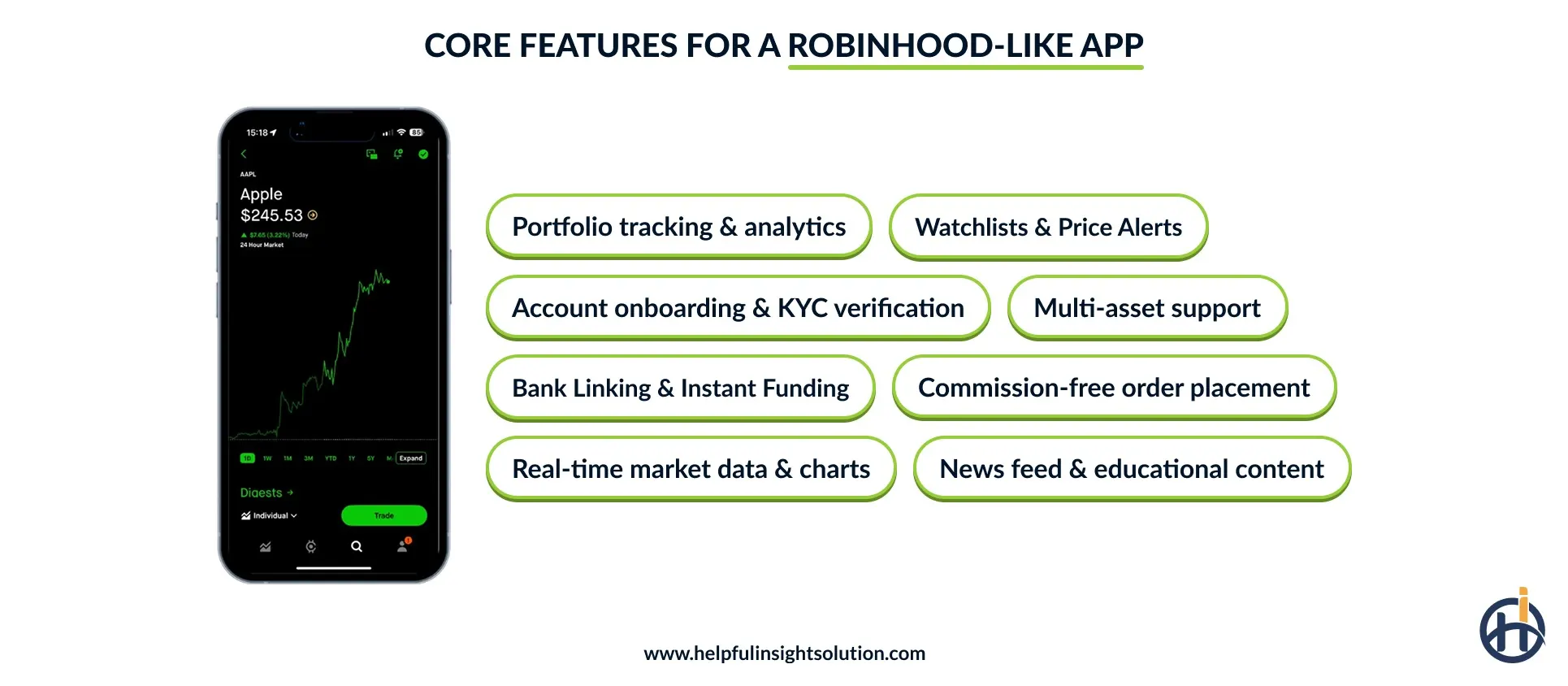
1. Account onboarding & KYC verification
Users register with their details, go through automated KYC and AML identity checks using SSN and ID document verification, and are free to trade once they’ve passed the process. The onboarding flow must be seamless and quick to meet KYC/AML compliance requirements.
2. Bank linking & instant funding
Users securely link their bank account via Plaid to transfer funds in and out of the app. Robinhood has immediate buying power against pending deposits, allowing users to trade immediately instead of having to wait for the funds to clear.
3. Real-time market data & charts
The app delivers live prices for stocks, ETFs, and other assets, with historical charts and major technical indicators powered by AI in Fintech. This information helps traders track market movements and make timely decisions on buying or selling.
4. Commission-free order placement
Users can easily buy fractional shares and place limit, market, or stop-loss orders with no trading commission. It can minimize the barrier to entry and allow anyone to start investing with any amount of money.
5. Portfolio tracking & analytics
A summary of total holdings, weighted average cost basis, and total gain or loss is displayed on a centralized dashboard. Users can easily view the performance of their investments with an aggregated balance sheet, which provides a holistic view.
6. Watchlists & price alerts
Traders can also add stocks to a personalized watchlist to track assets they don’t own and receive an alert when they reach a preset target price. Push notifications keep users informed the moment a tracked stock hits a target price.
7. News feed & educational content
It delivers relevant financial news related to user holdings and watchlists from providers like Reuters and Dow Jones. The app includes beginner-friendly educational content to assist new investors in understanding the fundamentals of the market.
8. Multi-asset support
In addition to stocks, the app allows users to trade ETFs and crypto, all from a single account. It appeals to a wider audience by giving users a chance to diversify across financial investments without needing multiple platforms.
Features to include in your online trading app
Building a Robinhood clone app requires knowledge of several must-have and next-gen features. Experts use advanced AI technologies like NLP or Generative AI in finance to create these features, which can support compliance and improve consistency when properly designed, tested, and monitored.
| Type | Feature | Description |
| Must-Have | Recurring/automatic investments | Lets users schedule automatic recurring buys into a stock or ETF, encouraging consistent, hands-off investing habits. |
| Must-Have | Tax reporting & document generation | Automatically generates tax forms (like 1099s) and capital gains summaries, saving users the hassle at filing time. |
| Must-Have | Two-factor & biometric authentication | Adds fingerprint/face-ID login and 2FA on top of standard passwords to protect accounts handling real money. |
| Must-Have | Order history & trade confirmations | Gives users a clear, timestamped log of every executed trade with confirmation details for transparency and recordkeeping. |
| Must-Have | Referral & rewards program | Rewards users with cash, free stock, or credits for inviting friends, driving low-cost organic user acquisition. |
| Next-Gen | AI-powered robo-advisory | Uses AI to analyze a user’s risk profile and goals, then auto-builds and rebalances a personalized investment portfolio. |
| Next-Gen | Social/copy trading | Lets users follow or automatically mirror the trades of experienced investors within the app’s own community. |
| Next-Gen | Voice-activated trading assistant | Enables users to check balances, place trades, or get market updates through natural voice commands. |
| Next-Gen | Predictive market sentiment analysis | Uses AI/NLP to scan news and social chats, giving users a real-time sentiment score on stocks they follow. |
| Next-Gen | Gamified learning & investment simulator | Offers a risk-free paper-trading mode with gamified challenges to help beginners practice investing before using real money. |
Core trading app development architecture
Before understanding how to create an app like Robinhood, it is crucial to know some fundamentals that build the core of the platform. In this section, we are going to explore the fintech architecture that will help enterprises across the complete development process.
Trading engine: The engine that processes buy and sell orders in real time, filling them as quickly and cost-effectively as possible.
Real-time data: A system that provides users with real-time market depth, streaming price information, and trade updates.
Latency: The time delay between order placement and execution must be minimized to ensure competitive, fair trade pricing.
Order Management System (OMS): Tracks and manages the full lifecycle of an order, from placement and modification to execution and settlement.
Risk management engine: Keeps an eye on positions and transactions so suspicious trading activity, limit breaches, and other trading issues can be detected.
Brokerage-as-a-Service (BaaS)/Build vs. White-Label
Enterprises can build a platform like Robinhood based on a custom model or use white-label brokerage solutions for faster market release. To get the right IT services in finance based on the budget requirements and project complexity, it is crucial to understand the differences between these two approaches. The following table provides key factors that differentiate custom solutions from white-label.
| Parameter | Build In-House | White Label/BaaS |
| Development time | Takes 9–14+ months to build core trading infrastructure from scratch | Launches in 2–4 months using pre-built brokerage APIs |
| Cost | Requires higher upfront investment for custody, clearing, and licensing | Significantly lower upfront cost with pay-as-you-grow pricing |
| Regulatory ownership | Enterprises hold SEC/FINRA broker-dealer licensing and compliance liability. | The sponsor bank holds the licensing, while BaaS providers operate under its regulatory framework and compliance standards. |
| Customization & control | Full control over the trading engine, UI/UX, and feature roadmap | Limited to the customization options the provider’s platform allows |
| Scalability & differentiation | Easier to scale uniquely and build proprietary features long-term | Faster to market but harder to differentiate since core infra is shared with other clients |
How to build a Robinhood-like app for investment and trading?
We are going to study the process to create an app like Robinhood in this section, with key development steps. From market planning and tech stack selection to performance monitoring, each stage is discussed in detail.
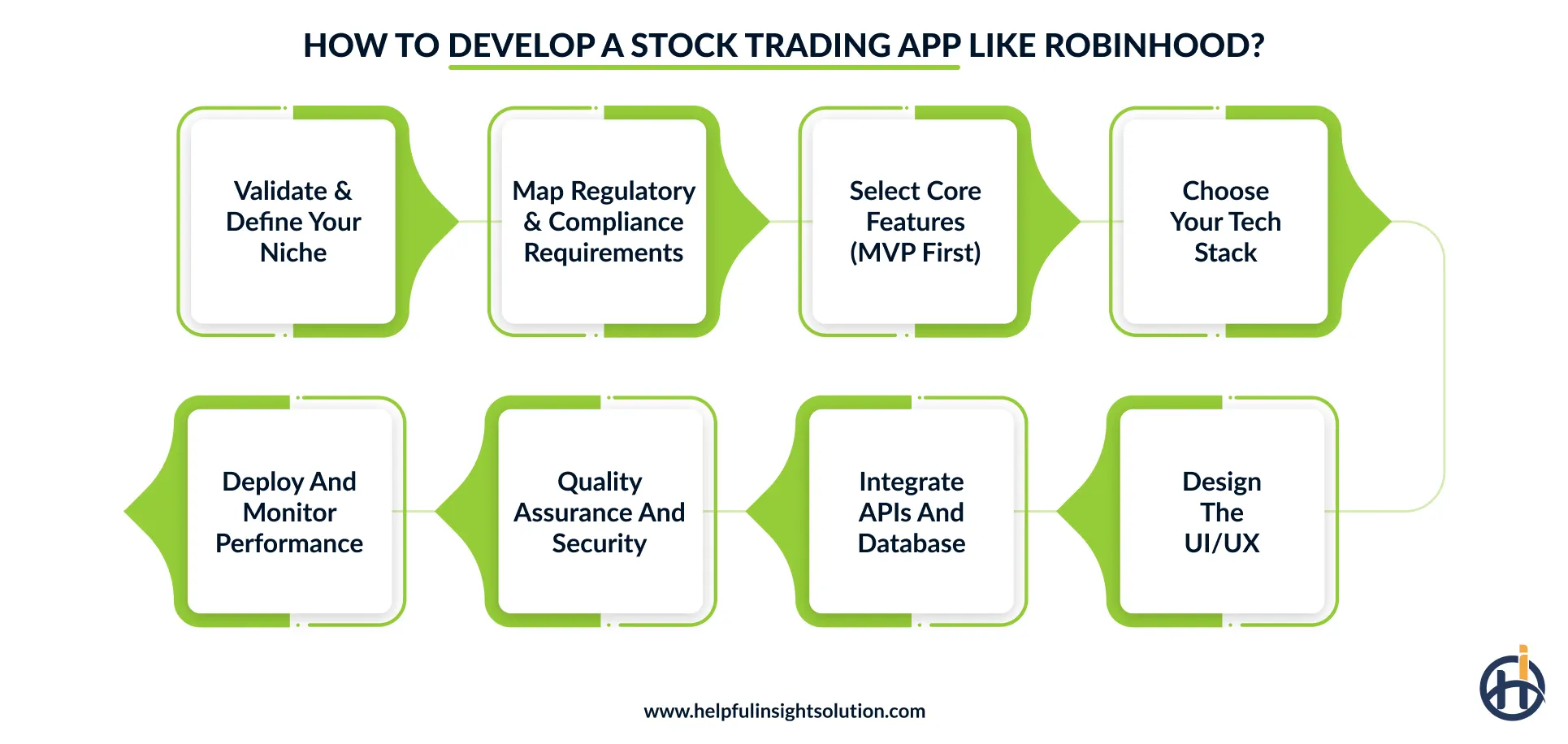
1. Validate & define your niche
Research customers and competitors before creating a Robinhood clone app and find a gap that other apps don’t address, such as a geographical area, an asset class, or an investor type. This decision may influence the overall feature set, compliance requirements, and market approach.
- Identify user pain points that Robinhood is failing to cover today.
- Analyze competitor pricing strategies early to find opportunities for market positioning.
2. Map regulatory & compliance requirements
It is important to understand the need for licenses and frameworks for the app, like SEC/FINRA registration, KYC/AML, or PCI-DSS for payment processing. By recognizing them early, businesses can reduce costs on redesign, as compliance rules may impact the architecture and vendor selection.
- Seek legal advice to understand license responsibilities early in each jurisdiction.
- Map out data privacy needs across all target operating locations.
3. Select core features (MVP first)
For the initial launch, it is beneficial to consider basic features like account onboarding, brokerage connection, and basic order placement, saving advanced features for future updates. Businesses can hire a Robinhood app development company to accelerate implementation and validate demand before spending extra money.
- Use a scoring matrix to prioritize feature development based on user value.
- Prepare a roadmap of features to prioritize development, with an MVP release plan.
4. Choose your tech stack
It is crucial to identify key frameworks, databases, and third-party APIs that will be used to build the app, from the frontend frameworks to brokerage-as-a-service providers like Alpaca or Drive Wealth. The ideal stack creates a balance between development speed, scalability, and maintenance costs.
| Component | Tools | Description |
| Mobile app development | Flutter, React Native, Swift (iOS), Kotlin (Android) | Powers the cross-platform or native mobile experience users interact with for trading and portfolio management. |
| Backend & API layer | Node.js (NestJS), Python (Django/FastAPI), Java (Spring Boot) | Handles core business logic, order processing, and secure communication between the app and backend services. |
| Database & storage | PostgreSQL, Redis, TimescaleDB | Manages transactional data (accounts, orders) in PostgreSQL, caching in Redis, and time-series price history in TimescaleDB. |
| Real-time data streaming | Apache Kafka, WebSockets | Streams live market prices and order updates to users instantly without needing to refresh the app. |
| Brokerage & trading infrastructure | Alpaca, DriveWealth, Apex Clearing | Provides ready-made order execution, custody, and clearing so you don’t need your own broker-dealer license to launch. |
| Identity verification & bank linking | Plaid, Jumio, Onfido | Automates KYC identity checks and securely links user bank accounts for funding and withdrawals. |
| Cloud infrastructure & DevOps | AWS (EC2, RDS, S3), Docker, Kubernetes | Hosts, scales, and containerizes the application to handle high-traffic trading periods reliably. |
| Security & authentication | OAuth 2.0, JWT, Auth0 | Manages secure user login, session tokens, and role-based access control across the platform. |
5. Design the UI/UX
Enterprises must design features like order reviews, disclosures, error prevention, portfolio visibility, and accessibility that create trust among users, ensuring comfort in managing real money in the app. If mobile app navigation is clear and the design is intuitive, onboarding drop-off will be lower.
- Perform usability testing with users before finalizing screen mockups.
- Ensure that designs can easily accommodate stock trading and investment requirements.
6. Integrate APIs and database
At this stage, fintech software development experts connect the platform to the brokerage infrastructure, KYC verification providers, and the payment gateways. Additionally, they optimize the database to handle transaction data and feed prices in real time, which boosts the overall mobile app functionality.
- Use several cache levels to cut down database impact at high trading volumes.
- Reduce the risk of data loss and support recovery after failures.
7. Quality assurance and security
Run thorough functional, load, and penetration tests to uncover bugs and vulnerabilities before real money is at risk, and use certification frameworks such as SOC 2 or ISO 27001. Investment apps experience large traffic spikes in highly volatile markets, so performance testing is as important as security testing.
- Conduct comprehensive stress testing to check system resilience to user load.
- Encrypt sensitive data at rest and in transit, applying key-management and access controls.
8. Deploy and monitor performance
Once you’ve launched the app on the app stores, monitor the system with observability tools to catch issues regarding latency, system, and performance. After a release, regularly update and iterate the trading platform, based on user feedback and experiences, to remain competitive and compliant.
- Establish alerts for system malfunctions or downtime to proactively fix issues.
- Constantly monitor uptime, latency, and error logs for the platform.
Regulatory & compliance roadmap
Other than SEC and FINRA requirements, various practices of cybersecurity in fintech include PCI-DSS compliance, end-to-end encryption, and regular security audits. They are essential to protect sensitive financial data and maintain user trust across regions.
As these regulations will evolve in the future, partnering with a reliable e-trading app development services provider is beneficial to easily implement modern compliance after launch. Some of the major financial compliance and regulations are listed in this section.
- SEC Registration: Requires registering as a broker-dealer or partnering with one to legally facilitate securities trading in the US.
- FINRA Membership: Mandates membership with the Financial Industry Regulatory Authority to operate as a broker-dealer and follow its trading conduct rules.
- SIPC Protection: Provides insurance coverage (up to $500,000) to protect user securities but has statutory limits and does not cover market losses.
- KYC Automation: Automates identity verification subject to the brokerage’s compliance, such as the SSN program and jurisdiction.
- AML Monitoring: Continuously screens transactions to identify suspicious patterns for investigation and reporting under the applicable AML program.
- FinCEN Compliance: Requires reporting suspicious transactions and maintaining records per the Financial Crimes Enforcement Network’s guidelines.
- SOC 2 Type II: Certifies that the platform’s data security controls are effectively maintained over an extended audit period.
- PII Vaulting: Encrypts and isolates users’ personally identifiable information in a secure, access-controlled storage layer.
- PFOF Disclosures: Requires transparent disclosure to users about how their orders are routed and monetized through market makers.
- GDPR/CCPA Privacy: Ensures user data handling complies with European and California privacy laws, including consent and data deletion rights.
What is the cost to build an app like Robinhood?
Knowing the cost to build an app like Robinhood is crucial for businesses that want to deliver smart trading options across digital assets to their users. Mobile app features, location factor, team hiring models, and platform choice affect the cost to build a FinTech app that offers investment and trading services.
Additionally, they also influence the Robinhood app development timeline, impacting the budget and resources. In this section, we will explore a table that describes key factors based on complexity, including cost, duration, and features.
| Complexity Level | Cost Range | Description | Timeline |
| Basic App (MVP) | $15,000 – $35,000 | Core trading, basic KYC, single asset | 2–3 months |
| Low-to-Medium Complexity App | $35,000 – $70,000 | Multi-asset support, watchlists, and alerts added | 4–6 months |
| Medium-Complexity App | $70,000 – $110,000 | Real-time data, portfolio analytics, compliance | 6–9 months |
| Advanced/High-Complexity App | $110,000 – $150,000 | AI features, robo-advisory, social trading tools | 9–12 months |
| Enterprise-Grade Solution | $150,000 – $200,000 | Full compliance, custom infra, global scalability | 14+ months |
How do apps like Robinhood make money?
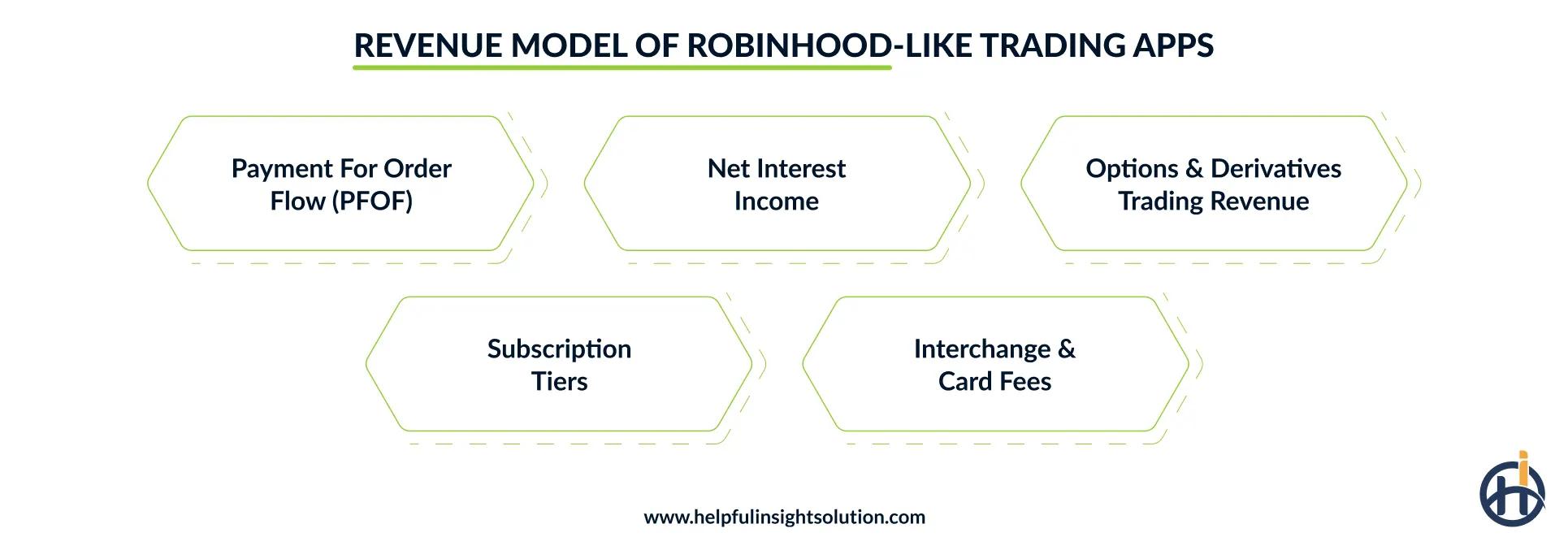
Monetization is a crucial success factor for any entrepreneur investing in Robinhood clone app development. Here, you will study various money-making strategies, such as subscriptions, trading revenue, and card fees.
1. Payment for order flow (PFOF)
Trading apps route user buy/sell orders to market makers like Citadel Securities instead of executing trades directly on an exchange. In exchange for this order flow, the market maker pays the platform a fee per trade, making it one of the largest revenue sources for commission-free apps.
2. Net interest income
Platforms earn interest by holding uninvested user cash and lending it out, as well as by charging interest on margin loans extended to traders. Since users often earn little to no interest on their idle cash balances, this spread becomes pure profit for the platform.
3. Options & derivatives trading revenue
Options and derivatives trades typically generate wider spreads and higher payment-for-order-flow rates than simple stock trades. This makes each options transaction significantly more profitable per trade compared to standard equity orders.
4. Interchange & card fees
Services that provide a connected debit card or cash management account get a fixed portion of a small interchange fee with each purchase. This model shows up frequently among fintech startup ideas because it ensures a consistent and low-cost revenue opportunity at scale.
5. Subscription tiers
Various premium membership plans, like Robinhood Gold, charge users a monthly or annual fee based on several benefits such as larger instant deposits, professional research access, and lower margin rates. This creates a predictable, recurring revenue stream independent of trading volume.
Why choose Helpful Insight for building a stock trading platform like Robinhood?
We have already discussed that building a fintech app like Robinhood requires a better understanding of compliance requirements, proper market strategy, and sufficient budget. But a business investor also needs to hire the right mobile app development company that ensures technical expertise and consistent support.
We have been delivering smart fintech solutions for the past 10 years, helping clients to offer the best financial trading and investment services to users. Our experts use advanced technologies like AI and blockchain to enhance stock market research and ensure secure investing across digital assets.
We provide a customized calculator that helps businesses estimate the cost to build a trading app like Robinhood by considering several parameters. With our collaboration, enterprises may give rise to cutting-edge fintech platforms, increasing visibility in the market. Time is now running fast, and the only way to survive in this industry is to start investing in digital stock trading apps.
FAQs
An investor experiences multiple challenges in building a trading app like Robinhood related to security, cost, and technology. A few of the major issues are discussed in the following manner:
- Real-time data processing: The systems face problems in processing live stock and crypto price feeds without latency.
- High development costs: From a secure and feature-rich MVP to enterprise-grade apps, every trading platform is expensive.
- KYC and AML protocols: To onboard users and prevent financial fraud, it is necessary to implement KYC/AML protocols.
Businesses can partner with a license provider (BaaS) like Alpaca or DriveWealth that holds FINRA and SEC licenses in the US. This path helps with faster MVP launch, reduces capital investment, and avoids long delays in legal approvals. The partners handle backend compliance, trade execution, data clearing, and regulatory filings.
Most trading platforms like Robinhood use event-driven architectures, in-memory caches, and low-latency protocols like WebSockets to stream live prices. For order execution, they use brokerage APIs, state management, and execution routing, ensuring smooth transmission. These platforms maintain security, high performance, and fault tolerance.
These commission-free trading apps use various revenue models, such as payment for order flow and paid subscription tiers. Some other money-making strategies include interest on cash balances and margin lending services. Businesses can also generate income from cash sweep programs, security exchanges, or optional transfer and account fees.
New platforms can target niche-specific audiences by offering advanced AI integration or building stronger educational tools. They can choose a hybrid model by incorporating powerful charts and technical indicators. It is beneficial to build interactive forums, embedded tooltips, and guided learning into the trading workflow.