


Key Takeaways:
- ML technology helps businesses to analyze large volumes of data, identify patterns, and generate insights for faster decision-making.
- Predictive maintenance, fraud detection, personalized recommendations, demand forecasting, and medical diagnosis are use cases of machine learning.
- Machine learning can support intelligent automation, predictive modeling, and personalized services, reducing operational costs and improving productivity.
- Investors must identify business-specific use cases, prepare quality data, choose suitable ML models, and continuously monitor performance.
AI and machine learning are increasingly being adopted across business and technology applications. From larger-scale businesses to smaller enterprises, several investors are now aiming to achieve technical superiority in their systems.
In the USA, policies have been made to spread these technologies across different regions in the country.
They are targeting 89% of U.S. businesses with fewer than 20 employees and 98% of those with fewer than 100 employees to adopt machine learning use cases. This will make the implementation better for entrepreneurs who want to enhance growth and retain customers.
It is important to guide modern investors through effective ML and AI development services for automating repetitive business tasks and reducing overhead expenses.
By knowing how ML algorithms and models work for different industries and use cases, businesses can estimate their budget and other expenses. Enterprises from various domains can invest in this technology and gain a competitive edge over others.
In this blog, you will encounter several machine learning applications in healthcare, finance, supply chain, and more. Also, we are going to explore key benefits, core technologies, adoption challenges, and business needs in this write-up.
What is machine learning?
Machine learning is a subset of artificial intelligence that uses data and algorithms, allowing computers to learn and make predictions. This prevents developers from programming multiple pieces of code for different tasks and reduces expenses for businesses.
It analyzes large datasets to understand user behavior, build predictive models, and improve system accuracy.
- Software uses human-written rules to process input data and produce output accordingly.
- ML transfers the information into an algorithm to find patterns and identify logic.
- The systems build various models for faster decision-making and predict accurate results.
Why has machine learning become a business priority?
Enterprises are investing in machine learning because it supports measurable outcomes such as improved forecasting, fraud detection, and customer engagement.
Here, we are going to explore a few of the major parameters that investors measure before using ML in their existing systems.
- Operational expense: This measures the reduction in labor costs achieved by automating repetitive, manual tasks.
- Customer lifetime value (CLV): It tracks increased revenue from personalized recommendations that boost retention and repeat purchases.
- Customer acquisition cost: CAC helps to evaluate marketing efficiency gains by using predictive modeling to target high-conversion audiences.
- Mean time to detect (MTTD): It can determine how much faster automated systems flag financial fraud or cybersecurity threats.
- Mean absolute percentage error (MAPE): This measures forecast error as a percentage-based metric to evaluate demand or inventory forecasts.
Core technologies used in machine learning
In machine learning, various algorithmic models are used to train systems on different data and improve the learning curve. They use both structured and unstructured information to train models or use the trial-and-error method to make accurate decisions.
The key ML technologies are discussed in this section.
A. Primary models
Mainly, use cases for machine learning work on the following models that implement data training, processing, and execution. They use various types of information and perform actions to analyze data patterns in real-time.
1. Supervised learning: This ML domain helps to train models on labeled data where the output is known, allowing algorithms to map inputs and outputs accurately. It is primarily used in classification and prediction, such as fraud analysis or sales forecasting.
2. Unsupervised learning: It uses unlabeled data that enables algorithms to identify hidden patterns or structures without predefined answers. This learning method is implemented for customer segmentation, anomaly detection, and market analysis.
3. Semi-supervised learning: It combines a small amount of supervised data with larger unsupervised datasets, ensuring system accuracy and lowering the costs of manual labeling. This method is used in medical imaging, where data labeling is expensive and time-consuming.
4. Reinforcement learning: This is a trial-and-error approach, which allows algorithms to learn decision-making based on the actions performed. Reinforcement learning is highly useful in autonomous vehicles, robotics, and AI-driven game-playing.
B. Deep learning and CNNs
Machine learning offers two other technologies that are used for creating highly complex platforms. These include deep learning and convolutional neural networks, which are described in this section.
1. Deep learning: This technology uses multi-layered neural networks to learn complex patterns from images, text, or audio. It benefits from substantial amounts of data, but pretrained models and data augmentation can reduce task-specific data requirements. Some deep learning business applications include speech recognition, natural language understanding, and image classification.
2. Convolutional neural networks: These are neural-network architectures commonly used to process grid-like data such as images. This technology has multiple layers that help to detect features, from simple textures to complex objects. CNN is the core tool in most computer vision applications, like facial recognition and medical image analysis.
Machine learning use cases by industry
Risk score prediction, demand forecasting, route optimization, and automated quality control are specific machine learning applications in business.
This section describes all these use cases based on different industries, like healthcare, finance, retail, and others.
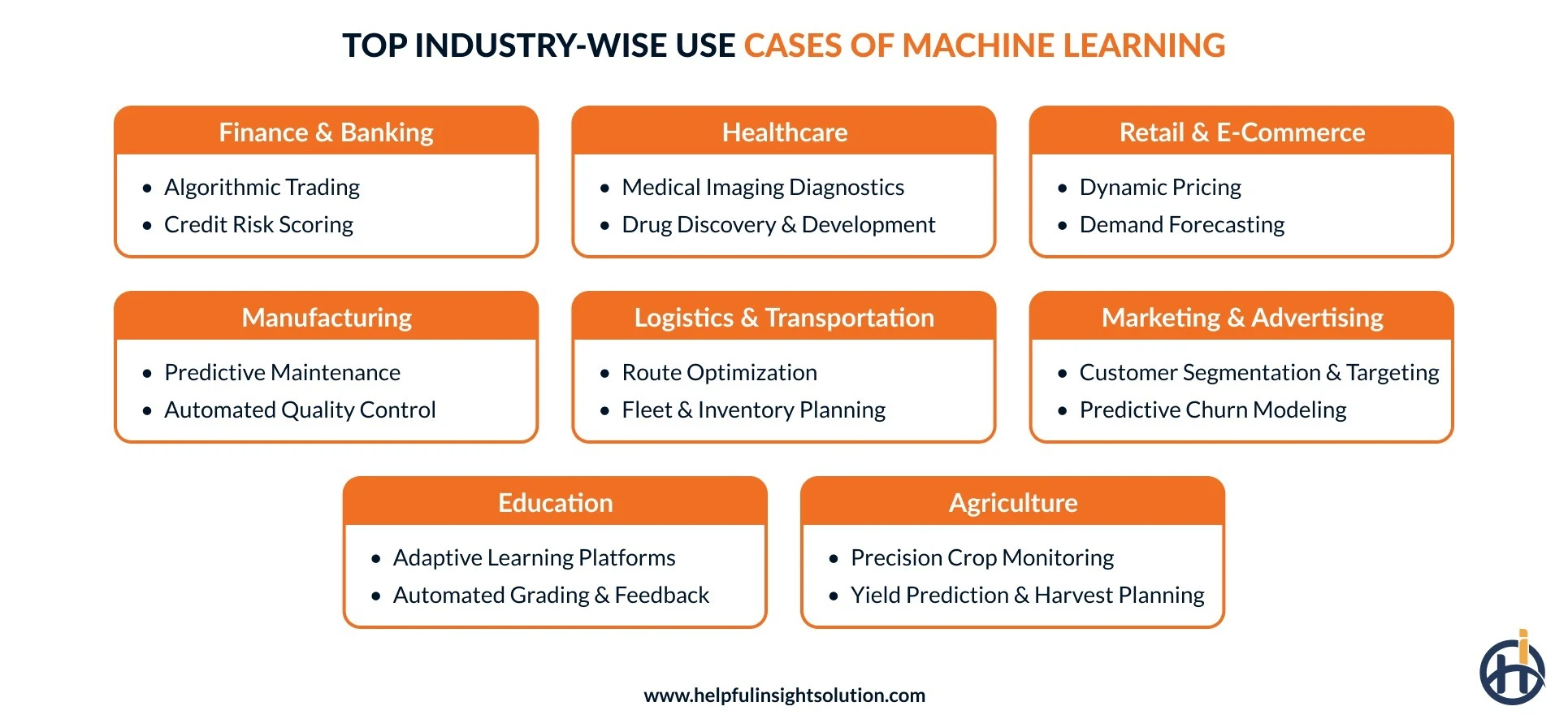
1. Finance & Banking
- Algorithmic trading
ML algorithms can analyze market, news, and historical data to support trading strategies, as execution speed and automation depend on the trading infrastructure and strategy.
They provide financial institutions with a powerful advantage in the markets that manual and traditional trading methods cannot achieve.
- Credit risk scoring
The technology can analyze additional factors other than credit report details, such as transaction patterns, customer spending habits, and borrowing behavior.
This helps to identify the financial risk of a potential consumer and facilitate quick loans without the higher default rates associated with traditional scoring.
Learn more: How AI Revolutionizes the Banking Industry
2. Healthcare
- Medical imaging diagnostics
Various ML models can easily analyze X-rays, MRIs, and CT scans to catch conditions, such as tumors and fractures, with high speed and accuracy.
Machine learning in healthcare enables radiologists to spend more time on urgent patient cases and detect multiple illnesses with enhanced clinical review.
- Drug discovery & development
Machine learning-powered healthcare solutions can recognize complex molecular and biological patterns, which accelerate the drug discovery process.
Additionally, this reduces the time for searching potential candidates and the cost associated with pharmaceutical development.
Learn more: How AI in Healthcare Is Transforming the Industry?
3. Retail & E-Commerce
- Dynamic pricing
ML can support dynamic pricing by using signals such as demand, inventory, and competitor prices to recommend or adjust prices according to defined business objectives.
Retailers will always maintain a strong competitive position and gain maximum margin on all products offered at all times.
- Demand forecasting
By analyzing past purchases, seasonal patterns, and current market trends, ML algorithms can forecast product demand with high accuracy.
These machine learning use cases help to effectively manage the overall inventory, minimizing overstock and stock-out conditions.
Learn more: How AI in Retail is Transforming the Retail Industry?
4. Manufacturing
- Predictive maintenance
ML implements predictive analytics to analyze various sensor data from machines to predict equipment failures before they occur, enabling proactive repairs instead of reactive fixes.
This significantly reduces unplanned downtime and maintenance costs for factory owners or manufacturing units.
- Automated quality control
Computer vision–powered ML systems inspect products on the production line to detect defects with greater speed and consistency than manual inspection.
These use cases of machine learning ensure higher product quality while reducing labor-intensive quality checks.
5. Logistics & Transportation
- Route optimization
Various machine learning models can easily compute the shortest delivery route based on weather, traffic, and delivery times with updated information.
This helps to decrease fuel use, delivery times, and operating costs for fleet owners and retail operators.
- Fleet & inventory planning
This AI technology allows businesses to predict shipping and demand volume in addition to allocating warehouse and vehicle capacity. Additionally, these systems support real-time space and mobility allocation across locations and time periods based on operational constraints.
Learn more: How is AI in transportation shaping the future of mobility?
6. Marketing & Advertising
- Customer segmentation & targeting
ML groups customers according to their behaviors, preferences, and buying intentions, using generative AI for marketing campaigns instead of random outreach programs. With this, businesses from across the globe can achieve better campaign relevance and improve conversion rates.
- Predictive churn modeling
It can automatically detect customers who will leave and unsubscribe from the service in the future through behavioral patterns. Additionally, it also tracks engagement signals and takes proactive actions to give retention offers before losing customers in real-time.
7. Education
- Adaptive learning platforms
The learning content is tailored to the understanding capabilities of a student through a personalized learning path.
Overall involvement and growth of students are also enhanced by the tool when compared to a general curriculum, which imparts a narrow range of knowledge and skills.
- Automated grading & feedback
Machine learning applications help subject matter experts to easily evaluate multiple assignments, quizzes, and essays, providing students with instant feedback. This reduces instructor workload while supporting iterative learning and individual growth.
8. Agriculture
- Precision crop monitoring
Various ML-driven tools can easily detect crop stress, pest infestation, or irrigation issues by using real-time satellite images and drone footage.
Farmers use this information to identify crop damage probability and fix it before the area is substantially affected.
- Yield prediction & harvest planning
ML processes weather data, soil conditions, and historical crop information to more precisely predict a crop’s yield.
This is one of the major machine learning examples in real life, which helps farmers to plan for harvesting, storage, and transportation arrangements.
Most common applications of machine learning
Common ML applications, such as chatbots, recommendation engines, and fraud detection, are implemented by investors. In this section, we are going to discuss them and understand why they are used on a large scale.

1. Natural language processing
Natural language processing helps to create machines that can easily read, understand, and generate human language, supporting both text and speech.
It enables language translation and sentiment analysis, allowing companies to automatically analyze and find insights from mass unstructured text.
Grammarly: It can analyze user text in real time to suggest improvements based on grammar, style, and clarity by using NLP.
2. Recommendation systems
Recommendation engines can analyze user behavior, preferences, and user history to recommend various products, services, and content of interest.
It is one of the major machine learning use cases that boost engagement and business revenue by personalizing customer experiences.
Netflix: The platform uses recommendation technologies to personalize content suggestions using signals such as viewing activity and user interactions.
3. Fraud Detection
Various ML-based fraud detection systems analyze transaction patterns in real time to identify anomalies that may indicate fraudulent activity.
This capability allows enterprises to easily block different suspicious activities before any financial damage occurs.
Mastercard: It has machine learning models to analyze vast amounts of data and detect potential fraudulent transactions in real time.
4. Chatbots and voice assistants
Machine learning can help chatbots classify requests, retrieve relevant information, and generate or select responses based on the application design.
Business investors have also gained an advantage, as these tools provide consistent support, lowering the operational expenditure.
Amazon Alexa: The platform uses voice recognition to interpret user commands and perform actions, from setting reminders to controlling smart home devices.
Benefits of integrating machine learning for businesses
Machine learning innovations offer multiple benefits like personalized experiences, task automation, and data accuracy. These advantages motivate enterprises to focus on ML-driven models and build smart platforms.
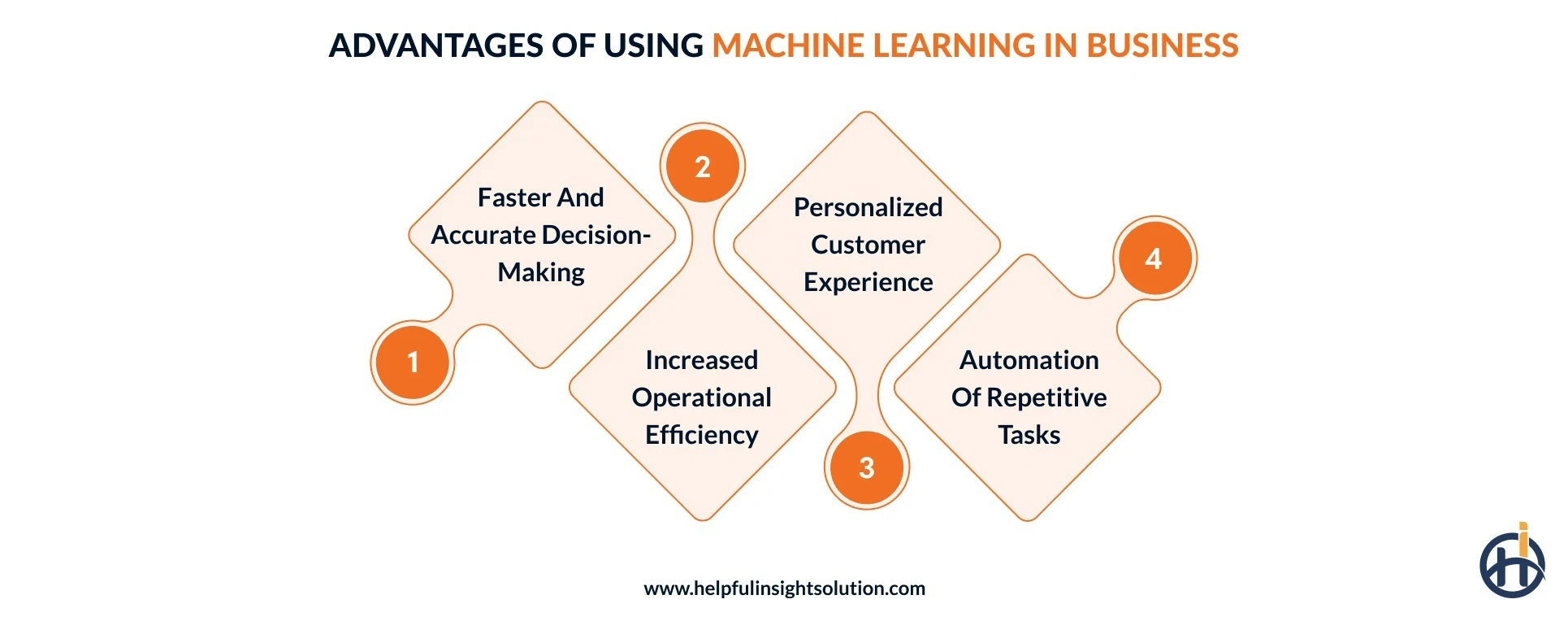
1. Faster and accurate decision-making
Various machine learning applications can easily analyze huge volumes of data faster than manual interpretation, uncovering trends and patterns that drive timely business decisions.
This helps to cut down on guesswork and outdated reports, allowing firms to move on and reduce chances of errors as they happen.
2. Increased operational efficiency
Machine learning finds process and workflow inefficiencies that are hard to detect through manual inspection, such as bottlenecks and resource constraints in the supply chain.
ML can support process optimization, automation, and prediction when workflows are designed and monitored appropriately.
3. Personalized customer experience
ML can personalize products, content, or recommendations using signals such as purchase history, behavior, and preferences.
Smart AI chatbots enhance customers’ satisfaction by increasing overall engagement and conversion rate.
4. Automation of Repetitive Tasks
Several repetitive tasks, such as data entry, invoice processing, or query resolution, can be handled by different ML-driven platforms. Through various ML use cases, workers can easily focus on high-value tasks that can impact business growth and revenue generation.
Major challenges in adopting machine learning
Organizations may face adoption challenges related to technical expertise, data readiness, infrastructure, governance, and change management. We will study various obstacles that businesses face during integration, along with their respective solutions.
1. Data quality and availability
Machine learning models fail because of inaccurate labels, missing values, data silos, and the lack of historical data. Also, real-time data changes can affect trained models, and strict compliance laws can restrict data collection and access.
Solution: Data cleaning, validation, augmentation, and performance monitoring can help address data-quality issues and identify when retraining or model updates are needed.
2. Legacy systems integration
Traditional systems cannot easily handle complex algorithms due to limited processing power, a lack of modern APIs, and system latency. Legacy software can introduce security, maintenance, and integration risks that may increase the overall ML implementation software cost and complexity.
Solution: Businesses can use tools like Swagger to bridge systems and upgrade data pipelines by implementing ETL tools, such as Talend.
3. Lack of in-house expertise
Organizations cannot easily adopt machine learning due to an excessive shortage of skilled machine learning experts. This is because ML engineers have advanced knowledge, maintain deployed systems, and charge higher fees for hiring.
Solution: It is beneficial to upskill existing software developers and allow them to use AutoML tools that require less coding and mathematical knowledge.
Partner with Helpful Insight to get started with machine learning technology
Time is running out for businesses that lag behind their competitors due to difficulty in technical adoption and working with legacy systems. It is the right time to approach a reliable and expert team that helps you to understand various machine learning use cases and implement them easily.
We have a proven track record in delivering smart NLP, computer vision, and Generative AI development solutions that use machine learning models for training data. Additionally, we simplify complex processes, allowing businesses to automate repetitive tasks and optimize workflow across systems.
The development of AI and machine learning applications has increased rapidly, which shows that almost everyone is investing in these technologies. So, businesses must hire our experts who ensure seamless ML integration and constantly monitor progress at regular intervals.
This will help them to build a collaborative ecosystem, deliver enhanced experiences, and ensure user retention.
FAQs
The average cost of making machine learning-powered platforms is highly dependent on the platform complexity and AI models. To build MVP features, the overall price ranges from $15,000 to $50,000 with basic API integration and rule-based automation. For advanced GenAI platforms that use LLMs and RAG, the cost may increase to $150,000 or more.
AI is a broader concept that allows machines to replicate human intelligence, whereas machine learning uses data to train them. Artificial intelligence helps in problem-solving, but ML is a method to identify patterns through historical data. AI depends on rule-based logic and decision trees rather than working on statistical algorithms for discovering rules automatically.
Small businesses can easily implement machine learning to optimize tasks, forecast trends, and personalize customer experiences. They can improve sales, inventory, customer support, marketing, and administration through automation. It is important to use pre-built tools and focus on specific use cases for seamless integration of machine learning technology.
Machine learning is used by entrepreneurs to enhance existing services through guided learning and automation. Some of the major commonly identified ML use cases are discussed as follows:
- Fraud detection: In banks, ML is used to review transactions and identify suspicious activities to prevent cyberattacks.
- Demand forecasting: It analyzes historical data and market trends to forecast inventory needs and reduce shortages.
- Predictive maintenance: This helps to avoid machinery breakdowns in factories by powering sensors and hardware.
In retail and e-commerce, machine learning helps enterprises to personalize product recommendations and ensure smart search. Through virtual assistants and chatbots, they offer real-time customer support for various queries. Users can experience dynamic pricing based on changing market demand and availability, which ensures trust and reliability.