

“Ensure your ecommerce business success through integrated AI chatbots.”
Every retailer, wholesaler, or distributor wants consistent growth in their business, which they can achieve through online platforms. Additionally, if they use AI-powered virtual assistants, then it will create more opportunities for them to increase sales and engage users.
The retail sector has around 30% share in the chatbot market, which is followed by the finance industry. North America was the largest contributor with a market share of 31.3% in 2025, allowing businesses to invest more in this technology.
The top AI chatbots for ecommerce are already providing advanced features that understand user behavior, provide personalized services, automate tasks, and support revenue growth.
You can start a business online or improve your existing infrastructure by integrating enhanced chatbots. For this, it is crucial to know various personal and commercial aspects from the user’s point of view.
In this blog, we will guide you through the different benefits and use cases of AI chatbots for your ecommerce business growth. There are a lot more things discussed in the content, but you need to focus on them and understand every point.
Growth of AI-Powered eCommerce Market
Before creating an ecommerce AI chatbot for your business, you must know about the current and future market growth. It is beneficial to approach an Ecommerce development company that provides the best insight with revenue comparison, ROI, and regional market share.
- The current value of the ecommerce AI market is $11.2 billion in 2026, with North America having 39% market share.
- The overall revenue will increase to $74.9 billion by the end of 2035 because the industry is growing at 23.6% CAGR between 2026 and 2035.
- In the USA, this market has a value of $3.1 billion in 2026, which will reach $20.9 billion at the end of this tenure.
- The machine learning segment has a market share of 48.4%, whereas the B2B entrepreneurs hold 57.6% in the business segment.
- AI chatbots manage 75% of customer engagement, with China having more than 80% GenAI platforms in various departments.
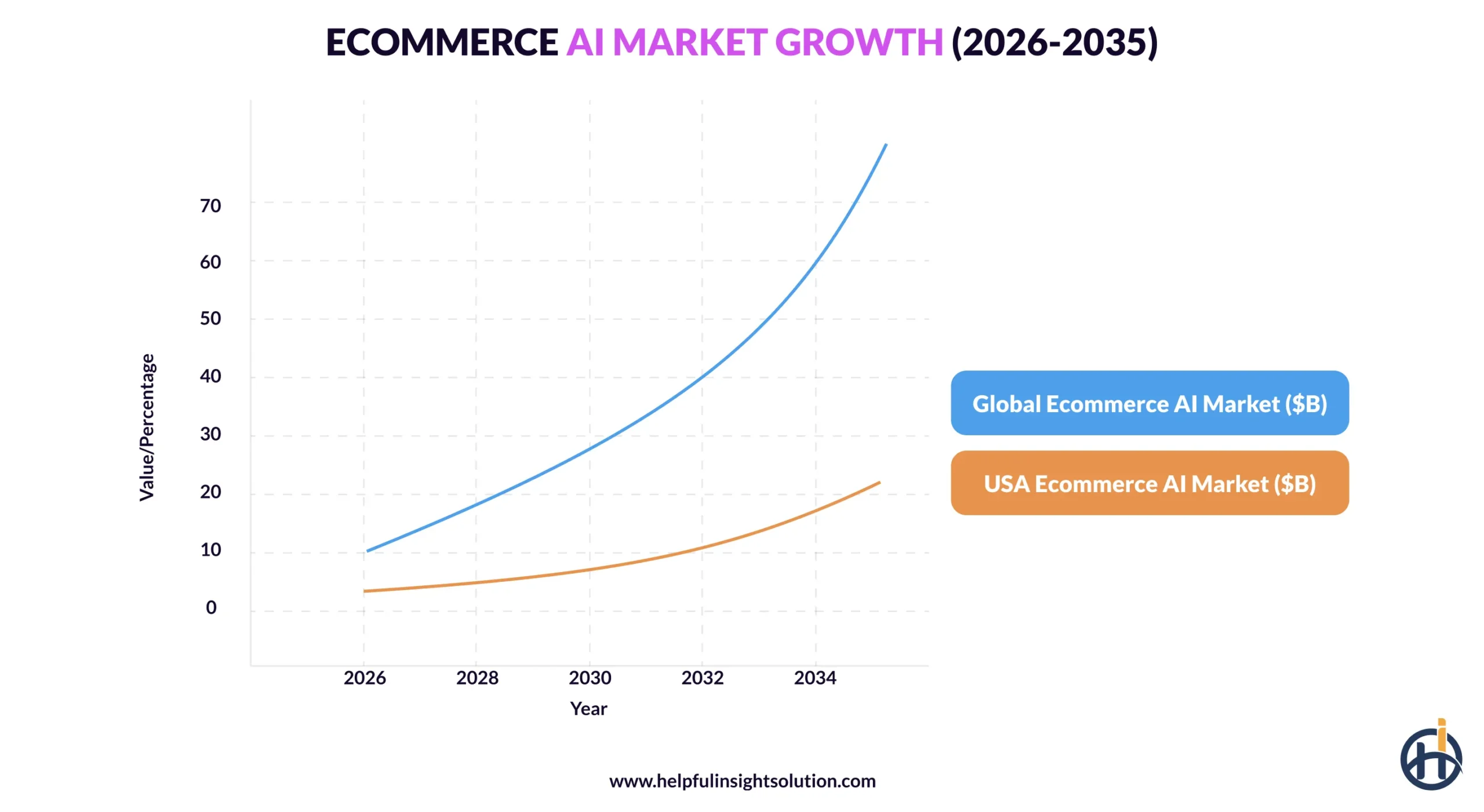
These market figures show the scope of the AI-driven ecommerce industry, which will grow rapidly. So, businesses must understand various conversational AI ecommerce models, as they have different functions based on the business’s operations.
Advantages of Using AI Chatbots in E-Commerce
A chatbot with AI features provides constant support, user personalization, and accurate predictions. These ecommerce chatbot benefits help businesses to enhance their services and increase business sales for growth.
1. 24/7 Availability and Support
An AI chatbot for online stores is active all the time, generating instant responses based on various user queries, such as shopping, orders, and contact information. This ensures consistent business growth through customer retention and time zone management.
2. Reduce Operational Costs
These tools help business investors to reduce the operational cost by 30% through real-time order tracking, predictable FAQs, and return processing. The impact of chatbots in ecommerce is that they reduce human interference, decreasing biased decisions.
3. Improve Sales & Leads
It is beneficial to use conversational AI in retail businesses because it offers user-centric recommendations and precise lead generation strategies. Additionally, investors can integrate advanced UI/UX design solutions to attract more customers for ordering.
4. Enhance User Personalization
One of the best benefits of AI chatbots in ecommerce is that they use hyper-personalization and proactive engagement to provide user-specific information. These tools offer multi-language support that allows people to review chats easily, increasing brand loyalty.
Top Use Cases of AI Chatbots for Ecommerce
We will discuss the best use cases of AI chatbots in ecommerce in this section, which include cart management and multi-language support. They ensure customer satisfaction, optimize platform retention, and prevent unethical users.
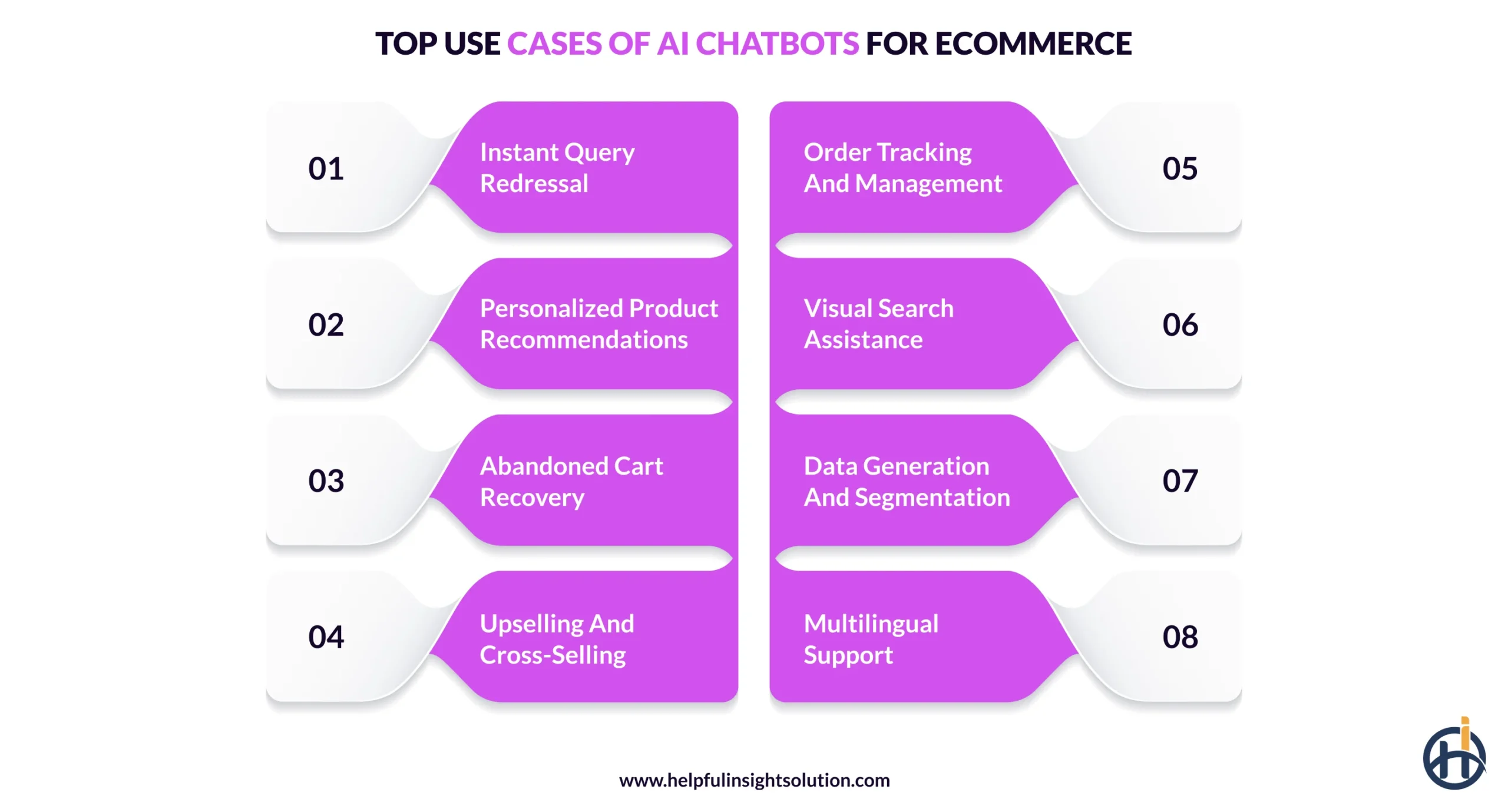
1. Instant Query Redressal
The advanced chatbots provide instant solutions to various user queries through ecommerce customer support automation. This reduces response time, enhances user engagement, ensures trust, and optimizes platform scalability.
These tools resolve user concerns that are related to payments, orders, returns, and personal accounts, enabling smooth communication.
Key Example: Amazon uses AI chatbots to answer customer queries about orders, refunds, and product details. This improves user satisfaction, lowering customer service costs during high-traffic sales periods.
2. Personalized Product Recommendations
Businesses can ensure ecommerce personalization with AI chatbots because these tools analyze user behavior, browsing history, and purchases.
You can increase sales and convert leads through enhanced virtual assistants for retail platforms. Additionally, they offer personalized products, discounts, and offers that improve engagement and boost overall growth.
Key Example: Nike’s recommendation engines suggest products based on browsing history and preferences. It boosts conversion rates by presenting highly relevant items based on the user’s behavior.
3. Abandoned Cart Recovery
The virtual assistants resolve doubts, deliver recovery messages, simplify checkout processes, and offer discounts to close sales for retailers.
They enable automated cart reminders for every product in the cart and can easily be connected with CRM systems. This ensures constant user engagement, increases retention rates, and provides instant product customization.
Key Example: Sephora deploys chatbots to send reminders and exclusive offers to users who leave items in their carts. These automated alerts help to recover lost sales and increase checkout completion rates.
4. Upselling and Cross-Selling
After the product selection, the AI-driven virtual assistants suggest complementary products, which is known as cross-selling. Additionally, these tools track user history and personal preferences to recommend high-end products, which is known as upselling. You must create an AI solution for ecommerce platforms that can deliver an increasing AOV and conversions.
Key Example: Alibaba uses AI chatbots to recommend premium versions or complementary products. This strategy increases average order value by encouraging customers to explore better or enhanced options.
5. Order Tracking and Management
Various chatbots use Generative AI in ecommerce platforms to optimize order tracking and management, ensuring real-time updates and enhancing user trust.
They perform various tasks, like instant order updates, automated refund processing, and delivery notifications. A confirmation is sent to the server for acceptance or denial of the order, generating fast responses.
Key Example: Walmart allows customers to track orders, modify deliveries, or initiate returns without humans. This streamlines post-purchase experiences and reduces operational workload for support teams.
6. Visual Search Assistance
Users can review descriptions of different products through visual assistance tools that allow them to upload images and search for the item in the results.
The best ecommerce AI chatbot platforms provide a direct purchase link, reducing manual scrolling. They inform users about the quality, texture, and price of the product, which increases global reach and business conversion.
Key Example: ASOS uses AI chatbots, enabling users to upload images and find similar products instantly. This enhances product discovery, especially in fashion, where visual preference is important.
7. Data Generation and Segmentation
As an entrepreneur, it is beneficial to use conversational AI for ecommerce services, as it helps to generate user data and filter valuable information. The chatbots include different generative and predictive models with transformative agents to understand complex datasets.
This helps in product discovery, cognitive behavior, and recommendations, boosting business sales.
Key Example: Shopify chatbots collect, analyze, and segment user data based on behavior, intent, and purchase history. They help businesses create targeted marketing campaigns and improve overall ROI.
8. Multilingual Support
You can implement AI-enabled chatbots that offer customer support in multiple languages, which ensures trust, increases sales, and offers instant resolution.
This helps users to easily select different products with automated suggestions and get answers through troubleshooting. These tools help businesses perform a 2-way marketing process across multiple channels.
Key Example: eBay uses AI chatbots that can interact in multiple languages, serving global customers. This ensures seamless communication across regions, expanding reach, and improving customer engagement.
How to Integrate AI-Enabled Chatbots into Ecommerce Platforms?
In this section, you will study the process of AI Chatbot Integration for eCommerce, covering various stages. From business research to AI model deployment, these steps support integration and development.
1. Understand Retail Business
Initially, businesses should know various requirements, which include user interests, budget needs, and advanced AI components. To build ecommerce chatbots, it is crucial to understand the impact of different AI technologies on market sales and revenue.
You must choose the right AI tech stack that can easily analyze various data, like prices, product IDs, user codes, and referral coupons for personalization and automation.
2. Backend System Integration
You should connect with experts who can use conversational AI for retail businesses, which involve both NLP and machine learning algorithms. They help in developing an automated infrastructure by using advanced models and SaaS-based architecture.
AI helps to enhance the functions of APIs that enable real-time notifications, payment alerts, and product tracking with automated requests and queries.
3. Train AI Chatbots
Now, it is necessary to train various AI models, like generative, predictive, and agentic, based on different user preferences and personal data. You can create an AI chatbot for ecommerce platforms by deploying multiple transformative agents that handle various tasks.
You must ensure that experts use advanced NLP and machine learning algorithms to collect, understand, process, and execute information on the server.
4. Design Conversation Flows
The capability of AI chatbots is dependent on rule-based and conversational models that unify various parameters, like products, users, and vendors. Businesses should approach an experienced AI chatbot development company that can easily manage complex retail tasks.
Additionally, it helps investors to understand the working of automated systems for inventories, billings, and payments, improving the overall efficiency.
5. Monitor & Optimize Models
Various tools monitor the performance and scalability of virtual assistants through different parameters, like user response, context, and delivery speed. It is beneficial to observe the best AI chatbots for ecommerce platforms that offer quick results, enhancing user experiences.
They update older versions and provide new models according to the needs of businesses, such as to increase retention rate and reduce overall user churn.
Key Technologies Used in AI-Driven Chatbots for Customer Support
To implement AI chatbots for customer engagement, it is beneficial to understand various artificial intelligence technologies. They help to process user information, create generative models, and deliver accurate results in real-time.
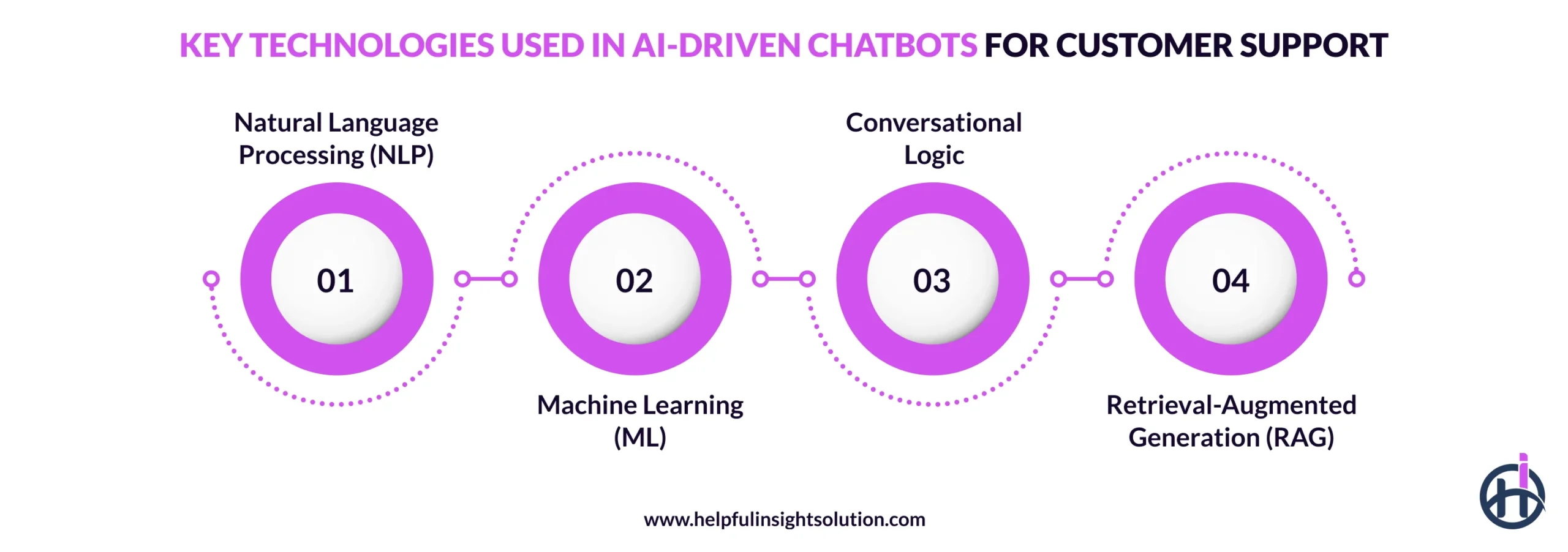
1. Natural Language Processing (NLP)
NLP helps to understand human language and behavior, generating a free-hand model that can operate through contextual algorithms. It is one of the major components in the development of AI-powered chatbots for ecommerce, which ensures accuracy and enhances customer support.
2. Machine Learning (ML)
The machine learning technology helps experts to train on various user data, such as product catalog, payment options, and vendor selection. You can hire dedicated developers who understand supervised, unsupervised, and reinforcement models that are used for improving data quality.
3. Conversational Logic
The conversational AI in ecommerce uses both NLP and ML to transform user input into machine language and generate logic based on business requirements. These tools are directly integrated into virtual AI-powered assistants for delivering instant responses with accuracy and transparency.
4. Retrieval-Augmented Generation (RAG)
RAG performs two different tasks, which include the extraction of data from pre-defined models and using transformers to generate responses in real-time. It offers a scalable infrastructure with enhanced training models that help to secure business documents, databases, and knowledge sets.
Common Challenges with AI Chatbots in Ecommerce Support
Before integrating AI chatbots for ecommerce, you must know various challenges that may occur. Here, we will study a few of the most important risks, like managing human tone, with their respective solutions.
1. Misunderstanding Customer Intent
The retail conversational AI chatbot may behave abnormally due to algorithmic issues and wrong data input. This decreases user trust and increases manual dependency, increasing the overall security and privacy risks.
Solution: AI must analyze chats to understand user issues, and can be shifted to human agents if it is inaccurate for data prediction.
2. Lack of Real-Time Services
Various investors do not include integration in the mobile app development services, which affects the bot’s performance. Additionally, they use outdated information that creates a gap between users and the server.
Solution: It is beneficial to use an API-first architecture that collects real-time information and webhooks for real-time order tracking.
3. Maintaining Human-Like Tone
The chatbots have a built-in content guide that provides robotic responses to users, which influences their experience. They are not able to connect with user intentions and fail to deliver instant product resolutions.
Solution: You must use RAG models for accuracy, provide characters to the chatbot, and train the data based on user behavior.
How Helpful Insight Boosting Ecommerce Sales Through AI Solutions?
The time has arrived to start integrating AI chatbots for ecommerce business growth and become a market leader through product automation, prediction, and personalization. You should hire a reliable and skilled partner who has experience with AI development services, such as chatbot integration and Generative AI models.
We help our clients to deliver the best AI-powered solutions that boost revenue generation and increase user engagement through advanced technologies.
Our experts focus on affordable resources, allowing businesses to create a conversational chatbot for ecommerce platforms. Additionally, they ensure complete support during the integration and development process, deploying secure platforms.
You must start immediately to take the competitive advantage, enhance brand value, and gather customers in large numbers.
FAQs
For creating AI-driven chatbot solutions for ecommerce businesses, the average time required is between 1 month and 3 months. The timeline may increase due to additional requirements like plugins, integrations, and add-ons. The duration may extend to 5 months due to project complexity, bot services, and data dependency issues.
The average monthly cost ranges between $20 and $150 for SaaS-based AI tools that require basic features like task automation. For customized solutions, the overall cost may range from $15K to $150K due to advanced AI personalization and prediction. The maintenance cost is 15-20% of the total integration and development prices, affecting the model.
Businesses should integrate AI chatbots in ecommerce platforms because they offer multiple benefits, like personalized shopping. Some of the major reasons are discussed in the following manner:
- These tools track user history and preferences to suggest the best products for shopping.
- Chatbots help users to resolve various issues, like returns, refunds, and replacements.
- They monitor purchases and orders to provide real-time information on drivers and items.
Various entrepreneurs use one or more AI-powered chatbots to increase their sales and boost user engagement. The best chatbots for ecommerce customer support are described as follows:
- Tidio: The chatbot helps in lead generation and conversion through data analysis.
- Zendesk: It is an AI agent that can be customized according to the user’s behavior.
- Click4Assist: This tool provides chat automation to deliver instant replies to user queries.
There are different types of AI chatbots available in the ecommerce industry that offer varied features. The main categories are explained in the following manner:
- NLP Chatbots: They use machine learning and NLP to study user intent, improving responses.
- GenAI Chatbots: These tools act as conversational models that generate automated answers.
- Voice Chatbots: They follow user commands for processing and provide voice-based results.