


Key Takeaways:
- RPA automates repetitive tasks across manufacturing, supply chain, quality control, and customer service, improving efficiency.
- Software bots can reduce human errors, increase productivity, and ensure accuracy by focusing on strategic automotive activities.
- RPA integrates with AI, IoT, and data analytics to enable predictive maintenance, smart quality inspection, and improved decision-making.
- From business assessment to performance monitoring, a dedicated RPA implementation process ensures increased ROI and long-term scalability.
Have you ever been to a large-scale factory or seen a car manufacturing unit? You might have observed that there is a lot of pressure on employees due to increased supply chain demands, adherence to regulatory standards, and faster delivery with accuracy.
Here comes the role of RPA in the automotive industry, as manual processes take much longer and increase the chance of failure. Robotic process automation helps workers by managing repetitive tasks that work on defined rules.
Additionally, it streamlines order processing, inventory updates, and warranty claims in real-time.
If we look at the market, the industry of RPA-enabled automotive platforms is booming in the Asia Pacific. According to Fortune Business Insights, the region has a share of 16.8%, with a revenue of $5.7 billion in 2027.
This digital transformation in automotive enterprise is the foundation for future growth with the rising Industry 4.0 evolution.
This blog covers RPA use cases in the automotive sector, including dealer network management, intelligent document processing, and more.
You’ll also find the key benefits, challenges, and implementation steps, along with future trends. It’s a complete guide on the topic.
What is RPA in the automotive industry?
Role of robotic process automation in the automotive industry involves using software bots to replicate human computer actions and automate tasks.
They perform various back-office processes like invoice creation, inventory tracking, and compliance report generation.
RPA assists businesses in preventing human errors, reducing operational expenses, and increasing focus on material engineering.
How does RPA work in automotive?
RPA technology in automotive works by gathering data from various sources and comparing it with predefined rules or reference data. Let’s take a closer look at how this mechanism works.
- It identifies various repetitive and rule-based tasks, such as quality control, document processing, and dealer network management.
- RPA bots map human actions, like clicks and keystrokes, to ensure automotive production automation for seamless data matching.
- The software bot interacts with the front-end user interface of various systems, like ERP, without complex backend coding.
- Bots can easily extract information from emails, web portals, and cloud servers to match it with the pre-defined rules.
- All these tasks are performed regularly at a faster rate, allowing systems to monitor the bot’s performance through a dashboard.
RPA in automotive: Market insights and adoption drivers
RPA can streamline the supply chain and manage vehicle recalls, helping automotive businesses cut costs and ensure strict compliance.
Entrepreneurs use advanced automotive software development services to drive profitability, meet regulatory demands, and enhance customer experiences.
This also boosts administrative efficiency and supports market growth across various segments.
Key market statistics and growth projections
As you know, the RPA-driven automotive industry is growing at a whopping rate. So, it becomes crucial to understand key metrics, like regional share, total revenue, and growth analysis, before investing in intelligent automation for automotive.
Here is a detailed discussion of the RPA automotive market.
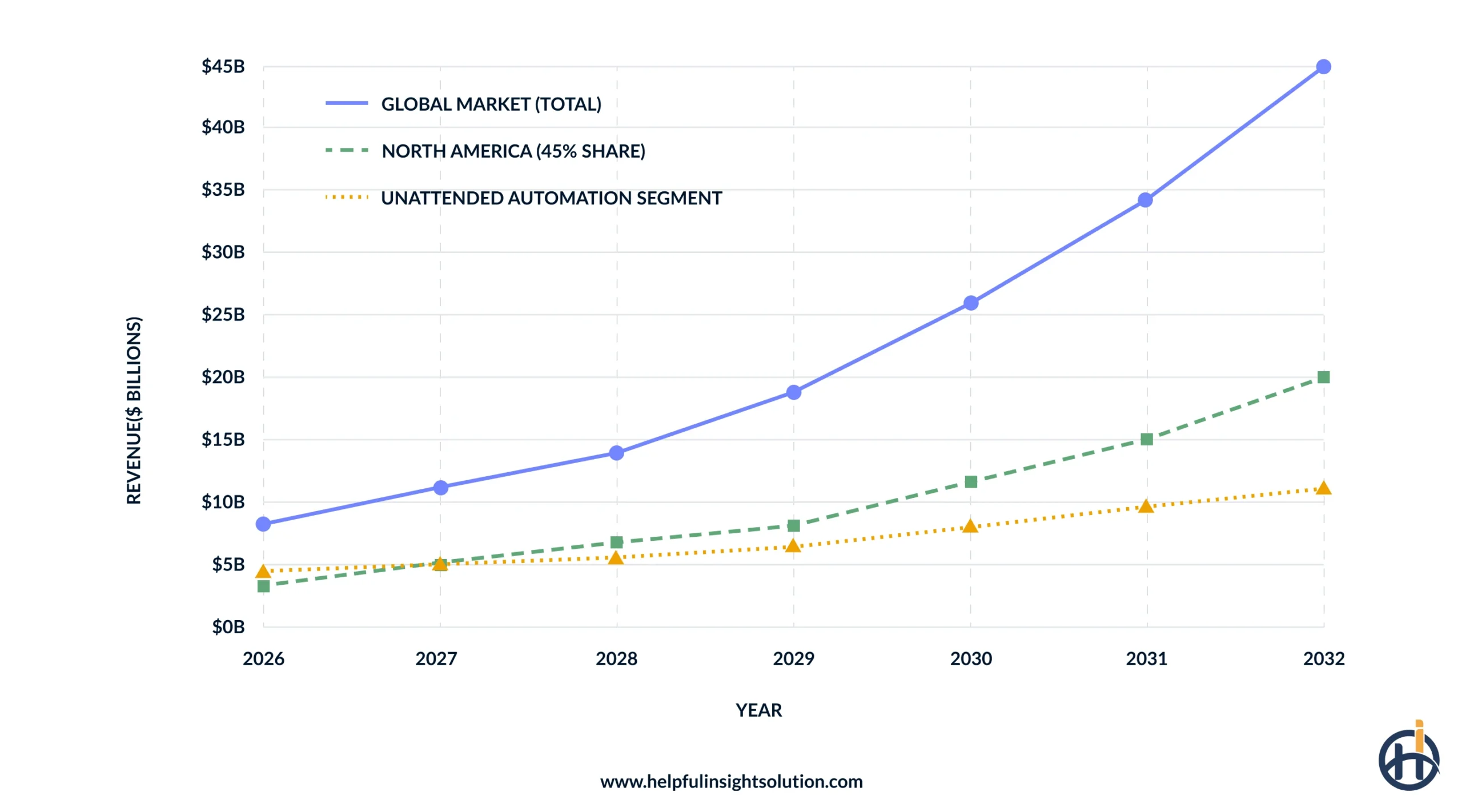
- The size of the RPA-powered automotive market is $8.2 billion in 2026, with North America having a share of 45% in the market.
- By 2032, the RPA-based automotive market will reach a revenue of $44.4 billion, as its growth rate is 32.6% CAGR between 2026 and 2032.
- The Unattended automation segment has a share of 52% in the market and is growing at a rate of 17.5% CAGR over this tenure. Why are automotive companies adopting RPA now?
This facility is helping automobile giants to increase market reach and allow employees to focus on strategic initiatives.
The key drivers of this change include supply chain resilience, enhanced dealership experience, and focused financial processing.

Top RPA use cases in the automotive industry
In this section, we will explore supply chain automation, warranty claims processing, and more RPA use cases in the automotive industry.
They cover various departments and ensure complete assistance through integrated technologies.
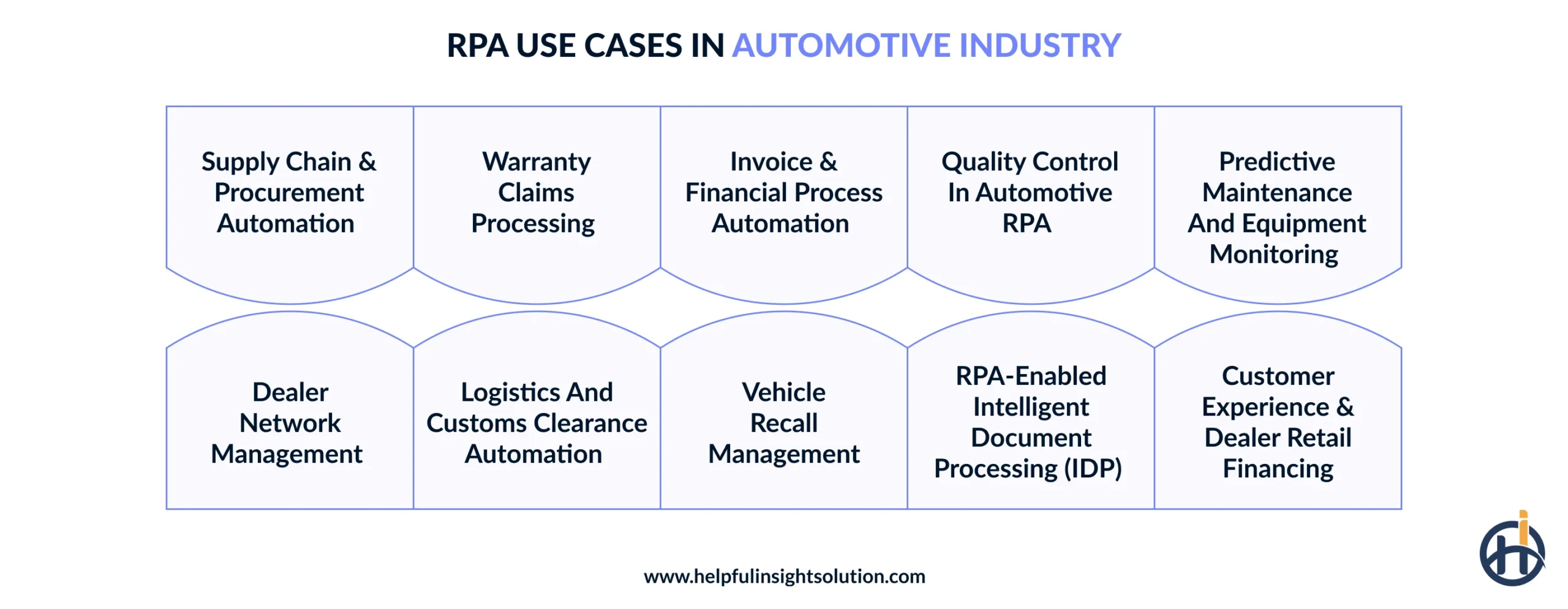
1. Supply chain & procurement automation
Robotic process automation improves purchase orders, getting suppliers on board, tracking inventory, and making procurement easier in the automotive supply chain.
This means people do not have to do much work, suppliers work better with the company, and the materials are available on time.
- Automates purchase orders, supplier onboarding, and inventory replenishment to eliminate repetitive manual tasks. It ensures materials are always available for uninterrupted vehicle production.
- Tracks inventory levels and supplier performance in real time to improve procurement decisions. This reduces stock shortages, overstocking, and procurement delays.
- Integrates with ERP and supply chain systems to synchronize procurement workflows. It improves supplier collaboration while lowering operational costs.
2. Warranty claims processing
RPA checks warranty claims, makes sure customer and vehicle information is correct, and approves claims based on rules that are already set.
With warranty claims processing automation, claims are settled faster, mistakes are reduced, and accuracy is increased at a large scale.
- Verifies warranty eligibility by validating customer, vehicle, and service records automatically. It slows down manual review time and claim-processing errors.
- Automates claim approvals and routing based on predefined business rules. It accelerates settlements while maintaining compliance with warranty policies.
- Generates claim reports and audit trails for better visibility and transparency. This allows investors to target more individuals and simplifies regulatory audits for them.
3. Invoice & financial process automation
RPA helps with making invoices, checking payments, paying bills, and making reports for car businesses through integrated tools.
It is one of the best RPA use cases that makes sure payments are correct, gets money to people faster, and follows standard automotive rules.
- Automates invoice creation, payment reconciliation, and accounts payable workflows. This minimizes manual accounting errors and speeds up financial operations.
- Matches invoices with purchase orders and payment records automatically. It prevents duplicate payments and strengthens financial accuracy. his reduces
- It produces financial reports and compliance documents with instant data collection. This helps finance teams make faster and data-driven business decisions.
4. Quality control in automotive RPA
The use of RPA in automotive quality management helps to collect various data on how well products are made and automatically makes reports on inspections and problems with products.
This allows manufacturers to find problems early and keep making consistently good products.
- Collects production and inspection data from multiple manufacturing systems automatically. This enables faster identification of quality defects and process issues.
- Generates quality inspection reports without manual intervention. It helps manufacturers maintain consistent production standards across facilities.
- Sends instant alerts when defects exceed acceptable quality thresholds. It helps businesses to easily handle product recalls, improves inspection, and decreases surface issues.
5. Predictive maintenance and equipment monitoring
RPA works with sensors and artificial intelligence systems to check how well machines are working and schedule maintenance when it is needed.
The predictive maintenance automation reduces stops in production, makes machines last longer, and makes manufacturing more efficient.
- Monitors machine performance using IoT sensors and automated workflows. This detects equipment issues before they result in costly failures.
- Schedules preventive maintenance based on equipment health instead of fixed timelines. It extends machine lifespan while reducing unexpected downtime.
- Analyzes maintenance history and operational data to optimize servicing schedules. This improves manufacturing efficiency and asset utilization.
6. Dealer network management
This technology helps get dealers started, makes sure inventory is updated in real time, tracks sales, and checks performance across dealerships.
RPA dealer network management makes operations more consistent and helps manufacturers and dealers communicate better.
- Automates dealer onboarding, contract processing, and account management activities. Enterprises can optimize administrative work and accelerate dealer activation.
- Synchronizes inventory, pricing, and sales information across dealership locations. It ensures accurate and consistent business operations.
- Tracks dealer performance through automated reporting and analytics dashboards. This helps manufacturers improve dealer productivity and customer service.
7. Logistics and customs clearance automation
With RPA, businesses can manage tasks like shipping documents, customs forms, tracking freight, and checking compliance for vehicles across borders.
It prevents delays, minimizes mistakes on documents, and gets vehicles to customers around the world faster.
- Automates shipment documentation and customs declaration processes. This minimizes paperwork while reducing border clearance delays.
- Tracks freight movement and delivery status across domestic and international routes. It improves shipment visibility and logistics planning.
- Validates compliance documents before cross-border transportation begins. It allows enterprises to avoid regulatory risks and prevents shipment disruptions.
8. Vehicle recall management
RPA finds vehicles that are affected by a recall, tells customers and dealers, and tracks the progress of the overall process.
With vehicle recall management automation, you can make recalls happen faster by following regulations and keep customers safe during their journey.
- Identifies affected vehicles by analyzing production and service databases automatically. This enables manufacturers to launch recalls without delay.
- Sends automated notifications to customers, dealers, and service centers. It improves communication and increases recall completion rates.
- Tracks recall progress and generates compliance reports throughout the campaign. This ensures regulatory adherence while enhancing customer safety.
9. RPA-enabled Intelligent Document Processing (IDP)
RPA-enabled IDP (Intelligent Document Processing) platforms can take information from invoices, purchase orders, and vehicle registration documents.
This eliminates the need for people to enter data by hand, makes documents more accurate, and speeds up business processes.
- Extracts information from invoices, purchase orders, contracts, and registration documents automatically. This eliminates repetitive manual data entry tasks.
- Validates extracted data using AI and predefined business rules. It improves document accuracy while reducing processing errors.
- Routes verified documents directly into ERP and enterprise systems. This accelerates approvals and streamlines end-to-end business workflows.
10. Customer experience & dealer retail financing
In the automotive industry, RPA ensures loan application approvals, gets customers started, and handles requests for service after a sale across dealership networks.
This gives customers service, makes financing easier, and makes buying a vehicle a better experience.
- Automates customer onboarding, financing applications, and credit verification processes. This can increase approval rates and enhance the buying experience.
- Processes loan approvals and financing documentation with minimal manual effort. It enables faster vehicle purchases and improves operational efficiency.
- Handles after-sales service requests and customer communication automatically. This strengthens customer relationships while increasing long-term loyalty.
Key benefits of RPA in the automotive sector
The key benefits of RPA in automotive include increased efficiency, reduced expenses, and improved compliance.
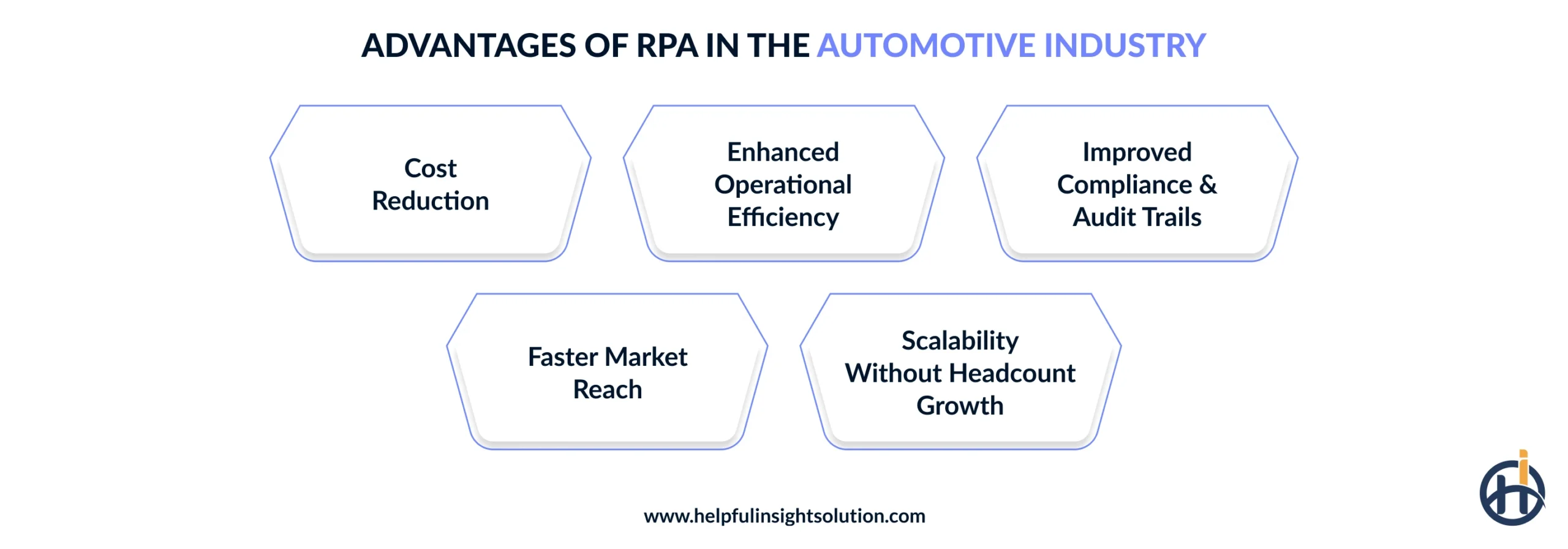
We’ll explore all these advantages in this section to help businesses see why it’s worth investing in this domain.
1. Cost reduction
RPA automates high-volume tasks, which reduces labor expenses, data-entry errors, and complexities in standard regulations. It prevents rework on backend tasks, like invoice processing or billing, and streamlines automotive workflows.
2. Enhanced operational efficiency
The software bots operate 24/7, which boosts supply chain tracking and reduces order processing time from hours to minutes. The integration of RPA for automotive manufacturing improves financial operations and customer satisfaction.
3. Improved compliance & audit trails
The enforcement of business rules and immutable activity logs is one of the top benefits of RPA that ensures transparency and data centralization. Bots can eliminate mistakes, run background checks, track unauthorized access, and review datasets to verify transactions.
4. Faster market reach
Robotic process automation minimizes supply chain timelines to fasten prototyping, system coordination, and order processing. This supports innovation, enhances decision-making, and helps businesses in detecting system errors through the distribution cycle.
5. Scalability without headcount growth
RPA bots scale various operations to manage fluctuating demands and process surges in warranty claims, supply chain logistics, or seasonal orders.
They focus on product optimization and quality control that lowers administrative overhead and fatigue.
Steps to Build RPA-Driven Automotive Solutions
Here we will study how to implement RPA technology in automotive through the following process. It discusses important development stages, from planning to deployment and monitoring, with detailed information.
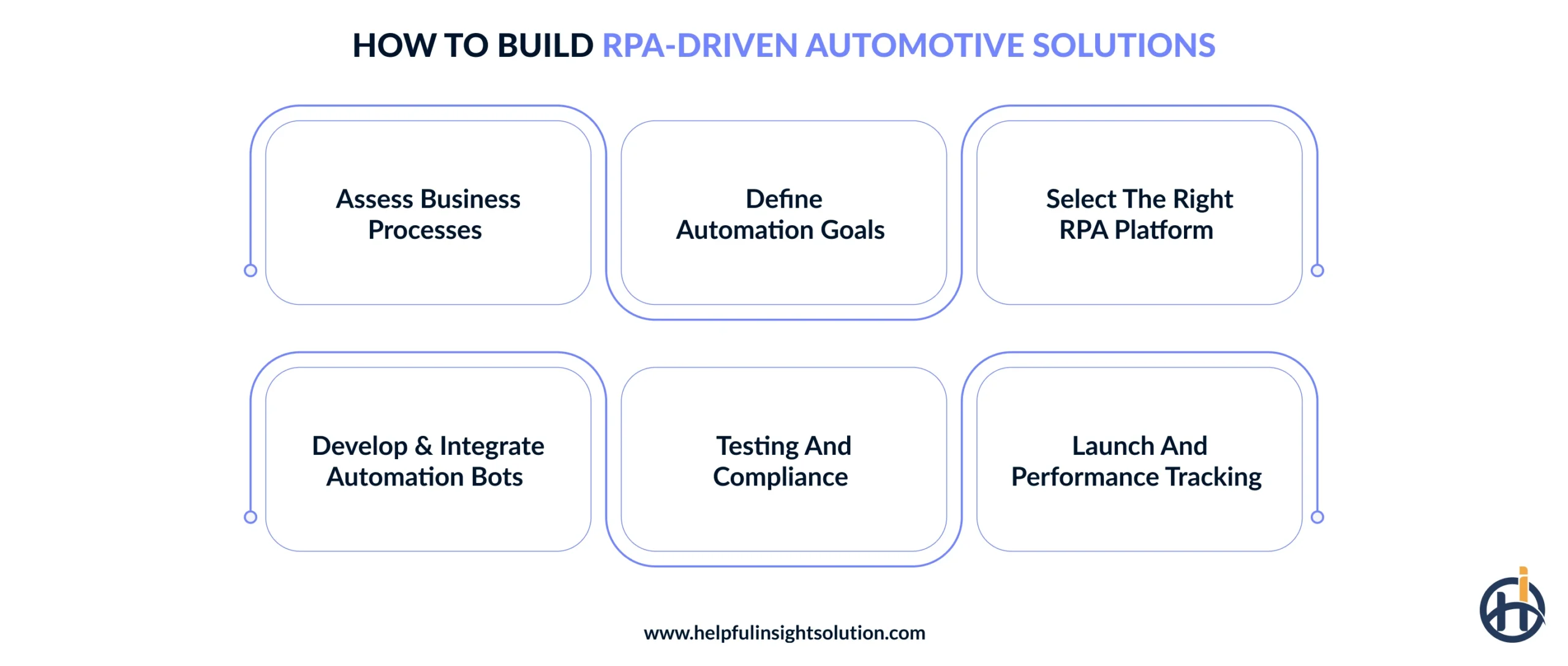
1. Assess business processes
You should begin by looking at repetitive tasks and workflows across manufacturing, supply chain, inventory, finance, and customer service.
Check for bottleneck tasks that often have errors and processes that depend on each other to see where automation can add value.
A thorough examination of the process sets a base for automation to work well.
2. Define automation goals
Set goals like cutting operational costs, making production more efficient, reducing manual mistakes, or speeding up workflows. Use targets such as processing time, accuracy, productivity, and return on investment to judge how well automation works.
Having goals makes sure the automation aligns with the company’s overall plans.
3. Select the right RPA platform
It is crucial to select robotic process automation services that work with AI, connect to ERP systems, and can be deployed in the cloud.
They enhance automotive operations and look for features like development, security, analytics, and compatibility with current manufacturing systems.
The right platform allows for automation and makes future expansion simpler.
4. Develop & integrate automation bots
Businesses must create automation bots that can do tasks like processing invoices, updating inventory, scheduling production, and making quality reports.
These bots can work with systems like ERP, CRM, MES, and supply chain management software to share data easily. With automotive ERP RPA integration, you can automate the workflow and make it work efficiently.
5. Testing and compliance
You can test these automation bots well to make sure they work correctly in different situations and when they have a lot of work to do.
It is necessary to follow all the industry rules, regulations, quality standards, and security needs. Businesses can avoid multiple problems when they put the bots to work and make sure they are reliable.
6. Launch and performance tracking
Now it is easy to launch the RPA solution and keep an eye on its performance by using real-time analytics and dashboards.
You must watch the processing speed, accuracy, downtime, and cost-saving capability of bots. It is crucial to update bots so they can do tasks such as invoice processing, inventory updates, production scheduling, and quality reporting.
Major RPA integration challenges for the automotive industry
Data security, legacy system integration, and synchronization are the major RPA challenges in the automotive industry.
We will explore these crucial issues with their respective solutions in this section to ensure seamless development.
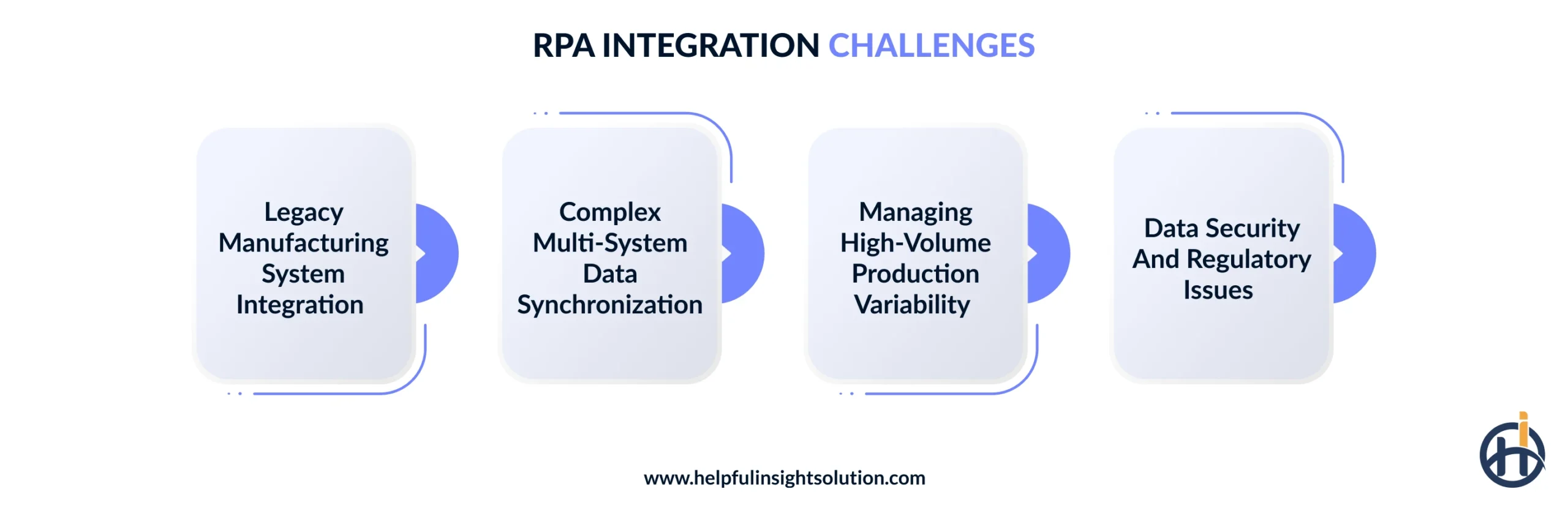
1. Legacy manufacturing system integration
The integration of RPA in legacy systems, like ERP, WMS, and MES, is complex due to outdated architecture. Fragile UI, screen scraping, and a lack of modern APIs increase the difficulty of connecting automotive systems.
Solution: The use of RPA surface automation and process discovery tools helps to automate data mapping and normalization for faster data transfer.
2. Complex multi-system data synchronization
Fragmented infrastructure and distributed information can cause data mismatch, high bot maintenance, and operational downtime. Batch processing creates backlogs during the execution of data, such as inventory levels and price changes.
Solution: It is beneficial to implement robust middleware platforms and centralized data protocols across dealer networks to ensure communication.
3. Managing high-volume production variability
The processing of massive data while handling assembly schedules and supply chain constraints is a crucial challenge. These include rigid bot logic, complex data inconsistencies, system sprawl, and frequent exceptions.
Solution: For automotive process automation, you can implement AI/ML tools that monitor bot performance and ensure system troubleshooting.
4. Data security and regulatory issues
The challenge is the movement of automotive data, like supplier invoices, across IT domains without encryption. Also, an unauthorized user can compromise login credentials and get unlimited network access.
Solution: Businesses can utilize centralized enterprise credential vaults, assign unique identifiers, and establish governance frameworks.
Future RPA Trends in the Automotive Industry
A business investor must know various future trends of RPA in automotive, which include smart factories, AI-driven manufacturing, and more.
Here you are going to understand the top RPA trends and explore their future projections.
1. AI-powered autonomous manufacturing
Autonomous manufacturing allows robots and systems to make decisions during production without involving people.
The use of AI in the automotive industry reduces the time when machines are not working and improves quality products because it can predict things smartly.
2. Digital twin-driven process automation
Digital twins are like copies of the machines and equipment used in manufacturing. This lets companies optimize and make their automated processes better before they actually start using them. It reduces the risks of things going wrong and helps them make changes to their processes faster.
3. Connected smart factory automation
Smart factories will connect systems that automate tasks with IoT devices, artificial intelligence, and cloud platforms. This will let machines, systems and departments talk to each other automatically.
It will enhance real-time monitoring, predict when maintenance is needed, and make production very efficient.
4. Autonomous supply chain orchestration
RPA connects with AI to manage things like inventory, buying supplies, logistics, and working with supplier onboarding automation across the whole network.
This smart management improves predicting what people will want, reduces delays, and creates supply networks that can fix themselves.

Partner with Helpful Insight to create successful RPA-enabled automotive platforms
We have studied how RPA in the automotive sector is enhancing the supply chain, reducing manual workload, and increasing efficiency through various use cases.
Now, it’s time for businesses to approach an AI development company that can understand business requirements and implement RPA models accordingly.
We help investors to analyze system compatibility with modern bots and make changes to enhance supply chain efficiency, defect detection, and quality control.
Our experts have access to the best robotic process automation platforms that deliver affordable integration tools.
Businesses can implement RPA for quality assurance, predictive maintenance, and automated invoicing, ensuring a smooth customer experience. This helps them to boost the enterprise economy, retain the maximum audience, and increase brand value.
It is always beneficial for investors to adopt advanced technologies and build smarter solutions.
FAQs
For a single-process deployment, the time to integrate RPA in automotive platforms ranges from 2 months to 3 months. The overall timeline may increase to 5 months or more due to enterprise-grade solutions and system requirements. Software design, testing, and maintenance are the key factors that influence the duration of platform integration.
The cost of implementing RPA ranges from $10,000 to $30,000 for a single-bot pilot project that handles simple customer queries. The total cost increases to $200,000 based on multi-process deployments for mid-sized to large enterprises. At massive scale, the price can reach up to $400,000 due to enhanced ERP and legacy supply chain support.
RPA is non-invasive and can easily operate at the user interface level to replicate human actions like product searching and booking. It does not require complex back-end APIs to connect older ERP systems with modern cloud-based CRMs. Bots can easily extract information from the legacy systems and validate it with the supply chain software.
The RPA platforms depend on the existing tech stack and specific automation goals, such as dealer management. Some of the best RPA tools for automotive companies are described in the following manner:
- UiPath: It is suitable for large-scale enterprise automation and offers robust process mining.
- Power Automate: This Microsoft 365 ecosystem provides integration and built-in AI capabilities.
- Blue Prism: This platform provides security-first environments with governance and audit trails.
RPA automates data collection, object inspection, and alert generation to enhance automotive quality control. This improves system analysis, fastens data entry, and ensures compliance.
- Defect tracking: Bots compare data from assembly line sensors and inspection cameras to prevent large defects.
- Recall management: RPA can cross-verify Vehicle Identification Numbers (VINs) to identify affected vehicles.
- Supplier audits: Bots can evaluate quality defect rates and inspection documents from various suppliers.
Unattended RPA allows bots to operate without human supervision and to easily run on virtual machines to execute routine, rule-based tasks. They can handle various backend processes, such as invoice landing and generating financial reports, as per queries. Bots can also work with attended RPA to provide a hybrid system where manual decisions are required.