


Key takeaways:
- The benefits of RPA cover cost reduction, accuracy improvement, round the clock operations, scalability, compliance, and smarter decision making across every business function.
- Companies already running RPA estimate that bots could take on 52% of their total work capacity, more than half the workload, redirected away from human hands.
- Unstructured data, system update fragility, and cognitive decision making are limitations of RPA that require honest assessment before committing to automation.
- Most RPA business cases underestimate total investment by focusing only on software licensing, leaving out hidden recurring costs that significantly impact the accuracy of long-term ROI projections.
- Banking, insurance, healthcare, retail, and manufacturing see the strongest RPA returns because they combine high transaction volumes with strict compliance requirements and legacy systems.
Nearly every organization has work that runs on autopilot. Emails that trigger the same response, reports pulled from the same systems, invoices processed the same way they were three years ago. The volume is high. The logic is fixed. And yet it still consumes hours of skilled employee time. The benefits of RPA begin here, turning wasted human potential on predictable work into cost savings, accuracy improvements, and operations that run around the clock.
RPA deploys software robots to handle rule-based digital tasks like data extraction, system updates, and data entry, across existing infrastructure, without replacing the systems already in place. The business case is already being proven at scale. According to a Market.us report, organizations that have adopted RPA believe software bots could handle as much as 52% of their total work capacity.
That is not a marginal efficiency gain, that is half the workload shifted away from human hands, freeing your best people for decisions, strategy, and work that actually moves the business forward.
If you are evaluating RPA but unsure whether the investment justifies itself, this blog gives you an honest, complete look at every benefit of robotic process automation and everything else you need to make that decision confidently.
So, let’s get started.
Core benefits of robotic process automation that drive business growth
The RPA benefits businesses experience go far beyond cutting costs. Improved accuracy, faster processing times, and the ability to scale operations without adding headcount are just the beginning.
How deep the impact runs depends on how well RPA implementation is planned and which processes are prioritized first. The right choices here separate companies that see real transformation from those that see marginal improvement.
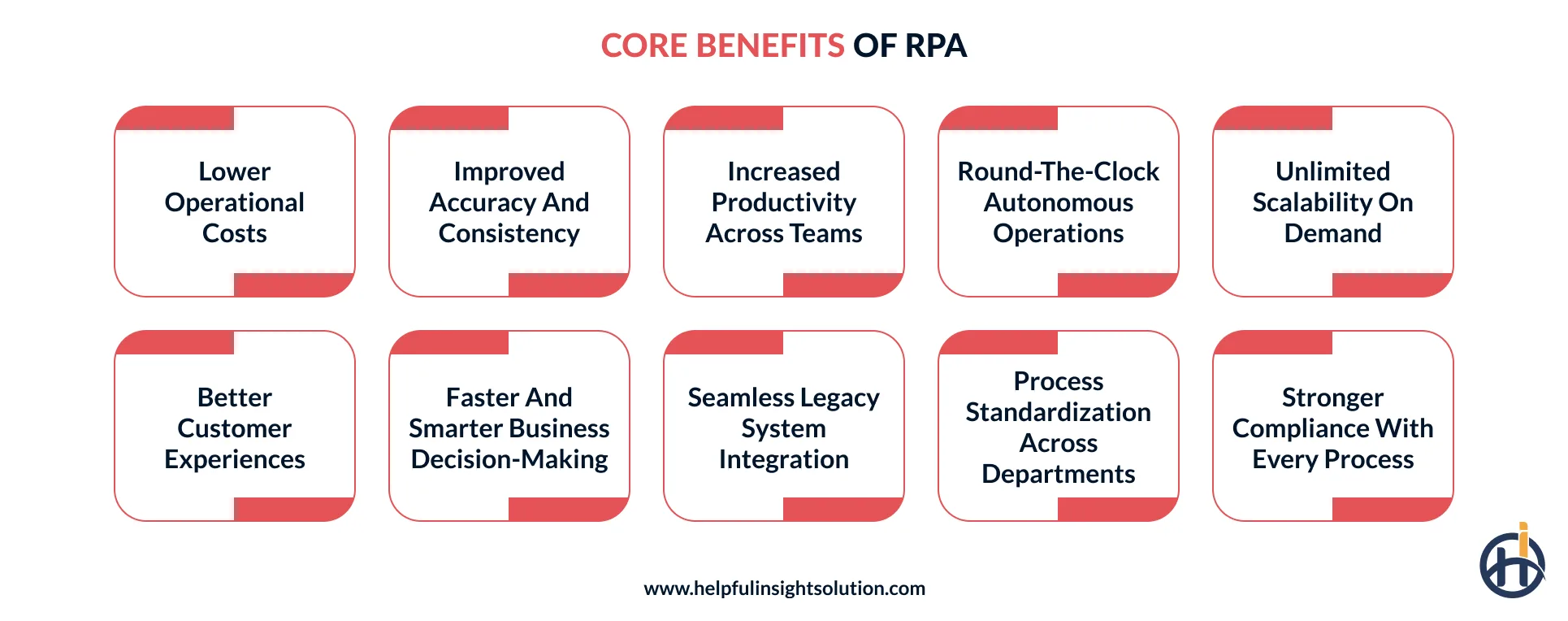
1. Lower operational costs
Operational costs are one of the biggest reasons businesses explore automation. Software robots take over high-volume clerical work without overtime, benefits, or downtime and they do it faster. But the real shift happens in where that money goes next.
Enterprises automating their most demanding manual tasks have redirected up to 50-60% of labor-related costs straight into core operations. That reallocation changes the financial trajectory of a business, turning ROI from something measured in years into something visible within months.
2. Improved accuracy and consistency
At high volumes, even a 1% human error rate creates thousands of mistakes, each one carrying rework costs and customer impact. RPA in finance shows this most clearly, bots extract figures, cross-reference purchase orders, and flag discrepancies before they reach accounts payable, eliminating the manual checking that high-volume financial workflows demand.
Unlike humans, bots do not lose focus after hour six of data processing. They execute the same logic the same way every time, turning what was an ongoing error management problem into a non-issue.
3. Increased productivity across teams
The biggest productivity drain in most organizations is not complexity, it is volume of predictable, repeatable work. When skilled teams spend their day moving data between systems or generating the same reports, higher value work gets pushed aside. Workflow automation shifts that balance. Teams get their time back, backlogs shrink, and output increases without anyone working longer hours.
Uber saw this firsthand, automating invoice processing reduced average handling time by 70%, freeing their finance team for more strategic priorities.
4. Round-the-clock autonomous operations
One of the most operationally significant benefits of RPA is that work does not stop when your team logs off. RPA systems process data, run batch updates, and track inventory 24/7 without supervision.
By the time staff arrive in the morning, overnight tasks are already complete and systems are current, no delays and backlog waiting. If your business runs across time zones, your teams in different regions are never waiting on each other to move work forward.
5. Unlimited scalability on demand
Most operations hit a ceiling during peak periods because adding capacity means adding people, who take time to hire and train. RPA removes that dependency entirely. More bots can be deployed quickly when volumes increase and scaled back just as easily when they drop.
The result is an operation that grows with demand rather than struggling against it, without the headcount costs that traditional scaling carries.
6. Better customer experiences
Robotic process automation improves customer experience by automatically routing support tickets, processing claims, updating order statuses, and pulling customer data across systems without manual intervention. Customers never see that running behind their experience. They just notice that things work faster, errors stop happening, and their issues get resolved without being passed around.
The benefits of using RPA are felt directly by the end customer, even though the automation runs entirely behind the scenes.

7. Faster and smarter business decision-making
RPA systems strengthen decision-making from the ground up, starting with the data then pulling it accurately, structuring it, and delivering it without the delays. When reports generate automatically, leadership stops questioning the data and starts acting on it. Companies pairing AI development services with RPA get something extra, the ability to catch patterns and flag issues in data that no one would have thought to look for manually.
8. Seamless legacy system integration
Replacing legacy systems is expensive, disruptive and not always necessary. One of the most practical benefits of robotic process automation is that it works on top of existing infrastructure rather than replacing it.
Bots interact with legacy software the same way a human would like clicking and extracting without requiring API builds or custom integrations. Systems that would otherwise need costly overhauls continue running exactly as they are, just with automation handling the repetitive work.
9. Process standardization across departments
Most operational inefficiencies come from the same task being done six different ways across departments. A hidden RPA advantage is that implementation forces organizations to map and clean their workflows before automation begins. Bots follow uniform logic without exception, which means inconsistent processes have to be standardized first.
The byproduct is an organization that runs on predictable, auditable workflows rather than individual habits and workarounds.
10. Stronger compliance with every process
Compliance failures happen because manual processes depend on people remembering rules consistently under pressure. RPA in healthcare, financial services, and insurance removes that dependency entirely, building stronger compliance into every process by default.
Each automated step leaves a timestamped record without anyone having to think about it. When an audit comes, the trail is already there, complete, accurate, and not dependent on how thoroughly someone documented their work on any given day.
Industries where RPA delivers real benefits
RPA delivers real benefits across industries, but where those gains hit hardest depends on the volume of rule-based work, the cost of process errors, and how much regulatory pressure the industry operates under. The higher those three factors, the faster and more measurably RPA benefits compound.
The industries covered below sit at that intersection, which is exactly why automation adoption within them has moved faster than anywhere else.
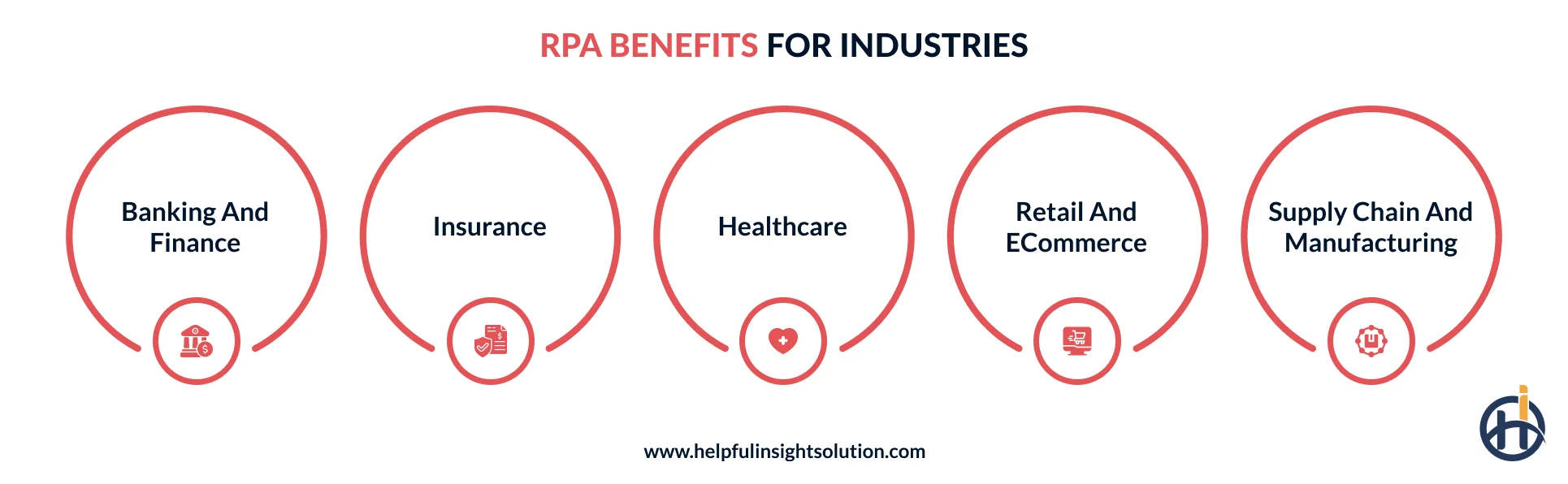
1. Banking and Finance
Few industries carry the combined pressure of high transaction volumes, strict regulatory requirements, and zero tolerance for processing errors. The benefits of RPA implementation in banking are felt across the entire operation in form of faster cycle times, cleaner compliance records, and back-office teams no longer buried in manual checking.
Key use cases
- Customer onboarding
- Fraud detection
- Loan processing
- KYC and AML compliance checks
2. Insurance
No industry handles more structured, rule-based paperwork than insurance. The benefits of RPA in insurance show up directly in claims processing, where automating data extraction and validation has reduced workflow time by as much as 75% for organizations that have implemented it correctly. Faster claims mean lower operational costs and significantly better customer retention.
Key use cases
- Policy administration
- Customer onboarding
- First notice of loss (FNOL) processing
- Regulatory compliance reporting
3. Healthcare
Healthcare organizations spend nearly as much time managing administrative processes as delivering care and the cost of getting those processes wrong falls on both the organization and the patient. The RPA advantages in this sector are felt across billing accuracy, scheduling efficiency, and cutting the administrative overhead.
Key use cases
- Patient scheduling and appointment management
- Revenue cycle management
- Clinical trial data collection
- Revenue cycle management
4. Retail and eCommerce
Retail sector operate on margins where speed and accuracy are not optional. Inventory that does not update in real time and orders that sit unprocessed all create customer experience problems that compound fast.
RPA in eCommerce and retail addresses these pressure points directly by keeping stock data current across platforms and handling returns processing without the delays that manual workflows introduce.
Key use cases
- Inventory tracking and updates
- Order processing and fulfillment
- Price monitoring and updates
- Customer data management
5. Supply chain and manufacturing
Supply chain and manufacturing run on precision, a single process failure upstream creates delays that ripple through every stage that follows. The benefits of RPA in manufacturing are felt across supplier coordination, inventory tracking, and procurement processing. It keeps production schedules intact and reduces back-office errors.
Key use cases
- Purchase order generation and processing
- Supplier invoice reconciliation
- Shipment tracking and status updates
- Quality control documentation
Read Also:- Top RPA Use Cases Across Industries With Real-Life Examples
What are the limitations of RPA?
RPA is powerful, but it has boundaries every organization should understand before investing. The technology does not adapt on its own when underlying systems change or exceptions appear, bots stop working as expected. Getting RPA adoption right means knowing these limitations before deployment, not after.
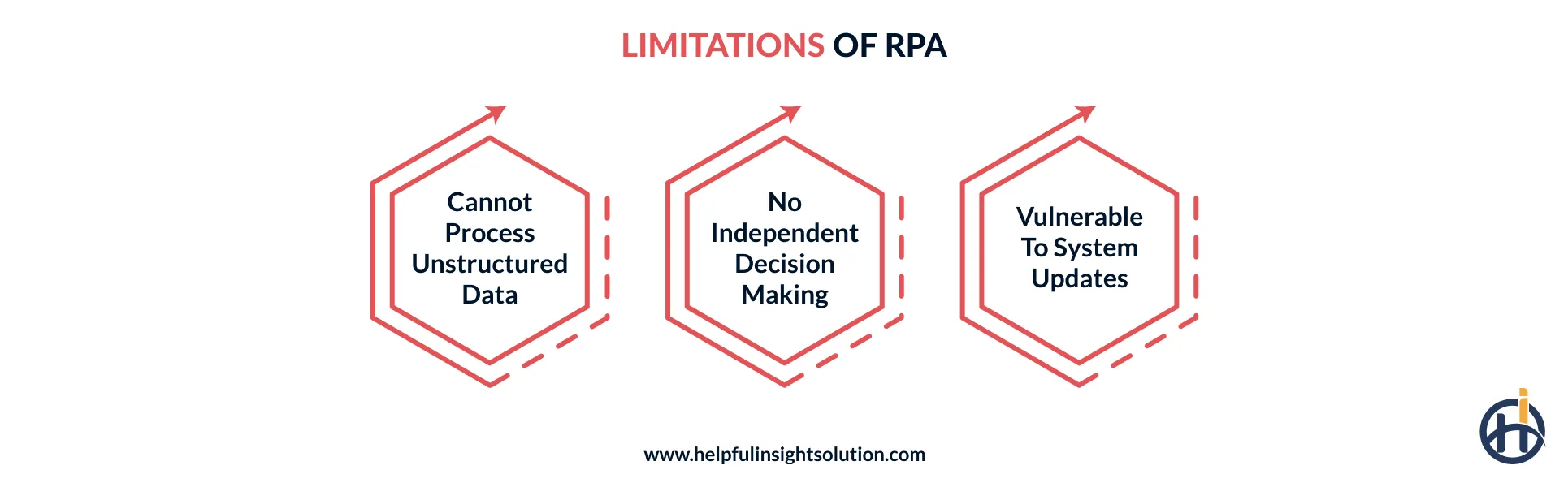
1. Cannot process unstructured data
Structure is not always guaranteed in real business data. Emails arrive in different formats, PDFs vary by sender, and contracts don’t always follow identical templates. RPA has no way to interpret that variability. Adding machine learning is the only way to bridge that gap, standalone RPA simply was not built for it.
2. No independent decision making
RPA solutions follows instructions precisely but cannot think beyond them. When an invoice arrives with a missing field or a form changes its layout, the bot stops. Every scenario outside its programmed rules requires a human to step in and resolve it manually.
3. Vulnerable to system updates
A routine software update that takes an IT team minutes to deploy can take significantly longer to fix across every affected bot. RPA bots interact through the visual interface rather than deep system integrations. Minor interface changes silently corrupt automated workflows, and the only way back is manual reprogramming.
How to calculate the ROI of your RPA investment?
Most RPA ROI calculations stop at labor savings. That’s the easiest number to find, but it is far from the most significant one. The real return shows up across reduced error costs, faster processing cycles, compliance savings, and the downstream impact of decisions made on cleaner data. To build an accurate picture, each category needs its own measurement approach.
Here is how to calculate RPA ROI:
1. Baseline your current process cost
Start with what automation will replace. Document the number of employees on the process, time spent per task, hourly labor costs, and current error rates. Without this foundation, ROI figures have nothing accurate to stand against.
2. Total investment and ownership cost
Robotic process automation investment goes beyond the initial license fee. Every cost category below needs to be accounted for before any ROI projection can be considered realistic:
- Software licensing
- Infrastructure and hardware setup
- Internal development and testing
- Ongoing maintenance and upgrades
3. Hard savings vs soft savings
Separate your savings into two categories before running any calculation. Hard savings cover direct reductions like labor costs, error correction expenses, and overtime. Soft savings cover indirect gains like improved compliance and employee retention. Among the advantages of robotic process automation, soft savings are consistently the most underreported in ROI calculations.
4. Apply the ROI formula
Once savings are totaled, apply the standard formula to determine your return:
Total Annual Benefits – Total Investment Cost
RPA ROI = _______________________________________ × 100
Total Investment Cost
A positive percentage confirms the investment delivers measurable return. The higher the figure, the faster confidence builds internally for scaling automation further.
5. Calculate your payback period
Payback period tells you exactly when automation stops costing and starts paying. Calculate it using:
Payback Period = Total Investment Cost ÷ Monthly Net Savings
Most well-scoped RPA implementations recover their investment within 6 to 12 months, anything beyond 18 months signals the wrong processes were automated first.
6. Reassess after going live
Initial ROI projections are estimates. Real production numbers like actual processing speeds, error rates, and maintenance costs do not always match pre-deployment estimates exactly. Reassess quarterly, update your inputs, and recalculate. The most accurate return on investment only emerges after the automation program has had time to stabilize.

Conclusion
Automation adoption has crossed the tipping point. RPA is no longer something businesses explore, it is something they depend on. Enterprises running on automation today are operating in a fundamentally different way than those still dependent on manual processes, responding faster and making smarter data-driven decisions.
The top RPA benefits covered in this blog, from cost reduction and accuracy gains to compliance consistency, are not theoretical. Businesses across industries are already experiencing them firsthand. What determines whether your organization sees the same results comes down to implementation quality, process selection, and having the right partner.
Helpful Insight is an industry-leading robotic process automation company with over a decade of experience delivering automation programs across industries. Getting RPA right comes down to automating the right processes with the right approach. We help organizations do exactly that, turning automation potential into measurable business results.
If your organization is ready to take that step, our team is ready to make sure yours is one of them.
FAQs
RPA is important because it handles rule-based, repetitive work that consumes skilled employee time without adding business value. The impact goes beyond labor savings, it reduces processing errors, accelerates cycle times, and connects systems that previously required expensive backend integration to communicate.
RPA implementation brings down costs, speeds up processing, and cuts errors that manual work consistently produces. Staff move away from repetitive tasks toward work that actually needs their attention, all without existing infrastructure overhaul.
Yes, RPA is worth it for small businesses. Lower transaction volumes mean faster implementation and quicker returns. Automating invoice processing, data entry, and reporting reduces overhead without adding staff, making it easier to scale without proportional cost increases.
For well-chosen processes, 6 to 9 months is a realistic payback window. Pick the wrong processes and that timeline stretches. Implementation quality and process selection matter more than the technology itself when it comes to how fast returns arrive.
Not in the way most people assume. RPA takes over rule-based tasks, the work that consumes time without requiring genuine human capability. What it actually replaces is the portion of human’s day that was never a good use of their skills.