


Key Takeaways
- The top RPA use cases range from fraud detection in banking and claims settlement in insurance to price monitoring in retail and network incident management in telecom.
- Robotic process automation uses software bots to mimic human interactions with digital systems that execute repetitive tasks with consistent speed and accuracy.
- 53% of organizations have already deployed RPA, with another 19% planning deployment within two years.
- AI-powered RPA combines machine learning and automation to handle unstructured data and complex decisions that rule-based bots cannot process independently.
- Not every process qualifies for RPA implementation; the strongest ones are high-volume, rule-based workflows that follow consistent logic with minimal exceptions and clear measurable outputs.
In most organizations across different industries, a significant portion of daily work is entirely predictable. Log into systems, copy data from one platform to another and generate reports. That gap between what employees do and what they could be doing is where the most impactful RPA use cases begin.
Robotic process automation simply means deploying software robots to handle rule-based, high-volume digital tasks that manual processes were never efficient at handling to begin with. Unlike traditional automation, it works across existing systems without complex integrations, making RPA implementation far more accessible than most organizations expect.
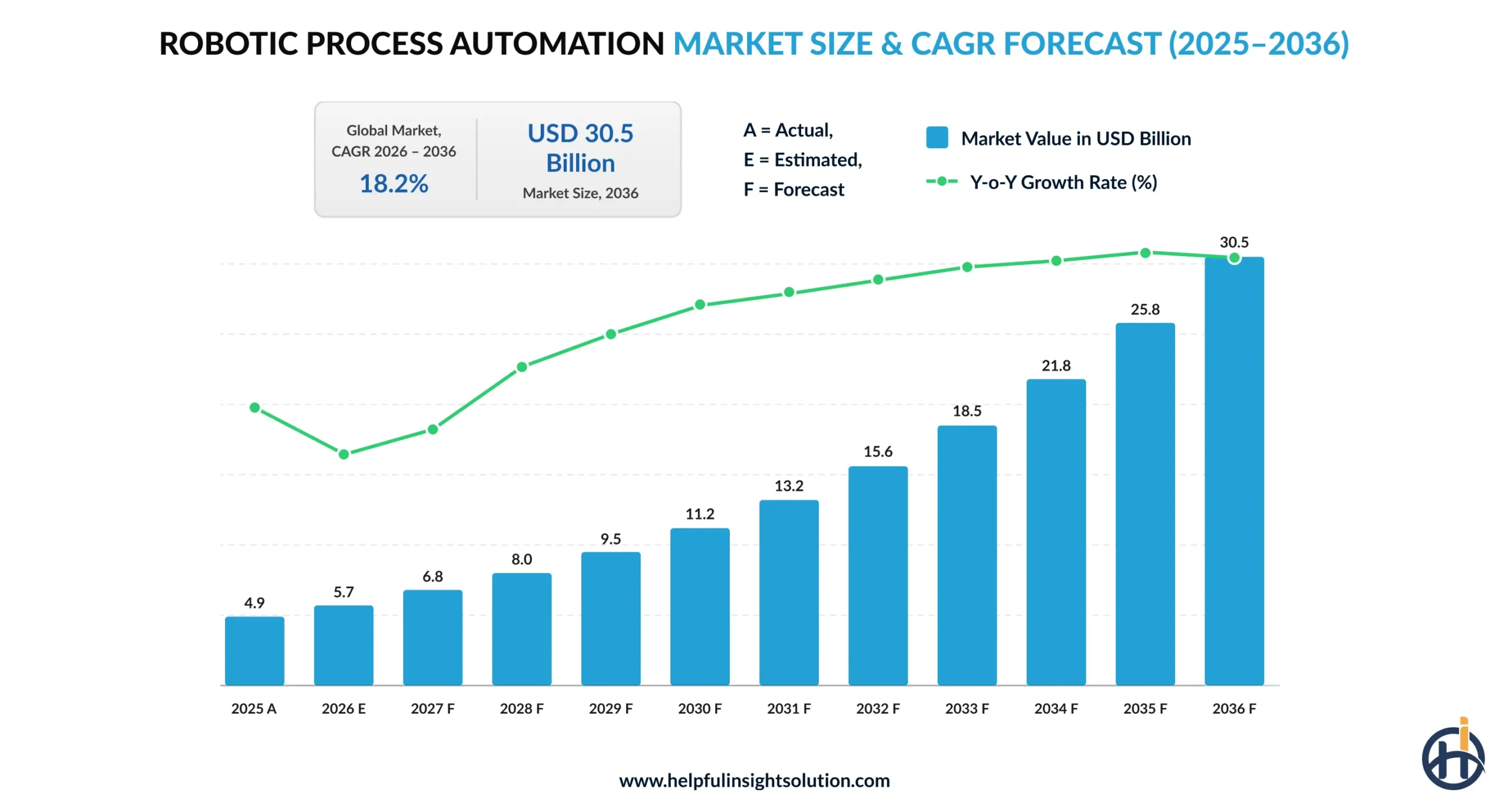
The numbers reflect that. The global RPA solutions market is projected to reach $30.5 billion by 2036, and according to the Market.us report, 53% of organizations have already begun deploying RPA bots. Adoption is no longer concentrated in large enterprises; it is moving across mid-market organizations and spanning every major industry vertical.
Whether you are evaluating intelligent automation for the first time or scaling an existing business process, this blog covers the best RPA use cases delivering the most measurable impact.
Key benefits of RPA implementation
There are many benefits of implementing RPA, from reduced costs, lower manual effort and fewer processing errors to stronger compliance. For most businesses, the operational shift becomes visible within the first few months of RPA implementation.
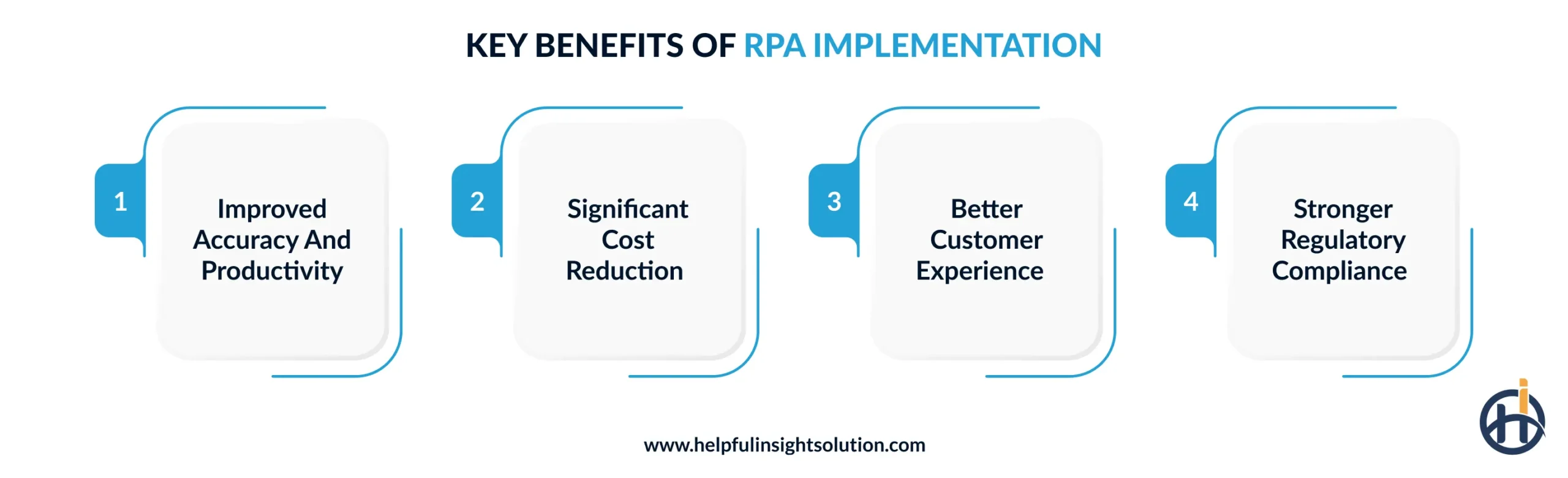
1. Improved accuracy and productivity
High-volume manual processing does not just slow teams down; it introduces errors that cost significantly more to correct than to prevent. RPA bots maintain identical accuracy whether processing ten transactions or ten thousand, with no degradation in output quality.
Teams are no longer stretched across repetitive work, which means their time and capacity go toward responsibilities that carry more operational weight.
2. Significant cost reduction
Repetitive back-office work carries a real cost in salaries, processing time, and error correction. As per Deloitte, the average cost reduction from intelligent automation adoption is 31%. This shows what happens when rule-based tasks stop consuming skilled employees’ hours.
RPA solutions don’t just reduce operational expenses; they redirect that spend toward functions that actually drive business growth.
3. Better customer experience
Poor customer experience rarely starts at the front end. It starts in the back office, slow order processing, data mismatches, queries that take too long to resolve. Workflow automation addresses those gaps by accelerating processing times, maintaining data integrity and ensuring consistent service delivery across every customer interaction.
4. Stronger regulatory compliance
Keeping up with regulatory requirements across multiple processes is operationally demanding. RPA solutions handle compliance-driven tasks like report preparation, policy verification, and requirement monitoring with precision. Nothing gets missed, nothing gets interpreted differently by different team members. It gives compliance teams a complete, accurate audit trail without additional manual effort.
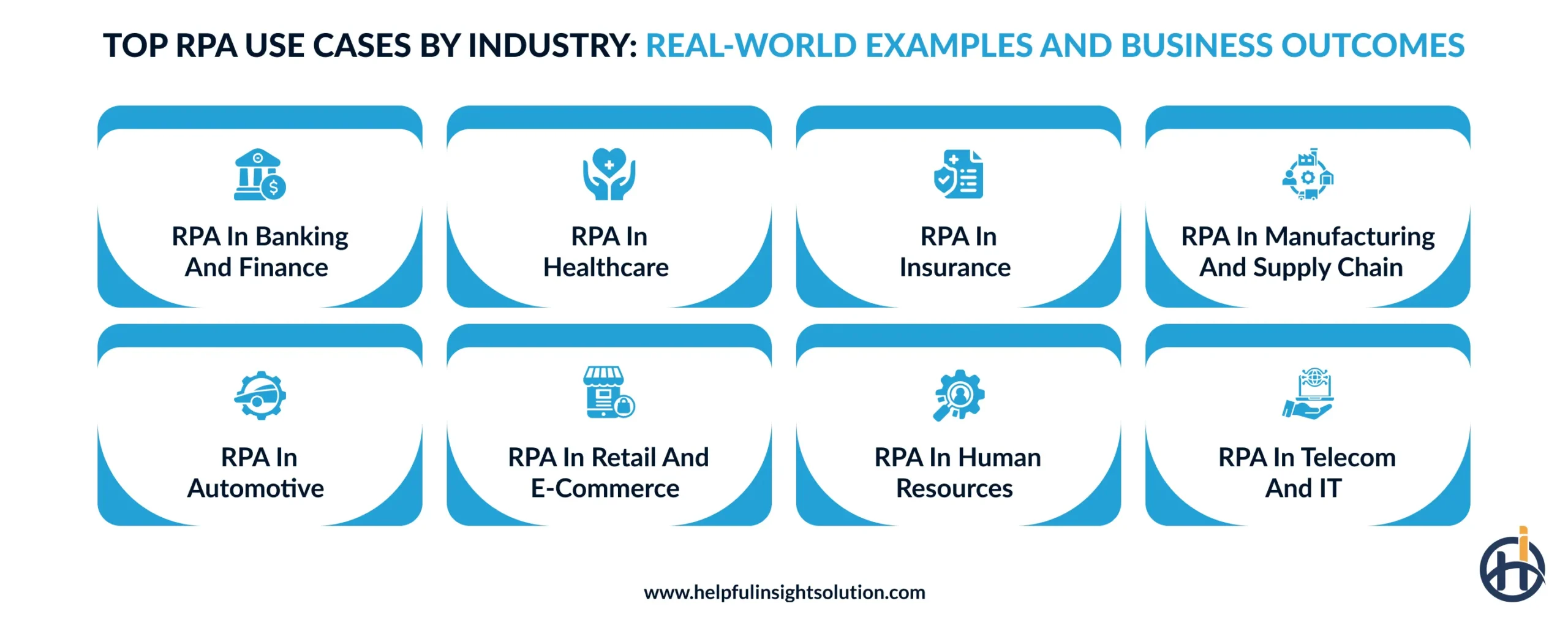
Top RPA use cases by industry: real-world examples and business outcomes
RPA use cases are actively reshaping how organizations handle their most operationally demanding processes. From reducing claims processing time in insurance to eliminating manual reconciliation in banking, deployment outcomes are measurable and consistent across sectors.
In this section, we will explore the best robotic process automation use cases.
1. RPA in banking and finance
From fraud detection to loan processing, the use cases of RPA in the banking sector help automate the high-volume, compliance-driven workflows that traditional manual processes struggle to handle accurately and at scale.
KYC and customer onboarding
For banks processing thousands of new accounts weekly, manual KYC verification is a difficult task. RPA tools extract customer data, validate identity documents and run AML checks across multiple systems simultaneously without human intervention.
Bank of America is a great example of this as they deployed intelligent automation across this workflow, reducing onboarding time significantly.
Fraud detection and monitoring
Transaction fraud is rarely caught through manual monitoring. RPA in finance enables continuous, real-time surveillance across transaction histories and login activity, automatically flagging suspicious behavior the moment it deviates from established risk thresholds.
Security researchers note that a compromised process at this scale can affect 1M+ customer records before any traditional detection method responds.
Loan and mortgage processing
Mortgage processing involves dozens of document types, multiple verification systems and strict compliance checkpoints. AI-powered RPA automates data extraction from applications, pays tax returns, validates them against core banking systems, then routes completed files for decision without manual handoffs.
2. RPA in healthcare
Healthcare organizations deal with some of the highest administrative workloads across any sector. These RPA in healthcare use cases show where automation is reducing that burden most effectively.
Patient data management and EHR updates
Managing patient data across disconnected hospital systems is one of healthcare’s most time-consuming administrative burdens. RPA systems sync lab results, demographics and clinical notes directly into EHR systems without manual entry.
Boston Scientific, which is a biotechnology medical engineering firm, deployed this exact approach to manage cardiac device patient data. Bots updated records and triggered clinical alerts automatically
Claims processing and billing automation
Billing errors and claim denials put direct pressure on revenue cycles and manual review at scale simply cannot catch every mismatch. Intelligent bots handle eligibility verification, claim submission and error detection, processing each case against payer requirements without oversight gaps. Reimbursement cycles that previously took days are processed in hours, with less back-office correction work.
Appointment scheduling and patient onboarding
Most delays in scheduling a doctor’s appointment come from manual coordination between availability, insurance verification and patient intake. Bots move through that sequence without dropping steps or creating gaps. Confirmations go out automatically, records update in real time and staff attention shifts to patients rather than administrative follow-up.
3. RPA in insurance
There are so many applications of RPA in insurance from claims processing, fraud detection to policy renewals, helping in overall workflow automation.
Automated claims assessment and settlement
In insurance, claims assessment involves multiple verification steps like policy coverage checks, adjuster routing and fraud screening. Each handled manually adds hours to a process that policyholders are already watching closely. Robotic process automation moves through that entire sequence automatically, cutting processing time from 72 hours to under 5 minutes with 99% accuracy.
Policy administration and renewals
Policy administration runs on repetitive, high-volume transactions which cover record updates, cancellations, premium recalculations and renewal notices that consume significant staff time without adding analytical value. Autonomous agents aggregate policyholder data, track expiration dates and dispatch personalized renewal notices.
As a result, coverage lapses drop, renewal cycles accelerate and administration teams shift their attention to cases that genuinely require human judgment.
Underwriting and risk assessment
Underwriting decisions depend on data quality and gathering that data manually slows down the entire process. Bots pull applicant information from internal databases and third-party sources like credit scores and motor vehicle records, standardizing everything into unified profiles.
For example, Encova Insurance deployed automation to eliminate application backlogs, allowing underwriters to focus exclusively on complex risk evaluations.
4. RPA in manufacturing and supply chain
Manufacturing teams have to deal with enormous volumes of repetitive, data-heavy tasks across production, quality and compliance. Top RPA use cases in manufacturing show where automation is eliminating inefficiencies and delivering measurable operational gains.
Production planning and scheduling
When demand shifts mid-cycle, manually updating production schedules across ERP systems and supplier portals creates delays. RPA solutions handle that continuously from forecasts, inventory records and machine capacity data to keep schedules current.
One of the best real-life examples of this application is Whirlpool. They applied RPA across their operation to align supplier deliveries with internal timelines and eliminate the planning gaps.
Quality control and defect reporting
Quality checks across high-volume production lines cannot rely on periodic manual inspection. RPA consolidates data from sensors, machine parameters and inspection records continuously, identifying deviations against predefined specifications in real time. When anomalies are detected, defect reports are generated automatically, and supervisors are alerted.
Equipment maintenance and downtime tracking
Most equipment failures do not happen without warning, but the signals are there in performance metrics. ML-enhanced RPA continuously tracks machine performance, generating service tickets and updating enterprise systems the moment readings deviate from acceptable ranges. Maintenance teams are notified without delays and production schedules stay intact.
5. RPA in automotive
Robotic process automation use cases in the automotive sector cover dealer invoice processing, claims processing to vehicle recall management, assisting in reducing processing time and operational overhead effectively.
Invoice processing
Automotive dealers generate thousands of vendor invoices weekly, each requiring verification against purchase orders and receipts before payment approval. RPA technology extracts invoice data using OCR, and posts approved payments directly into ERP systems.
AI-powered business process automation takes that further by identifying invoice anomalies and payment patterns that rule-based matching alone would miss.
Vehicle order management and tracking
Managing vehicle orders manually across dealer portals and supply chain systems creates status gaps. With RPA, you get order details, update inventory records and trigger purchase orders automatically based on real-time stock levels. Transit gets tracked without manual follow-up and dealers receive delivery estimates.
After-sales service and repair scheduling
Service scheduling across large dealer networks involves retrieving vehicle histories, checking warranty coverage, confirming technician availability and sending appointment reminders. Robotic process automation takes over each of those steps
For example, Ford deployed RPA bots across its dealer network to send automated maintenance reminders.
6. RPA in retail and e-commerce
High order volumes, competitive pricing pressure and stock accuracy demands make retail one of the most automation-ready sectors. These RPA in e-commerce and retail use cases show where businesses are seeing the most impact.
Order Processing and Returns Management
Every delayed order and slow return creates a customer experience problem that is difficult to recover from. Workflow automation through RPA analyzes incoming orders, validates customer information and updates records simultaneously. When returns come in, bots verify purchase history, approve eligible items and issue refunds.
Price monitoring
E-commerce pricing does not stay fixed, competitor rates shift across marketplaces multiple times daily. RPA crawls competitor websites and online marketplaces around the clock, detecting rate changes and updating product prices automatically based on preset rules. Walmart uses this across its online stores to stay competitively priced at all times.
Inventory management
Retailers managing stock across multiple locations cannot rely on manual checks to maintain accurate inventory levels. AI-powered RPA tracks stock across systems, detecting shortfalls before they affect availability. Therefore, stockouts drop and overstock situations become far less frequent as a result.
7. RPA in human resources
RPA implementation in HR helps with solving issues like payroll errors and onboarding delays. RPA use cases show how organizations are removing administrative load from HR teams.
Employee onboarding and offboarding
Onboarding a new hire involves creating profiles, generating offer letters and provisioning IT access each step handled separately by HR staff. RPA solutions complete that entire process without manual coordination, ensuring new hires have system access and documentation ready from day one. Even during offboarding, access gets revoked, final payouts processed and asset returns tracked.
Payroll processing
Managing payroll manually carries significant error risk like tax miscalculations, and missed deductions. Bots cross-reference timesheet data against HRIS and financial records, apply tax rules and process deductions without manual calculation at any stage.
IBM used RPA bots to handle payroll validation and payslip generation across multiple geographies, bringing error rates and processing cycles down considerably across its global operations.
Leave and attendance management
For HRs, tracking leave and attendance across large teams involves matching data from biometric logs, digital timesheets and HR systems. This RPA use case helps verify leave balances against company policies, process approvals and update attendance records without HR staff managing each request individually.
8. RPA in telecom and IT
Slow service activation, unresolved incident tickets and manual provisioning workflows cost telecom and IT teams a lot. RPA in telecom & IT is changing how these operations run at scale.
Network incident management and resolution
RPA keeps telecom networks running by monitoring performance metrics around the clock and responding to faults the moment they are detected. When a server outage occurs, bots gather diagnostics, create support tickets and assign them to the right teams.
Service activation and provisioning
This application of RPA helps streamline service provisioning by transferring customer data across billing, CRM and operations support systems simultaneously. New accounts, SIMs and broadband services get activated in seconds rather than days.
Verizon is a leading telecommunications company in the USA that deployed bots to handle back-end processing of fiber and 5G Home Internet orders, verify customer details, and provision service profiles without manual data entry.
IT helpdesk and ticket management
RPA gives IT helpdesk teams a structured way to handle high ticket volumes without response times suffering. Tickets get sorted and directed to the right teams the moment they come in. Password resets, access approvals and software installations clear without anyone from the IT team getting involved.
What are the RPA implementation best practices?
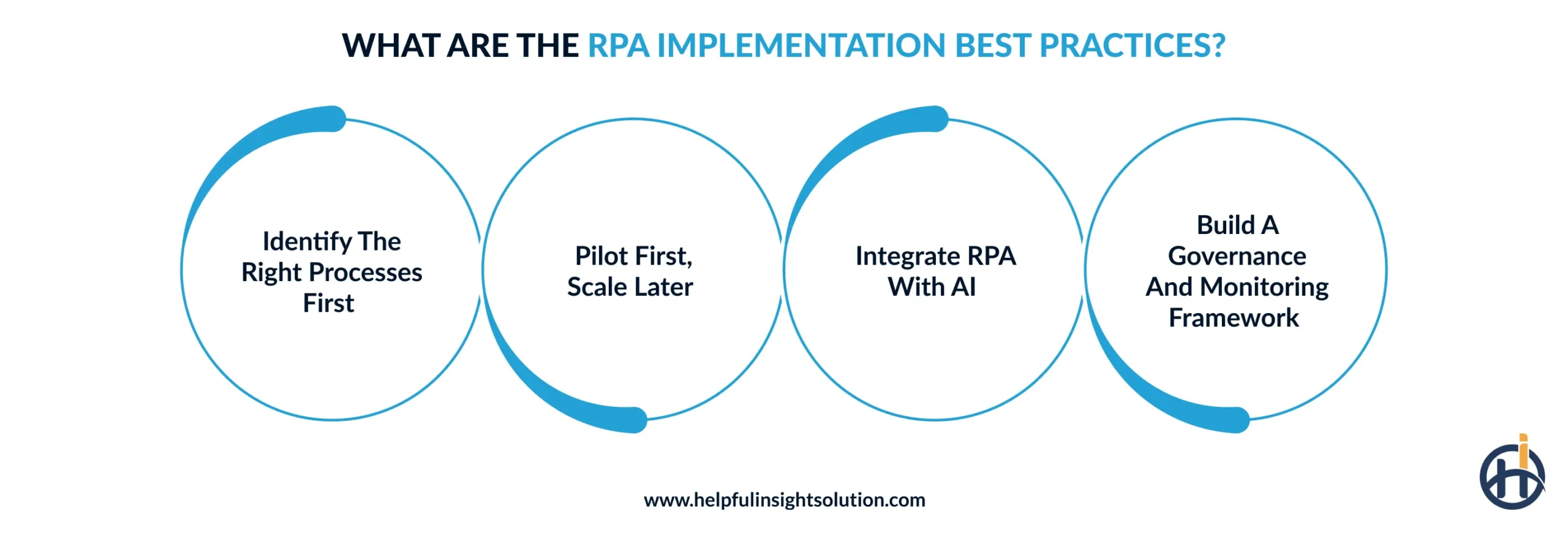
The best practices to implement RPA cover everything from identifying the right processes and running pilots to integrating with existing systems and building governance frameworks that keep deployments on track as programs grow.
1. Identify the right processes first
Not every process is worth automating. The ones that deliver the most impact are rule-based, high-volume and follow consistent patterns with minimal exceptions. Organizations need to map which workflows consume the most time and carry the clearest automation logic before deployment begins. Skipping that step is the most common reason digital transformation programs fail to deliver.
2. Pilot first, scale later
Always start with a focused pilot program. The practical gaps like integration issues, exception handling, data quality inconsistencies only become visible when workflow automation runs against live data.
3. Integrate RPA with AI
Unstructured data, variable outcomes and judgment-based decisions need AI + RPA working together rather than bots operating alone. So, make sure you combine artificial intelligence with RPA to get maximum benefit. An experienced AI development company helps design that integration from the ground up, before gaps become expensive to fix.
4. Build a governance and monitoring framework
RPA bots without governance are hard to scale cleanly. Ownership gaps, unmonitored failures and compliance blind spots are common in implementation programs that skipped this step. Getting the framework in place early saves considerable effort later.
How to identify the right RPA use case for your business?
There are so many best RPA use cases by industry, but which one your business actually needs depends on different criteria. In this section, we will provide you with the key tips to choose the right use case of RPA.
- Check for tasks your team handles hundreds of times daily, the higher the frequency, the stronger the case for automation.
- Look for tasks that require staff to manually move data across several applications, those are where automation by RPA saves the most time
- Identify areas where manual mistakes like missed fields, wrong entries, miscalculations create costly downstream corrections that repeat every cycle.
- Look for work that produces a defined, verifiable result every time, makes it simple to track bot performance and demonstrates returns.
Conclusion
RPA has moved well past the stage where organizations debate its value. Across banking, healthcare, insurance, manufacturing and beyond, the business case is no longer theoretical, it is documented in processing times, error rates and cost structures that have shifted measurably since deployment.
What deserves attention now is what comes next. RPA technology is increasingly the foundation on which broader automation initiatives are built, where AI-powered RPA and intelligent decision-making extend automation well beyond rule-based task execution.
For CEOs and CTOs evaluating that next step, the question is not whether robotic process automation applies to your operations. It is how much further your competitors are willing to go before you do.
At Helpful Insight, we work with businesses of all sizes across industries from identifying the right processes to building governance frameworks that scale. Our robotic process automation services are practical, measurable and built to grow with your operations.
Our team builds RPA solutions around your specific processes, industry requirements and business goals nothing off the shelf. We know what makes automation programs work in practice and we bring that experience to every engagement we take on.
Share your project requirements with us. We will assess your workflows and identify the highest-impact automation opportunities
FAQs
The top RPA use cases span multiple industries like automating KYC verification and fraud detection in banking, claims processing in insurance, patient data management in healthcare, payroll processing in HR and order management in retail and e-commerce.
RPA in banking and finance is most effectively deployed across KYC onboarding, fraud monitoring, loan processing and regulatory compliance reporting. These processes share consistent logic, high transaction volumes and strict accuracy requirements.
RPA in healthcare automates the administrative processes that consume the most clinical staff time like patient data entry, claims submission, and appointment scheduling. The result is faster processing, fewer errors and improved patient care.
RPA technology handles rule-based tasks by following preset logic it does exactly what it is programmed to do. Intelligent automation adds AI and machine learning, enabling systems to interpret unstructured data and improve with time.