


Key Takeaways:
- In transportation, AI improves fleet management, enhances road safety, optimizes routes, and speeds up decision-making.
- Businesses can easily reduce fuel expenses, ensure predictive maintenance, and improve asset utilization with smart AI systems.
- To implement AI in logistics, it is crucial to gather high-quality data, integrate with existing transportation platforms, and maintain compliance.
- Artificial intelligence combines with cloud and IoT technologies to streamline data gathering, processing, and execution in real-time.
The transportation industry is a key driver of economic growth, powering on-time deliveries, satisfied customers, and continuous innovation. Technologies like AI in transportation management are helping businesses predict the fastest routes, assess environmental conditions, and monitor vehicle health.
Beyond logistics, AI is also shaping public-centric services like self-driving cars, smart parking systems, and automatic number plate recognition, making everyday mobility smarter and more efficient. As market challenges grow more complex, AI is being rapidly woven into existing logistics platforms, helping businesses stay ahead of modern trends and maintain a competitive edge.
Precedence Research states that the AI-powered transportation market will reach a volume of $10.2 billion by 2028. The market value will cross $23.1 billion by 2032, giving rise to multiple startups and ventures across the globe. This is the new age of public and private transport business, where investors can target a greater ROI through AI-driven technologies.
This blog is a complete guide that explains various AI applications in transportation, their benefits, the integration process, and some must-know challenges. We are also discussing major real-world examples and future scope in this write-up.
What is AI in transportation?
AI uses advanced technologies like machine learning and computer vision to ensure safe travel through autonomous vehicles, smart traffic control, and route planning. Artificial intelligence in transportation helps businesses to maintain supply chain efficiency, improve customer service, and reduce manual overheads.
In cities, this technology monitors vehicle movement by using high-resolution cameras that can easily track number plates and rule violations. The increased use of AI in the supply chain delivers predictive maintenance of cars or buses and ensures smooth navigation by observing weather conditions or road blocks.
- AI systems react faster than humans, ensuring safety across logistics operations.
- It optimizes fuel consumption by reducing repair and maintenance expenses.
- The environment stays clean and carbon-free through smart route planning.
Market projection of AI trends in the transportation industry
The use of AI transportation systems is increasing rapidly because of worldwide adoption across businesses. In this section, we will encounter some interesting market facts that help you to understand revenue growth under various conditions.
- According to Precedence Research, the global market for AI in transportation is generating revenue of $8.3 billion in 2027, with North America having a 40% market share.
- The growth rate is 22.7% CAGR, which is common everywhere, resulting in a global volume of $34.8 billion by 2034.
- In the US, the market value is $1.9 billion in 2026, which will reach $9.9 billion by the end of this tenure.
- Coherent Market Insights says that the software segment has a share of 55%, whereas deep learning technology holds 46.6% in the transportation market.
- According to Technavio, the AI-powered routing systems in the USA have improved traffic flow by 25% because businesses are investing 40% in the R&D segment.
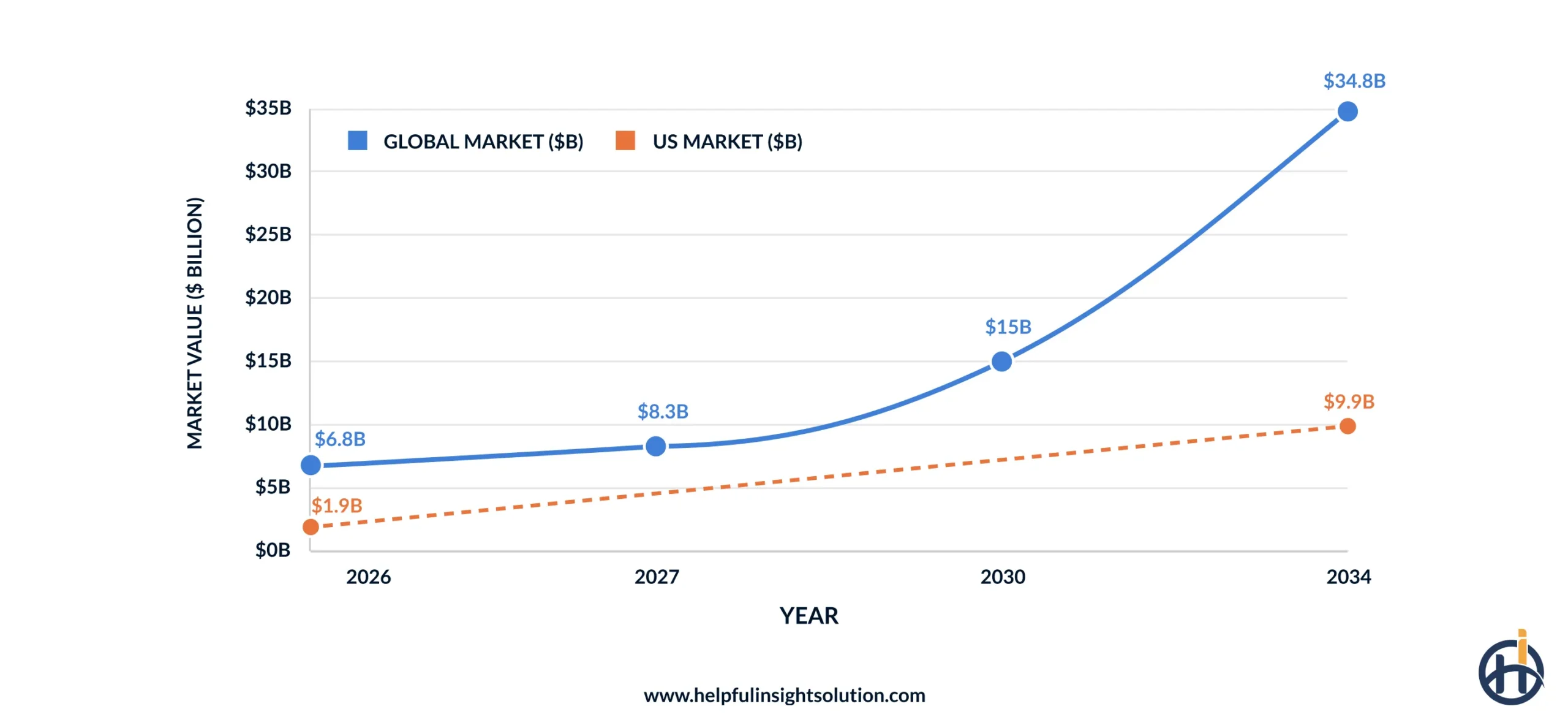
The above points show that AI is creating new opportunities for supply chain, logistics, and personnel enterprises. It is important to make wise investments by analyzing various trends, applications, market scope, and future outcomes.
Top 10 use cases of artificial intelligence in transportation
Driver-assistance systems, route optimization, and smart parking are some of the best use cases of AI in transportation. Here we will discuss the top 10 applications of AI-enabled logistics systems with detailed information.
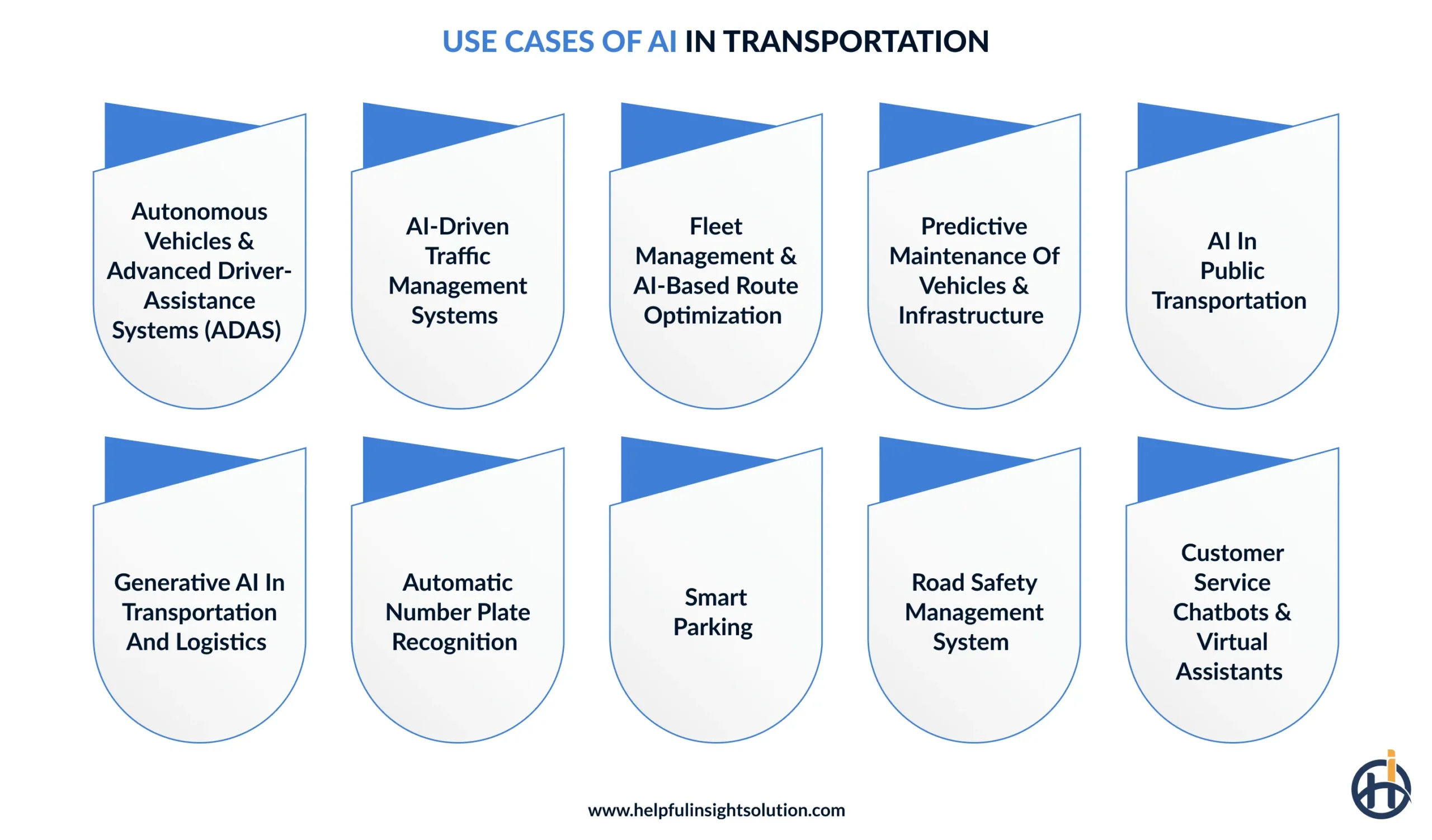
1. Autonomous vehicles & Advanced driver-assistance systems (ADAS)
Autonomous driving, vehicle-to-infrastructure (V2I) communication, and driver-assistance technology are affected by AI data interpretation from vehicle and traffic cameras. This facility improves road safety, mitigates driver error, and works towards future autonomous driving.
Focus points:
- Enables blind-spot detection to prevent lane-change collisions.
- Assists parking through automated steering and obstacle sensing.
- Supports emergency response with automatic collision notification systems.
Read Also: Cost to Build An Advanced Driver Assistance System Like Tesla Autopilot
2. AI-driven traffic management systems
AI-driven traffic management systems can easily monitor live traffic, congestion trends, and incident reports to optimize and reroute vehicle flow for businesses. This also increases the overall vehicle throughput, decreases travel time, and eases congestion in complicated city networks.
Focus points:
- Detects accidents instantly using connected camera networks citywide.
- Prioritizes emergency vehicles by adjusting signals automatically.
- Forecasts congestion hotspots using historical event and weather data.
3. Fleet management & AI-based route optimization
It facilitates business processes from locating current vehicle positions to logging driver behavior and determining ideal driving or delivery routes. These services help to minimize fuel consumption and total operational expenses and maximize fleet usage.
Focus points:
- Monitors driver fatigue through behavior and alertness tracking.
- Automates load balancing across multiple vehicles and routes.
- Flags unauthorized vehicle usage through geofencing alerts instantly.
4. Predictive maintenance of vehicles & infrastructure
AI can predict equipment failure or infrastructure issues before an actual breakdown, helping to decrease the total maintenance costs. Additionally, it reduces asset lifecycle costs with advanced monitoring and analysis of sensor data, usage patterns, and operating behavior.
Focus points:
- Detects early wear in bridges and railway tracks.
- Schedules part replacements before failures disrupt operations.
- Reduces unplanned breakdowns through continuous engine health monitoring.
5. AI in public transportation
AI in public transportation enables public transit to optimize scheduling for all forms of public transport and improve logistics for buses, metros, and trains. This helps to minimize waiting times for travellers, meet varying capacity, and improve commuter journeys.
Focus points:
- Personalizes commuter alerts based on individual travel habits.
- Balances crowd density across train and bus carriages.
- Adjusts fare pricing dynamically based on demand patterns.
6. Generative AI in transportation and logistics
By analyzing complex logistics data to forecast inventory needs and generate scenarios, AI can aid in generating optimum delivery schedules and plans. This also includes providing insights into market demand dynamics and even writing new content for reports and customer communications.
Focus points:
- Drafts contracts and compliance documents for shipping automatically.
- Simulates disruption scenarios to stress-test supply chain resilience.
- Generates synthetic training data for autonomous vehicle systems.
7. Automatic number plate recognition
This technology allows computer vision to automatically detect and identify number plates of vehicles for toll collection, access control at parking facilities, and law enforcement. It enhances the accuracy rate, the processing speed, and the effectiveness of monitoring by removing human errors.
Focus points:
- Flags stolen or blacklisted vehicles at checkpoints instantly.
- Enables contactless entry for gated communities and offices.
- Supports congestion pricing enforcement in restricted city zones.
8. Smart parking
AI-based smart parking technologies use advanced sensors and cameras to detect vacant parking spaces, guiding vehicles in real-time. This reduces the overall search time for parking, relieves traffic congestion in the urban environment, and increases parking efficiency.
Focus points:
- Predicts peak parking demand using historical booking trends.
- Enables cashless, app-based reservation and payment systems.
- Reduces emissions by minimizing circling time for parking.
9. Road safety management system
The AI systems can easily analyze traffic flow patterns, accident data, and roadway conditions to locate risk factors and predict dangers before they occur. It allows safety personnel and law enforcement agencies to be alerted early to deal with the situation in an appropriate manner.
Focus points:
- Identifies drunk or distracted driving through behavior analysis.
- Alerts authorities to hazardous weather-related road conditions.
- Tracks pedestrian movement patterns near high-risk crossings.
10. Customer service chatbots & virtual assistants
The AI-powered chatbot provides customer support to users for reservations, tracing, and other issues related to the transportation and logistics services. The bot will provide 24/7 availability to answer the common requests raised by the users in relation to the services.
Focus points:
- Handles multilingual queries for international travelers seamlessly.
- Automates refund and cancellation requests without human agents.
- Sends proactive delay notifications through conversational AI alerts.
Read Also: AI in the Automotive Industry: Benefits, Use Cases and Real-World Examples
Key AI technologies in transportation
You must know which AI technologies in transportation are applicable for route planning, vehicle monitoring, and other operations. These include machine learning, NLP, computer vision, and IoT that focus on specific tasks.
1. Machine learning (ML)
Machine learning in transportation can easily study past and present data to forecast traffic, find demand changes, and determine the best routes. Businesses invest in machine learning development to make informed decisions and optimize logistics operations, manage fleets, and schedule deliveries.
2. Computer vision
This technology helps multiple vehicles see and observe their environment by detecting multiple objects, pedestrians, lanes, and obstructions. It is highly beneficial in self-driving capabilities, automated toll systems, and intelligent surveillance units.
3. Natural language processing (NLP)
Natural language processing allows users to interact with navigation systems and customer service portals, allowing them to book rides by just speaking. Data analysis also benefits from this aspect, as NLP can extract data from vocal reports and shipping documents.
4. Internet of Things (IoT) with AI
IoT devices are used in various trucks or containers to collect real-time data on location and condition, delivering the information to AI. They can easily understand trends and make required changes to prevent issues, ensuring predictive maintenance, fleet tracking, and supply chain visibility.
Benefits of using AI for transportation
Businesses implement artificial intelligence in transportation because it ensures safety across routes and enhances experiences. Some of the most important advantages of using AI are discussed in this section.
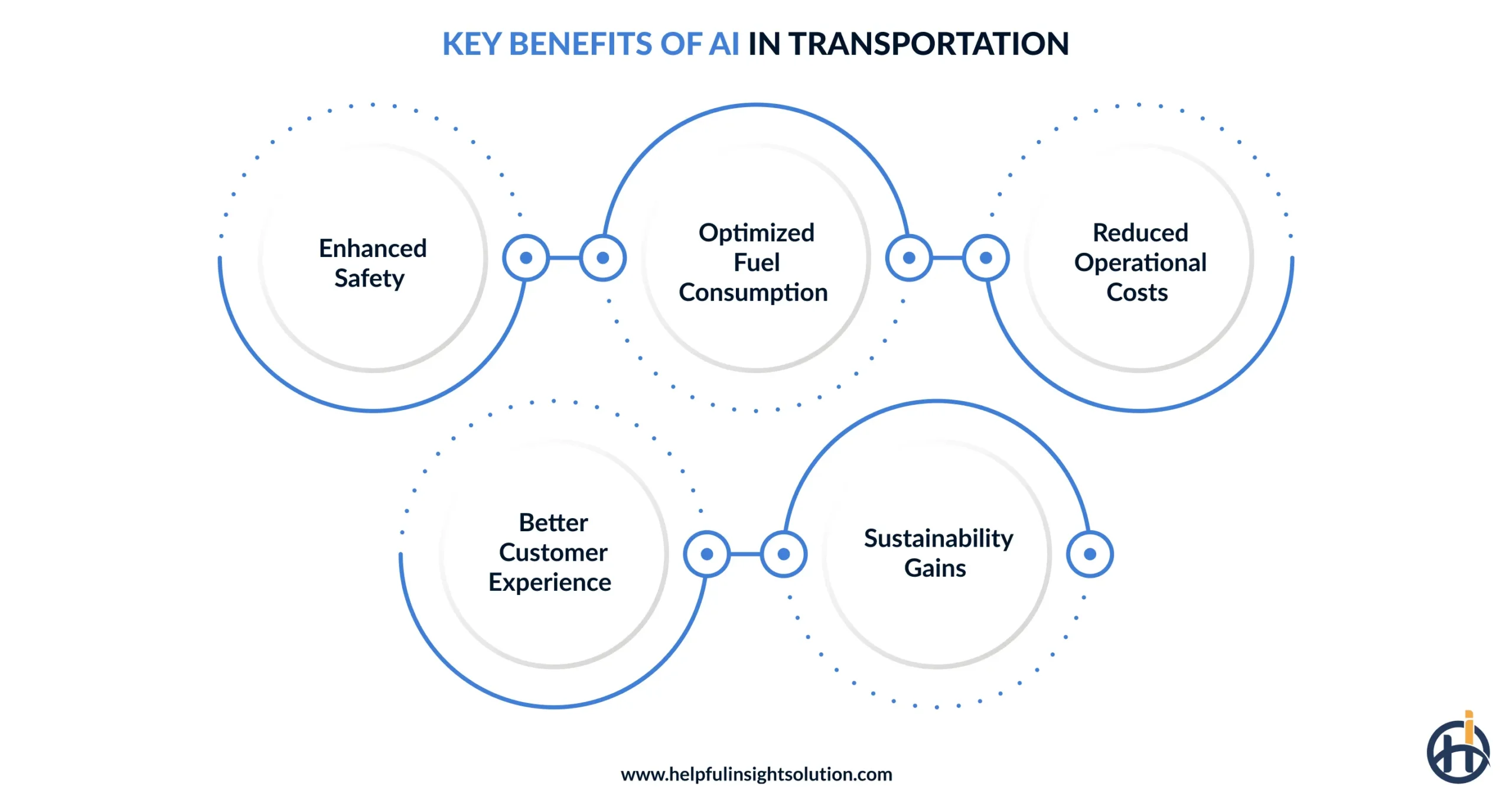
1. Enhanced Safety
Computer vision and predictive analysis powered by AI can recognize and report potential threats before they become dangers, from driver weariness to treacherous road conditions. This way, collisions may be avoided, road users protected, and a company’s liability exposure minimized.
2. Optimized fuel consumption
By analyzing driving behaviors, traffic situations, and route statistics, AI can chart the most fuel-efficient routes, along with suggested driving methods. Savings on fuel costs may be maximized by limiting the amount of time spent idling, reducing the necessity for circuitous trips, and curbing excessive speeds.
3. Reduced operational costs
Aided by automated logistics planning and prognostics of the vehicle parts that need repair, the AI cuts the costs associated with maintaining large and complex vehicle fleets. Additionally, it improves supply networks through efficient work scheduling and a decrease in maintenance downtime.
4. Better customer experience
Clients are provided with real-time delivery ETAs, in-transit cargo tracking, and individualized offers that assure their total knowledge and satisfaction. This builds customer trust and loyalty, translating into long-term retention and stronger relationships with business partners.
5. Sustainability gains
The carbon footprint and environmental impact of a company are decreased by the optimization of routes, fuel usage, and vehicular idling. This allows businesses to adhere to environmentally sound policies while capturing the interest of environmentally aware consumers.
Major AI integration challenges in transportation
While choosing AI for transportation, it is crucial to know various challenges, like security, cost, and regulations. We are going to study all these issues in this section with their respective industry solutions.
1. High implementation costs
The implementation cost is increased by massive upfront hardware, software, and personnel requirements. This leads to expensive infrastructure modernization, specialized talent shortages, and complex updates.
Solution: SaaS-based models, small-scale AI tools, phased pilot rollouts, and PPPs help to reduce integration expenses.
2. Data privacy & security concerns
This is caused by mass surveillance risks, cyber-physical vulnerabilities, and data aggregation threats. It affects route algorithms and large central databases that hold user payment details and their travel history.
Solution: Federated learning is used to train AI models on private data, which restricts data leaks and real-time cyberattacks.
3. Legacy system compatibility
AI technology can result in architectural incompatibilities, fragmented data silos, and processing latency without proper management. A rigid architecture cannot handle complex computations because of fixed constraints.
Solution: It is crucial to build transition layers and focus on edge processing that reduces cloud query dependency and latency.
4. Regulatory & ethical hurdles
Some regulatory issues include legal liability and algorithmic bias, which occur due to differences in law. Also, it is difficult for humans to easily understand deep learning models with complete data reliability.
Solution: Businesses must implement regular system audits and audit logs to monitor fairness and trace AI accountability.
How to implement artificial intelligence in transportation?
To integrate AI in transportation, businesses must follow a dedicated process that ensures constant support. From assessment to monitoring, the following steps help in managing the budget and resources.
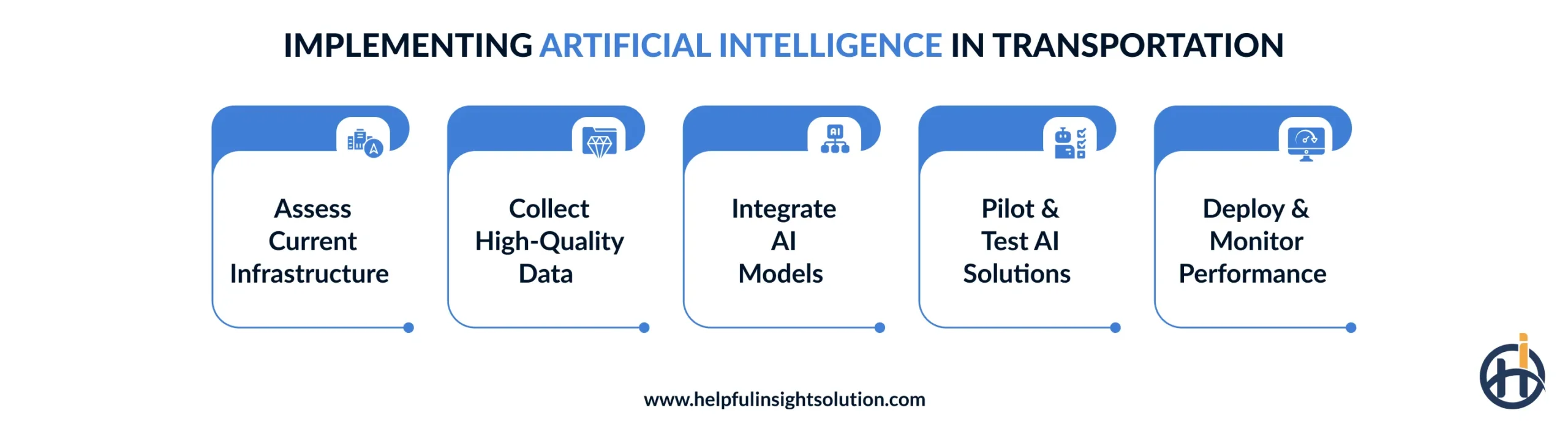
1. Assess current infrastructure
Before embracing this technology, companies should analyze existing IT infrastructures to discover operational gaps and integration points. This process should examine relevant hardware capabilities, system configurations, and current workflow structures to establish a clear infrastructure overview.
This guarantees that AI systems will complement a well-functioning existing network, not create new challenges for the infrastructure.
2. Collect high-quality data
Whether through the utilization of vehicle onboard data or external IoT sources, the organization has to secure accurate data sets at the initial phase of AI deployment.
One key consideration at this stage includes setting up efficient and stable data pipelines, ensuring consistency among various data points. These include IoT devices, historical records, and GPS to create usable data that can be used effectively by AI models.
3. Integrate AI models
As soon as appropriate data is collected and labeled, an AI algorithm should be developed, either using off-the-shelf models or customized solutions, that fits the organization’s requirements.
It is crucial to integrate generative AI development services with the underlying transportation systems and various workflows. This ensures they communicate efficiently with relevant database structures, applications, and real-time APIs.
4. Pilot & test AI solutions
Before full-scale deployment, you should implement and test AI-powered solutions in a pilot phase. This controlled environment will allow you to gather insights into real-world performance without committing to high costs.
The pilot helps test the accuracy and effectiveness of your solution in a smaller setting and identify and address any potential issues with user acceptance.
5. Deploy & monitor performance
After validating the performance of your AI solution during the pilot phase, you can expand its deployment across your entire transportation network. Monitor the performance of the AI and the results in a sustained manner even after the expanded deployment.
This will facilitate ongoing adjustments to performance, including the ability to monitor for drift and to account for any new challenges.
Real-world AI-driven transportation examples
Here you are observing the best AI systems in transportation, which offer smart routing services to users. We will understand how they impact logistics operations and improve the supply chain with their key features.
1. Waymo
Google’s Waymo uses sensors, computer vision, and machine learning to make fully autonomous cars that take passengers around cities in the US. It makes real-world drives on public roads that don’t require human assistance for self-driving, maneuvering vehicles through city life as well as unforeseen events.
Major Impact:
- Reduced accidents through AI-powered autonomous navigation.
- Expanded safe, driverless rides across major cities.
2. FedEx
Goods delivery service FedEx utilizes AI, along with advanced technologies, within its entire global delivery network for predicting demand for package amounts. It uses sorting operations at distribution hubs to determine how routes should best accommodate the speed of shipment at delivery time.
Major Impact:
- Cut delivery times with optimized AI routing.
- Improved sorting accuracy across global logistics hubs.
3. Uber’s Michelangelo ML platform
Uber built its Michelangelo ML platform to power core functions like ETA predictions, dynamic pricing, and driver-rider matching across its ride-hailing network. This internal AI system enables Uber to process massive amounts of real-time data, improving operational efficiency and customer experience.
Major Impact:
- Improved ETA accuracy for millions of riders.
- Enabled smarter, real-time driver-rider matching decisions.
4. Heathrow Airport’s monitoring solution
Heathrow’s AI system, developed by Assaia and known as ApronAI, enhances various functions through camera systems stationed at all of its airline gate services. The camera systems enhance efficiency in boarding, refueling, and baggage unloading, helping passengers prepare for departure with precision.
Major Impact:
- Boosted on-time takeoffs through real-time turnaround tracking.
- Increased gate efficiency without new infrastructure investment.
The future of transportation with AI innovations
The future of artificial intelligence in the transportation industry is impacted by modern innovations and trends. In this section, you are going to study major future projections that are crucial for every investor.
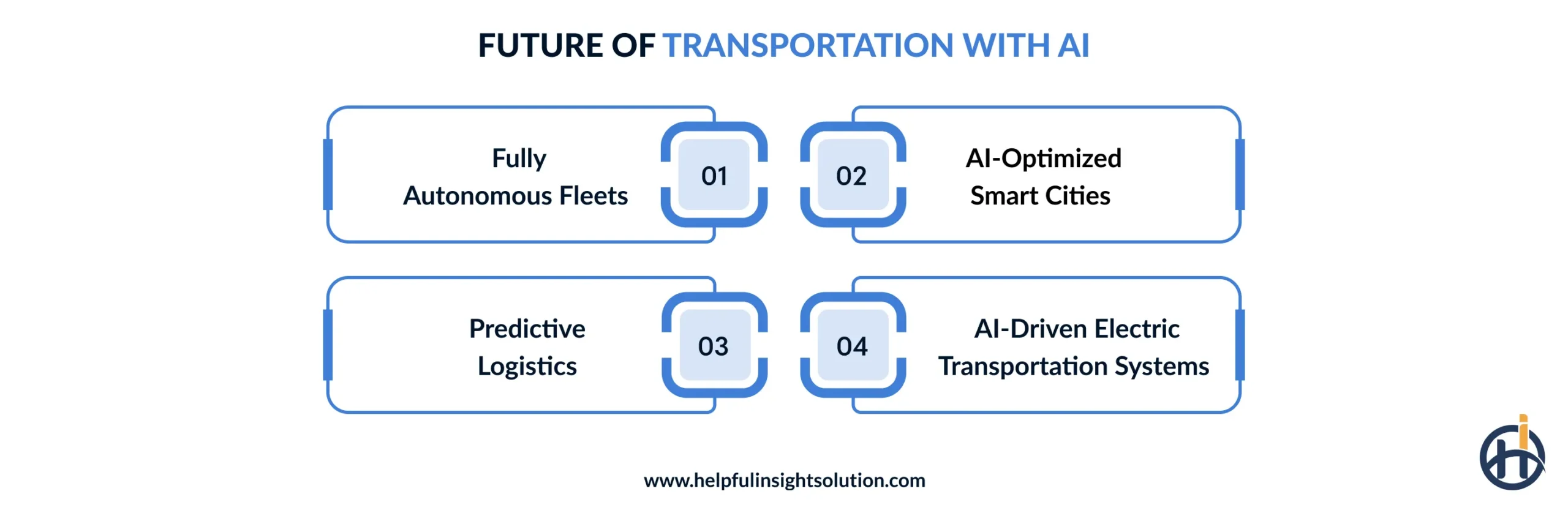
1. Fully autonomous fleets
The growth and maturation of self-driving technology will result in the adoption of fully autonomous trucks, vans, and taxis with low levels of human input. These will result in cost efficiencies, improved safety, and 24-hour operations within the passenger and freight logistics industries.
2. AI-optimized smart cities
AI for transportation will be fully integrated within cities to coordinate all vehicles, traffic signals, parking systems, and mass transit. This helps the systems react to dynamically shifting conditions for efficient transportation throughout future cities.
3. Predictive logistics
AI will predict disruptions in customer demand and delivery latencies through predictive analytics services before they occur, allowing businesses to adapt supply chains. These AI capabilities will help eliminate bottlenecks and optimize worldwide logistics systems more efficiently than before.
4. AI-driven electric transportation systems
AI will increasingly power intelligent EV networks, battery control, energy-efficient routes, and other logistics services. It will enable widespread adoption of electric transportation networks across a multitude of industries.
Why choose Helpful Insight for developing AI-enabled smart transportation systems?
Enterprises can use computer vision, NLP, or generative AI in transportation and logistics based on their network, market needs, and public demands. It is highly recommended to approach the right AI development company that has experience in creating and deploying similar platforms for business investors.
We help with supply chain automation, smart delivery solutions, enhanced customer support platforms, and optimized routing systems. Our experts specialize in fleet management, helping businesses to reduce operational expenses, manual workload, and human errors.
We provide dedicated teams according to business specifications and project requirements that work on modern trends, the latest technologies, and budget planning.
This streamlines daily operations, enabling workers to perform tasks with greater efficiency. As an entrepreneur, you can easily aim for enhanced brand visibility, increased investment returns, and customer retention.
FAQs
For creating AI-powered transportation software, the average cost ranges from $20,000 to $100,000 for startups and mid-sized enterprises. The overall cost may increase to $180,000 or more for large logistics businesses due to complex requirements. Investors must utilize third-party AI integration services that provide subscriptions.
Generative AI optimizes route planning, demand forecasting, and document automation through conversational models. It can analyze live traffic patterns, weather reports, and vehicle constraints to suggest delivery paths. Experts build simulations to recommend alternate strategies by looking at different real-time operations.
Artificial intelligence ensures smooth traffic flow management, capacity utilization, and eco-driving to reduce environmental changes. It monitors fuel consumption, greenhouse gas emissions, and mechanical issues to predict road congestion and timing. Additionally, AI helps to prioritize public transit and focus on congestion control.
To replace human drivers, AI requires strict legal accountability, public trust, and complex crisis management, which is not possible. Advanced systems follow predefined codes, but humans can handle different operations without any guidance. AI requires regulatory uncertainty and liability gaps that currently limit widespread autonomous vehicle deployment.
Smart traffic management helps logistics companies to reduce urban carbon emissions through adaptive signal control and route guidance. Enhanced traffic progression results in lower fuel burn and a reduction in toxic pollutants. Various AI models track data to reduce greenhouse gases, improve the air quality index, and enhance supply chain efficiency.