

Every fintech product runs on a set of interconnected services, like a client application, a payment gateway, a core ledger, and a fraud detection engine. Fintech architecture is how these components are structured and integrated, so each transaction is processed accurately and with low latency.
The way fintech architecture is designed determines how efficiently a product scales when transaction volume spikes, adds new third-party integrations, and meets the regulatory requirements of each market it works in.
A wrong decision at this stage is not just a bug that gets fixed in the next sprint, it is a structural problem that costs much more to fix once real is moving through the system.
This guide covers what fintech architecture is, its core components, the main types of architecture, how it differs by product, and the best practices for building a secure and scalable system.
What is Fintech Architecture?
Fintech architecture is the technical blueprint for building a financial product. It defines how the data system processes each transaction and maintains data security. It also lays the foundation for the rules the product must follow, such as fraud checks and audit records, to meet regulatory compliance requirements.
Fintech software architecture is made before the code is written, and the rest of the development follows it. In finance, this matters even more because a single choice, like where customer data is stored, can decide whether the product meets a regulator’s data residency rule.
A change to the plan after launch costs far more, because the system is already live and handling real money.
Why FinTech Architecture Matters
Fintech is a regulated industry, and architecture decides whether it satisfies those regulations and can adopt new ones.
The market is heading for $460.76 billion in 2026 and $1,760.18 billion by 2034, according to Fortune Business Insights, and that growth leads to more volume and tighter regulation on every product.
Fintech architecture is what makes a product ready to withstand the demand of this growing market.
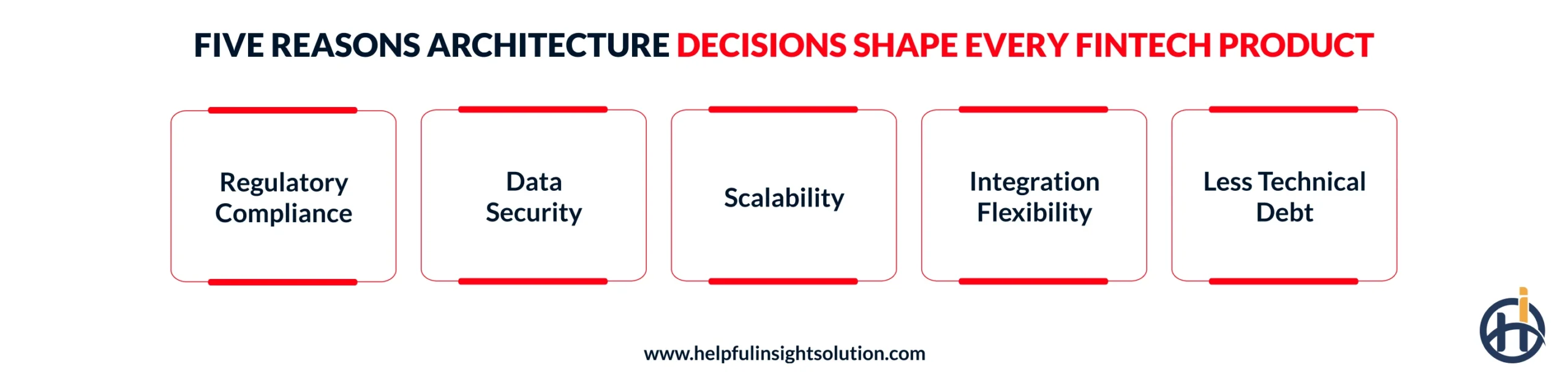
- Security: A fintech app stores and moves sensitive data like login credentials, card numbers, and personal financial records. This makes it more vulnerable to data theft than most software. Fintech software architecture builds the encryption and access control to protect vulnerable customer data from the start. One exposed service can put customer records at risk and break PCI DSS compliance, which is why fintech cybersecurity has to be designed into the fintech architecture from the first version.
- Scalability: Fintech software runs on unpredictable load. It works well when the transaction volume is within the threshold; however, when volume increases, the architecture is what makes it scalable. Fintech architecture components split into smaller services let you add capacity only where the load is, and the product keeps its speed as the user base grows.
- Integration flexibility: Every fintech application exchanges information with third-party services like banking APIs and KYC providers to complete specific tasks. If those integrations are hard-coded into the core, one provider update can break onboarding, while an API-first design keeps each integration behind a middleware layer that can be swapped without a rebuild.
- Technical debt is the result of unplanned development. A fintech architecture ensures that the development works in a planned way and meets all the requirements, eliminating technical debt from the ground up.
Core Fintech Architecture Components
A fintech application is built in different layers, and together these layers form the fintech architecture. Each layer does a specific job, and these are the core fintech architecture components that appear in almost every build.
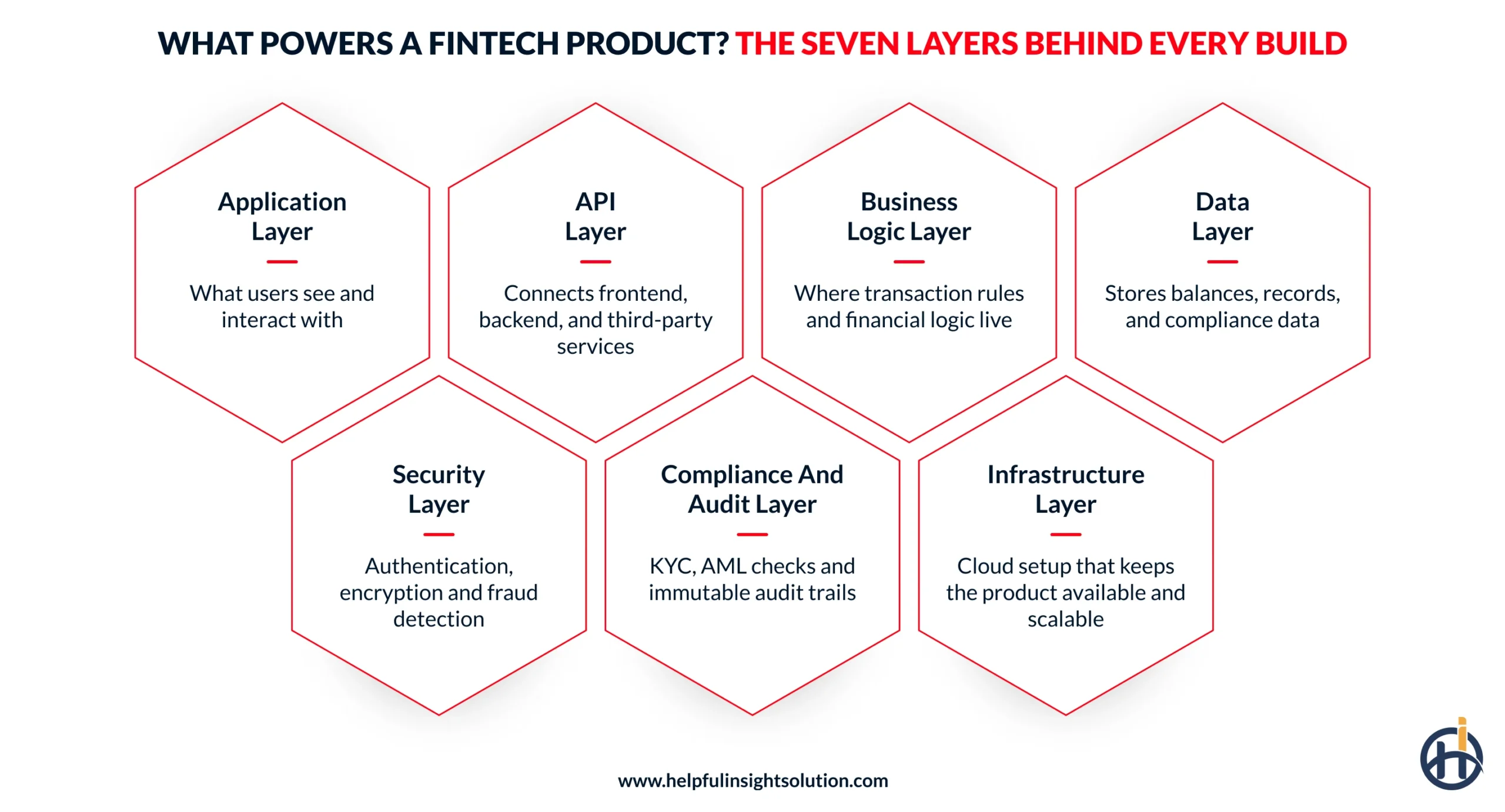
If any of these layers are not planned, it might affect the whole fintech app development project.
Application Layer
The application layer is what the customers see and interact with. It could be a login screen, dashboard, payment interface, and transaction history.
In fintech, this layer carries more weight than in most products because it is the first thing users evaluate when deciding whether to trust the product with their money. Also, a clean UI/UX that avoids common design mistakes keeps users comfortable and reduces drop-offs during transactions.
API Layer
The API layer connects the front end with the back end and integrates the product with external services. Every user request, like a balance check or a fund transfer, passes through this layer.
APIs are highly prone to cybersecurity attacks, a fintech app architecture must have a process to ensure that each API request is authenticated first, and no call runs without permission.
Standards like OAuth 2.0 and rate limiting at the API gateway are the basic security controls used at this layer
Business Logic Layer
This layer specifies all the rules of the product and the process for the transaction. It is responsible for verifying whether the payment is allowed, applying relevant charges & limits, and updating the ledger with the status.
Since every transaction passes through this layer, its design affects the accuracy and speed of the product.
Data Layer
The data layer stores all the data a product needs, such as customers’ details, account balances, transaction histories, audit logs, and compliance records.
Also, it ensures that the data stays accurate, as even minor discrepancies in balance records or transaction states can result in real financial losses or regulatory findings.
The data layer also has a direct impact on compliance, because different countries have their own rules on what data you can store, where it must be stored, and how it can be used.
For example, GDPR in Europe controls where the data of EU residents is stored and how it is handled. CCPA in the US gives people in California specific rights over their data. India’s Digital Personal Data Protection Act (DPDP) and the RBI data localisation rules require certain data to stay on servers within the country.
All these rules directly shape the database design, like where the data is stored, how it is copied, and how long it is kept.
Security Layer
The security layer handles authentication, encryption, fraud detection, and session management across the entire product. It enforces who can access the system, what they can do inside, and how protected if a breach occurs.
In practice, this means multi-factor authentication at login, AES-256 encryption for data at rest, TLS for data in transit, and role-based access control that gives each user only the data their work needs.
Transaction monitoring using AI in fintech is also part of this layer. It scores each transaction against known risk patterns in real time and flags anomalies before they turn into fraud.
Compliance and Audit Layer
The compliance and audit layer ensures the product follows the financial regulations. It handles KYC and AML checks when a user signs up, and it monitors transactions for any suspicious activity and enforces the rules that differ by jurisdiction.
This layer also keeps an audit trail, a record of every action with the time and the user behind it.
When an internal review needs to trace a transaction, the audit trail gives a complete chain of custody. This is why IT compliance for fintech is easier and cheaper to manage when the compliance layer is built into the fintech architecture from the start, instead of being added after the product is live.
Infrastructure Layer
The infrastructure layer is the cloud and server environment that runs the entire product, usually on AWS, Azure, or Google Cloud Platform. It decides how much traffic the system can handle and how fast it recovers after an outage.
It also affects how quickly the app can scale during a busy time. Reliable infrastructure keeps a fintech app available when a payment cannot wait.
In fintech, infrastructure decisions also impact compliance beyond performance. Data residency rules like GDPR in Europe and RBI localisation in India decide where the infrastructure has to be located.
Disaster recovery and uptime SLAs are also infrastructure concerns that banking partners and enterprise clients often audit before signing any agreement. The infrastructure layer is where a 99.9% uptime promise is either kept or broken.
Types of FinTech Architecture.
There is no single best type of fintech architecture, because each one fits a different stage and scale of a product. Here are the five fintech architecture types most teams compare before a build.
| Type | What it is and where it fits | Pros | Cons |
| Monolithic | A single codebase deployed as one unit. A common starting point for a fintech MVP with a small team. | Fast initial development; one build to test and deploy; low infrastructure cost early. | Scales only vertically; a fault in one module can bring down the whole process; tight coupling raises risk as it grows. |
| Microservices | The application is split into independently deployable services, like payments, onboarding, and KYC. Used by fintechs at scale. | Independent horizontal scaling per service; fault isolation between services; parallel deployment by separate teams. | Distributed-system complexity; needs CI/CD, container orchestration, and observability; higher operational cost early. |
| API-first / modular | An API-first fintech architecture exposes every function through a defined API contract, used by the product, partners, and internal services. Suits open banking and bank integrations. | Reusable API contracts across web, mobile, and third parties; fast partner integration; clean versioning. | Requires upfront API design and governance; every endpoint needs authentication, rate limiting, and documentation. |
| Event-driven | An event-driven architecture in fintech communicates through asynchronous events over a message broker. A completed payment emits an event that triggers notification and ledger updates. Fits real-time, multi-step flows. | High-throughput real-time processing; loose coupling between services; new consumers added without changing producers. | Eventual consistency is harder to reason about; debugging spans multiple event flows; needs a reliable broker and dead-letter handling. |
| Serverless | Functions-as-a-service that the cloud scales per invocation, billed on usage. Fits spiky, stateless tasks like KYC checks or report generation. | Auto-scaling per request; no server management; pay-per-use billing. | Cold-start latency; vendor lock-in; poor fit for long-running or stateful workloads. |
The core decision for most teams is monolithic vs microservices fintech, and it comes down to scale. A monolith is enough while the product is small, and microservices earn their overhead once traffic and the team grow.
How Architecture Differs by FinTech Product Type?
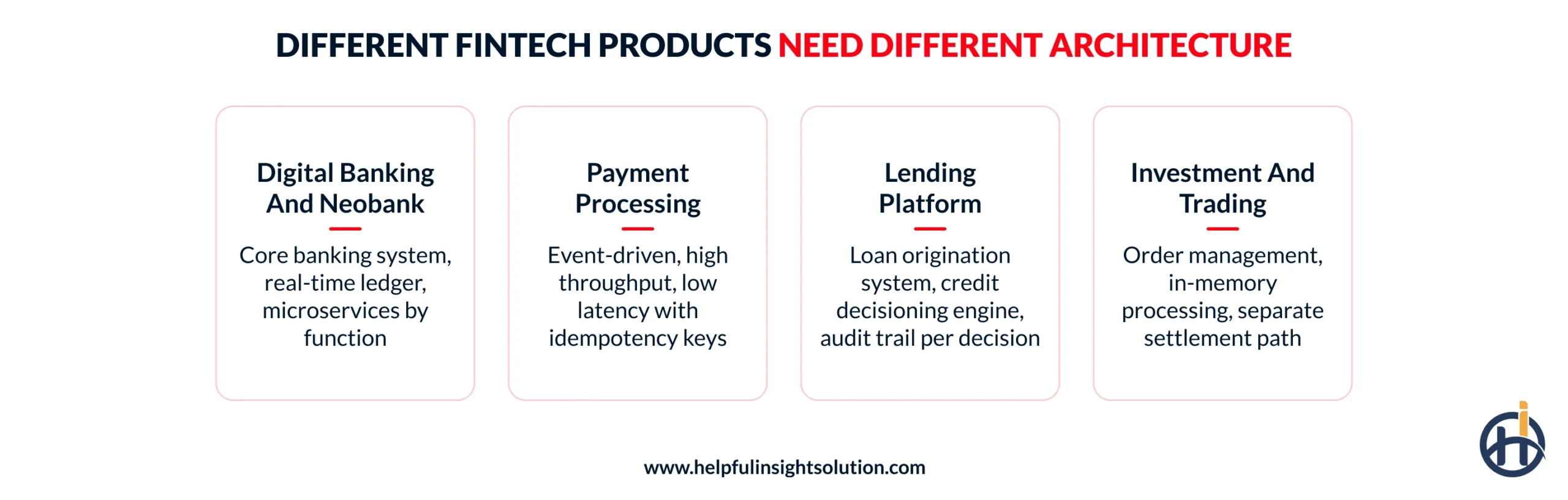
The fintech architecture a product needs depends on what it actually does, because a bank, a payment processor, and a lender each emphasize a different part of the system.
Digital Banking and Neobank Architecture
A neobank is a digital-first bank, with no physical branches. Neobank architecture is built around a core banking system and a real-time ledger, usually as microservices split by function, like onboarding, accounts, cards, payments, and notifications, each deployable and scalable independently.
Most neobanks connect to a sponsor bank or a Banking-as-a-Service (BaaS) provider through APIs instead of building the core, and the architecture has to keep its ledger in sync with that partner.
Payment Processing Architecture
Payment processing architecture is optimised for two things above all else: high throughput and low latency. It runs on an event-driven model, where authorization, capture, and settlement move as separate asynchronous stages over a message queue.
This lets each stage scale on its own, and a slowdown in one stage does not block the others.
Idempotency keys are a must in this architecture. They make sure that if a payment request is retried because of a network timeout or a failed response, the same transaction does not go through twice.
Without them, the retry logic can create duplicate charges, and charging a customer twice is one of the worst trust failures in any payment product.
Lending Platform Architecture
In a lending platform, the architectural challenge is the credit decision, not the payment. The architecture focuses on a loan origination system (LOS) and a credit decisioning engine.
The loan lifecycle moves through clear states, like application, underwriting, disbursement, and servicing.
Lending platform architecture also depends on data pipelines that pull credit bureau reports and alternative data into a scoring model, often using a combination of real-time API calls for bureau data and batch jobs for alternative data. Since a lending decision has to be explainable to a regulator, the architecture keeps an audit record of every input behind an approval.
Investment and Trading Platform Architecture
Investments and trading platforms have low-latency and consistency needs in fintech. An order management system connects to a matching engine or a broker API, and market data streams in continuously.
Price and position must stay consistent under heavy concurrent load, because a stale price or a position that does not update in real time can lead to wrong trades.
For the live trading path, this architecture leans on in-memory processing, where active data is kept in memory instead of read from disk on every request.
Settlement runs on a separate and slower cycle, usually T+1 or T+2. The architecture tracks this settlement path apart from the live order flow, which keeps the two states from interfering with each other.
FinTech Architecture vs. Tech Stack: What is the Difference?
Many people use fintech architecture and tech stack interchangeably, believing they are the same; however, they are not.
Fintech architecture is the structural design of the system. It explains how components are organised, how they communicate, and how the system handles scale, failures, and compliance requirements. It defines the overall shape of the product.
The tech stack, on the other hand, is the set of technologies used to build that architecture, such as programming languages, frameworks, databases, and cloud services.
Two fintech products can have the same tech stack, but still have a different architecture. One can be a monolith, and the other can be microservices.
Fintech software architecture is decided first, and the selection of the tech stack follows it.
Summarizing, in the fintech architecture vs tech stack comparison, architecture is the blueprint, and the tech stack is the material used to build it.
Security and Compliance in Fintech Architecture
Fintech is among the most regulated industries, and these regulations are far more than the legal formalities.
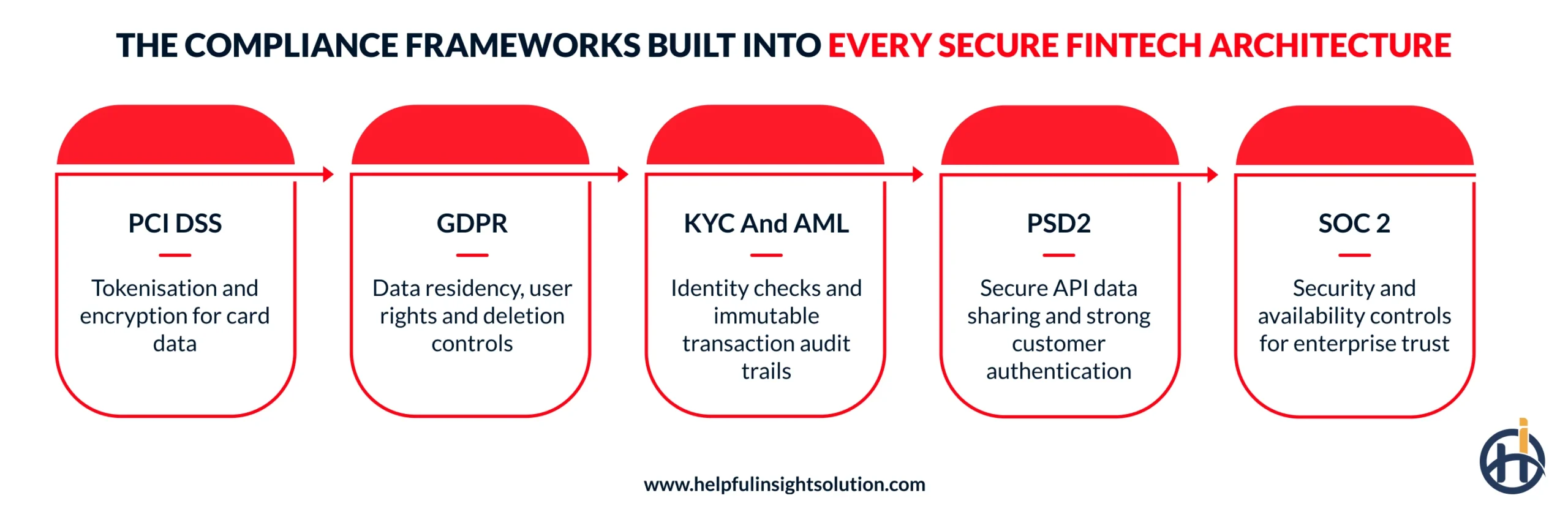
These regulations define how the system is designed and built. In a compliant fintech software architecture, frameworks like PCI DSS, GDPR, KYC/AML, PSD2, and SOC 2 are considered from the very beginning.
- PCI DSS is meant for protecting card data. The fintech architecture has to encrypt data and store it as tokens, which hides the real card number. No raw card data should exist in the system outside of the PCI DSS-compliant environment.
- GDPR is a European data protection law that governs where user data should be stored and handled. For example, the personal data of European users often has to stay on servers within Europe. Also, it says that users must have the authority to delete their data whenever they need to.
- For KYC and AML jobs, the role of architecture is record-keeping. Every identity check and unusual transaction has to be saved in an audit trail that cannot be changed later, and kept ready for a regulator to review. Some fintech products extend this further using blockchain development for tamper-proof settlement records and cross-border payment trails.
- PSD2 is open banking in Europe to ensure that the data shared through APIs is secure. It also requires strong customer authentication (SCA), which adds an extra step like an OTP or fingerprint before an account is accessed.
Fintech Architecture Best Practices
Choosing the right architectural type is important, but how you build it matters too. How the architecture is built and maintained determines whether that choice holds up under real operating conditions.
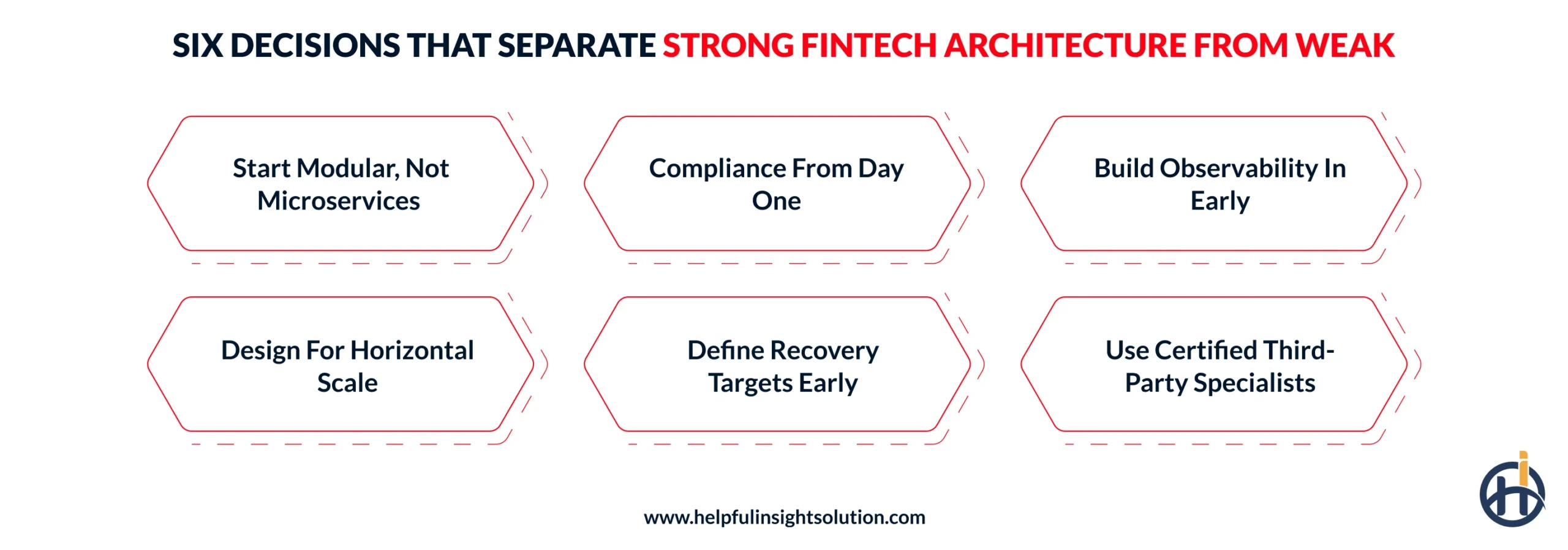
The practices below apply regardless of which architectural type a team selects.
Start With a Modular Monolith Before Microservices
Microservices offer genuine scalability advantages but carry real operational overhead — distributed system complexity, container orchestration, independent deployment pipelines, and a team structure capable of managing independent services. For an early-stage fintech with a small team and limited infrastructure budget, that overhead arrives before the benefits are needed.
Modular monolith fintech architecture can help fintech startups. The whole application stays as one, but the code is divided into separate modules, such as payments, KYC, and accounts. It keeps the setup simple, and the code still stays organized.
Later, when the product grows and scalability becomes a real need, these modules can be moved into microservices. This way, you get an easy start now, and an easier way to scale when the time comes.
Design for Compliance and Auditability From Day One
The biggest mistake is that fintech startups focus on building products first, and compliance as the second thing. But in fintech, this approach is risky and expensive, as adding compliance later on might require rewriting the core parts of the application.
The fintech architecture best practice is to design the architecture for compliance from the first day. It must follow the relevant compliance requirements from day one, like KYC, AML, and data protection. This also means keeping audit trails, where every action and transaction is recorded and cannot be changed later.
When auditability is built in, the system stays ready for a review at any time. You do not have to prepare records at the last moment, because they are already there. This is also a core part of IT services in the finance industry, and it builds trust with regulators and partners.
Build Observability and Audit Trails From the Start
In fintech, trust is what brings users to your application. The way to achieve trust is by having transparency and letting users know what is happening inside the system at all times.
Observability makes this possible, and it should be part of the fintech architecture from the start. It is done through logs, metrics, and monitoring that show the health of each service.
If a payment fails or a service slows down, the team should know at once. Without observability, such issues are noticed only when users start complaining. By then, the damage is already done, and in a financial product every failed transaction means real money.
Audit trails are a part of this too. They keep a record of every important action, which helps in both debugging and compliance. When observability and audit trails are added early, the team can find problems fast and keep the system stable.
Plan for Horizontal Scalability Before You Need It
Fintech traffic is never steady. It stays predictable most of the time, but it can jump suddenly, for example on a payday or during a big sale. If the system is not ready for this, it slows down or crashes at the worst moment.
Fintech architecture can ensure scalability in two ways. One is vertical scaling, where you add more power to a single server. The other is horizontal scaling, where you add more servers and share the load between them. For fintech, horizontal scaling works better, because you can add capacity as the traffic grows.
A scalable fintech architecture is designed in a way that new servers can be added without changing the core system. It is much harder to add this later, when the product is already live and under load.
Define Disaster Recovery and Uptime SLAs Early
No system stays up forever. Servers fail, networks drop, and sometimes data gets lost. In fintech, this is a bigger problem than in most apps, because downtime means stopped payments and unhappy users. This is why disaster recovery has to be planned early.
Disaster recovery is a plan for how the system gets back to normal after a failure. It includes regular backups, a backup server ready to take over, and a clear idea of how fast the system should recover.
Two things matter most here: the Recovery Time Objective (RTO), which is how fast the system should recover, and the Recovery Point Objective (RPO), which is how much data you can afford to lose.
Uptime SLAs are also important here. An SLA is a promise about how much the system will stay available, for example, 99.9% of the time. Banks and partners often ask for these numbers before they work with a fintech company.
This means the fintech architecture has to be built to meet them from the start.
Use Secure, Specialized Third-Party Partners for Sensitive Data
Not every part of a fintech product has to be built in-house. Some tasks, like storing card details or verifying identity, are very sensitive and need a high level of security. For these, fintech development outsourcing to a specialized partner is often the safer option.
Not every sensitive function in a fintech product needs to be built in-house. For card data storage and payment processing, PCI DSS-certified providers like Stripe or Adyen already hold the certification; integrating with them shifts the compliance burden for card data to a specialist who has already passed the audit rather than requiring the product to build and maintain that compliance independently.
A payment provider such as Stripe is already PCI DSS certified, so meeting those compliance requirements would be easier for you. Similarly, a KYC provider already handles sensitive data, so you can expect the same for your fintech company, too.
A fintech app development company can help you access third-party services and integrate them securely with your application.
Common FinTech Architecture Challenges
Every fintech architecture faces predictable challenges. Understanding them before the build starts is significantly less expensive than encountering them during development or after launch.
- Legacy system integration – Legacy system integration is the most common challenge. Many fintech companies are still running on legacy systems, like core banking platforms, mainframe-based ledgers, and older payment processors. These systems use different data formats, expose limited APIs, and are slow to change. To connect them to modern architecture, the team has to build adapters that translate between the old and new formats, which requires a lot of engineering effort. There is also a real risk of data loss or corruption during this translation.
- Fintech architecture has to balance speed and security. Every startup wants to launch quickly, but in fintech, security cannot be ignored just for speed. If the team moves too fast, they can leave security gaps in the system. And moving too slowly means losing the market. This balance is always difficult to maintain.
- Scaling also brings cost and complexity. It is not only technical work, but it also increases the cost. When the number of users grows, the system needs more servers, more monitoring, and sometimes a bigger team. Handling all this and keeping the cost under control becomes difficult over time.
- Managing many third-party providers and regulators is difficult too. A single fintech often works with many providers and more than one regulator at the same time. Each provider has its own APIs, and each regulator has its own rules. Keeping everything in sync and staying compliant with all of them needs continuous effort.
Real-World Examples of Successful Fintech Architecture
Two well-known fintech companies show how architecture choices shape a product.
Monzo: A Bank Built on Microservices
Monzo is a UK digital bank and one of the best-known examples of microservices in fintech. Since 2015, Monzo has built its architecture on microservices. It has been using more than 2,800 microservices that are working independently.
Monzo built the backend of its application in the Go language, kept all the code in a single repository, and hosted everything on AWS with Kubernetes. They also built their own tools for deployment, and a service can be released or rolled back quickly.
This fintech architecture helped Monzo to ensure that engineers can work on different services at the same time, without affecting others. So the bank remains available without facing maintenance downtime.
Stripe: An API-First Payment Platform
Stripe is another example. When it started, most payment providers were treating their API as a side tool. Stripe did the opposite and made the API the main product itself. Every feature was designed to be simple for developers, with clear documentation and idempotency keys, so developers can implement it easily.
The API-first approach of Stripe helped businesses add Stripe payments with just a few lines of code. This is one of the main reasons Stripe became very popular with developers, and why so many fintech products are built on top of it.
Both examples show the importance of fintech architecture. The architecture is not just a technical detail; it decides how well a fintech product can grow and adapt.
Conclusion
Fintech architecture is the base of every strong fintech product. It decides how safe, scalable, and reliable the system will be as it grows. Choosing well in the early stage saves a lot of cost and effort later, while poor choices are hard to fix once the product is already live.
But building a strong architecture needs both financial knowledge and technical skill. You may know your product and your market well, and a technical partner like Helpful Insight can handle the architecture side with you.
Frequently Asked Questions
The main fintech architecture components are the application layer, API layer, business logic layer, data layer, security layer, compliance layer, and infrastructure layer. Along with these, many systems also add a caching layer, like Redis or Memcached, to make responses faster, and a message queue, like Kafka or RabbitMQ, to handle tasks in the background. Together, these parts decide how the system runs and scales.
Fintech architecture is the structure of the system, while the tech stack is the set of tools used to build it. For example, a common fintech tech stack includes a backend language like Java or Go, a database like PostgreSQL, and a cloud platform like AWS. The architecture decides how these tools are used and connected.
For most startups, a modular monolith is the better choice at the start. Microservices are powerful, but they need more resources and a bigger team to manage. A simple rule is to begin with a monolith, and move to microservices only when the product grows and really needs it.
The most common ones are PCI DSS, GDPR, KYC/AML, and PSD2. Apart from these, many fintechs also follow SOC 2 and ISO 27001, which are security standards that partners and enterprise clients often ask for. Each of these standards affects how data is stored, secured, and audited.
There is no fixed cost, because it depends on the product, the features, and the team. A simple MVP costs much less than a full platform with many services and integrations. You can read more about this in our guide on fintech app development cost.
AWS, Azure, and Google Cloud are all used widely in fintech. Most fintechs choose based on the compliance certificates, the pricing, and the services they need. All three support data residency, which helps fintechs meet rules like GDPR.