


Key Takeaways:
- RPA automates various repetitive tasks, like customer onboarding, KYC verification, and loan processing, to ensure faster workflows.
- It helps to reduce operational expenses, prevent human errors, improve productivity, and ensure a smooth customer experience.
- For successful implementation, you must understand RPA requirements, choose the right technologies, and ensure compliance.
- The RPA implementation cost depends on platform complexity, scalability, AI capabilities, and enterprise-grade solutions.
The digital revolution impacted the banking industry on a large scale, allowing banks to deliver services with lightning-fast speed. From account-opening to KYC updates and insurance claims, RPA in banking has improved all kinds of repetitive tasks, ensuring accuracy across systems.
It has helped banks to easily reduce manual workload that leads to data entry errors, increased expenses, data inconsistency, and transaction failures. RPA integrates with AI to empower banking systems with demand forecasting and predictive analytics.
The expansion of robotic process automation in banking for small and medium-sized financial institutions ensured efficiency and compliance. Regional banks that are using SaaS-based RPA solutions can easily reduce their expenses by up to 25%, competing with larger organizations. This indicates that the implementation of RPA is suitable for all banks and fintech platforms.
This blog provides you with complete information on how you can integrate RPA in existing banking systems with its core benefits and use cases. Additionally, we will discuss the cost, challenges, tools, and top examples in this content. So, get ready to explore the best of RPA with us in this journey.
What is robotic process automation in banking?
In banking, robotic process automation refers to software bots that are programmed to mimic human tasks, such as clicking, typing, and opening files. It automates multiple repetitive and rule-based tasks without interfering with the bank’s legacy systems.
RPA in financial services offers multiple facilities, like customer onboarding, loan processing, account reconciliation, and fraud detection. This allows banks to reduce operational expenses, prevent data entry errors, and ensure 24/7 security support.
- The adoption rate of RPA in the banking industry is 30%, which is the highest among other domains.
- Around 75% of leading global banks have implemented RPA solutions that improve processing time by up to 80%.
- Increasing regulatory needs boosted the development of risk and compliance management platforms.
Businesses are increasing their investments in RPA-enabled banking solutions, as this market is growing at a rate of 16.7% CAGR between 2026 and 2033. The robotic process automation in the banking market will reach a revenue of $4.8 billion by the end of this tenure.
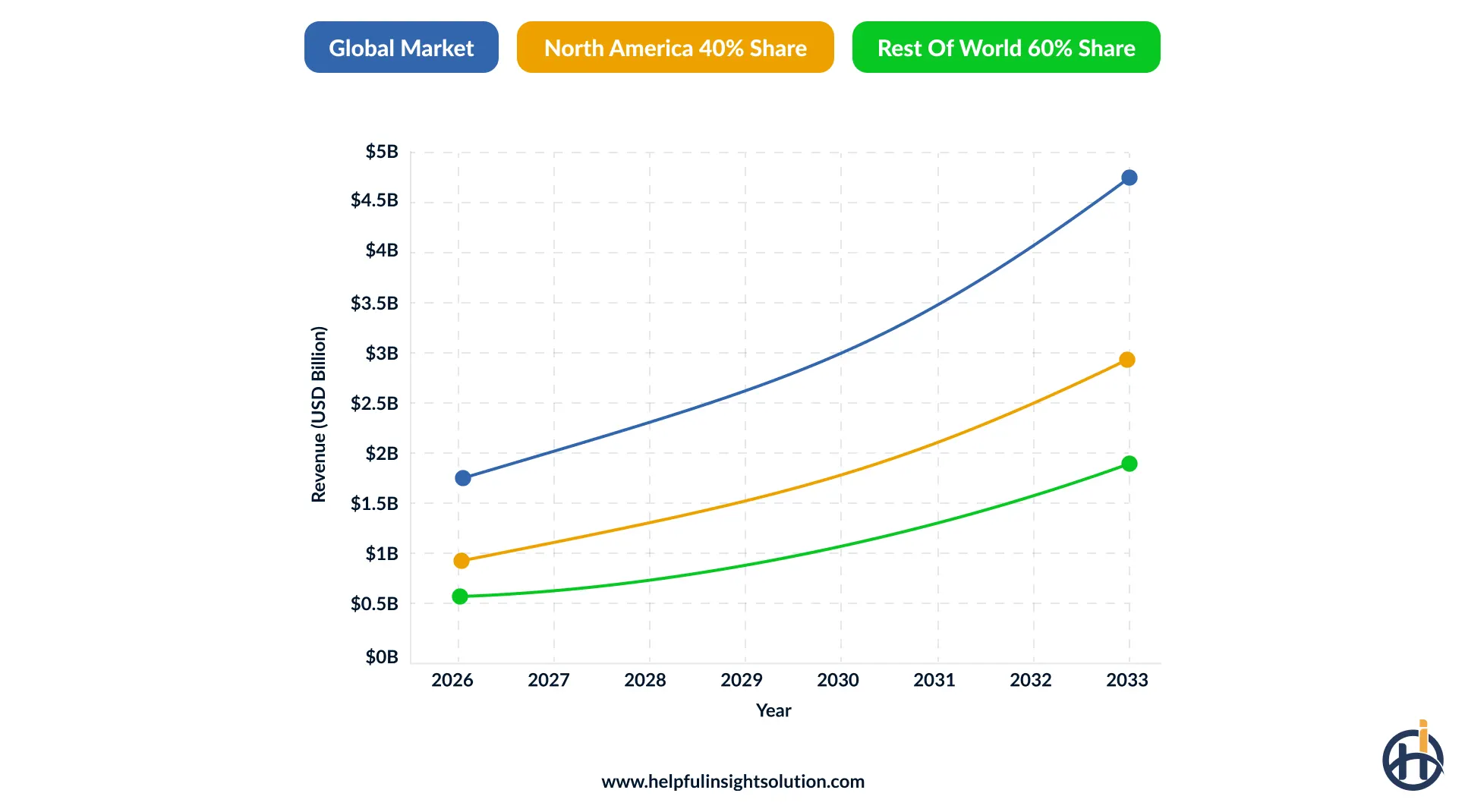
Based on the regional segment, North America has a share of 40% in this market. The number of electronic transactions in the USA has increased by 7.2% over the past five years. All these stats show that this market has a positive growth potential, creating several opportunities for investors.
How does RPA work in banking operations?
Business investors must know how RPA in banking works so they can easily integrate it into existing systems. You will understand the working mechanism of RPA, from data collection to payment processing.
1. Map banking processes
RPA replicates various human tasks, like application login, typing documents, and file transfer. This function increases data processing speed, reduces manual errors, and enhances working efficiency.
2. Configure and train RPA bots
The information is directed into the software “bots” that execute all these operations without disturbing banking units. From data extraction to system updates, they manage various file formats across devices.
3. Automated banking workflows
Different banking tasks, such as KYC verification, mortgage processing, and account reconciliation, are managed by RPA. It streamlines high-volume administrative workflows across various departments in real-time.
4. System optimization and scaling
Bots interact with the user interfaces to gather customer information and share databases with ERP or CRM servers. They optimize banking governance by scaling cloud infrastructure and AI-native services.
Key benefits of RPA in banking
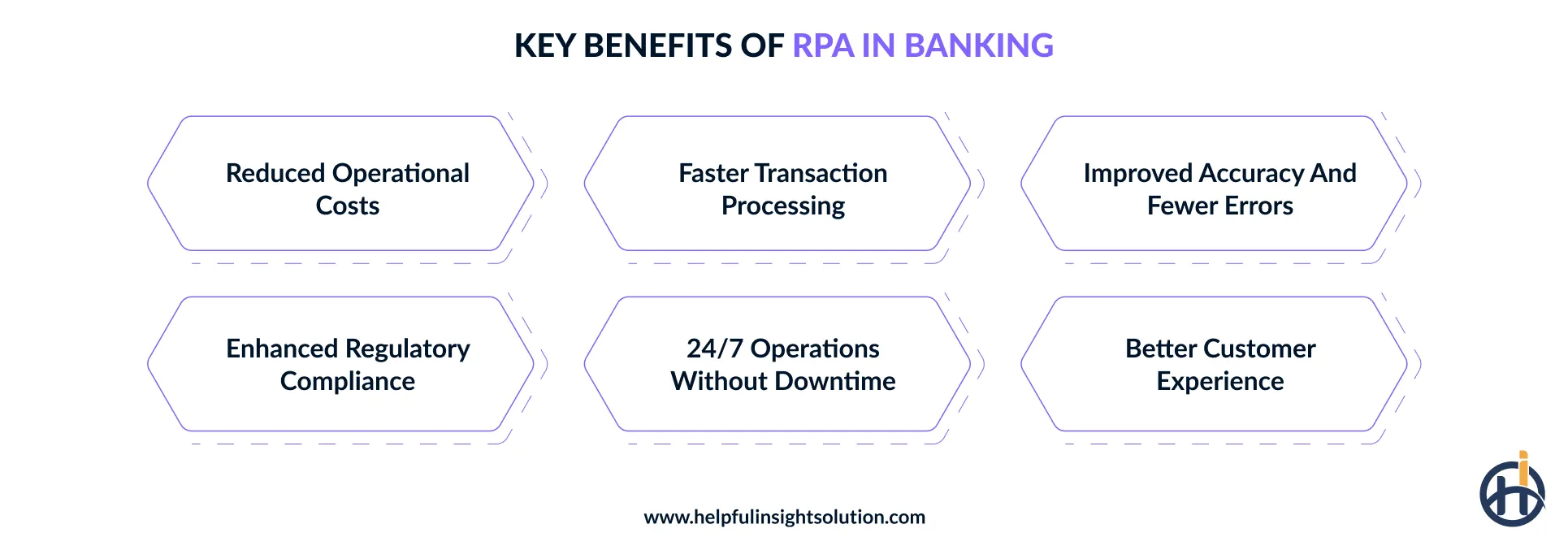
Cost reduction, accuracy, faster payments, and constant support are the major benefits of RPA in banking. We are going to discuss all these automation advantages that every entrepreneur must consider before investing.
1. Reduced operational costs
RPA bots can perform repetitive and high-volume tasks, which reduces operational expenses and allows humans to focus on advisory roles. They improve financial corrections, reduce penalties, and administer accounts by automating customer management.
2. Faster transaction processing
Banks can increase loan approval, account opening, and KYC verification rates by using RPA solutions that automate rule-based operations. Additionally, they enhance money transactions between different customers or merchants through instant query redressal.
3. Improved accuracy and fewer errors
Automation of data entry tasks reduces errors and ensures accuracy, which is one of the key benefits of RPA in the banking sector. The platforms can easily manage massive data structures with precision and prevent fatigue during heavy traffic loads.
4. Enhanced regulatory compliance
RPA ensures immutable audit trails, automated AML checks, and zero-error regulatory reporting, which reduces data breaches and system attacks. It can compile, format, and submit mandatory reports, such as Suspicious Activity Reports (SARs), with efficiency.
5. 24/7 operations without downtime
With RPA, banks can constantly run batch updates, process transactions, and handle customer queries without increasing downtime risks. It reduces backlog data and works in different time zones, preventing the need for real-time human operators.
6. Better customer experience
It reduces response times, ensures uninterrupted services, and minimizes financial errors during complex banking operations. RPA provides seamless synchronization across different mobile apps, web portals, and banking systems so customers get high-quality solutions.
Top RPA use cases that transform banking services
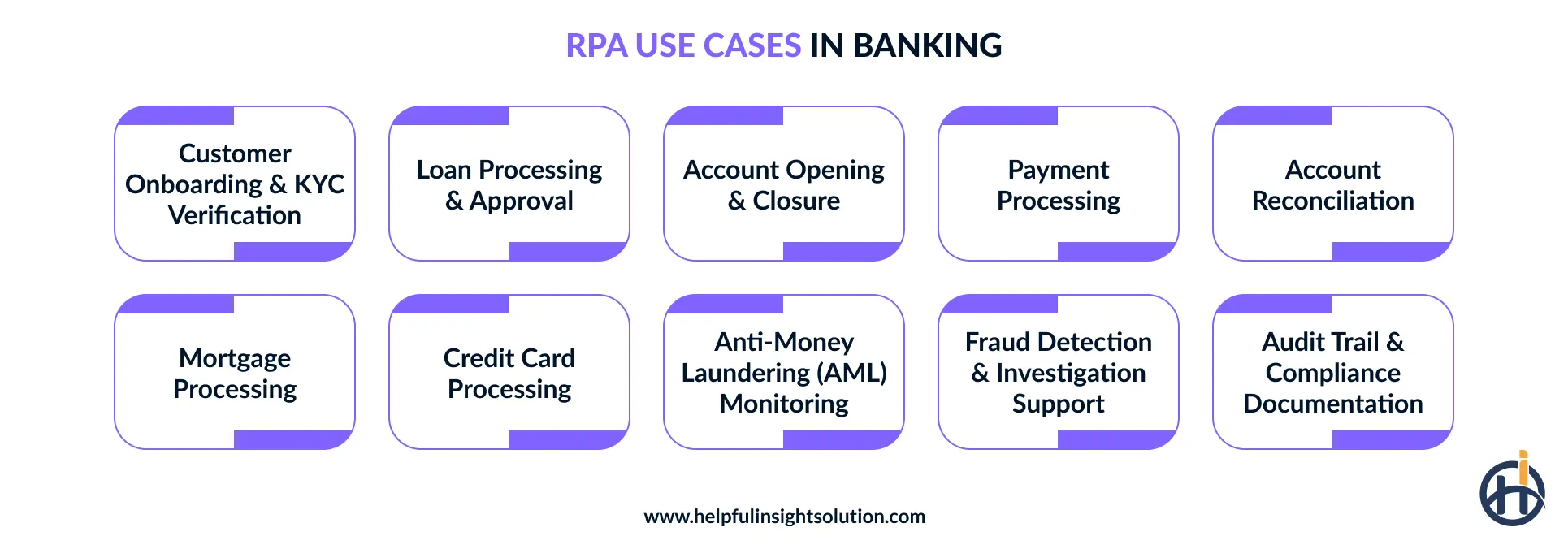
This section provides the best robotic process automation use cases in banking, divided into 3 categories. They are based on various tasks, covering customer verification, invoicing, fraud detection, and more. Let’s study the following applications with detailed information.
1. Customer Onboarding & KYC Verification
Robotic process automation collects, validates, and verifies customer information when someone is opening an account. The RPA system uses bots to get data from identity documents update the banking systems and do KYC checks without anyone having to do it. This makes the process of opening an account faster and more accurate and it also helps the bank follow the rules.
2. Loan Processing & Approval
The RPA system helps with loan applications by collecting documents checking customer information and sending the applications to the teams. It checks if the customer is eligible for the loan and updates the loan management system as it goes along. This minimizes loan approval time, increase efficiency, and reduces mistakes that people might make.
3. Account Opening & Closure
Banks use the RPA system to automate account-opening, checking documents and updating customer records in different systems. The bots also take care of requests to close accounts by doing the checks and telling the right departments. This RPA use case makes the experience better for the customer because it is faster and more consistent.
4. Payment Processing
The RPA system automates checking payments doing transactions and confirming them in banking channels. It checks the payment details updates the records and flags anything that is not right for someone to look at. This helps banks process payments faster and reduces mistakes that can happen when people do it.
5. Account Reconciliation
Banks use the RPA system to compare transactions in the banking systems, payment gateways and financial records. The bots find any transactions that do not match make reports about it and highlight anything that needs to be looked at. This makes the financial records more accurate and reduces the time it takes to reconcile them.
6. Mortgage Processing
The RPA system makes it easier to process mortgage applications by collecting customer documents checking information and tracking how the application is going. It automatically updates the loan records and sends the applications through the different stages of approval. It increases the mortgage approval rate and ensures that the documents are consistent for verification.
7. Credit Card Processing
Banks use RPA to do things like process credit card applications, allowing bots to check the information of people who want credit cards and activate the cards if they are approved. They also help with updating bills changing credit limits and dealing with problems. All of this is done automatically which makes things more efficient and helps customers.
8. Anti-Money Laundering (AML) Monitoring
RPA is always watching transactions to make sure everything is okay, as it uses rules to figure out if something suspicious is going on. It collects data about customers and transactions checks everything and makes reports for the people who make sure the bank is following the rules. This helps the bank follow the rules about money laundering and reduces the amount of work people have to do.
9. Fraud Detection & Investigation Support
RPA helps the teams that deal with fraud by collecting data about transactions and finding activity that’s not normal. It sends alerts when something unethical is going on, allowing bots to gather information from systems to help investigate. The use of AI in cybersecurity helps banks respond faster and deal with fraud better.
10. Audit Trail & Compliance Documentation
RPA keeps track of everything it does so there are records for people inside and outside the bank to check. It stores documents keeps track of what happened and makes sure everything is accurate. This makes things more transparent and easier to prepare for audits and helping with invoices and many other things that banks have to do.
RPA in Retail vs Commercial vs Investment vs Private Banking: A detailed comparison
There are commonly 4 types of banking services, which include retail, commercial, investment, and private. They target different groups of people, such as individuals, merchants, fundraisers, and large enterprises, respectively. Whether you want to include RPA in commercial banking or RPA in investment banking, the following table helps you to understand the key differences.
| Parameter | Retail Banking | Commercial Banking | Investment Banking | Private Banking |
| Primary RPA use cases | Customer onboarding, account services, loan processing | Cash management, trade finance, invoicing | Trade settlement, compliance, risk reporting | Wealth management, client onboarding, portfolio reporting |
| Target customers | Individual consumers and households | SMEs and large enterprises | Corporations, institutions, governments | High-net-worth and ultra-high-net-worth individuals |
| Process complexity | High-volume, standardized customer workflows | Moderate complexity with business-specific workflows | Highly complex, data-intensive financial operations | Personalized, relationship-driven financial services |
| Automation priority | Faster customer service and transaction processing | Operational efficiency and document automation | Speed, accuracy, and regulatory compliance | Personalized service and advisor productivity |
| Compliance focus | KYC, AML, consumer protection regulations | AML, tax reporting, business compliance | SEC regulations, AML, financial reporting | KYC, AML, data privacy, fiduciary compliance |
| Key business benefits | Reduced costs, faster services, improved customer satisfaction | Improved operational efficiency and reduced processing delays | Lower operational risk and accelerated trade execution | Enhanced client experience and streamlined wealth operations |
| Common RPA integrations | Core banking, CRM, mobile banking, payment systems | ERP, treasury, accounting, trade finance platforms | Trading platforms, market data, risk management systems | CRM, portfolio management, financial planning software |
RPA and AI: What your bank needs and when to implement
Robotic Process Automation: As you know, RPA helps banks to automate repetitive tasks according to pre-defined information and set regulations. It allows operators to handle data entry operations and manage customer queries through integrated bots.
Artificial Intelligence: It predicts future results based on unstructured data and handles complex tasks, like fraud detection. AI uses machine learning and other technologies to build models that analyze customer patterns and personalize banking services.
Businesses can use both RPA and AI in banking to generate automated financial data and allow systems to follow them as per the requirements. Banks must integrate AI development services to automate customer onboarding, personalize loan approvals, and ensure data security.
| Banking Task / Operation | Technology Needed | Why AI, RPA, or Both? | When to Implement |
| Customer Onboarding & KYC Verification | Both (AI + RPA) | AI validates identity documents while RPA automates customer onboarding workflows and data entry. | Implement when onboarding volumes increase and manual verification slows customer acquisition. |
| Loan Processing & Approval | Both (AI + RPA) | AI evaluates creditworthiness and risk, while RPA automates document collection, validation, and workflow routing. | Deploy when loan processing becomes time-consuming or approval turnaround needs improvement. |
| Transaction Processing | RPA | RPA automates repetitive payment processing, account updates, and transaction reconciliation with high accuracy. | Introduce when transaction volumes grow, and repetitive back-office tasks consume significant resources. |
| Fraud Detection & Risk Monitoring | AI | AI identifies suspicious transaction patterns and predicts fraudulent activities using machine learning models. | Implement when the bank requires real-time fraud detection and proactive risk management. |
| Regulatory Compliance & Reporting | Both (AI + RPA) | AI interprets compliance requirements, while RPA gathers data and generates audit-ready regulatory reports. | Adopt when compliance workloads increase, and regulatory reporting becomes more frequent. |
| Customer Support & Virtual Assistants | AI | AI-powered chatbots and virtual assistants provide personalized, 24/7 customer support and query resolution. | Deploy when customer service demand exceeds the capacity of human support teams. |
| Account Reconciliation & Financial Reporting | RPA | RPA automatically compares financial records, identifies discrepancies, and generates reports with minimal manual intervention. | Implement when reconciliation processes are repetitive, time-intensive, and prone to human error. |
How to implement RPA in the banking industry?
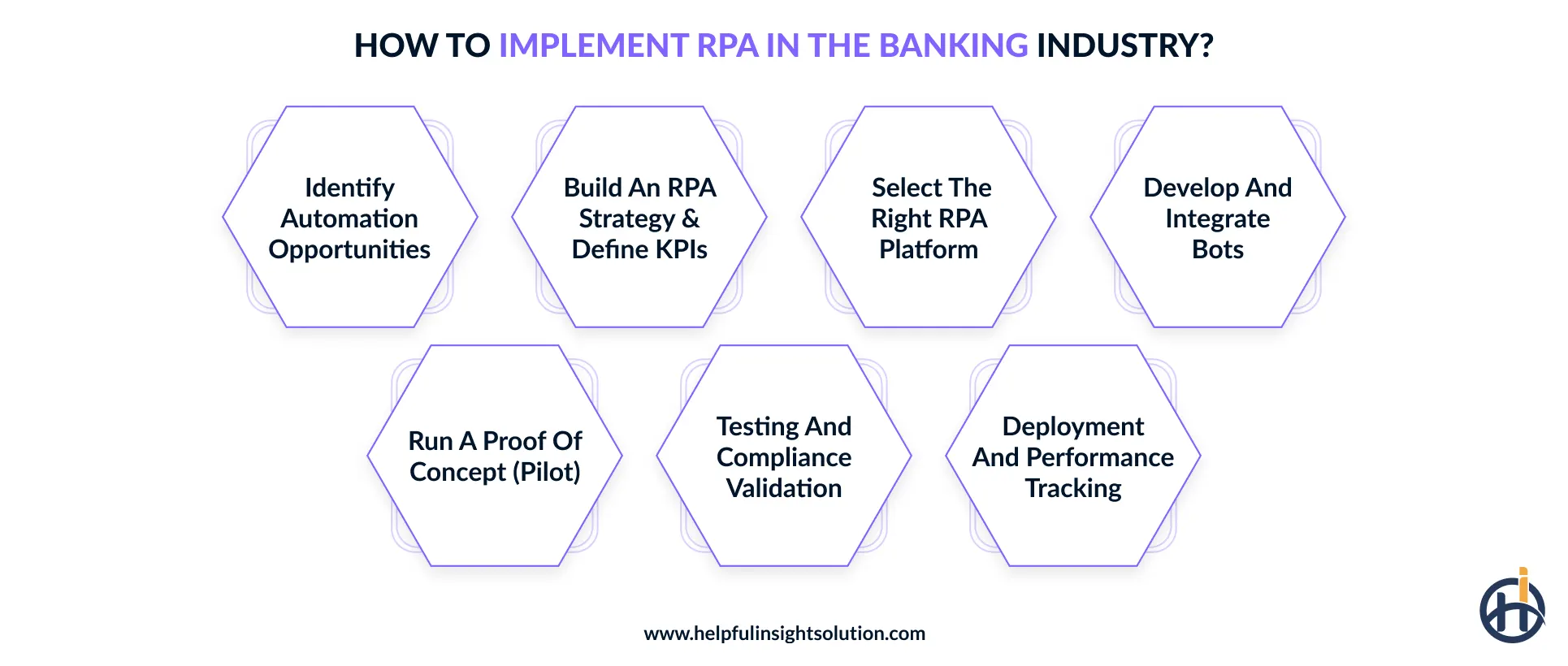
To implement RPA in banking, you must follow a certified process to prevent losses and ensure consistency. In this section, we will explore the generally used integration stages, from strategy planning to maintenance.
1. Identify automation opportunities
Start by looking at the banking operations to find tasks that are done over and over and take up a lot of time and resources. Things like checking who the customers are, processing loans, and reporting to make sure the bank is following the rules are usually good places to start. Focus on the tasks that will make the difference in making the bank run more smoothly and saving money.
2. Build an RPA strategy & define KPIs
Make a plan to automate these tasks that fits with robotic process automation services and specific business goals. Set goals that can be measured, such as how long it takes to process things, how much it costs, and how well the bank is following the rules. Having a plan makes sure that automating tasks actually helps the bank.
3. Select the right RPA platform
Choose a platform for automation that can handle a lot of work, is secure, can use intelligence, and works well with the bank’s existing systems. Think about how easy it’s to get started, how to make sure everything runs smoothly, how much support the vendor offers, and how much it will cost in the long run. The right platform should be able to handle what the bank needs now and in the future.
. Develop and integrate bots
Set up the automation tools to do the tasks that were chosen based on the rules of the bank. Connect them to the banking applications, APIs, customer relationship management systems, and older platforms to make sure all the data is shared smoothly. If everything is connected properly, the automation will be consistent and reliable across all the departments.
5. Run a Proof of Concept (Pilot)
Start a test project by automating one task and see how it goes before rolling it out to the whole bank. Check how well the automation tools are working, find any gaps in the workflow, and get feedback from the people who will be using them. If the test project is successful, it will make it less risky to put the automation in place.
6. Testing and compliance validation
Test the automation tools to make sure they are working correctly, can integrate with systems, are fast, and are secure. Check that the automated tasks are following all the rules and regulations, such as knowing who the customers are, preventing money laundering, and following the General Data Protection Regulation. Doing all this testing makes sure the automation is reliable and follows all the rules.
7. Deployment and performance tracking
Put the automation in place step by step to keep a close eye on how it is working using special dashboards. Track metrics such as how fast things are processed, how accurate they are, how much the automation tools are being used, and how much money is being saved to find ways to improve. Regularly checking and improving the automation program makes sure it stays efficient, secure, and able to handle work.
Implementation Costs of RPA in the Banking Industry
The implementation of robotic process automation in banking is dependent on the platform complexity and system compatibility. The cost ranges from $20,000 to $120,000, with features like CRM integration, report generation, compliance reporting, and dashboards. The overall cost may increase to $400,000 or more due to workflow orchestration, hyperautomation, and disaster recovery.
Businesses can create banking process automation software by including these features according to their budget requirements. Here is a table that describes estimated costs based on the different development models.
| Platform complexity | Estimated cost (USD) | Timeline | Description |
| Basic/MVP model | $20,000 – $50,000 | 2–4 months | It automates rule-based banking processes such as data entry, account verification, or report generation with basic dashboard integrations. |
| Intermediate platform | $50,000 – $120,000 | 4–7 months | This includes automated workflows, system integration, CRM, role-based access, analytics, and compliance reporting. |
| Advanced-level system | $120,000 – $250,000 | 7–10 months | It provides AI-driven document processing, workflow orchestration, fraud detection, process monitoring, and advanced analytics. |
| Enterprise-grade solution | $250,000 – $400,000+ | 10–18 months | This delivers banking services with hyperautomation, AI/ML capabilities, cloud deployment, and disaster recovery for large financial institutions. |
Compliance considerations for developing RPA-driven banking solutions
For creating a compliant and RPA-driven banking platform, it is crucial to follow strict regulations that ensure data security and secure transactions. Businesses must use KYC, AML, GDPR, and other compliance measures while integrating RPA in financial services. They are applicable for all types of banking methods, whether you include RPA in retail banking or other processes. Let’s understand these standards through the following table.
| Compliance/Regulation | Description |
| Know Your Customer (KYC) | It ensures RPA bots accurately automate customer identity verification and maintain compliant onboarding processes to prevent financial fraud. |
| Anti-Money Laundering (AML) | It requires automated monitoring, transaction screening, and suspicious activity reporting to detect and prevent money laundering and financial crimes. |
| Payment Card Industry Data Security Standard (PCI DSS) | This mandates secure handling, processing, and storage of payment card information through encryption, access controls, and continuous security monitoring. |
| General Data Protection Regulation (GDPR) | It governs the collection, processing, storage, and protection of personal data for customers in the European Union, ensuring privacy and data security. |
| SOC 2 (System and Organization Controls 2) | It verifies that RPA platforms follow stringent controls for security, availability, confidentiality, processing integrity, and customer data protection. |
| ISO/IEC 27001 | This is an Information Security Management System (ISMS) framework that protects banking data through risk management and continuous security improvements. |
Major challenges with RPA-driven banking systems
Businesses face several challenges of robotic process automation in banking, such as scalability and banking integration. We are discussing these problems with their respective solutions, helping investors to overcome them.
1. Integration with legacy banking systems
Frequent UI updates and poor data quality lead to system fragility because legacy platforms are rigid and complex. Execution speed also plays a major role in the integration of RPA bots, as they offer faster processing.
Solution: You should integrate middleware and Intelligent Document Processing (IDP) platforms with phased assessments in banking systems.
2. Regulatory compliance and data security
It is difficult to prevent unauthorized access, manage bot credentials, and ensure compliance audits during workflow changes. It is also dependent on the internal structure, affecting data quality and real-time accuracy.
Solution: Banks must establish a zero trust and Privileged Access Management (PAM) framework to generate automated permissions.
3. Process complexity and frequent changes
While integrating RPA in finance, if the bots are trained on wrong data, then they can violate banking regulations. They can expose sensitive customer data, increase access risks, and harm platform security.
Solution: Cognitive technologies like NLP and hyperautomation platforms manage multiple UI updates, backlogs, and regulatory shifts.
4. Scalability and bot maintenance
Workflow extension can cause broken processes, lack of standardization, data overload, and costly downtime. RPA bots require constant regression testing and scripting to remain functional, which is highly expensive.
Solution: It is beneficial to implement a centralized RPA Center of Excellence (CoE) that ensures a smooth transition between APIs.
How to choose the right RPA platform for your bank?
Various RPA platforms help banks to automate their onboarding, verification, and transactional services. You can choose a suitable RPA technology in banking by going through each tool and its application.
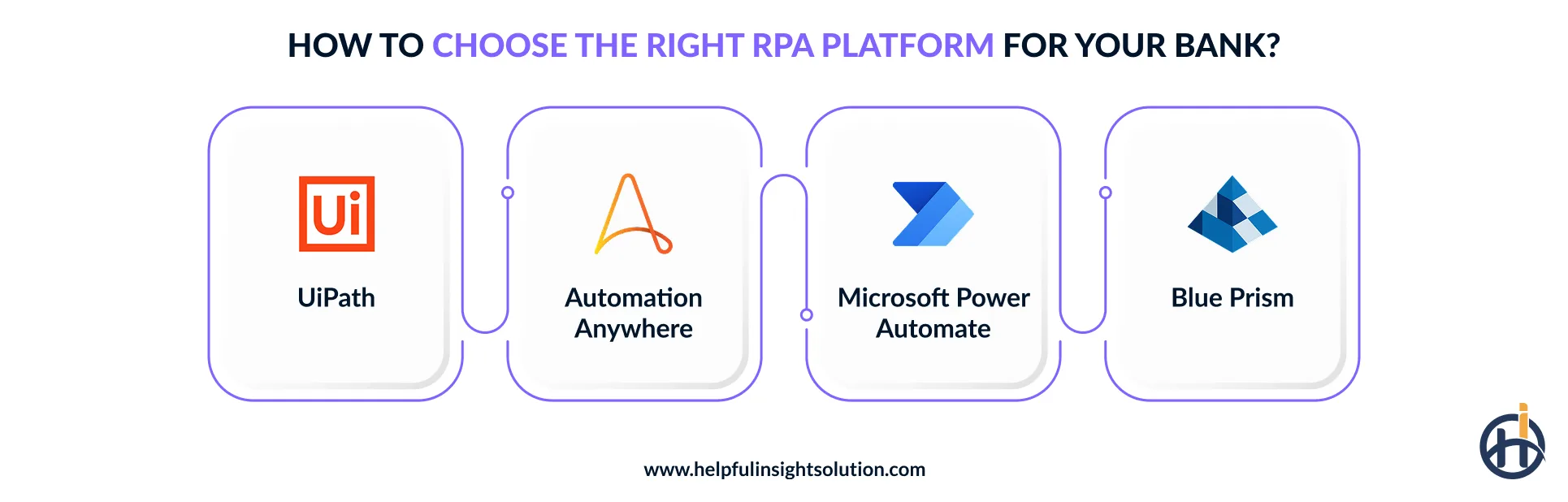
1. UiPath
UiPath is a popular choice for banks, as it uses intelligence to automate tasks, understand documents, and manage workflows from start to finish. This helps banks with things like verifying customer identities, processing loans, detecting fraud, and making reports.
2. Automation Anywhere
Automation Anywhere is another option that uses intelligence and analytics to automate complex tasks in banking. Various banks use it to automate customer onboarding processes, transactions, reconcile finances, and follow regulations.
3. Microsoft Power Automate
Microsoft Power Automate is a tool that lets banks create automated workflows without needing to write a lot of code. It works well with Microsoft 365 and Dynamics 365 and is good for automating tasks like approvals, managing documents, creating reports, and other repetitive tasks.
4. Blue Prism
Blue Prism is suitable for large financial institutions, offering security and governance features to handle a large volume of tasks. Banks often use it to automate tasks like processing payments, reconciling accounts, managing audits, and integrating with banking systems.
Real-world banking examples of RPA in action
Here we will observe the top robotic process automation examples in banking that offer quick customer support and loan processing. They have improved their financial processes through bot integration and smart data analytics.
1. HSBC
HSBC uses robotic process automation to automate the process of verifying customers, screening for money laundering, and generating reports to show they are following the rules. This helps the bank get things done faster, reduce mistakes, and ensure they are doing what the government requires.
2. Wells Fargo
Wells Fargo uses robotic process automation to make loan processing easier, reconcile accounts, handle payments, and help customers. By automating tasks that have to be done over and over, the bank can get things done faster, as the employees can focus on more important work.
3. Banco Santander
Banco Santander has started using process automation to automate work in the back office to process mortgages, get new customers, and make reports to the government. By reducing the amount of work that has to be done by hand, making sure everything is done the way the bank can work more efficiently and get things done faster for customers.
RPA Case Study: How we helped our client to enhance banking operations
The client was operating 50+ branches of retail and commercial banks, where multiple transactions were performed daily. Its back-office tasks depended on manual processing, which resulted in delayed customer service and increased operational costs.
The bank officials contacted us to implement an automated system to streamline workflows and improve compliance without replacing the existing platform.
Challenges it faced:
- Customers experienced slow account activation and long waiting times.
- Loan approvals were time-consuming due to manual data entry and high volumes.
- Banking teams took days to prepare regulatory reports and conduct audits.
- Data had to be entered in different applications, which reduced efficiency.
Our solution: We created banking process automation software that automated various financial tasks and improved the existing infrastructure. It reduced repetitive human intervention, standardized workflow, and enhanced visibility across banking operations.
How we have implemented:
- First, we have identified processes that are performed frequently, such as money lending, account opening, and documentation.
- Our experts created RPA bots that collect customer information, update KYC, and perform security checks.
- It automated loan processing through document verification, eligibility checks, and status notification.
- We have connected RPA bots with CRM, ERP, and APIs to deliver information instantly from the server.
- Integrated a centralized dashboard that regularly monitors bot performance, processing time, and system KPIs.
Business outcome: After implementing robotic process automation in banking systems, our client has improved the accuracy and efficiency of its daily operations. Employees now focus on customer satisfaction through instant query redressal and 24/7 technical support. This has increased transactional volumes, enhanced loan processing, and ensured compliance.
Future of robotic process automation in the banking sector
The future of RPA in banking will include AI-enabled financing, hyperautomation, and cloud-native solutions. They will enhance customer experiences, remove manual workload, and increase trust.
1. AI-powered credit processing
RPA and AI in banking can automate tasks like credit scoring, document verification, and loan eligibility assessments. This means they can approve loans faster and make decisions, and people do not have to get involved as much in lending operations.
2. Hyperautomation across banking operations
RPA, Artificial Intelligence, machine learning, process mining, and workflow orchestration will work together to automate all the banking processes from start to finish. This will make the bank work better, cost less, and provide service to all the departments.
3. Enhanced compliance and risk management
In the future, RPA solutions will always be watching transactions, automating reports that the bank has to give to the government, and keeping track of everything that happens. This will help the bank follow all the rules and find problems before they happen and change quickly when the financial rules change.
. Cloud-native and API-driven banking
Banks will use AI-powered RPA in the banking industry that is based on cloud architectures and an API-first approach to make it easy to connect the main banking systems and fintech applications. This will make it possible for the bank to exchange data in real time and get new digital banking capabilities up and running faster.
How does Helpful Insight deliver AI-driven RPA integration for banks?
We have discussed how RPA in banking can improve daily repetitive and rule-based operations, enhancing customer experiences. Now, to integrate this technology, you must hire an experienced and skilled team that ensures RPA expertise and constant support.
We deliver the best financial software development services, from consulting to execution, with strong technical guidance, budget planning, and market insights. You can discuss different ideas with us and make strategies that work better for your banking platform.
Our experts can implement robotic process automation in banking by analyzing system requirements, choosing the right tools, and configuring APIs. This allows financial institutions to boost the revenue cycle, reduce manual dependency, and ensure security across devices.
You can try different RPA combinations to become a market leader and gather more customers, increasing retention rates.
FAQs
Robotic process automation helps banks to cut operational costs, remove data entry errors, and enhance various financial tasks. It uses bots for loan processing and customer onboarding, which transfer information 80% faster. Additionally, it also ensures regulatory compliance and payment security, allowing employees to focus on customer engagement.
Traditional RPA systems work on predefined and rule-based data to perform repetitive tasks, following structured commands. AI-driven RPA solutions use machine learning, NLP, and computer vision to manage unstructured data for decision-making. Businesses implement both to handle various operations, from data entry to customer service automation.
Banks should implement robotic process automation to improve fraud detection, as it monitors large transaction volumes in real-time. Bots analyze various threats, flag anomalies, and automate security responses, like freezing accounts or triggering alerts. They collect information from different third-party sources and create client profiles to find inconsistencies.
RPA removes manual data entry, performs invoicing, redirects loan approvals, and routes payments in accounts payable. This results in faster processing time, reduces operational costs, and prevents common human errors. Bots help bank officials to extract information from documents or invoices and send it over the ERP server for accounting operations.
In credit card application processing, RPA automates data extraction, background checks, and KYC/AML verifications. This streamlines approval, allowing banks to easily issue cards to qualified customers within a few hours. It reads data from OCR or uploaded documents and cross-verifies across multiple systems before payment, reducing manual tasks.