

Key Takeaways
- Voice technology handles routine tasks so medical staff focus on actual patient care, improving their overall experience.
- Speech recognition and natural language processing make voice systems work together and turn spoken words into clinical action.
- There are different types of voice technologies, each designed for specific tasks like documenting patient notes, handling calls, or monitoring health.
- Security, compliance, and EHR compatibility must be evaluated before picking any voice technology vendor in healthcare.
In most hospitals, even today, patients call to book appointments. They call to ask about test results, prescription refills, and referrals. And more often than not, nobody picks up. So they call again and sit on hold.
And by the time someone answers, they’ve already Googled another clinic and booked there instead. That’s not a one-off situation. That’s a daily revenue leak most hospitals don’t even track.
On the other healthcare staff are busy with paperwork, manually logging appointments, chasing documentation, and updating records by hand. This is the exact problem voice technology in healthcare is solving right now.
Hospital and clinics using AI-powered voice solutions are already seeing the difference. Clinicians are getting time back from screens. Patients are actually talking to their doctors instead of waiting for them. Administrative backlogs that used to pile up for days are getting cleared in hours.
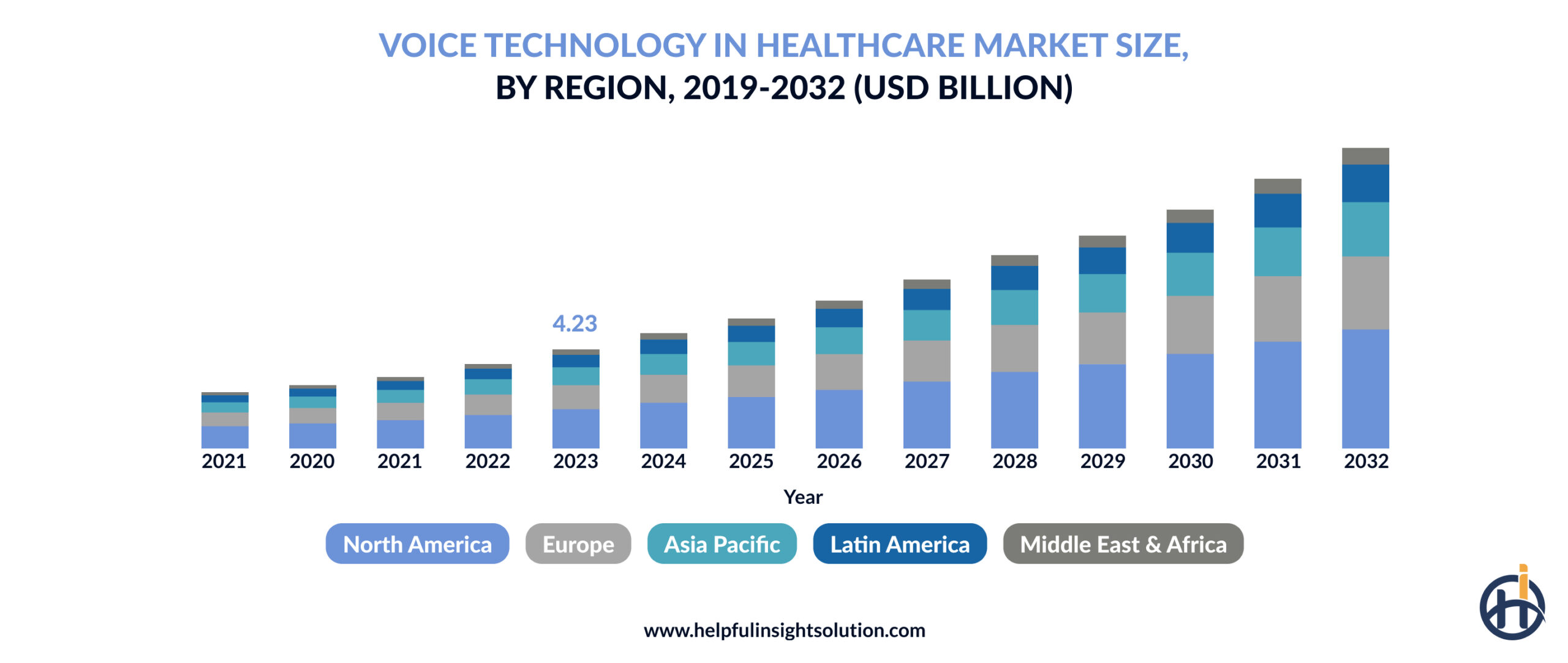
The market is responding to this shift. The global voice technology in healthcare market is projected to reach $21.67 billion by 2032. But knowing the market is growing and knowing how to actually use voice technology are two very different things.
This blog covers both. From what voice technology actually is, to the types, real-world use cases, and step-by-step implementation, everything you need to know is right here
What is Voice Technology in Healthcare?
Basically, it is a software that allows healthcare professionals and patients to interact with healthcare systems using voice commands. It uses speech recognition and natural language processing technology, which helps in tasks like transcribing clinical notes, booking appointments, and lab tests, all hands-free.
Wondering how it actually works? Let’s explore that:
Speech recognition listens and converts everything spoken into text in real time. It does not just transcribe words. It understands medical terminology, accents, and clinical context.
Natural language processing (NLP) takes that text and makes sense of it. It understands what is being asked, what action needs to happen, and routes it to the right place inside the system.
AI voice assistants then act on it. Scheduling an appointment, updating a patient record, and sending a prescription are all triggered by a single voice command.
Key Benefits of Voice Technology in Healthcare
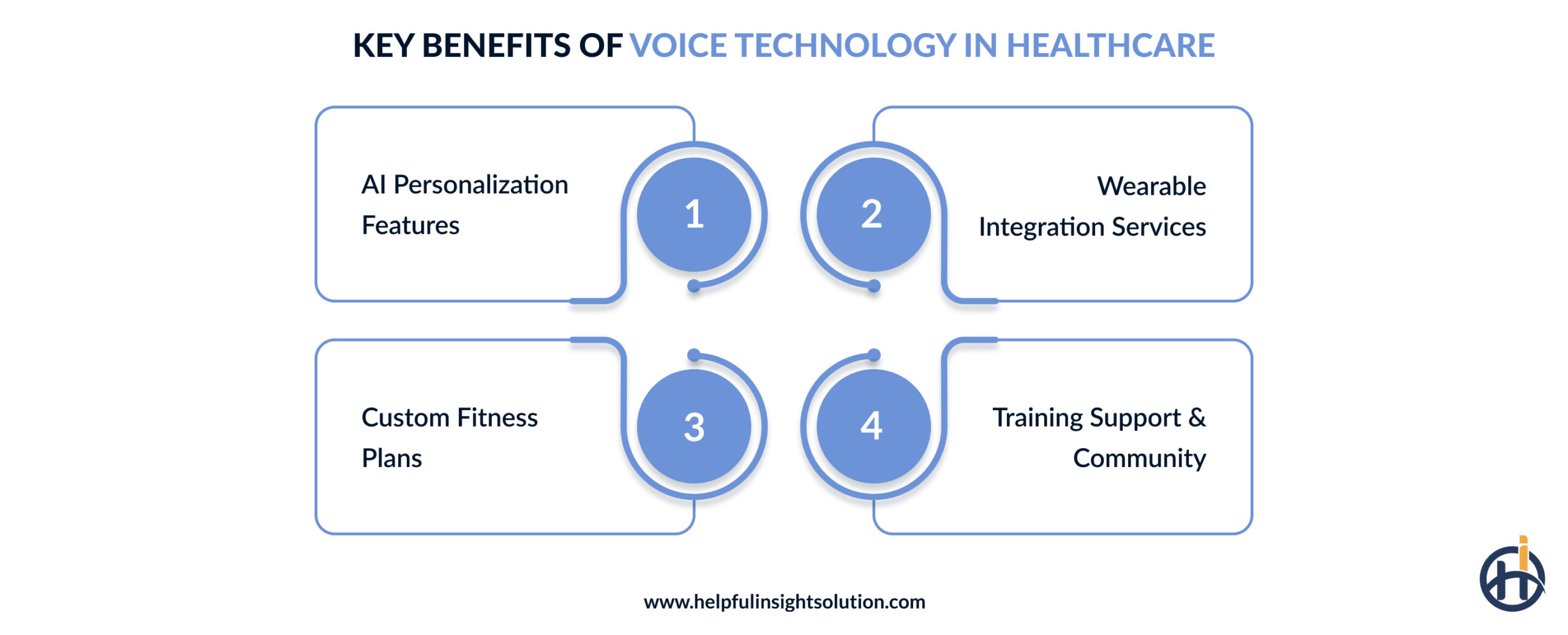
Confused about whether to invest in medical voice recognition software development? Thinking about whether it is worth the investment? Well, it is totally worth it as it offers amazing benefits that 360° transform the clinical workflows beyond delivering the best patient experience.
Let’s have a look at the advantages of voice or speech recognition technology in the healthcare industry.
1. Increased Efficiency and Productivity
A doctor seeing 30 patients a day cannot afford to spend 6 hours on documentation. Healthcare staff are managing growing administrative tasks daily. Voice technology handles repetitive tasks like dictating notes, updating EHRs, and logging prescriptions, so clinical staff work faster throughout their day.
2. Better Patient Engagement
Every clinic tries its best to deliver the best treatment and experience to the patients. Voice-enabled healthcare solutions can help in that. How? They check in on patients, flag missed doses, and confirm upcoming appointments without the need to make the call. This helps in a consistent boost in engagement rates.
3. Faster Clinical Documentation
In hospitals, documenting the notes is indeed one of the most time-consuming tasks. If notes aren’t written on time, there is a chance they will be forgotten. AI-driven voice technology captures clinical observations in real-time, the moment they happen. Documentation remains updated and nothing falls through the gap between seeing a patient and updating their file.
4. Improved Accuracy
Medical terminologies are complex, and if anything is typed in a rush can become a big issue. Voice technology healthcare captures exactly what the clinician says, including correct spelling, context, and record. Fewer transcription errors means fewer treatment decisions being made on wrong information.
Different Types of Voice Technology Used in Healthcare
Not every voice tool in healthcare does the same job. Some handle patient calls. Some document clinical notes. Some analyze speech patterns for early diagnosis. Understanding which type does what helps you know exactly where each one fits inside your system.
1. Voice-Enabled Virtual Health Assistants
Most patient requests are routine. Booking an appointment, asking about medication, and checking clinic hours. Medical voice assistants handle all of that through simple voice commands, any time of day. So, your staff stays focused on work that genuinely needs a person in the room.
2. Speech-to-Text Technology
This technology listens during consultations and updates patient records as the conversation happens. By the time the appointment ends, the notes are already complete. There is no need for medical staff to manually type, and there is no backlog waiting for the next morning.
3. Interactive Voice Response (IVR)
Patients used to hang up the moment they heard press 1 to book an appointment. Modern IVR holds a past and present conversation, books appointments, processes prescription requests, and manages after hours calls without routing anyone to voicemail.
4. Voice Biomarker Analysis
The way someone speaks, their pitch, pace, and tone, can reveal early signs of conditions like Alzheimer’s and respiratory illness before other symptoms even show up. A routine patient call becomes a passive diagnostic checkpoint without any extra tests.
Use Cases of Voice Recognition Technology in the Healthcare Industry
Voice recognition healthcare technology can be used in so many ways and can be implemented across different operations of healthcare organizations
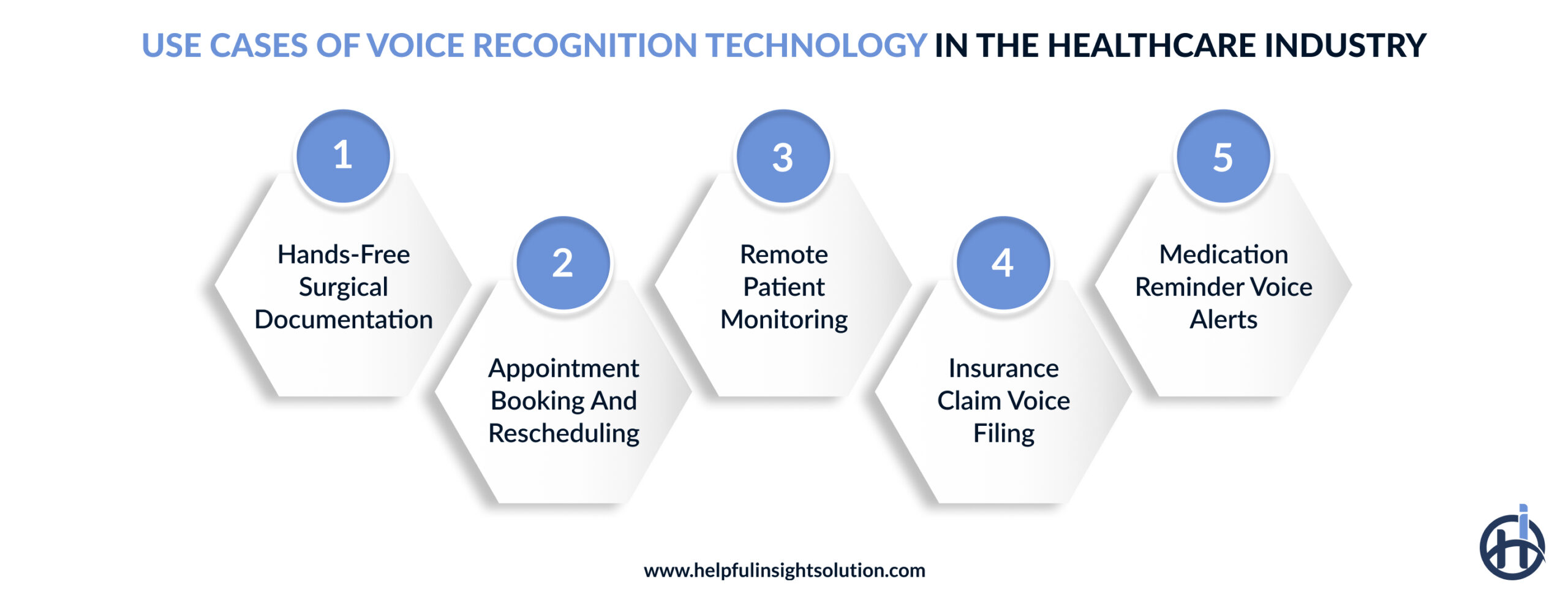
1. Hands-Free Surgical Documentation
The very first highly popular example of voice recognition technology in healthcare is clinical documentation. Surgeons use voice commands to log procedural notes, request instrument counts, and update records mid-procedure. As a result, nothing is missed, and everything is documented in real-time.
2. Appointment Booking and Rescheduling
Medical staff are overburdened with calls to book or cancel doctor appointments that actually don’t need a human to handle. Voice AI agents manage appointment scheduling, cancellations, and rescheduling around the clock. Zocdoc’s voice agent, Zo, already does this at scale, handling inbound patient calls autonomously and cutting wait times.
3. Remote Patient Monitoring
With AI voice generators and recognition systems, patients can manage chronic conditions and report symptoms right from their homes. The system flags anything that looks unusual and alerts the clinical team before it becomes an emergency. Presbyterian Hospital runs exactly this model, connecting patients with chronic conditions to nurses through remote monitoring.
4. Insurance Claim Voice Filing
Insurance claim filing has always been the part nobody enjoys, with rigid forms and manual logging. Voice technology replaces that entirely. Policyholders speak naturally to an AI assistant, details get captured in real time, and the claim moves forward without a single form being filled.
5. Medication Reminder Voice Alerts
Missed doses don’t just affect patients; they drive readmissions and inflate treatment costs. Medical voice assistant reminds patients when to take medication and logs confirmations, so they never miss their medication. For example, Hippocratic AI uses voice systems to help with simple patient tasks like medication reminders, regular check-ins, and preparing patients before appointments.
Steps to Integrate Voice Technology in Healthcare Systems
Want to implement voice technology powered by AI into your healthcare organization? Well, doing this requires following a series of steps that cover the points given below. Let’s take a look:
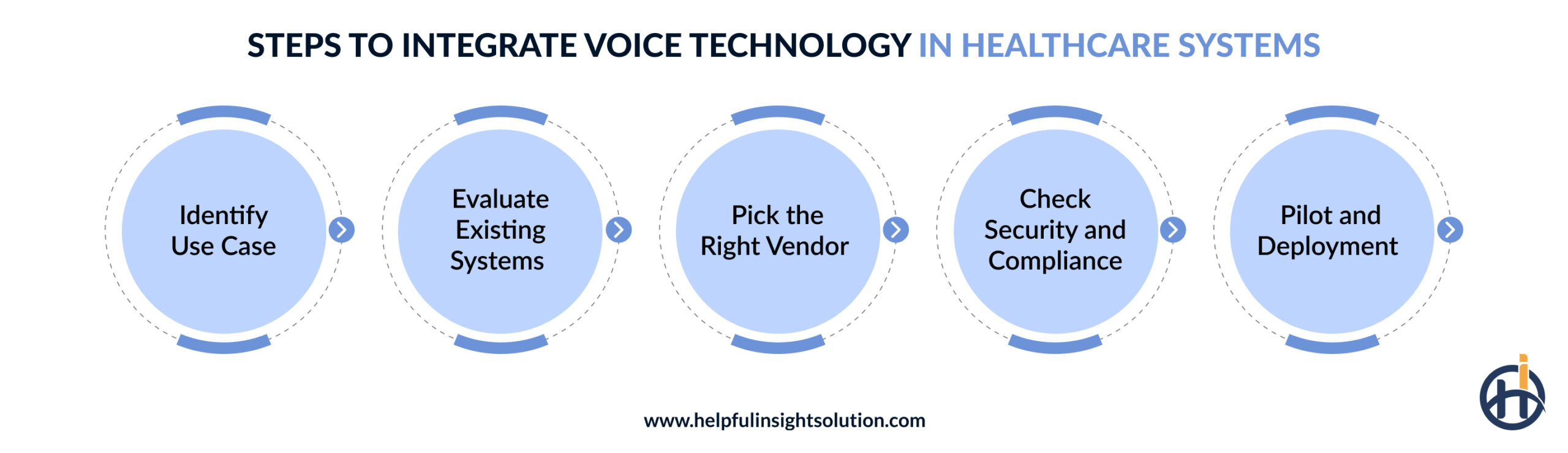
1. Identify Use Case
To begin, first, you have to decide why you want to use voice technology in healthcare and what purpose it will solve. Don’t try to solve everything at once. Start with the biggest problem. Maybe it’s documentation, scheduling, or patient follow-ups. Focus on the area causing the most trouble and where improvements are easy to measure.
2. Evaluate Existing Systems
Before bringing anything new in, assess your current technical infrastructure and systems. Your EHR systems, hospital management software, and data infrastructure-all of it needs to support real-time voice integration. Skipping this step usually creates bigger problems in the future.
3. Pick the Right Vendor
Not every AI development services provider understands healthcare. You need someone who has actually worked in this space, someone who knows HIPAA, understands EHR integration, and has built for clinical environments before. The wrong vendor is expensive to fix. Take your time with this one.
10. Check Security and Compliance
Healthcare voice recognition software constantly captures sensitive patient data. That means encryption, access controls, and data privacy compliance can’t be figured out after the system goes live. Sort all of this out before deployment, not after something goes wrong.
5. Pilot and Deployment
Rolling out an AI voice system across the entire operation right away usually isn’t the best move. It makes more sense to start with one department first and see how things actually work in a real setting. Talk to the staff using it every day, train them, pay attention to what slows them down, and make changes along the way. That early feedback can save a lot of trouble before expanding it further.

Partner with Helpful Insight to Build Voice Recognition Healthcare Software
Voice technology in healthcare isn’t a future investment anymore. Healthcare organizations using it today are already seeing shorter documentation times, fewer missed calls, and clinical staff who actually have time to focus on patients. The gap between hospitals or clinics that have adopted it and those still running on manual processes is only going to widen from here.
If you are also planning to implement AI-driven voice technology, our healthcare app development company is here to help you. We build secure and intelligent voice and medical speech recognition systems for real clinical environments. From EHR integration to patient-facing voice solutions, we build around your specific workflows and needs.
So, what are you waiting for? Connect with our team to build the best medical voice recognition software that your patients and clinical staff will actually use.
FAQs
The cost to implement voice technology healthcare is impacted by a broad range of factors. These factors include solution type, customization level, data collection and training, integration requirements, and the location of developers. Therefore, it’s hard to determine accurate pricing, but on average, it can fall between the range of $20,000 to $70,000 for pilot programs and $70,000 to $200,000 or more for enterprise-grade solutions.
The voice recognition software medical can be used for a wide range of tasks, like:
- Recording patient visit notes
- Booking appointments automatically
- Sending medication reminder calls
- Transcribing doctor conversations
- Supporting remote patient monitoring
- Assisting emergency response communication
Yes, voice technology can integrate with your existing systems like patient portals and EHRs, to improve accuracy, reduce paperwork, and allow healthcare staff to focus more on patient care.
Some of the popular real-life examples of voice recognition in healthcare are:
- Amazon Alexa in patient rooms
- Zocdoc’s Zo for appointment booking
- Hippocratic AI for patient follow-ups
- Nuance DAX for clinical notes