

Have you ever faced problems in delivering groceries or connecting with vendors in your region? It is a common issue for businesses that operate manually in this era of digital transformation and innovation.
There are many reasons, like consumer choices and price inconsistency, that affect the growth of local distributors. This forced 60% of market retailers in the USA to start an online grocery store, which helped them to increase 40% efficiency in their daily operations.
Additionally, businesses across the globe have started investing in retail delivery app development to boost sales and increase profit margin. For them, it is important to know various aspects like user choices, new innovations, and budget models to excel in this industry. It also involves other contributors like market vendors and delivery partners, other than the consumers.
You need a complete resource to understand market scenarios, benefits, app features, and steps to build a grocery delivery app. This blog covers all these topics with detailed information along with cost, monetization, and some other key facts in detail.
Stats on the Market Growth of Grocery Delivery Apps
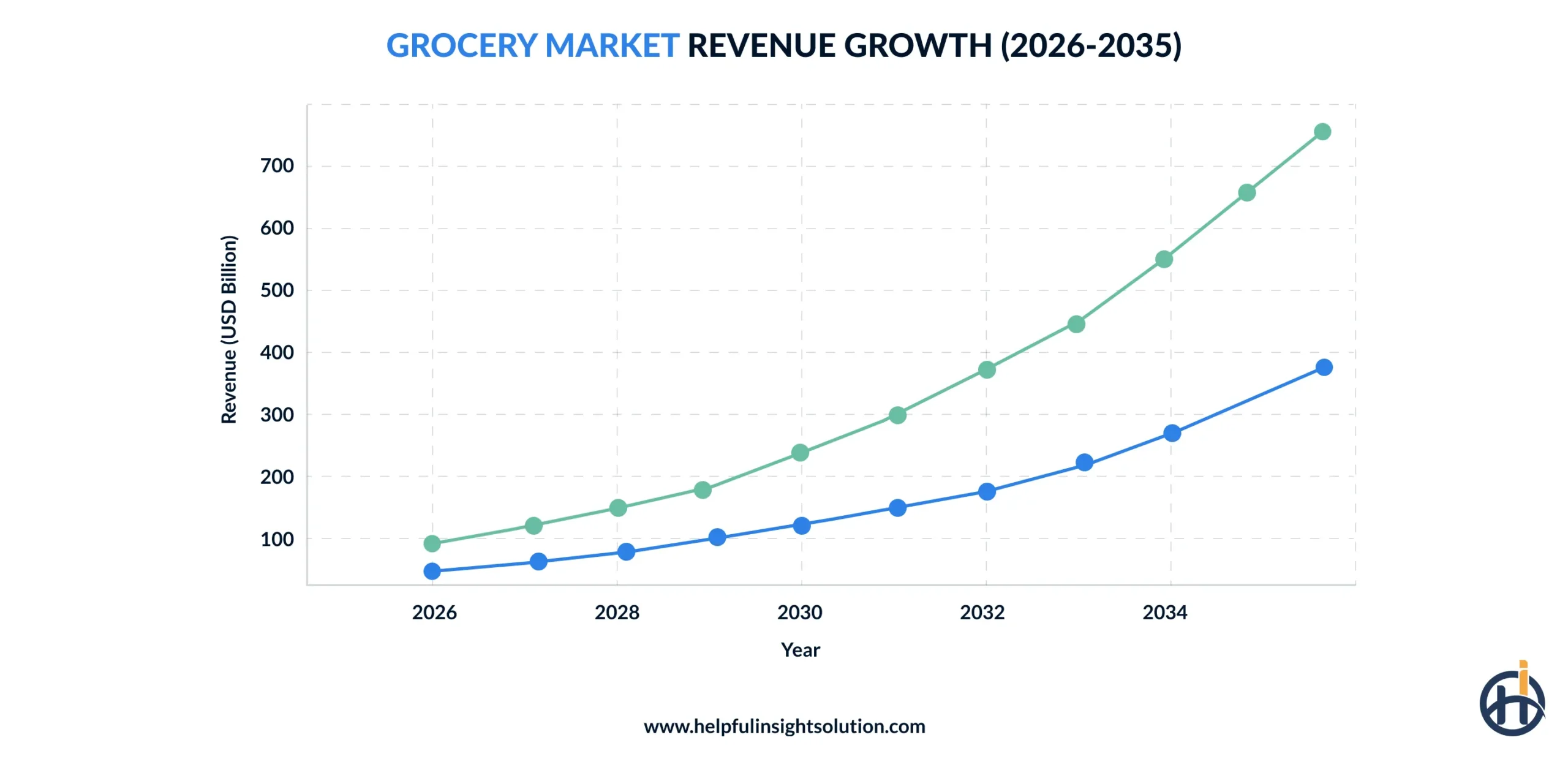
Businesses can observe a sudden rise in the on-demand grocery delivery app market because of increased user needs and investments. It is crucial to know various aspects, such as revenue share and growth rate, that help you to easily understand the current and future opportunities.
- In 2026, the current annual revenue of the grocery market is $93.2 billion, with the Asia Pacific region having 60% market share.
- By the end of 2035, this revenue will increase to $737 billion because the market is growing rapidly at a rate of 25.9% CAGR over this period.
- Currently, the Asia-Pacific region has a total volume of $44.1 billion, which will reach $446.4 billion by the end of this tenure.
- The North American and European regions hold a share of 24% and 29%, respectively, which will grow in the future.
- The retail segment has a share of 67.6%, whereas the staples and cooking essentials segment has around 28% market share.
If you are deciding to make the top grocery delivery apps, like Walmart and Amazon Fresh, after going through the above market figures, then you must hold on. There are a lot more things that you have to know before starting your online grocery business.
Available Types of Grocery Apps
To start delivering grocery delivery services, you need to know the various types of models available in the grocery industry. We will discuss the four major categories in this section before moving forward.
1. Instant Delivery Apps
These platforms deliver groceries in 10-20 minutes, focusing on common items, like snacks and dairy products. This reduces delays, enhances delivery networks, and improves shopping experiences for users.
2. Grocery Aggregator Apps
An on-demand grocery delivery app, like Walmart, connects customers with multiple local stores in a region. It helps them to easily browse products, compare prices, and order different items in real-time.
3. Chain Store Apps
They are launched by popular retail brands that offer direct access to grocery deliveries, decreasing dependency. Additionally, they help users to set pick-up slots, which increases efficiency and management.
4. Grocery Coupon Apps
You can build grocery apps that provide market coupons, discounts, and offers to repeat customers to ensure loyalty. Businesses can boost user engagement by delivering trust through improved services.
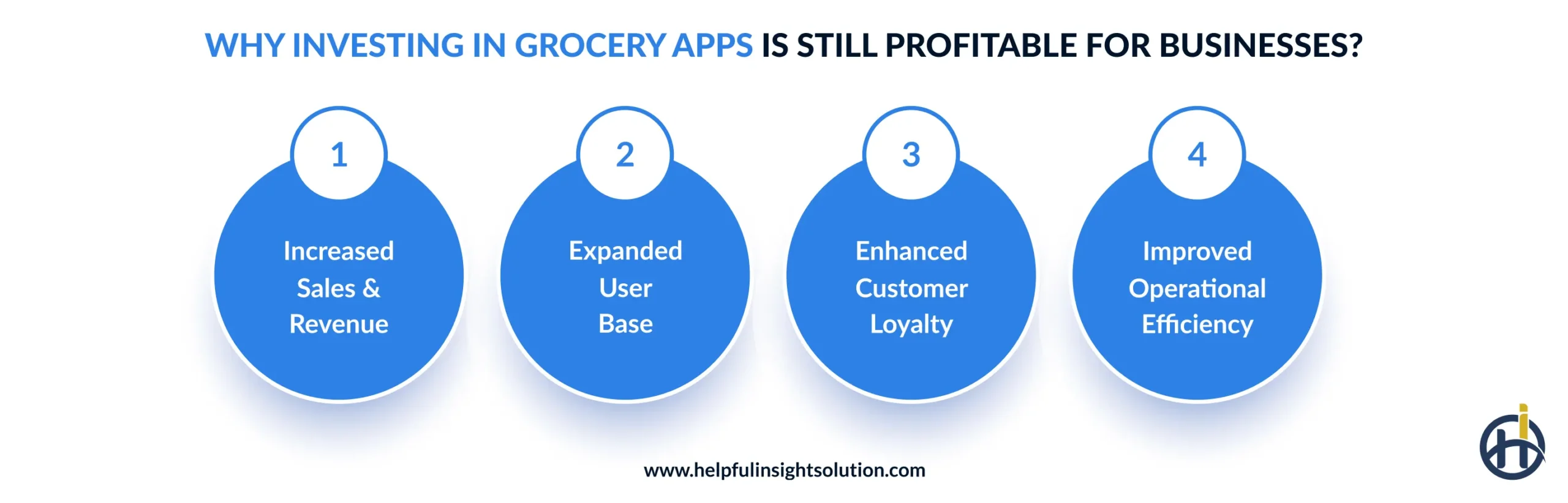
Why Investing in Grocery Apps is Still Profitable for Businesses?
Businesses can create a mobile grocery delivery application, as there are a lot of benefits, like an increase in sales. These platforms help in gathering a large number of customers and enhance task management. In this section, let’s explore the key benefits of grocery delivery apps and how they can create new opportunities for your business.
1. Increased Sales & Revenue
You should develop grocery apps, as they enhance user convenience by addressing modern demands and increasing sales efficiency. They can increase orders, multiply revenue streams, and improve conversion rates through optimized delivery services.
2. Expanded User Base
Businesses can expand their online grocery delivery business by crossing various physical and geographical limitations. The hyperlocal market allows retailers to serve a wider range of customers, reducing time consumption and inaccuracy.
3. Enhanced Customer Loyalty
By investing in grocery delivery application development, you can convert new users into repeat buyers, offering personalized services. Businesses can track customer preferences to provide various discounts on subscriptions that build trust and confidence.
Improved Operational Efficiency
An online grocery market helps businesses to reduce operational and management costs by providing remote settings. This is not dependent on store size, which helps retailers to easily handle multiple customers and deliver groceries on time.
Best Features of Online Grocery Applications
The must-have features of a grocery delivery app include delivery tracking, in-app chatting, and sales analytics. They improve user experiences through a smooth interface and instant app responsiveness.
-
User Panel Features
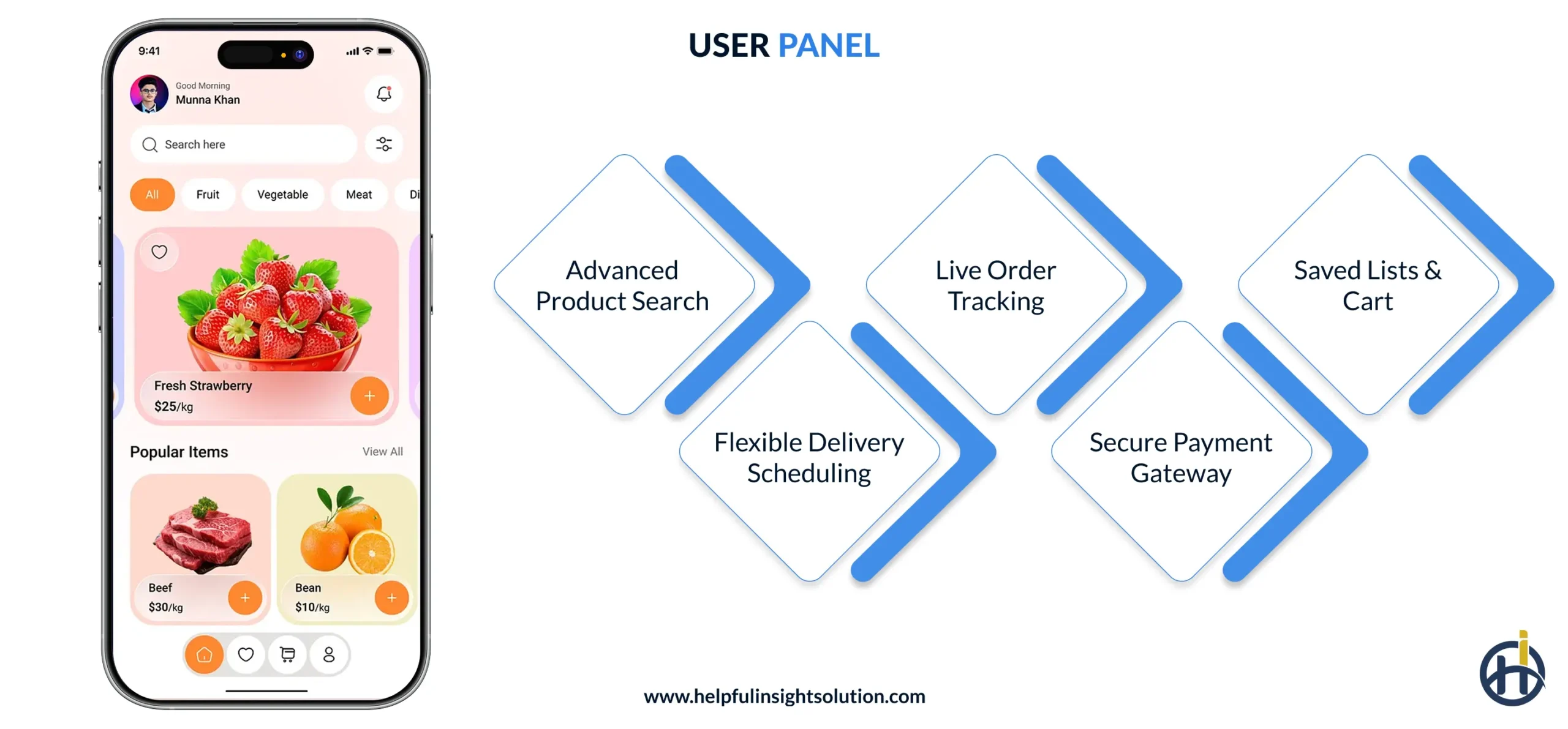
1. Advanced Product Search
A search bar with enhanced AI capabilities helps users to find various fruits, vegetables, and dairy products. It tracks past orders and personal preferences to deliver the best product recommendations.
2. Live Order Tracking
Users can easily track orders by using integrated mapping features that offer smooth GPS navigation services. It provides instant location, from pickup store to delivery address, ensuring live monitoring.
3. Saved Lists & Cart
It is easy to save products in wishlists or automated carts that provide complimentary products based on purchases. A custom grocery delivery app allows users to easily check out from a dynamic bucket list.
4. Flexible Delivery Scheduling
The top grocery delivery apps like Instacart allow customers to set delivery timings according to their availability. This is beneficial for corporate customers who are busy and cannot go to purchase products.
5. Secure Payment Gateway
This feature helps users to pay for various groceries through secure transaction methods, like UPI, COD, and Net Banking. People can also use credit cards to make payments online and get discounted deals.
-
Driver Panel Features
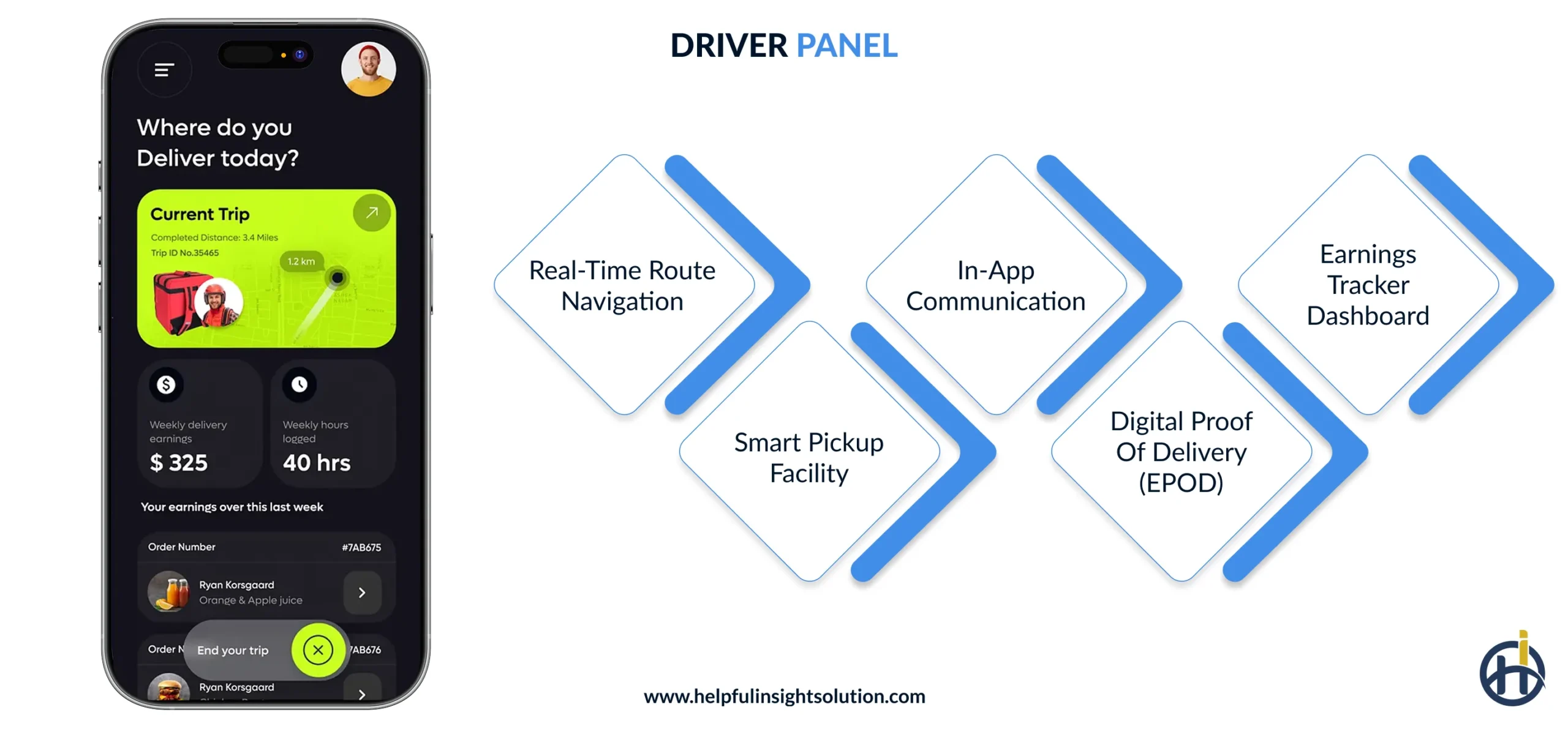
1. Real-Time Route Navigation
Drivers can review and select the shortest path from the store to the users’ location, allowing faster deliveries. This helps them to deliver multiple groceries and increase their earnings in a single day.
2. Smart Pickup Facility
The app provides a complete description of the grocery store with images, employees, and timings for drivers. It assists them in easily finding the vendors’ location by connecting with the owners in real-time.
3. In-App Communication
It is easy for drivers to chat with the users and store operators regarding delivery status and location updates. They can communicate through text and voice messages, ensuring accuracy and efficiency.
4. Digital Proof of Delivery (ePOD)
These grocery delivery app trends allow delivery partners to capture the image of the product for safety and reliability. Additionally, the app sends a digital receipt to users that proves the delivery is completed.
5. Earnings Tracker Dashboard
A personalized dashboard is given to the drivers, so they can easily track their daily or monthly earnings. It tracks various parameters like user reviews, distance traveled, and deliveries performed in real-time.
-
Admin Panel Features
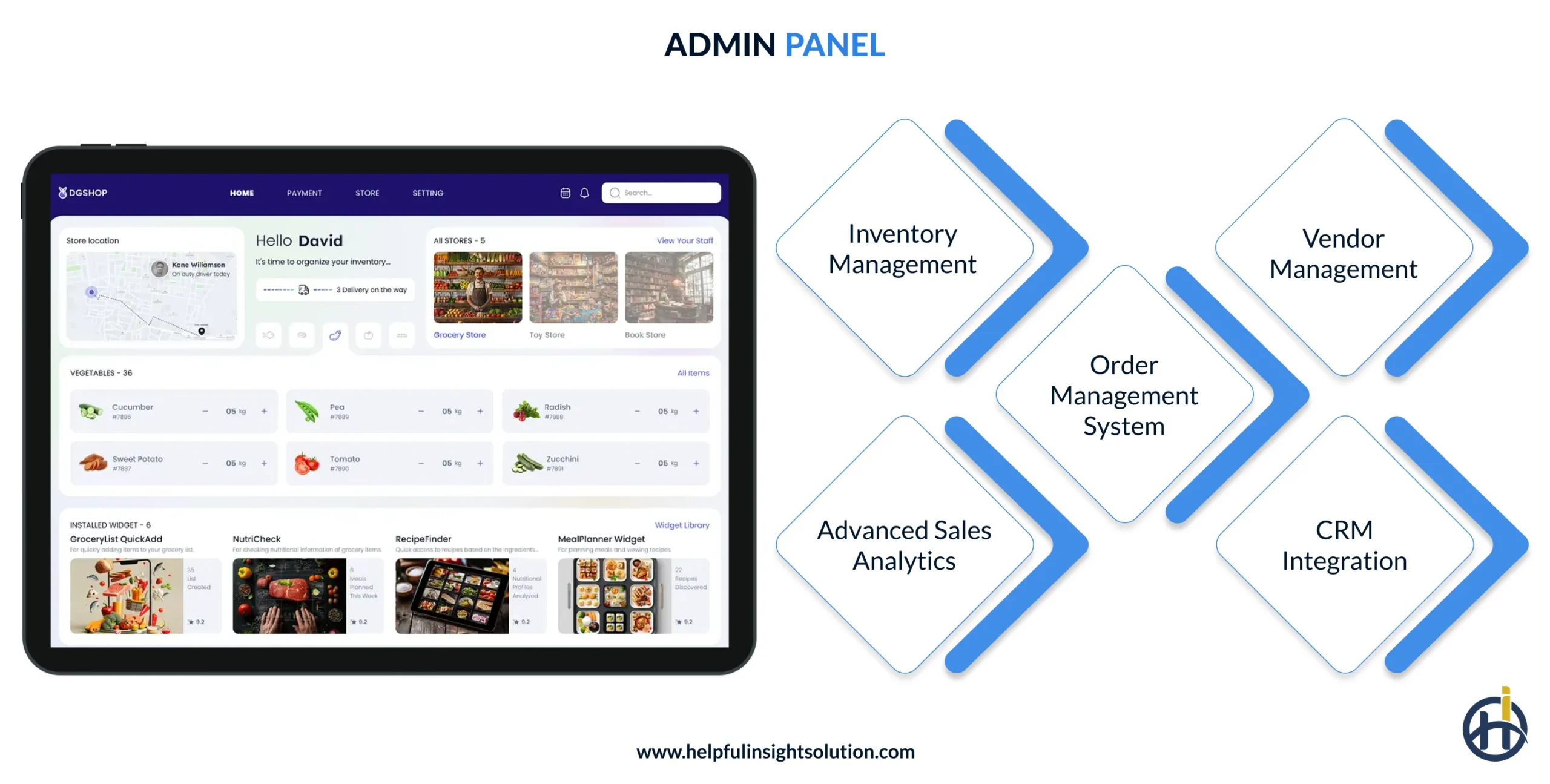
1. Inventory Management
A smart grocery app allows admins to check the available stock, send an order request, and update the status. This helps them to easily manage customers and grocery items, maintaining overall user trust.
2. Order Management System
Various fruit delivery apps handle multiple orders through dynamic APIs during peak hours and high demand. Additionally, they track refunds and cancellations, which require a quick reaction in less time.
3. Advanced Sales Analytics
Some analytics features in a grocery delivery application allow retailers to review monthly and yearly sales. They also provide an interactive dashboard that shows assets and liabilities in the business.
4. Vendor Management
Businesses with multiple grocery chains can connect with local vendors and regional market experts for expansion. They can provide discounts on grocery deliveries, building trust and authenticity in the market.
5. CRM Integration
An integrated CRM portal helps in tracking various user issues, like rotten products, missing items, and money fraud. The customer support team provides instant resolution by raising user-specific tickets.
-
Advanced Features
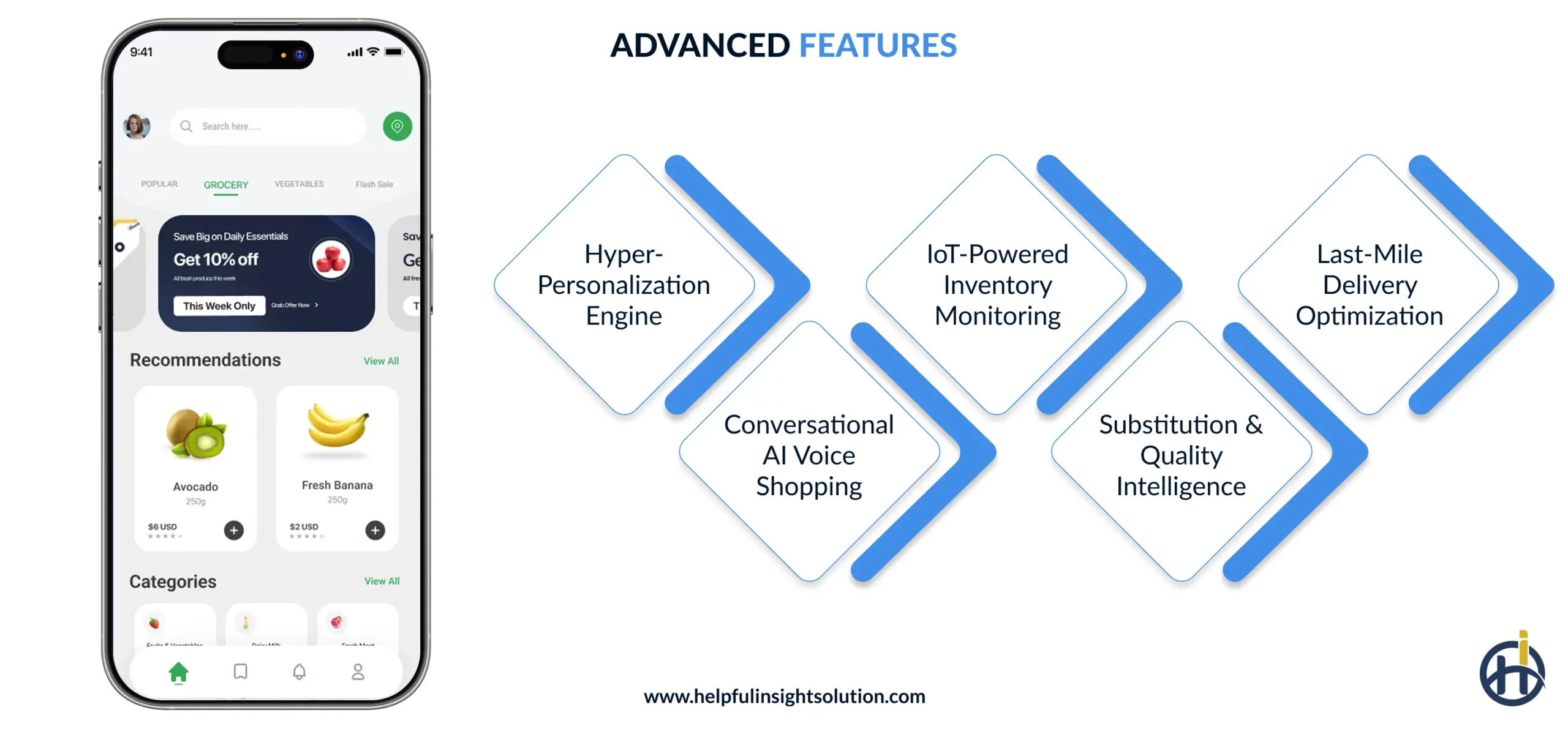
1. Hyper-Personalization Engine
AI is used to personalize user experiences based on their preferences, purchase history, and product searching. It recommends various grocery items that users buy daily or frequently at a particular time.
2. Conversational AI Voice Shopping
In the search bar, users can find products through advanced voice commands that use NLP components. An advanced grocery delivery app ensures human-like interactions, enabling better customer support.
3. IoT-Powered Inventory Monitoring
Businesses can use connected sensors, RFID tags, and GPS services to track inventories and grocery deliveries. This reduces errors, optimizes storage space, and prevents warehouse issues for retailers.
4. Substitution & Quality Intelligence
The increasing market demand for a particular product allows apps to select a suitable substitute grocery item. It uses AI-powered predictive models that analyze changes in inflation metrics and consumer behavior.
5. Last-Mile Delivery Optimization
This feature streamlines costlier deliveries for grocery vendors, enhancing the overall supply chain model. It involves route planning, automated shipment, and communication that ensure better workflow efficiency.
How to Create a Mobile App for Grocery Delivery?
Wondering how to develop a grocery delivery app? This section walks you through the entire development process, covering everything from planning and development to deployment and maintenance.
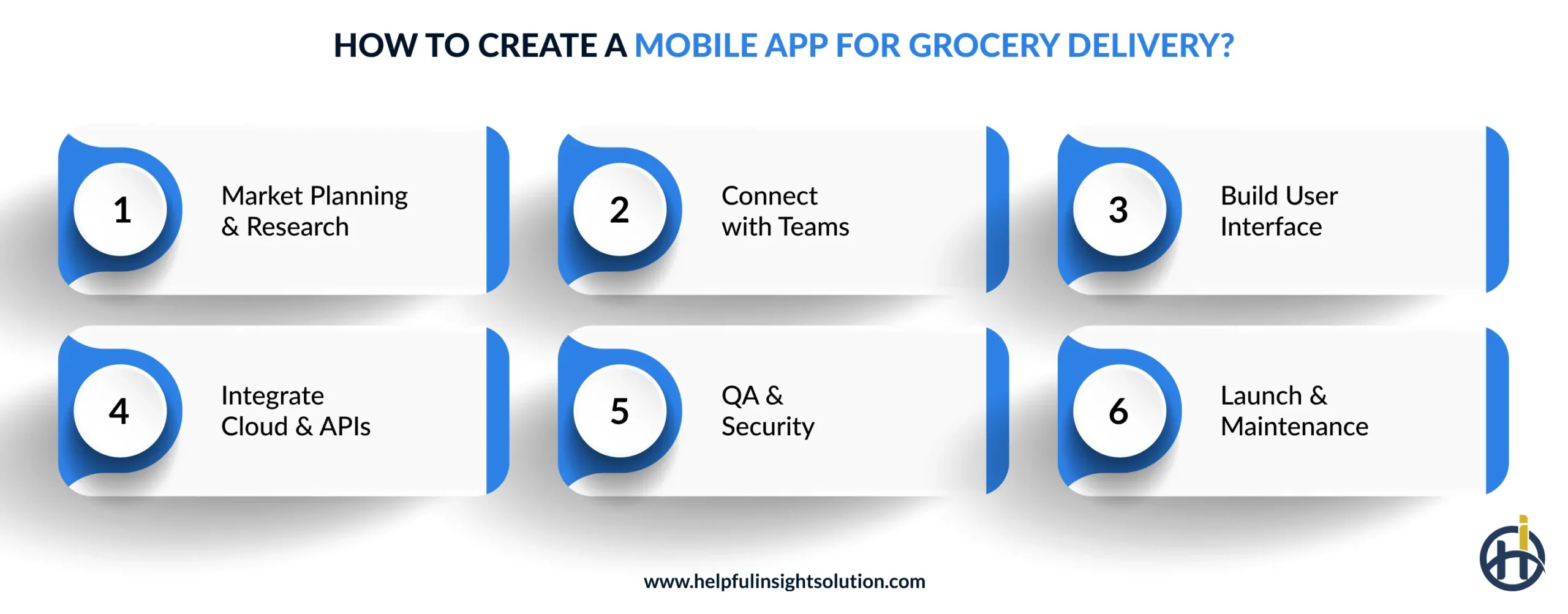
1. Market Planning & Research
The initial step involves various strategies, like blueprint making, budget model selection, and understanding current technical trends. Additionally, it is necessary to know user pain points, the market audience, and future business goals.
You should prepare a detailed document that helps you to easily identify the growing industry demands, commercial rates, and compliance policies.
2. Connect with Teams
To create a grocery delivery app, you need the best talent who can ensure strong and secure communication, delivering affordable services. It is beneficial to hire an experienced grocery delivery app development company that provides expert designers, backend engineers, and QA analysts.
Additionally, it must follow an agile and certified methodology for creating AI-powered grocery platforms based on increasing consumer needs and innovation.
3. Build User Interface
It is crucial to make a prototype that can show various frontend elements like navigation, scrolling, and on-click events that interact with users directly. The experts use Figma for designing the user interface and create multiple pages as per the requirements.
For coding, Flutter is a commonly used framework that provides open-source libraries and repositories, which can run on both Android and iOS versions.
4. Integrate Cloud & APIs
The backend integration is a crucial stage, which involves databases, dynamic APIs, and cloud solutions, ensuring complete support and responsiveness. They provide grocery delivery app services, such as real-time notification, complex data storage, and in-app chatting.
Additionally, they ensure secure transactions through integrated payment gateways that track user IDs and match them with the existing product IDs.
5. QA and Security
Now, you can test the application performance through various QA methods, like usability, unit, functional, and beta models. Based on the analysis, the experts should implement various encryption standards and compliance for data protection.
AI helps to predict fraud links and activate login features, user authentication, and biometrics, preventing data breaches or other firewall attacks. These security layers are especially critical in grocery shopping app development, where user data and payment information are handled at scale.
6. Launch & Maintenance
Your online grocery store is now ready for launch on various public platforms, like the Play Store, so people can easily download and use the app. It is mandatory to provide feature updates and ensure security checks at regular intervals for safety and productivity.
The maintenance services have a 15-20% share in the overall investment, as they allow mobile platforms to maintain efficiency and scalability across various devices.
Top Grocery Apps in the Market
The best grocery platforms are used by people across the globe, which offer exciting features like GPS monitoring and instant checkout. A list of these top apps is discussed here in a table format that describes key facts, like downloads and ratings.
You can select a grocery delivery platform based on your requirements and app popularity.
| Top Grocery Delivery Apps | Supported Devices | Downloads | Ratings |
| Walmart | Android & iOS | 100M | 4.8 |
| DoorDash | Android & iOS | 50M+ | 4.7 |
| Kroger | Android & iOS | 10M+ | 4.8 |
| Instacart | Android & iOS | 10M+ | 4.3 |
| PostmateS | Android & iOS | 10M+ | 4.3 |
| Gopuff | Android & iOS | 5M+ | 3.6 |
| ShipT | Android & iOS | 1M+ | 4.0 |
| Thrive Market | Android & iOS | 1M+ | 4.0 |
| FreshDirect | Android & iOS | 100K+ | 4.0 |
| Misfits Market | Android & iOS | 100K+ | 4.0 |
Tech Stack for Grocery Delivery App Development
For creating custom grocery delivery solutions, you need to use an advanced tech stack that includes the latest tools and technologies. They help to build engaging UI/UX design, integrate strong backend infrastructure, and test app performance.
We will understand the best tech stack for on-demand grocery delivery app development through the following table.
| Component | Tools / Technologies | Description |
| Frontend | React Native, Flutter, Swift (iOS), Kotlin (Android) | It helps to build a responsive and interactive mobile app interface for users. |
| Backend Development | Node.js, Django, Ruby on Rails | They handle business logic, APIs, and server-side operations. |
| Database | PostgreSQL, MongoDB, MySQL | It stores user data, orders, inventory, and transaction details. |
| Cloud Services | AWS, Google Cloud, Microsoft Azure | They provide scalable hosting, storage, and computing infrastructure. |
| Real-Time Tracking | Google Maps API, Mapbox | This enables live order tracking and route optimization. |
| Payment Gateway | Stripe, PayPal, Razorpay | This model offers secure online payments and transactions. |
| Authentication & Security | Firebase Auth, OAuth 2.0, JWT | These tools ensure secure login, user authentication, and data protection. |
| Push Notifications | Firebase Cloud Messaging (FCM), OneSignal | They send real-time alerts for order updates and promotions. |
| Admin Panel | Angular, React.js, Vue.js | It provides a dashboard for managing orders, users, and analytics. |
| AI & Analytics | TensorFlow, Google Analytics, Mixpanel | This enables demand forecasting, user behavior tracking, and insights. |
What is the Cost of Building a Mobile Grocery Application?
An entrepreneur must consult the grocery delivery app development cost with a reliable partner, as it provides the best insights that are easy to understand. The overall price is dependent on several market factors like the team’s location, the experience of developers, project complexity, and platform choice.
Each factor includes several parameters, from lowest to highest, that influence the total cost and business models. On average, the cost to build a grocery delivery app ranges from $10K to $60K, which may increase due to additional needs and project requirements.
You must know about cost-affecting factors to understand their effect in the real-world situation. We will also see a general formula for calculating the estimated cost by considering key factors.
App Complexity: Various AI-powered features, like personalization and automated discounts, increase the cost. But they ensure improved user engagement, business operations, and constant market growth.
Team’s Location: You can hire experts from the USA or Canada because they offer advanced resources and infrastructure. This affects the overall grocery app development rate in these countries more than in Asian regions.
Developers’ Experience: It is beneficial to select developers with more than 4 years of experience, as they are skilled. Businesses can also hire junior experts, but they do not ensure quality and support.
Development Platform: Creating apps on different platforms, like Android and iOS, is expensive for investors. They must choose hybrid frameworks, like Flutter, that support both operating systems.
Total Development Cost = (Total Development Hours) × (Hourly Rate of Developers)
Ways to Monetize Grocery Delivery Apps
A business investor should make a grocery delivery app to generate profits by implementing various revenue models. These include subscription plans, advertising, delivery charges, and commissions.
1. Commission-Based Model
You can charge grocery stores or supermarkets for every order, providing a steady and scalable revenue with 2-10% rates. This percentage value may vary based on order volume, merchant size, and product categories, streamlining the overall workflow.
2. Delivery & Service Fees
A fruit and vegetable delivery app helps businesses to make revenue by applying distance-based fees and dynamic pricing for customers. This model allows them to balance the cost to develop a grocery delivery app through service charges and premium rates.
3. Subscription Plans
To understand user preferences, you must hire app developers who can implement AI-based subscription models that track their daily purchases. Some of the common plans include monthly or annual memberships that provide free delivery and lower service fees.
4. Advertising Campaigning
Businesses can implement various ads and virtual banners to track user traffic on the grocery platform, enhancing brand value and visibility. You can apply different charges per click based on geographic locations, demographics, and overall volume.
5. Surge Pricing
You can implement temporary charges on high weekend demands and limited stocks in a grocery app solution, increasing revenue. It helps to create a balance between retailers and customers, allowing brands to manage growing market expenses.
Partner with Helpful Insight to Enhance Your Grocery Delivery Business
We have studied the grocery store app development process, tech stack, top platforms, and other major topics in this blog. Now, you should approach a renowned partner that can deliver cost-effective solutions to increase customer engagement and business revenue.
We help you to follow various future trends in grocery delivery apps, such as route optimization and IoT-based deliveries, enhancing efficiency. Additionally, our experts ensure the credibility of your ideas and needs.
They can develop a grocery delivery app with advanced AI technologies to track user behavior and predict results before buying. With custom grocery mobile app development services, you enter into the rapidly growing grocery market and build trust among users. It is a golden chance for investors through which they can increase brand visibility and enhance retention rate.
FAQs
An online grocery store creates a connection between customers and local fruit or vegetable vendors, reducing delays and enhancing experiences. A simple working process is discussed as follows:
- Users create an account and search for different groceries.
- They place the order through checkout and make payments.
- The store confirms the order, and a delivery partner is assigned.
- Buyers can track the real-time location of the drivers through GPS.
- After delivery, users provide feedback and report inconsistencies.
To build a grocery delivery platform with simple functionalities, the overall time required is between 1 month and 4 months. This duration may extend to 8 months or more because of additional features, like AI personalization and IoT-based tracking. The timeline is dependent on the grocery store app development process, business needs, and complexity model.
Most grocery apps provide end-to-end encryption by using MFA, PCI-DSS compliance, and RBAC that protect sensitive user information. The experts perform penetration testing and security audits with HTTP protocols to safeguard data. They implement secure cloud solutions like AWS and GDPR for data sharing in a real-time scenario.
AI uses advanced prediction and automation models to provide real-time GPS, estimated delivery time, and dynamic routes, reducing delays. It helps to personalize user preferences through recommendation algorithms, which improve buying experiences. Additionally, this technology helps businesses to forecast the overall sales and revenue growth.
Businesses should follow a certified process for hiring the best partner to create grocery delivery apps. The key hiring stages are described in the following manner:
- You must list your requirements and project needs.
- It is crucial to analyze past performance and client reviews.
- Now, you can conduct personal interviews to judge technical skills.
- The experts must have ethical skills and ensure work integrity.
- At last, you can discuss the future goals and outcomes.